Archive
Ephemeris: 02/26/2024 – The angle of the rising and setting planets from the Sun vary with the seasons
This is Bob Moler with Ephemeris for Monday, February 26th. Today the Sun will be up for 10 hours and 59 minutes, setting at 6:25, and it will rise tomorrow at 7:24. The Moon, 2 days past full, will rise at 8:44 this evening.
In late winter and early spring dark skies return within a few days after the full Moon. Indeed, this is the first day after the full moon, which was on Saturday morning, that we have dark skies. Well for 40 minutes before the Moon rises. This is because the ecliptic which is the Sun’s path in the sky is as close to vertical as it can get for us. It shows planets near the Sun and the area of the full moon as steeply inclined to the horizon as possible. Twelve years ago this month when my wife and I were on a Hawaiian cruise, I was aboard ship looking at the sky after sunset and was amazed to see Jupiter and Venus* vertically aligned in the west. It was because we were located around the Tropic of Cancer and near the equinox, so the ecliptic was actually vertical after sunset. It was quite a jolt to see that. So this time of year we can see planets close to the sun at sunset and the moon to go away after full rapidly.
The astronomical event times given are for the Traverse City/Interlochen area of Michigan (EST, UT –5 hours). They may be different for your location.
* On the broadcast I said Jupiter and Saturn, relying on my memory. As can be seen below, it was Jupiter and Venus.
Addendum
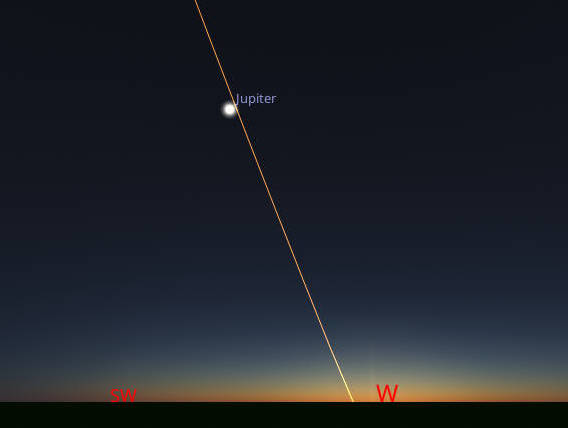
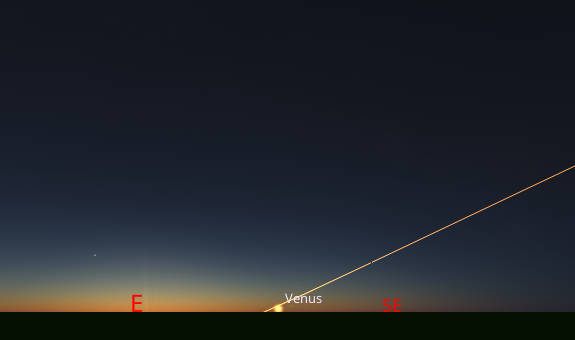
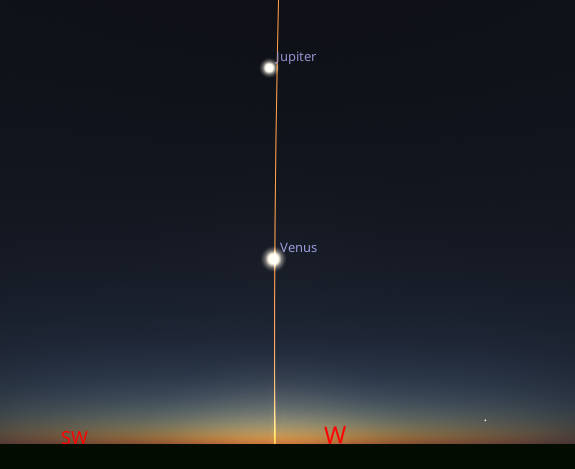
03/16/2021 – Ephemeris – Tonight we’ll have exactly 12 hours of night
This is Ephemeris for Tuesday, March 16th. Today the Sun will be up for 11 hours and 57 minutes, setting at 7:50, and it will rise tomorrow at 7:50. The Moon, 3 days past new, will set at 11:15 this evening.
Did you notice what I just said? Sunset’s at 7:50 pm and sunrise’s at 7:50 am. Tonight we’ll have exactly 12 hours of night. That’s what the word equinox means, equal night… But the vernal or spring equinox isn’t until Saturday when spring starts. By then night, including twilight, will be down to 11 hours, 50 minutes. The disparity comes down to modern versus older definitions. Equinox, being Latin is an older definition. The modern instant of sunrise and sunset occurs when the top of the Sun’s disc touches the sea horizon. Because our atmosphere bends light, and at its greatest when looking at the horizon, the Sun will have set already, geometrically, by the time the bottom edge of the Sun appears to touch that sea horizon. Making daylight a bit longer than you’d think.
The astronomical event times given are for the Traverse City/Interlochen area of Michigan. They may be different for your location.
Addendum
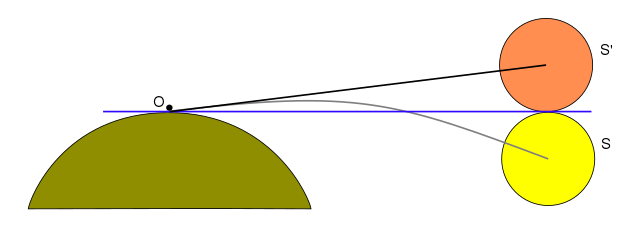
How the atmosphere bends the light of the Sun or Moon rising or setting to appear higher than it actually is. S is the actual position of the Sun, S’ is the apparent position of the Sun. The blue line is the observer O’s horizon. The gray line is the actual, though much exaggerated, light path bent or refracted by the Earth’s atmosphere. The black line is the apparent sight line to the Sun. Credit Francisco Javier Blanco González, 2017
01/15/2019 – Ephemeris – Welcome 8:19 a.m. listeners
Ephemeris for Tuesday, January 15th. Today the Sun will be up for 9 hours and 11 minutes, setting at 5:28, and it will rise tomorrow at 8:16. The Moon, 1 day past first quarter, will set at 3:11 tomorrow morning.
Welcome to the 8:19 a.m. listeners to this program. Due to the two-hour span from the 6:19 and 8:19 airings it was thought to always give you event times in advance, which is why I’m giving tomorrow’s sunrise times. Don’t worry tomorrow’s sunrise time will never be more than 2 minutes before or after today’s. Right now, sunrise times are retreating by a half-minute a day. It’s faster in spring and fall. For more information see my blog: bobmoler.wordpress.com. Transcripts of the program are there with illustrations and additional information. And today a way to create your own sunrise and sunset calendar.
The times given are for the Traverse City/Interlochen area of Michigan. They may be different for your location.
Addendum
The times of rising and setting of celestial objects is accurate for only one spot on the Earth. In the case of the times I give, it’s for my house. There’s a good reason for it. I live approximately half way between Interlochen and Traverse City. In the early days I interpolated from astronomical tables in the Royal Astronomical Society of Canada’s Observers Handbook. I preferred it to the Naval Observatory’s Astronomical Almanac, which was more expensive. Anyway I had a relatively flat horizon everywhere but north, so if I climbed on the roof I could check out and verify the rising and setting times. Note that the times assume a flat sea horizon.
About accurate times: At my latitude celestial objects rise and set one minute later for each 12 1/3 miles (19.85 km) you are west of me, or a good landmark would be Traverse City West Senior High School. For every 12 1/3 miles east of there rising and setting events would be earlier by a minute. The correction for latitude or north and south isn’t that simple. See the illustration below:
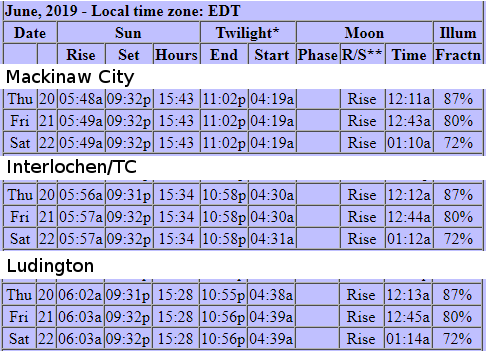
These are snippets of calendars for three locations that are in a straight line from south-southwest to north-northeast in the IPR listening area. A line drawn perpendicular to it to the west-northwest is to the Sun’s setting point. Thus the setting times for all three locations are the same. However their rising times are the most divergent, as are the daylight hours.
On my Ephemeris website, not to be confused with the blog that you are now reading, I have rise and set calendars for: Cadillac, Interlochen/Traverse City (Source for times on the Ephemeris program), Ludington, Mackinaw City, Petoskey, Eagle Harbor – Keweenaw Peninsula, Houghton Lake, and Earth’s Equator at the Prime Meridian. Go Here: http://ephemeris.bjmoler.org/calendar.htm.
If you’d like these times for a different location go to the Complete Sun and Moon Data for One Day, or Sun or Moon Rise/Set Table for One Year from the United States Naval Observatory (USNO). It calculates sunrise, sunset, moonrise, moonset, and twilight for locations in the US and other locations world-wide. Note that these do not follow the changes to and from Daylight Saving Time.
12/09/2016 – Ephemeris – The earliest sunset
Ephemeris for Friday, December 9th. The Sun will rise at 8:08. It’ll be up for 8 hours and 53 minutes, setting at 5:02. The Moon, 2 days past first quarter, will set at 3:39 tomorrow morning.
In twelve days we will have the shortest day in terms of daylight hours. But the change isn’t uniformly distributed in the morning and evening. Tonight and tomorrow evening we will have the earliest sunsets Sunset times have been within the same minute for the last few days and will continue for the next few. The latest sunrise will occur on January second. The reason is that the Sun is traveling faster eastward than average, so the Earth’s rotation takes a little longer each day to catch up with it. Near the solstice the Sun is at a higher latitude, where the longitude lines are closer together, also the Earth is nearing its closest to the Sun, so moves faster its orbit adding to the effect. The effect exists in June but isn’t as noticeable.
Times are for the Traverse City/Interlochen area of Michigan. They may be different for your location.
Addendum
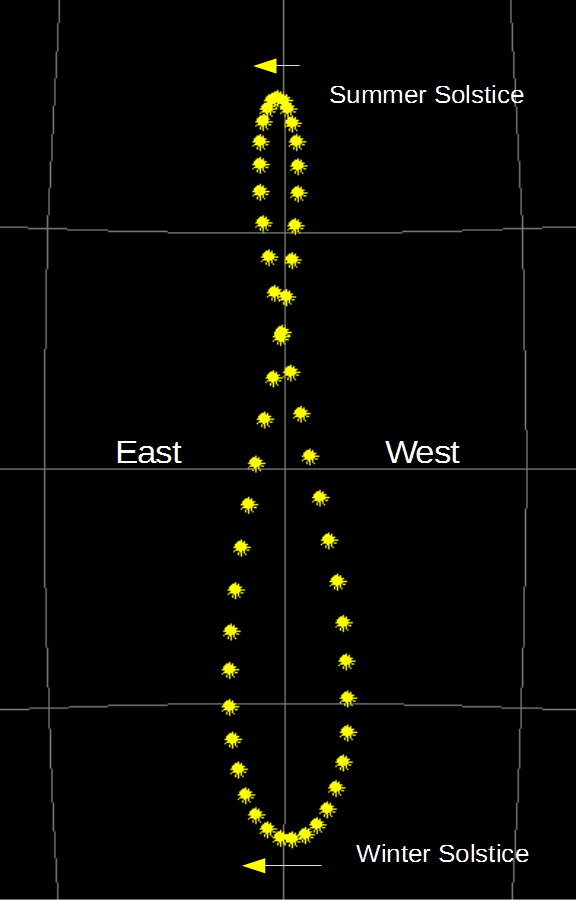
This figure 8 is called an analemma. One can find it on old globes in the Pacific Ocean. Explanation below. Created using my LookingUp program by plotting the Sun at 7 day intervals at local noon for a year.
At the bottom of the analemma is where the Sun is near the winter solstice when it is moving its fastest eastward. At the top, near the summer solstice the Sun is moving faster than average, but not as fast as it is now. The Earth will be nearest the Sun on January 4th, a point called perihelion. Aphelion next year, when the Earth is farthest from the Sun, will be July 3rd next year.
 Bob Moler's Ephemeris Blog