Archive
12/08/2015 – Ephemeris – The hard charging Taurus the bull
Ephemeris for Tuesday, December 8th. The Sun will rise at 8:07. It’ll be up for 8 hours and 55 minutes, setting at 5:02. The Moon, 3 days before new, will rise at 6:03 tomorrow morning.
Low in the east at 9 p.m. is the constellation of Orion the giant hunter . Above him is Taurus the bull. His face is a letter V shape of stars lying on its side with the bright orange-red star Aldebaran at the bottom left tip of the V as its angry blood-shot eye. Orion is depicted in the sky facing with club in one hand and a shield in the other the approaching and in some depictions charging Taurus. The V of stars is a star cluster called the Hyades. The Pleiades are in his shoulder above. Taurus in Greek mythology was the guise the god Zeus when he carried off the maiden Europa. Europa’s still with him, sort of, as the intriguing satellite orbiting Zeus’ Roman equivalent Jupiter. In fact the moons around the planet Jupiter are generally named for Jupiter’s lovers and friends. His wife is missing from the entourage, and will be until the NASA spacecraft Juno reaches Jupiter next year.
Times are for the Traverse City/Interlochen area of Michigan. They may be different for your location.
Addendum
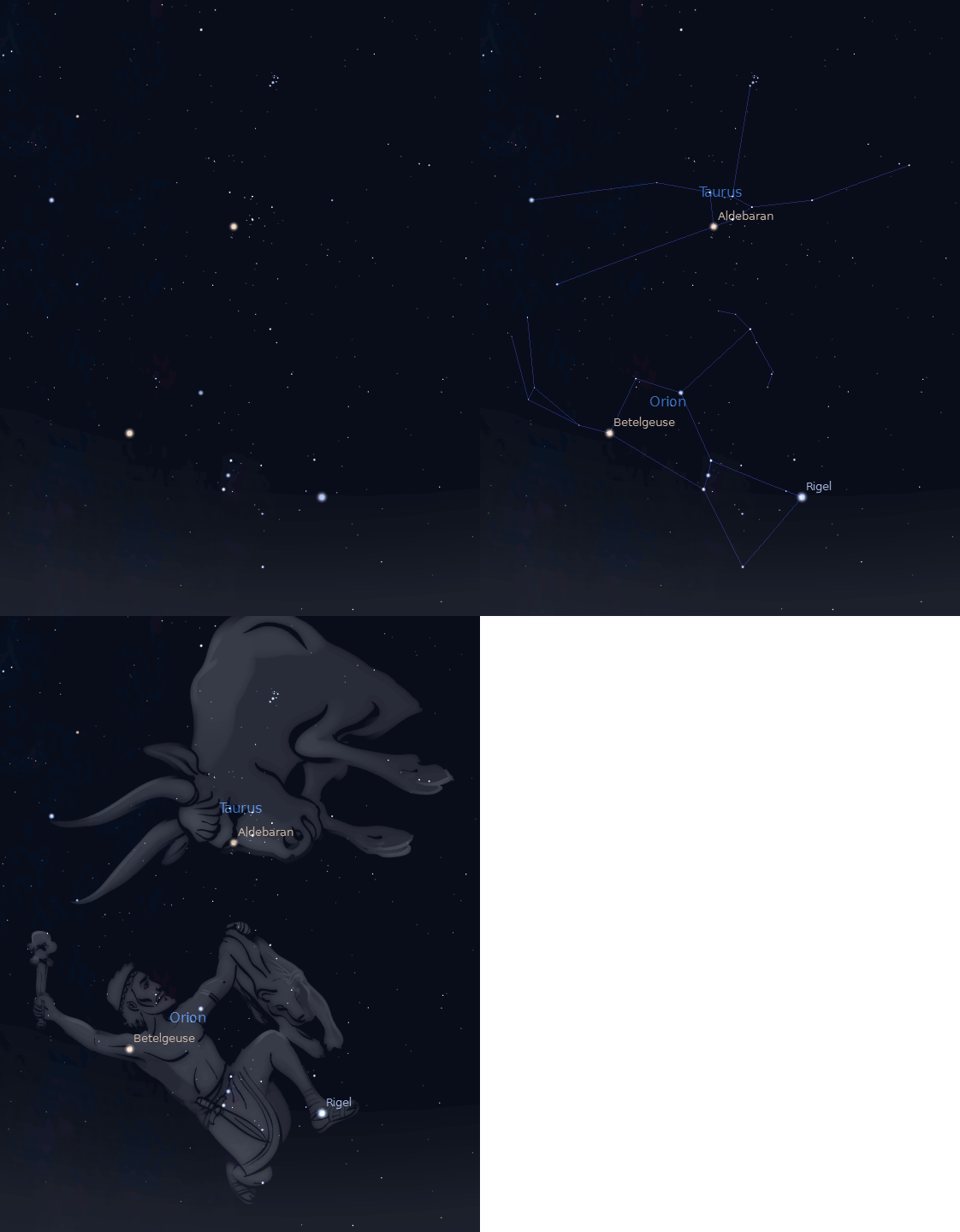
Three views of Taurus the bull and Orion the hunter for 9 p.m. on December 8, 2015. Created using Stellarium and GIMP.
11/30/2015 – Ephemeris – Orion Rising
Ephemeris for Monday, November 30th. The Sun will rise at 7:58. It’ll be up for 9 hours and 5 minutes, setting at 5:04. The Moon, 3 days before last quarter, will rise at 10:12 this evening.
We have a few hours of darkness tonight before the Moon comes up. In the east the central winter constellation Orion the hunter throws a leg over the horizon between 8 and 9 p.m. as Robert Frost told in his poem Star-Splitter. The upright rectangle that is his body on January evenings is tilted to the left as he rises, with bright red star Betelgeuse at the top left of the rectangle, his shoulder. At the opposite corner is blue-white Rigel, a knee. In the center of the rectangle is a line of three stars nearly vertically aligned, which represents Orion’s belt. Above Orion is another bright orange star at one end of a letter V shape of stars. That’s Aldebaran the angry eye in the face if Taurus the bull who apparently is none to happy with Orion.
Times are for the Traverse City/Interlochen area of Michigan. They may be different for your location.
Addendum
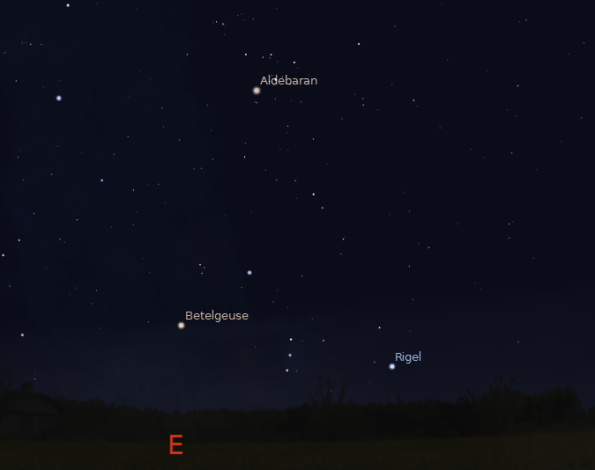
Orion Rising at 8:30 p.m. (3 1/2 hours after sunset) on November 30th. Created using Stellarium.
02/16/2015 – Ephemeris – The Winter Circle
Feb 16. This is Bob Moler with Ephemeris for President’s Day, Monday, February 16th. The sun will rise at 7:42. It’ll be up for 10 hours and 30 minutes, setting at 6:12. The moon, 2 days before new, will rise at 6:25 tomorrow morning.
The winter skies are blessed with more first magnitude stars than any other season. That’s a full one-third of the total are seen is a relatively small area. Six of these stars lie in a large circle centered on the seventh. This circle is up at 9 p.m. Starting high overhead is Capella in Auriga the charioteer. Moving down clockwise is Aldebaran in the face of Taurus the Bull. Then down to Orion’s knee we find Rigel. Down and left is the brightest star of all Sirius the Dog Star in Canis Major, lowest of these stars in the south-southeast. Moving up and left is Procyon in Canis Minor, Above Procyon is Pollux in Gemini the twins. All these are centered on Betelgeuse the bright red star in Orion’s shoulder.
Times are for the Traverse City/Interlochen area of Michigan. They may be different for your location.
Addendum
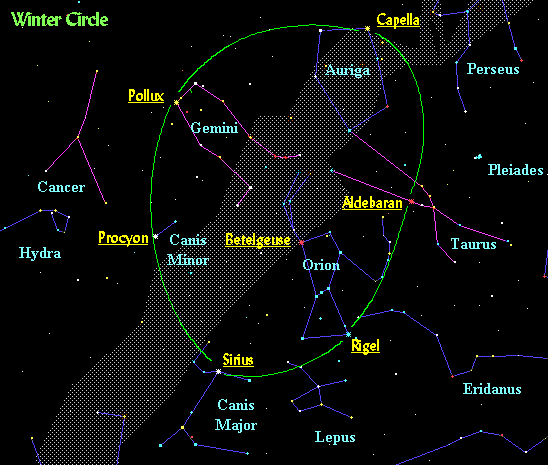
The Winter Circle of 1st magnitude stars
01/13/2015 – Ephemeris – How to find Comet Lovejoy
Ephemeris for Tuesday, January 13th. The sun will rise at 8:17. It’ll be up for 9 hours and 7 minutes, setting at 5:25. The moon, at last quarter today, will rise at 2:03 tomorrow morning.
A new comet has entered the evening sky for northern hemisphere observers. It is best seen in binoculars as a fuzzy blob. Photographs reveals a green comet with a faint wispy tail. It was discovered by Australian amateur astronomer Terry Lovejoy. It’s his 5th comet. Tonight the comet is located in line with the bottom side of the letter V of stars, the head of Taurus the bull, The V is lying on its side and to the right by the width of a fist held at arm’s length will be the fuzzy ball of the head of the comet. Charts for finding the comet can be found on my blog at bobmoler.wordpress.com today and also every Wednesday for the next month or so. Photographs of this beautiful comet can be found on space.com and spaceweather.com among other websites.
Times are for the Traverse City/Interlochen area of Michigan. They may be different for your location.
Addendum
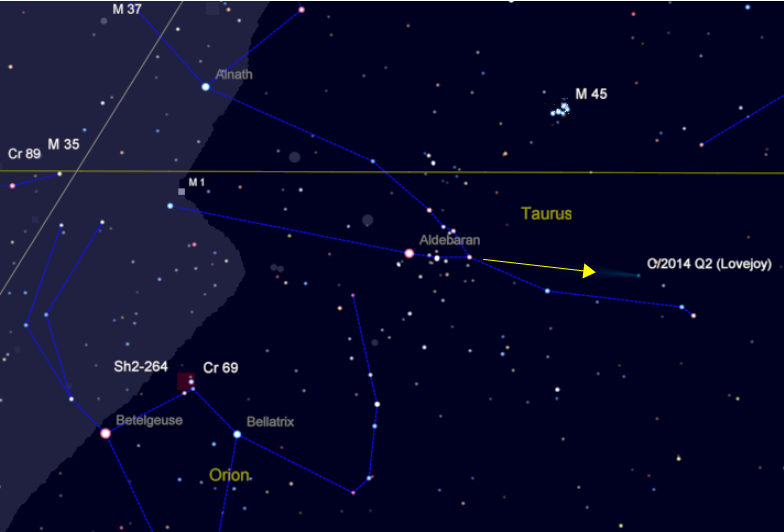
Finding Comet Lovejoy at 9 p.m., January 13, 2015. created using Cartes du Ceil (Sky Charts). Click on image to enlarge.
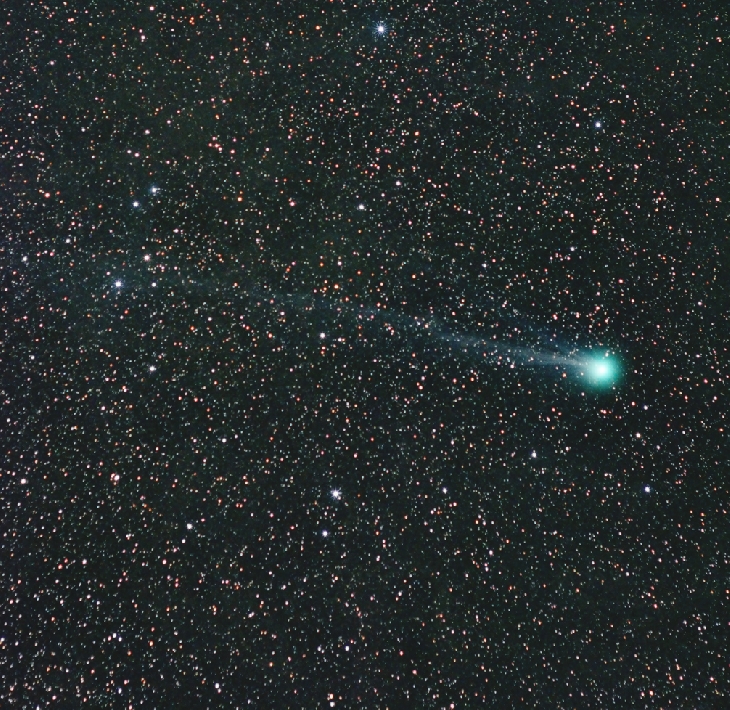
Comet Lovejoy taken by Jan Curtis on January 11, 2015 @ Near Santa Fe, New Mexico. Found on http://www.spaceweather.com. Great photo Jan. Click on image to enlarge.
02/27/2014 – Ephemeris – Lepus the hare, the rabbit that got away
Ephemeris for Thursday, February 27th. The sun will rise at 7:23. It’ll be up for 11 hours and 4 minutes, setting at 6:27. The moon, 2 days before new, will rise at 6:36 tomorrow morning.
Orion, the central winter constellation is seen in the south at 9 p.m. He is a hunter, but he’s preoccupied with the charge of Taurus the bull from the upper right. At Orion’s feet, and unnoticed by him is the small constellation of Lepus the hare. It’s very hard to see a rabbit in its eight dim stars: however, I do see a rabbit’s head ears and shoulders. A misshapen box is the head and face of this critter facing to the left. His ears extend upwards from the upper right star of the box, and the bend forward a bit. Two stars to the right of the box and a bit farther apart hint at the front part of the body. In Lepus telescopes can find M79, a distant globular star cluster, one of the few of these compact star clusters visible in the winter sky.
Times are for the Traverse City/Interlochen area of Michigan. They may be different for your location.
Addendum
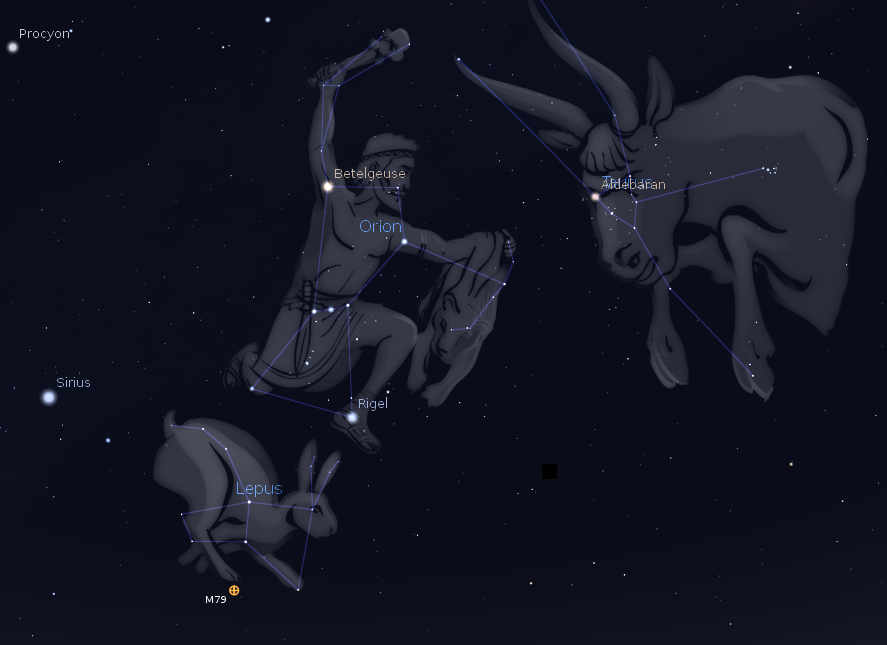
Lepus the hare as imagined in Stellarium. I haven’t added the four stars in the ears as I saw it based on the older Sky and Telescope magazine star charts.
Globular star cluster M79 is very distant: 41,000 light years from us and 60,000 light years from the center of the Milky Way. It possibly was a member of the Canis Major Dwarf Galaxy that seems to have become entangled with our own Milky Way galaxy. That’s what massive galaxies do to smaller, less massive dwarf galaxies: “Resistance is futile, you will be assimilated”.
12/10/2013 – Ephemeris – The bright star Aldebaran, the Follower
Ephemeris for Tuesday, December 10th. The sun will rise at 8:08. It’ll be up for 8 hours and 53 minutes, setting at 5:02. The moon, 1 day past first quarter, will set at 2:18 tomorrow morning.
The central constellation of winter, Orion, is in the east southeast at 9 p.m. Above it is Taurus the bull. The bright orange star in Taurus is Aldebaran. Aldebaran appears at the lower left tip of a letter V group of stars lying on its side that is the face of the bull. Aldebaran isn’t actually part of the group, called the Hyades star cluster. The cluster is about 153 light years away, while Aldebaran is 65. The star has an orange hue because its surface is cooler than the sun’s. However Aldebaran is 44 times larger in diameter, and shines 465 times brighter than the sun. The name Aldebaran means “Follower” because it follows the Pleiades star cluster through the skies. The Pleiades is above right of Aldebaran.
Times are for the Traverse City/Interlochen area of Michigan. They may be different for your location.
Addendum
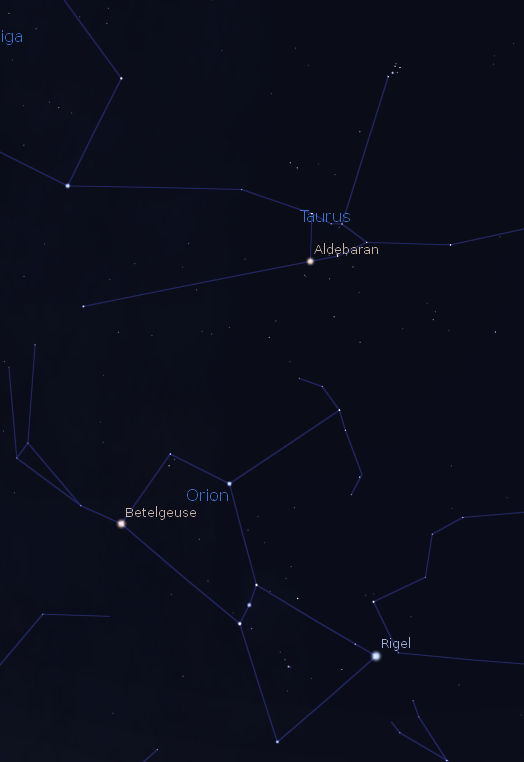
Aldebaran, the Hyades, of Taurus, Orion and the Pleiades at 10 p.m. December 10, 2013. Created using Stellarium.
12/05/2013 – Ephemeris – The constellation Taurus the bull
Ephemeris for Thursday, December 5th. The sun will rise at 8:03. It’ll be up for 8 hours and 58 minutes, setting at 5:02. The moon, 3 days past new, will set at 8:27 this evening.
Early in the evening the moon will appear above the bright planet Venus in the southwest. Low in the east at 9 p.m. is the constellation of Orion the giant hunter. Above him is Taurus the bull. His face is a letter V shape of stars lying on its side with the bright orange-red star Aldebaran at the bottom tip of the V as its angry blood-shot eye. Orion is depicted in the sky facing with club in one hand and a shield in the other the approaching and in some depictions charging Taurus. The V of stars is a star cluster called the Hyades. The Pleiades are in his shoulder above. Taurus in Greek mythology was the guise the god Zeus when he carried off the maiden Europa. Europa’s still with him, sort of, as the intriguing satellite orbiting Zeus’ Roman equivalent Jupiter.
Times are for the Traverse City/Interlochen area of Michigan. They may be different for your location.
Addendum
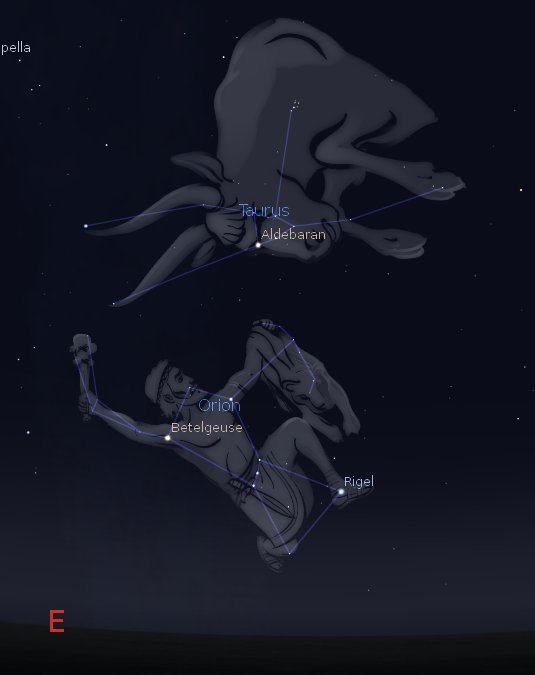
Taurus and Orion in the east at 9 p.m, December 5, 2013. Created using Stellarium.
01/14/2013 – Ephemeris – Lepus the hare, overlooked by Orion
Ephemeris for Monday, January 14th. The sun will rise at 8:16. It’ll be up for 9 hours and 11 minutes, setting at 5:27. The moon, 3 days past new, will set at 9:23 this evening.
Orion, the central winter constellation is seen in the southern sky this evening. He is a hunter, as artists depict him, he is preoccupied with the charge of Taurus the bull from the upper right. At Orion’s feet, and unnoticed by him is the small constellation of Lepus the hare. It’s very hard to see a rabbit in its eight dim stars: however, I can see a rabbit’s head ears and shoulders. A misshapen box is the head and face of this critter facing to the left. His ears extend upwards from the upper right star of the box, and the bend forward a bit. Two stars to the right of the box and a bit fart
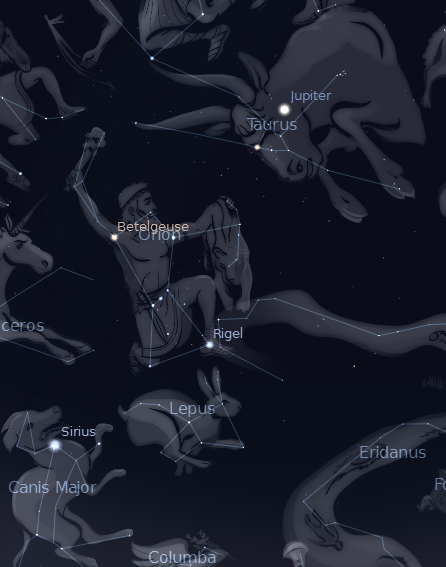
Orion facing Taurus letting Lepus escape with Jupiter in 2013. Created using Stellarium.
her apart hint at the front part of the body. In Lepus telescopes can find M79, a distant globular star cluster, one of the few visible in the winter sky.
Times are for the Traverse City/Interlochen area of Michigan. They may be different for your location.
Addendum
12/11/2012 – Ephemeris – The Pleiades and Hyades star clusters
Ephemeris for Tuesday, December 11th. The sun will rise at 8:09. It’ll be up for 8 hours and 52 minutes, setting at 5:02. The moon, 2 days before new, will rise at 7:13 tomorrow morning.
At 8 to 9 p.m. The constellation of Taurus the bull rises higher in the east to southeast. Taurus contains two bright clusters of stars. The most famous of these is the Pleiades, also known as the Seven Sisters. The other is a letter V shape that is the face of Taurus, the Hyades. In the Greek mythology they are half-sisters of each other, all fathered by the Titan Atlas. They are apparently fleeing from the giant Orion rising in the east. The Pleiades are the younger of the two star clusters, and there has been some problem in estimating their distance. They could be from 390 to 460 light years away. The distance to Hyades is much better known at 153 light years. It was the star cluster upon which greater distances could be measured.
Times are for the Traverse City/Interlochen area of Michigan. They may be different for your location.
Addendum
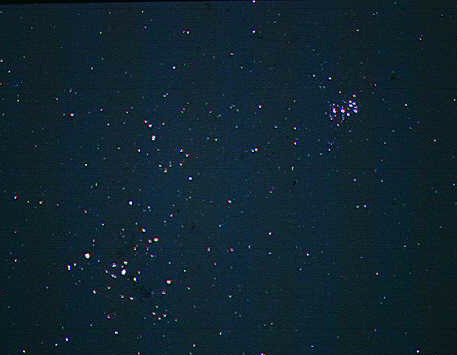
The Hyades (lower left) and the Pleiades (upper right). My photograph from many years ago.
12/06/2012 – Ephemeris – The constellation Taurus the bull
Ephemeris for Thursday, December 6th. The sun will rise at 8:05. It’ll be up for 8 hours and 57 minutes, setting at 5:02. The moon, at last quarter today, will rise at 1:10 tomorrow morning.
Low in the east southeast at 9 p.m. is the constellation of the giant hunter Orion. Above him is Taurus the bull. His face is a letter V shape of stars lying on its side, the star cluster Hyades, with the bright orange-red star Aldebaran at one tip of the V as its angry blood-shot eye, but actually about half way between us and the cluster. Jupiter is complicating this this year, appearing in Taurus. Orion is depicted in the sky facing, with club in one hand and a shield in the other, the approaching and in some depictions charging Taurus. The Pleiades star cluster is in his shoulder. Taurus in Greek mythology was the guise the god Zeus when he carried off the maiden Europa. Europa’s still with him as the intriguing satellite orbiting Zeus’ Roman equivalent the planet Jupiter.
Times are for the Traverse City/Interlochen area of Michigan. They may be different for your location.
Addendum
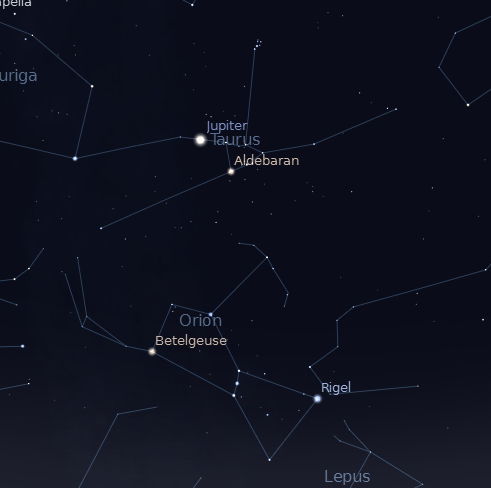
Taurus and Orion in the east at 9 p.m. December 6, 2012. Created using Stellarium.
 Bob Moler's Ephemeris Blog