Archive
04/23/2014 – Ephemeris – Where are those bright planets this week?
Ephemeris for Wednesday, April 23rd. The sun rises at 6:45. It’ll be up for 13 hours and 52 minutes, setting at 8:37. The moon, 1 day past last quarter, will rise at 4:06 tomorrow morning.
Wednesday is Bright Planets Day, or should I say classical planets day here on Ephemeris. Bright Jupiter will be in the western sky as darkness falls tonight. It will set at 2:17 a.m. Reddish Mars is in Virgo and outshines the bright bluish star Spica below it as darkness falls. Mars is up at sunset in the east. It will pass due south at 12:26 a.m. It’s 58.1 million miles (95.5 million kilometers) away now, and moving away. It will set at 6:14 a.m. Saturn will rise at 9:54 p.m. It’s in the faint constellation of Libra the scales this year. It will pass due south at 2:52 a.m. The telescope will bring out Saturn’s beautiful rings, whose short dimension now is as wide as the planet. Brilliant Venus will rise in the east at 5:14 a.m. and will stay pretty low to the horizon.
Times are for the Traverse City/Interlochen area of Michigan. They may be different for your location.
Addendum
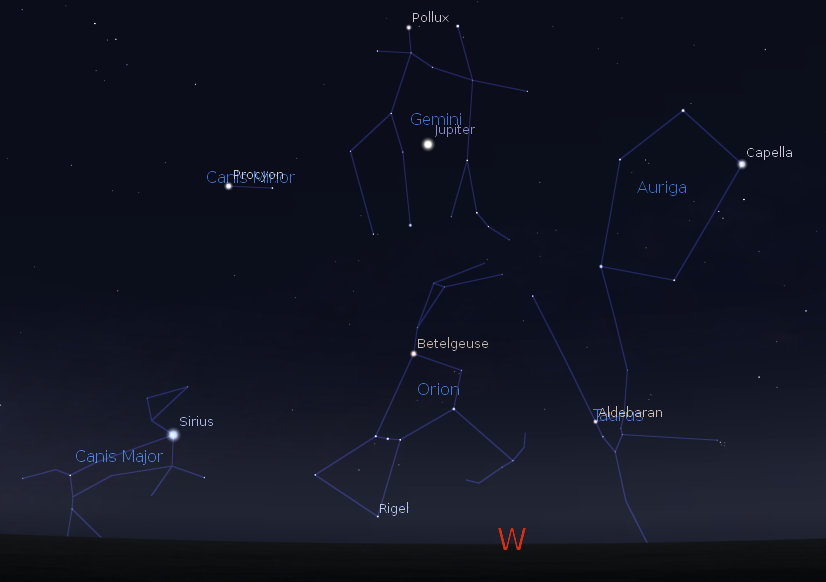
Jupiter and the setting winter constellations in the west at 10 p.m. on April 23, 2014. Created using Stellarium.
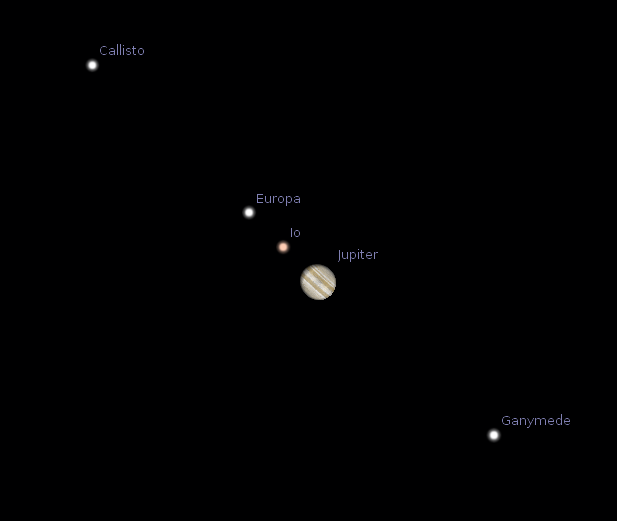
Jupiter and satellites through a telescope at 10 p.m. on April 23, 2014. Created using Stellarium.
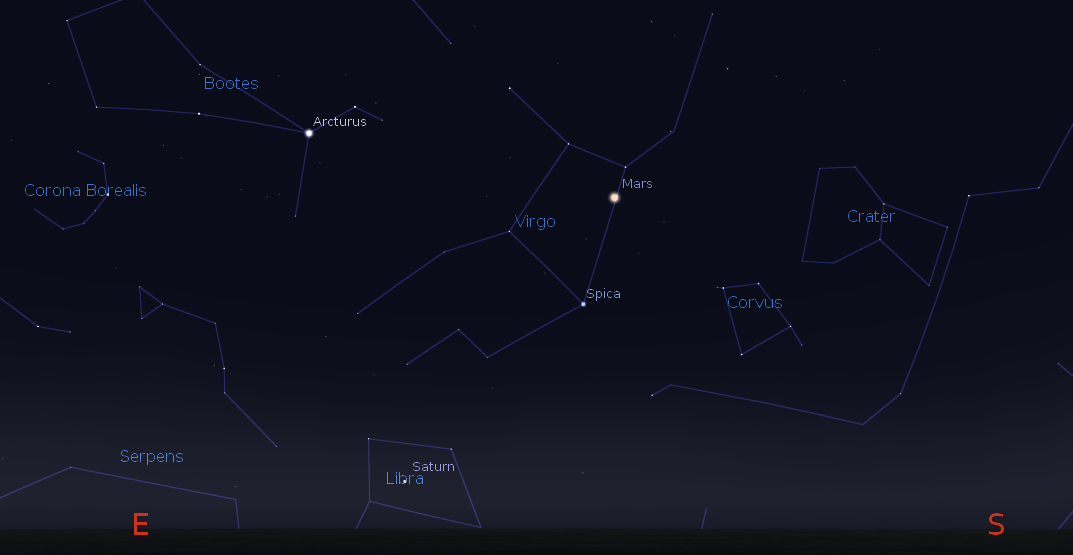
Mars, Saturn and some spring constellation at 10:30 p.m. April 23, 2014. Created using Stellarium.
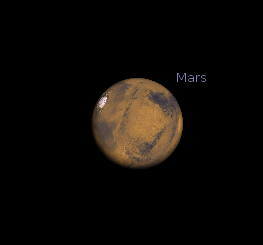
Telescopic Mars. Actually Mars is much smaller in appearance than Jupiter. Interesting albedo features can be seen. For 10:30 pm. April 23, 2014. Created using Stellarium.
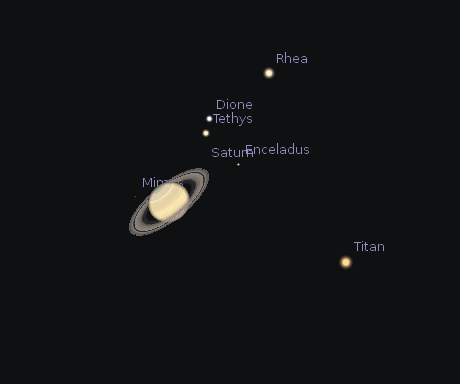
Telescopic Saturn at 11 p.m. April 23, 2014. You may want to wait a bit for it to rise some more for clearer views. Created using Stellarium.
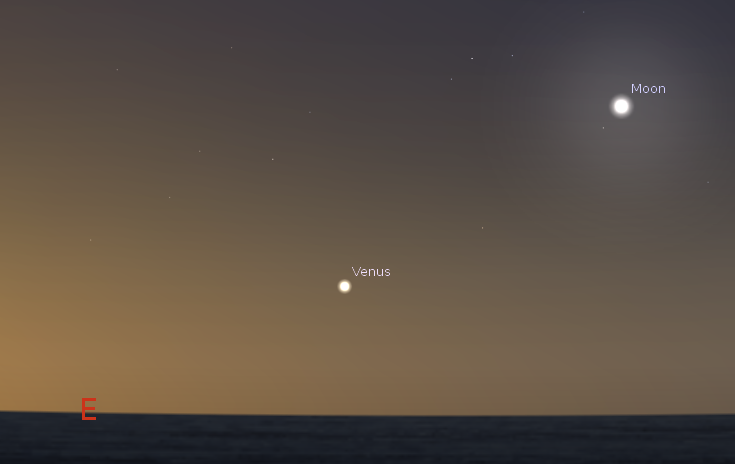
Venus and the Moon looking eastward at 6 a.m. on April 24, 2014. Created using Stellarium.
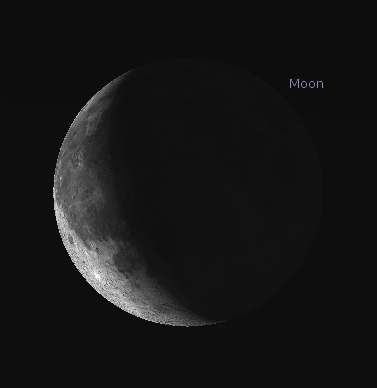
The moon as seen in binoculars at 6 a.m. on April 24, 2014. Created using Stellarium.
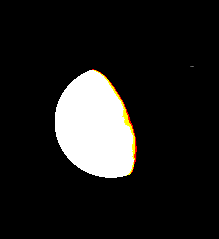
Venus through a telescope at 6 a.m. April 24, 2014. Note that none of these planetary images are to the same scale. Created using Stellarium.
04/16/2014 – Ephemeris – It’s our weekly look at the classical planets
Ephemeris for Wednesday, April 16th. The sun rises at 6:56. It’ll be up for 13 hours and 31 minutes, setting at 8:28. The moon, 1 day past full, will rise at 10:14 this evening.
Wednesday is Bright Planets Day, or should I say classical planets day here on Ephemeris. Bright Jupiter will be in the western sky as darkness falls tonight. It will set at 2:42 a.m. Reddish Mars is in Virgo and outshines the bright bluish star Spica below it as darkness falls. Mars is up at sunset in the east. It will pass due south at 1:03 a.m. It’s 57.4 million miles away now, very near its closest. It will set at 6:48 a.m. Saturn will rise at 10:24 p.m. and be seen to the left of the bright moon tonight. It will pass due south at 3:22 a.m. The telescope will bring out Saturn’s beautiful rings, whose short dimension now is as wide as the planet. Brilliant Venus will rise in the east at 5:22 a.m. and will stay pretty low to the horizon.
Times are for the Traverse City/Interlochen area of Michigan. They may be different for your location.
Addendum
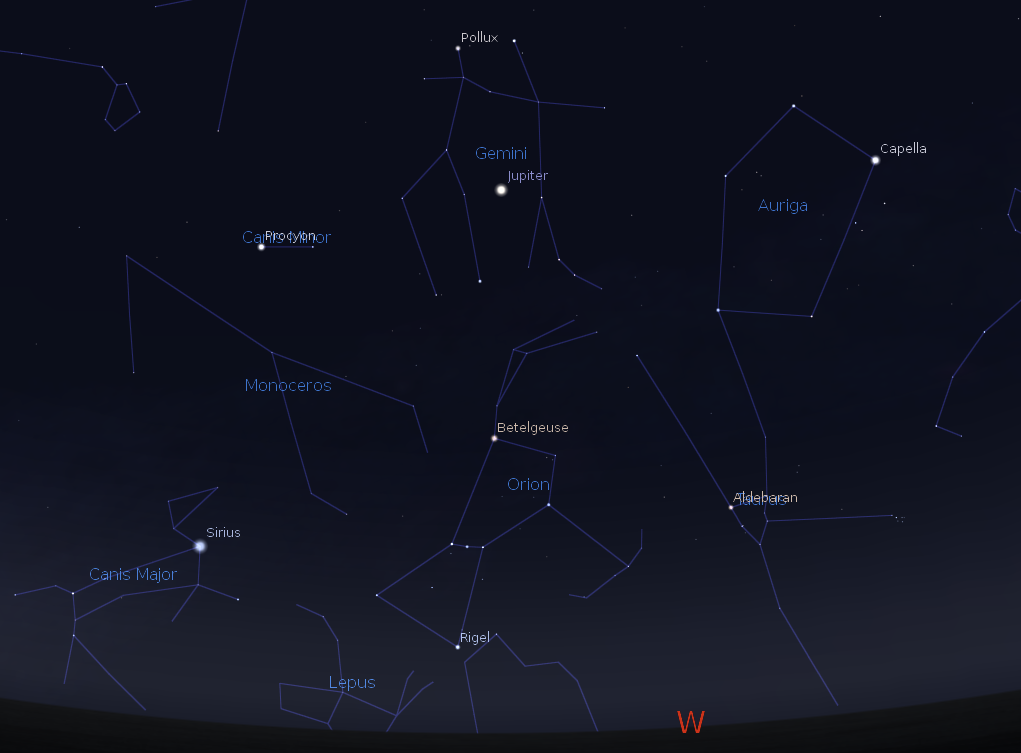
Jupiter and the setting winter constellations in the west at 10 p.m. on April 16, 2014. Created using Stellarium.
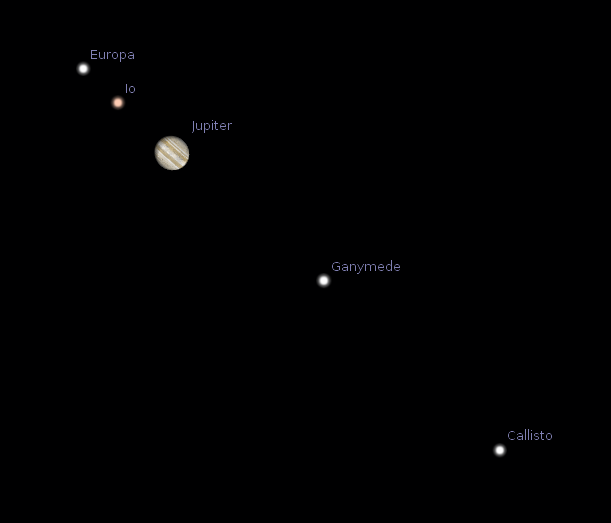
Jupiter and satellites through a telescope at 10 p.m. on April 16, 2014. Created using Stellarium.
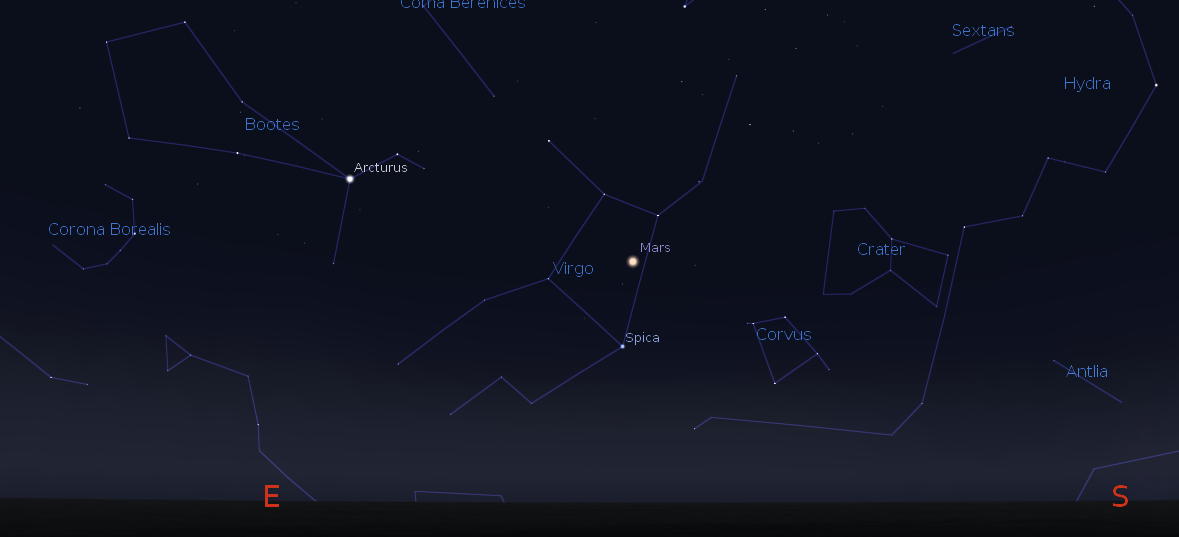
Mars and some low spring constellations in the southeast at 10 p.m. on April 16, 2014. Created using Stellarium.
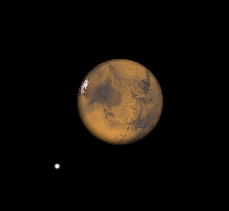
Telescopic Mars. Actually Mars is much smaller in appearance than Jupiter. Interesting albedo* features can be seen. For 10 pm. April 16, 2014. Created using Stellarium.
* Albedo – reflectance value, dark and bright features. Values are 1 for perfectly reflectant (white), to 0 for black.
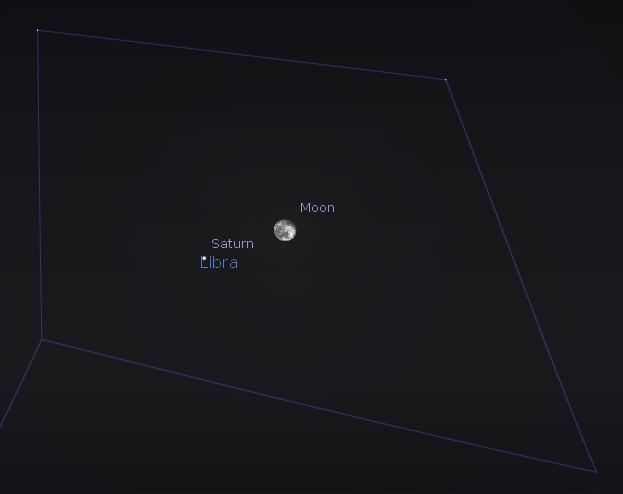
Saturn and the Moon rising in the southeast at 11 p.m. Created using Stellarium.
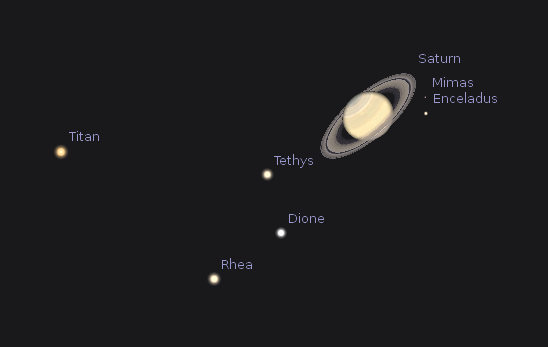
Telescopic Saturn at 11 p.m. April 16, 2014. You may want to wait a bit for it to rise some more for clearer views. Created using Stellarium.
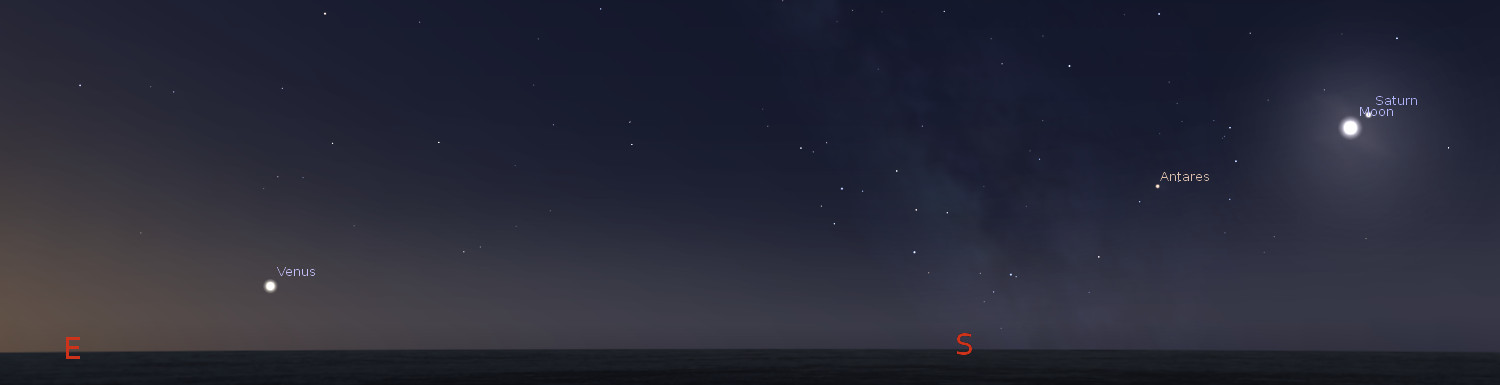
Venus and Saturn at 6 a.m. April 17, 2014. Note that the Moon has scooted to the left of Saturn overnight. Created using Stellarium.
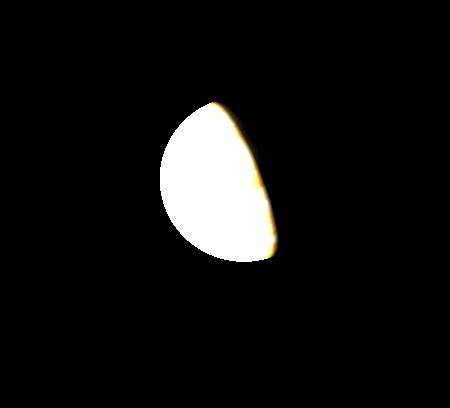
Venus through a telescope at 6 a.m. April 17, 2014. Note that none of these planetary images are to the same scale. Created using Stellarium.
04/04/2014 – Ephemeris – Follow the Moon this weekend
Note: Sorry for the late post.
Ephemeris for Friday, April 4th. The sun will rise at 7:17. It’ll be up for 12 hours and 55 minutes, setting at 8:13. The Moon, 3 days before first quarter, will set at 1:32 tomorrow morning.
During this weekend the Moon will be slowly crossing the evening sky, approaching the planet Jupiter. Pay attention if you can to each night’s position and how its phase changes. It is moving farther from the sun in the sky, so we see it more and more illuminated by the sun. Sunday night it will draw even with Jupiter, with the planet some 10 moon widths north or above the Moon. It doesn’t seem at first thought that the Moon rotates, since we see the same face from the Earth all the time,. But the Moon does rotate, once a month. If it didn’t rotate we’d see all of it from our changing view of it over the month. The part of the Moon we can’t see from Earth is not the dark side, it is the far side which is fully illuminated at our new moon.
Times are for the Traverse City/Interlochen area of Michigan. They may be different for your location.
Addendum
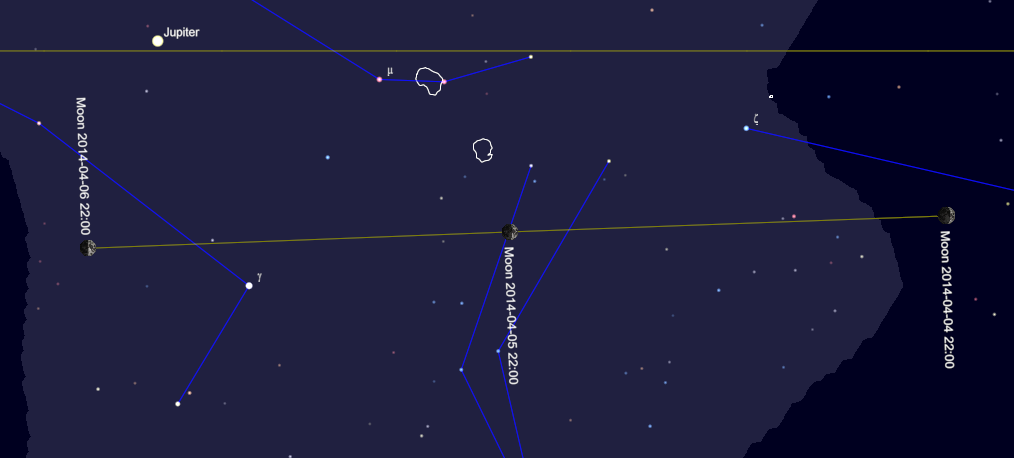
Motion and phase of the Moon for April 4, 5, and 6 2014. Created using Cartes duCiel (SkyCharts).
Click on image to enlarge. Yes, the moon is really that small.
03/19/2014 – Ephemeris – Wednesday is bright planet day
Ephemeris for Wednesday, March 19th. The sun will rise at 7:47. It’ll be up for 12 hours and 6 minutes, setting at 7:53. The moon, 3 days past full, will rise at 11:19 this evening.
Wednesday is bright planet day on Ephemeris. Jupiter will be in the southern sky as darkness falls tonight. It’s cruising against the stars of Gemini now, and moving east after spending a couple of months backtracking to the west. It will pass due south at 8:39 p.m., and will set at 4:22 a.m. in the west-northwest. Reddish Mars is in Virgo now and left and a bit above bright star Spica in the late evening, which it now outshines. Mars will rise at 9:56 p.m. It will pass due south at 3:29 a.m. Saturn will rise at 12:21 a.m. in the east-southeast. It’s seen against the stars of Libra the scales this year. Venus will rise at 5:48 tomorrow morning and shines brightly in the southeast before sunrise. It will reach its greatest angle from the sun on Saturday.
Times are for the Traverse City/Interlochen area of Michigan. They may be different for your location.
Addendum
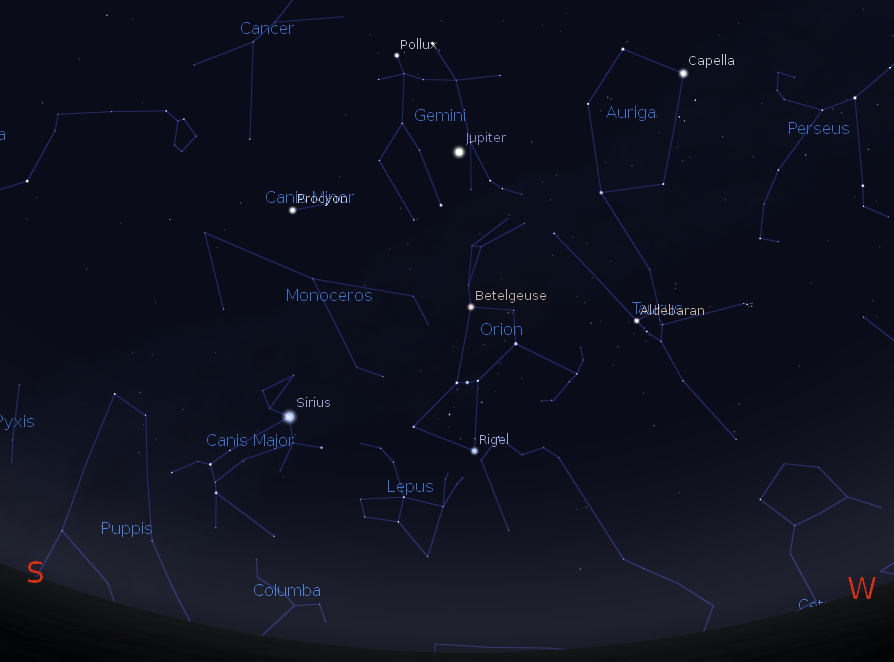
Jupiter and the winter constellations at 10 p.m. on March 19, 2014. Created using Stellarium.
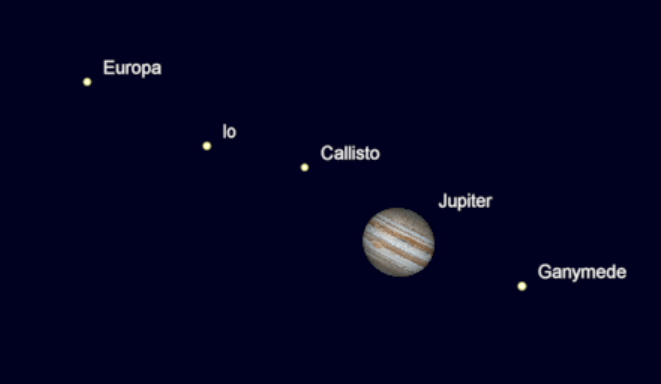
- Jupiter and moons at 10 p.m. on March 19, 2014. Created using Cartes du Ciel.
Note the Great Red Spot. It will transit the disk ( be centered) at 10:48 p.m. Since the 1960’s the Great Red Spot has not been that red. It’s faded quite a bit since then. I tend to think of it a a pastel pink. This is a north is up view, but most telescopes invert the image and/or show a mirror image, so don’t give up too soon.
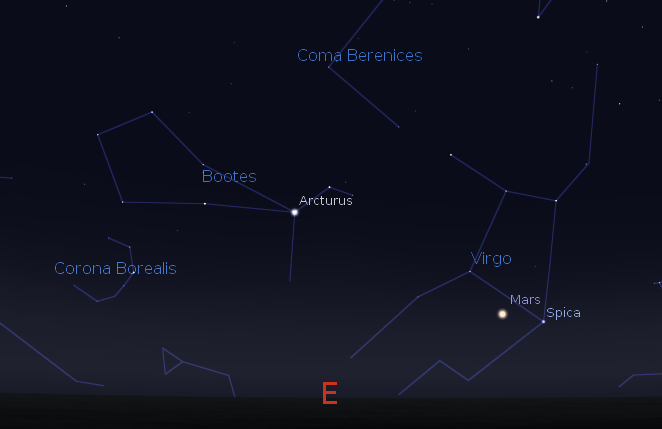
Mars low in the east at 11 p.m. on March 19, 2014. Created using Stellarium.
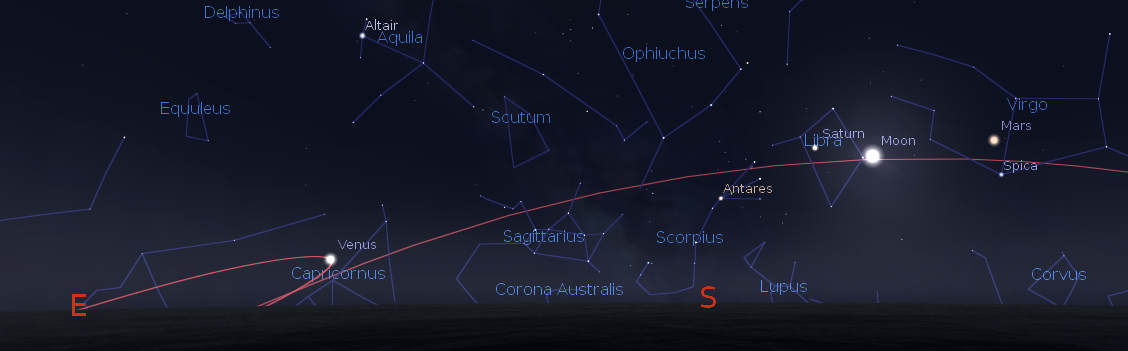
- Mars, Saturn, and Venus with the constellations of summer at 6:30 a.m. on March 20, 2014. I’ve added Venus’ orbit and the ecliptic. Created using Stellarium.
Saturday Venus will be at its greatest western elongation from the sun of 47º. As can be seen it’s about there now. The ecliptic is the plane of the earth’s orbit, and the other planets stick reasonably close to it because the solar system is essentially flat. I’m sure the new Cosmos will cover how the solar system formed and the reason the solar system is flat and also one way.
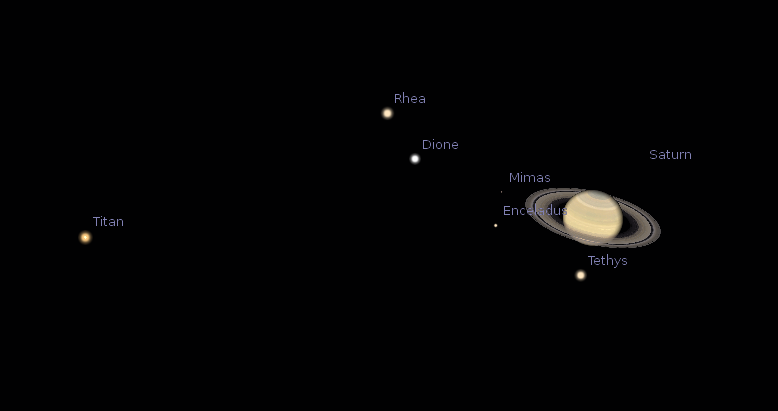
Saturn and its moons at 6:30 a.m., March 20, 2014. Only the moon Titan can be easily seen in small telescopes. Created using Stellarium.
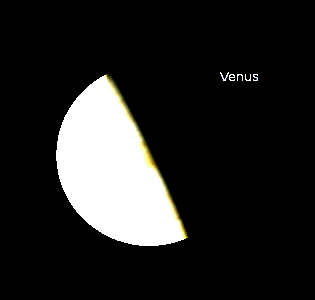
Venus at 6:30 a.m., March 20, 2014. I burned in the image of Venus because that’s what it looks like. Stellarium shows the Venusian clouds as seen in ultraviolet light. In white light Venus is a cue ball. Created using Stellarium.
Spring starts tomorrow!
02/10/2014 – Ephemeris – Jupiter will appear near the Moon tonight
Ephemeris for Monday, February 10th. The sun will rise at 7:49. It’ll be up for 10 hours and 14 minutes, setting at 6:04. The Moon, half way from first quarter to full, will set at 5:28 tomorrow morning.
The planet Jupiter will appear above the moon tonight. At 9 p.m. Jupiter will be 5 and a half degrees, or 11 moon widths above the Moon. It will only get a little closer as the night progresses. The Moon will pass below Jupiter from our vantage point. In binoculars or a telescope the planets satellites can be seen spread out around the planet. Some of us amateur astronomers with pretty good-sized telescopes still can see only the same 4 moons that Galileo saw in 1610. The count of the Jovian satellites is up to something like 67, but these are small bodies Jupiter picked up from the outer part of the asteroid belt. Many of these are in retrograde of backward orbits, a sure sign of capture.
Times are for the Traverse City/Interlochen area of Michigan. They may be different for your location.
Addendum
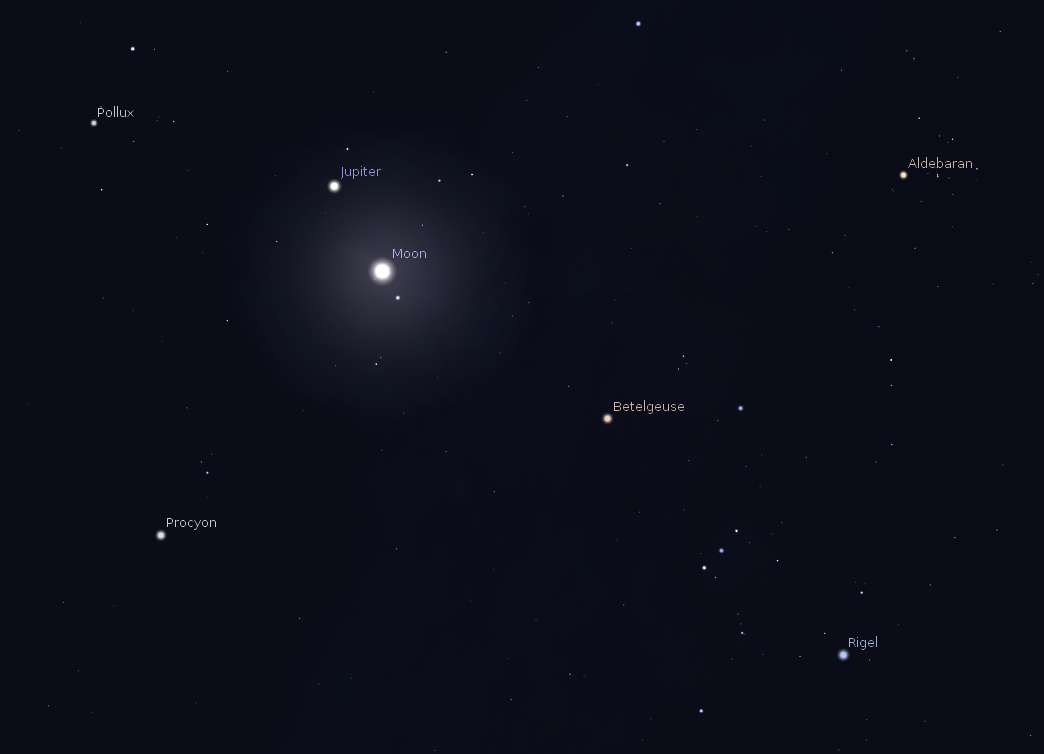
The Moon and Jupiter at 9 p.m. on February 10, 2014. Created using Stellarium.
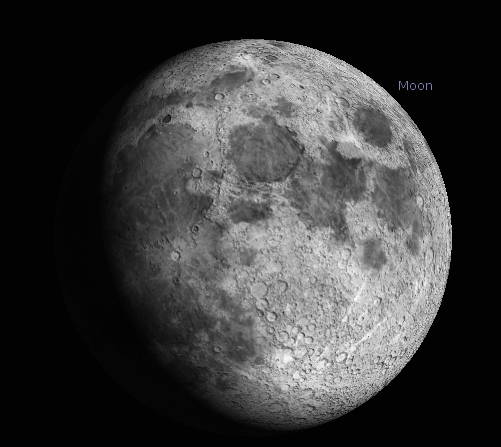
The Moon at 9 p.m. on February 10, 2014. Created using Stellarium.
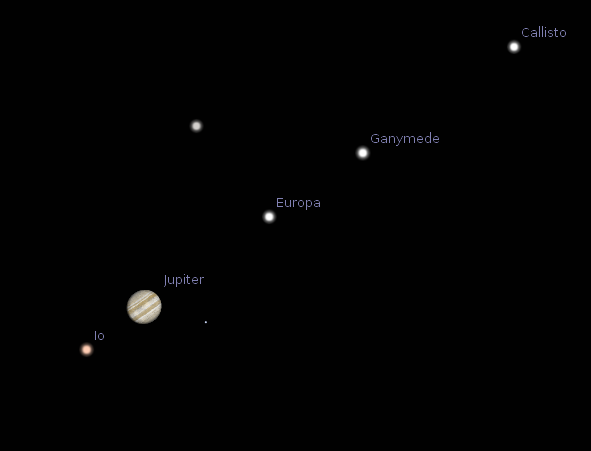
Jupiter at 9 p.m. on February 10, 2014. There’s quite a few interloper stars nearby. Created using Stellarium.
08/21/2012 – Ephemeris – The moon, the planets Mars, Saturn and the star Spica get together tonight
Ephemeris for Tuesday, August 21st. The sun rises at 6:52. It’ll be up for 13 hours and 44 minutes, setting at 8:37. The moon, 3 days before first quarter, will set at 10:21 this evening.
Tonight the moon will join the triangle of the planets Saturn, Mars and the star Spica. Mars is the dimmest of the three star-like objects and is nearly directly above the moon. Saturn is yellowish and to the upper right, while the star Spica is the bluest of the 21 brightest first magnitude stars. Mars gets its color from rust, good old iron oxide. Saturn has a yellowish tinge due partly to the color of its cloud tops. The color of the rings is much more white of ice. But since Saturn reflects the sun, some of that yellowness come from the sun itself. While the daylight sun appears white to us, our night vision shifts to the blue, so sunlike stars appear yellowish. This shift to the blue also enhances the color of a blue star like Spica.
Times are for the Traverse City/Interlochen area of Michigan. They may be different for your location.
Addendum
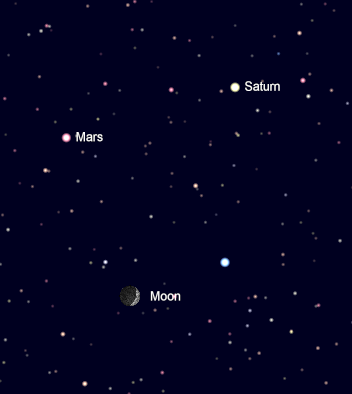
The moon and the planets Mars and Saturn plus the bright star Spica before 10 p.m. Created using Stellarium.
Spica is the unnamed star to the right of the moon.
06/06/11 – Ephemeris – The moon tonight
Monday, June 6th. Today the sun will be up for 15 hours and 25 minutes, setting at 9:24. The moon, 2 days before first quarter, will set at 12:50 tomorrow morning. Tomorrow the sun will rise at 5:58.
The moon tonight is a fat crescent. In binoculars the small Sea of Crises is prominently located as a gray patch at the edge of the moon. The Sea of Fertility is below it, while the sea of Tranquility is between them and near the terminator, the sunrise line on the moon. In telescopes there are three craters south of Tranquility, most prominent of which is Theophilus. With its prominent central peak. Farther to the north of Crises and near the terminator is the crater Posidonus, larger than Theophilus, but has a double crater wall on one side. Larger telescopes can see cracks in its floor . It has no central peak, and shows its age of maybe three and a half billion years.
* Times are for the Traverse City/Interlochen area of Michigan. They may be different for your location.
Addendum
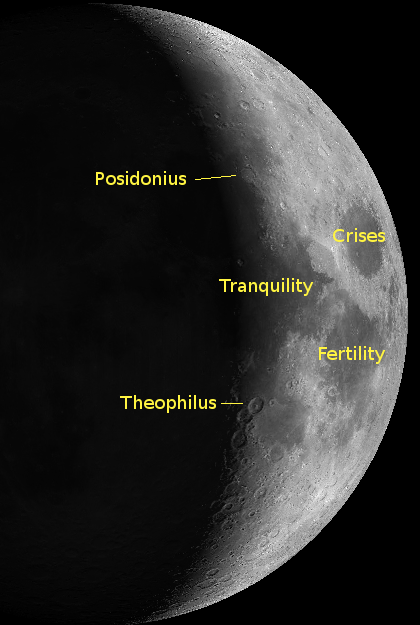
The moon on June 6, 2011 - Virtual Moon Atlas
 Bob Moler's Ephemeris Blog