Archive
02/10/2022 – Ephemeris – The waxing gibbous Moon is revealing more seas and craters
This is Ephemeris for Thursday, February 10th. Today the Sun will be up for 10 hours and 14 minutes, setting at 6:04, and it will rise tomorrow at 7:48. The Moon, 2 days past first quarter, will set at 4:38 tomorrow morning.
The Moon tonight is a waxing gibbous phase. More gray lunar seas are appearing near the terminator, the sunrise line. From north to south these seas, most only partially in sunlight, are: At the far north, the Cold Sea, Sea of Showers, The sea where the famous crater Copernicus is, the Sea of Islands. The southernmost sea at the terminator is the Sea of Clouds. Some large and prominent craters can be seen with binoculars or a small telescope can be seen in the south, the striking and relatively fresh Tycho, with its Moon girdling ejecta rays, though the rays are best seen at full moon. And the huge crater Clavius, with an arc of 5 smaller craters, one on its wall and the others on its floor, in ever diminishing sizes.
The astronomical event times given are for the Traverse City/Interlochen area of Michigan (EST, UT – 5 hours). They may be different for your location.
Addendum
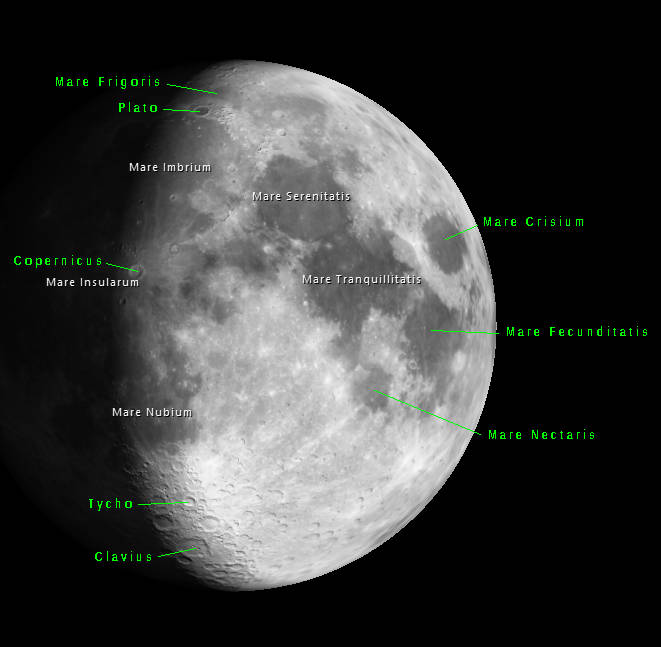
2 days past first quarter Moon as it would be seen in a small telescope or even binoculars, annotated. For this evening, February 10, 2022. Click on the image to enlarge it. Created using Virtual Moon Atlas. Annotations in white are from the app, mine are in green. Translations of the sea names are below.
Translations
Mare Crisium – Sea of Crises
Mare Fecunditatis – Sea of Fertility
Mare Frigoris – Sea of Cold
Mare Imbrium – Sea of Showers
Mare Insularum – Sea of Islands
Mare Nectaris – Sea of Nectar
Mare Nubium – Sea of Clouds
Mare Serenitatis – Sea of Serenity
Mare Tranquilitatis – Sea of Tranquility
A closer look
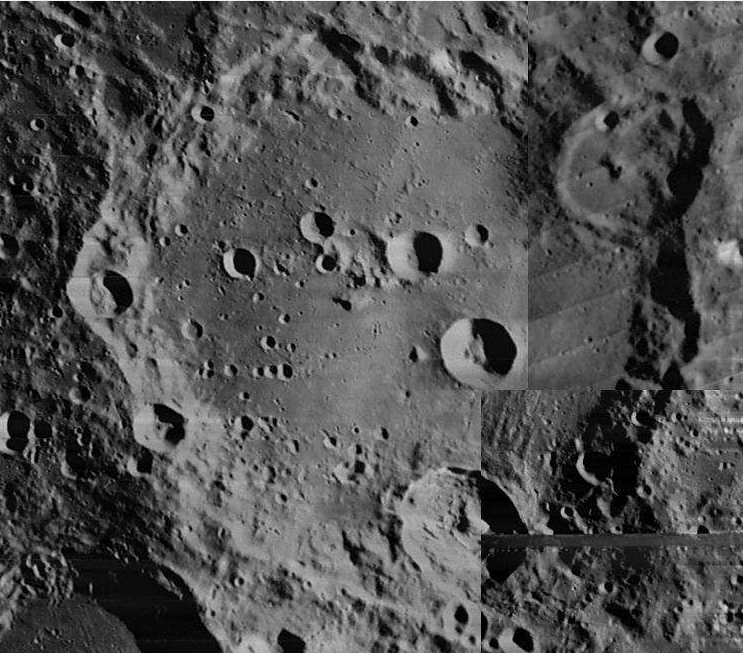
A montage of Clavius as photographed by one of the Lunar Orbiter spacecraft in the 1960s From Digital Lunar Orbital Photographic Atlas. Credit Jeff Gillis, Lunar and Planetary Institute.
07/23/2018 – Ephemeris – The importance of Mars in determining the nature of the solar system
Monday, July 23rd. The Sun rises at 6:19. It’ll be up for 14 hours and 59 minutes, setting at 9:18. The Moon, half way from first quarter to full, will set at 3:41 tomorrow morning.
The accurate observational positions of Mars by Tycho Brahe allowed Johannes Kepler in the early 17th century to discover his three laws of planetary motion. Tycho was the last and greatest of the naked eye astronomers. Kepler befriended Tycho who jealously guarded his observations. It was only after his death in 1601 that Kepler took possession of Tycho’s data. Until then it was believed that planets moved with uniform circular motion, even though they didn’t look like it. Astronomers added circle after circle, called epicycles, to attempt to make their system work. Mars was the worst case. Kepler finally determined that Mars, and indeed all the planets, orbited the Sun in elliptical orbits. That was his first law of planetary motion.
The times given are for the Traverse City/Interlochen area of Michigan. They may be different for your location.
Addendum
The source if the images below is the talk “Mars 2018” I gave at the Betsie Valley District Library, July, 20, 2018.
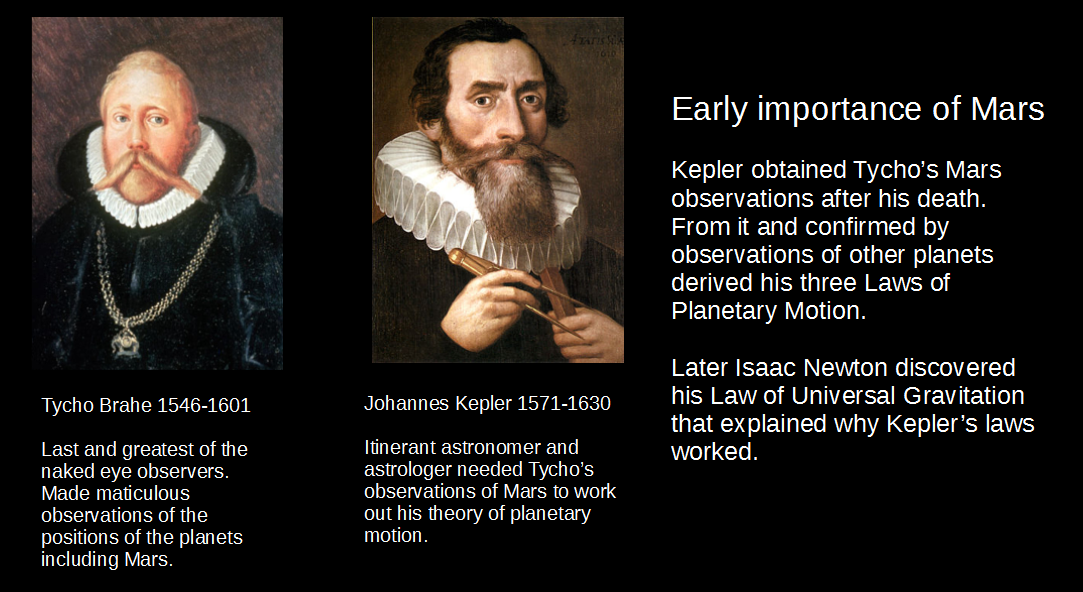
Tycho and Kepler. Artist for Tycho: Eduard Ender (1822-1883). Artist for Kepler, unknown. Source: Wikipedia.
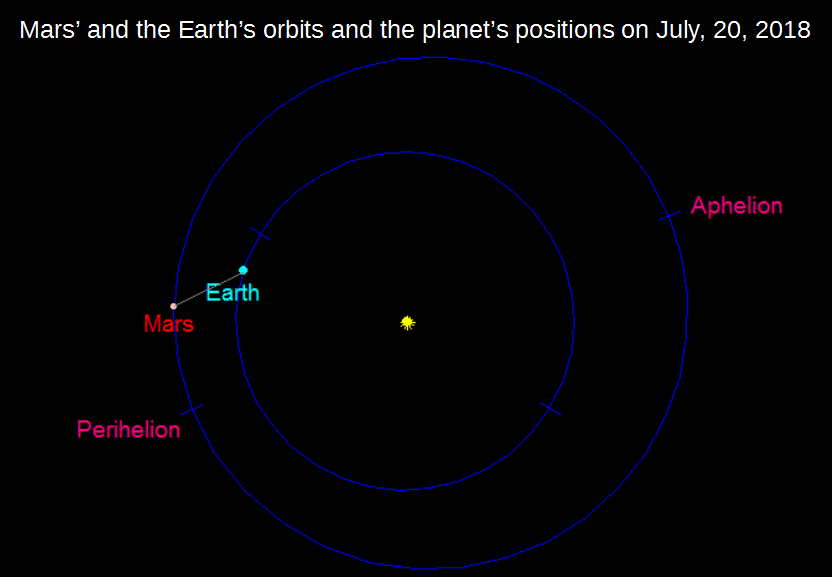
Mars’ and Earth’s orbits to scale and positions of the Earth and Mars July 20, 2018, one week before opposition. Note that Mars’ orbit is decidedly not circular. Credit my LookingUp program.
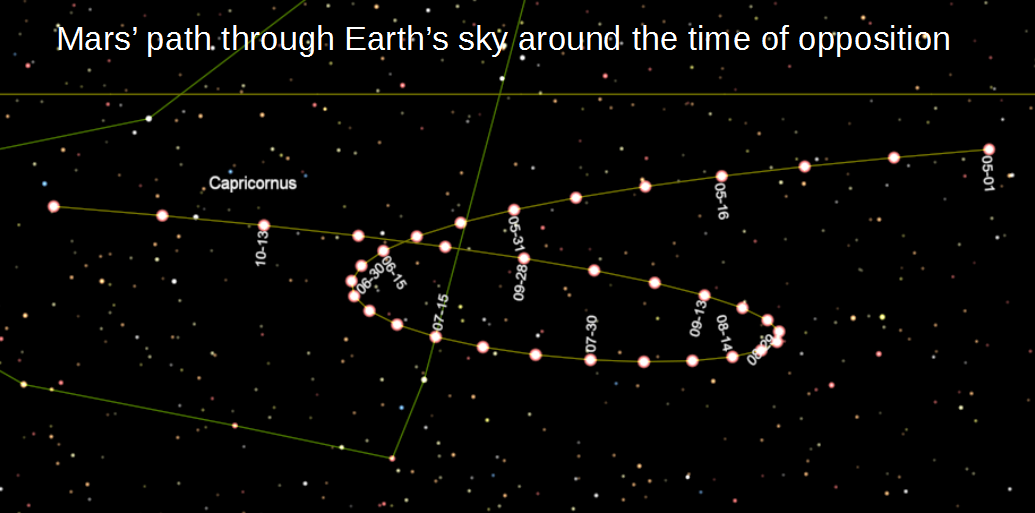
Created using Cartes du Ciel (Sky Charts).
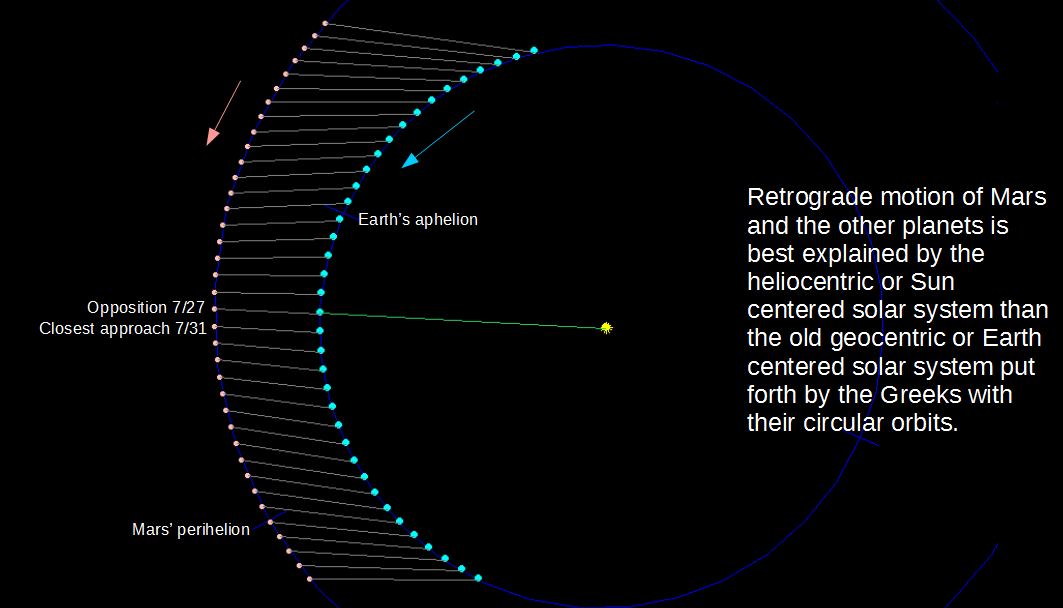
Created using Cartes du Ciel (Sky Charts).
10/10/2016 – Ephemeris – Checking out the gibbous Moon tonight
Ephemeris for Indigenous Peoples Day*, Monday, October 10th. The Sun will rise at 7:52. It’ll be up for 11 hours and 13 minutes, setting at 7:06. The Moon, 1 day past first quarter, will set at 2:20 tomorrow morning.
The Moon is beginning to dominate the evening sky. So it’s time to get out that telescope or powerful binoculars. The terminator which now is the sunrise line will be cutting through the Sea of Showers, also known as Mare Imbrium. Just south of it is the large crater Copernicus, 56 miles (93 km) in diameter. Copernicus, near the Moon’s equator hit a flat lunar sea, so it’s quite conspicuous. Another crater near the Moon’s south pole is conspicuous because it’s so big. It’s Clavius, with an arc of diminishing sized craters within. It is 136 miles (225 km) in diameter. In the book and movie 2001: A Space Odyssey, it is the location of the US Moon Base, with the monolith in the distinctive crater Tycho north of it.
Times are for the Traverse City/Interlochen area of Michigan. They may be different for your location.
Addendum
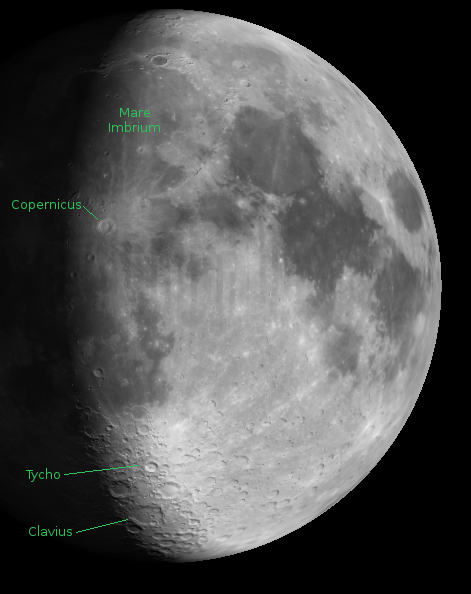
The Moon at 9 p.m. October 10, 2016, with the landmarks described in the text above,
* Indigenous Peoples Day – This is officially the Columbus Day holiday in the United States, which commemorates the landing of Christopher Columbus possibly on Plana Cay, which he named San Salvador. While in his four voyages he visited some Caribbean islands, Central and South America. He never made it to North America. Columbus was appointed the Viceroy and Governor of the Indies. He was accused of torture and other crimes. And the treatment of the Indigenous peoples as been horrific then and ever since, so pardon them if they don’t celebrate Columbus Day. This person of European ancestry tends to agree with them.
06/13/2016 – Ephemeris – Two early astronomers honored by prominent craters on the Moon
Ephemeris for Monday, June 13th. Today the Sun will be up for 15 hours and 32 minutes, setting at 9:29, and it will rise tomorrow at 5:56. The Moon, 1 day past first quarter, will set at 2:54 tomorrow morning.
The Moon tonight sports two craters, named for important astronomers near the south end of the of our satellite. The first, the smaller of the two sticks out for its sharp edges and dark shadows. It is Tycho, which at full moon exhibits moon encircling rays. It’s 52 miles (86 km) in diameter. Named for Tycho Brahe that last great naked eye astronomer in the 16th century, whose precise positions of Mars allowed Johannes Kepler to formulate his Three Laws of Planetary Motion. Clavius is a large crater south and closer to the terminator, the sunrise line, than Tycho. It has a curious arc of several smaller craters on its floor. Clavius is 136 miles (225 km) in diameter. Clavius completed work on the Gregorian calendar.
Times are for the Traverse City/Interlochen area of Michigan. They may be different for your location.
Addendum
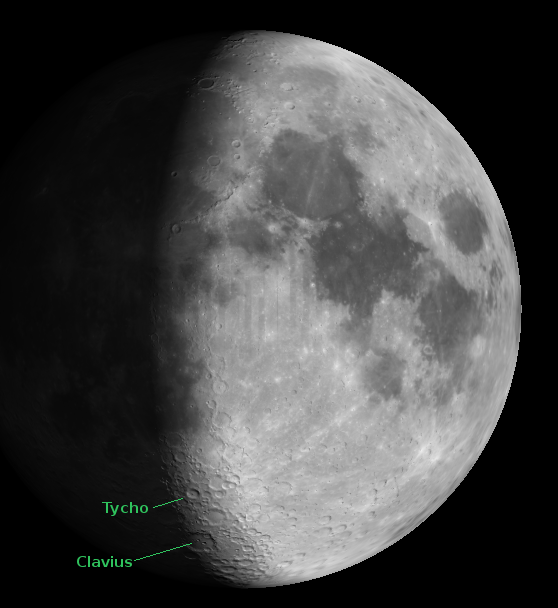
The Moon at 10 p.m. June 13, 2016 featuring the craters Tycho and Clavius. Created using Virtual Moon Atlas.
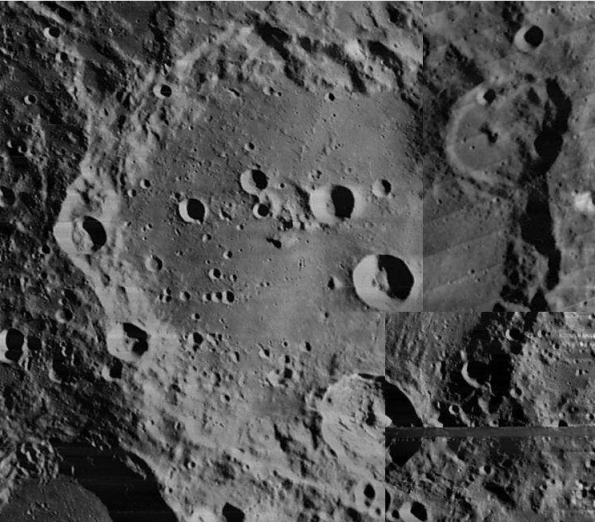
Clavius as photographed by one of the Lunar Orbiter spacecraft in the 1960s From Digital Lunar Orbital Photographic Atlas. Credit Jeff Gillis, Lunar and Planetary Institute.
11/19/2015 – Ephemeris – The no longer quite first quarter Moon tonight
Ephemeris for Thursday, November 19th. The Sun will rise at 7:44. It’ll be up for 9 hours and 26 minutes, setting at 5:11. The Moon, at first quarter today, will set at 1:06 tomorrow morning.
The Moon actually was at first quarter at 1:27 (6:47 UT) this morning. By this evening, when it’s out the terminator, the sunrise line, on the Moon will be curved giving the it a definite gibbous appearance. The upside down rabbit image in the Moon’s dark seas on the illuminated right half can be seen. In a telescope or even powerful binoculars at 9 p.m. the Terminator cuts the southern crater Tycho in half. The large crater Clavius south of it is just catching the morning Sun. To the north the sunrise line cuts the large Mare Imbrium or Sea of Showers in half. In the mountains on the north shore of Imbrium the large walled plain, really a crater, Plato can be seen. Pan near the terminator in the south and the Straight Wall might be spotted as a long shadow.
Times are for the Traverse City/Interlochen area of Michigan. They may be different for your location.
Addendum
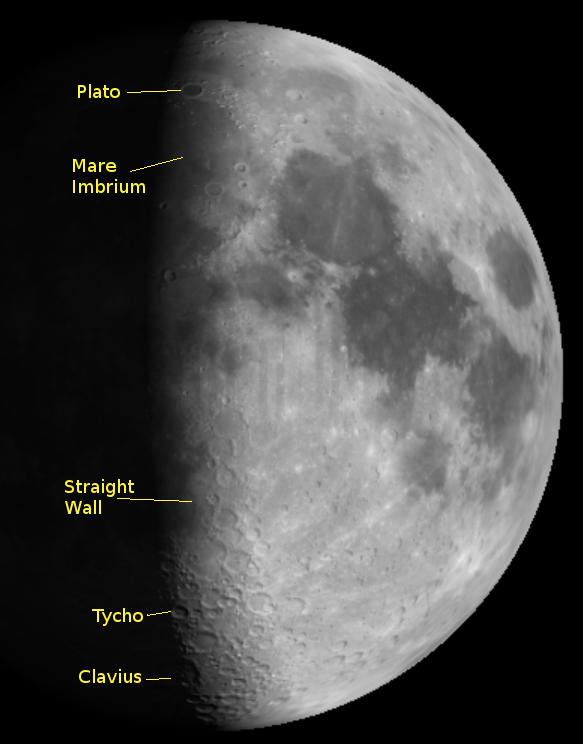
The Moon at 9 p.m. EST November 19, 2015. (2 hr UT November 20) Created using Virtual Moon Atlas.
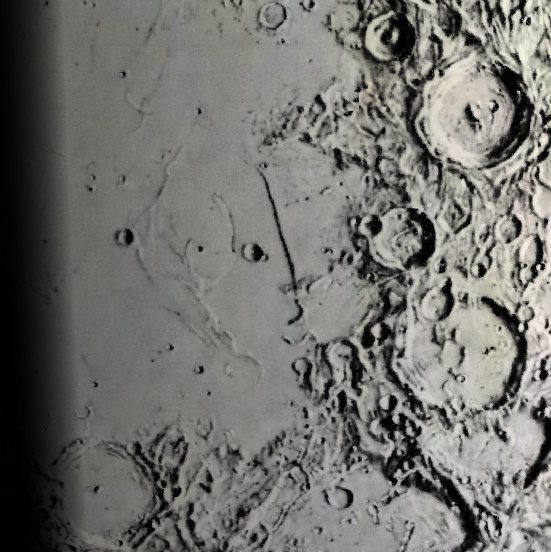
Closeup chart of the Straight Wall.
08/04/2014 – Ephemeris – The Moon’s remarkable crater Clavius
Ephemeris for Monday, August 4th. The sun rises at 6:32. It’ll be up for 14 hours and 31 minutes, setting at 9:03. The moon, 1 day past first quarter, will set at 1:20 tomorrow morning.
Let’s take a look at the Moon tonight. The south end of the moon is bright part, the lunar highlands, the oldest terrain on the Moon. A huge crater is visible that just came into sunlight. It is the crater Clavius. It’s visible in binoculars, but it is best seen in a telescope with enough magnification so the moon more than fills the field of view. Clavius has four small craters on its floor in a slight arc, in descending order of size. Clavius itself is 136 miles (225 km) in diameter. It has a flat floor, but it’s large enough to be convex following the curvature of the Moon, a fact that can be seen when Clavius is close to the terminator as it will be tonight. It is another one of my favorite lunar features.
Times are for the Traverse City/Interlochen area of Michigan. They may be different for your location.
Addendum
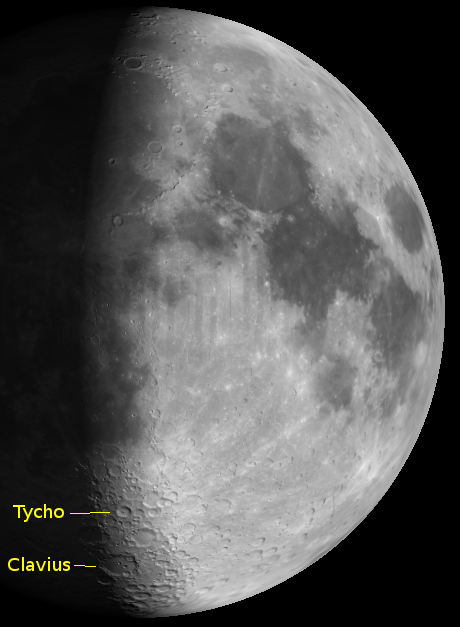
The Moon highlighting the craters Clavius and Tycho for 10 p.m. August 4, 2014. Created using Virtual Moon Atlas.
A note: For science fiction fans in the book and movie 2001 a Space Odyssey by Arthur C. Clarke the U.S. Moon Base was located in the crater Clavius, and the lunar monolith, designated TMA-1 (Tycho Magnetic Anomaly 1) in surveys, was located in the nearby crater Tycho.
Clavius as photographed by one of the Lunar Orbiter spacecraft in the 1960s. From Digital Lunar Orbital Photographic Atlas. Credit Jeff Gillis, Lunar and Planetary Institute.
08/15/2013 – Ephemeris – Plato and Copernicus (the craters)
Ephemeris for Thursday, August 15th. The sun rises at 6:45. It’ll be up for 14 hours and 2 minutes, setting at 8:47. The moon, 1 day past first quarter, will set at 1:43 tomorrow morning.
The moon now is slightly gibbous. The term gibbous comes from Latin meaning having a hump or humpbacked. In binoculars or a small telescope look to the upper left where the great Sea of Showers or Mare Imbrium is being revealed by the advance of sunrise. The flat walled plain, actually a crater called Plato is off the top of Imbrium. It is circular and 61 miles in diameter. It looks oval to us because of the curvature of the moon. Below or south at the other edge of Imbrium, just coming into sunlight is the marvelous crater Copernicus with it’s triple central peaks. It’s 56 miles in diameter. In a good enough telescope one can see that the crater walls appear terraced. Copernicus is 2 miles deep.
Times are for the Traverse City/Interlochen area of Michigan. They may be different for your location.
Addendum
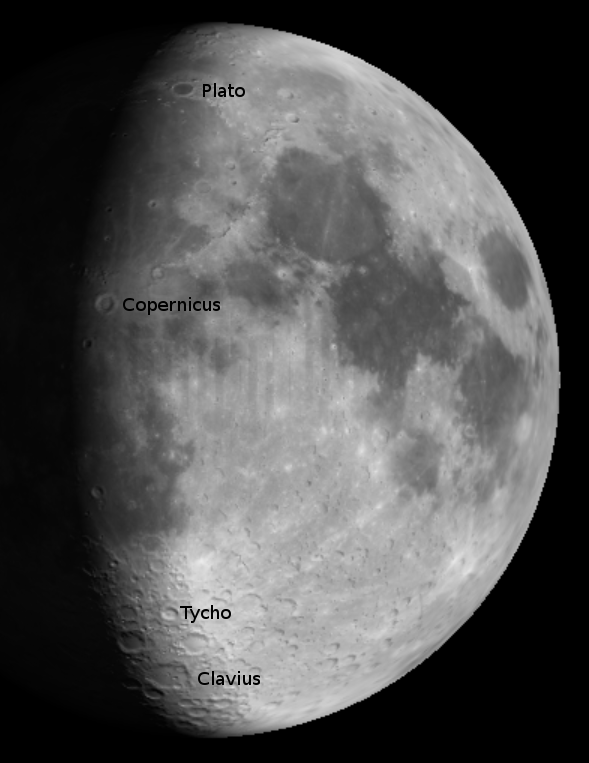
The moon a day after first quarter on August 15, 2013. Created using Virtual Moon Atlas.
The image also includs the craters Tycho and Clavius craters in the southern highlands.
03/08/2012 – Ephemeris – The full moon
Ephemeris for Thursday, March 8th. The sun will rise at 7:06. It’ll be up for 11 hours and 33 minutes, setting at 6:40. The moon, at full today, will rise at 7:30 this evening.
The full moon, contrary to what you’d think is a poor time to observe it. The moon is essentially gray on gray. And at full moon we are looking at the moon from about the same perspective as the sun, so there are no shadows to delineate its fine features. Since the actual instant of full moon occurred at 5 this morning, some shadows will be creeping in on the moon’s upper right face as it is seen in the evening. Full moon is the best time to see the maria or lunar seas, the dark areas that make up the man in the moon. In binoculars can be seen the bright rays emanating from the crater Tycho near the south end of the moon. Other craters have rays too, but none so long and distinctive. Night by night for the next two weeks the moon’s illuminated landscape will wane.
* Times are for the Traverse City/Interlochen area of Michigan. They may be different for your location.
Addendum
The image below is of the waxing gibbous moon presumably from last Sunday night. The phase fits Virtual Moon Atlas for that date. And I received the photo Monday. many of the full moon features including the maria and the crater Tycho can be seen on it. Click on it to see the larger version.
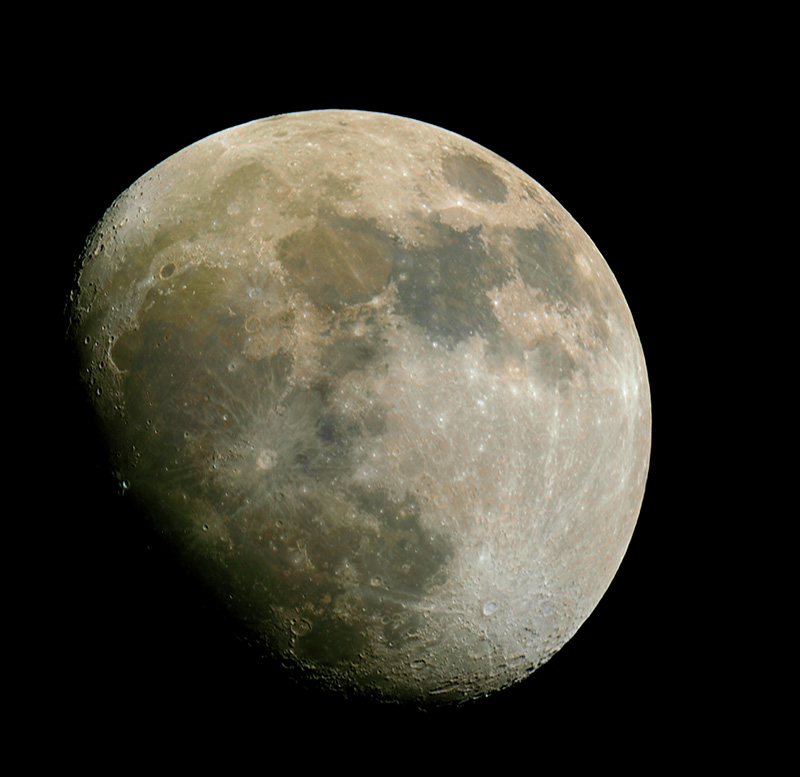
The gibbous moon 03/04/2012 by Scott Anttila
This is from Scott: “The full-size image is huge, a 6 panel mosaic by my DSLR in the (Celestron) C11. It has had the saturation boosted to show detail in the seas that otherwise is difficult if not impossible to detect. You can also see where different minerals are located in the highland areas. Not many people like this view of the moon, I’m fairly fond of it.”
 Bob Moler's Ephemeris Blog