Archive
Let’s search for the naked-eye planets for this week
This is Bob Moler with Ephemeris for Wednesday, August 17th. Today the Sun will be up for 13 hours and 57 minutes, setting at 8:45, and it will rise tomorrow at 6:48. The Moon, 2 days before last quarter, will rise at 11:37 this evening.
Let’s search for the naked-eye planets for this week. Two of the naked-eye planets are in the evening sky: Mercury sets too close to the Sun to be seen in the evening, but as it gets darker, Saturn can be seen low in the southeast. At 6 am tomorrow, the planets will be spread out from brilliant Venus low in the east-northeast to Saturn in the west-southwest. Mars will be a lot higher than Venus in the southeast. Jupiter is farther to the right in the south-southwest. Mars is dimmer than Jupiter, but is slowly getting brighter as the Earth creeps up on it. Saturn ends the line of planets lower than Venus, if it’s visible at all, in the west-southwest, only 5 degrees above a sea, or Lake Michigan horizon.
The astronomical event times given are for the Traverse City/Interlochen area of Michigan (EDT, UT – 4 hours). They may be different for your location.
Addendum
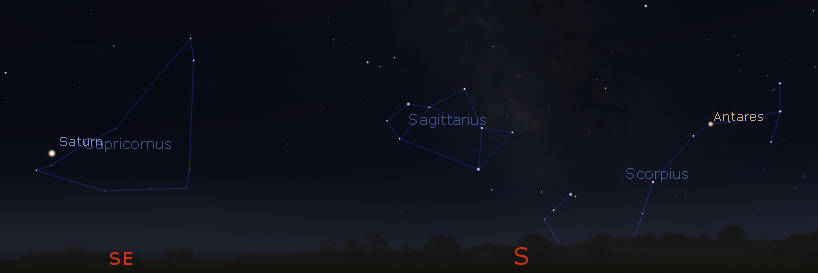
An animation showing Saturn at 10 pm, along with three zodiacal constellations, with and without labels, just after the end of nautical twilight tonight at 10 pm, August 17, 2022. Click on the image to enlarge it. Created using Stellarium and GIMP.
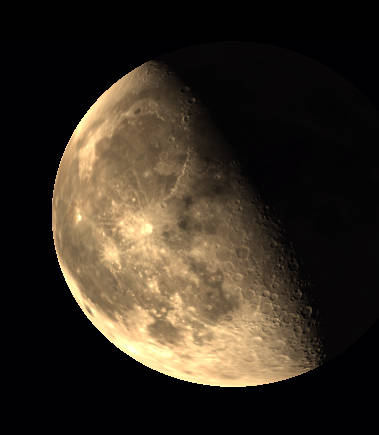
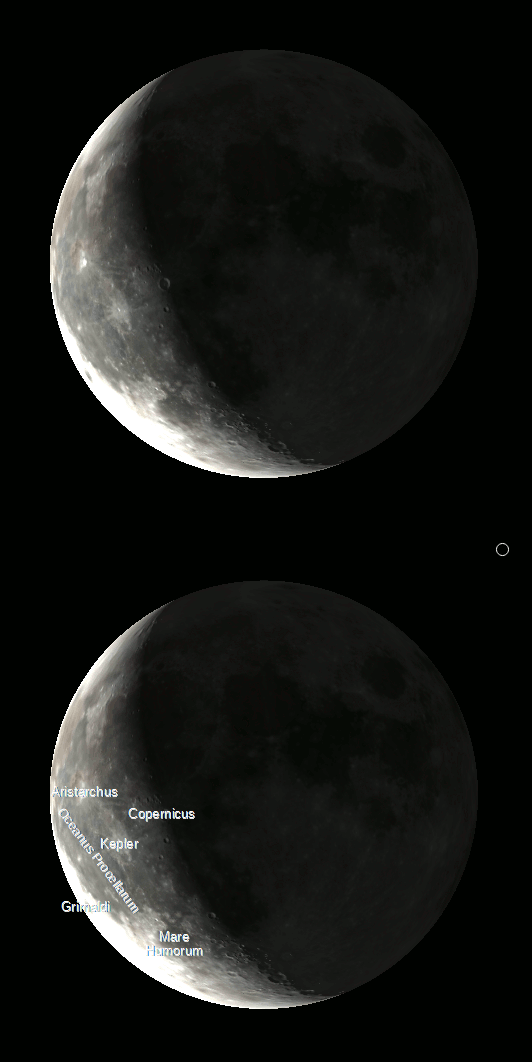
The Moon as it might appear at midnight tonight, August 18, 2022. Created using Stellarium.
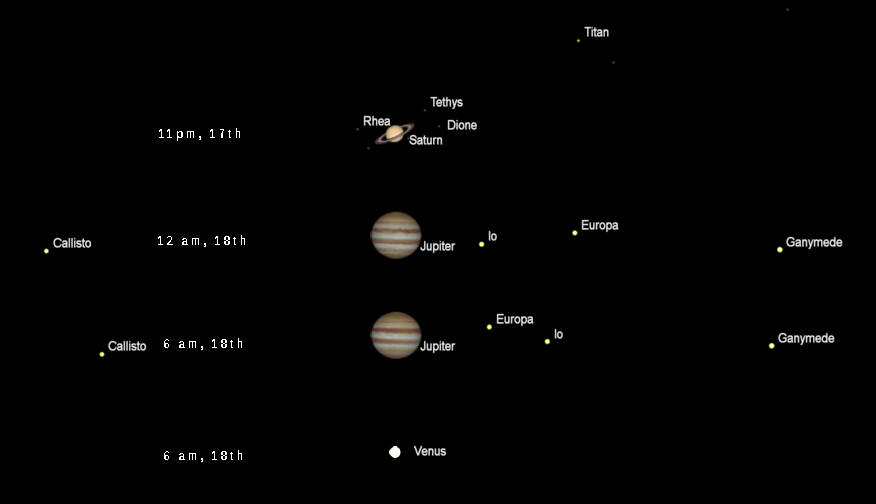
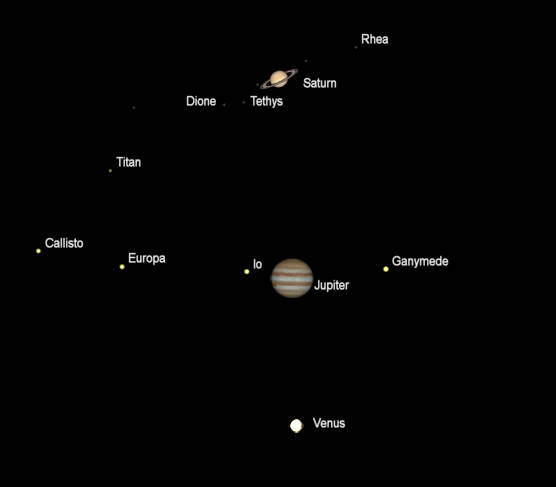
Views of Saturn, Jupiter, and Venus (north up) as they would be seen in a small telescope, with the same magnification. The times vary for each planet. Jupiter is shown twice, at midnight and 6 am, since its moons, especially Io and Europa, move rapidly. I do not show planets less than 10 seconds of arc in diameter, so Mars doesn’t show up yet. It will soon. Apparent diameters: Saturn 18.76″, its rings 43.70″; Jupiter 47.33″. Mars 9.04″, 84.7% illuminated; Venus 10.31″, 94.3% illuminated. The ” symbol means seconds of arc (1/3600th of a degree.) Click on the image to enlarge it. Created using Cartes du Ciel (Sky Charts).
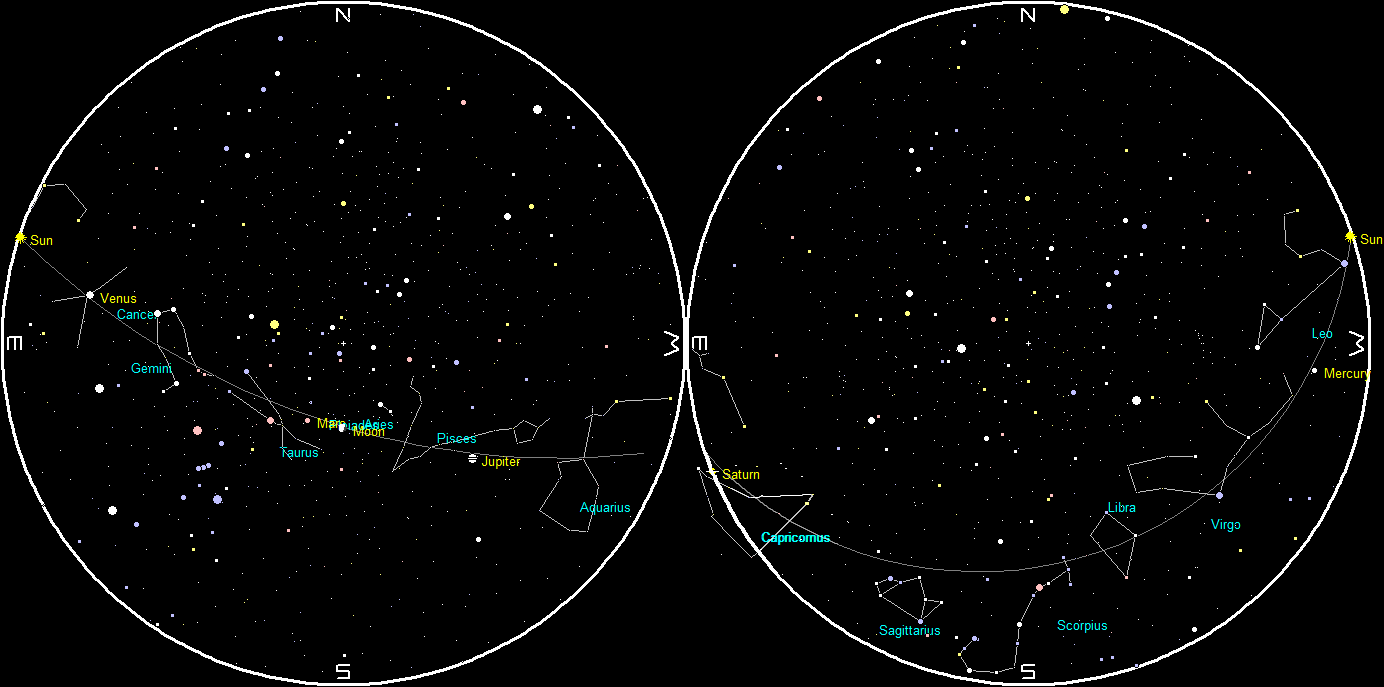
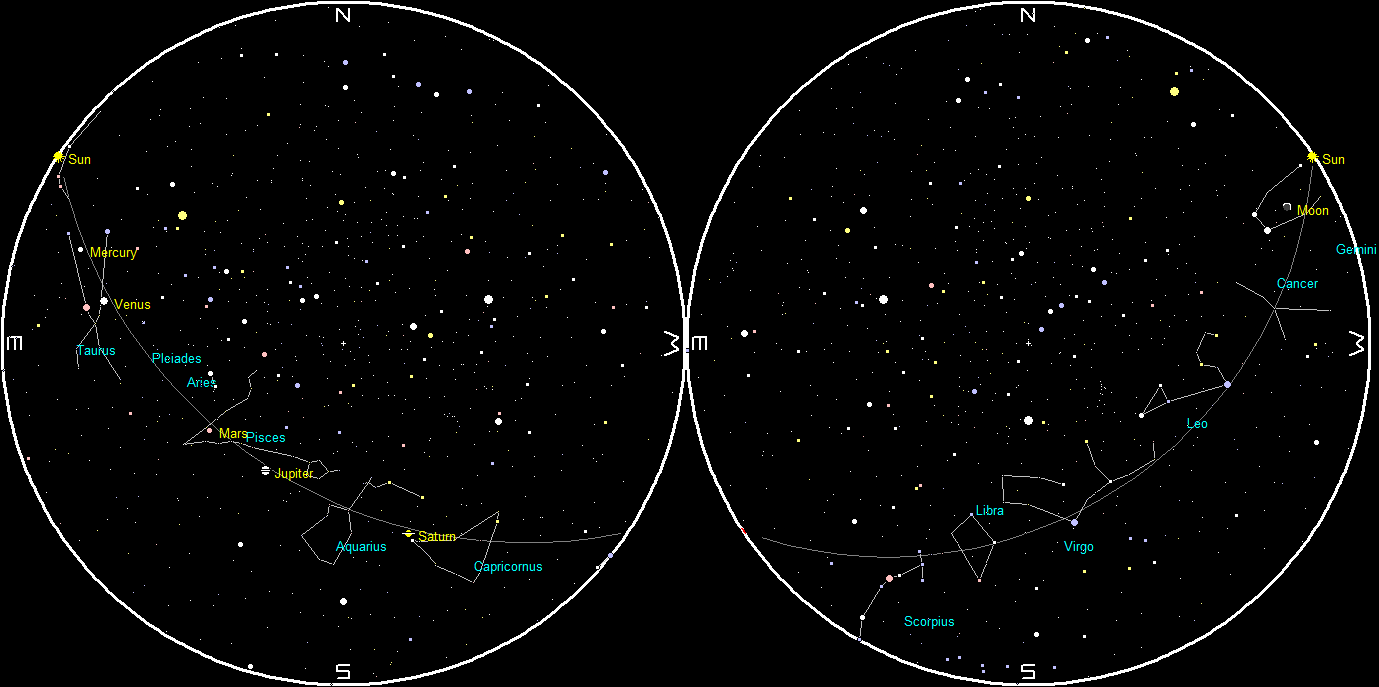
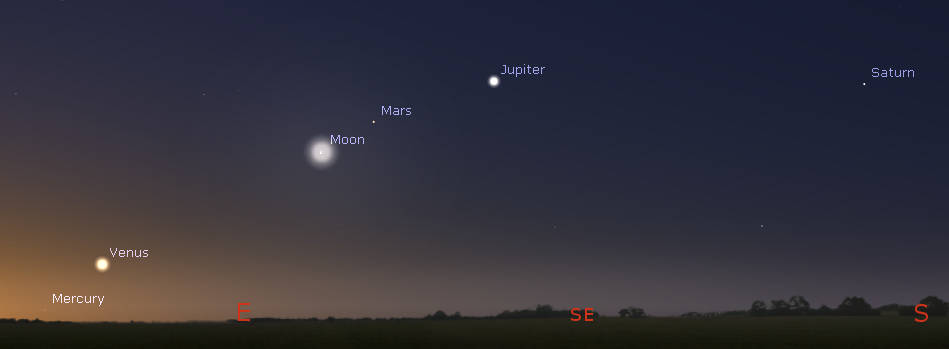
The naked-eye planets and the Moon at sunset and sunrise on a single night, starting with sunset on the right on August 17, 2022. The night ends on the left with sunrise on the 18th. Click on the image to enlarge it. Created using my LookingUp program.
08/10/2022 – Ephemeris – Let’s search for the naked-eye planets for this week
This is Bob Moler with Ephemeris for Wednesday, August 10th. Today the Sun will be up for 14 hours and 16 minutes, setting at 8:56, and it will rise tomorrow at 6:40. The Moon, 1 day before full, will set at 5:37 tomorrow morning.
Let’s search for the naked-eye planets for this week. All but one of the naked-eye planets are in the morning sky, That one is Mercury, too close to the Sun to be seen in the evening. At 6 am tomorrow, the planets will be spread out from brilliant Venus low in the east-northeast to Saturn in the west-southwest. Mars will be a lot higher than Venus in the southeast. Jupiter is farther to the right in the south-southwest. Mars is dimmer than Jupiter, but is slowly getting brighter as the Earth creeps up on it. Saturn ends the line of planets much lower than Venus in the west-southwest. Tonight, Saturn will rise about 9:12 pm in the east-southeast. It won’t be in the morning sky next week, having moved into the evening sky.
The astronomical event times given are for the Traverse City/Interlochen area of Michigan (EDT, UT – 4 hours). They may be different for your location.
Addendum
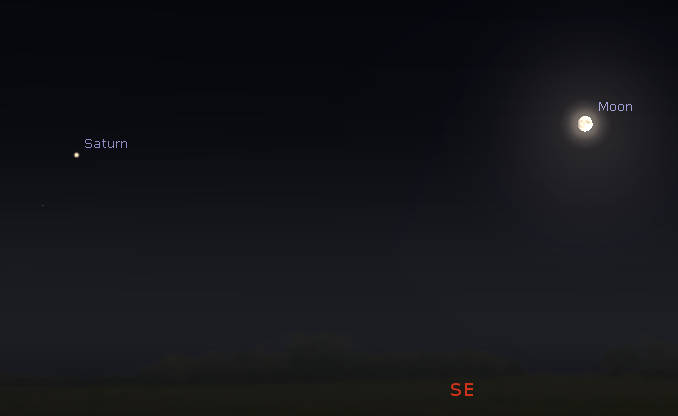
Saturn and the Moon at 10 in the evening. Saturn is not officially in the evening sky, but it rises shortly after sunset. Created using Stellarium.
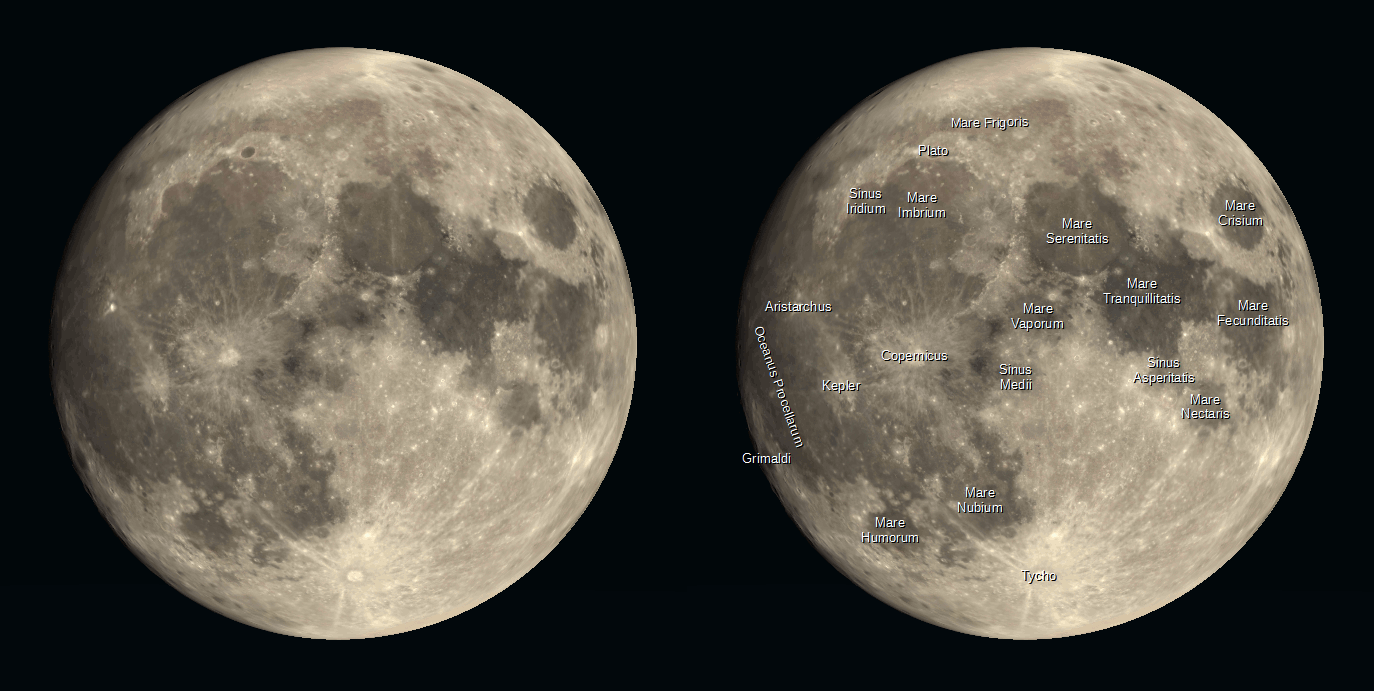
The Moon tonight with animated labels for 10 pm, August 10, 2022. Created using Stellarium; Labels, LibreOffice Draw, animation, GIMP.
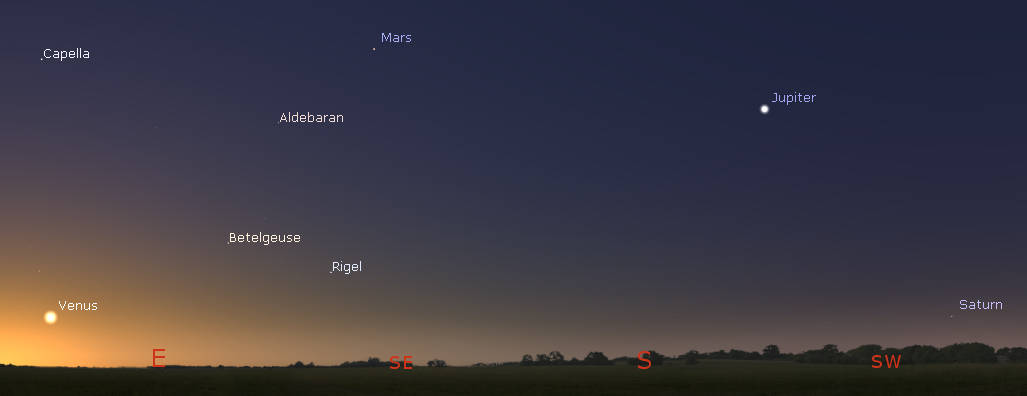
Morning planets at 6 am tomorrow morning, August 11, 2022. With six weeks left in summer, the bright winter stars begin to appear in morning twilight, along with the planets. Click on the image to enlarge it. The span of the planets from Venus to Saturn is 158 degrees. Click on the image to enlarge it. Created using Stellarium.
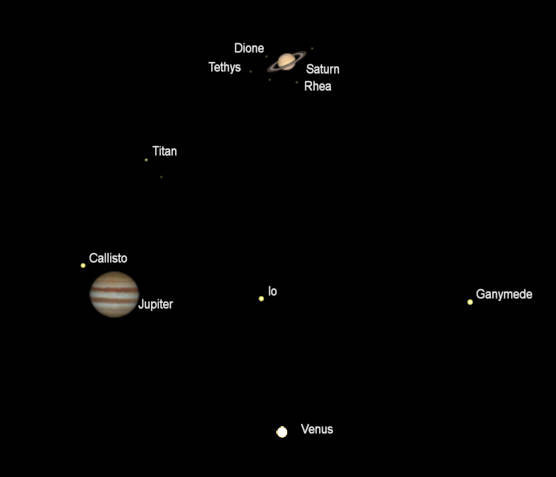
Views of Saturn, Jupiter, and Venus (north up) as they would be seen in a small telescope, with the same magnification. Saturn is shown at 10 pm EDT (UT -4) on August 10, 2022. Jupiter and Venus are shown for, tomorrow morning at 6 am. I do not show planets less than 10 seconds of arc in diameter. Apparent diameters: Saturn 18.76″, its rings 43.70″; Jupiter 46.47″. Mars is not shown, its apparent diameter is 8.71″, 84.7% illuminated; Venus 10.46″, 94.3% illuminated. Jupiter’s moon Europa is in the planet’s shadow at that time. The ” symbol means seconds of arc (1/3600th of a degree.) Click on the image to enlarge it. Created using Cartes du Ciel (Sky Charts).
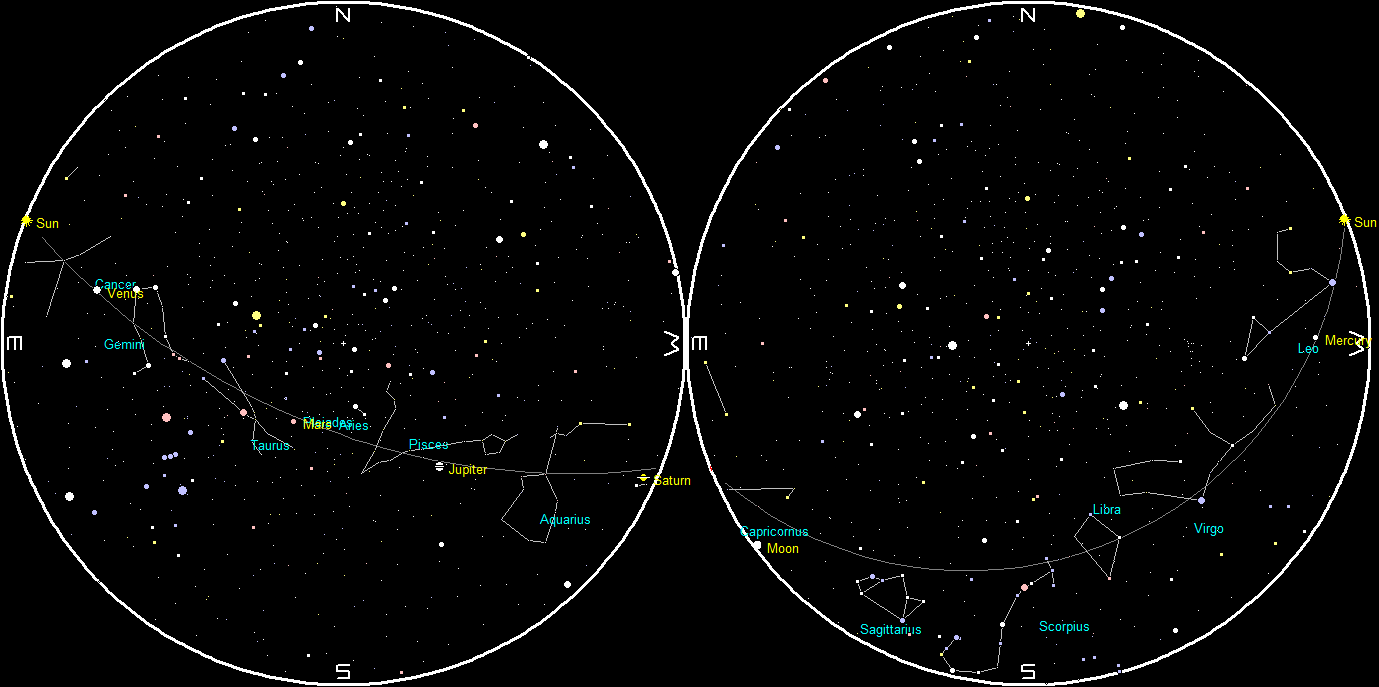
The naked-eye planets and the Moon at sunset and sunrise on a single night, starting with sunset on the right on August 10, 2022. The night ends on the left with sunrise on the 11th. Notice that all the naked-eye planets except Mercury are in the morning sky now. That’s about to change in a week and a half, when Saturn moves into the evening sky at opposition on the 14th. Click on the image to enlarge it. Created using my LookingUp program.
08/03/2022 – Ephemeris – Let’s search for the naked-eye planets for this week
This is Ephemeris for Wednesday, August 3rd. Today the Sun will be up for 14 hours and 34 minutes, setting at 9:05, and it will rise tomorrow at 6:32. The Moon, 2 days before first quarter, will set at 11:56 this evening.
Let’s search for the naked-eye planets for this week. All but one of the naked-eye planets are in the morning sky, That one is Mercury, too close to the Sun to be seen in the evening. At 5:30 tomorrow morning, the planets will be spread out from brilliant Venus low in the east-northeast to Saturn in the southwest. Mars will be a lot higher than Venus in the southeast. Jupiter is farther to the right in the south. Mars is dimmer than Jupiter, but is slowly getting brighter as the Earth creeps up on it. Saturn ends the line of planets much lower than Jupiter in the southwest. Tonight, Saturn will rise about 9:33 pm in the east-southeast, though it won’t be an official evening planet until it rises before sunset, which is 11 days away.
The astronomical event times given are for the Traverse City/Interlochen area of Michigan (EDT, UT – 4 hours). They may be different for your location.
Addendum
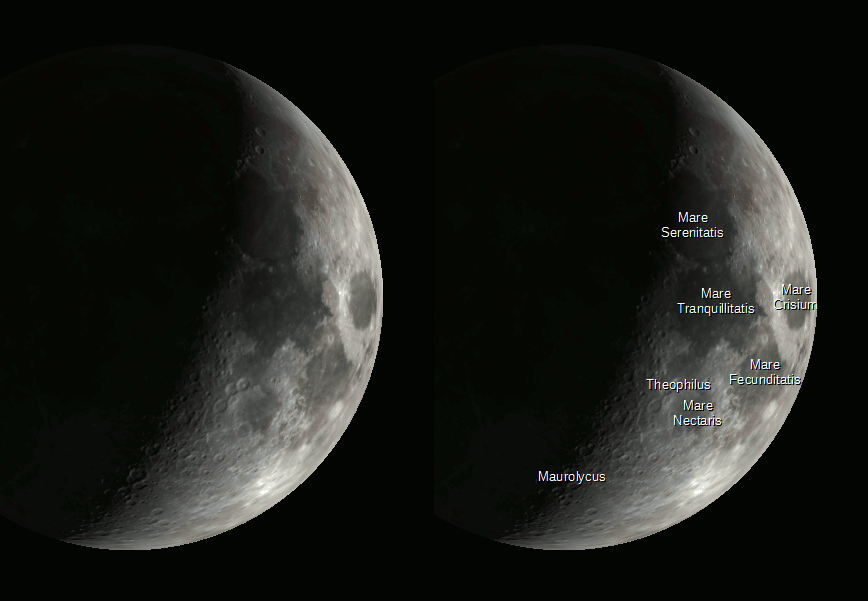
The annotated Moon for 10:30 this evening, August 3, 2022. Labels are centered on the feature they name. The crater Theophilus isn’t as prominent as it would have been 12 hours earlier, when it was nearer the terminator, the sunrise line. Search for it in the box above, right on this page, where I have more to say about it. It’s one of my favorite craters. Created using Stellarium, Libreoffice Draw, and GIMP.
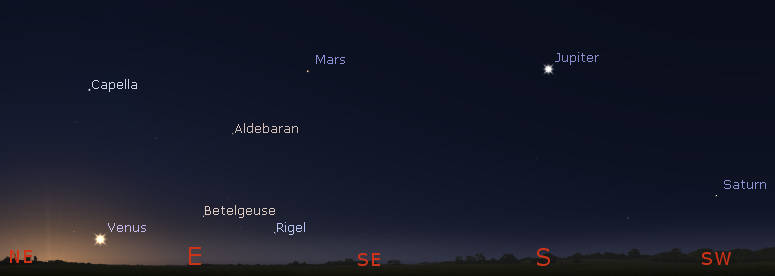
Morning planets at 5:30 am tomorrow, August 4, 2022. With summer almost half over, the bright winter stars begin to appear in morning twilight along with the planets. Click on the image to enlarge it. The span of the planets from Venus to Saturn is 148 degrees. Click on the image to enlarge it. Created using Stellarium.
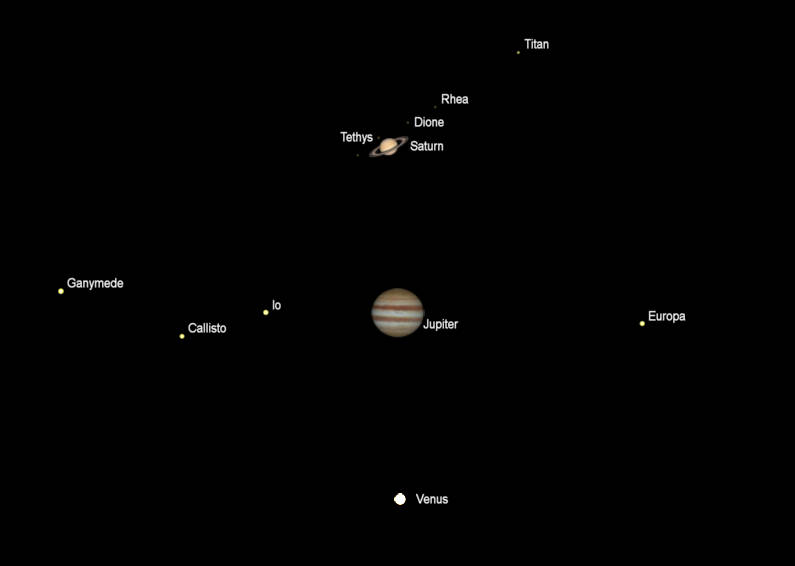
Views of Saturn, Jupiter, and Venus (north up) as they would be seen in a small telescope, with the same magnification, tomorrow morning at 5:30 am, August 4, 2022. I do not show planets less than 10 seconds of arc in diameter. Apparent diameters: Saturn 18.73″, its rings 43.63″; Jupiter 45.54″. Mars is not shown, its apparent diameter is 8.41″, 84.7% illuminated; Venus 10.64″, 93.2% illuminated. The ” symbol means seconds of arc (1/3600th of a degree.) Click on the image to enlarge it. Created using Cartes du Ciel (Sky Charts).
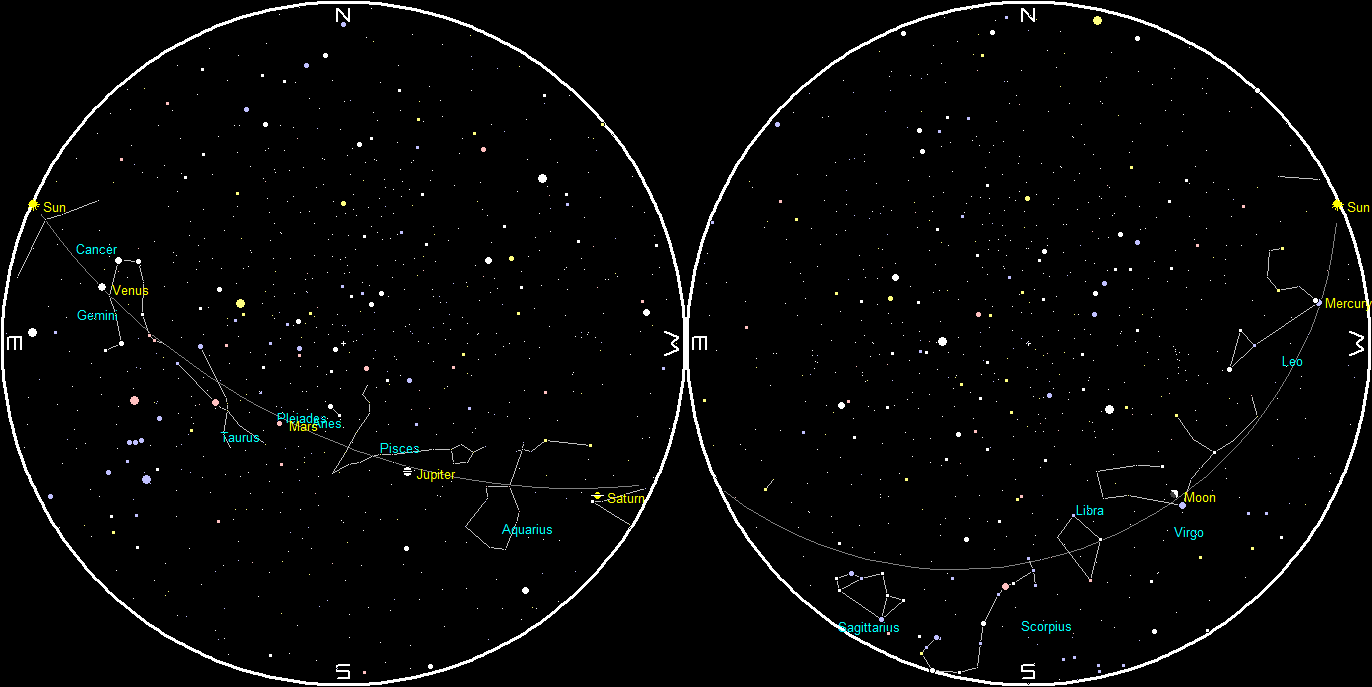
The naked-eye planets and the Moon at sunset and sunrise on a single night, starting with sunset on the right on August 3, 2022. The night ends on the left with sunrise on the 4th. Notice that all the naked-eye planets except Mercury are in the morning sky now. That’s about to change in a week and a half, when Saturn moves into the evening sky when it reaches opposition from the Sun on the 14th. Click on the image to enlarge it. Created using my LookingUp program.
07/27/2022 – Ephemeris – Let’s search for the naked-eye planets for this week
This is Bob Moler with Ephemeris for Wednesday, July 27th. Today the Sun will be up for 14 hours and 50 minutes, setting at 9:14, and it will rise tomorrow at 6:24. The Moon, 1 day before new, will rise at 5:52 tomorrow morning.
Let’s search for the naked-eye planets for this week. All but one of the naked-eye planets are in the morning sky, That one is Mercury, too close to the Sun to be seen in the evening. At 5:30 am tomorrow, the planets will be spread out from brilliant Venus low in the east-northeast to Saturn in the southwest. Mars will be a lot higher than Venus in the east-southeast. Jupiter is farther to the right in the south. Mars is dimmer than Jupiter, but is slowly getting brighter as the Earth creeps up on it. Saturn ends the line of planets much lower than Jupiter in the southwest. Tonight, Saturn will rise about 10:06 pm, though it won’t be an official evening planet until it rises before sunset, which won’t happen until August 14th.
The astronomical event times given are for the Traverse City/Interlochen area of Michigan (EDT, UT – 4 hours). They may be different for your location.
Addendum
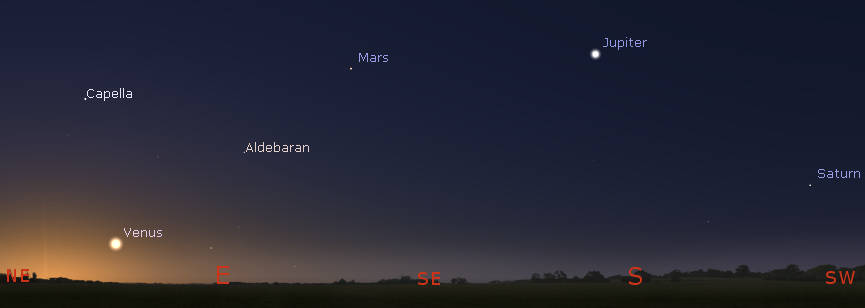
Morning planets at 5:30 am tomorrow , July 28, 2022. The planets and Moon actually appear in a straight line in the sky, being placed along the ecliptic, or path of the Sun in the sky. The ecliptic is a great circle on the celestial sphere. Click on the image to enlarge it. The span of the planets from Venus to Saturn is 140 degrees. Two of winter’s first magnitude stars, Aldebaran and Capella, are now visible in morning twilight. Click on the image to enlarge it. Created using Stellarium.
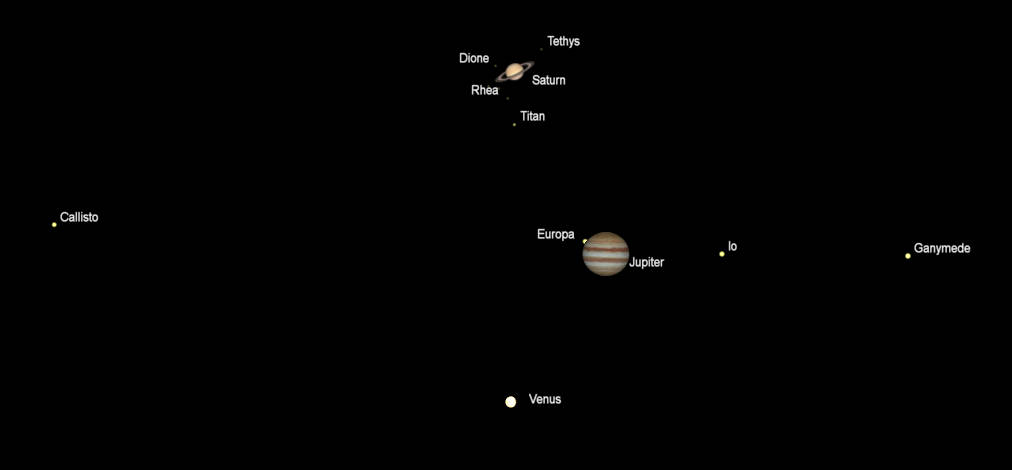
Views of Saturn, Jupiter, and Venus (north up) as they would be seen in a small telescope, with the same magnification, tomorrow morning at 5:30 am, July 28, 2022. I do not show planets less than 10 seconds of arc in diameter. Apparent diameters: Saturn 18.67″, its rings 43.49″; Jupiter 44.58″. Mars is not shown, its apparent diameter is 8.13″, 84.8% illuminated; Venus 10.84″, 91.9% illuminated. The ” symbol means seconds of arc (1/3600th of a degree.) Click on the image to enlarge it. Created using Cartes du Ciel (Sky Charts).
Noting Jupiter and moons image: Europa has just appeared from being behind Jupiter’s disk at 5:27 am (8:27 UT). It had disappeared into Jupiter’s shadow earlier at 12:23 am (4:23 UT).
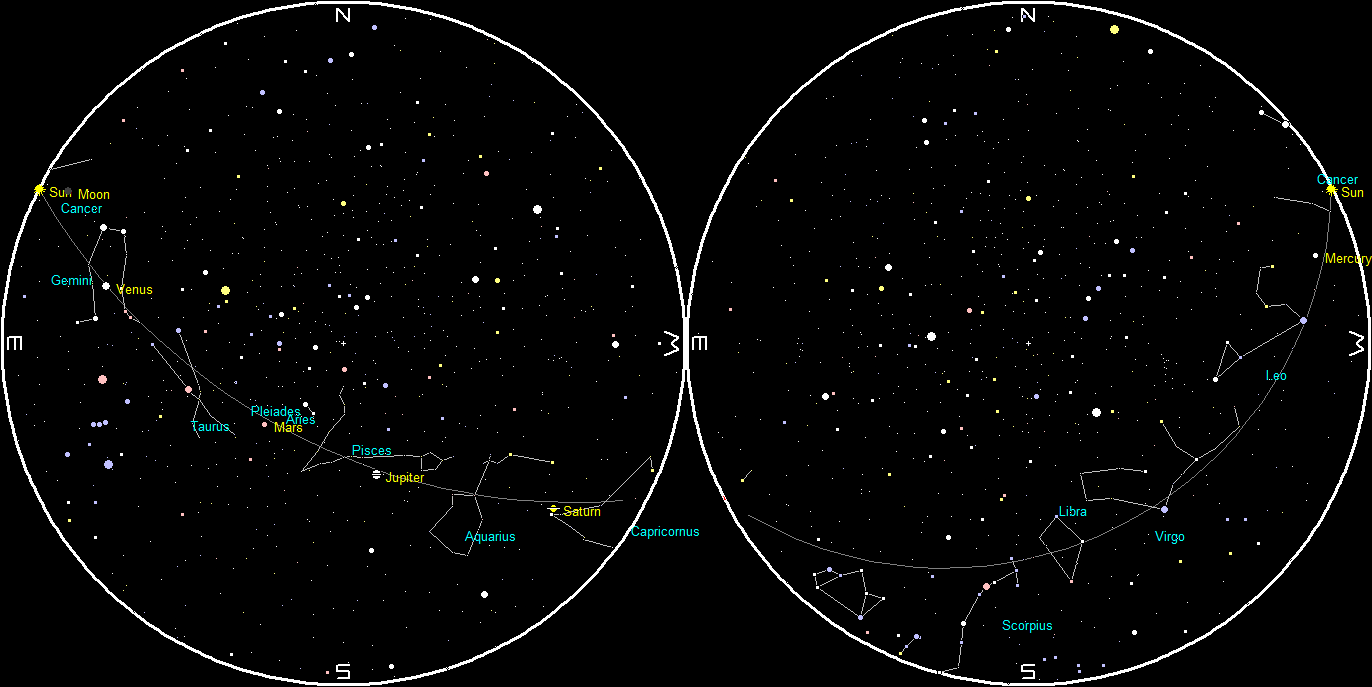
The naked-eye planets and the Moon at sunset and sunrise on a single night, starting with sunset on the right on July 27, 2022. The night ends on the left with sunrise on the 28th. Notice that all the naked-eye planets except Mercury are in the morning sky now. Click on the image to enlarge it. Created using my LookingUp program.
07/20/2022 – Ephemeris – Let’s search for the naked-eye planets for this week
This is Ephemeris for Wednesday, July 20th. Today the Sun will be up for 15 hours and 5 minutes, setting at 9:21, and it will rise tomorrow at 6:17. The Moon, at last quarter today, will rise at 1:13 tomorrow morning.
Let’s search for the naked-eye planets for this week. All but one of the naked-eye planets are in the morning sky, That one is Mercury, too close to the Sun to be seen in the evening. At 5:15 am tomorrow, the planets will be spread out from brilliant Venus low in the east-northeast to Saturn higher in the south-southwest. Mars will be a lot higher than Venus in the east-southeast. The waning crescent Moon will be just right of Mars. Jupiter is farther to the right in the southeast. Mars is dimmer than Jupiter, but is slowly getting brighter as the Earth creeps up on it. Saturn ends the line of planets lower than Jupiter in the south-southwest. Tonight, Saturn will rise about 10:30 pm, though it won’t be an official evening planet until it rises before sunset, which won’t happen until mid-August.
The astronomical event times given are for the Traverse City/Interlochen area of Michigan (EDT, UT – 4 hours). They may be different for your location.
Addendum
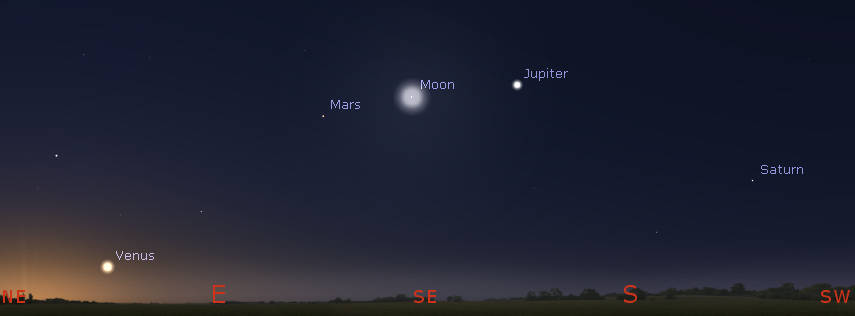
The morning planets and the Moon at 5:15 am tomorrow morning, July 21, 2022. The planets and Moon actually appear in a straight line in the sky, being placed along the ecliptic, or path of the Sun in the sky. The ecliptic is a great circle on the celestial sphere. Click on the image to enlarge it. The span of the planets from Venus to Saturn is 129 degrees. Click on the image to enlarge it. Created using Stellarium.
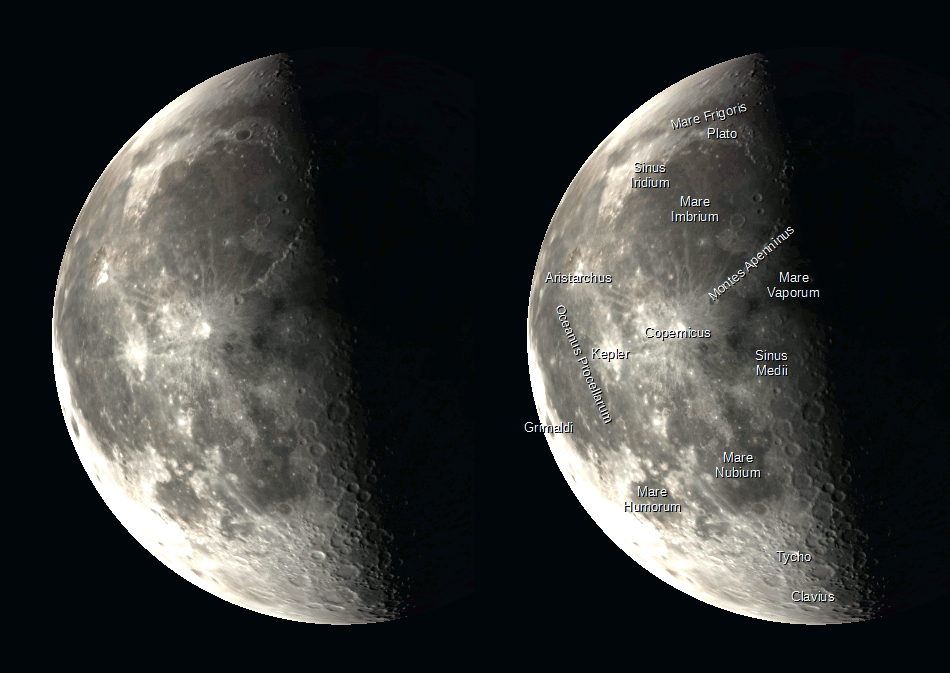
Animated last quarter Moon at 5:15 tomorrow morning, July 21, 2022, with labels. Created using Stellarium and LibreOffice.
Translations
Mare Frigoris – Sea of Cold
Mare Humorum – Sea of Moisture
Mare Imbrium – Sea of Showers
Mare Nubium – Sea of Clouds
Mare Serenitatis – Sea of Serenity
Mare Vaporum – Sea of Vapors
Montes Apenninus – Apennine Mountains
Oceanus Procellarum – Ocean of Storms
Sinus Iridium – Bay of Rainbows
Sinus Medii – Central Bay
Note that Mare is pronounced Mar-é
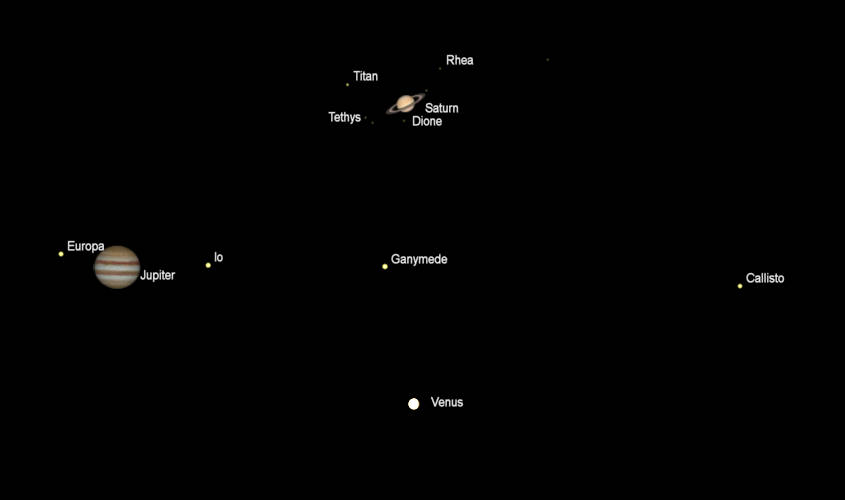
Views of Saturn, Jupiter, and Venus (north up) as they would be seen in a small telescope, with the same magnification, tomorrow morning at 5:15 am, July 21, 2022. I do not show planets less than 10 seconds of arc in diameter. Apparent diameters: Saturn 18.56″, its rings 43.24″; Jupiter 43.47″. Mars is not shown, its apparent diameter is 7.84″; Venus 11.10″. The ” symbol means seconds of arc (1/3600th of a degree.) Click on the image to enlarge it. Created using Cartes du Ciel (Sky Charts).
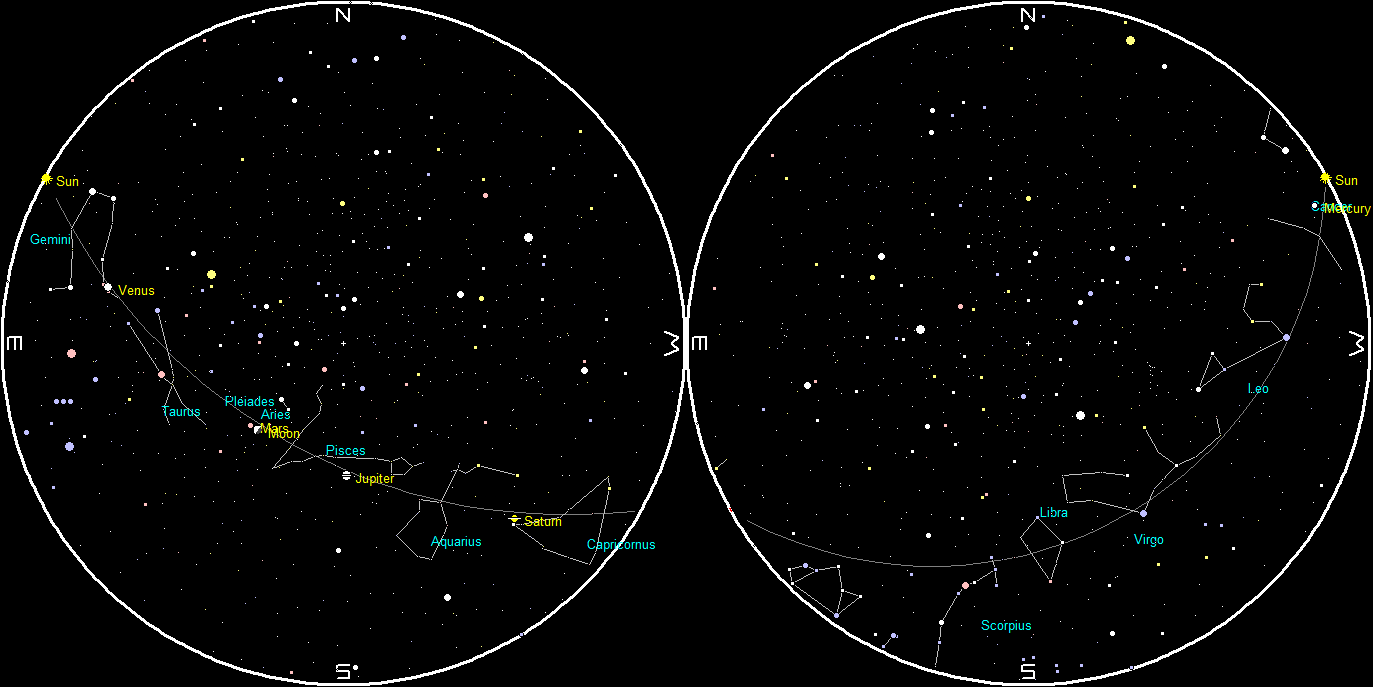
The naked-eye planets and the Moon at sunset and sunrise on a single night, starting with sunset on the right on July 21, 2022. The night ends on the left with sunrise on the 21st. Notice that all the naked-eye planets except Mercury are in the morning sky now. Click on the image to enlarge it. Created using my LookingUp program.
07/13/2022 – EPHEMERIS – Let’s search for the naked-eye planets for this week
This is Ephemeris for Wednesday, July 13th. Today the Sun will be up for 15 hours and 17 minutes, setting at 9:26, and it will rise tomorrow at 6:10. The Full Buck Moon, also a supermoon, will rise at 10:05 this evening.
Let’s search for the naked-eye planets for this week. All the naked-eye planets are in the morning sky, although Mercury is too close to the Sun to be seen. On the Saturday it will leave the morning sky crossing over to the evening sky. At 5 am tomorrow, the planets will be spread out from brilliant Venus low in the east-northeast to Saturn higher in the south-southwest. Mars will be a lot higher than Venus in the east-southeast. Jupiter is a bit higher in the southeast. Mars is dimmer than Jupiter, but is slowly getting brighter as the Earth creeps up on it. Saturn ends the line of planets in the south-southwest. Tonight, Saturn will rise about 11:03 pm, though it won’t be an official evening planet until it rises before sunset, which happens in mid-August.
The astronomical event times given are for the Traverse City/Interlochen area of Michigan (EDT, UT – 4 hours). They may be different for your location.
Addendum
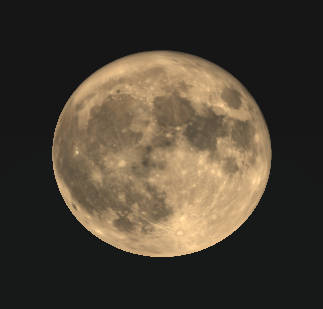
Tonight’s full supermoon shortly after it will rise at 10:30 pm July 13, 2022. Created using Stellarium.
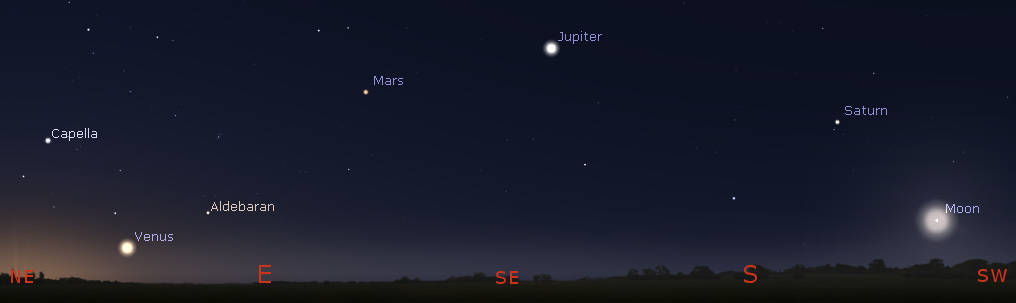
The morning planets and the Moon at 5 am tomorrow morning, July 14, 2022. The planets and Moon actually appear in a straight line in the sky, being placed along the ecliptic, or path of the Sun in the sky. The ecliptic is a great circle on the celestial sphere. Click on the image to enlarge it. The span of the planets from Venus to Saturn is 122 degrees. Two of winter’s first magnitude stars, Aldebaran and Capella, are now visible in morning twilight. Click on the image to enlarge it. Created using Stellarium.
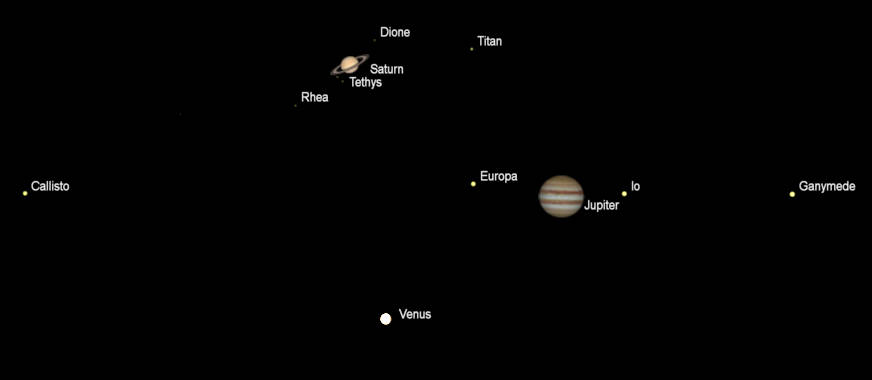
Views of Saturn, Jupiter, and Venus (north up) as they would be seen in a small telescope, with the same magnification, tomorrow morning at 5:00 am, July 14, 2022. I do not show planets less than 10 seconds of arc in diameter. Apparent diameters: Saturn 18.46″, its rings 43.01″; Jupiter 42.63″. Mars is not shown, its apparent diameter is 7.63″; Venus 11.31″. The ” symbol means seconds of arc (1/3600th of a degree.) Click on the image to enlarge it. Created using Cartes du Ciel (Sky Charts).
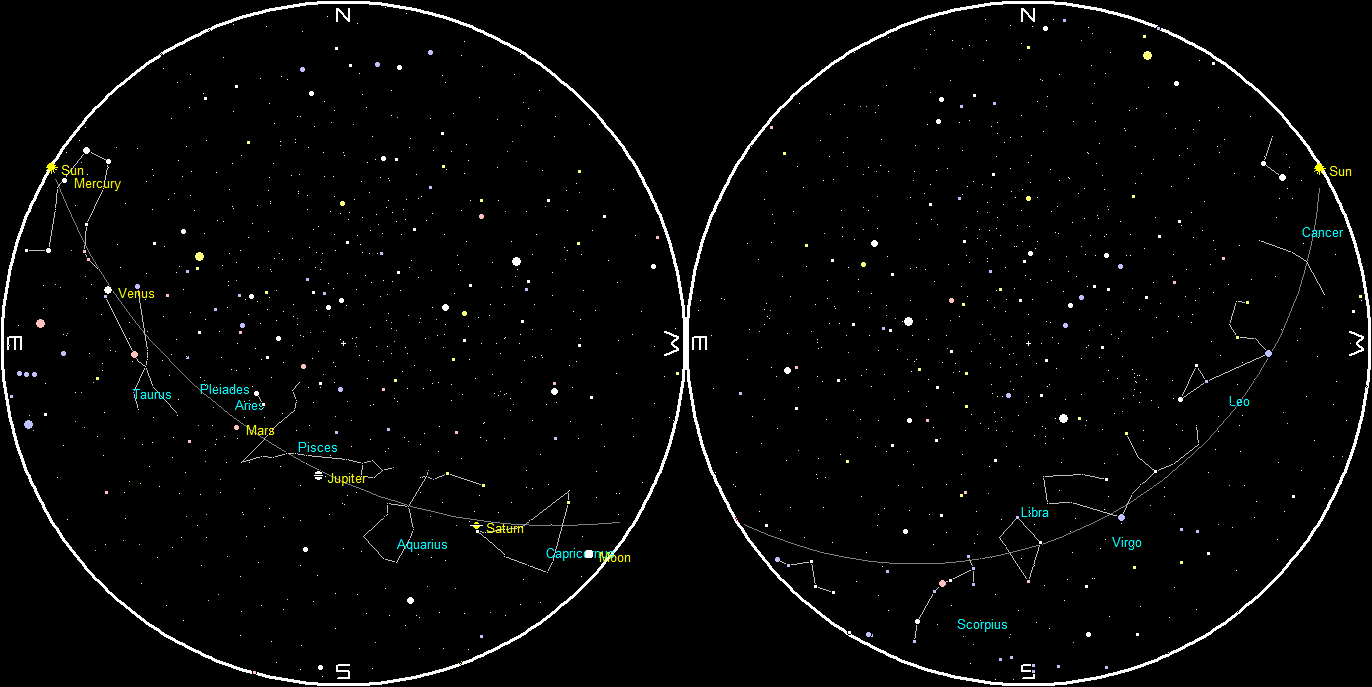
The naked-eye planets and the Moon at sunset and sunrise on a single night, starting with sunset on the right on July 13, 2022. The night ends on the left with sunrise on the 14th. Notice that all the naked-eye planets are in the morning sky now. Click on the image to enlarge it. Created using my LookingUp program.
07/06/2022 – Ephemeris – Let’s search for the naked-eye planets for this week
This is Bob Moler with Ephemeris for Wednesday, July 6th. Today the Sun will be up for 15 hours and 26 minutes, setting at 9:30, and it will rise tomorrow at 6:04. The Moon, at first quarter today, will set at 1:32 tomorrow morning.
Let’s search for the naked-eye planets for this week. All the naked-eye planets are in the morning sky, although Mercury is too close to the Sun to be seen. On the 16th, it will leave the morning sky, crossing over to the evening sky. At 5 am tomorrow, the planets will be spread out from brilliant Venus low in the east-northeast to Saturn higher in the south. To the right and above of Venus, in the east-southeast, will be the Mars. Jupiter is a bit higher in the southeast. Mars is dimmer than Jupiter, but is slowly getting brighter as the Earth creeps up on it. Saturn ends the line of planets in the south. Tonight, Saturn will rise about 11:30 pm. It won’t be an official evening planet until it rises before sunset. That won’t happen until mid-August.
The astronomical event times given are for the Traverse City/Interlochen area of Michigan (EDT, UT – 4 hours). They may be different for your location.
Addendum
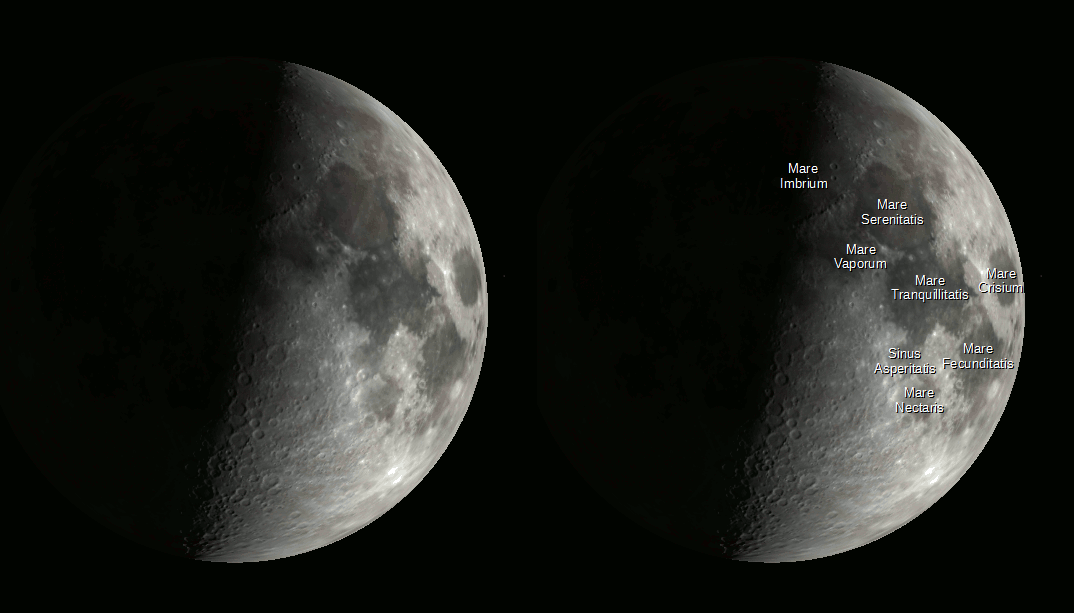
First quarter Moon tonight with prominent features labeled. Created using Stellarium, GIMP and LibreOffice.
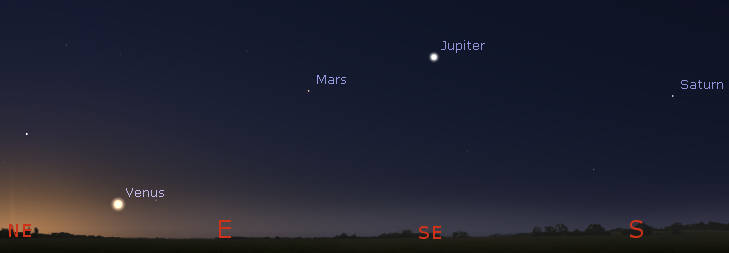
The morning planets at 5 am tomorrow morning, July 7, 2022. The planets actually appear in a straight line in the sky, being placed along the ecliptic, or path of the Sun in the sky. The ecliptic is a great circle on the celestial sphere. Click on the image to enlarge it. The span of the planets from Venus to Saturn is 113 degrees. Click on the image to enlarge it. Created using Stellarium.
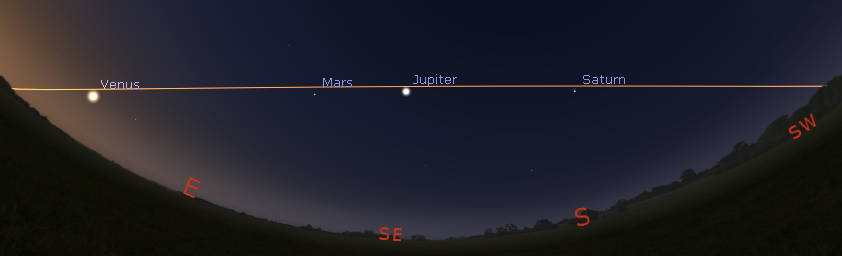
Distortions of rendering a spherical sky on a flat plane. The morning planets as seen in a stereographic view where great circles, like the ecliptic and horizon, are either circles or straight lines. In this image, the ecliptic, orange line, runs through the center of the plot, so it appears straight. In the real sky, both the planets and the horizon appear to be in straight lines. This assumes that your horizon is flat. Click on the image to enlarge it. Created using Stellarium.
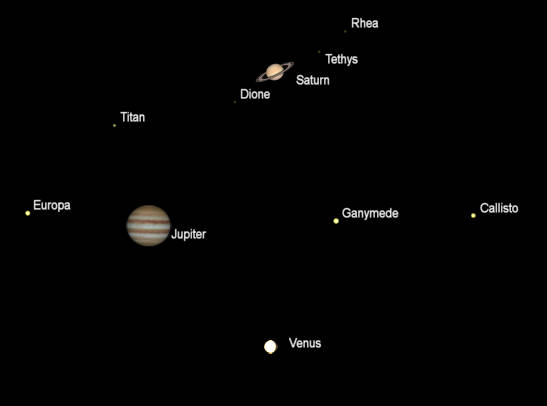
Views of Saturn, Jupiter, and Venus (north up) as they would be seen in a small telescope, with the same magnification, tomorrow morning at 5:00 am, July 7, 2022. I do not show planets less than 10 seconds of arc in diameter. Apparent diameters: Saturn 18.32″, its rings 42.68″; Jupiter 41.68″. Mars is not shown, its apparent diameter is 7.41″ and is 85.4% illuminated; Venus 11.60″, 87.5% illuminated. Jupiter’s 4th Galilean moon, Io, is missing because it is in Jupiter’s shadow. The ” symbol means seconds of arc (1/3600th of a degree.) Created using Cartes du Ciel (Sky Charts).
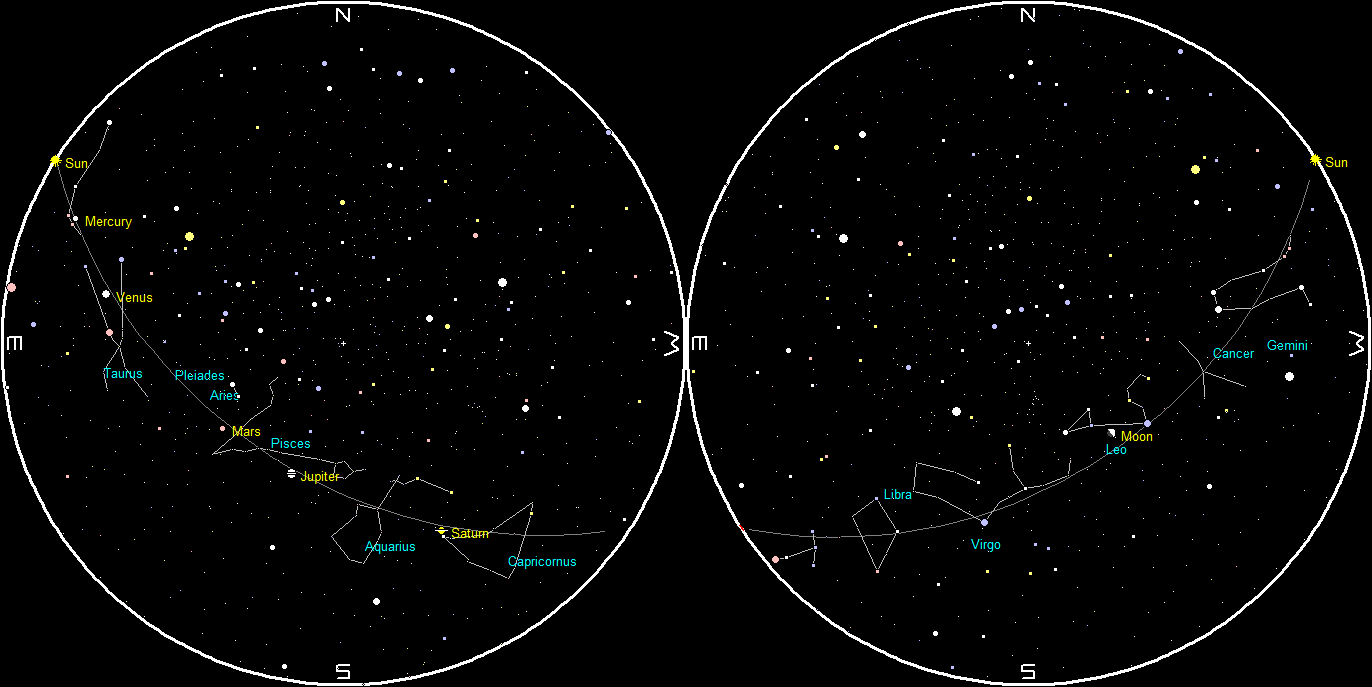
The naked-eye planets and the Moon at sunset and sunrise on a single night, starting with sunset on the right on July 6, 2022. The night ends on the left with sunrise on the 7th. Notice that all the naked-eye planets are in the morning sky now. Click on the image to enlarge it. Created using my LookingUp program.
06/29/2022 Ephemeris – Let’s search for the naked-eye planets for this week
This is Ephemeris for Wednesday, June 29th. Today the Sun will be up for 15 hours and 32 minutes, setting at 9:32, and it will rise tomorrow at 6:00. The Moon, 1 day past new, will set at 10:32 this evening.
Let’s search for the naked-eye planets for this week. All the naked-eye planets are in the morning sky, although Mercury is too close to the Sun to be seen. At 5 am tomorrow the planets will be spread out from Mercury invisible on the horizon, brilliant Venus low in the east-northeast to Saturn higher in the south. To the right and above of Venus, in the east-southeast, will be the Mars. Jupiter is in the southeast. Mars is dimmer than Jupiter, but is slowly getting brighter as the Earth is slowly advancing on it. Saturn ends the line of planets in the south. By tomorrow night, Saturn will rise a minute before midnight. It won’t be an official evening planet until it rises before sunset. That won’t happen until mid-August.
The astronomical event times given are for the Traverse City/Interlochen area of Michigan (EDT, UT – 4 hours). They may be different for your location.
Addendum
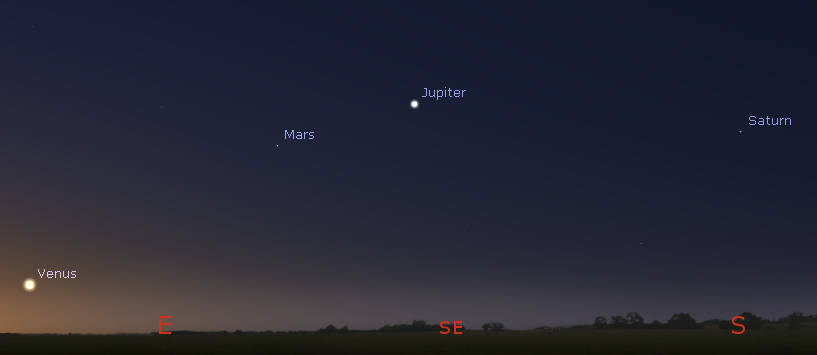
The morning planets at 5 am tomorrow morning, June 30, 2022. The planets actually appear in a straight line in the sky, being placed along the ecliptic, or path of the Sun in the sky. The ecliptic is a great circle on the celestial sphere. Click on the image to enlarge it. The span of the planets from Venus to Saturn is 114 degrees. Click on the image to enlarge it. Created using Stellarium.
The image above was plotted using the Miller cylindrical projection. While the azimuths are correct, the other plots are not. The planets actually appear to be in a straight line in the sky. I’ve finagled a stereographic projection to show that fact, as seen below.
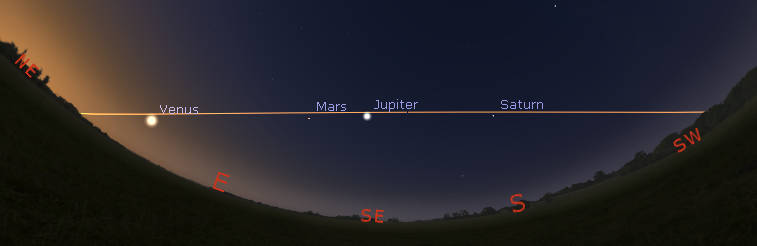
Distortions of rendering a spherical sky on a flat plane. The morning planets as seen in a stereographic view where great circles, like the ecliptic and horizon, are either circles or straight lines. In this image, the ecliptic, orange line, runs through the center of the plot, so it appears straight. In the real sky, both the planets and the horizon appear to be in straight lines. This assumes that your horizon is flat. Created using Stellarium.
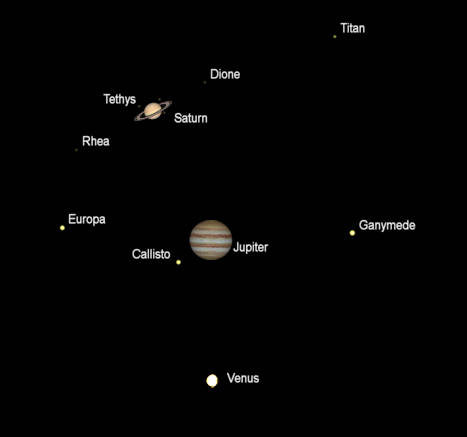
Views of Saturn, Jupiter, and Venus (north up) as they would be seen in a small telescope, with the same magnification, tomorrow morning at 5:00 am, June 30, 2022. I do not show planets less than 10 seconds of arc in diameter. Apparent diameters: Saturn 18.16″, its rings 42.31″; Jupiter 40.75″. Mars is not shown, its apparent diameter is 7.20″ and is 85.7% illuminated; Venus 11.91″, 85.8% illuminated. Jupiter’s moon Io will be behind the planet at that time. The ” symbol means seconds of arc (1/3600th of a degree.) Created using Cartes du Ciel (Sky Charts).
The naked-eye planets and the Moon at sunset and sunrise on a single night, starting with sunset on the right on June 29, 2022. The night ends on the left with sunrise on the 30th. Notice that all the naked-eye planets are in the morning sky now. Click on the image to enlarge it. Created using my LookingUp program.
06/22/2022 – Ephemeris – Let’s search for the naked-eye planets for this week
This is Ephemeris for Wednesday, June 22nd. Today the Sun will be up for 15 hours and 34 minutes, setting at 9:32, and it will rise tomorrow at 5:57. The Moon, 2 days past last quarter, will rise at 2:48 tomorrow morning.
Let’s search for the naked-eye planets for this week. All the naked-eye planets are in the morning sky, although Mercury may be too close to the Sun to be seen. It might just be visible low in the east-northeast after 5. That’s at least for those as far north as we are. At 5 am tomorrow the planets will be spread out from Mercury, actually invisible, near the horizon, brilliant Venus low in the east-northeast to Saturn higher in the south. To the right of Venus, tomorrow morning, stretching from east to southeast, will be the Moon, Mars and Jupiter. Mars is quite a bit dimmer than Jupiter. All will be in line sloping to the upper right with Saturn all by its lonesome in the south. The naked-eye planets are arranged in the morning sky, in the same order as their distances from the Sun.
The astronomical event times given are for the Traverse City/Interlochen area of Michigan (EDT, UT – 4 hours). They may be different for your location.
Addendum
The morning planets and the waning crescent Moon at 5 am tomorrow morning, June 23, 2022. Click on the image to enlarge it. The span of the planets from Venus to Saturn is 95 degrees. Click on the image to enlarge it. Created using Stellarium.
Waning crescent Moon closeup, annotated, as seen in binoculars or a small telescope. Created using Stellarium, Libreoffice and GIMP.
Views of Saturn, Jupiter, and Venus (north up) as they would be seen in a small telescope, with the same magnification, tomorrow morning at 5:00 am, June 23, 2022. I do not show planets less than 10 seconds of arc in diameter. Apparent diameters: Saturn 17.99″, its rings 41.90″; Jupiter 39.86″. Mars is not shown, its apparent diameter is 7.00″ and is 86.1% illuminated; Venus 12.27″, 84.1% illuminated. The ” symbol means seconds of arc (1/3600th of a degree). Created using Cartes du Ciel (Sky Charts).
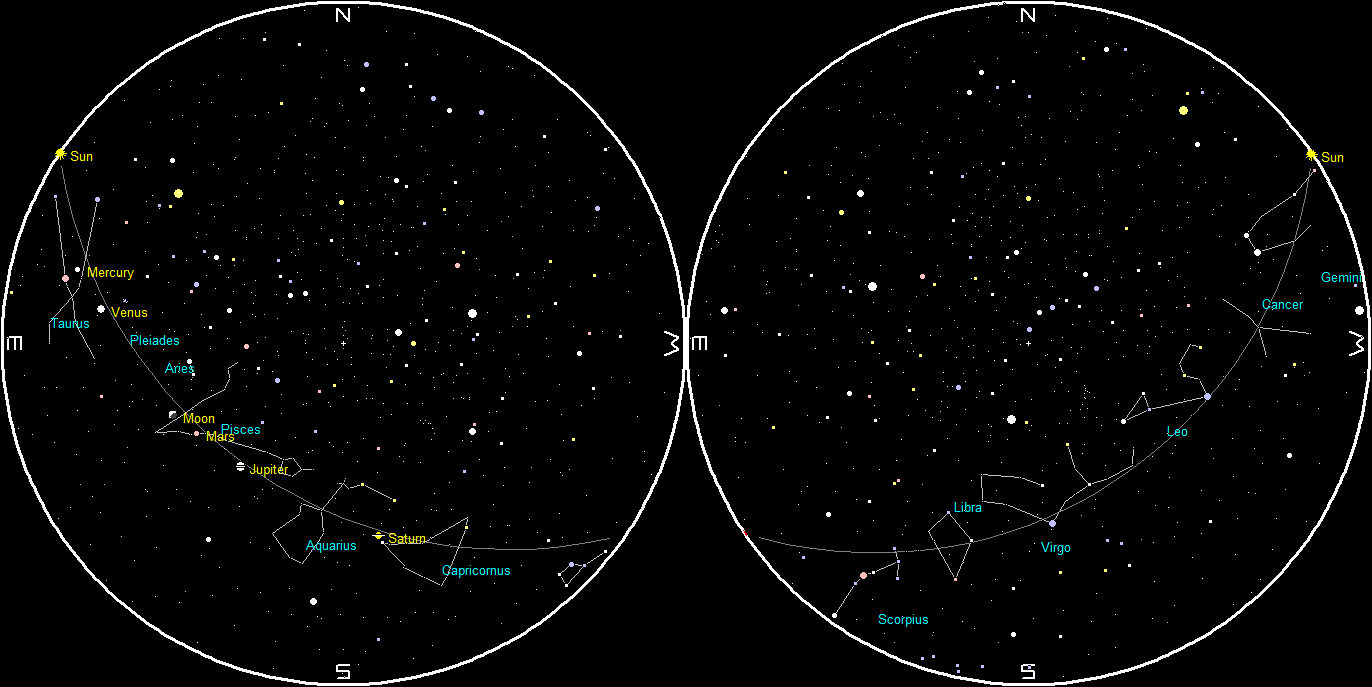
The naked-eye planets and the Moon at sunset and sunrise on a single night, starting with sunset on the right on June 22, 2022. The night ends on the left with sunrise on the 23rd. Notice that all the naked-eye planets are in the morning sky now. Click on the image to enlarge it. Created using my LookingUp program.
06/15/2022 – Ephemeris – Let’s search for the naked-eye planets for this week
This is Ephemeris for Wednesday, June 15th. Today the Sun will be up for 15 hours and 33 minutes, setting at 9:30, and it will rise tomorrow at 5:56. The Moon, 1 day past full, will rise at 11:27 this evening.
Let’s search for the naked-eye planets for this week. All the naked-eye planets are in the morning sky, although Mercury may be too close to the Sun to be seen. It might just be visible low in the east-northeast after 5. That’s at least for those as far north as we are. At 5 am tomorrow the planets will be spread out from Mercury near the horizon, brilliant Venus low in the east to Saturn higher in the south-southeast. To the right of Venus, tomorrow morning, in the east-southeast are Mars and Jupiter. Mars is quite a bit dimmer than Jupiter. All will be in line sloping to the upper right with Saturn all by its lonesome in the south-southeast. The naked-eye planets are arranged in the morning sky, in the same order as their distances from the Sun.
The astronomical event times given are for the Traverse City/Interlochen area of Michigan (EDT, UT – 4 hours). They may be different for your location.
Addendum
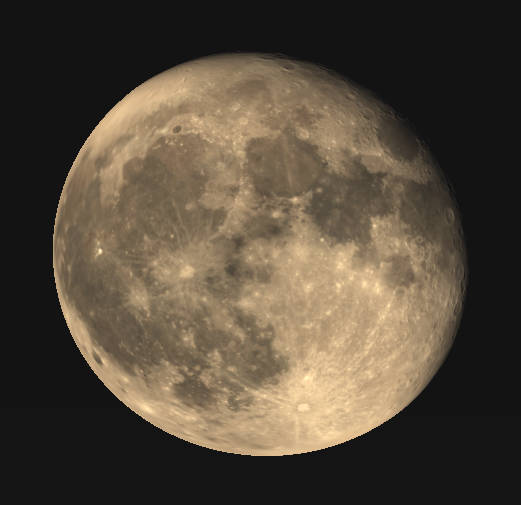
The Moon as it might appear at midnight June 16, 2022, through binoculars or a small telescope. Atmospheric refraction will affect the shape of the Moon when it’s very low in the sky. Created using Stellarium.
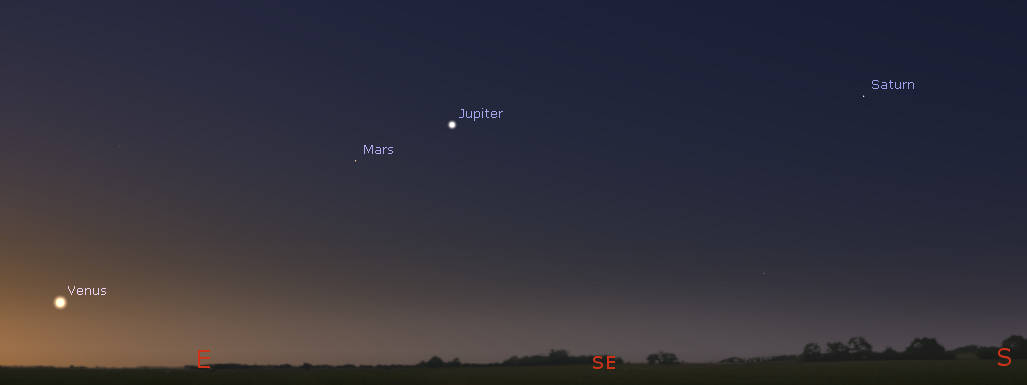
Morning planets at 5 am tomorrow morning, June 16, 2022. Click on the image to enlarge it. The span of the planets from Venus to Saturn is 87 degrees. Click on the image to enlarge it. Created using Stellarium.
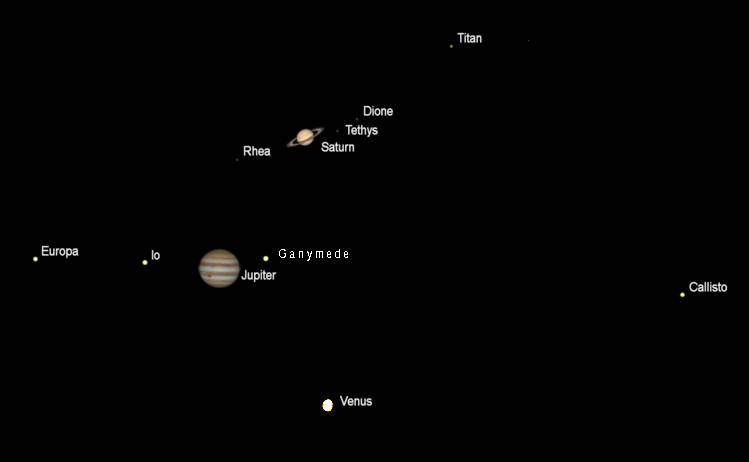
Views of Saturn, Jupiter, and Venus (north up) as they would be seen in a small telescope, with the same magnification, tomorrow morning at 5:00 am, June 16, 2022. I do not show planets less than 10 seconds of arc in diameter. Apparent diameters: Saturn 17.80″, its rings 41.47″; Jupiter 39.02″. Mars is not shown, its apparent diameter is 6.81″ and is 86.4% illuminated; Venus 12.66″, 82.2% illuminated. The ” symbol means seconds of arc (1/3600th of a degree.) Created using Cartes du Ciel (Sky Charts).
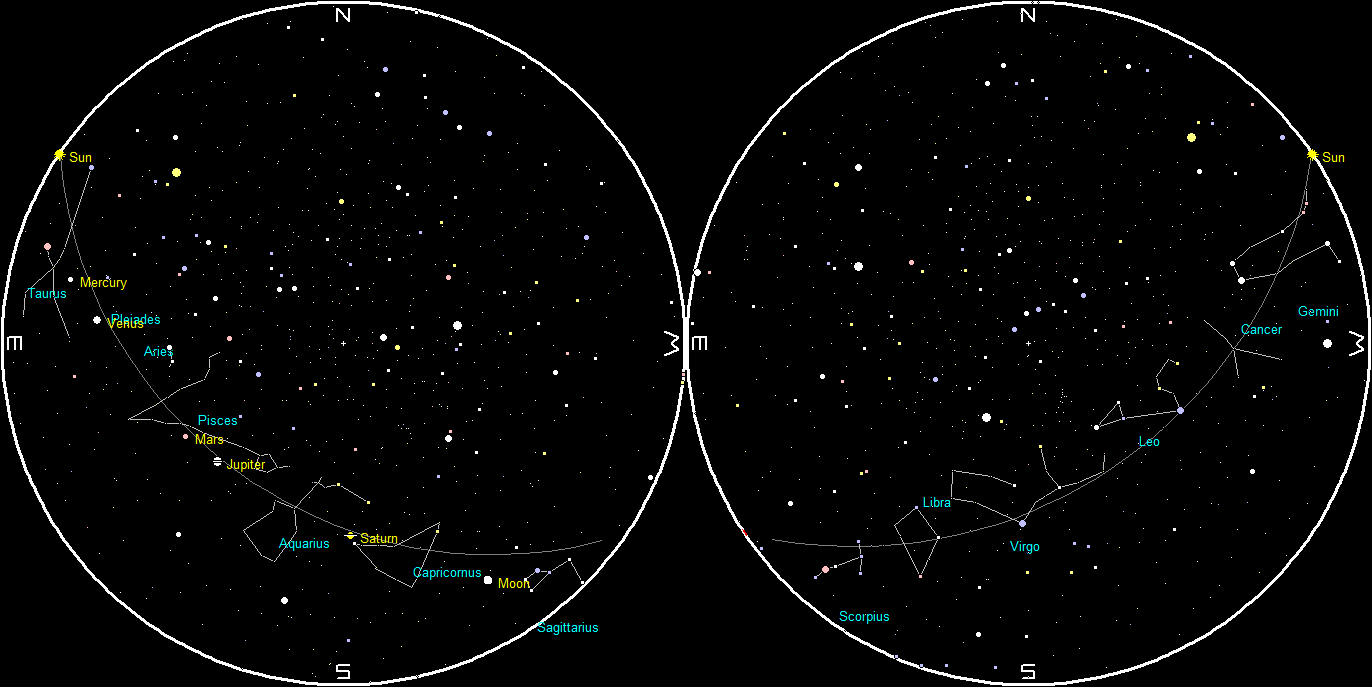
The naked-eye planets and the Moon at sunset and sunrise on a single night, starting with sunset on the right on June 15, 2022. The night ends on the left with sunrise on the 16th. Notice that all the naked-eye planets are in the morning sky now. Click on the image to enlarge it. Created using my LookingUp program.
 Bob Moler's Ephemeris Blog