Archive
07/08/2020 – Ephemeris – Let’s look at the naked-eye planets and a comet for this week
This is Bob Moler with Ephemeris for Wednesday, July 8th. Today the Sun will be up for 15 hours and 23 minutes, setting at 9:29, and it will rise tomorrow at 6:06. The Moon, 3 days past full, will rise at 12:05 tomorrow morning.
Let’s look at the naked-eye planets and a comet for this week. Jupiter now rises at 9:41 pm in the east-southeast. Saturn will rise 22 minutes later at 10:03 pm right behind Jupiter. Mars, is stretching its lead left of Saturn and will rise at 1 am in the east. Its now down to 71 and a half million miles (115.2 million km) away, as the Earth slowly overtakes it at the rate of about 3.9 million miles (6.2 million km) a week. Venus will rise at 3:47 am in the east-northeast as our Morning Star. Newly discovered Comet NEOWISE will rise at 3:16 am and be visible in the northeast before the twilit sky brightens too much. The comet gets its name from the NASA Satellite and mission to detect near Earth objects or NEOs in the infrared.
The event times given are for the Traverse City/Interlochen area of Michigan. They may be different for your location.
Addendum
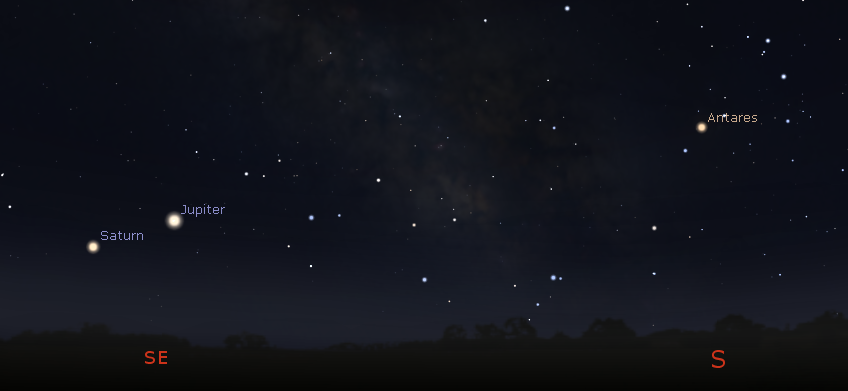
Saturn and Jupiter planets plus two southern constellations to the right of them at 11 pm tonight July 8, 2020. Just right of Jupiter is Sagittarius that looks more like a teapot than a centaur with a bow and arrow. Further right is Scorpius the scorpion. Click on the image to enlarge. Created using Stellarium.
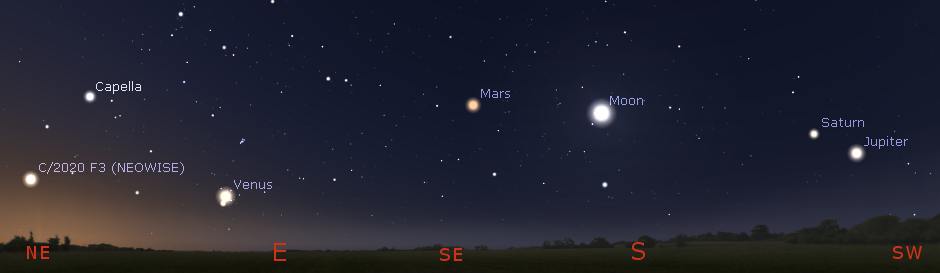
Planets, the Moon and a comet visible at 5 am tomorrow morning July 9, 2020. Venus appears just above the star Aldebaran. Comet NEOWISE’ tail is visible, but not at this scale, and it is shown as being too bright. Click on the image to enlarge. Created using Stellarium.
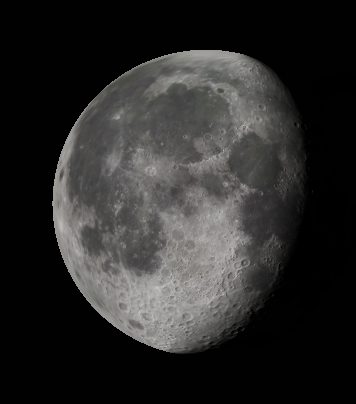
The Moon as it might appear tomorrow morning at 5 a.m. July 9, 2020. Created using Stellarium.
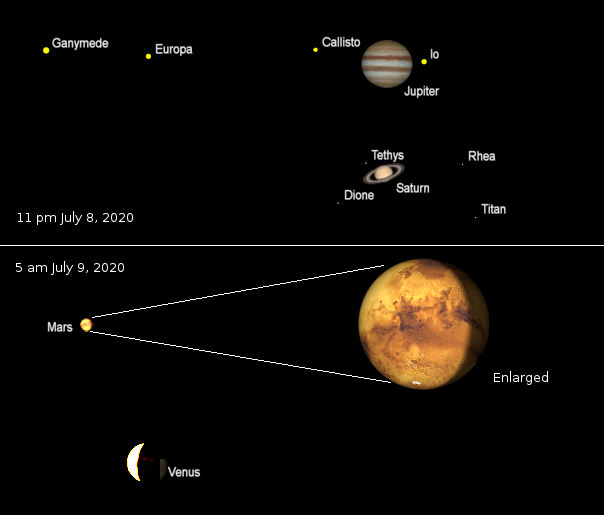
The planets as seen in a telescope (north up) with the same magnification tonight and tomorrow July 8/9, 2020. Apparent diameters: Jupiter, 47.57″; Saturn, 18.43″, rings, 42.94″, Mars, 12.19″, and Venus 37.66″. Mars also displays an enlargement showing surface detail. The ” symbol means seconds of arc (1/3600th of a degree.) Created using Cartes du Ciel (Sky Charts).
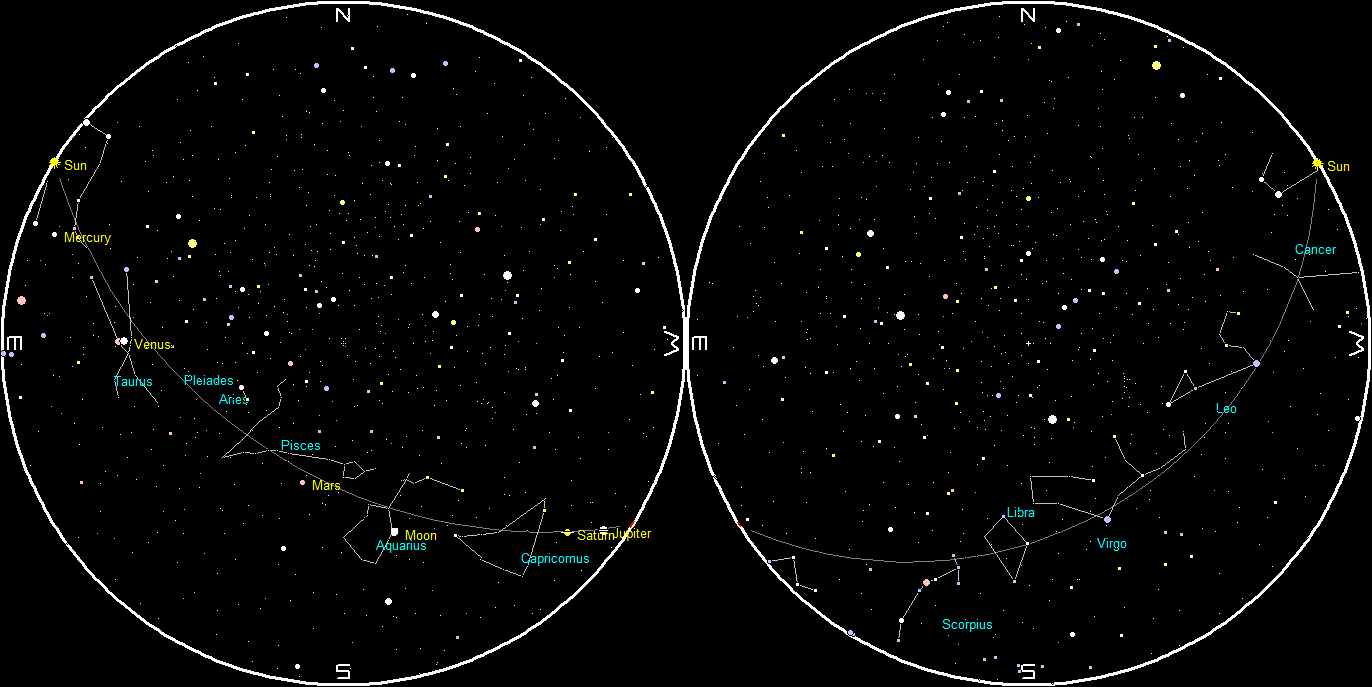
Planets and the Moon at sunset and sunrise of a single night starting with sunset on the right on July 8, 2020. The night ends on the left with sunrise on the 9th. The closeness of Jupiter and Saturn in the morning sky unfortunately overlays planets and labels. Click on the image to enlarge. Created using my LookingUp program.
07/01/2020 – Ephemeris – Let’s look at the naked-eye planets for this week
This is Ephemeris for Wednesday, July 1st. Today the Sun will be up for 15 hours and 30 minutes, setting at 9:31, and it will rise tomorrow at 6:01. The Moon, 3 days past first quarter, will set at 3:49 tomorrow morning.
Let’s look at the naked-eye planets for this week. Jupiter now rises in the evening, tonight it’s at 10:08 pm in the east-southeast. Saturn will rise 19 minutes later at 10:27 pm right behind Jupiter. Mars, is stretching its lead left of Saturn and will rise at 1:18 am in the east. Its now down to 75.4 million miles (121.5 million km) away, as the Earth slowly overtakes it at the rate of about 4 million miles (6.4 million km) a week. Jupiter and Saturn will be hanging out between Sagittarius and Capricornus this year while Mars is slowing its rapid eastward motion now two constellations over in Pisces. Finally, Venus will rise at 4:05 am in the east-northeast in the twilight as our Morning Star.
The event times given are for the Traverse City/Interlochen area of Michigan. They may be different for your location.
Addendum
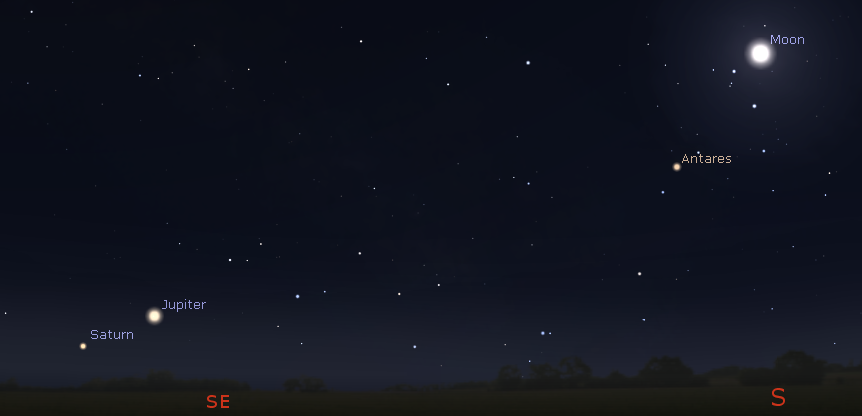
Almost evening planets Jupiter and Saturn, and the Moon at 11 pm on July 1st, 2020. Both Jupiter and Saturn are still officially morning planets since they rise after sunset. Click on the image to enlarge. Created using Stellarium.
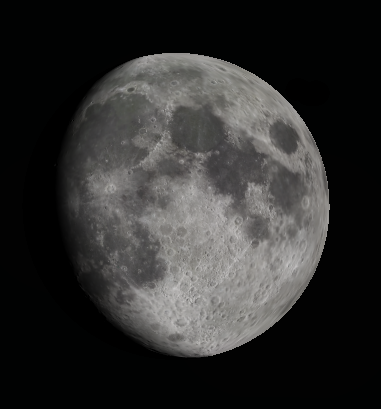
The gibbous Moon as it might appear this evening, July 1st, 2020, in a pair of binoculars or small telescope. Created using Stellarium.
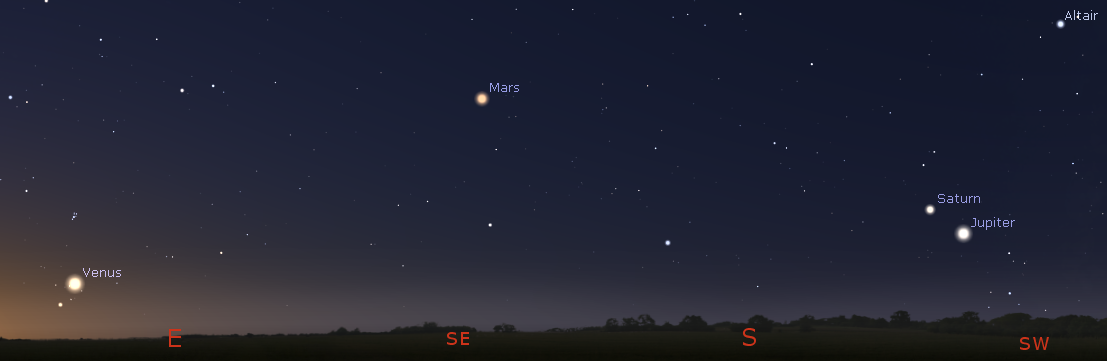
The morning planets, including Jupiter and Saturn which are also visible in the late evening. Click on the image to enlarge. Created using Stellarium.
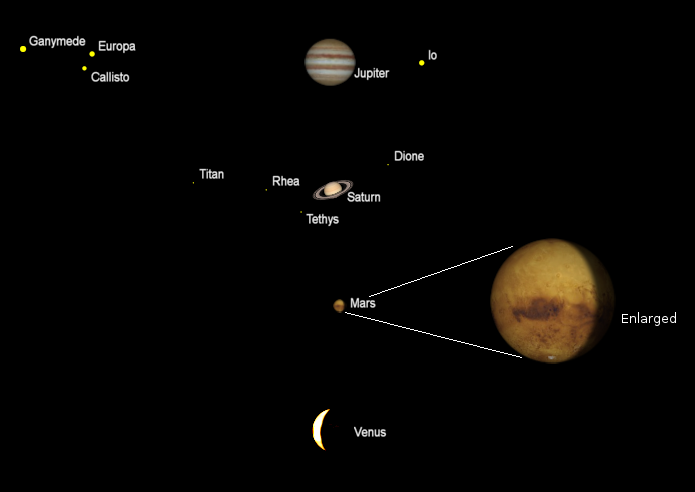
The planets as seen in a telescope (north up) with the same magnification tomorrow morning July 2, 2020. Apparent diameters: Jupiter, 47.34″; Saturn, 18.37″, rings, 42.79″, Mars, 11.57″, and Venus 42.15″. Mars also displays an enlargement showing surface detail. The ” symbol means seconds of arc (1/3600th of a degree.) Created using Cartes du Ciel (Sky Charts).
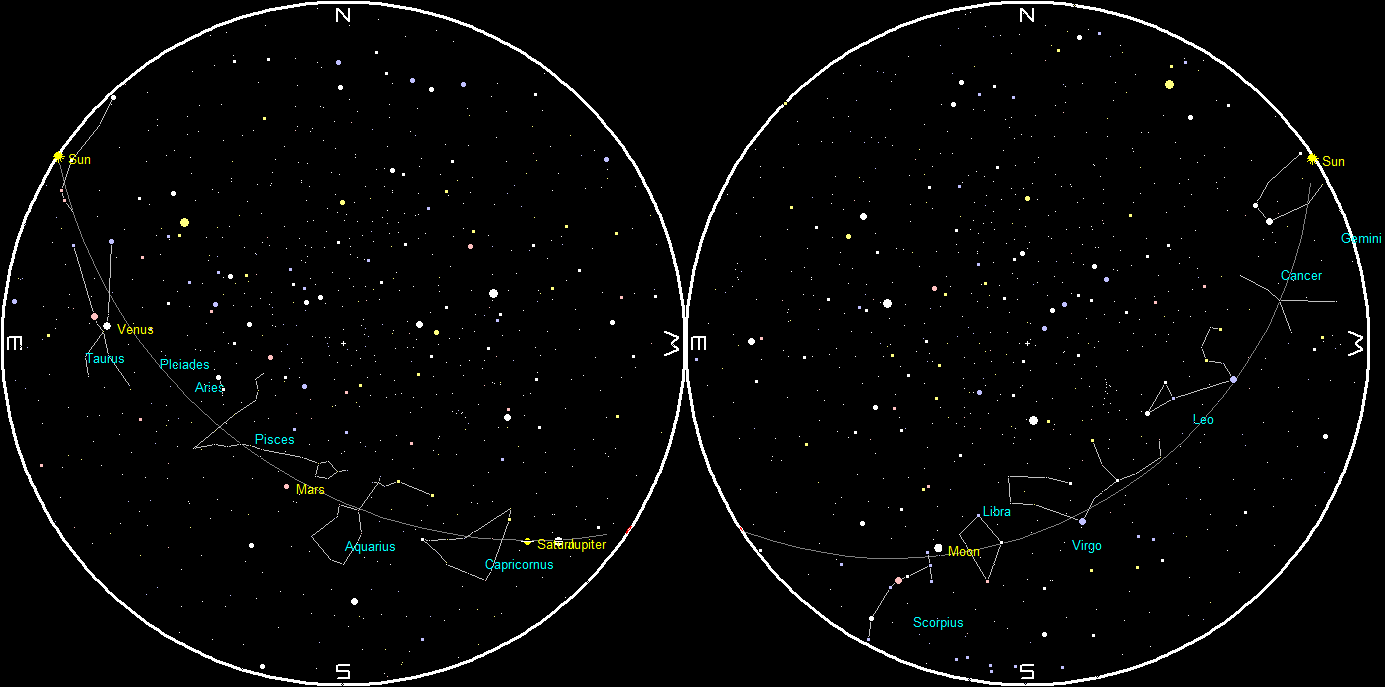
Planets and the Moon at sunset and sunrise of a single night starting with sunset on the right on July 1, 2020. The night ends on the left with sunrise on the 2nd. The closeness of Jupiter and Saturn in the morning sky unfortunately overlays planets and labels. Click on the image to enlarge. Created using my LookingUp program.
06/24/2020 – Ephemeris – Let’s look at the naked-eye planets for this week
This is Bob Moler with Ephemeris for Wednesday, June 24th. Today the Sun will be up for 15 hours and 34 minutes, setting at 9:32, and it will rise tomorrow at 5:58. The Moon, 3 days past new, will set at 12:27 tomorrow morning.
Let’s look at the naked-eye planets for this week. Jupiter now rises in the evening, tonight it’s at 10:42 pm in the east-southeast. Saturn will rise 18 minutes later at 11pm right behind Jupiter. Mars, is stretching its lead left of Saturn and will rise at 1:36 am in the east. Its now down to 83.4 million miles (134.3 million km) away, as the Earth slowly overtakes it at the rate of about 4 million miles (6.4 million km) a week. Jupiter and Saturn will be hanging out between Sagittarius and Capricornus this year while Mars is slowing its rapid eastward motion now two constellations over in Pisces. Finally, Venus will rise at 4:26 am in the east-northeast low in the twilight as our Morning Star.
The event times given are for the Traverse City/Interlochen area of Michigan. They may be different for your location.
Addendum
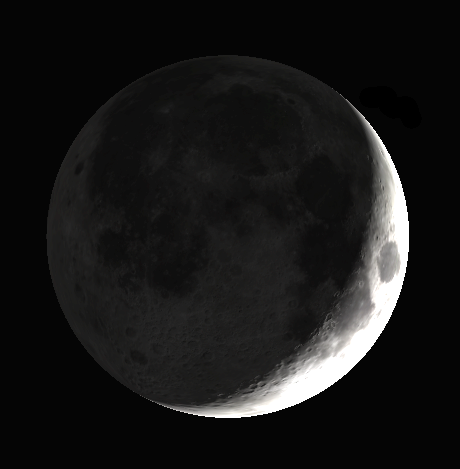
The Moon as seen through binoculars or small telescope tonight June 24, 2020. Note earthshine on the night side of the Moon. Created using Stellarium.
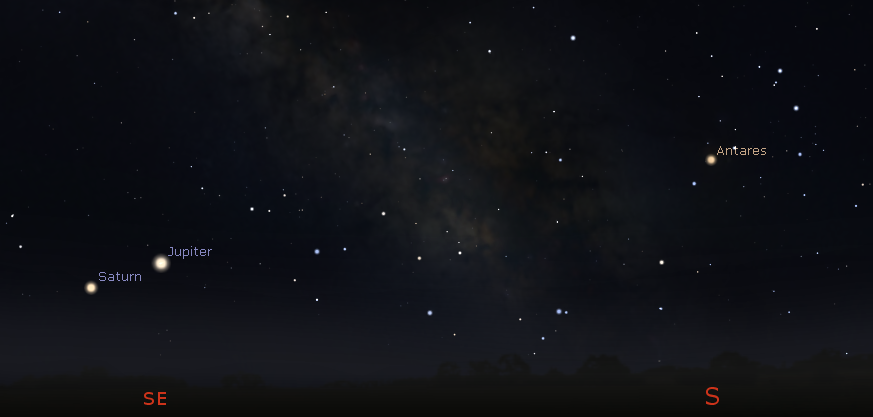
Jupiter & Saturn at midnight. Note the Teapot of Sagittarius to the right of Jupiter and the stars of Scorpius including Antares farther right. Click on the image to enlarge. Created using Stellarium.
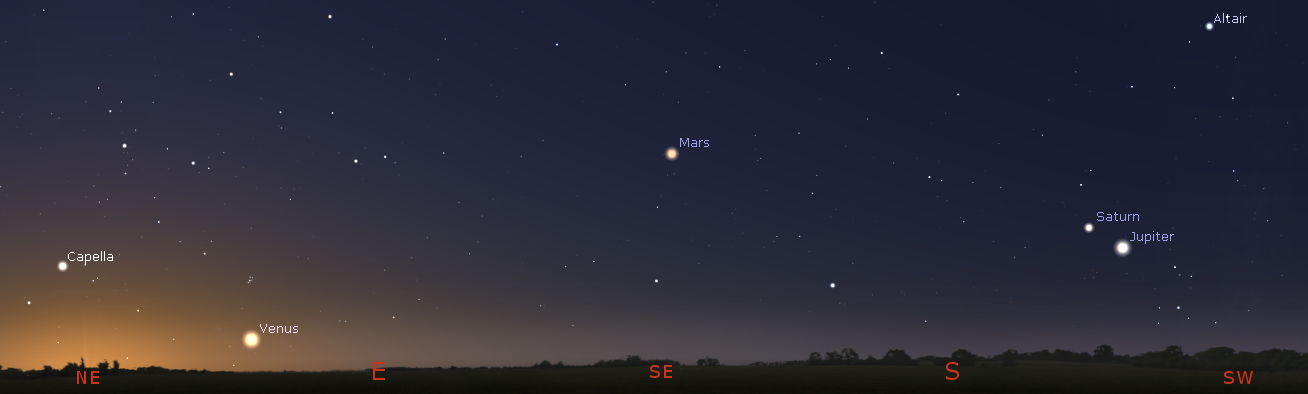
Four of the five naked-eye planets stretched out on this panorama from northeast to southwest at 5 am tomorrow morning June 25, 2020. Click on the image to enlarge. Created using Stellarium.
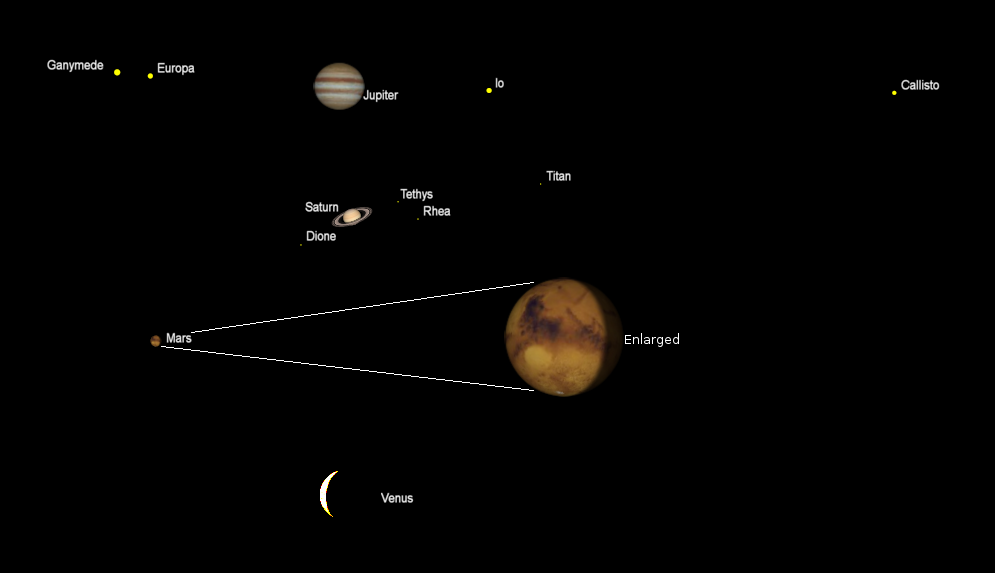
The planets as seen in a telescope (north up) with the same magnification tomorrow morning June 25, 2020. Apparent diameters: Jupiter, 46.96″; Saturn, 18.28″, rings, 42.58″, Mars, 10.99″, and Venus 47.10″. Mars also shows an enlargement showing surface detail. The ” symbol means seconds of arc (1/3600th of a degree.) Click on the image to enlarge. Created using Cartes du Ciel (Sky Charts).
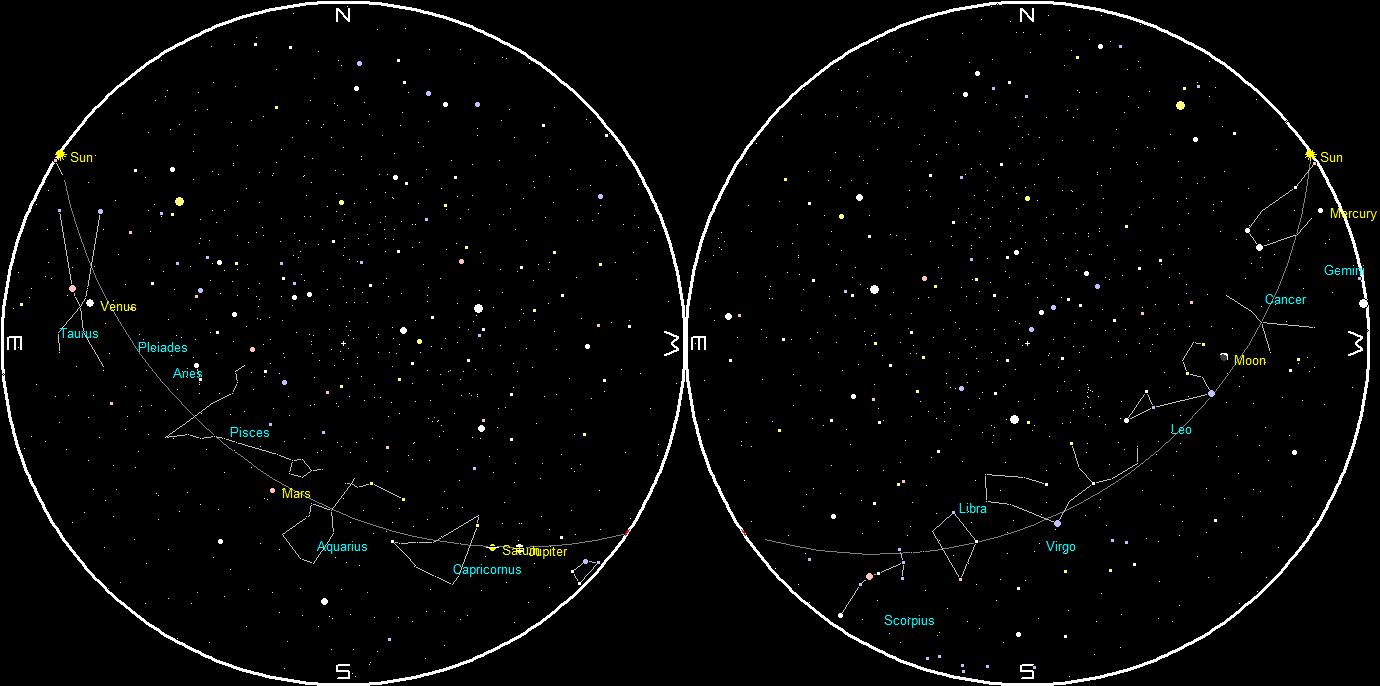
Planets and the Moon at sunset and sunrise of a single night starting with sunset on the right on June 24, 2020. The night ends on the left with sunrise on the 25th. The closeness of Jupiter and Saturn in the morning sky unfortunately overlays planets and labels. Click on the image to enlarge. Created using my LookingUp program.
06/17/2020 – Ephemeris – Let’s look for the naked-eye planets for this week
This is Bob Moler with Ephemeris for Wednesday, June 17th. Today the Sun will be up for 15 hours and 34 minutes, setting at 9:31, and it will rise tomorrow at 5:56. The Moon, half way from last quarter to new, will rise at 4:18 tomorrow morning.
Let’s look for the naked-eye planets for this week. Jupiter now rises before midnight at 11:12 pm in the east-southeast. Saturn will rise 17 minutes later at 11:29 right behind Jupiter. Mars, is stretching its lead left of Saturn and will rise at 1:53 am in the east. Its now down to 83.4 million miles (134.3 million km) away, as the Earth slowly overtakes it at the rate of about 4.3 million miles (7.0 million km) a week. Jupiter and Saturn will be hanging out between Sagittarius and Capricornus this year while Mars is slowing its rapid eastward motion now two constellations over in Pisces. Finally, Venus will rise at 4:51 am in the east-northeast low in the twilight as our new Morning Star.
The event times given are for the Traverse City/Interlochen area of Michigan. They may be different for your location.
Addendum
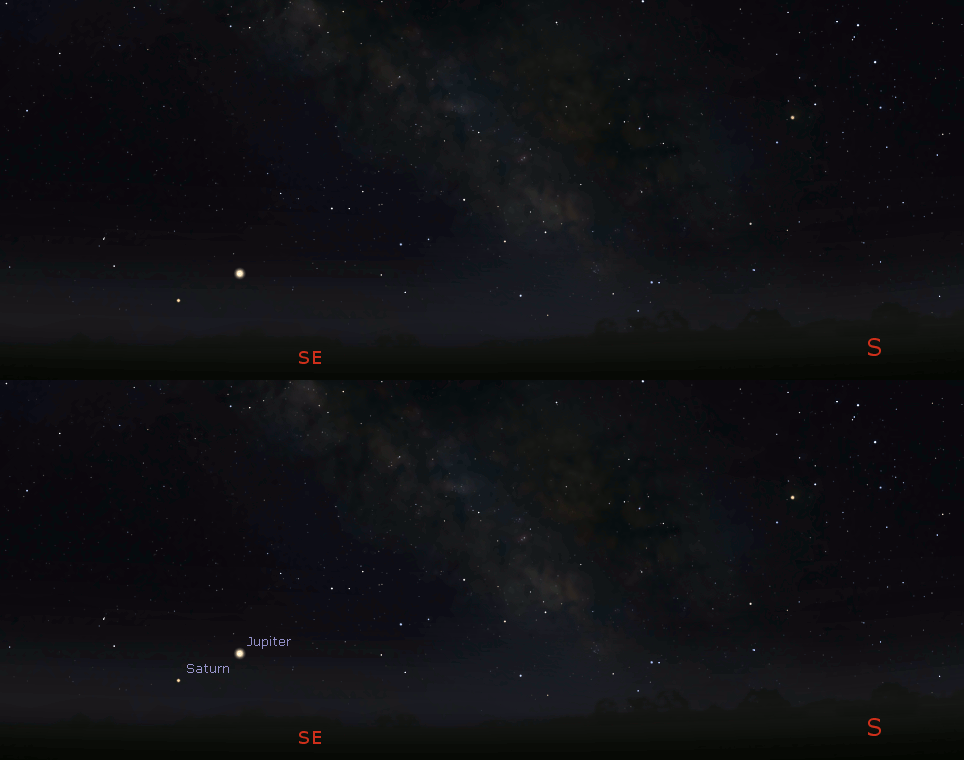
Jupiter and Saturn finder animation for midnight June 18, 2020. For other locations, approximately 2 1/2 hours after sunset. Also showing the stars of the Teapot of Sagittarius to the upper right of the SE compass point and most, except the bottom stars of Scorpius in the south. Click on the image to enlarge. Created using Stellarium and GIMP.
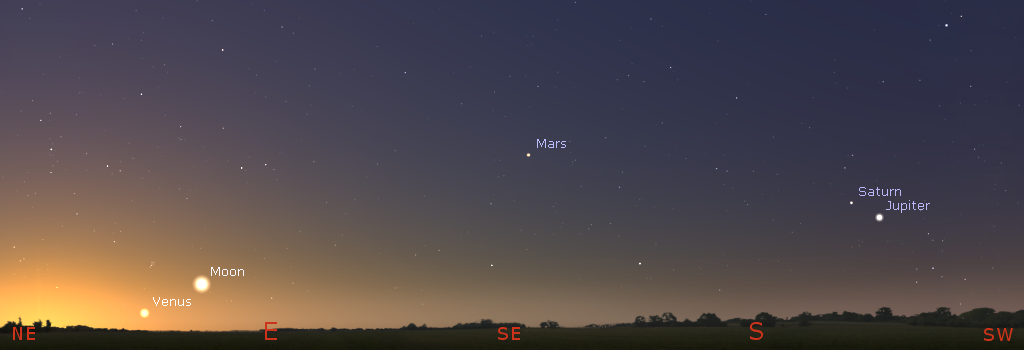
Panorama of the morning planets at 5:15 am or about 45 minutes before sunrise tomorrow June 18, 2020. Click on the image to enlarge. Created using Stellarium.
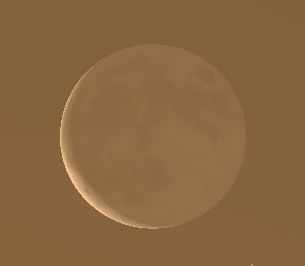
The Moon as it might be seen in binoculars tomorrow morning before sunrise June 18, 2020. Created using Stellarium.
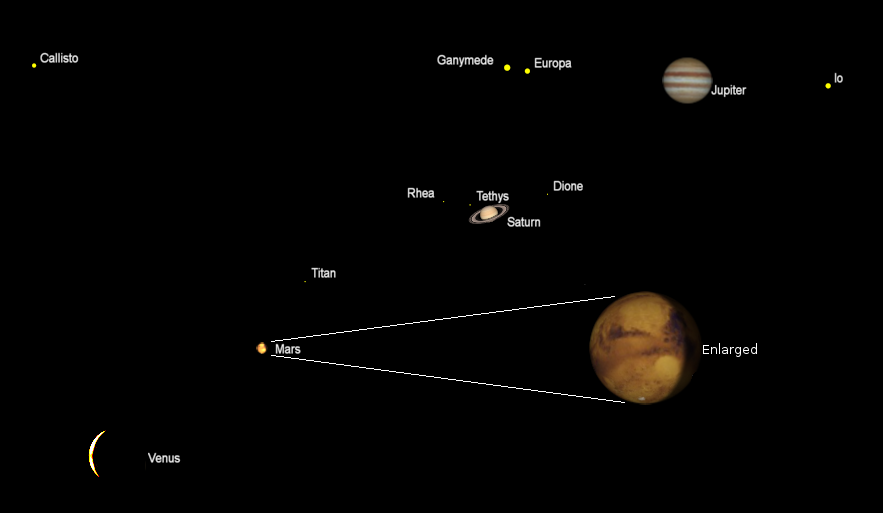
The planets as seen in a telescope (north up) with the same magnification. Jupiter and Saturn tomorrow morning of June 18, 2020. Apparent diameters: Jupiter, 46.34″; Saturn, 18.14″, rings, 42.36″ and Mars, 41.38″. Mars also shows an enlargement showing surface detail. The ” symbol means seconds of arc (1/3600th of a degree.) Click on the image to enlarge. Created using Cartes du Ciel (Sky Charts).
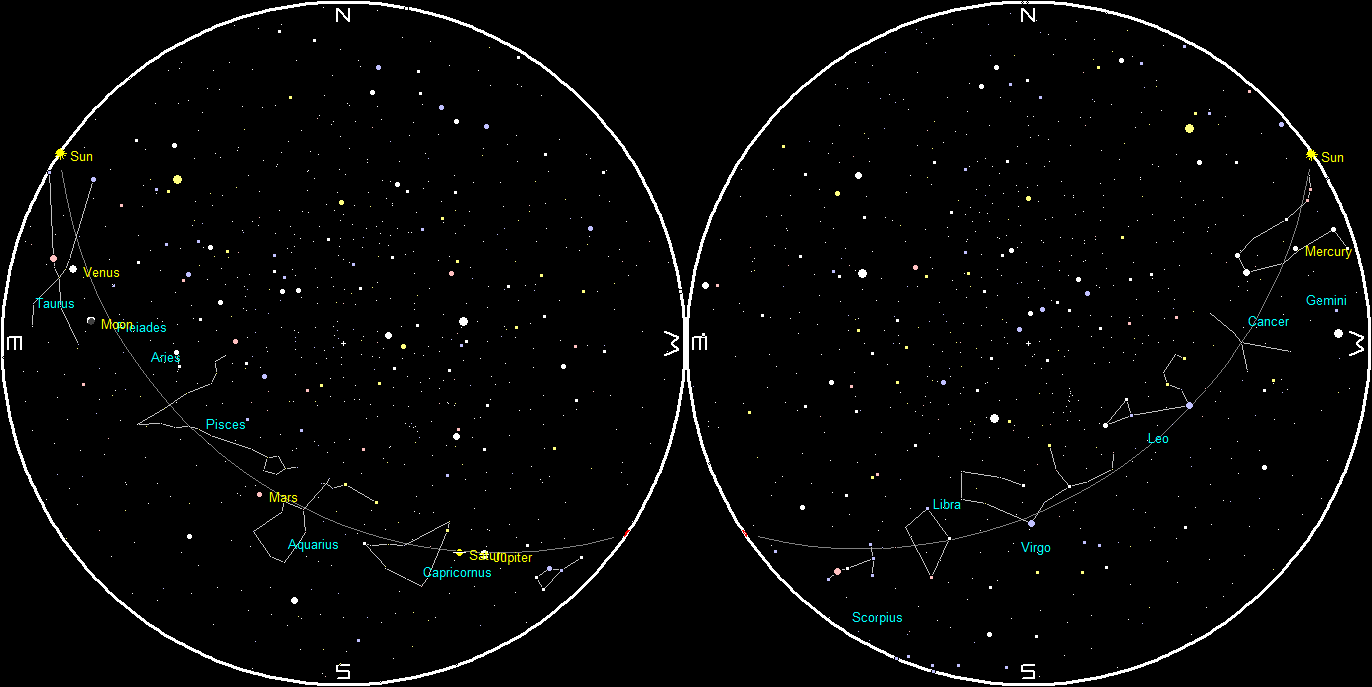
Planets and the Moon at sunset and sunrise of a single night starting with sunset on the right on June 17, 2020. The night ends on the left with sunrise on the 18th. The closeness of Jupiter and Saturn in the morning sky unfortunately overlays planets and labels. Click on the image to enlarge. Created using my LookingUp program.
06/03/2020 – Ephemeris – Let’s look at the naked-eye planets for this week
This is Ephemeris for Wednesday, June 3rd. Today the Sun will be up for 15 hours and 24 minutes, setting at 9:23, and it will rise tomorrow at 5:58. The Moon, 2 days before full, will set at 5:15 tomorrow morning.
Let’s look at the naked-eye planets for this week. This afternoon Venus will pass between the Earth and the Sun and head toward the morning sky. It’s only 26.8 million miles (43.2 million km) away, and quite invisible. Mercury is visible in the northwest after sunset, coming to greatest separation or elongation from the Sun of 23.6 degrees It will set tonight at 11:16 pm. In the morning sky there are three planets in the south and southeast. Bright Jupiter will rise first at 12:10 am, followed by Saturn at 12:26 am. Mars, is stretching its lead left of Saturn and will rise at 2:27 a.m. Its now down to 91.9 million miles (148.0 million km) away, as the Earth slowly overtakes it at the rate of about 4.4 million miles (7.0 million km) a week.
The event times given are for the Traverse City/Interlochen area of Michigan. They may be different for your location.
Addendum
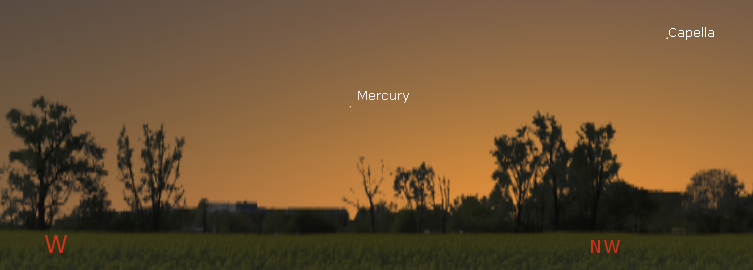
Mercury in the evening tonight at 10 pm June 3, 2020. This is 11 hours before greatest eastern elongation, 23.6° east of the Sun. Click on the image to enlarge. Created using Stellarium.
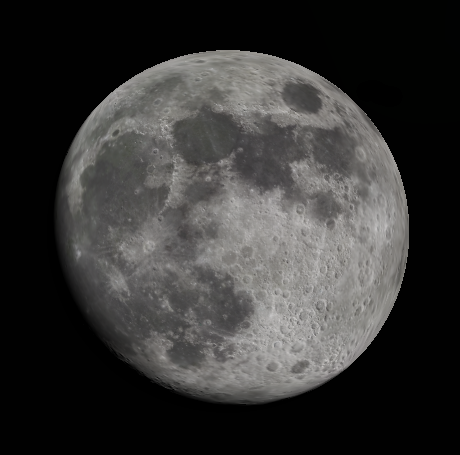
The Moon in binoculars or a low power telescope. Created using Stellarium.
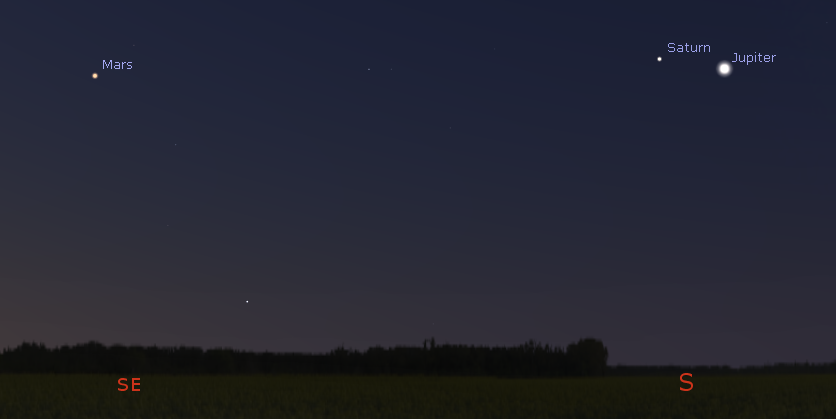
Jupiter, Saturn and Mars in the growing twilit skies of 5 am tomorrow morning, June 4, 2020. Click on image to enlarge. Created using Stellarium.
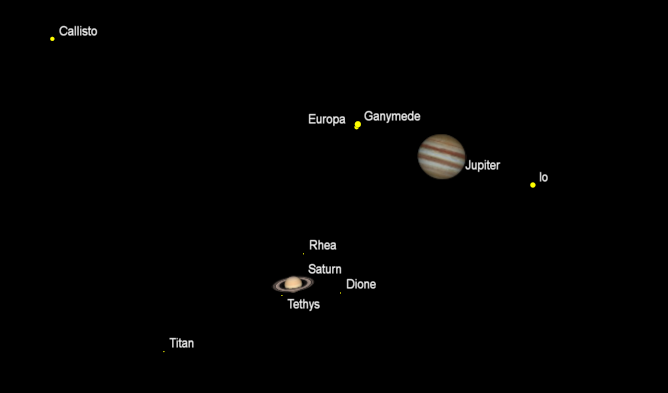
The planets as seen in a telescope with the same magnification. Jupiter and Saturn tomorrow morning of June 4, 2020. Apparent diameters: Jupiter, 45.06″; Saturn, 17.87″, rings, 41.62″. Mars at 9.49″ won’t be added until it reaches 10″, which looks like next week. The ” symbol means seconds of arc (1/3600th of a degree). Created using Cartes du Ciel (Sky Charts).
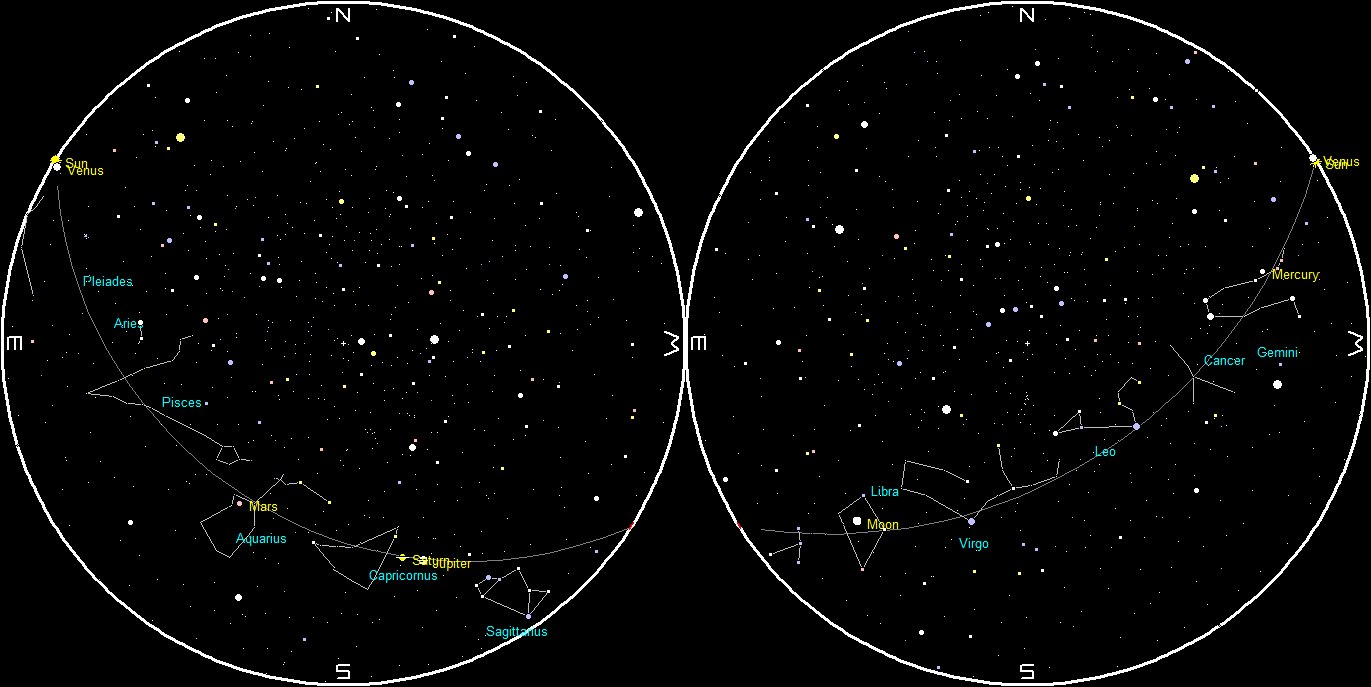
Planets and the Moon at sunset and sunrise of a single night starting with sunset on the right on June 3, 2020. The night ends on the left with sunrise on the 4th. The closeness of Jupiter and Saturn in the morning sky unfortunately overlays planets and labels. Click on the image to enlarge. Created using my LookingUp program.
05/27/2020 – Ephemeris – Let’s look at the naked-eye planets for this week
This is Ephemeris for Wednesday, May 27th. Today the Sun will be up for 15 hours and 14 minutes, setting at 9:17, and it will rise tomorrow at 6:02. The Moon, 2 days before first quarter, will set at 1:49 tomorrow morning.
Let’s look at the naked-eye planets for this week. Venus is our evening star shining brightly in the northwest. It will be our evening star for only another week and defeated by twilight for most of that time. A tiny crescent can now be seen in binoculars. It will cross between the Earth and the Sun on June 3rd. It will set tonight at 10:16 p.m. It’s only 27.6 million miles (44.5 million km) away. Mercury is making an appearance above and left of Venus now. In the morning sky there are three planets in the south and southeast. Bright Jupiter will rise first at 12:39 a.m. Followed by Saturn at 12:54 a.m. Mars, is stretching its lead left of Saturn and will rise at 2:44 a.m. Its now down to 96 million miles (155 million km) away, as the Earth slowly overtakes it at the rate of about 5 million miles (8 million km) a week.
The event times given are for the Traverse City/Interlochen area of Michigan. They may be different for your location.
Addendum
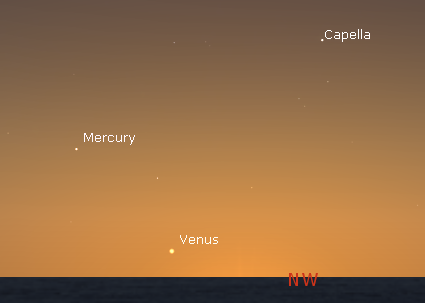
Venus & Mercury in twilight tonight at 10 p.m. May 27, 2020. Created using Stellarium.
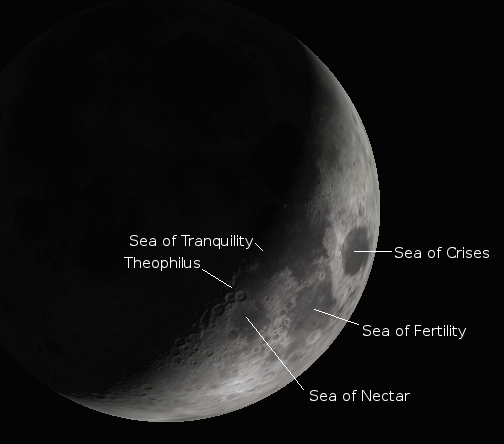
The Moon in a small telescope this evening May 27, 2020 with some seas and craters labeled. Created using Stellarium.
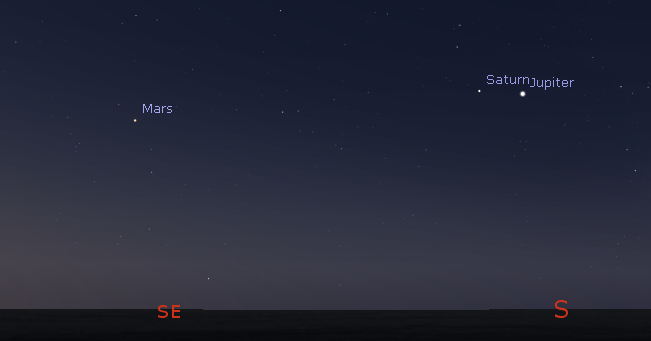
The Morning planets at 5 am. Created using Stellarium.
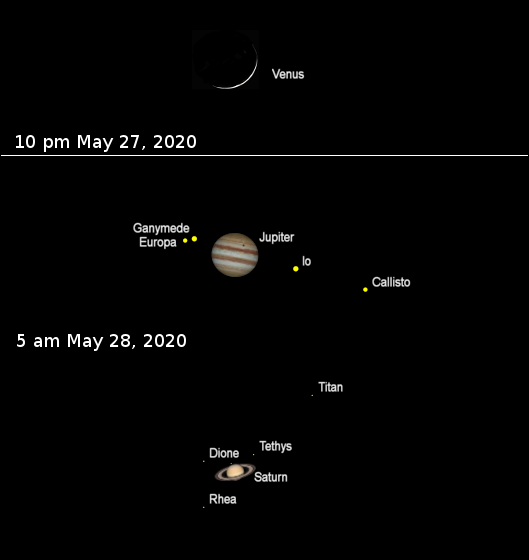
The planets as seen in a telescope with the same magnification. Venus, Jupiter and Saturn on the night of May 27/28, 2020. Apparent diameters: Venus, 56.49″. larger than Jupiter, at 44.24″; Saturn, 17.70″, rings, 41.22″. Mars at 9.06″ won’t be added until it reaches 10″. The ” symbol means seconds of arc (1/3600th of a degree.) Created using Cartes du Ciel (Sky Chart).
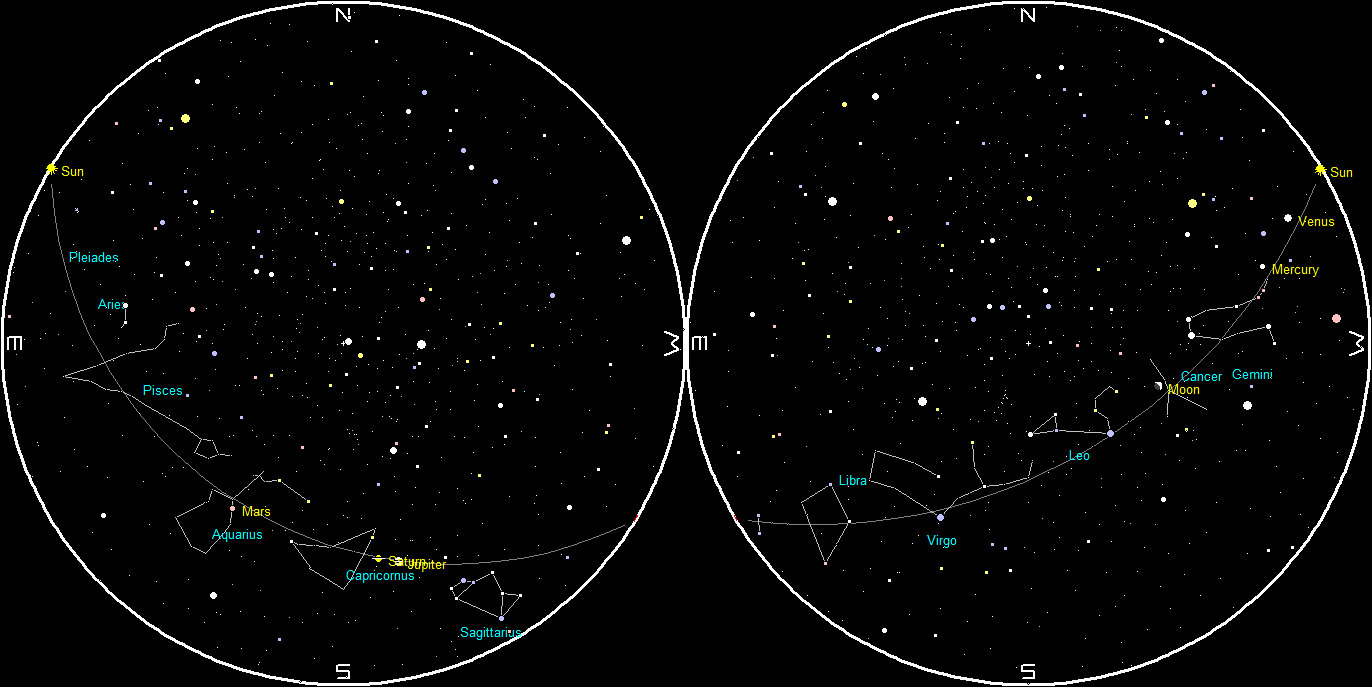
Planets and the Moon at sunset and sunrise of a single night starting with sunset on the right on May 27, 2020. The night ends on the left with sunrise on the 29th. The closeness of Jupiter and Saturn in the morning sky unfortunately overlays planets and labels. Click on the image to enlarge. Created using my LookingUp program.
05/22/2020 – Ephemeris – Venus hangs out with Mercury and the Moon this weekend
This is Ephemeris for Friday, May 22nd. Today the Sun will be up for 15 hours and 5 minutes, setting at 9:12, and it will rise tomorrow at 6:06. The Moon is new today, and won’t be visible
Low in the northwest shortly after sunset our brilliant evening star Venus may be seen. It’s getting closer to the Sun every evening. This is an illusion because Venus is in the process of passing between the Earth and the Sun, so it’s not getting closer to the Sun, but it is getting closer to us at 29 million miles (46.8 million km) today. Mercury has passed Venus and is now to the left and a bit above Venus as seen at 10 p.m. Both are pretty close to the horizon, so you may have to move to a spot with a low northwestern horizon. Tomorrow night the day old sliver of the Moon will be spotted just below both of them. It should be quite a sight with these two planets and the Moon in the twilight, just after sunset.
The event times given are for the Traverse City/Interlochen area of Michigan. They may be different for your location.
Addendum
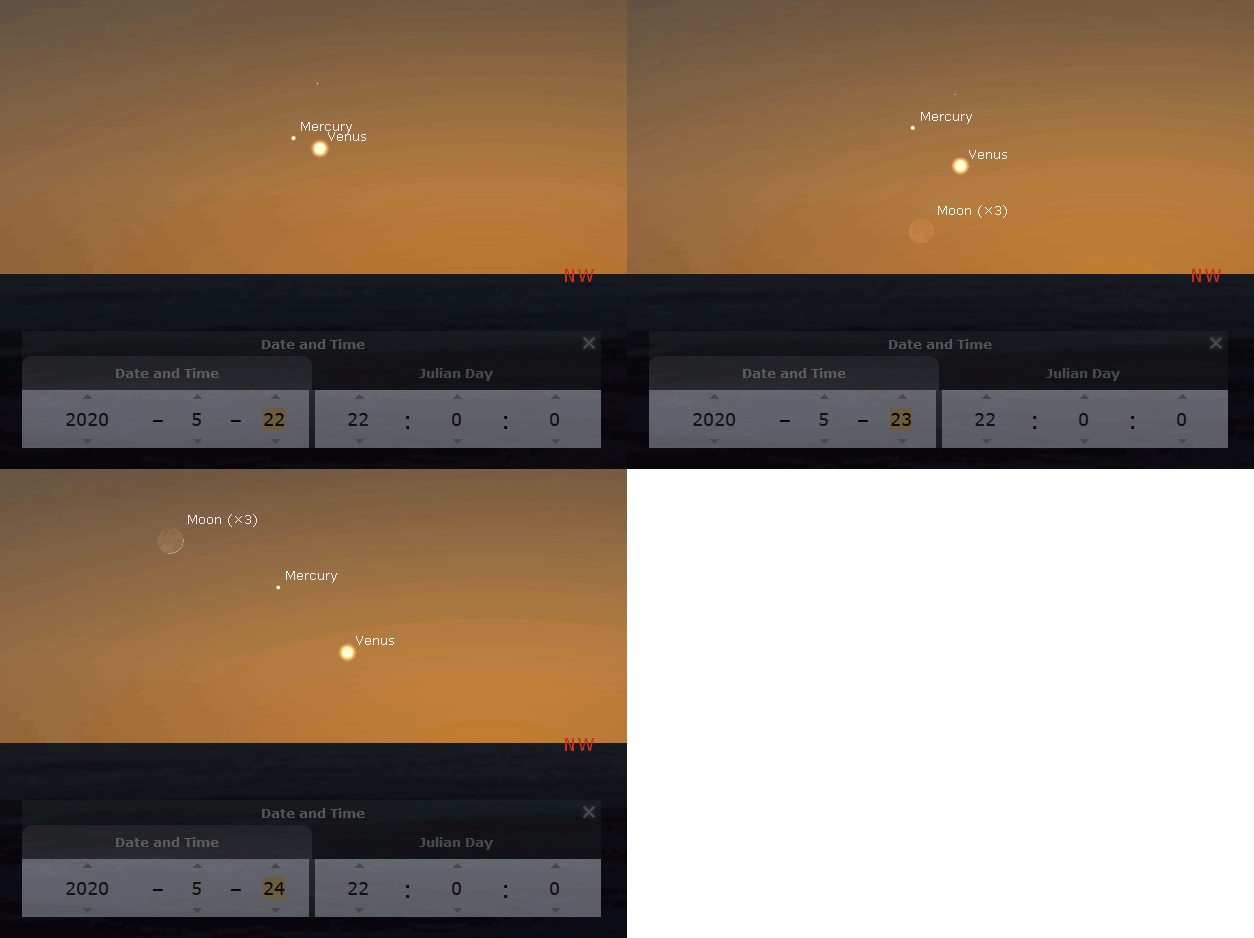
Venus, Mercury, Moon animation for 10 pm May 22nd, 23rd and 24th, 2020. The Moon is shown 3 times actual size in an attempt to show its phase. Created using Stellarium and GIMP.
05/20/2020 – Ephemeris – Let’s look at the naked-eye planets for this week
This is Ephemeris for Wednesday, May 20th. Today the Sun will be up for 15 hours and 1 minute, setting at 9:10, and it will rise tomorrow at 6:08. The Moon, 2 days before new, will rise at 5:49 tomorrow morning.
Let’s look at the naked-eye planets for this week. Venus is our evening star shining brightly in the west northwest. It will be our evening star for only the next 2 weeks. A tiny crescent can now be seen in binoculars. It will cross between the Earth and the Sun on June 3rd. It will set at 11:05 p.m. It’s only 30 million miles (48 million km) away. Mercury is making an appearance just below Venus now. In the morning sky there are three planets close together in the south and southeast. Bright Jupiter will rise first at 1:07 a.m. Followed by Saturn at 1:22 a.m. Mars, is stretching its lead left of Saturn and will rise at 3:00 a.m. Mars continues to get closer. Its now down to 101million miles (163 million km) away, as the Earth slowly overtakes it at the rate of about 5 million miles (7 million km) a week.
The event times given are for the Traverse City/Interlochen area of Michigan. They may be different for your location.
Addendum
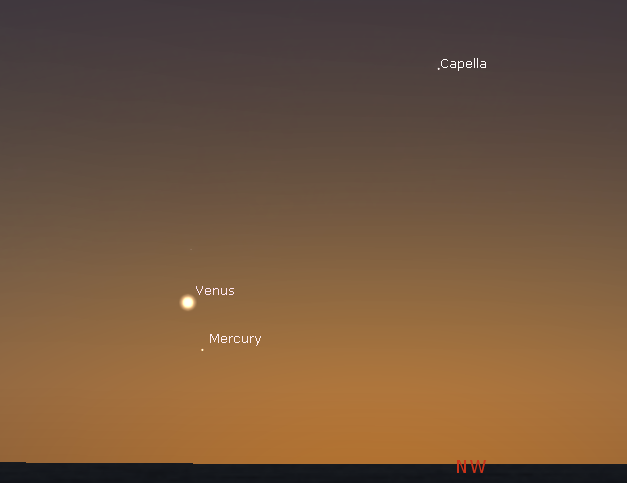
Venus and Mercury as it should appear at 10 pm low in the northwest over the Lake Michigan horizon. May 20, 2020. Created using Stellarium.
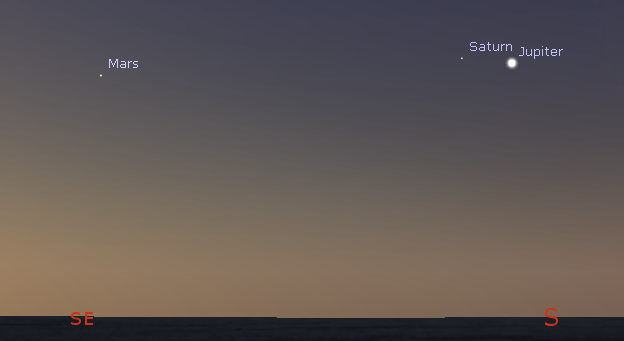
Jupiter, Saturn and Mars seen in the southern sky at 5:30 am tomorrow morning May 21, 2020. Created using Stellarium.
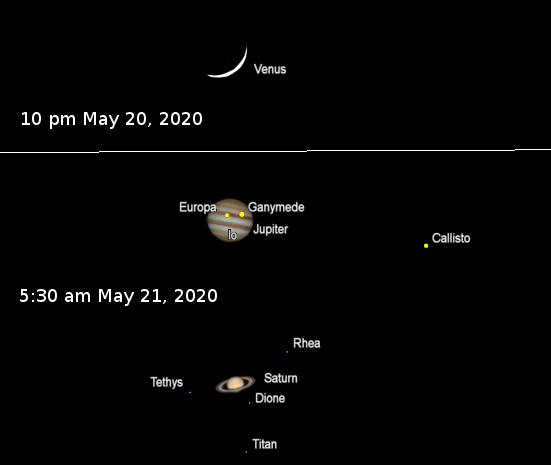
The planets as seen in a telescope with the same magnification. Venus, Jupiter and Saturn on the night of May 13/14, 2020. Apparent diameters: Venus, 52.76″, larger than Jupiter, at 43.37″; Saturn, 17.51″, rings 40.80″. Mars at 8.66″ won’t be added until it reaches 10″. Mercury is gibbous at 6.04″. The ” symbol means seconds of arc (1/3600th of a degree.) Note that Jupiter has two moons in transit, with another behind the planet. The transiting moons are nearly invisible, so only one moon, Callisto is visible. Created using Cartes du Ciel (Sky Charts).
Jovian satellite events (Subtract 4 hours from UT to get EDT)
Moon      Event          Date         UT
Europa:   Shadow start:  21 May 2020  2:36
Ganymede: Shadow end:    21 May 2020  5:50
Europa :  Shadow start:  21 May 2020  6:13
Ganymede: Transit start: 21 May 2020  7:02
Europa:   Transit start: 21 May 2020  8:22
Europa:   Shadow end:    21 May 2020  8:58
Ganymede: Transit end:   21 May 2020 10:24
Source: The Pluto Project https://www.projectpluto.com/jevent.htm
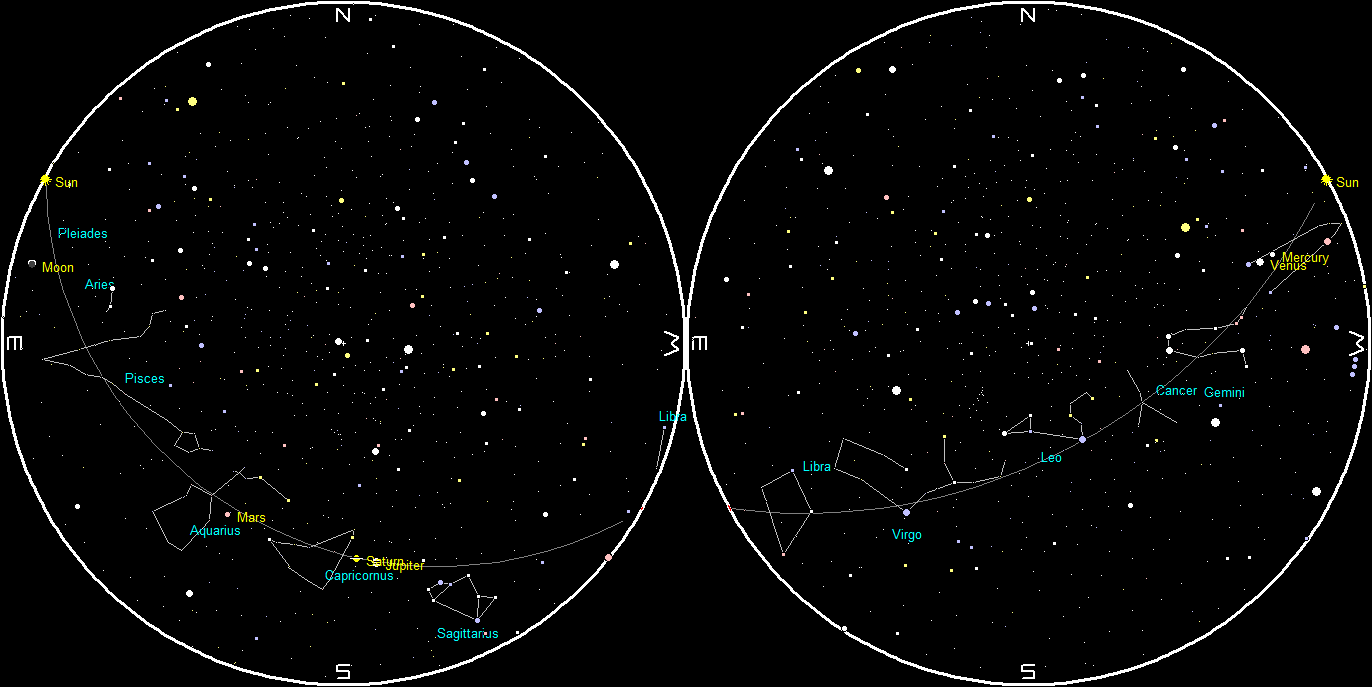
Planets and the Moon at sunset and sunrise of a single night starting with sunset on the right on May 20, 2020. The night ends on the left with sunrise on the 21st. The closeness of Jupiter and Saturn in the morning sky unfortunately overlays planets and labels. Click on the image to enlarge. Created using my LookingUp program.
05/13/2020 – Ephemeris – Let’s look at the naked-eye planets for this week
This is Ephemeris for Wednesday, May 13th. Today the Sun will be up for 14 hours and 46 minutes, setting at 9:02, and it will rise tomorrow at 6:15. The Moon, 1 day before last quarter, will rise at 3:08 tomorrow morning.
Let’s look at the naked-eye planets for this week. Venus is our evening star shining brightly in the west. It will be our evening star for only the next 3 weeks. A tiny crescent can now be seen in binoculars. It will cross between the Earth and the Sun on June 3rd. It will set at 11:43 p.m. It’s only 33 million miles (53 million km) away. In the morning sky there are three planets fairly close together in the south-southeast with the Moon among them tomorrow morning. Bright Jupiter will rise first at 1:35 a.m. Followed by Saturn at 1:50 a.m. Mars, is stretching its lead left of Saturn and will rise at 3:14 a.m. Mars is getting closer to us all the time now, until it closest to us in October of this year.
The event times given are for the Traverse City/Interlochen area of Michigan. They may be different for your location.
Addendum
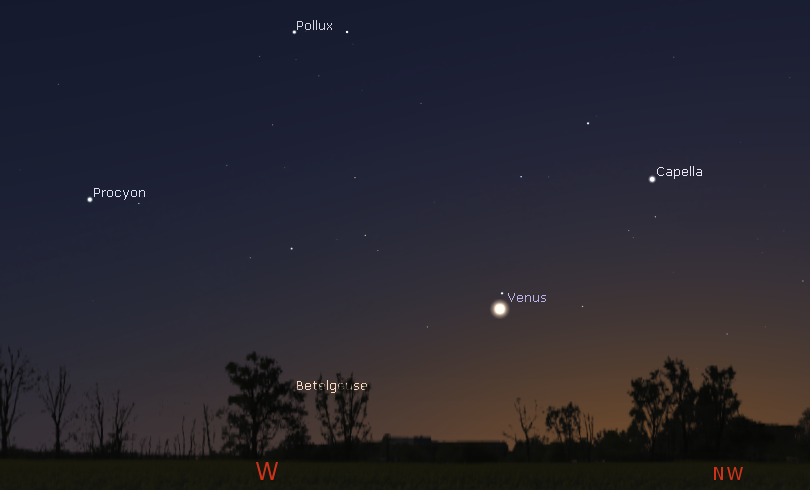
Venus in evening twilight and bright evening stars tonight at 10 p.m. May 13, 2020. Click on the image to enlarge. Created using Stellarium.
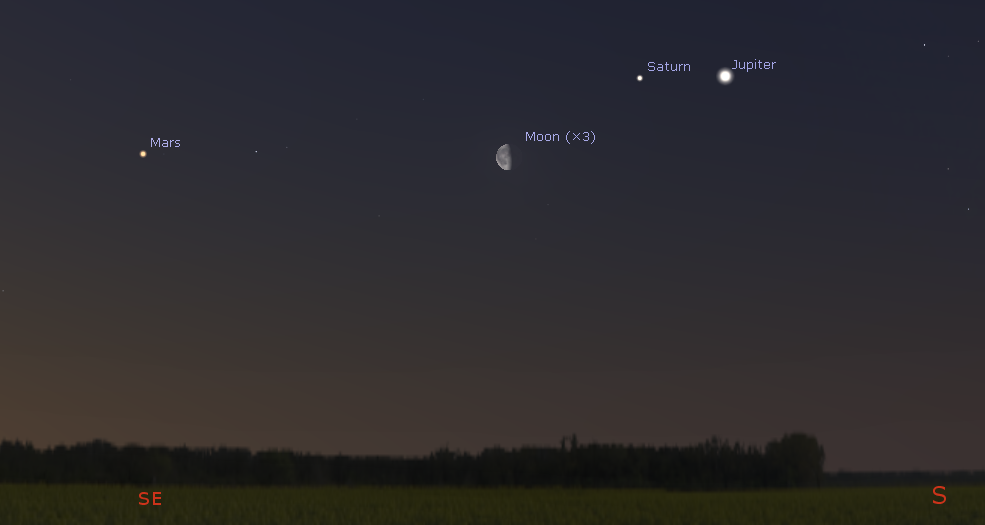
Morning planets and the Moon in twilight at 5:30 a.m. tomorrow morning, May 14, 2020. The Moon is shown at three times its actual size. Click on the image to enlarge. Created using Stellarium.
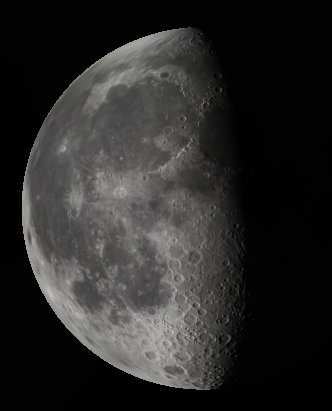
The Moon as it might be seen in binoculars at 5:30 a.m. tomorrow May 14, 2020. Created using Stellarium.
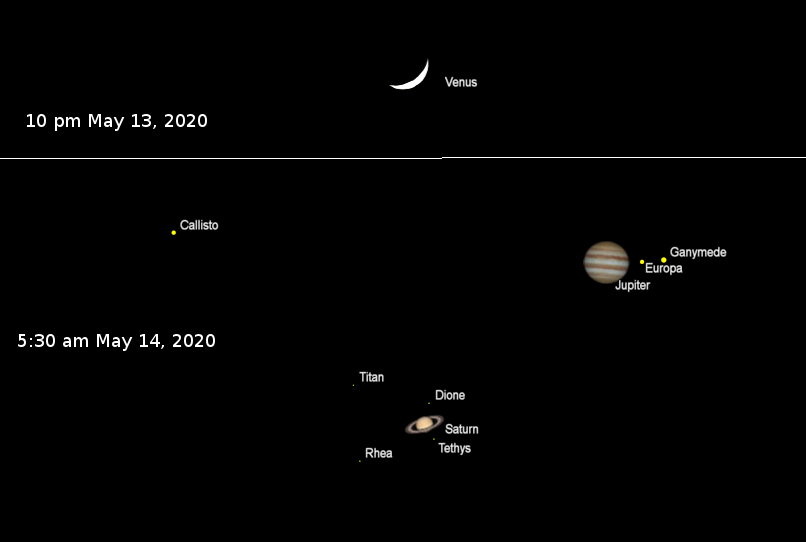
The planets as seen in a telescope with the same magnification. Venus, Jupiter and Saturn on the night of May 13/14, 2020. Apparent diameters: Venus, 47.88″. larger than Jupiter, at 42.46″; Saturn, 17.32″, rings, 40.35″. Mars at 8.28″ won’t be added until it reaches 10″. The ” symbol means seconds of arc (1/3600th of a degree.) Created using Cartes du Ciel (Sky Charts).
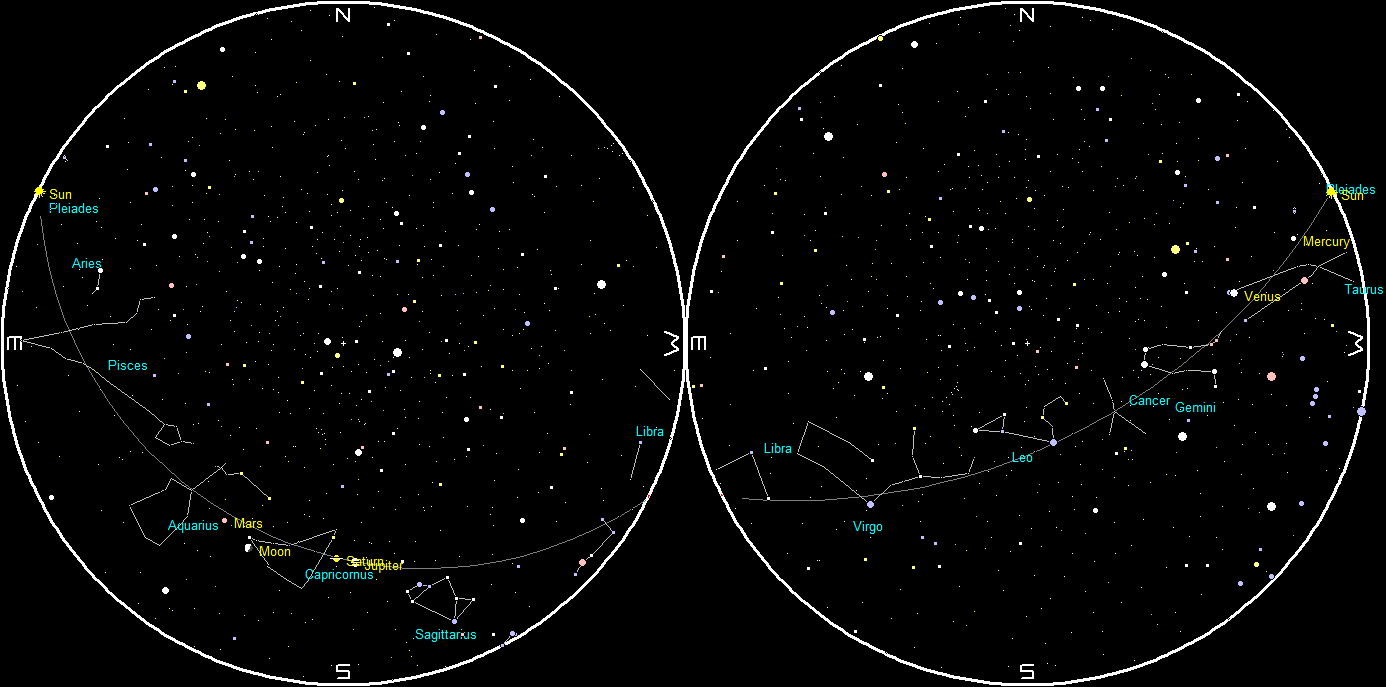
Planets and the Moon at sunset and sunrise of a single night starting with sunset on the right on May 13, 2020. The night ends on the left with sunrise on the 14th. The closeness of Jupiter and Saturn in the morning sky unfortunately overlays planets and labels. Click on the image to enlarge. Created using my LookingUp program.
05/06/2020 – Ephemeris – Let’s look at the naked-eye planets for this week
This is Ephemeris for Wednesday, May 6th. Today the Sun will be up for 14 hours and 29 minutes, setting at 8:54, and it will rise tomorrow at 6:23. The Moon, 1 day before full, will set at 6:46 tomorrow morning.
Let’s look at the naked-eye planets for this week. Venus is our evening star shining brightly in the west. It will set at 12:10 a.m. It’s closing in on the Sun in our sky, by approaching the Earth at only 37 million miles (59 million km) away. In the morning sky there are three planets fairly close together in the south-southeast. Bright Jupiter will rise first at 2:02 a.m. Followed by Saturn at 2:17 a.m. Mars, stretching its lead left of Saturn, will rise at 3:31 a.m. Mars is now down to 110 million miles (177 million km) away, as the Earth slowly overtakes it at the rate of about 4 million miles (7 million km) a week. Mars will be closest to us in October at 38 and a half million miles away. That’s only 3 million miles (5 million km) further than it was 2 years ago.
The event times given are for the Traverse City/Interlochen area of Michigan. They may be different for your location.
Addendum
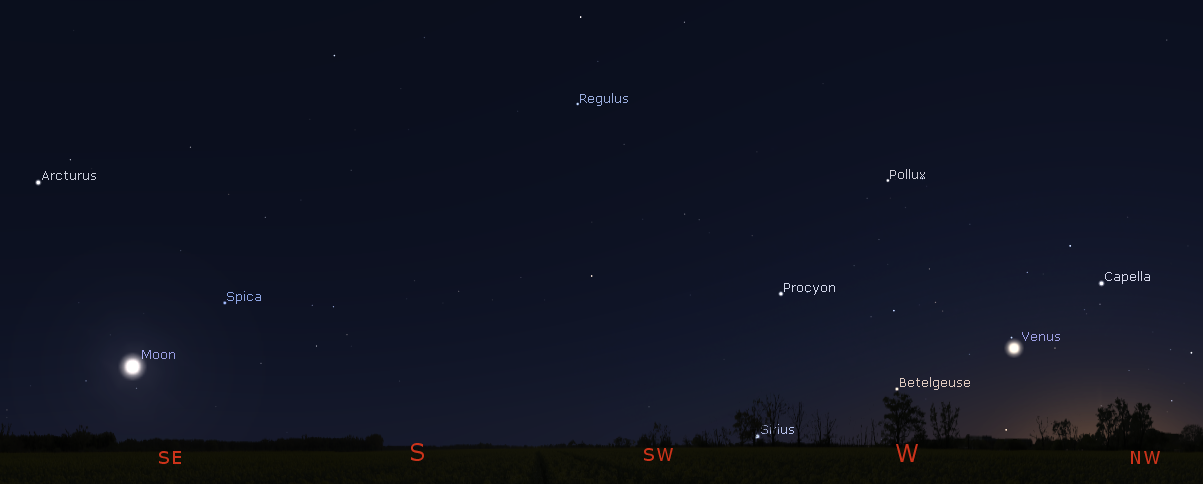
Venus, the Moon and bright evening stars tonight at 10 p.m. May 6, 2020. Click on the image to enlarge. Created using Stellarium.
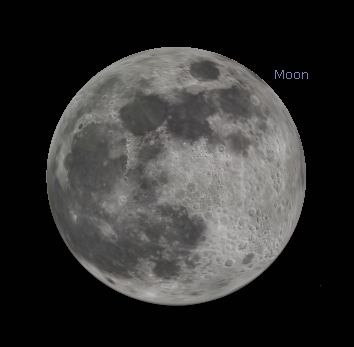
The nearly full Moon as it might be seen in binoculars at 10 p.m. tonight May 6, 2020. Created using Stellarium.
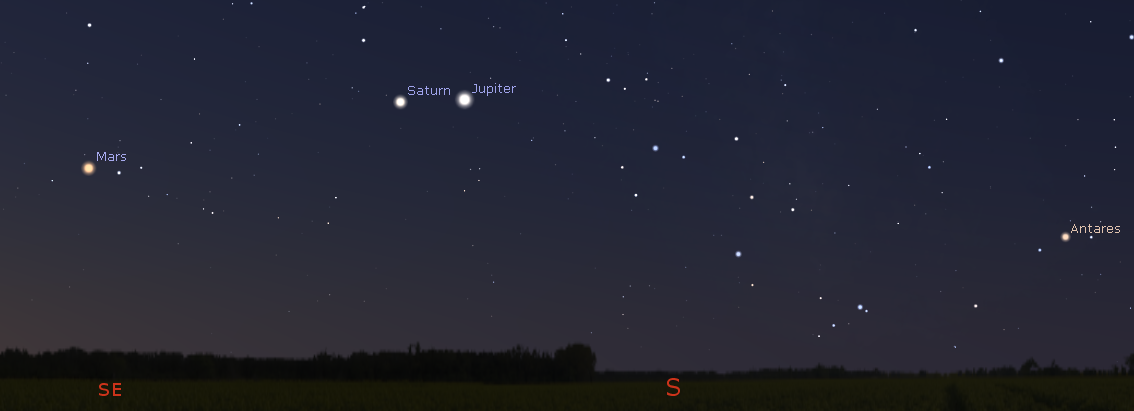
Morning planets in twilight at 5:30 a.m. tomorrow morning, May 7, 2020. Click on the image to enlarge. Created using Stellarium.
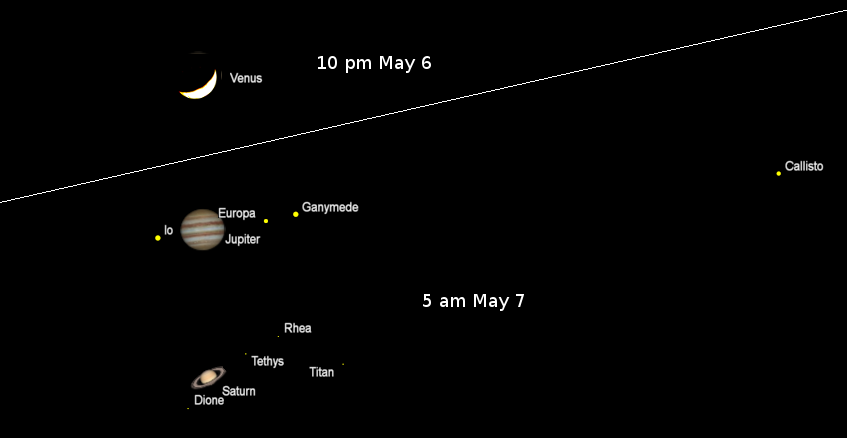
The planets as seen in a telescope with the same magnification. Venus in the evening and Jupiter and Saturn in the morning on the night of May 6/7, 2020. Apparent diameters: Venus, 42.88″. larger than Jupiter, at 41.54″; Saturn, 17.12″, rings, 39.89″. Mars at 7.92″ won’t be added until it reaches 10″. The ” symbol means seconds of arc (1/3600th of a degree.) Created using Cartes du Ciel (Sky Charts).
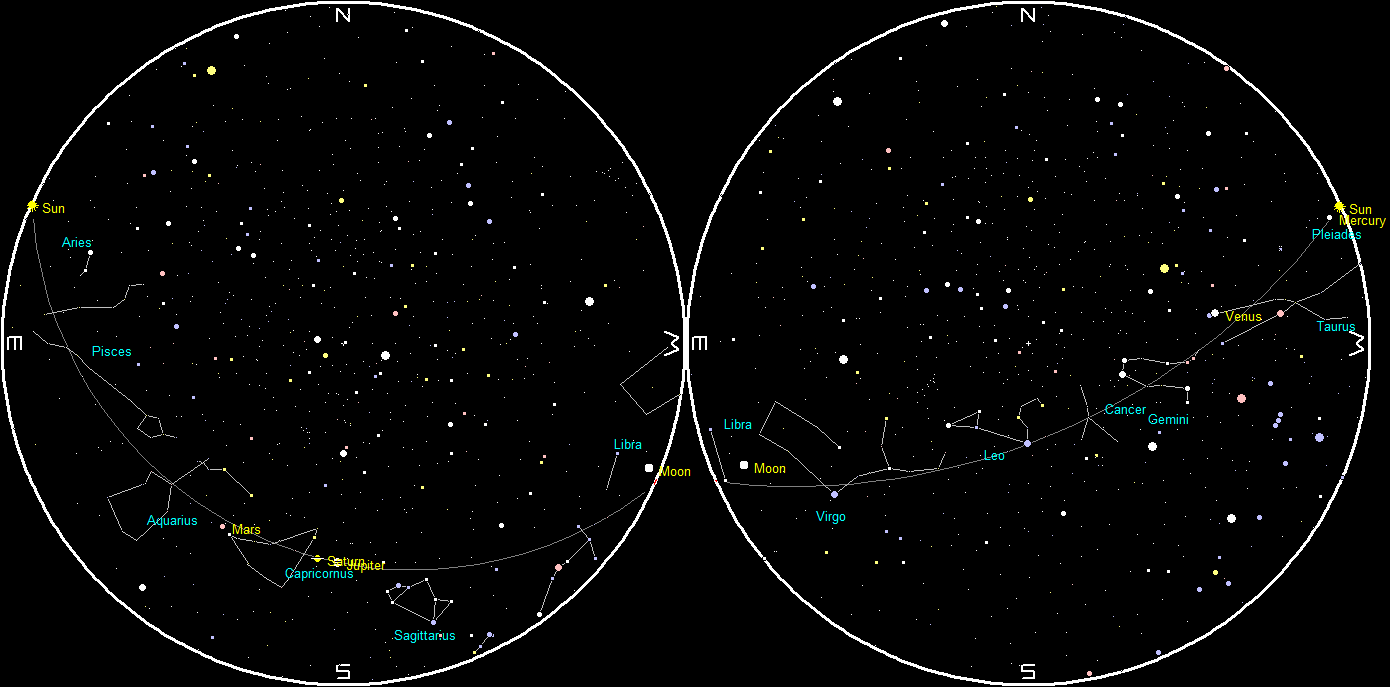
Planets and the Moon at sunset and sunrise of a single night starting with sunset on the right on May 6, 2020. The night ends on the left with sunrise on the 7th. The closeness of Jupiter and Saturn in the morning sky unfortunately overlays planets and labels. Click on the image to enlarge. Created using my LookingUp program.
 Bob Moler's Ephemeris Blog