Archive
Ephemeris: 11/21/2025 – Finding Taurus the bull
This is Ephemeris for Friday, November 21st. Today the Sun will be up for 9 hours and 21 minutes, setting at 5:09, and it will rise tomorrow at 7:49. The Moon, 1 day past new, will set at 5:36 this evening.
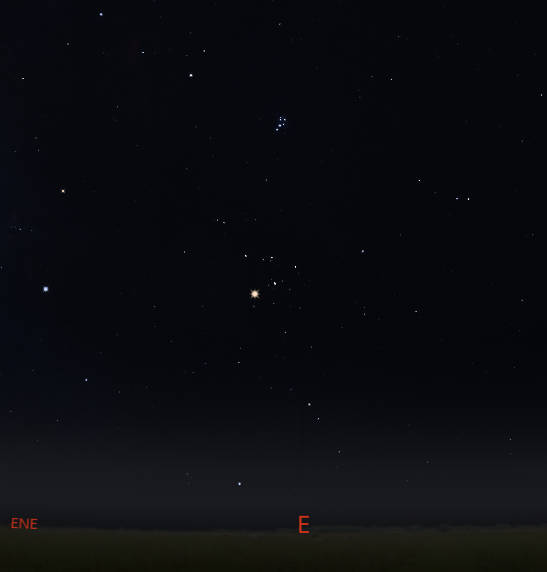
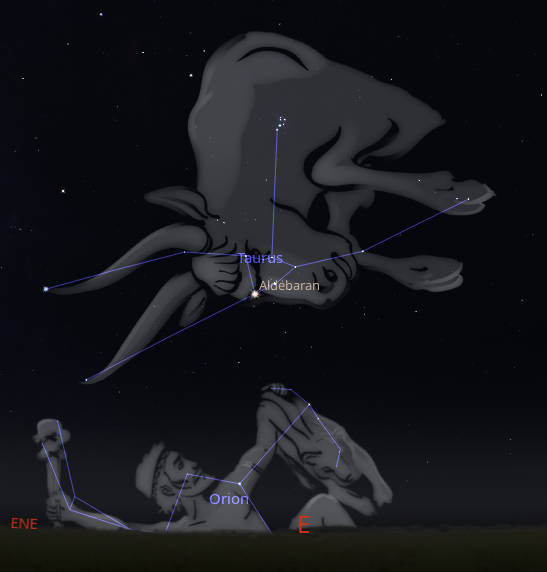
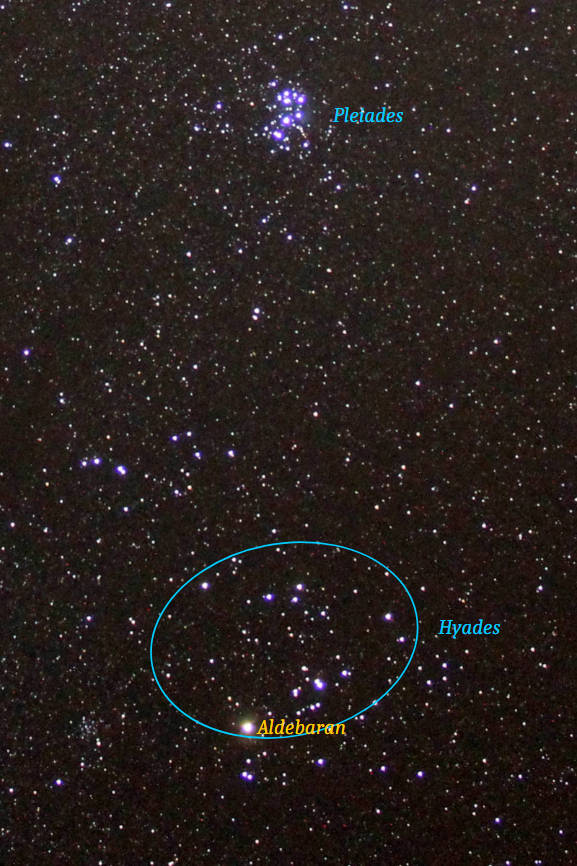
Low in the east at 8 this evening and below the beautiful Pleiades star cluster is Taurus the bull. His face is a letter V shape of stars lying on its side, the star cluster Hyades, which in Greek Mythology were the half-sisters of the Pleiades, with the bright orange-red star Aldebaran at one tip of the V as its angry bloodshot eye. Aldebaran is actually about halfway between us and the cluster. The Pleiades star cluster is in his shoulder. Taurus is seen charging downward at that hour, the rising constellation of Orion. Taurus in Greek mythology was the form the god Zeus assumed when he carried off the maiden Europa. Europa’s still with him as a moon orbiting Zeus’ Roman counterpart, the planet Jupiter.
The astronomical event times given in this blog are for the Traverse City/Interlochen area of Michigan (Lat 44.7° N, Long 85.7° W; EDT, UT – 4 hours) unless stated otherwise. Times will be different for other locations.
Addendum
Ephemeris: 05/02/2024 – All about the constellation of Boötes and Ursa Major
This is Ephemeris for Thursday, May 2nd. Today the Sun will be up for 14 hours and 19 minutes, setting at 8:49, and it will rise tomorrow at 6:29. The Moon, 1 day past last quarter, will rise at 4:27 tomorrow morning.
Seen in the east at 10:30 p.m. tonight is the kite shaped constellation of Boötes the herdsman. The bright star Arcturus is at the bottom of the kite to the right. It is pointed to by the arc of the handle of the Big Dipper, higher in the east. Boötes represents a young hunter named Arcas, son of Callisto, a beautiful young lady who had the misfortune of being loved by Zeus the chief of the Greek gods. Zeus’ wife Hera, found out about it, and since she couldn’t punish Zeus, turned the poor woman into a bear. Arcas, many years later, unaware of the events surrounding his mother’s disappearance was about to kill the bear when Zeus intervened and placed them both in the sky to save her, as Arcas still pursues her across the sky nightly.
The astronomical event times given are for the Traverse City/Interlochen area of Michigan (EDT, UT–4 hours). They may be different for your location.
Addendum

04/28/2022 – Ephemeris – The story of Arcas and Callisto
This is Bob Moler with Ephemeris for Thursday, April 28th. Today the Sun will be up for 14 hours and 6 minutes, setting at 8:44, and it will rise tomorrow at 6:35. The Moon, 2 days before new, will rise at 6:16 tomorrow morning.
Appearing in the eastern sky at 10 p.m. tonight is the kite shaped constellation of Boötes the herdsman. The bright star Arcturus is at the bottom of the kite which is horizontal to the left, pointed to by the arc of the handle of the Big Dipper, higher in the east. The Big Dipper is the hind end of the constellation Ursa Major, the Great Bear. In one story, Boötes represents a young hunter named Arcas, son of Callisto, a beautiful young woman who had the misfortune of being loved by god Zeus. Zeus’ wife, Hera, found out about the affair, and since she couldn’t punish Zeus, turned the poor woman into a bear. Arcas, many years later, unaware of why his mother disappeared, was about to kill the bear when Zeus intervened and placed them both in the sky, where he continues to chase her across the sky nightly.
The astronomical event times given are for the Traverse City/Interlochen area of Michigan (EDT, UT – 4 hours). They may be different for your location.
Addendum
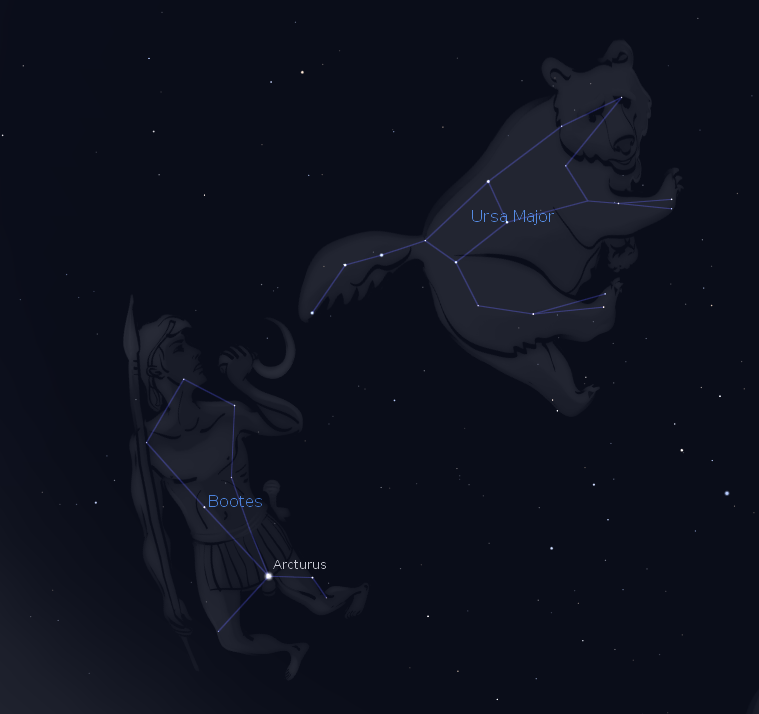
Boötes and Ursa Major aka Arcas chasing Callisto around the pole of the sky. Created using Stellarium.
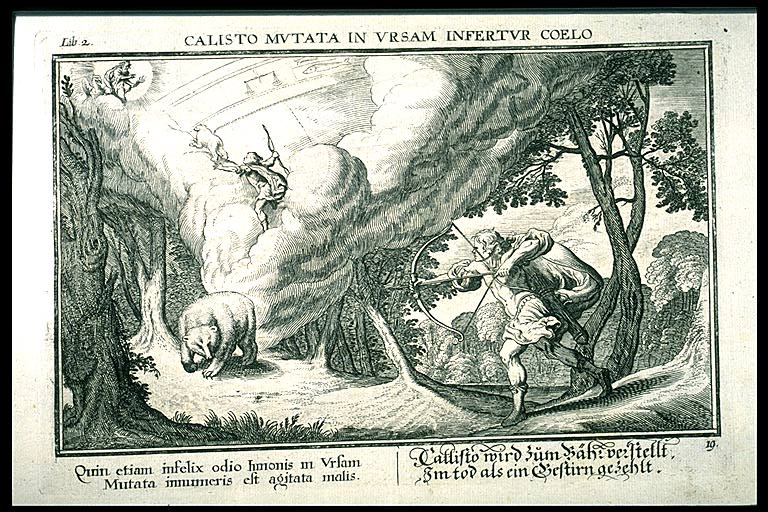
Arcas about to slay the bear by the 17th century artist Baur. Source: University of Virginia Electronic Text Center
04/13/2020 – Ephemeris – The story of Callisto and Arcas or Ursa Major and Boötes
This is Ephemeris for Monday, April 13th. Today the Sun will be up for 13 hours and 25 minutes, setting at 8:26, and it will rise tomorrow at 6:59. The Moon, 1 day before last quarter, will rise at 3:09 tomorrow morning.
Appearing mid way up the sky in the east at 10 p.m. is the kite shaped constellation of Boötes the herdsman. The bright star Arcturus is at the bottom-right of the kite, pointed to by the arc of the handle of the Big Dipper, above it. In one Greek myth Boötes represents a young hunter named Arcas, son of Callisto, a beautiful young lady who had the misfortune of being loved by Zeus the chief of the Greek gods. Zeus’ wife Hera, found out about the affair, and since she couldn’t punish Zeus, turned the poor woman into an ugly bear. Arcas, unaware of the events surrounding his mother’s disappearance in his youth was about to kill the bear when Zeus intervened and placed them both in the sky to save her. To this day Boötes continues to chase the Great Bear, Ursa Major, around the pole of the sky each night.
The event times given are for the Traverse City/Interlochen area of Michigan. They may be different for your location.
Addendum
Bootes and Ursa Major aka Arcas chasing Callisto around the pole of the sky. Created using Stellarium.
Arcas about to slay the bear by the 17th century artist Baur. Source: University of Virginia Electronic Text Center
03/12/2020 – Ephemeris – The mythology behind the constellation of Gemini
Ephemeris for Thursday, March 12th. Today the Sun will be up for 11 hours and 46 minutes, setting at 7:45, and it will rise tomorrow at 7:57. The Moon, 3 days past full, will rise at 11:45 this evening.
Lets look at the next to last of the winter constellations, and member of the Zodiac. The constellation Gemini, the Twins is visible high in the southeast, above and left of Orion the hunter at 9 p.m. The namesake stars of the two lads, will be at the left end of Gemini, nearly vertically aligned. Castor is above, Pollux below. From them can be traced two lines of stars extending toward Orion that outline the two. In Greek mythology the lads were half brothers, Castor was fathered by a mere mortal, while Pollux was fathered by Zeus in the famous Leda and the swan affair and immortal, but were born together as twins. When Castor was killed during the quest for the Golden Fleece, Pollux pleaded with Zeus to let him die also, so he placed them together in the sky so they could be together forever.
The event times given are for the Traverse City/Interlochen area of Michigan. They may be different for your location.
Addendum
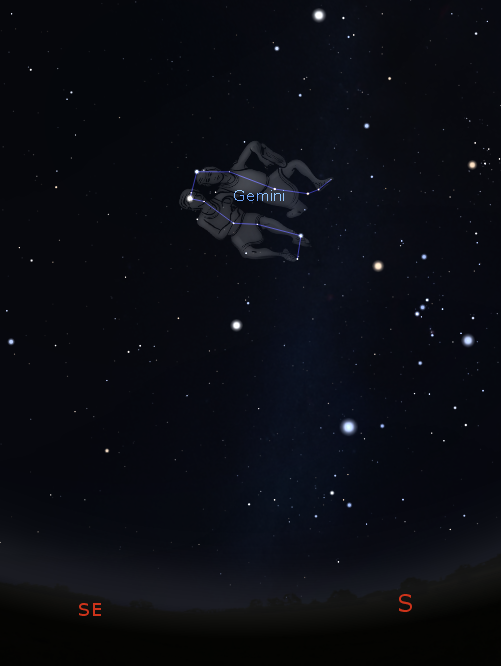
Gemini finder looking south-southeast around 9 p.m. March 10th, 2020. Created using Stellarium.
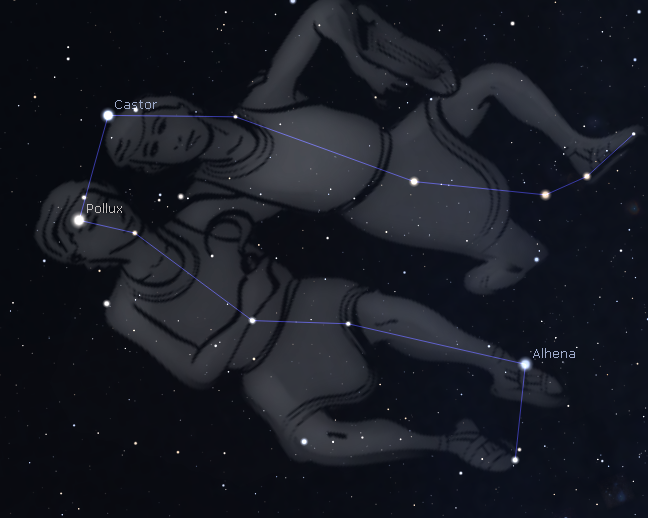
Castor and Pollux namesakes of the twins of Gemini in its position around 9 p.m. EDT March 12th. Created using Stellarium.
04/26/2019 – Ephemeris – The story of Ursa Major and Boötes
Ephemeris for Arbor Day, Friday, April 26th. Today the Sun will be up for 14 hours even, setting at 8:41, and it will rise tomorrow at 6:39. The Moon, at last quarter today, will rise at 3:39 tomorrow morning.
Seen in the east at 10 p.m. tonight is the kite shaped constellation of Boötes the herdsman. The bright star Arcturus is at the bottom of the kite to the right. It is pointed to by the arc of the handle of the Big Dipper, higher in the east. Boötes represents a young hunter named Arcas, son of Callisto, a beautiful young lady who had the misfortune of being loved by Zeus the chief of the Greek gods. Zeus’ wife Hera, found out about it, and since she couldn’t punish Zeus, turned the poor woman into a bear. Arcas, many years later, unaware of the events surrounding his mother’s disappearance was about to kill the bear when Zeus intervened and placed them both in the sky to save her, as Arcas still pursues her across the sky nightly.
The times given are for the Traverse City/Interlochen area of Michigan. They may be different for your location.
Addendum
Bootes and Ursa Major aka Arcas chasing Callisto around the pole of the sky. Created using Stellarium.
Arcas about to slay the bear by the 17th century artist Baur. Source: University of Virginia Electronic Text Center
02/11/2019 – Ephemeris – The stars Castor and Pollux
Ephemeris for Monday, February 11th. Today the Sun will be up for 10 hours and 16 minutes, setting at 6:05, and it will rise tomorrow at 7:47. The Moon, 1 day before first quarter, will set at 12:57 tomorrow morning.
At 9 p.m. the constellation of Gemini the twins will be seen high in the southeast. The namesake stars of the two lads are the two bright stars at the top of the constellation. Pollux the pugilist, or boxer, is the lower of the two, while Castor, the horseman, is the other star, or rather a six star system. In telescopes two close stars may be seen each is a spectroscopic binary, meaning the lines of two stars can be seen in the spectrum. A faint nearby spectroscopic binary also belongs. Pollux, though a single star, does have at least one planet, over twice the mass of Jupiter orbiting the star at a distance somewhat greater than Mars is from the Sun. Pollux is 34 light years away while Castor is 50 light years away. Not too far away as stars go.
The times given are for the Traverse City/Interlochen area of Michigan. They may be different for your location.
Addendum
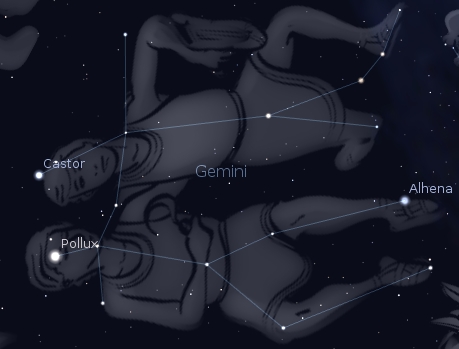
Gemini with Castor and Pollux. Created with Stellarium.
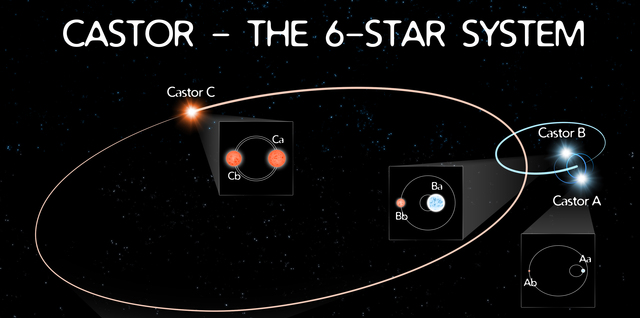
The Castor star system exploded in this JPL/NASA infographic.
01/24/2019 – Ephemeris – Taurus the bull
Ephemeris for Thursday, January 24th. Today the Sun will be up for 9 hours and 29 minutes, setting at 5:40, and it will rise tomorrow at 8:09. The Moon, half way from full to last quarter, will rise at 10:14 this evening.
Midway up the sky in the southeast at 8 p.m. is the constellation of the giant hunter Orion. Above him, to the right is Taurus the bull. His face is a letter V shape of stars lying on its side, the star cluster Hyades, with the bright orange-red star Aldebaran at one tip of the V as its angry blood-shot eye, but actually about half way between us and the cluster. Orion is depicted in the sky facing, with club in one hand and a shield in the other, the charging Taurus. The Pleiades star cluster is in his shoulder. Taurus in Greek mythology was the form the god Zeus when he carried off the maiden Europa. Europa’s still with him as the intriguing satellite orbiting Zeus’ Roman equivalent the planet Jupiter.
The times given are for the Traverse City/Interlochen area of Michigan. They may be different for your location.
Addendum
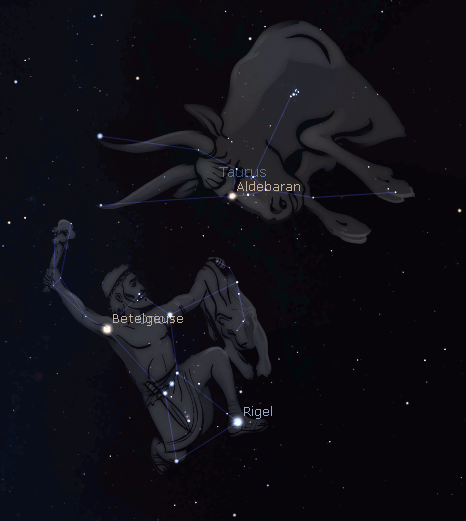
Taurus and Europa at 8 p.m. January 24, 2019. Created using Stellarium.
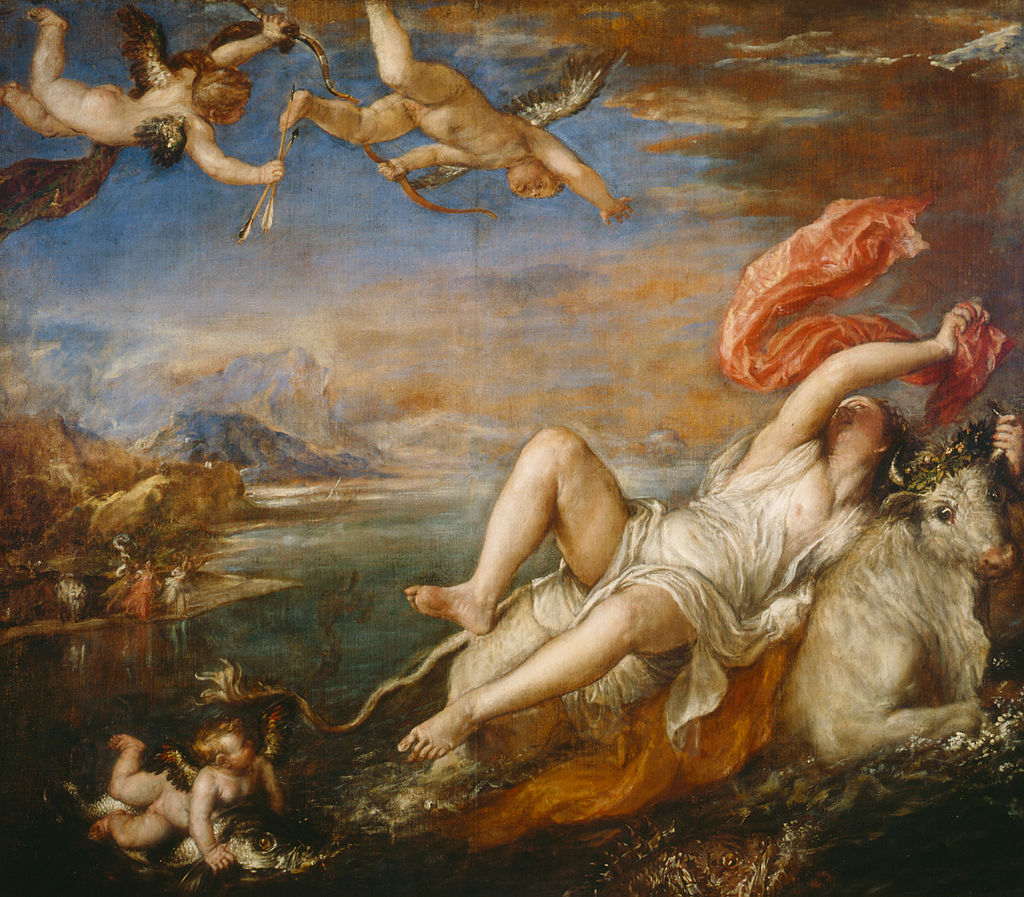
The Rape of Europa by Titian. According to the story Zeus as a bull abducted Europa and swam to Crete, where she became the first queen of that island, and bore him three sons. Other paintings of this subject are by Rembrandt and de Troy. This painting belongs to the Isabella Stewart Gardener Museum in Boston, MA. Click on the image to enlarge.
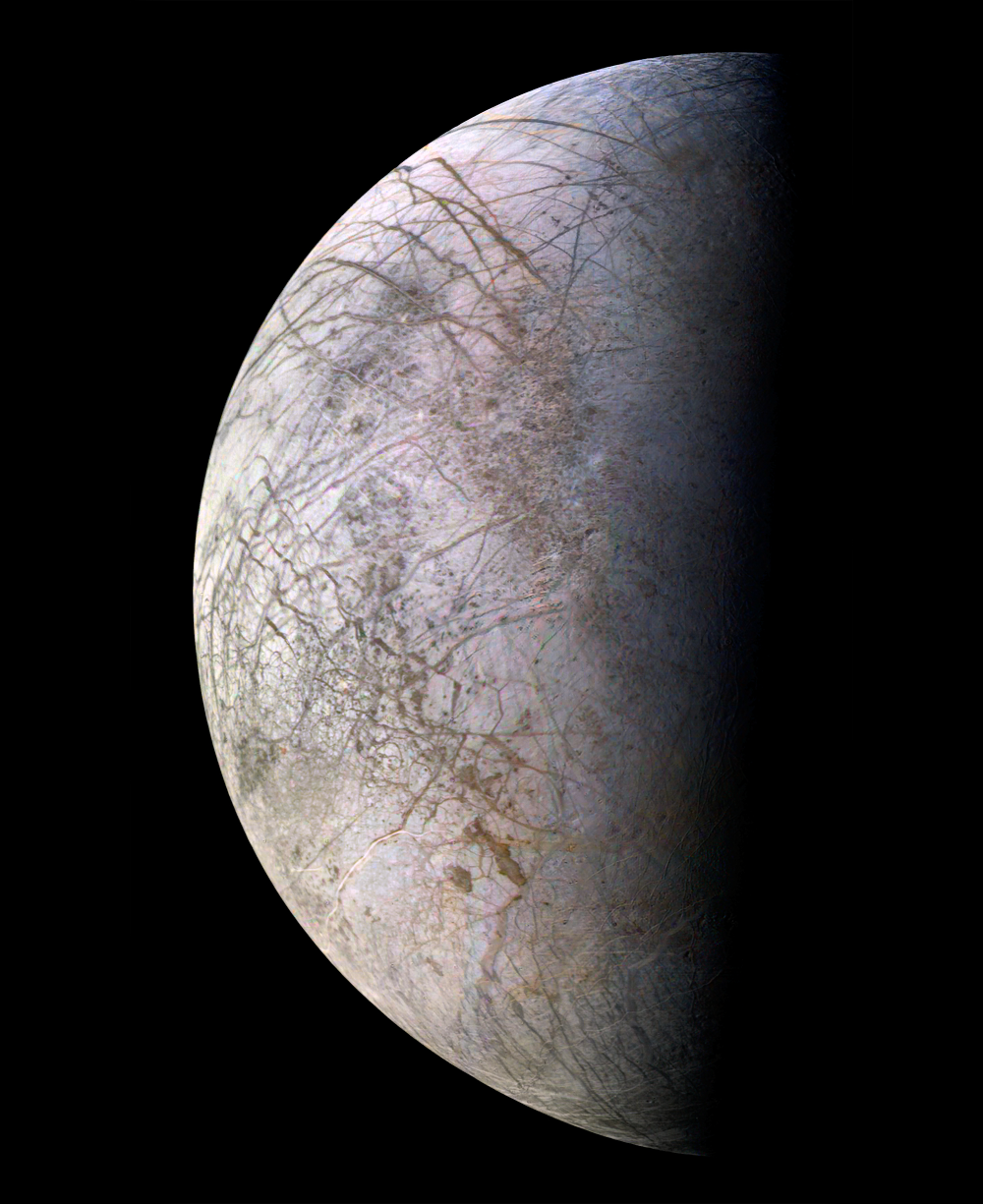
Jupiter’s satellite Europa, slightly smaller than the Earth’s moon, has a fresh ice surface with very little cratering. The ice floats on a deep water ocean supposedly containing more water than all the Earth’s oceans. Click on the image to enlarge. This is a place NASA will send a spacecraft to look for the chemistry of life. Credit NASA/JPL, Ted Stryk.
07/14/2017 – Ephemeris – Constellations of the Summer Triangle II: Cygnus the swan
Ephemeris for Friday, July 14th. Today the Sun will be up for 15 hours and 14 minutes, setting at 9:25, and it will rise tomorrow at 6:11. The Moon, 2 days before last quarter, will rise at 12:32 tomorrow morning.
Fairly high in the east at 11 p.m. Is the constellation of Cygnus the swan, flying south through the Milky Way. It is also called the Northern Cross. At the left, the tail of the swan or the head of the cross is the bright star Deneb, one of the stars of the Summer Triangle. The next star right is Sadr the intersection of the body and the wings of the swan seen in flight, or the intersection of the two pieces of the cross. There are two or three stars farther to the right that delineate the swan’s long neck or upright of the cross, that ends with the star Alberio in the beak of the swan or foot of the cross. The crosspiece of the cross extends to the stars on either side of the intersection star Sadr, while the swan’s wings extend to a couple more stars each.
The times given are for the Traverse City/Interlochen area of Michigan. They may be different for your location.
Addendum
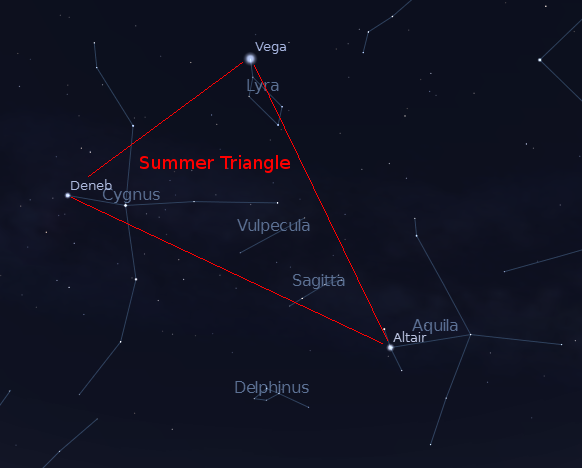
The Summer Triangle. Created using Stellarium and The Gimp.

Animated Cygnus finder chart. Created using Stellarium.
In mythology Cygnus was the form Zeus took in the Leda and the swan affair. Out of that union was born Pollux of Gemini fame. His half-brother and twin Castor was fathered by a mere mortal. Go here for their story.
Alberio is the star that shows in Cygnus’ eye. In telescopes of even low power Alberio shows as a binary star whose components are distinctly and beautiful blue and gold. Binoculars are not quite powerful enough to split these two.
04/25/2016 – Ephemeris – Arcas and Callisto
Ephemeris for Monday, April 25th. The Sun rises at 6:41. It’ll be up for 13 hours and 59 minutes, setting at 8:40. The Moon, 3 days past full, will rise at 11:56 this evening.
Appearing mid way up the sky in the east at 10 p.m. is the kite shaped constellation of Boötes the herdsman. The bright star Arcturus is at the bottom of the kite, pointed to by the arc of the handle of the Big Dipper, above it. In one story Boötes represents a young hunter named Arcas, son of Callisto, a beautiful young lady who had the misfortune of being loved by Zeus the chief of the Greek gods. Zeus’ wife Hera, found out about the affair, and since she couldn’t punish Zeus, turned the poor woman into an ugly bear. Arcas, unaware of the events surrounding his mother’s disappearance was about to kill the bear when Zeus intervened and placed them both in the sky to save her. To this day Boötes continues to chase the great bear Ursa Major around the sky each night.
Times are for the Traverse City/Interlochen area of Michigan. They may be different for your location.
Addendum
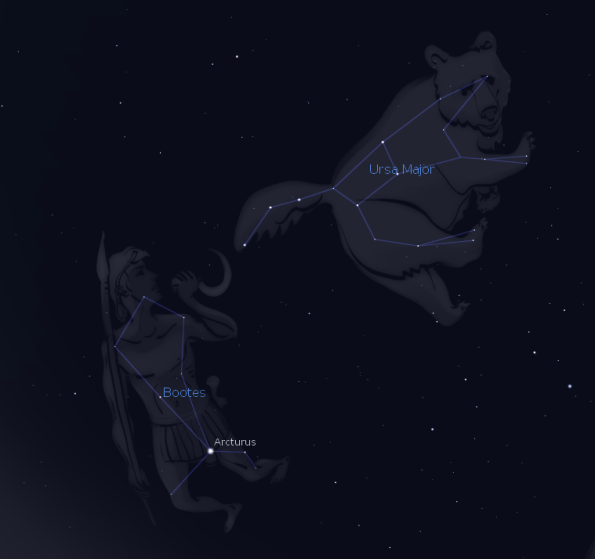
Bootes and Ursa Major aka Arcas chasing Callisto around the pole of the sky. Created using Stellarium.
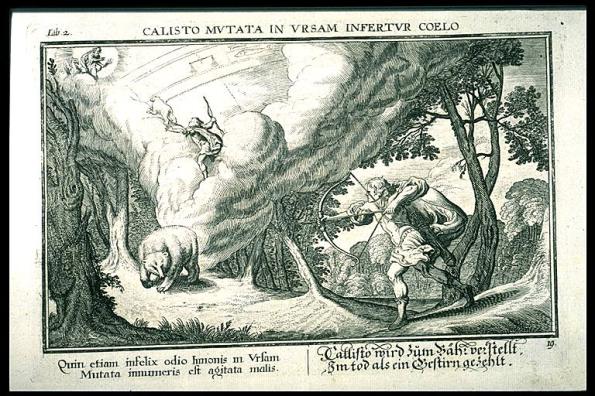
Arcas about to slay the bear by the 17th century artist Baur. Source: University of Virginia Electronic Text Center
 Bob Moler's Ephemeris Blog