Archive
04/29/11 – Ephemeris – May preview
Arbor Day, Friday, April 29th. The sun rises at 6:36. It’ll be up for 14 hours and 8 minutes, setting at 8:44. The moon, 4 days before new, will rise at 5:00 tomorrow morning.
Let’s look ahead at the month of May, the month when the promise of spring is finally fulfilled. Daylight hours in the Interlochen/Traverse City area will increase from 14 hours and 13 minutes Sunday to 15 hours 18 minutes on the 31st. The altitude, or angle, of the sun above the southern horizon at local noon will ascend from 60 degrees tomorrow to 67 degrees at month’s end. The altitude of the sun in the Straits area will be a degree lower than that. Local apparent noon this month, when the sun passes due south, will be about 1:38 p.m. This is the month of the Eta Aquarid meteor shower which will reach its peak next week. We’ll have dark skies for this very early morning meteor shower that’s related to Halley’s Comet.
* Times are for the Traverse City/Interlochen area of Michigan. They may be different for your location.
04/28/11 – Ephemeris – Some ancient ideas about Leo the lion
Thursday, April 28th. The sun rises at 6:37. It’ll be up for 14 hours and 5 minutes, setting at 8:43. The moon, 4 days past last quarter, will rise at 4:38 tomorrow morning.
The constellation Leo the lion is now high in the south at 10 pm. It’s directly below the Big Dipper at the zenith. Leo is marked by two sets of easily recognizable stars. The front of him is a backward question mark of stars, also known as the Sickle that mark his head and mane, along with the front part of his body. Regulus is the star at the bottom of that backwards question mark. It’s the Little King Star. The hind end of him is a triangle of stars ending with another bright star, but not as bright as Regulus. It’s Denebola which means Lion’s tail. It is thought when the sun was in this constellation long ago that the lions were driven by the heat to quench their thirst in the Nile river. Ancients physicians thought medicines were poison when the sun was here too.
* Times are for the Traverse City/Interlochen area of Michigan. They may be different for your location.
Addendum
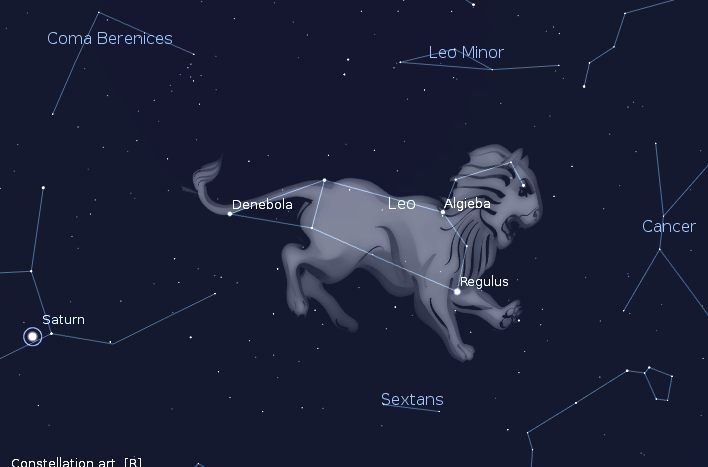
Leo, April 28 2011, 10 p.m. Created using Stellarium.
04/27/11 – Ephemeris – The bright planets for this week
Wednesday, April 27th. The sun rises at 6:39. It’ll be up for 14 hours and 2 minutes, setting at 8:41. The moon, 3 days past last quarter, will rise at 4:17 tomorrow morning.
It’s Wednesday and time again to take our weekly look at the whereabouts of the bright planets. The ringed planet Saturn will be visible in the southeast as it gets dark. It’s near the bright star Spica to its lower left. Spica has a blue tinge, while Saturn is yellowish. It will cross the meridian due south at 12:09 a.m. and will set at 6:01 a.m. In telescopes Saturn shows its rings which are slowly opening up along with at least one satellite, the large moon Titan. Our only other planet visible is Venus which is brilliant in the morning sky and will rise at 5:42 a.m. in the east.. It is really a beautiful sight in the morning twilight, though disappointingly small in a telescope. Jupiter, Mars and Mercury are all too close to the direction of the sun to be visible.
* Times are for the Traverse City/Interlochen area of Michigan. They may be different for your location.
04/26/11 – Ephemeris – Last chance to spot the winter constellations
Tuesday, April 26th. The sun rises at 6:40. It’ll be up for 13 hours and 59 minutes, setting at 8:40. The moon, 2 days past last quarter, will rise at 3:56 tomorrow morning
Lets face it we’re pretty sick of winter, what with all the relapses this month. But I’m never sick of the winter stars and constellations. With Leo and the other spring constellations taking over the skies from overhead to the south, the winter constellations are about to set in the west at 10 p.m. Orion’s rectangular torso is tipped to the right, his belt stars horizontal, 90 degrees from their rising orientation. The same is true of Castor and Pollux higher up which rose vertically and will set horizontally. The brightness and closeness of the stars here are a great contrast with the sparse numbers of stars visible overhead and to the south. That’s because the Milky Way runs through the winter stars and crosses to the north part of the sky.
* Times are for the Traverse City/Interlochen area of Michigan. They may be different for your location.
Addendum
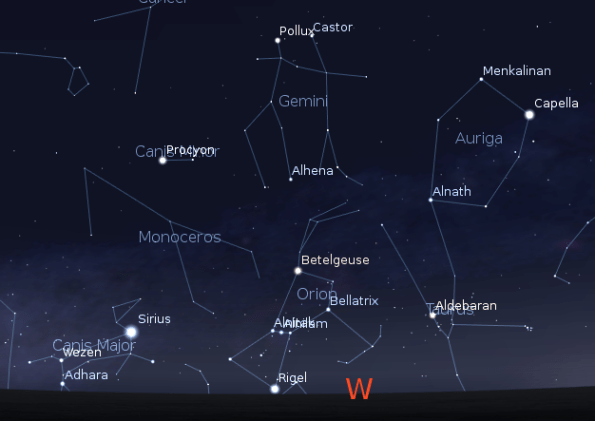
Winter Stars Setting in Late April. Created using Stellarium.
04/25/11 – Ephemeris – The constellation of Corvus the crow
Monday, April 25th. The sun rises at 6:42. It’ll be up for 13 hours and 57 minutes, setting at 8:39. The moon, 1 day past last quarter, will rise at 3:32 tomorrow morning.
The small constellation of Corvus the crow is located low in the south southeast at 10 this evening. It’s made of 5 dim stars, but the pattern is a distinctive distorted box with two stars at the upper left marking that corner. To the right is a fainter constellation of a thick stemmed goblet called Crater. Both appear above the long constellation of Hydra the water snake who is slithering just above the southern horizon.. In Greek mythology Corvus, then white, was the god Apollo’s pet. Apollo once bid Corvus to take a cup and fetch him some water. Corvus however dallied and waited for an unripe fig to ripen. Corvus grabbed a snake and returned with a story as to how the snake had delayed him. The angry Apollo turned the crow and all crows to this day black.
* Times are for the Traverse City/Interlochen area of Michigan. They may be different for your location.
Addendum
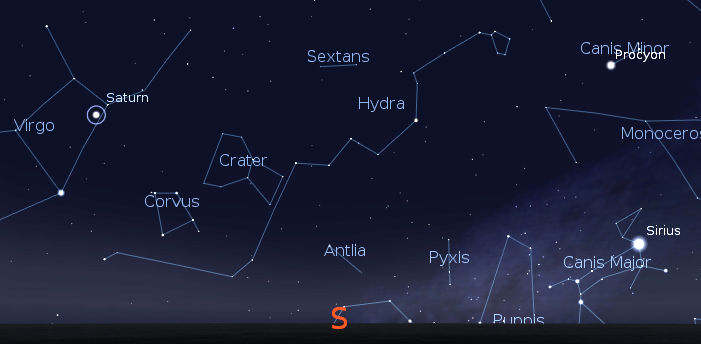
Corvus, Crater and Hydra via Stellarium for April 25, 2011 near 10 p.m.
04/22/11 – Ephemeris – The constellation Hydra and public viewing tonight
Good Friday, Friday, April 22nd. The sun rises at 6:47. It’ll be up for 13 hours and 48 minutes, setting at 8:35. The moon, 2 days before last quarter, will rise at 1:57 tomorrow morning.
Hydra the Water snake is the longest of the constellations. Its head is a group of five stars in a close group below a line between Leo the Lion and Gemini the twins in the southwest. Its stars drop down and skirt the horizon and end in the southeast. It takes a low southern horizon to follow its body. The Northwestern Michigan College’s Rogers observatory will be open tonight starting at 9 p.m. for observation of the heavens and the front half of Hydra. The featured celestial object of the evening will be the ringed planet Saturn.. The viewing night will be hosted by the Grand Traverse Astronomical Society and the NMC Astronomical Association. There will be an alternate program if its cloudy.
* Times are for the Traverse City/Interlochen area of Michigan. They may be different for your location.
Addendum
Hydra via Stellarium for April 22, 2011 at 10 p.m.
04/21/11 – Ephemeris – Queen Berenice’s hair
Thursday, April 21st. The sun rises at 6:48. It’ll be up for 13 hours and 45 minutes, setting at 8:34. The moon, 3 days before last quarter, will rise at 1:10 tomorrow morning.
High in the southeast at 10 p.m. is a tiny and faint constellation of Coma Berenices, or Berenice’s hair. In it are lots of faint stars arrayed to look like several strands of hair. The whole group will fit in the field of a pair of binoculars, which will also show many more stars. The story behind it was that Berenice was the Queen of Egypt, whose husband was away at war. This was in the days when the Greeks ruled Egypt after Alexander conquered it. She offered her golden tresses to the gods for the king’s safe return. The hair, was placed in a temple. However the offering disappeared when the king returned. Ever since then the constellation of Coma Berenices has been seen to commemorate the queen’s sacrifice.
* Times are for the Traverse City/Interlochen area of Michigan. They may be different for your location.
Addendum

Coma Berenices via Stellarium
Only one of the three stars that mark the constellation belong to the Coma Berenices star cluster near the top of this image. The cluster is about 270 light years away, making it one of the closest star clusters to us.
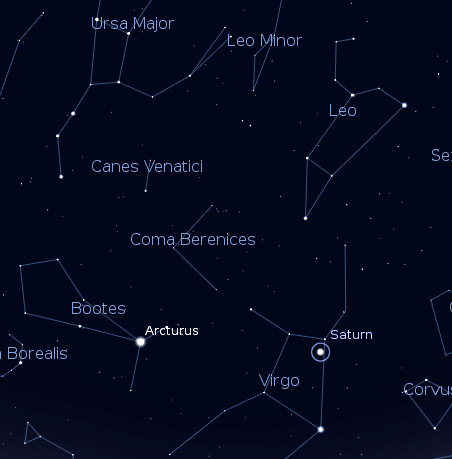
Coma Berenice Finder Chart via Stellarium
Here’s a star chart based on this evening at 10 p.m. on locating Coma Berenices in the southeastern sky.
Note: Stellarium is a free program. See the right column for a link.
04/20/11 – Ephemeris – The bright planets visible this week
Wednesday, April 20th. The sun rises at 6:50. It’ll be up for 13 hours and 42 minutes, setting at 8:33. The moon, 3 days past full, will rise at 12:13 tomorrow morning.
It’s Wednesday and time again to take a look at the whereabouts of the bright planets for this week. The ringed planet Saturn is rising before sunset and will be visible in the southeast as it gets dark. It’s near the bright star Spica to its lower left. Spica has a blue tinge, while Saturn is yellowish. It will cross the meridian due south at 12:38 a.m. and will set at 6:30 a.m. In telescopes Saturn shows its rings which are a year and a half along their seven and a half year period of opening along with at least one satellite, the large moon Titan. Venus is brilliant in the morning sky and will rise at 5:51 a.m. in the east.. It is really a beautiful sight in the morning twilight, though disappointingly small in a telescope. Jupiter, Mars and Mercury are all too close to the direction of the sun to be visible.
* Times are for the Traverse City/Interlochen area of Michigan. They may be different for your location.
04/19/11 – Ephemeris – How the Great Bear got its long tail
Tuesday, April 19th. The sun rises at 6:52. It’ll be up for 13 hours and 39 minutes, setting at 8:32. The moon, 2 days past full, will rise at 11:05 this evening.
The Greeks and Romans who saw the Great Bear, the constellation we call Ursa Major, they also saw it having a long tail. We’re more likely to see the Big Dipper. The bowl of the Big Dipper is the bear’s rump, while the handle is that notorious tail. The Big Dipper is overhead at 10 p.m. this evening. Now, to how did the ancient Romans explained the long tail. According to one story a god threw the bear into the sky. I don’t care if you’re immortal or not, you wouldn’t grab the end of the bear with the teeth. However grabbing the tail apparently caused the tail to stretch, giving the long tail we see in our skies. While the skies are dark before moonrise, check out the bear. He’s all there from the tip of his nose to the end of his claws.
* Times are for the Traverse City/Interlochen area of Michigan. They may be different for your location.
Addendum
Here’s a quotation from Star Names Their Lore and Meaning by Richard Hinckley Allen:
The long tail of the Bear, a queer appendage to a comparitively taillessanimal, is thus accounted for by old Thomas Hood in his didactic style:
Scholar.
I marvell why (seeing she hath the forme of a beare) her tail should be so long.
Master.
Imagine that Jupiter, fearing to come too nigh unto her teeth, layde hold of her tayle, and thereby drew her up into heaven; so that she of herself being very weightie, and the distance from the earth to the heavens very great, there was a great likelihood that her taile must stretch. Other reason I know none.
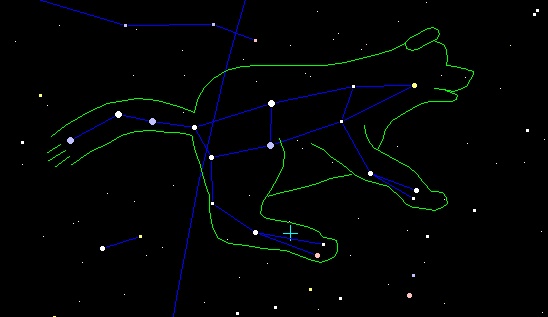
My rather crude drawing of Ursa Major, the Great Bear
04/18/11 – Ephemeris – Paschal Full Moon
Monday, April 18th. The sun rises at 6:53. It’ll be up for 13 hours and 37 minutes, setting at 8:30. The moon, 1 day past full, will rise at 9:49 this evening.
Last night our time the moon was full. It was the Paschal full moon, the first full moon of spring, or officially after March 21st. Western Christian churches celebrate Easter at the Sunday following. That would be the 24th, just one day short of the latest possible date of Easter. Eastern churches use a slightly different calendar and a different calculation method, but this year they celebrate Easter the same date. The calculation methods were chosen to make Easter roughly coincide with Jewish Passover. Christian churches use a calendar based on the earth’s orbit of the sun, or actually the seasons, while the Jewish calendar is based on the lunar cycle. That’s also pretty close this year because Passover begins tonight at sundown.
* Times are for the Traverse City/Interlochen area of Michigan. They may be different for your location.
 Bob Moler's Ephemeris Blog