Archive
05/31/11 – Ephemeris – June preview
Tuesday, May 31st. Today the sun will be up for 15 hours and 18 minutes, setting at 9:19. The moon, 1 day before new, will rise at 5:38 tomorrow morning. Tomorrow the sun will rise at 6:00.
Let’s preview June skies. There will be a lot of sun in June and very little night. The daylight hours will increase a bit from 15 hours and 19 minutes tomorrow to 15 hours and 33 minutes on the 21st, retreating back to 15 hours 30 minutes at month’s end. At this time of the year the sunset times for Ludington, Interlochen, Petoskey and Mackinaw City are very nearly the same. However the sunrise times are at their most divergent. With Ludington’s sunrise being 14 minutes later than Mackinaw City’s. The altitude of the sun above the southern horizon at local noon will hover around 68 to 69 degrees. Local noon, when the sun is actually due south will occur at about 1:43 p.m. Here’s what we’ve been waiting for: Summer will start on the 21st at 1:16 p.m.
* Times are for the Traverse City/Interlochen area of Michigan. They may be different for your location.
05/30/11 – Ephemeris – The constellation Corona Borealis
Memorial Day, Monday, May 30th. Today the sun will be up for 15 hours and 16 minutes, setting at 9:18. The moon, 2 days before new, will rise at 4:56 tomorrow morning. Tomorrow the sun will rise at 6:01.
High in the southeast east at 10:30 this evening can be seen a small nearly circular constellation of Corona Borealis, the Northern Crown. It is just below Boötes, the kite shaped constellation off the handle of the Big Dipper. According to Greek myth the crown was given by the gods to the princess Ariadne, daughter of King Minos of Crete. The crown is more like a tiara with the bright star Gemma also known as Alphecca at the front. While stars suggest that the crown is diamond studded, however the meaning of Gemma, a blossom suggests that Corona Borealis is a floral crown. Corona’s most famous star isn’t even visible to the unaided eye. It is R Coronae Borealis, a variable star, which appears to be surrounded by a dust cloud.
* Times are for the Traverse City/Interlochen area of Michigan. They may be different for your location.
Addendum

Corona Borealis with Boötes at 10:30 p.m. on May 30th. Created with Stellarium.
05/27/11 – Ephemeris – Spica, some thoughts about its future
Friday, May 27th. Today the sun will be up for 15 hours and 12 minutes, setting at 9:15. The moon, 3 days past last quarter, will rise at 3:27 tomorrow morning. Tomorrow the sun will rise at 6:03.
Yesterday I talked about Spica the bright star to the lower left of Saturn in the evening now. Spica is actually two very massive and hot stars orbiting each other in 4 days. One is 10 times the sun’s mass while the other is 7 times the sun’s mass. The more massive one will run out of hydrogen in its core first and begin to bloat in size. As it does so it will begin to transfer mass to the other star and speed up its evolution. The resulting show should be spectacular when seen at a safe distance. I’m not sure the stars 260 light year distance is safe enough. But we have many millions of years to wait before things get interesting, and that’s fine with me. What seems to be a silent, seemingly changeless sky can hide dramatic happenings.
* Times are for the Traverse City/Interlochen area of Michigan. They may be different for your location.
Addendum
Being only an amateur astronomer the above is rank speculation with no proof that the proposed events will happen. But it’s fun to think about.
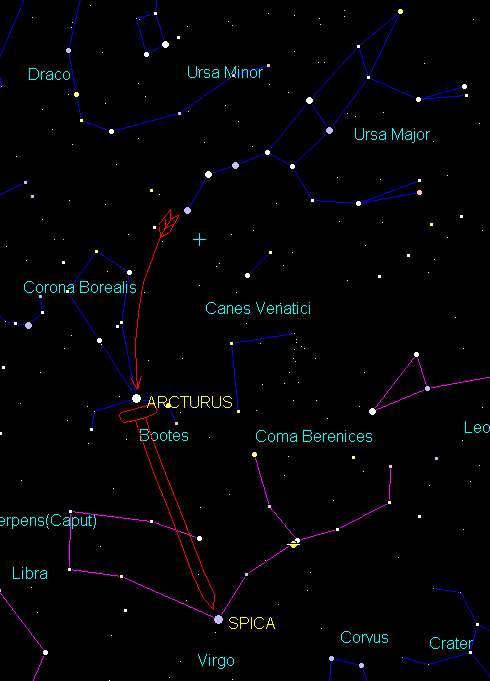
Follow the Spike to Spica, 5/26/2011
05/26/11 – Ephemeris – The bright star Spica
Thursday, May 26th. Today the sun will be up for 15 hours and 10 minutes, setting at 9:14. The moon, 2 days past last quarter, will rise at 3:04 tomorrow morning. Tomorrow the sun will rise at 6:03.
The bright star below and left of the planet Saturn these evenings is the 15th brightest night time star in the sky, called Spica. I’ve found that some pronounce it “Speeka”. Either is correct. It is the stalk of wheat the constellation Virgo is holding. Spica is actually two stars in a tight 4 day orbit of each other. They are both reasonably matched in mass and brightness. Astronomers give it a spectral type B which is a slightly blue star. I found out that once photographing a lunar eclipse near Spica, The star came out very blue. The twin stars of Spica are 260 light years away. I’m glad the stars are young now. They will have a very interesting future as they age and interact in the next few million years.
* Times are for the Traverse City/Interlochen area of Michigan. They may be different for your location.
Addendum
Follow the Spike to Spica, 5/26/2011
Note the unlables Saturn near Spics. The cross near the handle of the Big Dipper ro tail of Ursa major is the zenith at 11 p.m.
05/25/11 – Ephemeris – The bright planets this week.
Wednesday, May 25th. Today the sun will be up for 15 hours and 8 minutes, setting at 9:13. The moon, 1 day past last quarter, will rise at 2:42 tomorrow morning. Tomorrow the sun will rise at 6:04.
It’s Wednesday and time again to take a look at the whereabouts of the bright planets. The ringed planet Saturn will be visible in the south southeast as it gets dark. It’s near the bright star Spica to its lower left. Spica has a blue tinge, while Saturn is yellowish. It will cross the meridian due south at 10:13 p.m. and will set at 4:08 a.m. The morning planet traffic jam is breaking up. Rising first will be Jupiter at 4:28 a.m. in the east. Mars will rise at 5:13 followed by Venus 3 minutes later. Unless we have very clear skies and you have a very flat eastern horizon, you’d have to wait until maybe 5:15 or later to try to spot Venus. It will take binoculars to first locate them.
* Times are for the Traverse City/Interlochen area of Michigan. They may be different for your location.
05/24/11 – Ephemeris – The bright star Arcturus
Tuesday, May 24th. Today the sun will be up for 15 hours and 6 minutes, setting at 9:13. The moon, at last quarter today, will rise at 2:21 tomorrow morning. Tomorrow the sun will rise at 6:05.
Very high in the southeastern sky at 10:30 is found the kite shaped constellation of Boötes the herdsman, chasing or herding the Great Bear Ursa Major of which the Big Dipper is the hind end, across the sky. The bright star at the base of the kite is the 4th brightest night time star Arcturus. It can be found and name remembered by first locating the Big Dipper and by following the arc or curve of the handle to Arcturus. This star is an orange colored giant star, 37 light years away. Its light was used open the 1933 Chicago Worlds Fair believing its light left the star in 1893 the year of the previous Chicago Worlds Fair. It turns out that Arcturus is 3 light years closer than what they thought.
* Times are for the Traverse City/Interlochen area of Michigan. They may be different for your location.
05/23/11 – Ephemeris – The constellation Boötes
Monday, May 23rd. Today the sun will be up for 15 hours and 5 minutes, setting at 9:11. The moon, 1 day before last quarter, will rise at 1:59 tomorrow morning. Tomorrow the sun will rise at 6:06.
Appearing high in the eastern sky at 10 p.m. tonight is the kite shaped constellation of Boötes the herdsman. The bright star Arcturus is at the bottom of the kite, pointed to by the arc of the handle of the Big Dipper, overhead. In one story Boötes represents a young hunter named Arcas, son of Callisto, a beautiful young lady who had the misfortune of being loved by Zeus the chief Greek god. Zeus’ wife Hera, found out about it, and since she couldn’t punish Zeus, turned Callisto into an ugly bear. Arcas, unaware of why his mother disappeared in his youth was about to kill the bear when Zeus intervened and placed them both in the sky. Now Arcas as Boötes chases the Great Bear forever around the pole of the sky each night.
* Times are for the Traverse City/Interlochen area of Michigan. They may be different for your location.
Addendum
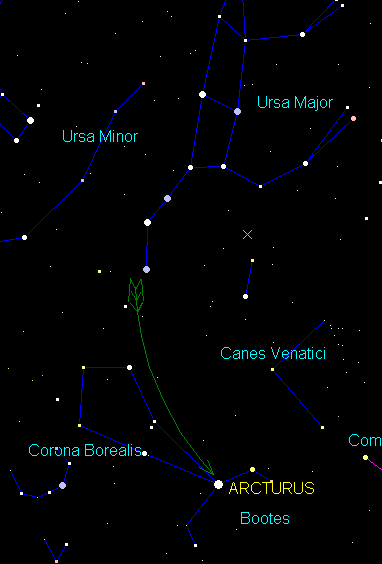
Bootes and the Big Dipper
05/20/11 – Ephemeris – Astronomy events this weekend in the Grand Traverse area
Friday, May 20th. Today the sun will be up for 14 hours and 59 minutes, setting at 9:08. The moon, 3 days past full, will rise at 12:30 tomorrow morning. Tomorrow the sun will rise at 6:08.
This weekend there are some local astronomical events It starts tonight with a viewing night at Northwestern Michigan’s Rogers Observatory with Saturn as the object best seen if it’s clear.. While the observatory opens at 9 p.m. Saturn itself will not be visible until after 9:30 due to the late sunset this time of year. The college has started to charge a fee for these event: $2 per person or $5 per family, something the Grand Traverse Astronomical Society has long opposed. Sunday the Astronomical Society will host exhibits at the NMC barbecue in the science building, plus viewing the sun if it’s clear. The society has many events this summer held at various venues around the area. Check gtastro.org for a schedule.
* Times are for the Traverse City/Interlochen area of Michigan. They may be different for your location.
05/19/11 – Ephemeris – The bright star Spica
Thursday, May 19th. Today the sun will be up for 14 hours and 57 minutes, setting at 9:07. The moon, 2 days past full, will rise at 11:47 this evening. Tomorrow the sun will rise at 6:09.
The large constellation of Virgo the reclining maiden is midway up the sky in the south when it gets dark. Virgo contains mostly faint stars in a large area of sky left of and below Leo the lion, but it has a few bright stars. Virgo’s brightest star Spica, can be found from the handle of the Big Dipper, overhead, following the arc to the star Arcturus, and straightening to a spike to Spica, the 16th brightest night time star. The planet Saturn is above and right of it. Spica is supposed to be a stalk of wheat held in Virgo’s hands. The star and Virgo itself were symbols of a bountiful harvest. The sun used to be in Virgo at the end of summer. In Egypt it was the goddess Isis, and at least one ancient temple was oriented to Spica’s setting point.
* Times are for the Traverse City/Interlochen area of Michigan. They may be different for your location.
Addendum
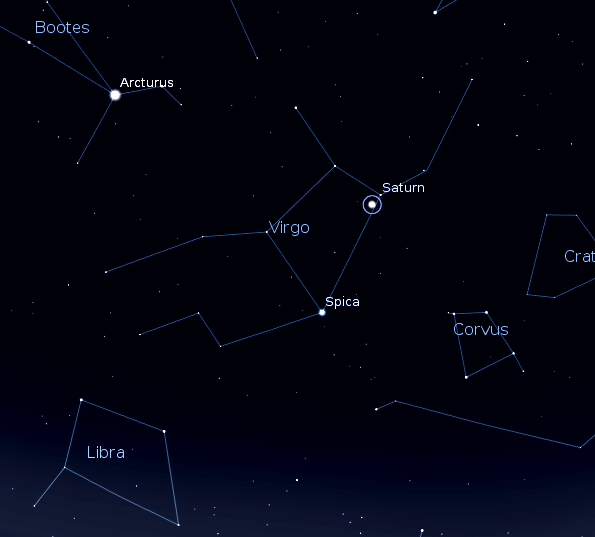
Virgo and Spica in the evening this month
05/18/11 – Ephemeris – The bright planets visible this week
Wednesday, May 18th. Today the sun will be up for 14 hours and 55 minutes, setting at 9:06. The moon, 1 day past full, will rise at 10:54 this evening. Tomorrow the sun will rise at 6:10.
It’s Wednesday and time again to take a look at the whereabouts of the bright planets. The ringed planet Saturn will be visible in the south southeast as it gets dark. It’s near the bright star Spica to its lower left. Spica has a blue tinge, while Saturn is yellowish. It will cross the meridian due south at 10:42 p.m. and will set at 4:36 a.m. The morning planet traffic jam is breaking up. Rising first will be Jupiter at 4:52 on the east. Mars will rise at 5:13 followed by Venus 3 minutes later. Mercury will rise at 5:24. Unless we have very clear skies and you have a very flat eastern horizon, you’d have to wait until maybe 5:45 to try to spot them. It will take binoculars to first locate Venus and Jupiter. Good luck finding the others.
* Times are for the Traverse City/Interlochen area of Michigan. They may be different for your location.
 Bob Moler's Ephemeris Blog