Archive
10/18/11 – Ephemeris – The Pleiades or Seven Sisters
Tuesday, October 18th. The sun will rise at 8:01. It’ll be up for 10 hours and 52 minutes, setting at 6:53. The moon, 1 day before last quarter, will rise at 11:25 this evening. | A marvelous member of the autumn skies can be found rising in the east at 9 in the evening. It is the famous star cluster called the Pleiades or the Seven Sisters. I might also add the ‘Tiny Dipper’. Many people can spot a tiny dipper shape in its six or seven stars, and mistake it for the Little Dipper. As nearsighted as I am, though corrected, I’ve never been able to see more than a few stars and a bit of fuzz. However with binoculars, even I can see over a hundred stars appear along with the dipper shape of the brightest. The fuzz I saw was unresolved stars, but in photographs the Pleiades actually contains remnant wisps of the gaseous cocoon they were born from a hundred million years ago. In Greek mythology the sisters were daughters of the god Atlas.
* Times are for the Traverse City/Interlochen area of Michigan. They may be different for your location.
Addendum
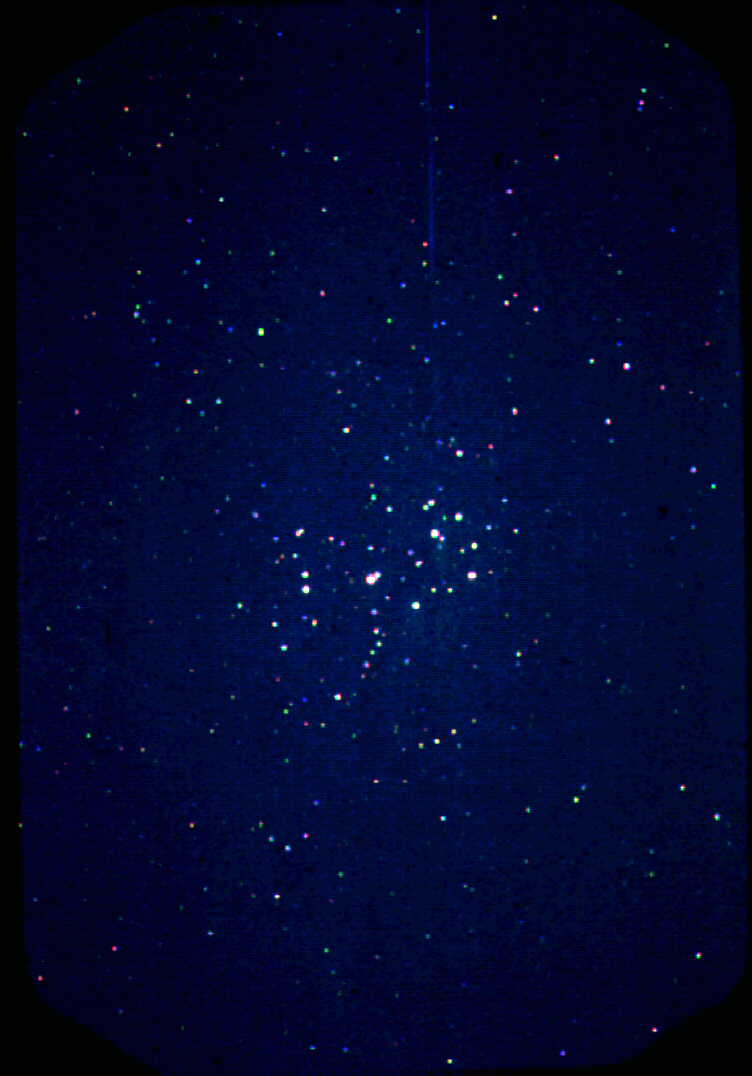
The Pleiades, about what you'd see in binoculars.
10/17/11 – Ephemeris – The constellation of Cassiopeia
Monday, October 17th. The sun will rise at 7:59. It’ll be up for 10 hours and 55 minutes, setting at 6:55. The moon, 2 days before last quarter, will rise at 10:25 this evening. | The stars of the autumn skies are replacing the summer stars from the east. Look in the northeastern sky by 9 p.m. and you can find the W shaped constellation of Cassiopeia the queen. Cassiopeia is so far north that it never sets for us in Michigan. It is opposite the pole star Polaris from the Big Dipper. There’s a dim star that appears above the middle star of the W which turns the W into a very crooked backed chair. Above and left of Cassiopeia is a dim upside down church steeple shaped constellation of Cepheus the king. The Milky Way flows through a corner of Cepheus and Cassiopeia toward the northeastern horizon and through the constellation of Perseus the hero, which kind of looks, to me, like a chicken, but that’s another story.
* Times are for the Traverse City/Interlochen area of Michigan. They may be different for your location.
Addendum
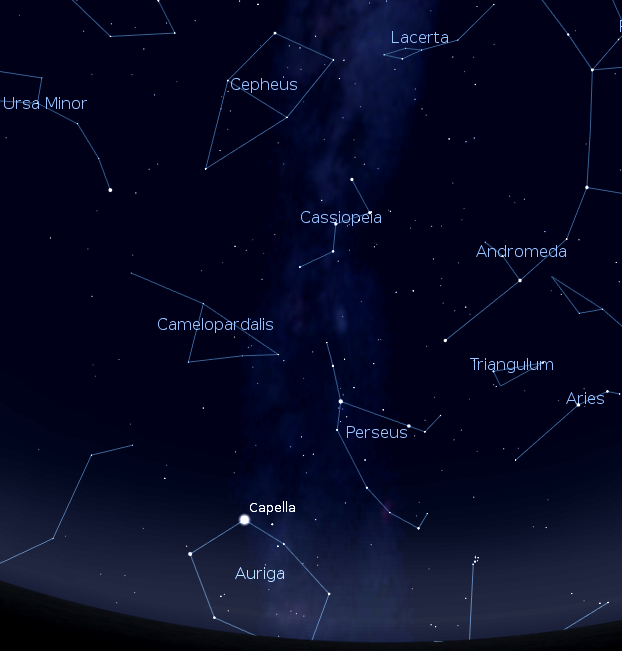
The constellation Cassiopeia and its neighbors. Created using Stellarium.
10/14/11 – Ephemeris – The Neutrino problem
Friday, October 14th. The sun will rise at 7:56. It’ll be up for 11 hours and 4 minutes, setting at 7:00. The moon, 3 days past full, will rise at 8:04 this evening.
The news came out a couple of weeks ago that some nuclear physicists apparently measured that neutrinos traveled faster than the speed of light. This needs to be corroborated before it is accepted by the physics world. We do have one good example of neutrinos traveling close to but not faster than the speed of light. That is a supernova in 1987 which was about 168 thousand light years away. The neutrinos arrived 3 hours before the light of the supernova arrived. The reason for the slightly earlier arrival time is that the neutrinos sailed from the core of the star like it wasn’t there. The light, however couldn’t escape until the explosion could push its way to the surface of the star. Neutrinos are wonderful and strange sub atomic particles. Check them out in Wikipedia.
* Times are for the Traverse City/Interlochen area of Michigan. They may be different for your location.
10/13/11 – Ephemeris – Jupiter viewing tips
Thursday, October 13th. The sun will rise at 7:54. It’ll be up for 11 hours and 7 minutes, setting at 7:01. The moon, 2 days past full, will rise at 7:29 this evening.
Jupiter is now rising before 8 p.m. in the east northeast. You’ll have to wait a couple of hours after it rises for good telescopic views of it. That was my problem in my youth with my first telescope. I was viewing Jupiter low on the horizon when it was just coming into the evening sky. I just couldn’t wait until it rose higher. The thick atmosphere of the earth I was looking through to see Jupiter washed out the planetary details of its cloud bands and Great Red Spot. So wait for later in the evening or wait a month or so until Jupiter is higher in the sky to get the best views of Jupiter in a telescope. Jupiter will be closest to the earth on the 29th of this month when it will be in opposition from the sun, rising at sunset and setting at sunrise.
10/12/11 – Ephemeris – The bright planets this week
Wednesday, October 12th. The sun will rise at 7:53. It’ll be up for 11 hours and 10 minutes, setting at 7:03. The moon, 1 day past full, will rise at 7:00 this evening.
It’s Wednesday and time again to take a look at the whereabouts of the bright planets. The planet Venus is rather close to the sun in the evening setting 38 minutes after the sun and not really visible. Jupiter is now the prominent planet of the evening sky after it rises at 7:45 p.m. in the east northeast and is seen against the stars of the constellation Aries. It will move due south at 2:34 a.m. In a telescope it will be accompanied by its 4 brightest moons, and as the planet rises higher Jupiter’s image becomes sharper, and its cloud bands will become visible. The moons and planetary features change from night to night and sometimes while you look. Mars will rise at 2:09 a.m also in the east northeast and is entering the constellation of Cancer.
* Times are for the Traverse City/Interlochen area of Michigan. They may be different for your location.
10/11/11 – Ephemeris – The Hunters Moon and libration
Tuesday, October 11th. The sun will rise at 7:52. It’ll be up for 11 hours and 13 minutes, setting at 7:05. The moon, at full today, will rise at 6:34 this evening.
Tonight’s full moon is the hunter’s moon, and it has some of the characteristics of last month’s Harvest Moon. That is the moon rises less than the average 50 minutes later each night. Tomorrow the moon will rose 26 minutes later than tonight. The moon rotates in the same time that it orbits the earth. Only the moon’s rotation is constant, but its orbit around the earth is elliptical, and is not at a constant speed. That causes the moon to wobble a bit. Tonight the south end of the moon is tilted a bit toward is as is the east or left edge. This tilt is called libration. I usually track libration by checking out the position of the small gray sea at the moon’s upper right quadrant called the Sea of Crises. It’s distance from the moon’s limb or edge is a good indicator of this libration.
* Times are for the Traverse City/Interlochen area of Michigan. They may be different for your location.
10/10/11 – Ephemeris – What happened with the Draconids last Saturday?
Columbus Day (observed), Monday, October 10th. The sun will rise at 7:51. It’ll be up for 11 hours and 16 minutes, setting at 7:07. The moon, 1 day before full, will set at 7:31 tomorrow morning.
Last Saturday nights International Observe the Moon Night coincided with the Draconid meteor shower. The Draconids are a periodic shower, not good most years, and when they do appear the shower, or rather meteor storm doesn’t last very long. The bright moon didn’t help, and the peak was predicted to occur in the afternoon our time. The meteors did appears, and right on time, too early for us to have seen it. The best way to detect them with a bright moon is with radio. And using that technique the estimated the peak of Draconid meteors was over 200 per hour. The responsible comet, Giacobini-Zinner, will pass our orbit next February, and may give us a chance to spot the Draconids in darker skies next year.
* Times are for the Traverse City/Interlochen area of Michigan. They may be different for your location.
10/07/11 – Ephemeris – International Observe the Moon Night
Friday, October 7th. The sun will rise at 7:47. It’ll be up for 11 hours and 25 minutes, setting at 7:12. The moon, half way from first quarter to full, will set at 4:28 tomorrow morning. | Tomorrow night is International Observe the Moon Night the Grand Traverse Astronomical Society will be out, if it’s clear, on the north side of Front Street in Traverse City, near the Martinek Clock. The moon will be bright and a fat gibbous phase. Later on in the evening Jupiter will appear to the east, and will provide even more moons to view. Also that night the Draconid meteor shower will be active, if we happen to pass through a cloud of comet debris from past passages of the Comet Giacobini-Zinner near this part of earth’s orbit. The Draconids have been spectacular at rare occasions in the past. We don’t expect a super shower this time, but it may be more active than it usually is. The bright moon will only allow the brightest to be seen.
* Times are for the Traverse City/Interlochen area of Michigan. They may be different for your location.
10/06/11 – Ephemeris – The Draconid meteor shower
Thursday, October 6th. The sun will rise at 7:46. It’ll be up for 11 hours and 28 minutes, setting at 7:14. The moon, 3 days past first quarter, will set at 3:26 tomorrow morning.
This weekend astronomers expect the meteor shower called the Draconids. This is a periodic shower which is active about once every six years. That is because it is related to a short period comet called Giacobini-Zinner. It was discovered in 1900 by the two named astronomers. Its orbit stretches from the earth’s orbit to somewhat past Jupiter’s. When the comet passes near the earth’s orbit we pass through a cloud of its debris when we get to that same spot. Giacobini-Zinner will do so next February. The comet’s nucleus is estimated to be a bit more than a mile in diameter. The Draconid meteors will appear to come from north of the bright star Vega, which is a bit west of overhead at 9 in the evening.
* Times are for the Traverse City/Interlochen area of Michigan. They may be different for your location.
Addendum
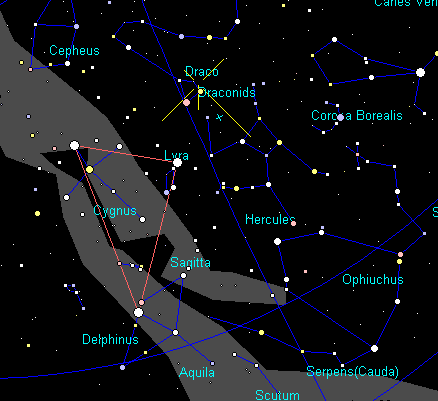
Draconid Meteor Shower Radiant
10/05/11 – Ephemeris – The bright planets visible this week
Wednesday, October 5th. The sun will rise at 7:44. It’ll be up for 11 hours and 31 minutes, setting at 7:16. The moon, 2 days past first quarter, will set at 2:21 tomorrow morning.
It’s Wednesday and time again to take a look at the whereabouts of the bright planets. The planet Venus is rather close to the sun in the evening setting 34 minutes after the sun and not really visible. The ringed planet Saturn also hidden in the bright twilight is setting 29 minutes after the sun. Jupiter is now the prominent planet of the evening sky after it rises at 8:15 p.m. in the east northeast and is seen against the stars of the constellation Aries. In a telescope it will be accompanied by its 4 brightest moons, and as the planet rises higher Jupiter’s image becomes sharper, and its cloud bands will become visible. Mars will rise at 2:14 a.m also in the east northeast and is entering the constellation of Cancer.
* Times are for the Traverse City/Interlochen area of Michigan. They may be different for your location.
 Bob Moler's Ephemeris Blog