Archive
01/20/2012 – Ephemeris – The Great Orion Nebula part 2
Ephemeris for Friday, January 20th. The sun will rise at 8:13. It’ll be up for 9 hours and 21 minutes, setting at 5:34. The moon, 3 days before new, will rise at 6:44 tomorrow morning.
The closest star nursery to us is the Great Orion Nebula, It 1,344 light years away give or take 20 light years. A light year is about 6 trillion miles, if you want to pace it out. It’s located in the constellation Orion’s sword that hangs below his belt. It shines by emission and reflection of the light of a clutch of four stars at its heart, astronomers have called the Trapezium. These extremely hot baby stars which look like eggs in a nest are not destined to live long. Unlike the sun’s 10 billion year life time these stars lifespan will be measured in millions of years. Yet do not mourn for them, Even now stars are forming in their dusty cocoons in the nebula. The Trapezium stars death will provide the material for new stars and planets to form in their stead.
* Times, as always are for the Traverse City/Interlochen area of Michigan.
Addendum
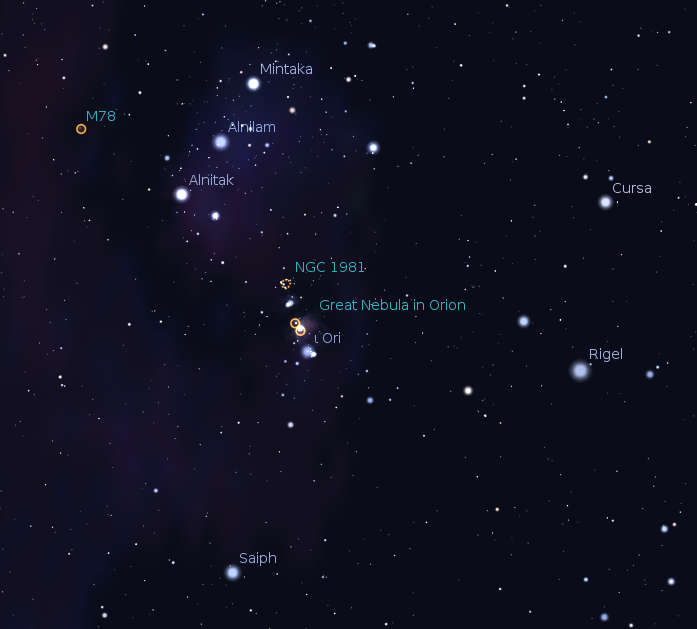
The lower part of Orion with the Great Orion Nebula. Created using Stellarium.
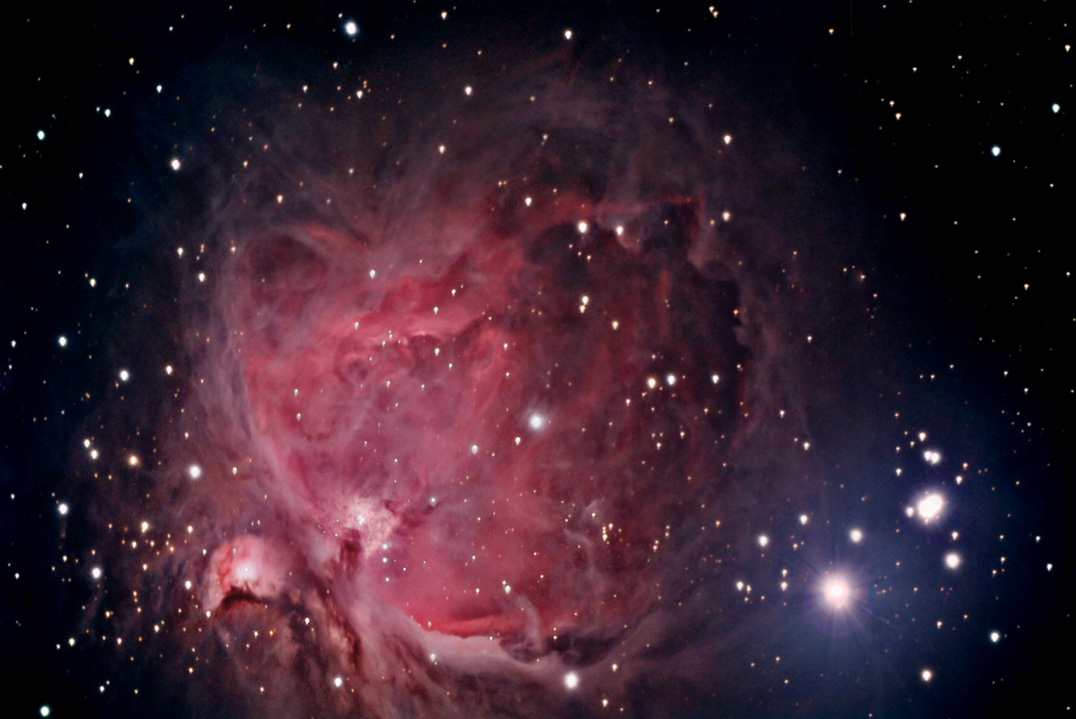
Great Orion Nebula by Scott Anttila
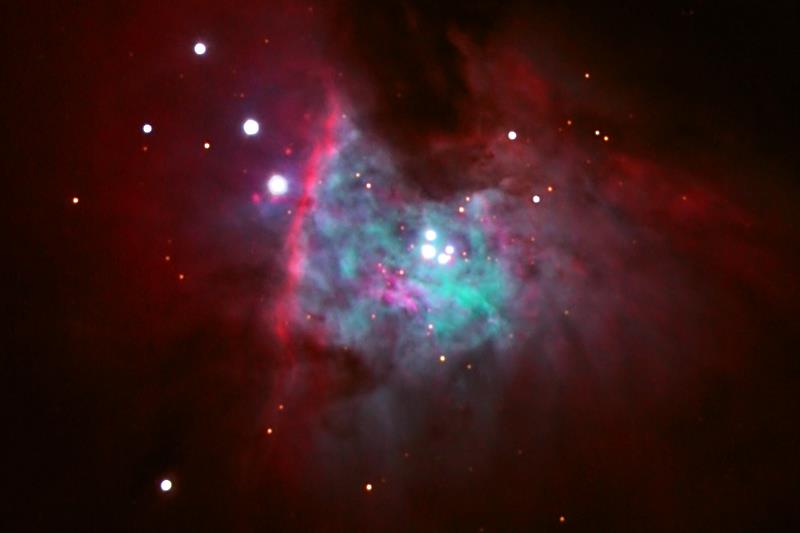
Inner part of the Great Orion Nebula. Image by Scott Anttila
This short exposure by Scott Anttila shows the Trapezium. It’s a bit rotated and enlarged compared to the photograph above, but the red bars and the Trapezium match up.
01/19/2012 – Ephemeris – The moon will pass the bright star Antares this morning
Ephemeris for Thursday, January 19th. The sun will rise at 8:13. It’ll be up for 9 hours and 19 minutes, setting at 5:32. The moon, 3 days past last quarter, will rise at 5:52 tomorrow morning.
This morning, you might want to take a quick peek outside to the southeast and see, if you can spot the crescent moon. If you can below and a bit right of it is a bright red star. That star is Antares in the constellation Scorpius, one of the first constellations of summer to appear in the evening sky. I thought you’d like the encouragement that summer is coming now that winter has finally come in earnest. The moon passes Antares every month, but this morning it appears especially close, since their actual closest approach was about 2 this morning. The entire moon may be faintly visible this morning as earthshine. Antares itself may be twinkling merrily due to earth’s atmosphere. It sometimes looks like a sparkler in binoculars.
* Times, as always are for the Traverse City/Interlochen area of Michigan.
Addendum
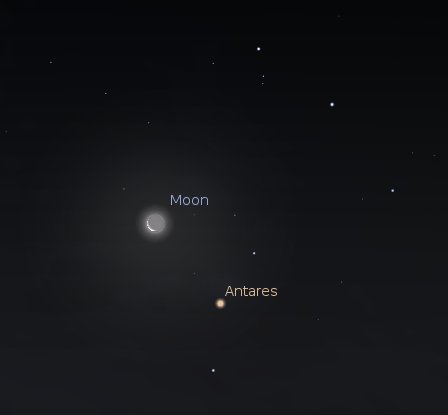
The Moon passes Antares in the morning hours of January 19, 2012. Created using Stellarium.
01/18/2012 – Ephemeris – Where are the bright planets this week
Ephemeris for Wednesday, January 18th. The sun will rise at 8:14. It’ll be up for 9 hours and 17 minutes, setting at 5:31. The moon, 2 days past last quarter, will rise at 4:51 tomorrow morning.
It’s time again to take a look at the whereabouts of the bright planets. Venus is brilliant in the southwestern sky after sunset and will set at 8:44. Jupiter is the most prominent planet of the evening sky, once Venus sets. It’s located high in the south and is seen against the stars of the constellation Aries. It will pass due south at 6:49 p.m. It will set at 1:36 a.m. Mars will rise at 10:03 p.m in the east northeast and is below the hind end of the constellation Leo the lion. It is 82.4 million miles away and closing. Mars will pass due south at 4:29 a.m. Saturn will rise at 1:15 a.m. just to the left of the bright star Spica in the east southeast.
* Times, as always are for the Traverse City/Interlochen area of Michigan.
01/17/2012 – Ephemeris – The Great Orion Nebula part 1
Ephemeris for Tuesday, January 17th. The sun will rise at 8:15. It’ll be up for 9 hours and 15 minutes, setting at 5:30. The moon, 1 day past last quarter, will rise at 3:43 tomorrow morning.
One of the great questions of Christian theologians of Galileo’s time was why God would create stars that no human could see with the naked eye. Galileo’s primitive telescope showed a myriad of formerly invisible stars. Starting with Galileo, astronomers have shown that the stars weren’t made for man, and neither are the stars eternal. Stars are born and die, some spectacularly as supernovae. In the constellation of Orion the hunter, below the three stars of his belt are what appear another three stars hanging down as his sword.. Looking at what appears as the middle star with binoculars or a telescope one can detect a haze, a nebula astronomers call it. This is the Great Orion Nebula, even now the birthplace of stars.
* Times, as always are for the Traverse City/Interlochen area of Michigan.
Addendum
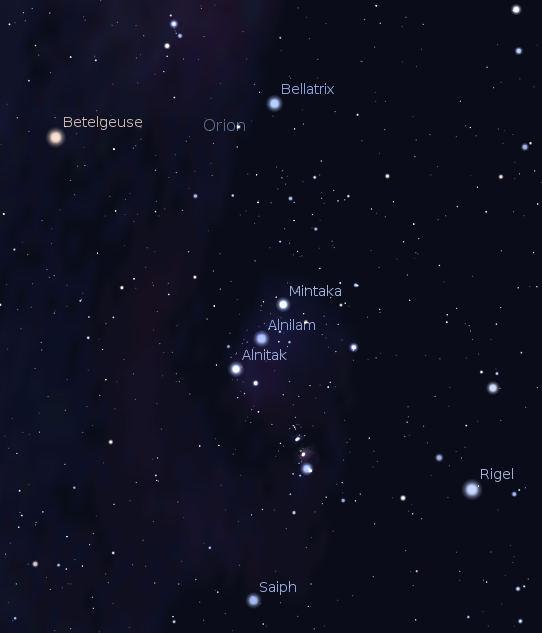
Torso of Orion centered on his belt. Created using Stellarium.
The lower part of Orion with the Great Orion Nebula. Created using Stellarium.
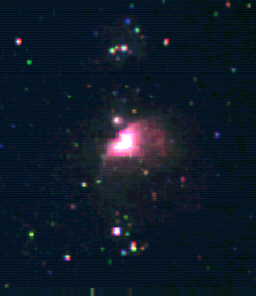
Great Orion Nebula in Orion's sword. My old photograph.
Note: The Great Orion Nebula usually photographs red due to the great abundance of the element hydrogen. However at low light levels our eyes are not sensitive to that particular color. So in the eyepiece the nebula looks gray or greenish due to the emission of hydrogen in the green and that of doubly ionized oxygen.
The Great Orion Nebula is also known by astronomers as M42 or Messier 42, a catalog of bright sky objects.
01/16/2012 – Ephemeris – The moon will appear below Saturn and Spica this morning
Ephemeris for Martin Luther King Day, Monday, January 16th. The sun will rise at 8:15. It’ll be up for 9 hours and 13 minutes, setting at 5:29. The moon, at last quarter today, will rise at 2:31 tomorrow morning. | This morning the crescent moon will appear below Saturn and the bright blue-white star Spica in the southeast before twilight brightens too much. When seen together Saturn and Spica really show the difference in their colors. Saturn reflects the light of our yellow sun, and that’s accentuated by it’s cream colored clouds. Only Saturn’s rings reflect the sun’s light pretty much unaltered because they’re made mostly of ice. Spica has the hottest surface temperature of any first magnitude star and shines with a blue tinge. This came home to me a long time ago, when I photographed a lunar eclipse with color film when the moon was next to Spica. Spica came out looking very blue indeed.
* Times, as always are for the Traverse City/Interlochen area of Michigan.
Addendum
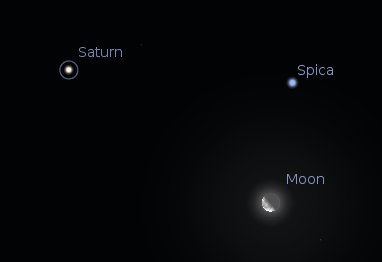
Saturn, Spica and the Moon on the morning of January 16, 2012. Created using Stellarium.
01/13/2012 – Ephemeris – The moon passes Mars tonight
Friday, January 13th. The sun will rise at 8:17. It’ll be up for 9 hours and 8 minutes, setting at 5:25. The moon, 3 days before last quarter, will rise at 10:52 this evening.
This evening the moon will pass below the planet Mars after the moon rises near 11 p.m. Mars is rather distant now, and it won’t be really near in its next close approach to us on March 5th when it will be slightly under 63 million miles away. In telescopes Mars is and will remain a tiny disk with a hint of a white polar cap on one end. Photographers with large telescopes and CCD cameras can capture Mars even better and show some surface detail. We have even closer views of Mars. Of course there is an operating rover called Opportunity still active on the planet and the Curiosity rover on its way plus three orbiting satellites, two US and one European. The satellites will be cruising overhead as Curiosity lands August 5th.
* Times, as always are for the Traverse City/Interlochen area of Michigan.
Addendum
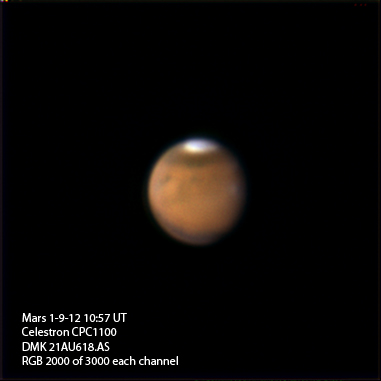
Mars on the morning of January 9, 2012. By Scott Anttila
Here’s Scott Anttila’a image of Mars from Monday morning, the 9th. Note Mar’s gibbous phase. Mars will become full when it’s at opposition from the sun March 3rd. It is only 9.7 seconds of arc in diameter. Also note, beside the northern polar cap that’s quite obvious, there is a hazy patch near the right edge of Mars. It is what telescopic astronomers of a hundred years ago called Nix Olympica, the Snows of Olympus. When the Mariner 9 spacecraft reached Mars in 1971 it found that there was a real mountain there. So the feature was renamed Olympus Mons or Mount Olympus. The white haze isn’t snow but water ice clouds that condense over the mountain peak. Mount Olympus is 14 miles high, three times taller than Mt Everest. The closest earth analog to it is the volcanic peak Mauna Kea on the island of Hawaii. Actually you’d have to throw in the entire island of Hawaii itself from the sea floor on up.
01/12/2012 – Ephemeris – Orion’s Belt
Thursday, January 12th. The sun will rise at 8:17. It’ll be up for 9 hours and 6 minutes, setting at 5:24. The moon, 3 days past full, will rise at 9:40 this evening.
Orion’s belt of three stars is one of the most noticeable star groupings in the sky. There are no other group of three bright stars in a straight line visible anywhere else in the sky. The star’s names from left to right are Alnitak, Alnilam and Mintaka. They are actually a bit farther away than the other bright stars of Orion. Alnilam, the center star is over three times the distance of red giant Betelgeuse above them and over twice as far as blue white giant star Rigel below them. Alnilam is 375 thousand times brighter than the sun according to the SIMBAD Astronomical Database. These three stars were also known as Frigga’s Spindle by the Norsemen. Frigga also known as Freya is the goddess we get the name of the day of the week Friday.
* Times, as always are for the Traverse City/Interlochen area of Michigan.
Addendum
Torso of Orion centered on his belt. Created using Stellarium.
01/11/2012 – Ephemeris – Where are the planets tonight?
Wednesday, January 11th. The sun will rise at 8:17. It’ll be up for 9 hours and 5 minutes, setting at 5:22. The moon, 2 days past full, will rise at 8:29 this evening.
It’s time again to take a look at the whereabouts of the bright planets. Venus is brilliant in the southwestern sky after sunset and will set at 8:25. Jupiter is the most prominent planet of the evening sky, once Venus sets. It’s located high in the south and is seen against the stars of the constellation Aries. It will pass due south at 7:15 p.m. It will set at 2:00 a.m.. Jupiter is a great sight in a small telescope with its four moons which change position from night to night. Mars will rise at 10:27 p.m in the east northeast and is below the hind end of the constellation Leo the lion. It is 88 million miles away and closing. Mars will pass due south at 4:54 a.m. Saturn will rise at 1:41 a.m. just to the left of the bright star Spica in the east southeast.
* Times, as always are for the Traverse City/Interlochen area of Michigan.
Addendum
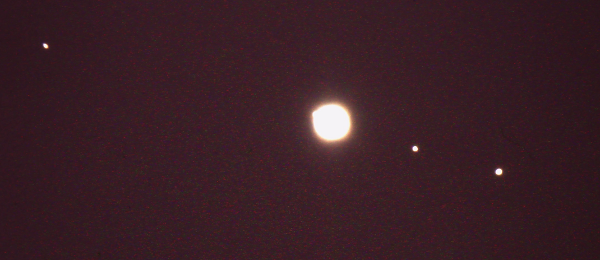
Overexposed Jupiter and its moons. My archival image.
The four Galilean satellites or moons of Jupiter are in order of distance from Jupiter Io, Europa, Ganymede and Callisto. They all orbit near Jupiter’s equator, and Jupiter itself has a very small axial tilt of about 3 degrees so the satellites seem to shuffle from one side to the other of Jupiter. The pattern is different night.
The programs Stellarium, Cartes du Ciel, and other sources including http://www.calsky.com can be used to determine the positions of the satellites. But there are clues by just looking at them.
- Io is closest to Jupiter and generally appears so. In the photograph above it appears as a bump on the left edge of Jupiter. It has a slight reddish tinge.
- Europa is dimmer than Io and also is usually close to Jupiter.
- Ganymede is easy. It’s the brightest.
- Callisto is usually found the farthest from Jupiter and is also the dimmest of the four.
Based on the photograph alone, which is undated, I’d guess that from left to right we have Callisto and Io to the left of Jupiter, Europa and Ganymede to the right.
Sometimes fewer than four satellites can be seen. They can hide in front of Jupiter, usually casting their shadow on the planet, behind Jupiter or in its shadow. Calsky will give you the times for your location.
Update
I located the date of the above image. It was taken the evening of March 17, 1989. A check with Cartes du Ciel (Sky Charts) confirm the satellite’s locations and order. Io was just ending a transit (passing in front ) of Jupiter.
01/10/2012 – Ephemeris – Venus, the evening star
Tuesday, January 10th. The sun will rise at 8:18. It’ll be up for 9 hours and 3 minutes, setting at 5:21. The moon, 1 day past full, will rise at 7:18 this evening.
Venus is getting brighter and is appearing higher in the southwest after sunset. This is our sister planet of the earth in size only. It is now nearly 115 million miles away, but it is getting closer. Venus is in an orbit inside the earth’s and is currently 67 million miles from the sun. It orbits the sun in 225 days, compared to earth’s 365 days. Right now Venus appears as a small gibbous orb. On March 27th it will appear at its greatest separation from the sun. It then will appear as half illuminated. Thereafter as it gets closer to the earth Venus will grow in size as its crescent gets thinner and thinner. When Venus passes between the earth and sun on the evening of June 5th, it will pass directly in front of the sun, an extremely rare event.
* Times, as always are for the Traverse City/Interlochen area of Michigan.
01/09/2012 – Ephemeris – Ephemeris on the Internet
Monday, January 9th. The sun will rise at 8:18. It’ll be up for 9 hours and 2 minutes, setting at 5:20. The moon, at full today, will rise at 6:09 this evening.
Although radio is a wonderful medium, it could help with a little visual assist from time to time. I have a website and a blog to help visualize the night sky and events. The website at ephemeris.bjmoler.org is updated monthly with that months sky events with illustrations and animations, while the Ephemeris Blog is updated daily at bobmoler.wordpress.com. By the way Moler is spelled simply M-O-L-E-R, no extra letters. Searching my name in Google will display these sites near the top. The blog has transcripts of the programs and best of all illustrations of the program topics, something I can’t do here. The nice thing about blogs is they are searchable by topic. I also have links to other sites if interest and free astronomical software.
* Times, as always are for the Traverse City/Interlochen area of Michigan.
Note:
These blog entries are scheduled to be released at 6 a.m. on the air date. The mp3s of the programs are available, generally a week at a time on the Ephemeris website.
 Bob Moler's Ephemeris Blog