Archive
03/08/2012 – Ephemeris – The full moon
Ephemeris for Thursday, March 8th. The sun will rise at 7:06. It’ll be up for 11 hours and 33 minutes, setting at 6:40. The moon, at full today, will rise at 7:30 this evening.
The full moon, contrary to what you’d think is a poor time to observe it. The moon is essentially gray on gray. And at full moon we are looking at the moon from about the same perspective as the sun, so there are no shadows to delineate its fine features. Since the actual instant of full moon occurred at 5 this morning, some shadows will be creeping in on the moon’s upper right face as it is seen in the evening. Full moon is the best time to see the maria or lunar seas, the dark areas that make up the man in the moon. In binoculars can be seen the bright rays emanating from the crater Tycho near the south end of the moon. Other craters have rays too, but none so long and distinctive. Night by night for the next two weeks the moon’s illuminated landscape will wane.
* Times are for the Traverse City/Interlochen area of Michigan. They may be different for your location.
Addendum
The image below is of the waxing gibbous moon presumably from last Sunday night. The phase fits Virtual Moon Atlas for that date. And I received the photo Monday. many of the full moon features including the maria and the crater Tycho can be seen on it. Click on it to see the larger version.
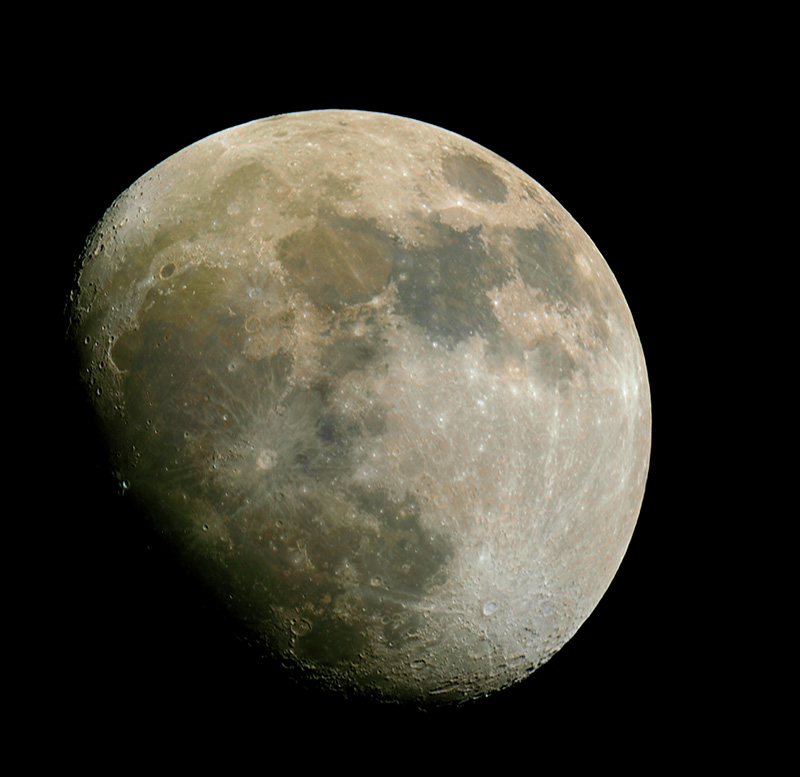
The gibbous moon 03/04/2012 by Scott Anttila
This is from Scott: “The full-size image is huge, a 6 panel mosaic by my DSLR in the (Celestron) C11. It has had the saturation boosted to show detail in the seas that otherwise is difficult if not impossible to detect. You can also see where different minerals are located in the highland areas. Not many people like this view of the moon, I’m fairly fond of it.”
03/07/2012 – Ephemeris – Where are the bright planets this week?
Ephemeris for Wednesday, March 7th. The sun will rise at 7:08. It’ll be up for 11 hours and 30 minutes, setting at 6:38. The moon, 1 day before full, will set at 6:47 tomorrow morning.
Let’s see what’s happening with the bright planets for this week. Mercury will make a brief appearance in the west after sunset. It will set at 8:15. Venus is brilliant in the western sky after sunset and will set at 10:39 in the west. Jupiter the second brightest planet after Venus is located just above it. They are approaching each other. Jupiter will set at 10:57 p.m.. Mars is up by sunset in the east and is in the constellation Leo the lion. It is 62.6 million miles away . It’s now as bright as most first magnitude stars. Mars will pass due south at 12:37 a.m. and will be setting in the west at sunrise. Saturn will rise at 10:00 p.m. just to the left of the bright star Spica in the east southeast. The moon will appear near it on Saturday evening.
* Times are for the Traverse City/Interlochen area of Michigan. They may be different for your location.
Addendum
Below is Mars a photo by Scott Anttila.
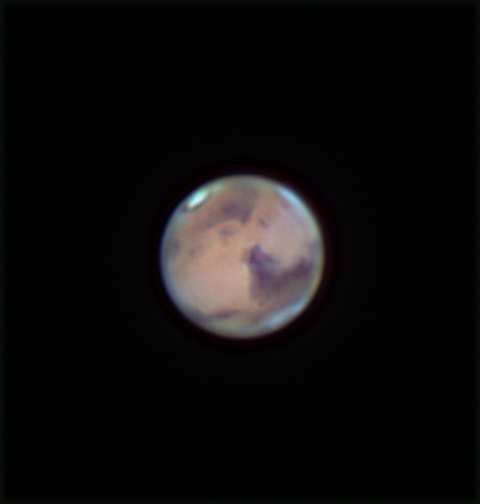
Mars on the morning of March 5, 2012 by Scott Anttila
Scott’s description: “Near 100% illumination, Syrtis Major, the Horse Tail, small polar cap, clouds all around the equatorial area. It is a quick and dirty processing of the Image. There might be more detail that can be teased out when I have more time.”
Syrtis Major is the large dark area. The name means Great Swamp. i am unfamiliar with the Horse Tail. I’m guessing that it’s the linear dark feature on the lower left of the image. If so the proper name is Sinus Sabaeus. Sinus is “Bay”. Ther are no bays or swamps on bone dry Mars or for that matter seas on the moon. The names were established before the nature of these features were known.
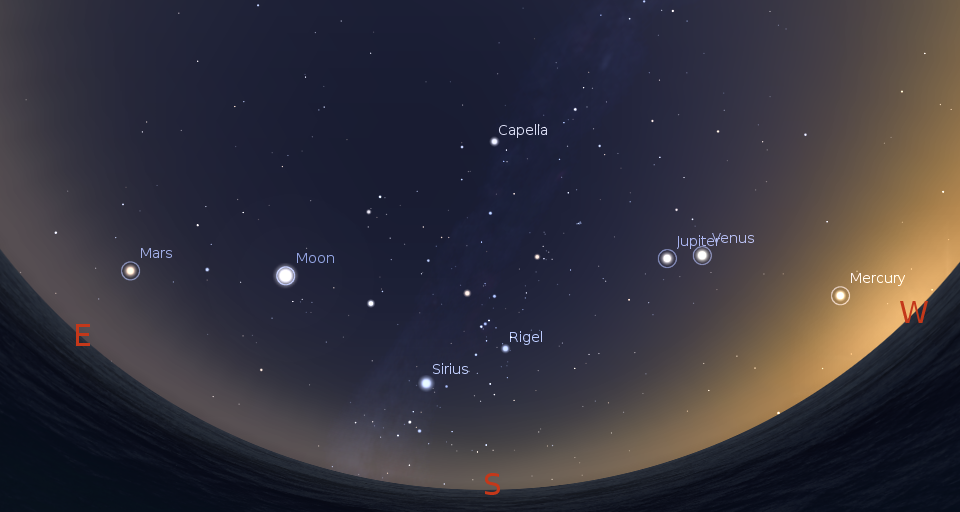
The sky after sunset showing all the evening planets. Created using Stellarium.
This is from Monday, but still pretty close to tonight’s view.
03/06/2012 – Ephemeris – Comparing Mercury with the moon
Ephemeris for Tuesday, March 6th. The sun will rise at 7:10. It’ll be up for 11 hours and 27 minutes, setting at 6:37. The moon, 2 days before full, will set at 6:18 tomorrow morning.
The planet Mercury, which is visible shortly after sunset, is the smallest planet and the one closest to the sun. Its diameter of about 3,030 miles is 50 percent larger than the moon. At first glance Mercury looks like the moon. However to the spacecraft now orbiting Mercury, it appears as a much different place. Mercury is very dense with a large iron core. The moon in contrast is a lightweight. There are no dark lava plains called seas on Mercury, as there are on the near face of the moon. The largest impact basin on Mercury is the Caloris basin, some 650 miles in diameter. At the antipodal point from the Caloris Basin, there is a patch of jumbled terrain actually called Weird Terrain where the impact forces were focused.
* Times are for the Traverse City/Interlochen area of Michigan. They may be different for your location.
03/05/2012 – Ephemeris – Mars closest and Mercury at greatest elongation from the sun
Ephemeris for Monday, March 5th. The sun will rise at 7:12. It’ll be up for 11 hours and 24 minutes, setting at 6:36. The moon, 3 days before full, will set at 5:48 tomorrow morning.
The planet Mars is at its closest to the earth of this time around today. The distance is 62.6 million miles. All planets have elliptical orbits. The Earth varies its distance from the sun by 3 million miles. Mars has a remarkably elliptical orbit which varies its distance from the sun by nearly 30 million miles. It is now at its farthest from the sun. Another small planet is making its appearance in the evening sky now. That’s Mercury seen low in the west after sunset, much closer to the horizon than bright Venus and Jupiter. Mercury is at its greatest apparent distance or elongation from the sun. Mercury will set at 8:14 p.m. It is hard to spot in twilight, so binoculars will help. Like Mars Mercury’s orbit is also very elliptical.
* Times are for the Traverse City/Interlochen area of Michigan. They may be different for your location.
Addendum
The southern sky with the planets at 7:15 p.m. Created using Stellarium.
The sky after sunset showing all the evening planets. Created using Stellarium.
Click on the image to enlarge.
03/02/2012 – Ephemeris – My talk tonight on Radio Astronomy
Ephemeris for Friday, March 2nd. The sun will rise at 7:17. It’ll be up for 11 hours and 14 minutes, setting at 6:32. The moon, 2 days past first quarter, will set at 4:02 tomorrow morning.
Radio astronomy will be the topic of yours truly this evening at the Grand Traverse Astronomical Society’s monthly meeting at 8 p.m. at Northwestern Michigan College’s Rogers Observatory. Prompted by my recent tour of the National Radio Astronomy Observatory in Green Bank West Virginia, I’ll overview this window on the universe that opened up after World War II. Starting at 9 p.m. will be the monthly viewing night at the observatory. On tap if its clear will be the moon and the planets Venus, Jupiter plus Mars at its closest this time around. The Observatory is located south of Traverse City on Birmley Road off either Garfield or Keystone roads.
* Times are for the Traverse City/Interlochen area of Michigan. They may be different for your location.
Addendum
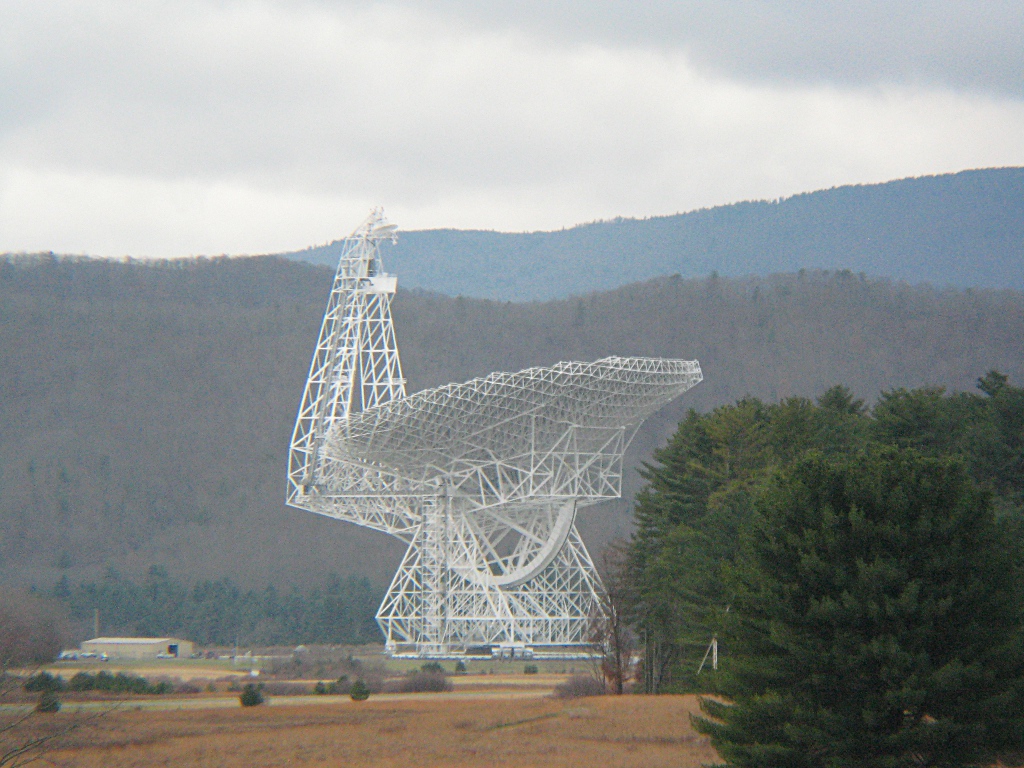
The Green Bank Telescope (GBT) the largest steerable radio telescope in the world
This is located at the National Radio Astronomy Observatory (NRAO) in Green Bank, WV. I visited there last November.
03/01/2012 – Ephemeris – Preview of March skies
Ephemeris for Thursday, March 1st. The sun will rise at 7:19. It’ll be up for 11 hours and 11 minutes, setting at 6:30. The moon, 1 day past first quarter, will set at 3:18 tomorrow morning.
Let’s look at the skies for the month of March. The sun will pass the celestial equator as the promising season of spring will begin. Daylight hours in the Interlochen/Traverse City area and will increase from 11 hours and 11 minutes today to 12 hours 44 minutes on the 31st. The altitude, or angle, of the sun above the southern horizon at local noon will be 38 degrees today and will ascend to nearly 50 degrees on the 31st. The altitude of the sun in the Straits area will be a degree lower. Local apparent noon this month, when the sun passes due south, will be about 12:49 p.m. Spring will begin on the 20th at 1:14 a.m. Mars will be in opposition with the sun Saturday and closest to us on Monday.
* Times are for the Traverse City/Interlochen area of Michigan. They may be different for your location.
 Bob Moler's Ephemeris Blog