Archive
07/05/2012 – Ephemeris – The Summer Triangle
Ephemeris for Thursday, July 5th. Today the sun will be up for 15 hours and 26 minutes, setting at 9:30. The moon, 2 days past full, will rise at 10:37 this evening. Tomorrow the sun will rise at 6:04.
Now that summer is here, the asterism or informal constellation called the Summer Triangle can be seen high in the east as it gets dark. Highest of the three bright stars is Vega in the constellation Lyra the harp, whose body is seen in a narrow parallelogram nearby. The second star of the triangle is Deneb lower and left of Vega, It appears dimmer than Vega because its is by far the most distant of the three. The third star of the Summer Triangle is seen farther below and right of Vega. It is Altair in Aquila the eagle, and the closest. Altair is 16.7 light years away, Vega is 25 light years while Deneb may be a whopping 1,550 light years away. [One light year is 6 about trillion miles. That’s 6 with 12 zeros after it.]
Times are for the Traverse City/Interlochen area of Michigan. They may be different for your location. Bracketed text was omitted from the broadcast due to time constraints.
Addendum
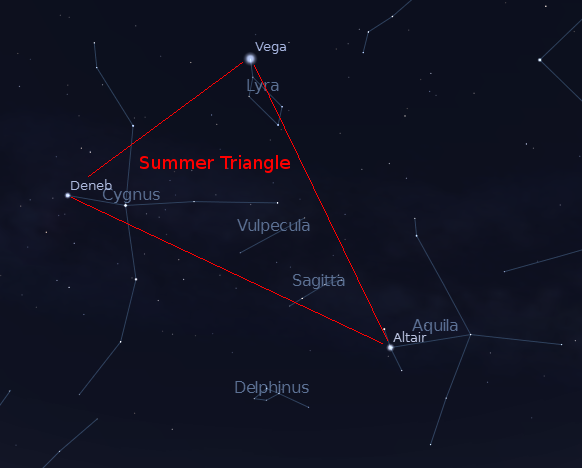
The Summer Triangle July 5, 2012 at 11 p.m. Created using Stellarium and The Gimp.
07/04/2012 – Ephemeris – The earth at aphelion
Ephemeris for Independence Day, Wednesday, July 4th. Today the sun will be up for 15 hours and 27 minutes, setting at 9:30. The moon, 1 day past full, will rise at 10:02 this evening. Tomorrow the sun will rise at 6:03.
Today, Independence Day the earth is at its greatest distance from the sun or about 94.5 million miles from the sun. It doesn’t do much to weaken the strength of sunlight, as you will find out when you go to the beach, But, occurring in summer, makes summer the longest season by a several days over winter. Our calendar tries to keep up with the seasonal or tropical year, while the earths revolution from its farthest or aphelion point to the next is slightly longer. Back in 1776 at the founding of our country the earth was farthest from the sun on June 30th. As we go more centuries into the future summer will get even a bit longer. But remember the poor Aussies whose winter will also get longer.
Times are for the Traverse City/Interlochen area of Michigan. They may be different for your location.
Addendum
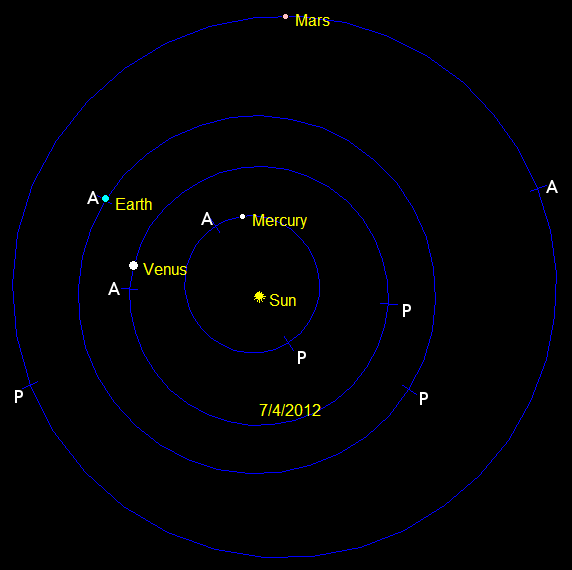
The orbits of the inner planets. (P)erihelion – (A)phelion
Perihelion is the closest point in an orbit to the sun, while aphelion is the farthest. The earth and Venus have the most circular orbits while Mars and Mercury have markedly elliptical orbits.
07/03/2012 – Ephemeris – How Curiosity will land on Mars
Ephemeris for Tuesday, July 3rd. Today the sun will be up for 15 hours and 28 minutes, setting at 9:30. The moon, at full today, will rise at 9:21 this evening. Tomorrow the sun will rise at 6:03.
At 1:31 on the morning of August 6th our time the Curiosity Rover will land on Mars. The entry, descent and landing of the rover will take just 7 minutes from first encountering the martian atmosphere. The planning to land this nearly one ton lander on Mars was enormous. There’s a heat shield to initially slow the spacecraft, then there is a parachute to slow it more. It will be on the parachute for a maximum of 90 seconds. Then 8 rockets will slow the rover more. These are on the descent stage with the rover tucked underneath. At the proper altitude the descent stage will lower the rover to the ground by cable, then fly off to crash some distance away. This isn’t the half of it. Check out the planetary dot org blog section for more details.
Times are for the Traverse City/Interlochen area of Michigan. They may be different for your location.
Addendum
How Curiosity Will Land – Part 1
How Curiosity Will Land – Part 2
Youtube video: “Challenges of Getting to Mars: Curiosity’s Seven Minutes of Terror”
07/02/2012 – Ephemeris – The KELT North Telescope
Ephemeris for Monday, July 2nd. Today the sun will be up for 15 hours and 28 minutes, setting at 9:30. The moon, 1 day before full, will set at 5:56 tomorrow morning. Tomorrow the sun will rise at 6:02. | Where astronomical telescopes are concerned the general rule is the bigger the better. By bigger I mean wider. The larger diameter of a telescope allows it to gather more light and resolve finer detail. These monsters have grown to be 10 meters in diameter with even larger ones in the planning stage. At the other end is the KELT North Telescope, one of a pair of telescopes stationed north and south of the equator. They use an 80 millimeter diameter telephoto lens to scan the sky in big chunks looking for exoplanets by the transit method, detecting the dimming of light of stars by an intervening planet, like our transit of Venus last month. The KELT North Telescope has found two of them so far.
Times are for the Traverse City/Interlochen area of Michigan. They may be different for your location.
 Bob Moler's Ephemeris Blog