Archive
11/30/2012 – Ephemeris – Previewing December skies
Ephemeris for Friday, November 30th. The sun will rise at 7:58. It’ll be up for 9 hours and 5 minutes, setting at 5:03. The moon, 2 days past full, will rise at 6:58 this evening.
Let’s look at the month of December which starts tomorrow. The hours of daylight will change little except to be darker in the morning and lighter in the evenings. In the Traverse City/Interlochen area sunset will be from 5:03 today, down to 5:02 and then advancing to 5:12 at the end of the month. The earliest sunset will be around the 10th. There is more movement in the sunrise times which will advance from 7:59 this morning to 8:19 on the 31st.Dec 1. Winter will officially arrive at the winter solstice on the 21st at 6:12 a.m. The noontime sun will dip from 23 ½ degrees to a bit less than 22 degrees above the southern horizon on that day. Daylight hours will drop from 9 hours 3 minutes tomorrow to 8:48 on the solstice.
Times are for the Traverse City/Interlochen area of Michigan. They may be different for your location.
11/29/2012 – Ephemeris – Sunita Williams, Astronaut
Ephemeris for Thursday, November 29th. The sun will rise at 7:57. It’ll be up for 9 hours and 6 minutes, setting at 5:04. The moon, 1 day past full, will rise at 6:06 this evening.
NASA astronaut Sunita Williams, Yury Malenchenko and Japanese astronaut Aki Hoshide landed last week Sunday in Kazakhstan with their Soyuz capsule after 125 days on the International Space Station. Williams and Hoshide went on three space walks to make repairs. This makes Sunny, as she likes to be called a total of 50 hours and 40 minutes of space walk time during seven EVAs, the most for any female. In her two space missions, she’s spent a total of 322 days in space, tops for a US woman. Perhaps the funniest incident that occurred to her was on her first trip to the space station. She requested a tube of wasabi sauce to spice up her food, she’s Indian American, The tube sprayed all over in the stations low air pressure and made quite a mess.
Times are for the Traverse City/Interlochen area of Michigan. They may be different for your location.
Addendum
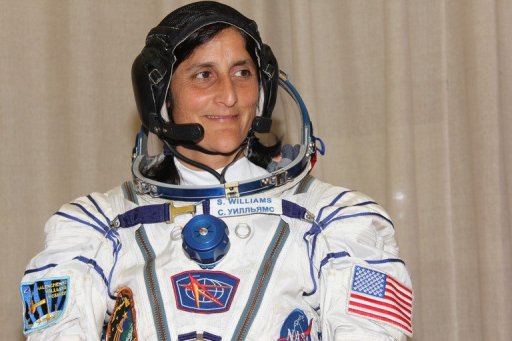
Sunita Williams in a Russian Sokol space suit prior to the Soyuz launch.
She was a flight engineer for Expedition 32, and station commander for Expedition 33, the second female station commander.
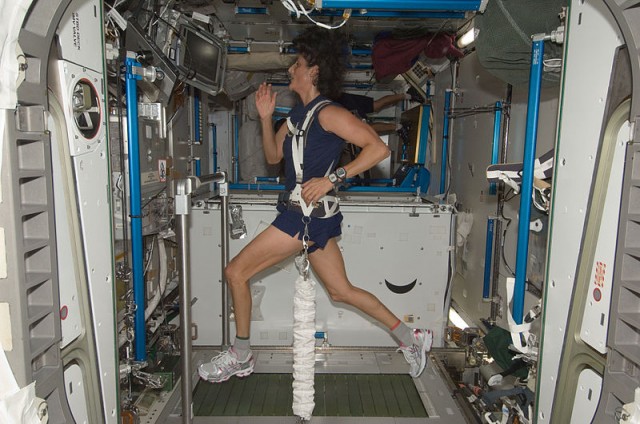
Sunny Williams doing the running leg of a triathlon aboard the ISS.

Astronaut Sunita Williams and her crew mates Russian cosmonaut Yury Malenchenko and Japanese astronaut Aki Hoshide
11/28/2012 – Ephemeris – Where are the bright planets this week?
Ephemeris for Wednesday, November 28th. The sun will rise at 7:56. It’ll be up for 9 hours and 8 minutes, setting at 5:04. The moon, at full today, will rise at 5:18 this evening.
Let’s check out the planets for this week. First there will be a penumbral eclipse of the moon this morning which we will not be able see. Penumbral eclipses are not very noticeable. At 6:15 p.m. Mars can be seen low in the southwest. Mars will set at 7:07. The planetary action will have already picked up on the other side of the sky. Jupiter, will rise at 5:16 p.m. in the east northeast. It is located in the constellation of Taurus. Tonight it will appear right above the moon. It will transit or pass due south at 12:49 a.m. Jupiter will reach opposition from the sun this Saturday December 1st, and will officially be part of the evening sky. Saturn will be the next planet to rise at 5:15 a.m. in the east southeast. Venus will rise at 5:23 and is almost directly below Saturn. Mercury will rise at 6:13 and will be seen below and left of Venus.
Times are for the Traverse City/Interlochen area of Michigan. They may be different for your location.
Addendum
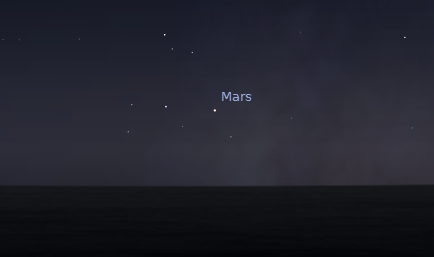
Mars low in the southwest at 6:15 p.m. on November 28, 2012. Created using Stellarium.
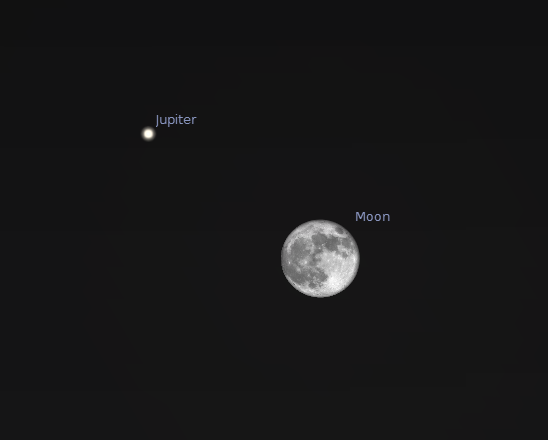
Jupiter and the Moon at 6:15 p.m. low in the east northeast on November 28, 2012. Created using Stellarium.
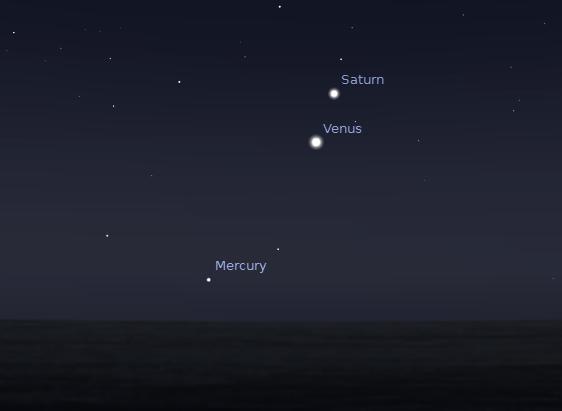
Saturn, Venus and Mercury low in the east southeast at 6:30 a.m. November 29, 2012. Created using Stellarium.
11/27/2012 – Ephemeris – What’s Curiosity’s big secret?
Ephemeris for Tuesday, November 27th. The sun will rise at 7:55. It’ll be up for 9 hours and 10 minutes, setting at 5:05. The moon, 1 day before full, will set at 7:53 tomorrow morning.
Last Tuesday NPR’s Joe Palca revealed that John Grotzinger the Principal Investigator for the Curiosity Rover mission on Mars had let slip that they may soon announce an earth shaking discovery. The Jet Propulsion Laboratory and NASA have been backpedaling ever since. The announcement may come next week Monday. The discovery may have been made with the SAM instrument, the most complex chemical lab sent into space. SAM is an acronym for Sample Analysis at Mars. It is hoped that SAM might detect organic compounds. Maybe it has. The Viking missions in 1976 failed to detect organics. It’s thought for organics to survive they would have to be below the surface shielded from the sun’s x-rays that get in through Mars’ thin atmosphere.
Times are for the Traverse City/Interlochen area of Michigan. They may be different for your location.
Addendum
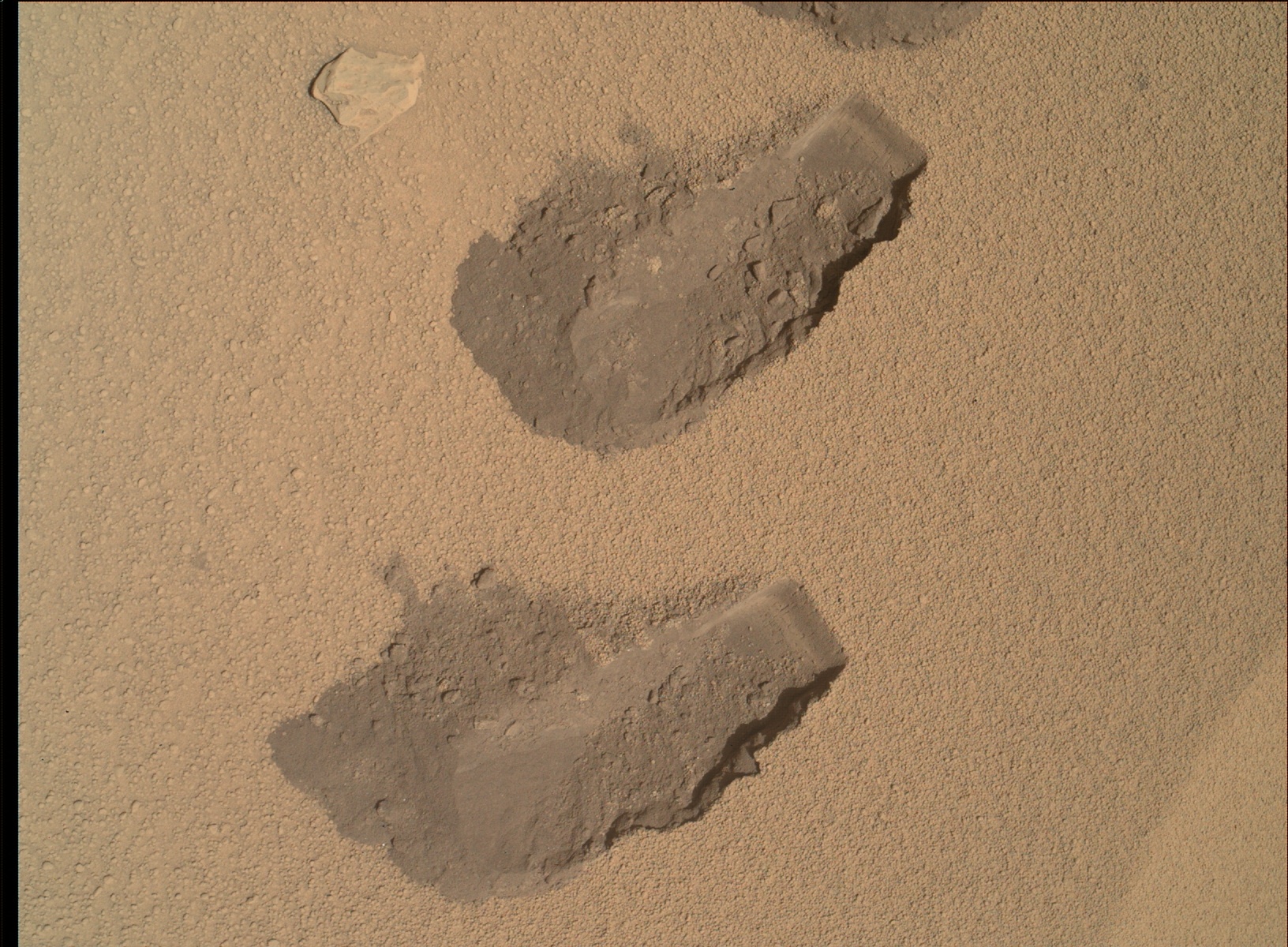
Scoop marks at RockNest. Image credit: NASA/JPL-Caltech/Malin Space Science Systems. Did the sample in question come from there?
When the Bad Astronomer Phil Plait posted his take on this last week. I responded that I thought it was a discarded Earth Bar wrapper. Think about it.
11/26/2012 – Ephemeris – Saturn and Venus pass in the morning twilight
Ephemeris for Monday, November 26th. The sun will rise at 7:53. It’ll be up for 9 hours and 11 minutes, setting at 5:05. The moon, 2 days before full, will set at 6:58 tomorrow morning.
This morning the planet Saturn will appear to the left of the much brighter Venus. By tomorrow morning Venus will be below Saturn. Both are moving eastward against the stars, but Venus being closer is moving faster. Venus is moving around and behind the sun from our vantage point. On March 28th next year it will pass behind the sun and will enter the evening sky. Saturn will increase its apparent distance from the sun and will be visible in the evening in late spring. Saturn is perhaps everyone’s favorite planets due to its spectacular rings that can be spotted in just about any telescope. This and next year the rings will be open to nearly their widest extent. Still orbiting Saturn the Cassini spacecraft is going strong.
Times are for the Traverse City/Interlochen area of Michigan. They may be different for your location.
Addendum
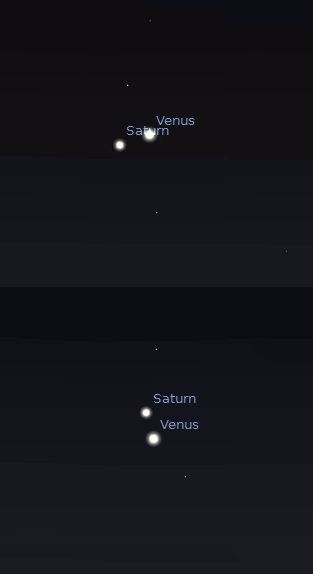
Venus and Saturn on the mornings of November 26 & 27, 2012 at 6:30 a.m. Created using Stellarium.
The long pause is on the 27th.
11/23/2012 – Emphemeris – Think Tatooine is special? How about a planet in a 4 star system.
Ephemeris for Friday, November 23rd. The sun will rise at 7:50. It’ll be up for 9 hours and 17 minutes, setting at 5:07. The moon, 3 days past first quarter, will set at 3:59 tomorrow morning.
The satellite named Kepler, which is attempting to detect planets around other stars has been up there for over 3 years and has received a mission extension. It is looking at a single patch of the sky in the constellation Cygnus. The count of confirmed and unconfirmed planets has risen to 23 hundred. Confirmations have to be done by ground based telescopes, so it will take a while to investigate all the finds for planets. The public can help sift through the Kepler data at www.planethunters.org. In fact the first planet hunters discovery was announced last month: A planet orbiting a pair of stars in the 4 star system. That’s a real feat considering they all look like a single point of light to Kepler.
Times are for the Traverse City/Interlochen area of Michigan. They may be different for your location.
Addendum
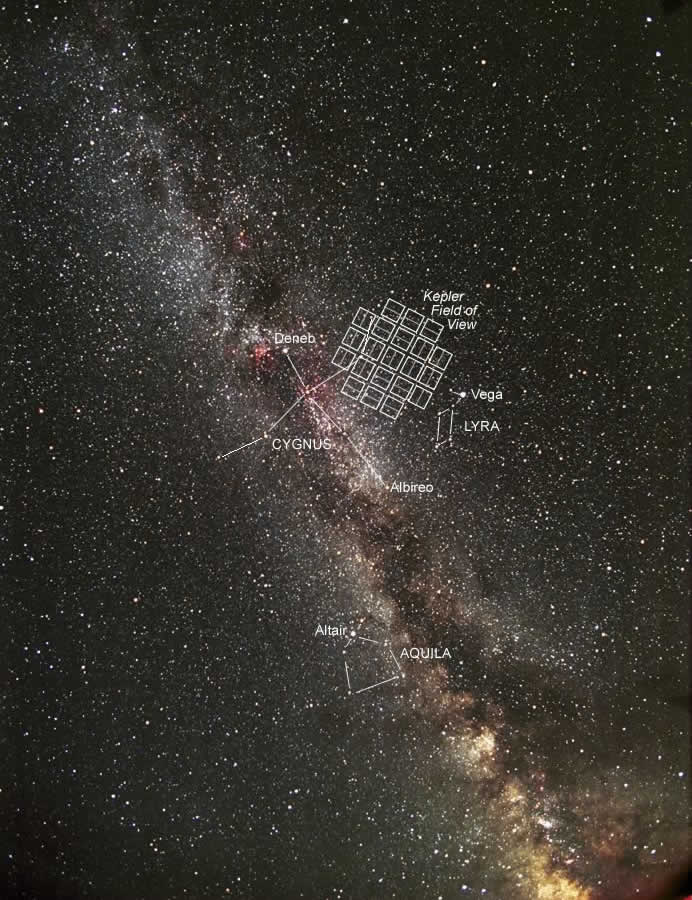
Kepler field of view. Credit C. Roberts, NASA.
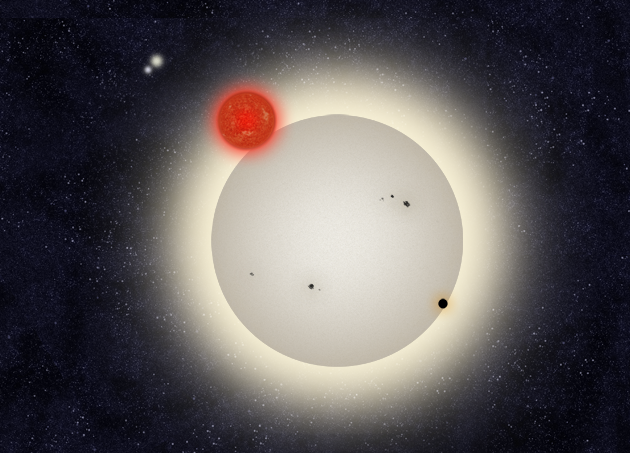
Artist’s rendition of PH1 (Planet Hunters 1) a planet in a 4 star system. Image credit: Haven Giguere/Yale.
Here’s the post from the Planet Hunters blog.
11/22/2012 – Ephemeris – Celestial navigation in the days of the Pilgrims
Ephemeris for Thanksgiving Day, Thursday, November 22nd. The sun will rise at 7:48. It’ll be up for 9 hours and 19 minutes, setting at 5:08. The moon, 2 days past first quarter, will set at 2:58 tomorrow morning.
Back in the days of the Pilgrims navigation was much less certain than it is today. At the mercy of the winds and weather, sailing took a lot of courage. Celestial navigation took the form of measuring the altitude of the pole star Polaris at night and the sun at noon. That and tossing a log overboard attached to a rope with knots at regular interval to gauge their speed and progress. That’s where we get the term knots as a measure of speed for nautical and aviation use. Today we have GPS to tell us where we are. However that is based on the position of not stars, but quasars, bright nuclei of distant galaxies, whose motions are currently too small to measure. Have a happy Thanksgiving.
Times are for the Traverse City/Interlochen area of Michigan. They may be different for your location.
Addendum
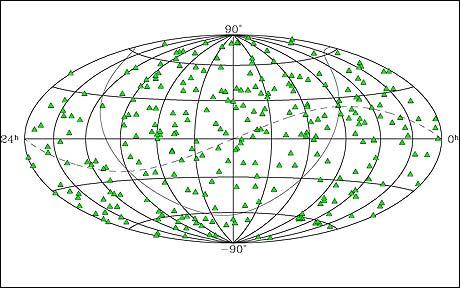
All sky map of quasar locations used as the celestial markers for the GPS system. Chart by David Bobolz, US Naval Observatory.
The chart above is from an article in the Telegraph.
11/21/2012 – Ephemeris – Where are the bright planets this week?
Ephemeris for Wednesday, November 21st. The sun will rise at 7:47. It’ll be up for 9 hours and 21 minutes, setting at 5:09. The moon, 1 day past first quarter, will set at 1:55 tomorrow morning.
Let’s check out the planets for this week. At 6:15 p.m. Mars can be seen low in the southwest. Mars, being the nearest planet outside the earth’s orbit takes its own sweet time leaving the evening sky. Mars will set at 7:10. The planetary action will have already picked up on the other side of the sky. Jupiter, will rise at 5:47 p.m. in the east northeast. It is located in the constellation of Taurus. It will transit or pass due south at 1:25 a.m. The morning planet Venus is the next planet to rise at 5:08 a.m. also in the east. Venus is now near the bright star Spica in the constellation of Virgo. Saturn can now be seen after it rises in the east southeast at 5:35 a.m. as twilight brightens. It’s approaching Venus from the lower left.
Times are for the Traverse City/Interlochen area of Michigan. They may be different for your location.
Addendum
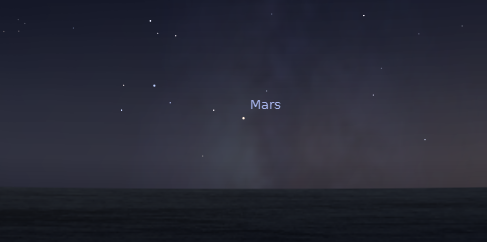
Mars low in the southwest at 6:15 p.m. November 21, 2012. Created using Stellarium.
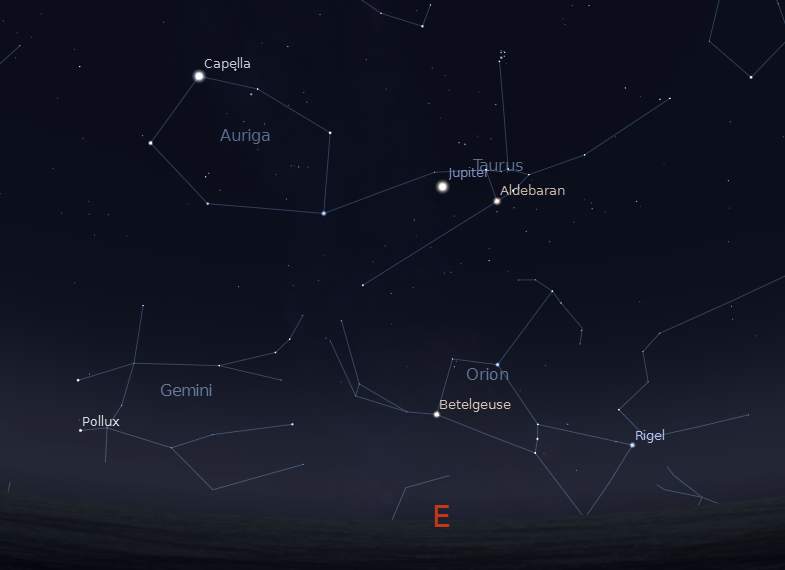
Jupiter with the rising winter constellation is the east at 9 p.m. November 21, 2012. Created using Stellarium.
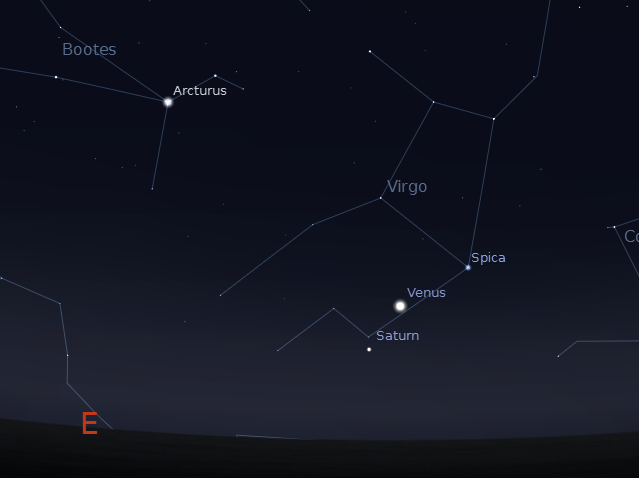
Venus and Saturn low in the east southeast at 6:30 a.m. November 22, 2012. Created using Stellarium.
11/20/2012 – Ephemeris – Tides from Sandy to Galaxies
Ephemeris for Tuesday, November 20th. The sun will rise at 7:46. It’ll be up for 9 hours and 23 minutes, setting at 5:09. The moon, at first quarter today, will set at 12:50 tomorrow morning.
It was three quarters of the moon’s revolution ago or three weeks that the moon was full and adding to the storm surge of Hurricane Sandy. When the moon is full or new the moon’s greater tidal force adds to the sun’s giving us the highest tides called spring tides. Tides are caused by the difference in the gravitational pull on a body from on side to the other when two bodies are close. That’s why the moon exerts a greater tidal force than the sun, even thought its very much less massive. Tides just don’t occur in earth’s oceans. Jupiter’s tidal force tore apart Comet Shoemaker-Levy 9 two years before its more than 20 pieces plunged into Jupiter’s atmosphere in 1994. Colliding galaxies exhibit tidal tails.
Times are for the Traverse City/Interlochen area of Michigan. They may be different for your location.
Addendum
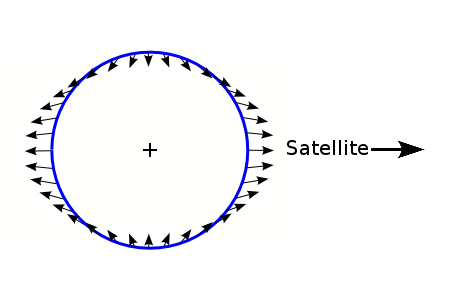
Tidal forces on a planet, the earth for instance by the moon. Source – Wikimedia.
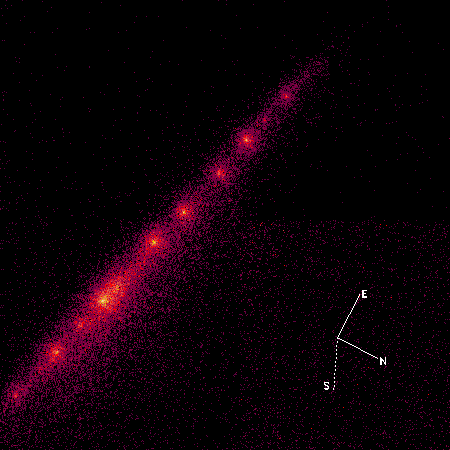
Comet Shoemaker-Levy 9 after a too close approach to Jupiter. The comet was torn into a “String of Pearls” by Jupiter,s immense tidal pull. They came back, crashing into Jupiter in July of 1994. Courtesy NASA Hubble Space Telescope.
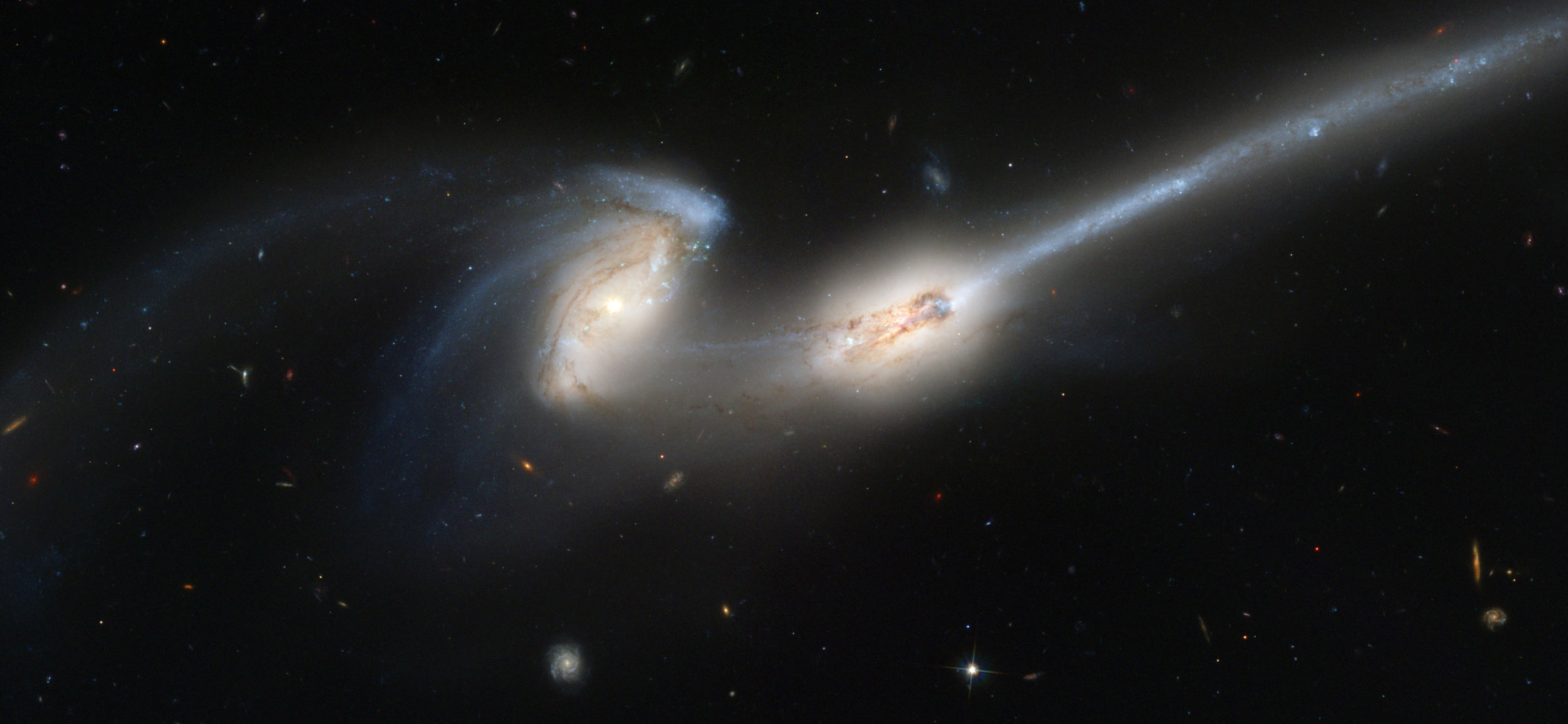
Two galaxies colliding, throwing off tidal tails as they close in. NGC4686 photo courtesy NASA and the Hubble Space Telescope.

Don’t do this at home! Spaghettification by black hole. The intense gravitational gradient near a black hole will stretch a body, be it asteroid or astronaut as they approach a black hole.
11/19/2012 – Ephemeris – A Leonid meteor peak at 1 a/m/ EST tomorrow morning.
Ephemeris for Monday, November 19th. The sun will rise at 7:45. It’ll be up for 9 hours and 25 minutes, setting at 5:10. The moon, 1 day before first quarter, will set at 11:43 this evening.
There is expected to be a peak of the Leonid meteor shower at around 1 tomorrow morning. By then the radiant of the meteor shower will have risen in the east in the head of Leo the lion in the curve of the backwards question mark that denotes the front end of the beast. The Leonids do not have the same numbers every year. Great meteor storms occur, on average every 33 years because they are associated with a comet of the same period, Comet Tempel-Tuttle. It last came through the inner solar system in 1998, so this is not a great year for them. However astronomers are getting better at predicting where the debris streams are that were liberated by the comet in its passes of the sun, giving observers a heads up on the best times to look.
Times are for the Traverse City/Interlochen area of Michigan. They may be different for your location.
Addendum
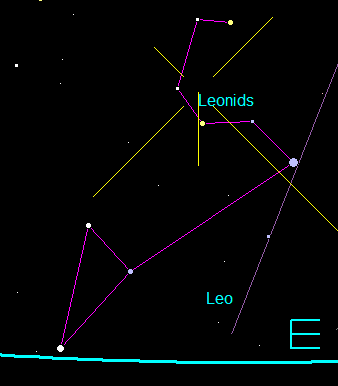
Leo rising at around 2 a.m. on the morning of November 20. Note the radiant in the sickle asterism of Leo. Created using Looking Up, my own program.
At 1 a.m. the triangle of stars at his haunches will not have risen yet. The maximum number of meteors per hour will be 10-20. However this is if the radiant is overhead. The numbers are expected to be lower. This will not be as visible west to here (Michigan).
 Bob Moler's Ephemeris Blog