Archive
07/04/2013 – Ephemeris – Patriotic Stars: Red, White and Blue
Ephemeris for Independence Day in the United States, Thursday, July 4th. Today the sun will be up for 15 hours and 27 minutes, setting at 9:30. The moon, half way from last quarter to new, will rise at 4:05 tomorrow morning. Tomorrow the sun will rise at 6:03.
Today is Independence Day so let’s look for some red, white, and blue stars. Red is easy, the red star Antares is seen in the south at 11 p.m. White is easy too, the official white calibration star Vega high in the east at 11 p.m. The blue star is really blue-white. The brightest of these out at 11 p.m. is Spica, low in the southwest to the right of the brighter Saturn. The color is best seen in binoculars. Star colors are quite subtle, and are an indicator of the temperature of their outer gaseous layers. The temperature of a stars outer layers, in order of their increasing temperatures are red, white and blue. Of these three the coolest on the outside, Antares is really the hottest inside, using helium as fuel.
Times are for the Traverse City/Interlochen area of Michigan. They may be different for your location.
Addendum
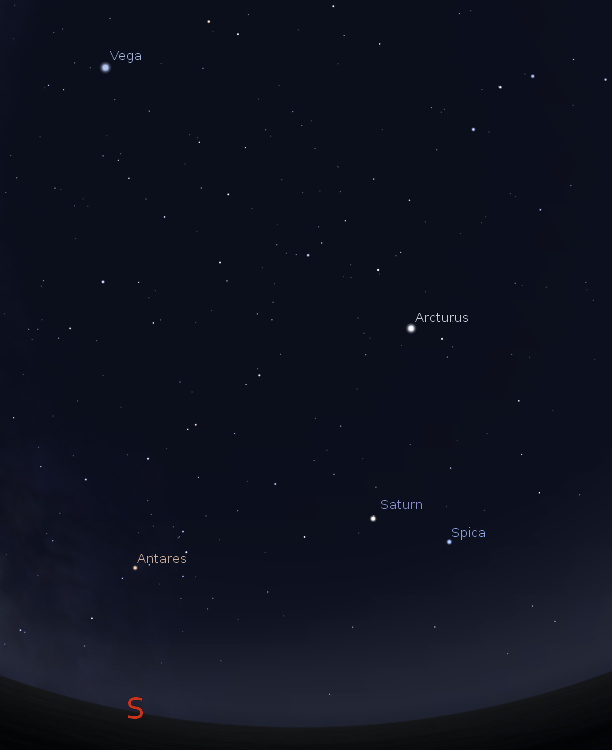
Red Antares, white Vega and blue Spica. Patriotic Stars this evening. Created using Stellarium.
07/03/2013 – Ephemeris – Where are the bright planets this week?
Ephemeris for Wednesday, July 3rd. Today the sun will be up for 15 hours and 28 minutes, setting at 9:30. The moon, 3 days past last quarter, will rise at 3:22 tomorrow morning. Tomorrow the sun will rise at 6:03.
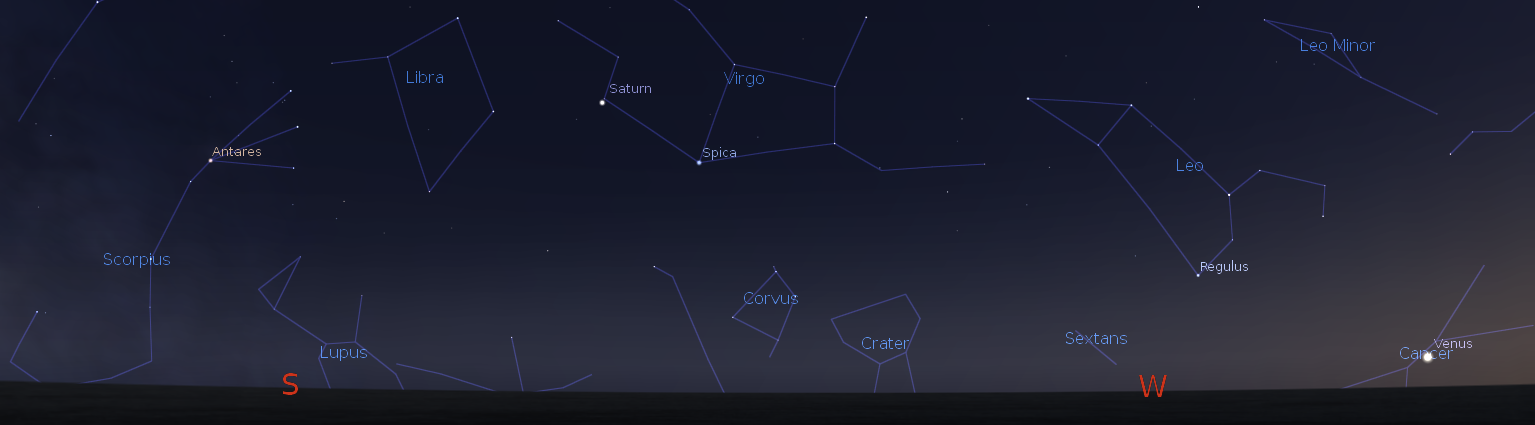
Lets check out the planets visible now. Venus is now low in the west northwestern sky in evening twilight, Venus will set at 11:03 p.m. Holding forth in the south southwest will be Saturn this evening, the brightest star-like object in the constellation Virgo appearing yellowish to the left of the extremely blue-white star Spica. Saturn is a wonderful sight in a telescope of 20 power or more. Small telescopes can also spot Saturn’s moon Titan as a dim star off a ways along the extent of the rings. Saturn will set at 2:27 tomorrow morning. Jupiter, Mars and Mercury are too close to the direction of the sun to be seen. I’ll cover Jupiter and Mars when they emerge later this month.
Times are for the Traverse City/Interlochen area of Michigan. They may be different for your location.
Ephemeris
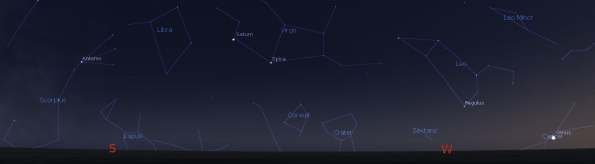
- Looking from west to south at Venus, Saturn and some constellations low in the sky at 10:45 p.m. on July 3, 2013. Created using Stellarium. Click on the image to enlarge.
07/02/2013 – Ephemeris – Lyra the harp in Greek mythology
Ephemeris for Tuesday, July 2nd. Today the sun will be up for 15 hours and 29 minutes, setting at 9:31. The moon, 2 days past last quarter, will rise at 2:45 tomorrow morning. Tomorrow the sun will rise at 6:02.
High in the east at 11 p.m. can be found a bright star just above a small, narrow, but very distinctive parallelogram of stars. They are the stars of the constellation Lyra the harp. The bright star is Vega the 5th brightest night-time star. To the Romans the star Vega represented a falling eagle or vulture. Apparently they never made the distinction between the two. It is a pure white star and serves as a calibration star for color and brightness. The harp, according to Greek mythology, was invented by the god Hermes. The form of the harp in the sky, is as he had invented it: by stretching strings across a tortoise-shell. Hermes gave it to his half-brother Apollo, who in turn gave it to the great musician Orpheus.
Times are for the Traverse City/Interlochen area of Michigan. They may be different for your location.
Addendum
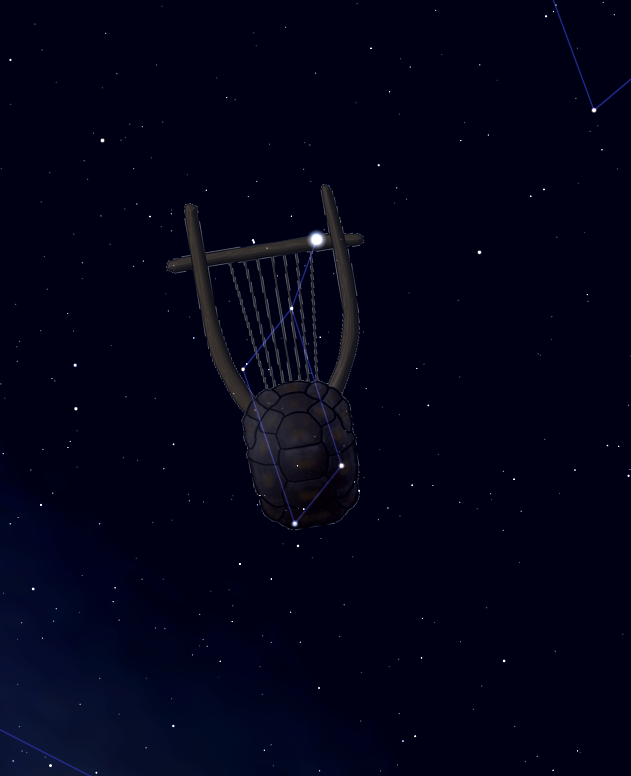
Lyra as a tortoise-shell harp. Created using Stellarium and free clip art.
Annotated Lyra:
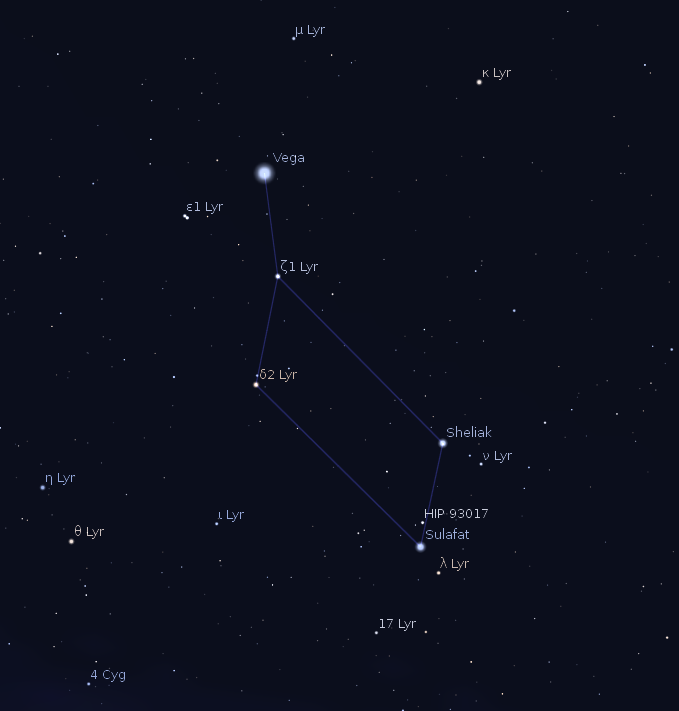
Magnified view of Lyra. Created using Stellarium.
07/01/2013 – Ephemeris – July preview
Ephemeris for Monday, July 1st. Today the sun will be up for 15 hours and 29 minutes, setting at 9:31. The moon, 1 day past last quarter, will rise at 2:11 tomorrow morning. Tomorrow the sun will rise at 6:01.
Lets preview July’s skies. The sun, having reached its northern solstice, is beginning to slide southward again, at first imperceptibly, then with greater speed. The daylight hours will decrease from 15 hours and 29 minutes today to 14 hours 40 minutes at month’s end. The daylight hours will be slightly shorter south of Interlochen, and slightly longer to the north. The altitude of the sun at local noon, when the sun is due south will decrease from 68 degrees tomorrow to 63 degrees at month’s end. The sun will be a degree lower in the Straits area. Despite the warmth, the earth will reach its greatest distance from the sun on Friday. The planets Venus and Saturn will be our evening planets this month.
Times are for the Traverse City/Interlochen area of Michigan. They may be different for your location.
Addendum
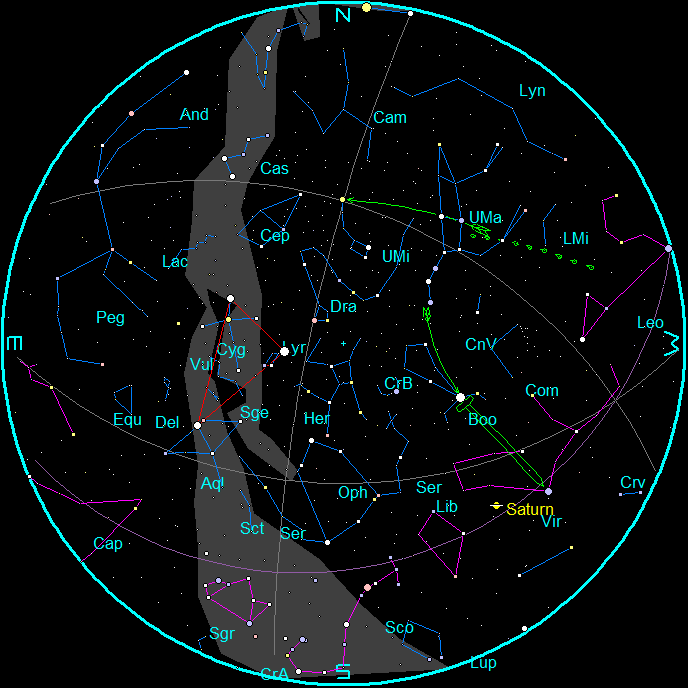
The stars and planets, specifically for July 15, 2013 at 11 p.m.
The constellation abbreviations, names and bright star names are found here.
- The arrow from the pointer stars of the Big Dipper to Polaris the North Star, near the north celestial pole.
- Follow the arc of the handle of the Big Dipper to Arcturus.
- A Leaky Dipper drips on Leo
- Follow the spike to Spica.
- The Summer Triangle (in red)
 Bob Moler's Ephemeris Blog