Archive
11/01/2013 – Ephemeris – Preview of Comet ISON plus a star party tonight in Traverse City
Ephemeris for Friday, November 1st. The sun will rise at 8:20. It’ll be up for 10 hours and 10 minutes, setting at 6:31. The moon, 2 days before new, will rise at 7:16 tomorrow morning.
This evening’s meeting of the Grand Traverse Astronomical Society starting at 8 p.m. at Northwestern Michigan College’s Rogers Observatory will be a special one. Yours truly will preview the viewing prospects for Comet ISON for this and next month. What will happen? Where do I look to see it? Will it be the comet of the century? On that last question, I can give an answer right now, we’ll know immediately if it isn’t. We probably won’t know for 87 years if it is. The century is still young. Due to the extreme interest in this subject, the visuals and other information from the talk will be released to the society’s gtastro.org web site. At 9 p.m. there will be a star party at the observatory, and another program if it’s cloudy.
Times are for the Traverse City/Interlochen area of Michigan. They may be different for your location.
Addendum
Click on image for slides from tonight’s talk:
10/31/2013 – Ephemeris – A look ahead at the skies of November
Ephemeris for Halloween, Thursday, October 31st. The sun will rise at 8:19. It’ll be up for 10 hours and 13 minutes, setting at 6:32. The moon, 3 days before new, will rise at 6:07 tomorrow morning.
Let’s look at the skies for the month of November. Comet ISON will continue to brighten this month, but will encounter bright twilit skies as it closes in with the sun the week of Thanksgiving. I’m hoping the comet will be visible to the naked eye by mid-month. The sun is still moving south rapidly. Daylight hours in the Interlochen/Traverse City area and will drop from 10 hours and 10 minutes tomorrow to 9 hours 5 minutes on the 30th. The altitude, or angle, of the sun above the southern horizon at local noon will be at 30 degrees tomorrow and will descend to 23 and a half degrees on the 30th. The altitude of the sun in the Straits area will be a degree lower. Local noon, this month, will be about 12:30 p.m. when standard time returns.
Times are for the Traverse City/Interlochen area of Michigan. They may be different for your location.
Addendum
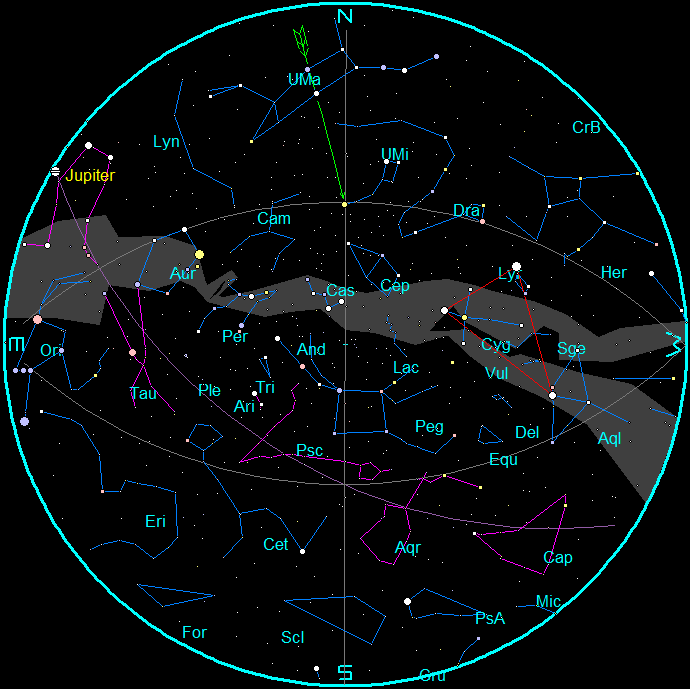
Star Chart based on 9 p.m. on November 15, 2013. Created using my program LookingUp.
The constellation abbreviations, names and bright star names are found here.
The red triangle is the Summer Triangle. The arrow through then front of the Big Dipper point to Polaris.
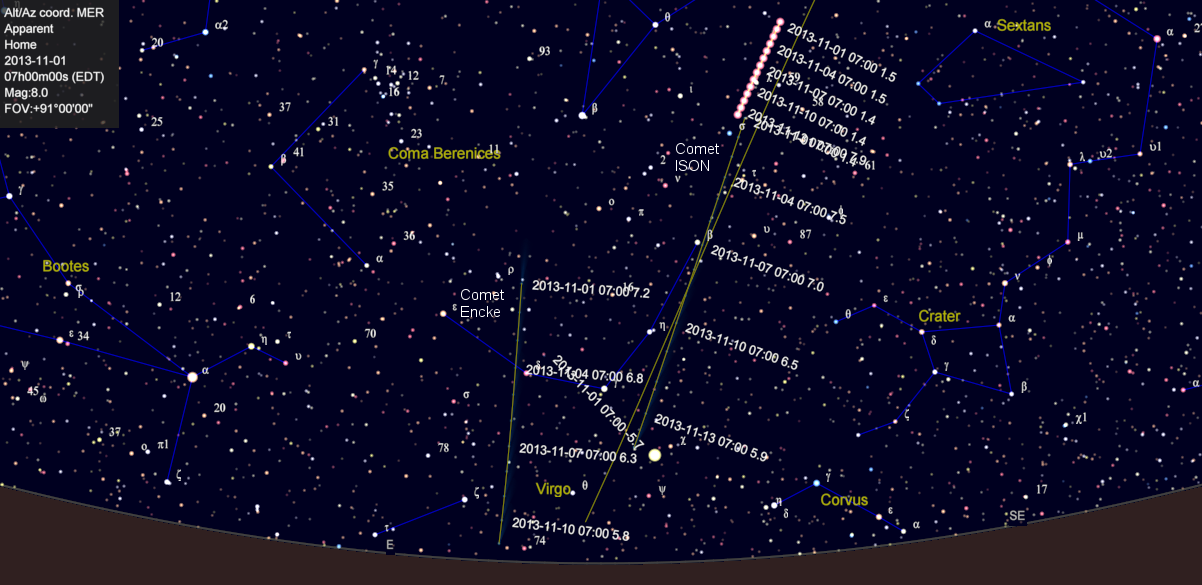
The path of Comet ISON and Comet Encke for November 1st through 14th, 2013. Created using Cartes du Ciel. Labels contain date and predicted magnitude. Click to enlarge.
Comet ISON will remain an early morning comet for November and most of December.
The oddball object with the skewed label is the moon.
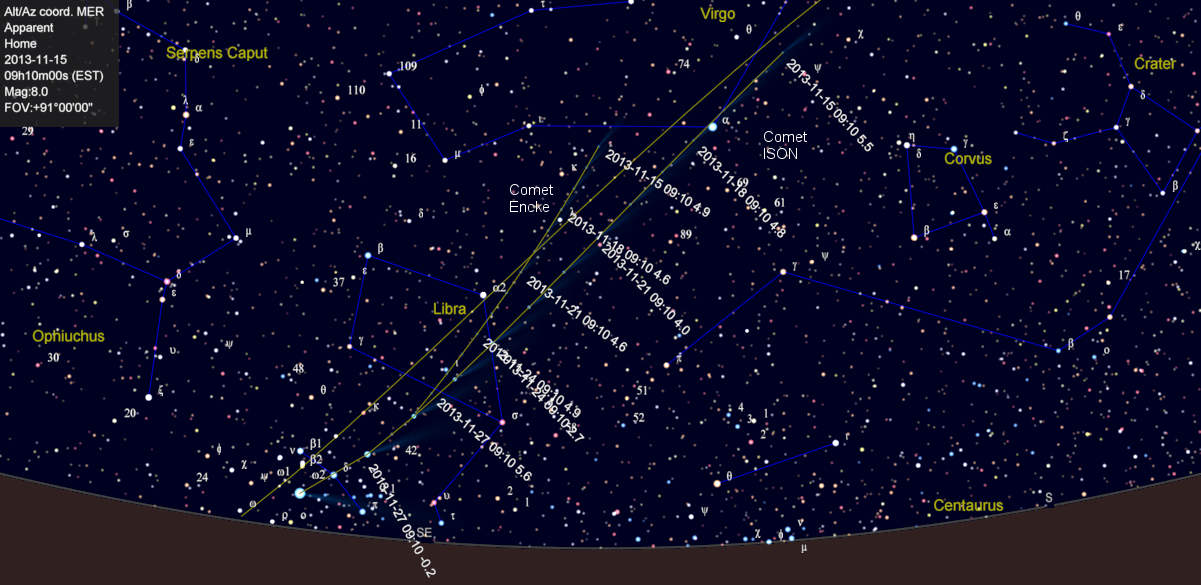
The path of Comet ISON and Comet Encke for November 15th through 28th, 2013. Created using Cartes du Ciel. The planets, Sun and Moon have been removed for clarity. Labels contain date and predicted magnitude. Click to enlarge.
The above two images are from my program Prospects for Viewing Comet ISON to be given tomorrow night at the regular meeting of the Grand Traverse Astronomical Society starting at 8 p.m. at Northwestern Michigan College’s Rogers Observatory south of Traverse City on Birmley Road.
Local school groups or clubs ca request the program by commenting to this post or emailing to info@gtastro.org.
10/30/2013 – Ephemeris – Where are the bright planets and Comet ISON now?
Ephemeris for Wednesday, October 30th. The sun will rise at 8:17. It’ll be up for 10 hours and 16 minutes, setting at 6:33. The moon, half way from last quarter to new, will rise at 5:01 tomorrow morning.
Let’s check out the bright planets. Venus is brilliant in the west southwest after sunset. Friday it will be at its greatest separation or elongation from the sun. Venus will set at 8:44 p.m. The giant planet Jupiter will rise at 10:55 p.m. in the east northeast. It’s cruising against the stars of Gemini now. It will pass due south at 6:31 a.m. Mars will rise at 3:08 a.m. also in the east northeast. Reddish Mars is below and left of the slightly brighter star Regulus in Leo now. It’s in the east at 6 a.m. Comet ISON is two-thirds the distance below Mars that Mars is below Regulus and nearly in line with the two. My guesstimate for magnitude is about 9, probably visible in telescopes. I haven’t seen it since earlier this month.
Times are for the Traverse City/Interlochen area of Michigan. They may be different for your location.
Addendum
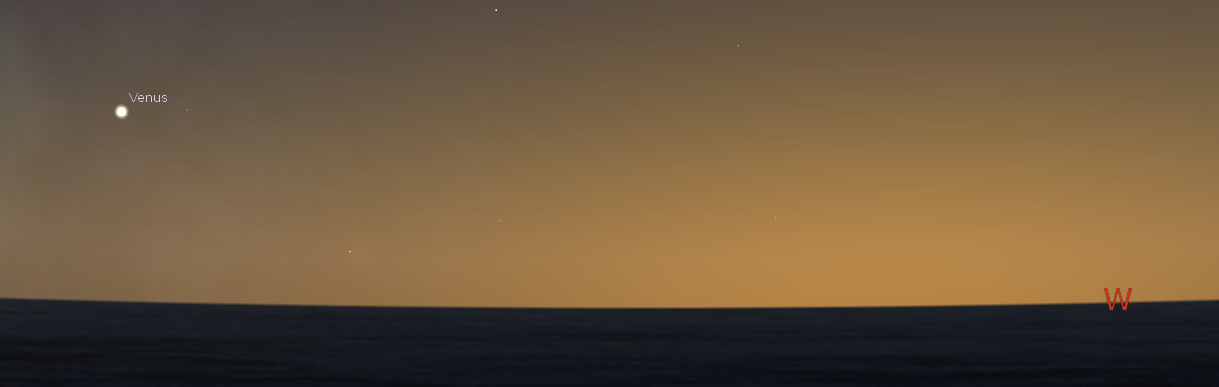
Venus in twilight at 7:15 p.m. on October 30, 2013. Created using Stellarium.
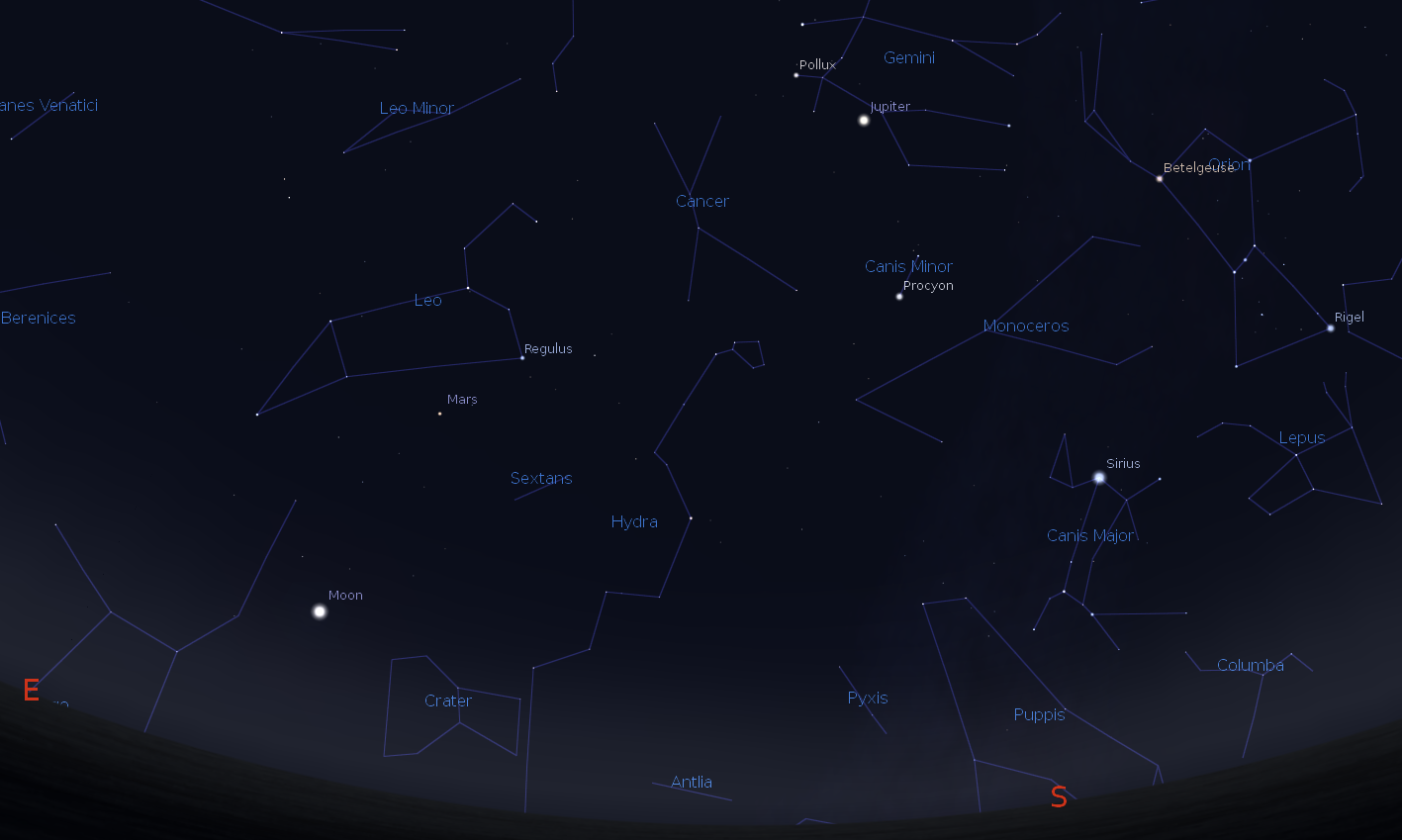
Jupiter and Mars at 6:30 a.m. October 31, 2013. Created using Stellarium.
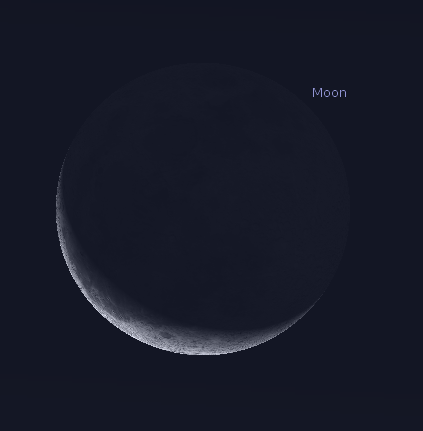
Closeup of the Moon at 6:30 a.m. on October 31, 2013. Created using Stellarium.
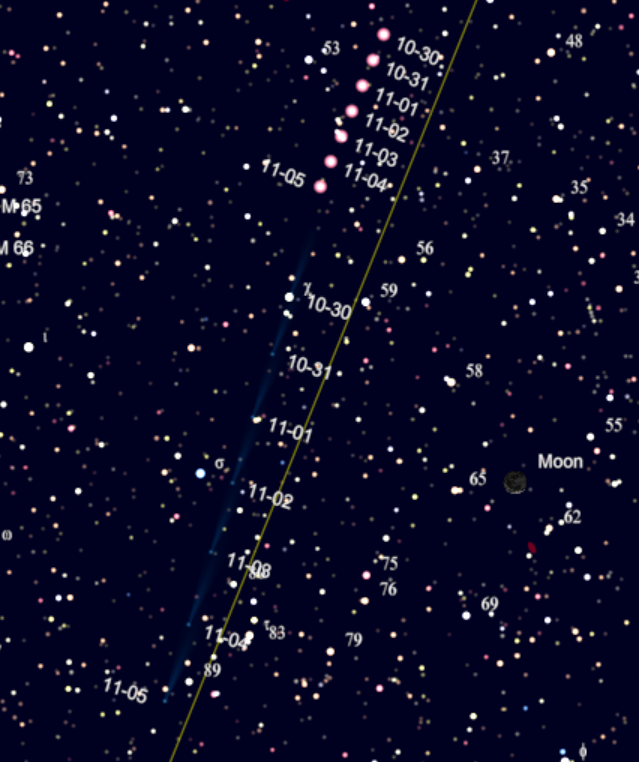
Comet ISON for October 30 to November 5, 2013. Created using Cartes du Ciel.
Click on the images to enlarge.
10/29/2013 – Ephemeris – Comet ISON 30 days before perihelion
Ephemeris for Tuesday, October 29th. The sun will rise at 8:16. It’ll be up for 10 hours and 18 minutes, setting at 6:35. The moon, 3 days past last quarter, will rise at 3:56 tomorrow morning.
In 30 days Comet ISON will meet its date with the sun. November 28th, Thanksgiving day Comet ISON will whip around the sun, and to us will seem to be sent at a near 90 degree angle from heading eastward to heading nearly due northward. That’s an illusion because we, on the earth will be moving, in effect under it. The closest Comet ISON will get to us is just under 40 million miles on December 26th and 27th. The morning waning crescent is no longer affecting the visibility of the comet, so barring clouds, it should be visible in dark skies in small telescopes. The website gtastro.org now has lots of information on the comet and where you can find more from good sources. I’ll tell you more on Friday.
Times are for the Traverse City/Interlochen area of Michigan. They may be different for your location.
Addendum
This is the major document from the Gtastro website cited above: The article from the GTAS Stellar Sentinel plus extra charts and information for viewing Comet ISON at perihelion (closest approach to the sun) safely online.
10/28/2013 – Ephemeris – The constellation Perseus the hero
Ephemeris for Monday, October 28th. The sun will rise at 8:15. It’ll be up for 10 hours and 21 minutes, setting at 6:36. The moon, 2 days past last quarter, will rise at 2:54 tomorrow morning.
About a third the way from the east northeastern horizon to the zenith at 9 p.m. and below the letter W shaped constellation of Cassiopeia the queen is Perseus the hero. It’s kind of a odd shape for a hero, To me it looks like a chicken running across the road. To those who’s imagination doesn’t run to poultry, its shape is also like the Greek letter pi. It’s two brightest stars are Mirfak and Algol the demon star. Look at the area around Mirfak with binoculars and you will see a large group of stars just below naked eye visibility. It’s called the Alpha Persei association. That because Mirfak is Alpha Persei. The group is about 560 light years away, which means, though close, are farther away than the Pleiades, below and right of them.
Times are for the Traverse City/Interlochen area of Michigan. They may be different for your location.
Addendum
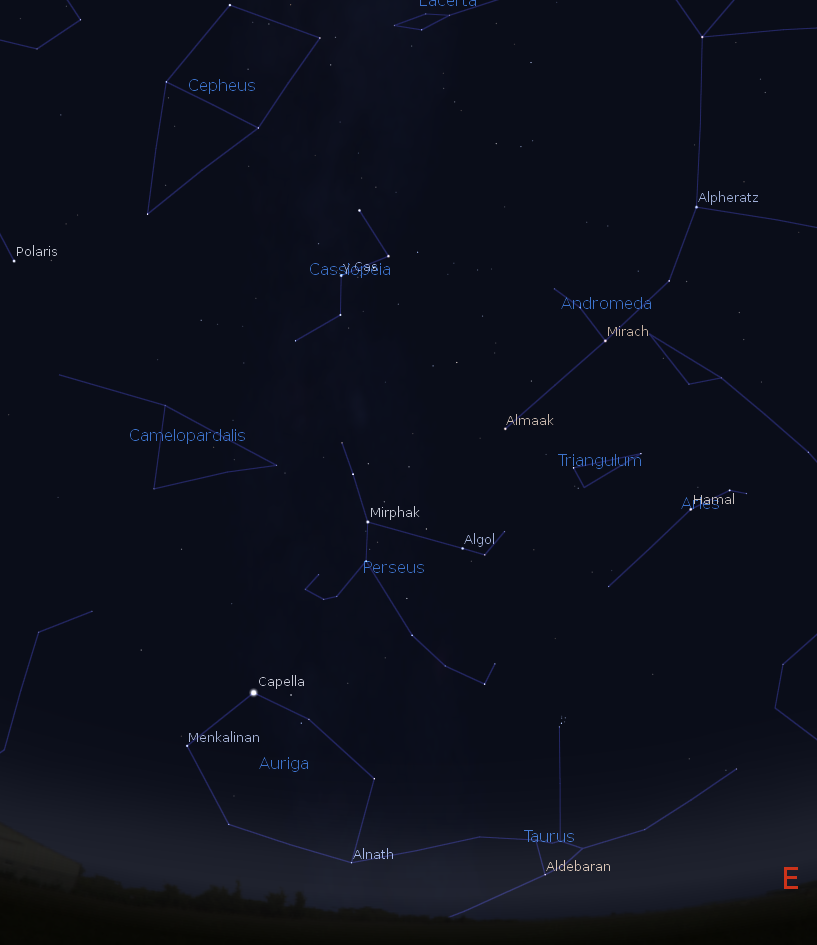
Perseus finder chart. Note the star Mirfak is spelled Mirphak on the chart. Created using Stellarium.
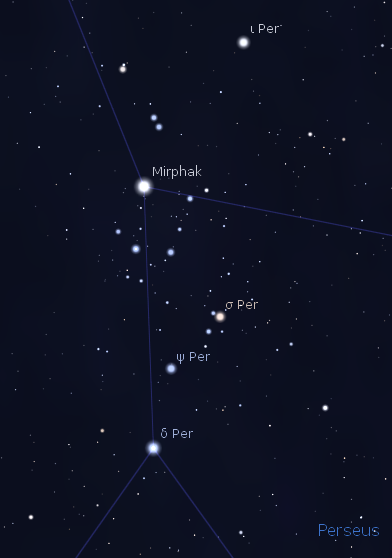
Alpha Persei Association. Created using Stellarium.
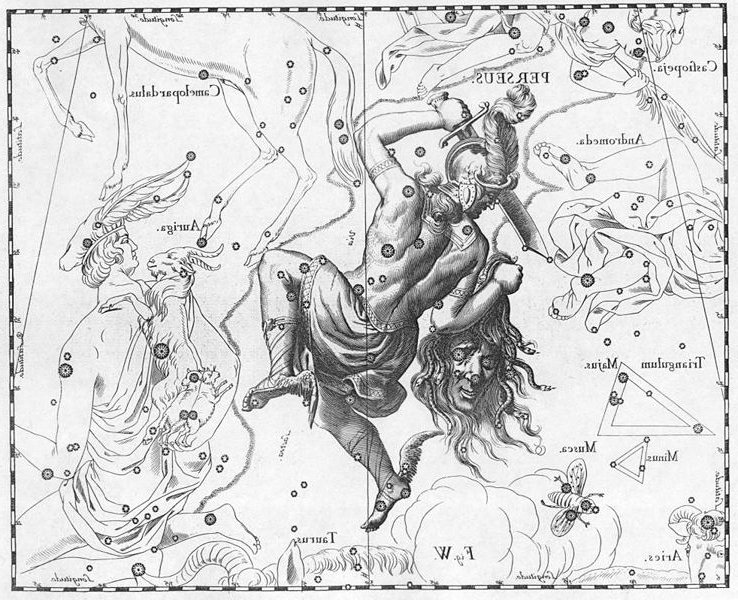
Perseus and the head of Medusa from the 1690 Uranographia by Johannes Hevelius. Image found with the article on Algol in Wikipedia.
10/25/2013 – Ephemeris – Fomalhaut the lonely star actually has companions
Ephemeris for Friday, October 25th. The sun will rise at 8:11. It’ll be up for 10 hours and 30 minutes, setting at 6:41. The moon, 1 day before last quarter, will rise at 11:56 this evening.
The lonely bright star low in the south at 9 p.m. these evenings is Fomalhaut the harbinger of autumn in my book. Fomalhaut has a recently discovered planet orbiting it Fomalhaut lower case b. However astronomers just announced the discovery of a third star in the system. I didn’t know it had two. The second star, Fomalhaut (capital) B is a binocular object 2 degrees of 4 moon widths south or below Fomalhaut. The just reported third star (now Fomalhaut big C) is a red dwarf star nearly 6 degrees or 11 moon diameters to the north of Fomalhaut or should I say Fomalhaut A. This star is 3 light years from the primary star which is itself only 25 light years from us. I think the more we study this star the more alphabet soup we’ll find.
Times are for the Traverse City/Interlochen area of Michigan. They may be different for your location.
Addendum
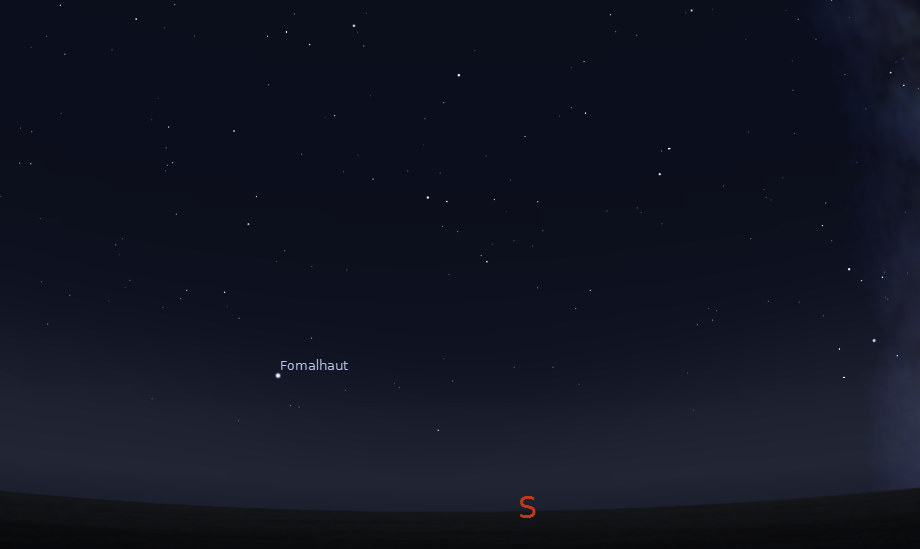
The bright star Fomalhaut all alone at 8:30 p.m. Created using Stellarium.
10/24/2013 – Ephemeris – The Pleiades or Seven Sisters
Ephemeris for Thursday, October 24th. The sun will rise at 8:09. It’ll be up for 10 hours and 33 minutes, setting at 6:42. The moon, 2 days before last quarter, will rise at 11:01 this evening.
We’re a month into autumn. Looking to the east northeast low in the sky at 9 p.m. there will be a hazy patch of light, or a tiny dipper of stars, depending on your eyesight and sky conditions. This is the Pleiades or seven sisters of Greek mythology. The Pleiades has a rich mythology in all cultures, which we will check out occasionally until they leave the night skies in the spring. The Pleiades is a star cluster, where stars are formed at the same time, in this case about 100 million years ago. It has left its cloud of gas and dust from which the stars formed, however long exposure photographs show that the Pleiades is passing through another thin cloud of gas and dust. The Pleiades is one of the closest star clusters to us at 425 light years.
Times are for the Traverse City/Interlochen area of Michigan. They may be different for your location.
Addendum
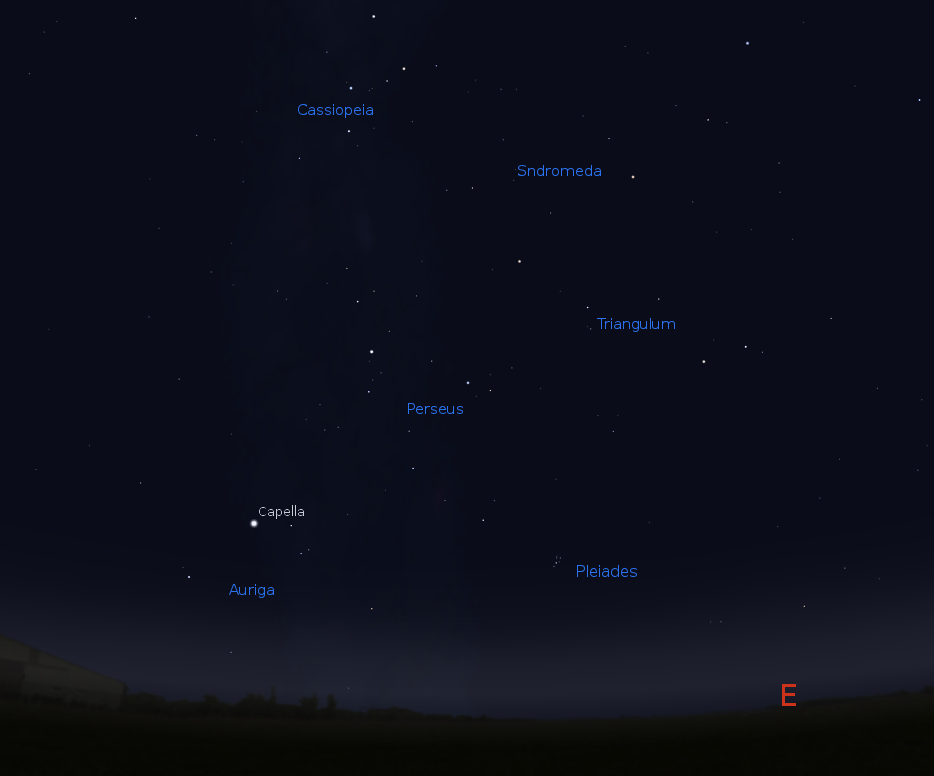
Looking to the east northeast at the Pleiades: 9 p.m. on October 24, 2013. Created using Stellarium,
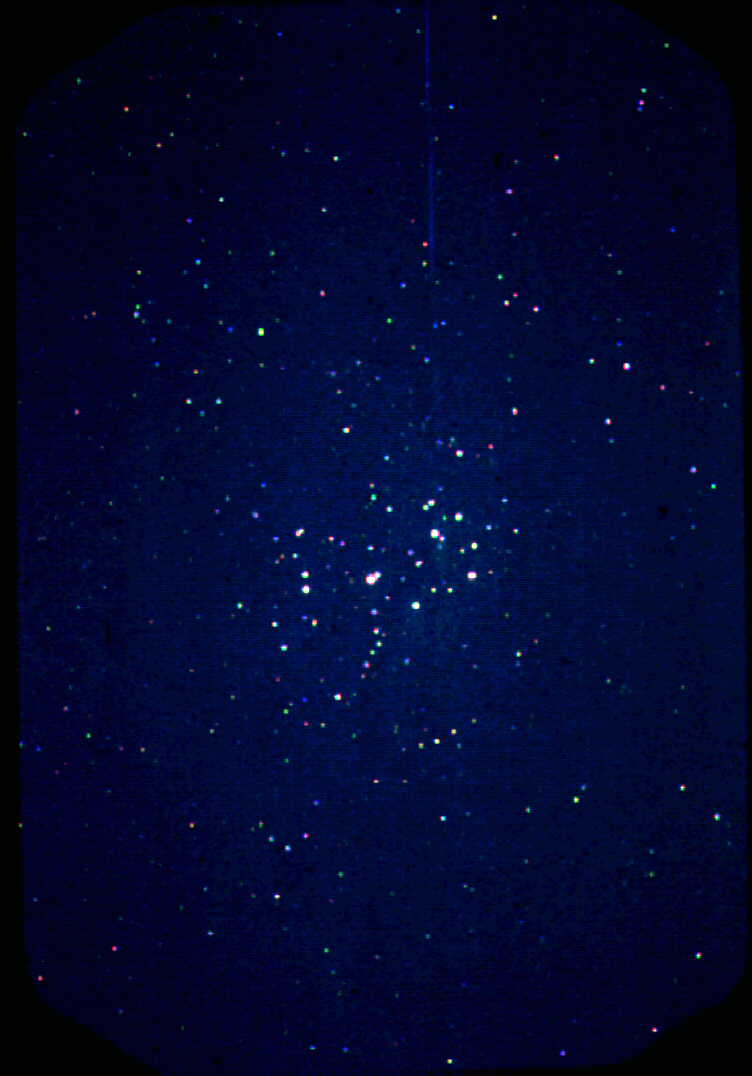
The Pleiades, about what you’d see in binoculars.
10/22/2013 – Ephemeris – Misinformation about Comet ISON: It ain’t Nibiru
Ephemeris for Tuesday, October 22nd. The sun will rise at 8:07. It’ll be up for 10 hours and 38 minutes, setting at 6:45. The moon, half way from full to last quarter, will rise at 9:19 this evening.
Don’t believe a lot of what you hear about Comet ISON from friends or the Internet. YouTube, for instance, has some good information, and some really nutty stuff. A couple of items to debunk right here. No, Comet ISON is not the rogue planet Nibiru. Nibiru was a Babylonian astronomical term, probably for the summer solstice point in the sky, not a planet. Ill-informed people want to frighten you by attaching the name to about any bright comet that comes along. I can tell because their knowledge of astronomical terms and planetary orbits is way off base. While the head of a comet can swell up to be greater than the size of the earth, it’s still a pretty good vacuum. We’ve sent spacecraft into cometary heads which have all survived.
Times are for the Traverse City/Interlochen area of Michigan. They may be different for your location.
10/23/2013 – Ephemeris – Where are the bright planets and Comet ISON for this week?
Ephemeris for Wednesday, October 23rd. The sun will rise at 8:08. It’ll be up for 10 hours and 35 minutes, setting at 6:44. The moon, 3 days before last quarter, will rise at 10:08 this evening.
Time again to check out the bright planets. Venus is brilliant in the west southwest after sunset. It will set at 8:44 p.m. The next planetary action will have to wait till after 11 p.m. The giant planet Jupiter will rise at 11:21 p.m. in the east northeast. It’s cruising against the stars of Gemini now. It will pass due south at 6:57 a.m. Mars will rise at 3:14 a.m. also in the east northeast. Reddish Mars is below and left of the slightly brighter star Regulus in Leo now. It’s in the east at 6 a.m. Comet ISON is a bit less than half the distance below Mars that Mars is below Regulus and in line with the two. The bright moon will interfere with spotting it. My guesstimate for magnitude is about 9.5, probably visible in telescopes if the moon wasn’t out.
Times are for the Traverse City/Interlochen area of Michigan. They may be different for your location.
Addendum:
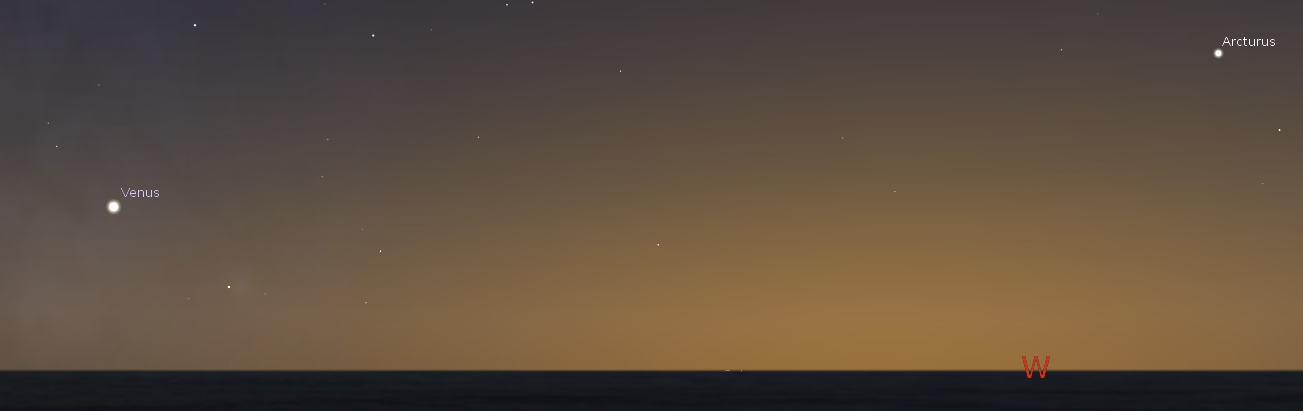
Venus low in the west southwest at 7:30 p.m. on October 23, 2013. Created using Stellarium
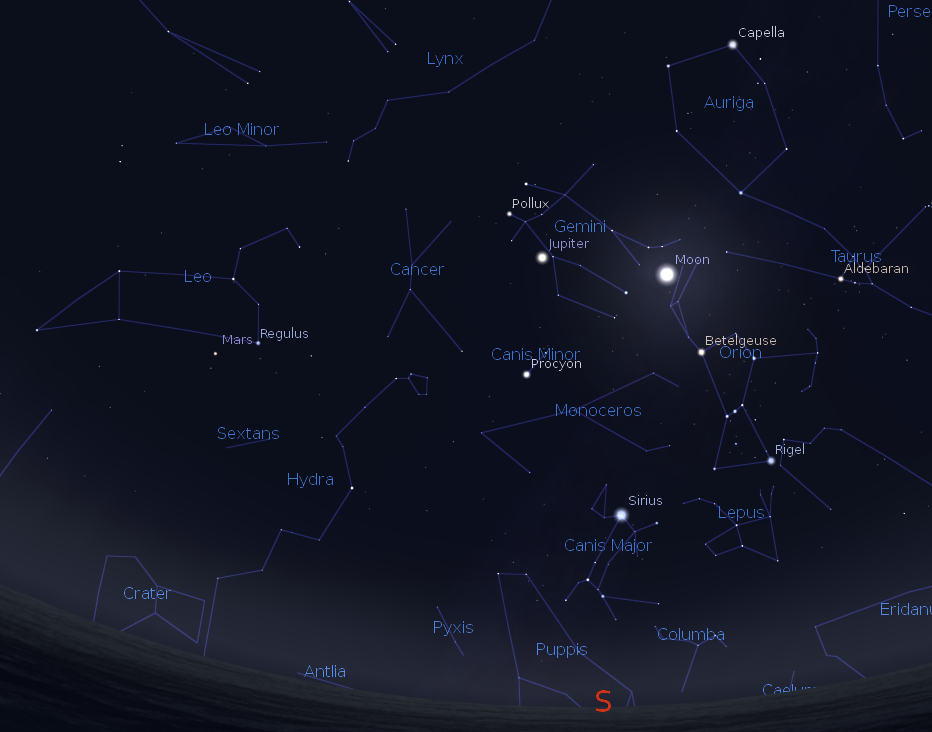
Jupiter, Mars and the Moon with the Winter and some spring constellations at 6:30 a.m. on October 24, 2013. Created using Stellarium.
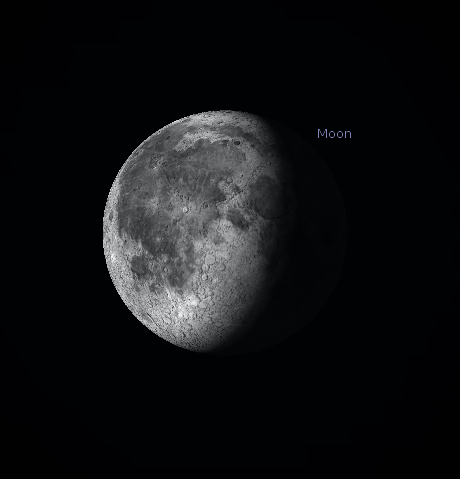
The moon’s phase the morning of October 24, 2013. Created using Stellarium.
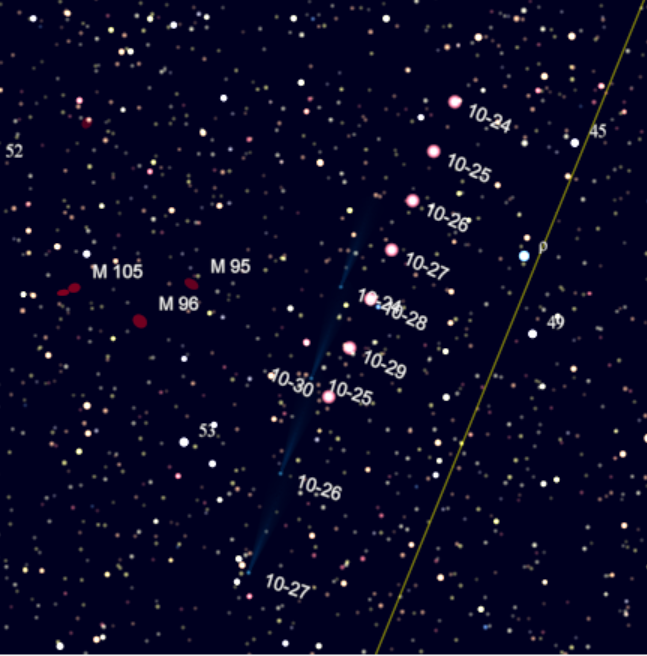
Mars and Comet ISON daily track from October 24th to the 30th, 2013. Be sure to match Mars dates with the comet dates. Created using Cartes du Ciel (Sky Charts).
10/21/2013 – Ephemeris – Sleeping Bear Dunes National Lakeshore 43rd Anniversary Star Party Tonight
Ephemeris for Monday, October 21st. The sun will rise at 8:05. It’ll be up for 10 hours and 41 minutes, setting at 6:47. The moon, 3 days past full, will rise at 8:33 this evening.
The Federal Government shutdown is over, and that means that the Sleeping Bear Dunes National Lakeshore is open again, just in time to hold its 43rd anniversary star party at the Dune Climb parking lot starting at 8 p.m. tonight with the Grand Traverse Astronomical Society. The moon will be rising shortly after the event starts. Also some of the brighter wonders of the heavens will be visible in the moon light. This will conclude the fourth year of star parties with the rangers at the park It started in 2010 with two star parties in October that year to commemorate the 40th anniversary of the founding of the park. Currently the society works with the park rangers to hold seven monthly star parties. The star party will be canceled if it’s cloudy.
Times are for the Traverse City/Interlochen area of Michigan. They may be different for your location.
 Bob Moler's Ephemeris Blog