Archive
03/17/2014 – Ephemeris – When Ireland had the world’s largest telescope
Ephemeris for St. Patrick’s Day, Monday, March 17th. The sun will rise at 7:51. It’ll be up for 11 hours and 59 minutes, setting at 7:51. The moon, 1 day past full, will rise at 9:11 this evening.
In the 19th century Ireland laid claim to having the largest telescope. It was a reflecting telescope with a mirror diameter of 72 inches. It was built by William Parsons the Third Earl of Rosse. The base of the telescope tube rested in a pit between two massive walls and could only look in a north-south direction. It saw first usage in 1847. The telescope was called the Leviathan of Parsonstown, and was in use until 1890. Mirrors in those days was made of a silvery alloy called speculum. Two mirrors were used alternately because speculum tarnished. The mirror not in use would have to be re-polished and swapped in from time to time. It was the largest telescope until the 100 inch at Mt. Wilson was put in service in 1917.
Times are for the Traverse City/Interlochen area of Michigan. They may be different for your location.
Addendum
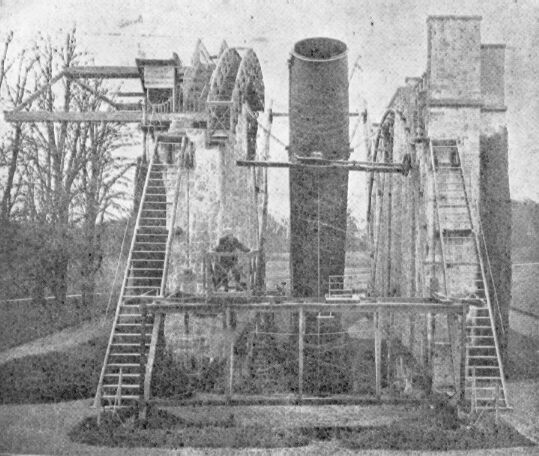
The 72 inch Leviathan of Parsonstown. source: http://www.klima-luft.de/steinicke/ngcic/persons/rosse3.htm
03/14/2014 – Ephemeris – Oldest (so far) earthly rock found
Ephemeris for Pi Day 3/14, Friday, March 14th. The sun will rise at 7:56. It’ll be up for 11 hours and 50 minutes, setting at 7:47. The moon, 2 days before full, will set at 7:08 tomorrow morning.
Scientists have found the oldest earth rock, actually a tiny zircon from Jack Hills in western Australia. The earth, with plate tectonics, and weathering is pretty hard on rocks, so it’s impossible to date the age of the Earth from them. The age of the solar system, and presumably the Earth is measured from meteorites which have been pretty much unaltered since the beginning. Dating meteorites gives us a pretty consistent 4.567 billion years as the oldest age. One spot in the zircon measures to date of 4.374 billion years ago. If the date holds up, it means the molten earth formed a solid surface very early, maybe 160 million years after its formation and 100 million years after a Mars sized object slammed into the Earth creating the Moon.
Times are for the Traverse City/Interlochen area of Michigan. They may be different for your location.
Addendum
Link to LiveScience Article for more information.
03/13/2014 – Ephemeris – An asteroid self destructs
Ephemeris for Thursday, March 13th. The sun will rise at 7:58. It’ll be up for 11 hours and 47 minutes, setting at 7:46. The moon, 3 days before full, will set at 6:40 tomorrow morning.
The solar system is getting weirder and weirder. Last week came the announcement from the Hubble Space Telescope folks, that they have been watching an asteroid in the main asteroid belt falling apart. The object was picked up last year by two sky survey groups and communicated to the Keck Telescope and Hubble telescope folks for further study. Both found that it was an asteroid slowly breaking up into smaller pieces, and watched it over several months breaking into smaller and smaller pieces. It’s thought that this asteroid is or was a rubble pile and the pressure of sunlight caused it to rotate fast enough to break it apart. The speeds of the dispersing particles is a mere earthly walking speed, ruling out a collision.
Addendum
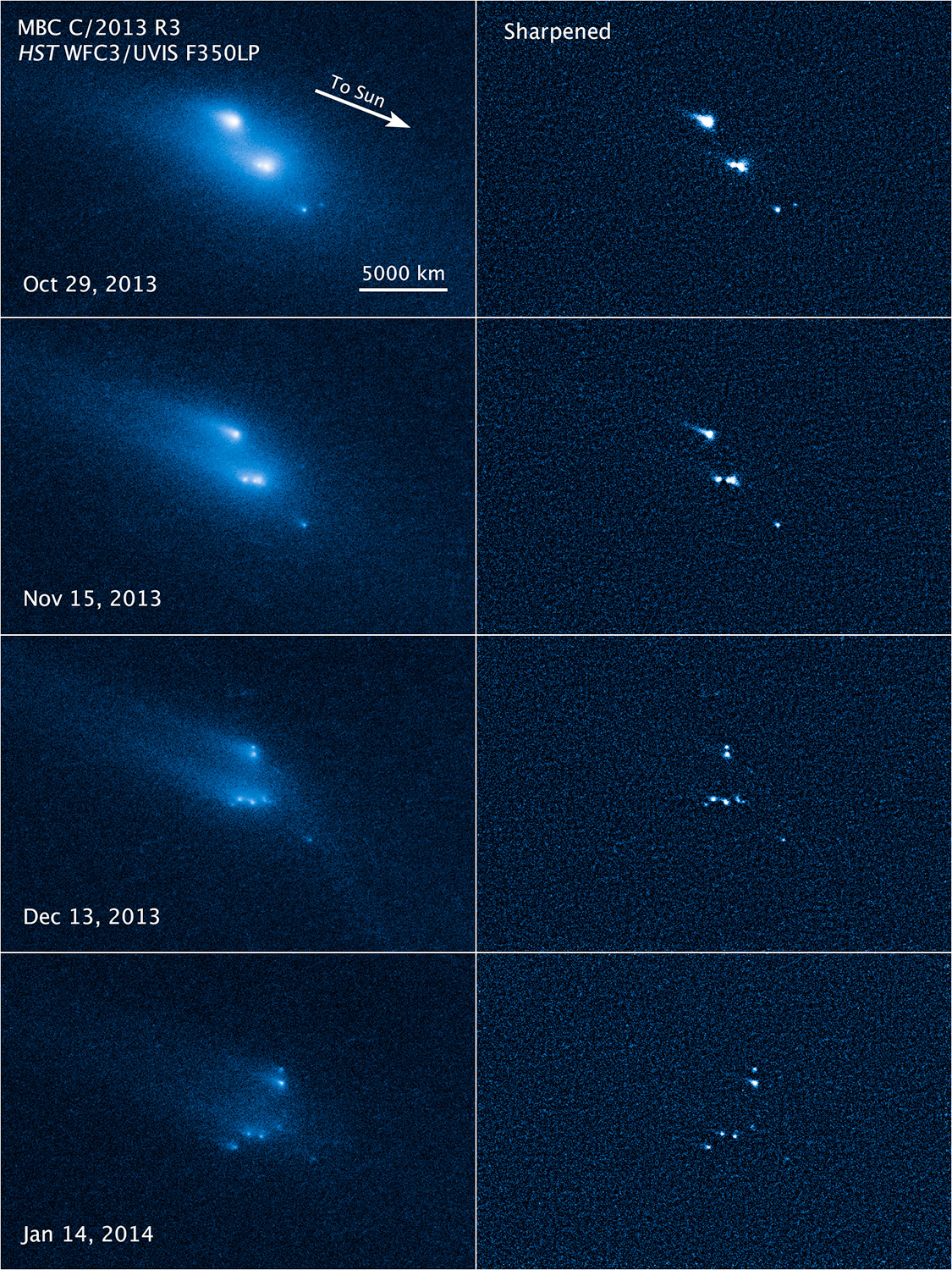
Four images of an asteroid breaking up over 3 months. The largest piece is perhaps the size of 4 football fields. Image Credit: NASA, ESA, D. Jewitt (UCLA).
Click here for the NASA page with more information.
03/12/2014 – Ephemeris – It’s Wednesday, do you know there the bright planets are?
Ephemeris for Wednesday, March 12th. The sun will rise at 8:00. It’ll be up for 11 hours and 44 minutes, setting at 7:44. The moon, 4 days before full, will set at 6:11 tomorrow morning.
Wednesday is where are the bright planets day on Ephemeris. Jupiter will be in the southeastern sky as darkness falls tonight. It’s cruising against the stars of Gemini now, and starting to move east after spending a couple of months backtracking to the west. It will pass due south at 9:05 p.m., and will set at 4:49 a.m. in the west-northwest. Reddish Mars is in Virgo now and above and left of the bright star Spica, which it now outshines. Mars will rise at 10:30 p.m. It will pass due south at 4:02 a.m. Saturn will rise at 12:50 a.m. in the east-southeast. It’s seen against the stars of Libra the scales this year. Venus will rise at 5:53 tomorrow morning and shines brightly in the southeast before sunrise.
Times are for the Traverse City/Interlochen area of Michigan. They may be different for your location.
Addendum
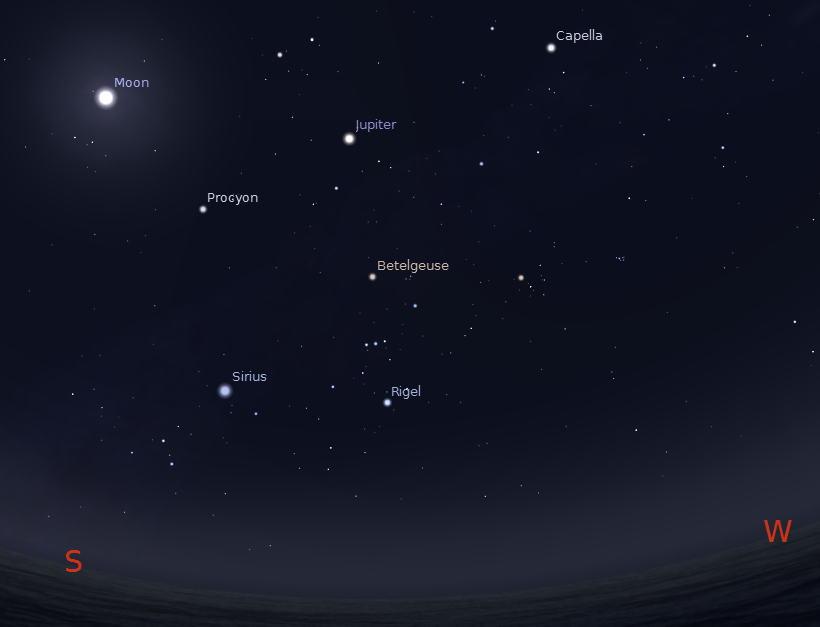
Jupiter, the Moon and the winter stars at 10 p.m. on March 12, 2014. Created using Stellarium.
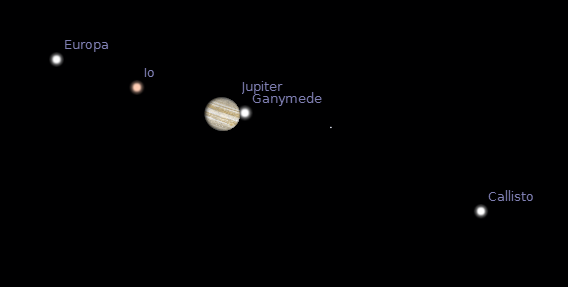
Jupiter and moons at 10 p.m. on March 12, 2014. Created using Stellarium.
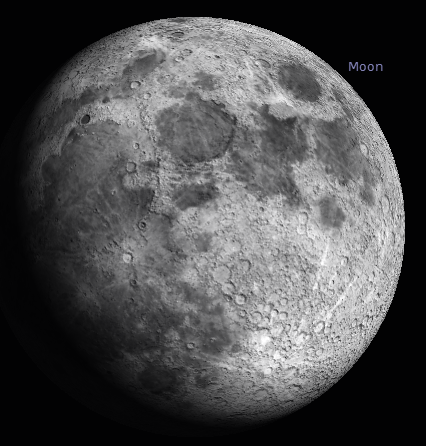
The Moon at 10 p.m. on March 12, 2014. Created using Stellarium.
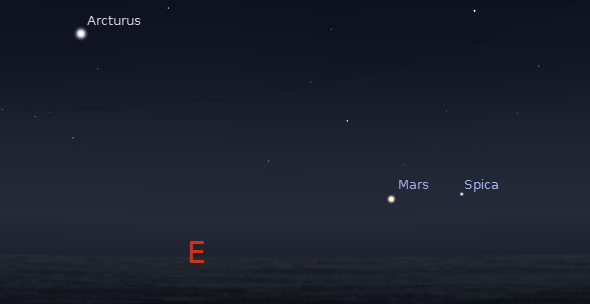
Mars rising at 11 p.m. on March 12, 2014. Created using Stellarium.
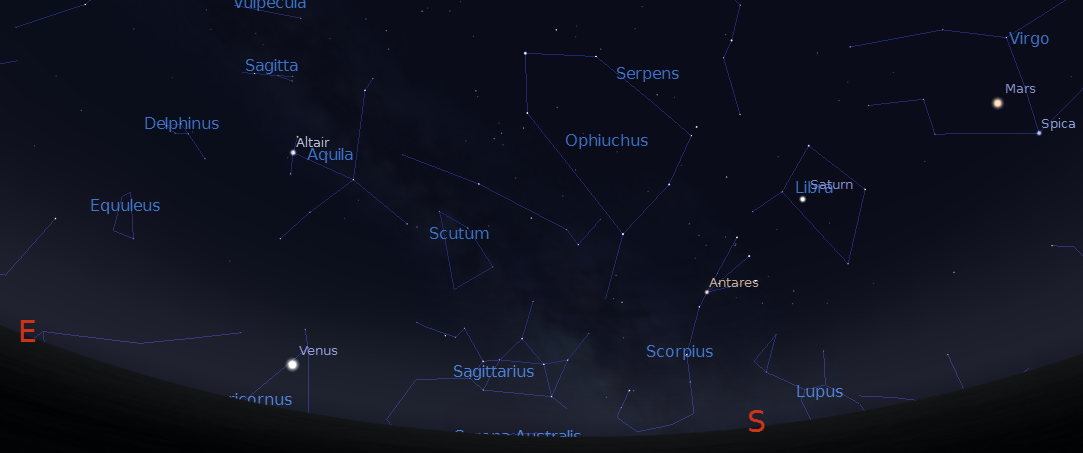
Mars, Saturn, and Venus with the constellations of summer at 6:30 a.m. on March 13, 2014. Created using Stellarium.
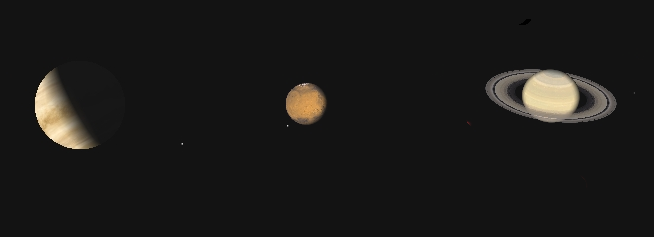
Venus, Mars and Saturn at the same magnification as seen in a telescope on March 13, 2014. Created using Stellarium.
03/11/2014 – Ephemeris – Observing the moon tonight: Bay of Rainbows and more
Ephemeris for Tuesday, March 11th. The sun will rise at 8:02. It’ll be up for 11 hours and 41 minutes, setting at 7:43. The moon, 4 days past first quarter, will set at 5:39 tomorrow morning.
The moon tonight is a pretty fat gibbous shape, with the sunrise line or terminator revealing the Bay of Rainbows, Sinus Iridium, that large half crater at the moon’s upper left edge, and the edge of the Sea of Showers, Mare Imbrium. In the figure of the man in the moon Imbrium is his big eye, kind of like the cartoon “Bill the Cat”. To the right of it, looking like a hole in a mountain chain, is Plato, whose dark floor is unmistakable even at full moon, when shadows are absent. The crater Copernicus is now beginning to be washed out as the morning shadows shrink. To the left of Copernicus, just catching the sun’s rays on the terminator, is the smaller crater Kepler. When the moon is full Kepler will show a fine ray system.
Times are for the Traverse City/Interlochen area of Michigan. They may be different for your location.
Addendum
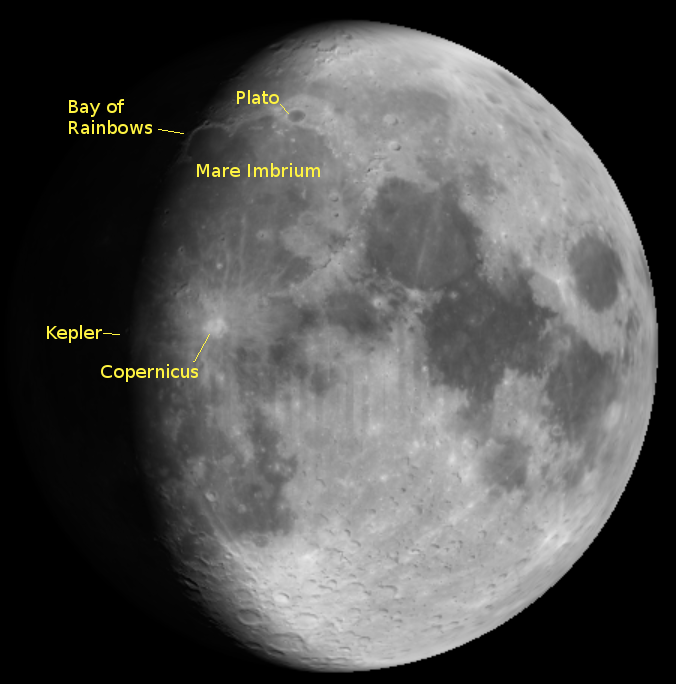
The Moon at 10 p.m. on March 11, 2014. Created using Virtual Moon Atlas.
Note for those not in the Eastern Daylight time zone. 10 p.m. is 2 hours March 12, 2014. If viewing before that time the terminator will be shifted to the right. After the terminator will be shifted to the left.
03/10/2014 – Ephemeris – Observing the Moon tonight and the crater Copernicus
Ephemeris for Monday, March 10th. The sun will rise at 8:03. It’ll be up for 11 hours and 38 minutes, setting at 7:42. The moon, 3 days past first quarter, will set at 5:04 tomorrow morning.
The moon has certainly changed appearance since I last talked about it last Thursday. It’s gone from a fat crescent to its gibbous phase. Gibbous by the way means hump-backed. Near the sunrise terminator can be seen the great crater Copernicus on the left side of the moon. This crater is 56 miles in diameter and the crater floor is two miles below the top of the crater rim. It has a three central peaks and the interior of the crater walls have slumped causing terracing. All these are easily seen with a small telescope. The crater has been dated to less than a billion years old, and it has a spray of ejecta around it that is roughly circular and can best be seen at full moon when the crater is washed out due to lack of shadows.
Times are for the Traverse City/Interlochen area of Michigan. They may be different for your location.
Addendum
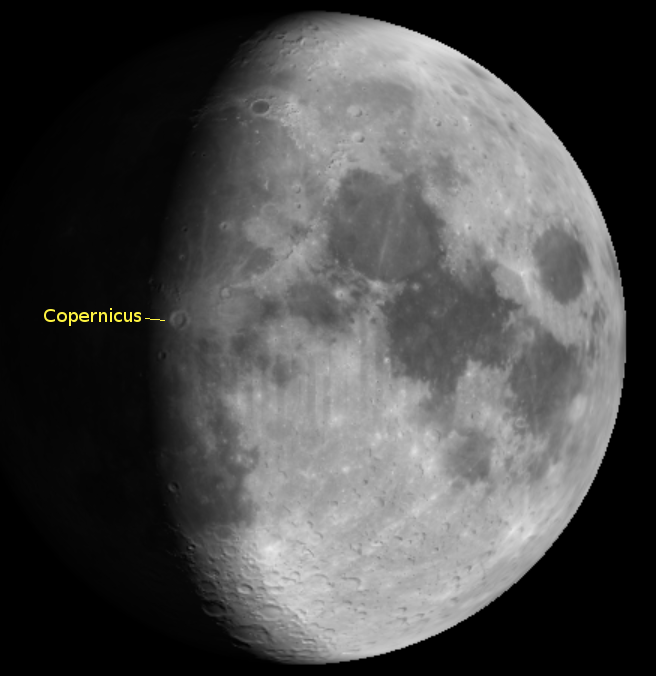
The Moon at 10 p.m. on March 10,2014 pointing out the crater Copernicus. Created using Virtual Moon Atlas.
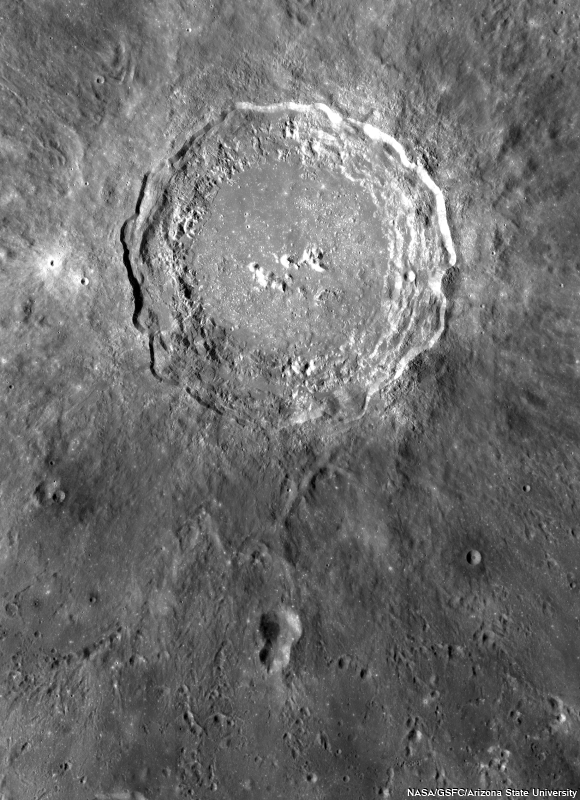
Copernicus from the Lunar Reconnaissance Orbiter. Credit: NASA/GSFC/Arizona State University
03/07/2014 – Ephemeris – Astronomy events at the Rogers Observatory tonight
Ephemeris for Friday, March 7th. The sun will rise at 7:09. It’ll be up for 11 hours and 28 minutes, setting at 6:38. The moon, 1 day before first quarter, will set at 1:51 tomorrow morning.
A Star Bowl quiz will be held this evening between the NMC Astronomy Club and the Grand Traverse Astronomical Society at this evening’s meeting of the society at 8 p.m. at Northwestern Michigan College’s Rogers Observatory. The society will accept anyone to help us. These NMC students are smart. After the Star Bowl there will be a star party starting at 9 p.m. On tap if its clear will be the Moon, and the planet Jupiter. Plus Orion and its great nebula, a star nursery only 1400 light years away will be a wonderful sight with its clouds and wisps of gas and dust illuminated by a clutch of hot baby stars. The Observatory is located south of Traverse City on Birmley Road off either Garfield or Keystone roads.
Times are for the Traverse City/Interlochen area of Michigan. They may be different for your location.
03/06/2014 – Ephemeris – Observing the Moon tonight!
Ephemeris for Thursday, March 6th. The sun will rise at 7:11. It’ll be up for 11 hours and 25 minutes, setting at 6:36. The moon, 2 days before first quarter, will set at 12:56 tomorrow morning.
The Moon’s appearance has changed since I last talked about it on Tuesday. The Crescent is wider. The terminator, the sunrise line on the Moon that gives the Moon it’s now crescent phase has uncovered most of the Sea of Tranquility. In fact the sun will have risen at the Apollo 11 landing site by this evening. With a small telescope just beneath the center of the moon and near the terminator is one of my favorite craters Theophilus with its well-defined central peak. It’s kind of middle-aged for craters on the moon from 1 to 3 billion years old. It’s in much better shape than the crater Cyrillus of nearly the same size that it partially overlaps, which is thought to be at least a billion years older and shows it.
Times are for the Traverse City/Interlochen area of Michigan. They may be different for your location.
Addendum
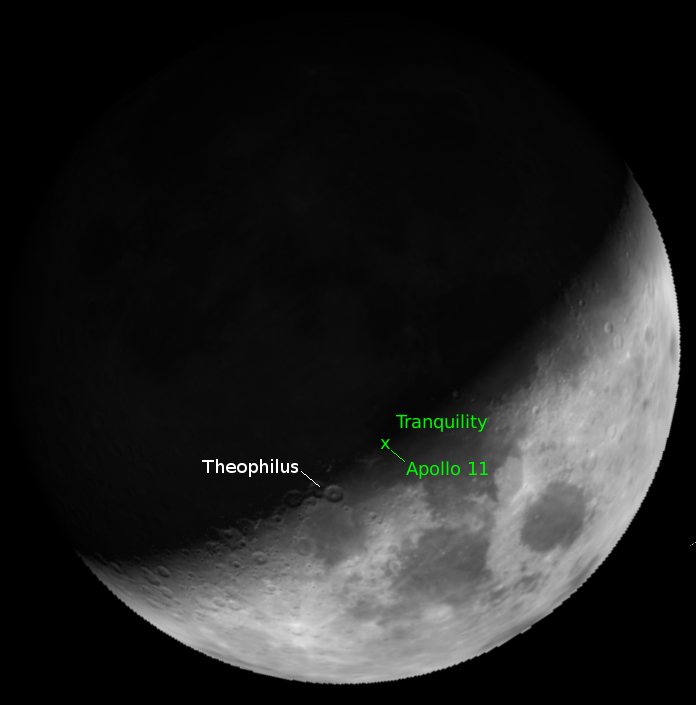
The Moon at 9 p.m. March 6, 2014 highlighting the Sea of Tranquility the Apollo 11 landing site (approximate) and the crater Theophilus. Created using Virtual Moon Atlas.
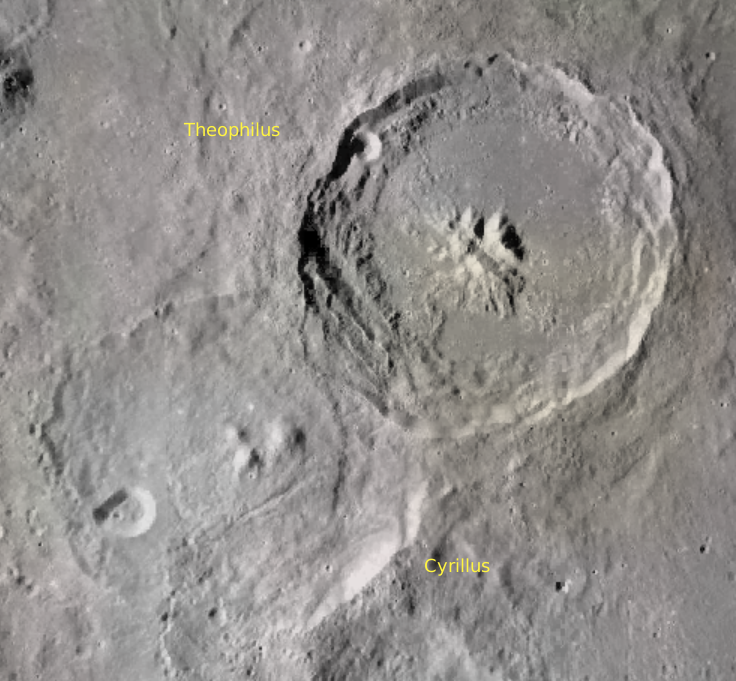
Lunar craters Theophilus and Cyrillus. Credit: NASA/LRO mapped onto Virtual Moon Atlas.
03/05/2014 – Ephemeris – It’s Wednesday, do you know where your planets are?
Ephemeris for Ash Wednesday, Wednesday, March 5th. The sun will rise at 7:12. It’ll be up for 11 hours and 22 minutes, setting at 6:35. The moon, 3 days before first quarter, will set at 11:56 this evening.
Wednesday is the “Where are the bright planets?” day on Ephemeris. Jupiter will be in the southeastern sky as darkness falls tonight. It’s cruising against the stars of Gemini now. It will pass due south at 8:33 p.m., and will set at 4:16 a.m. in the west-northwest. Reddish Mars is in Virgo now and above and left of the bright star Spica, which it now outshines. Mars will rise at 10:01 p.m. It will pass due south at 3:32 a.m. Saturn will rise at 12:18 a.m. in the east-southeast. It’s seen against the stars of Libra the scales this year. Venus will rise at 4:57 tomorrow morning and shines brightly in the southeast before sunrise.
Times are for the Traverse City/Interlochen area of Michigan. They may be different for your location.
Addendum
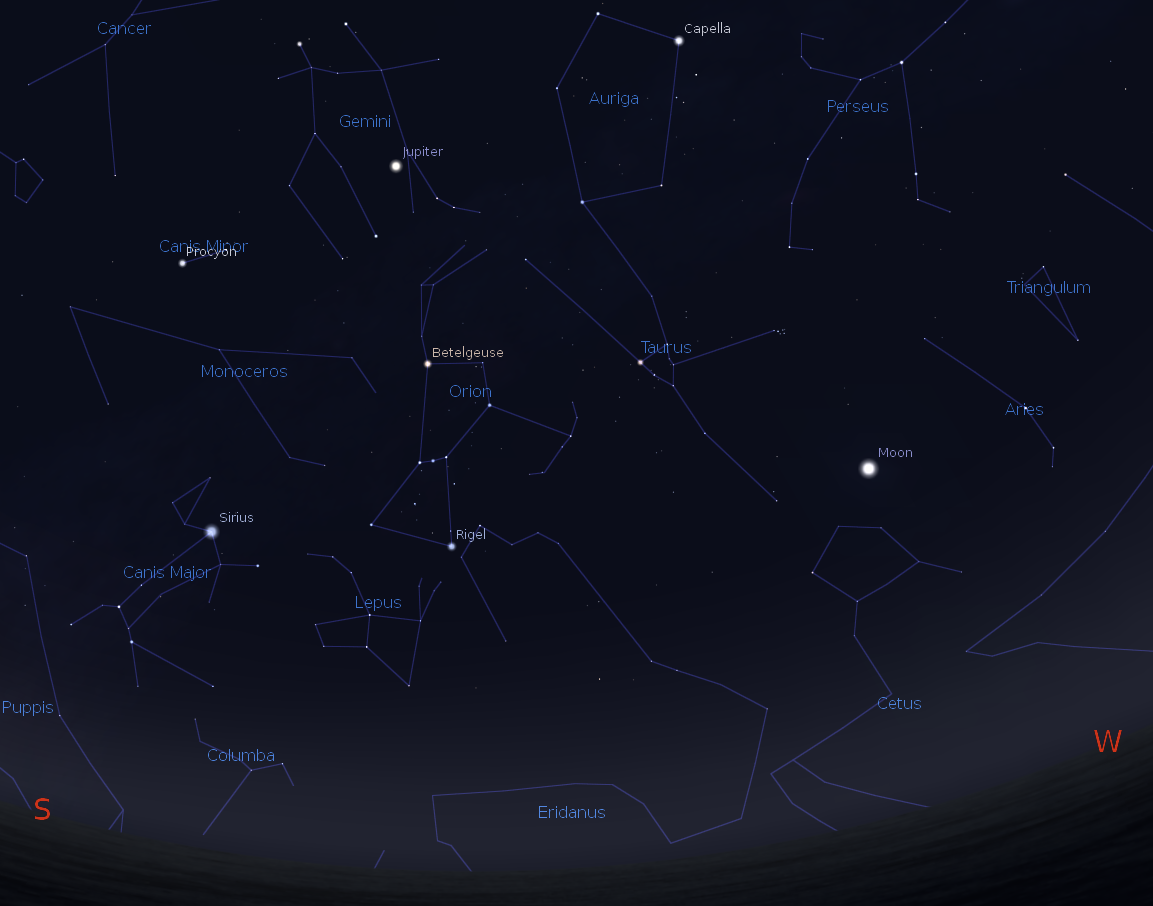
Jupiter, the Moon and the winter constellations at 9 p.m. on March 5, 2014. Created using Stellarium.
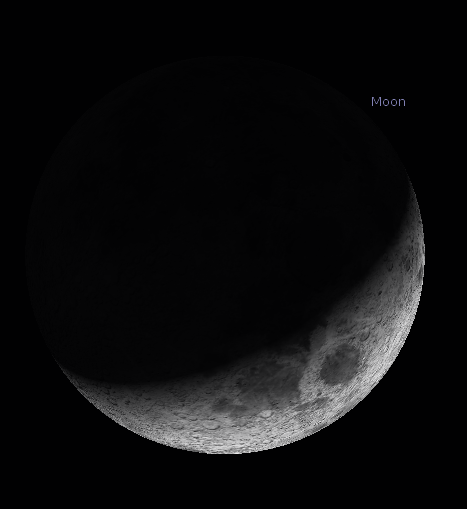
The Moon at 9 p.m. on March 5, 2014. Created using Stellarium.
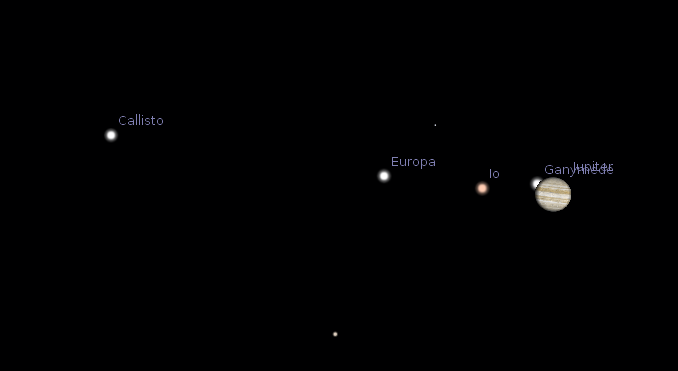
Jupiter and its moons at 9 p.m. on March 5, 2014. Created using Stellarium.
The Stellarium timing is a bit off. Ganymede won’t emerge from behind Jupiter until 9:37 p.m. It will disappear into Jupiter’s shadow at 11:07 p.m. and emerge from the shadow at 1:17 a.m.
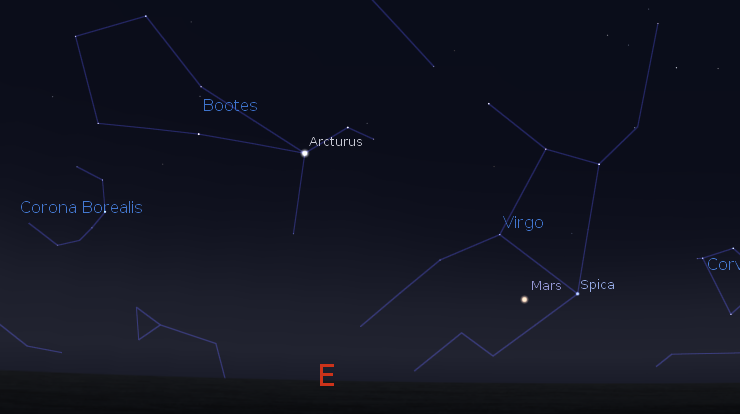
Mars rising near the star Spica at 11 p.m. March 5, 2014. Created using Stellarium.
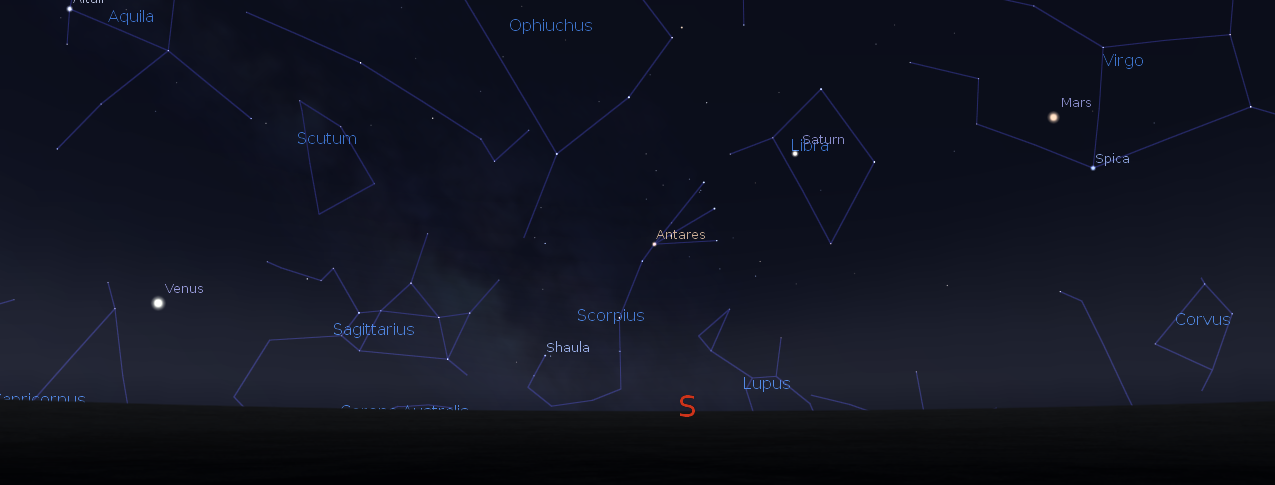
The morning planets Mars, Saturn and Venus with the moon at 6 a.m. March 6, 2014. Created using Stellarium.
The planets below is how they’d look in a small telescope. They are magnified twice as much as Jupiter and its moons above.
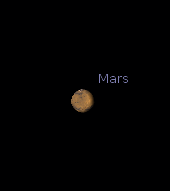
Mars at 6 a.m., March 6, 2014. Created using Stellarium.
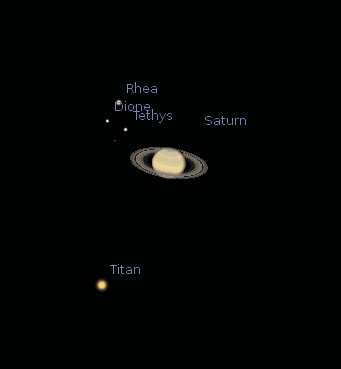
Saturn and its moons at 6 a.m., March 6, 2014. Created using Stellarium.
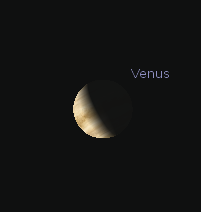
Venus at 6 a.m., March 6, 2014. Created using Stellarium.
03/04/2014 – Ephemeris – Observing the Moon tonight
Ephemeris for Fat Tuesday, Tuesday, March 4th. The sun will rise at 7:14. It’ll be up for 11 hours and 19 minutes, setting at 6:34. The moon, 3 days past new, will set at 10:52 this evening.
The Moon tonight is visible in the west after sunset. The sunrise terminator is slowly moving across its face. The solar day on the Moon equals its orbit of the Earth with respect to the sun of about 29 and a half days. As the moon is oriented in our sky the dark nearly circular sea. The Sea of Crises is rotated downward so it appear at between 4 and 5 o’clock on the moon’s face. At the bottom is the partially uncovered Sea of Fertility. With binoculars or preferably a small telescope can be seen the large crater Langrenus close to the lunar equator. A picture of that crater was one of the first brought back by the Apollo 8 crew in 1968. I’ve found it for the blog entry for this episode at bobmoler.wordpress.com.
Times are for the Traverse City/Interlochen area of Michigan. They may be different for your location.
Addendum
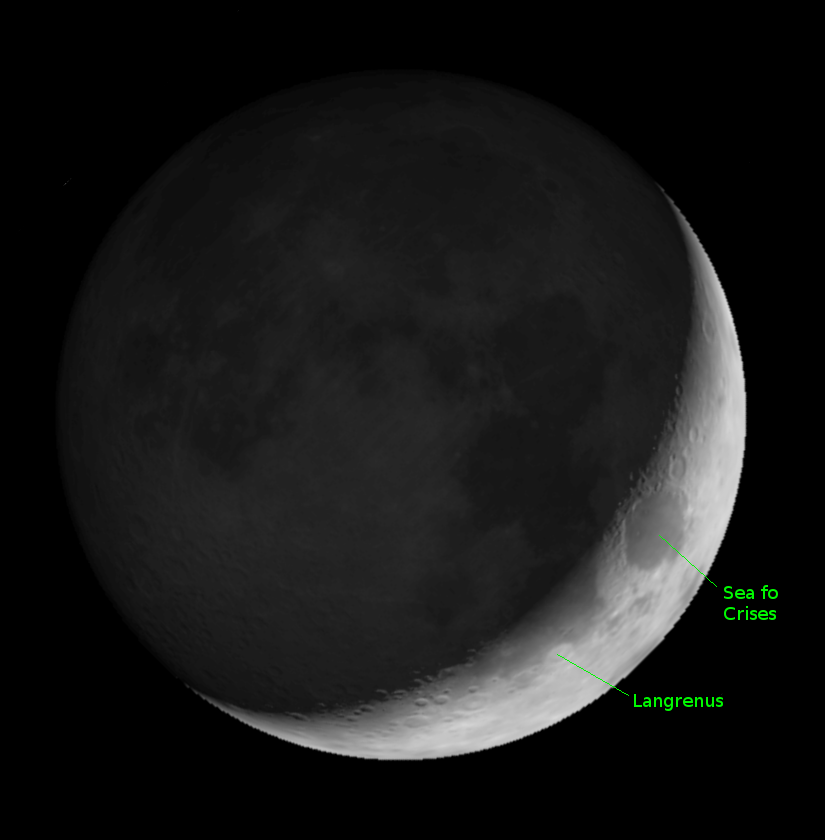
The moon rotated as if it were setting in the west showing the Sea of Crises (Mare Crisium) and the crater Langrenus. The image was enhanced to show Earth shine. Created using Virtual Moon Atlas.
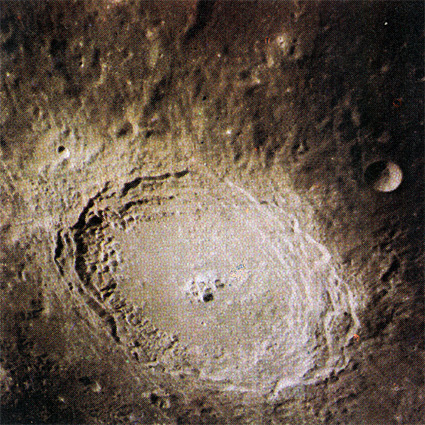
The crater Langrenus as imaged by the Apollo 8 crew on their historic orbiting of the Moon Christmas Eve 1968. Credit: NASA.
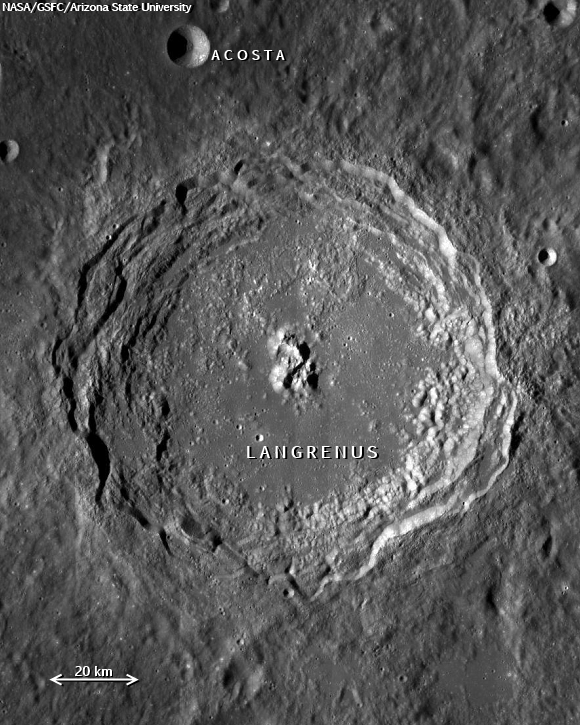
The crater Langrenus as imaged by the Lunar Reconnaissance Orbiter. Credit: NASA\GSFC\Arizona State University.
Note on credits: GSFC is the Goddard Space Flight Center.
 Bob Moler's Ephemeris Blog