Archive
01/22/2015 – Ephemeris – Let’s spot the Moon and Mars with a bonus look at Neptune
Ephemeris for Thursday, January 22nd. The sun will rise at 8:11. It’ll be up for 9 hours and 25 minutes, setting at 5:37. The moon, 2 days past new, will set at 8:44 this evening.
Tonight the crescent moon is nearing Mars low in the southwest in the early evening. The motion of Mars has been interesting for the last few months. Even though the Sun is overtaking it in the sky, it has been setting later each night, not earlier. This is due to the fact Mars is moving northeasterly in the sky, and the sun also is setting later. The moon, is a thin crescent. In binoculars, the terminator is crossing the small, near circular Sea of Crises near the top of the crescent. Lower down, in binoculars and especially in small telescopes a beautiful crater of Langrenus is fully visible. I have a picture of it from Apollo 8, a photograph from orbit. It looks pretty much like it will be visible tonight only a lot clearer.
Times are for the Traverse City/Interlochen area of Michigan. They may be different for your location.
Addendum
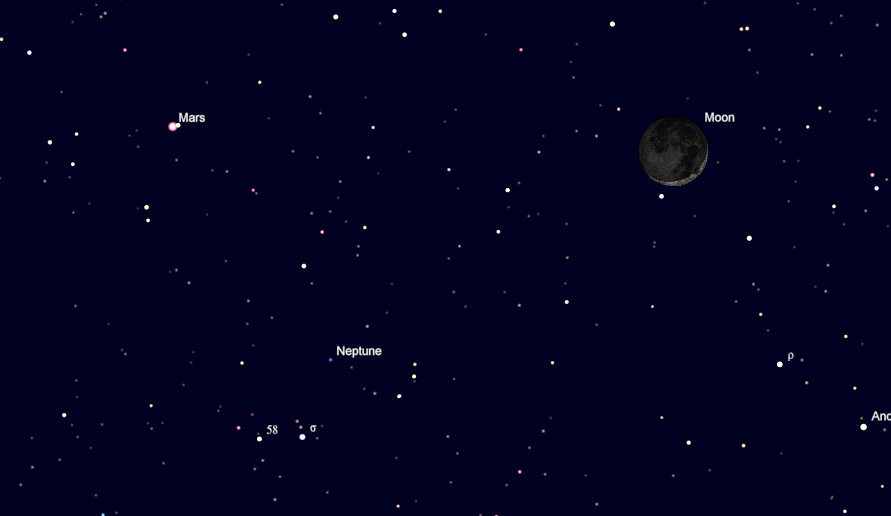
Magnified field with Mars, and the Moon. Neptune is also in the field for 7 p.m. January 22, 2015. Created using Cartes du Ceil (Sky Charts).
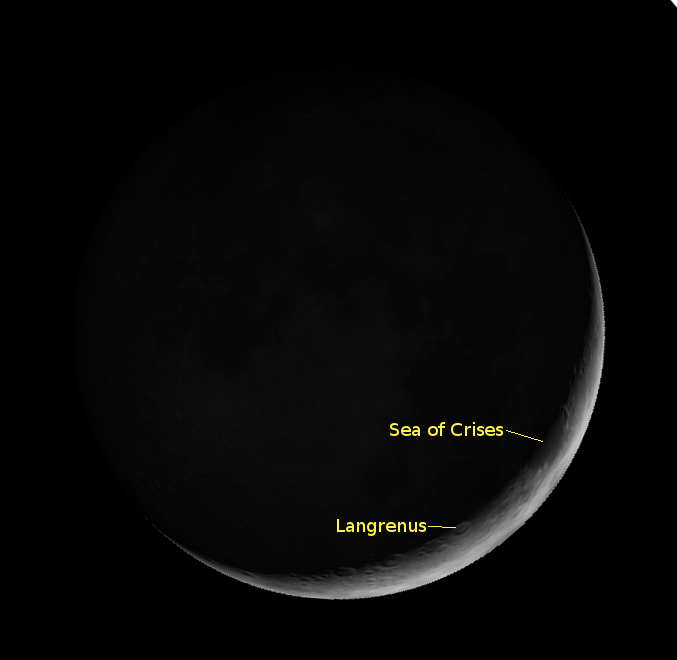
The Moon with Earth shine at 7 p.m. January 22, 2015. Created using Virtual Moon Atlas and GIMP.
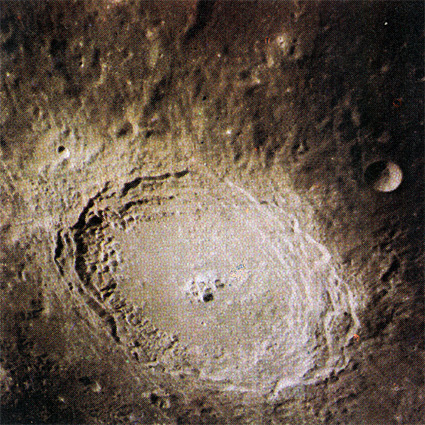
The crater Langrenus as imaged by the Apollo 8 crew on their historic orbiting of the Moon Christmas Eve 1968. Credit: NASA.
03/04/2014 – Ephemeris – Observing the Moon tonight
Ephemeris for Fat Tuesday, Tuesday, March 4th. The sun will rise at 7:14. It’ll be up for 11 hours and 19 minutes, setting at 6:34. The moon, 3 days past new, will set at 10:52 this evening.
The Moon tonight is visible in the west after sunset. The sunrise terminator is slowly moving across its face. The solar day on the Moon equals its orbit of the Earth with respect to the sun of about 29 and a half days. As the moon is oriented in our sky the dark nearly circular sea. The Sea of Crises is rotated downward so it appear at between 4 and 5 o’clock on the moon’s face. At the bottom is the partially uncovered Sea of Fertility. With binoculars or preferably a small telescope can be seen the large crater Langrenus close to the lunar equator. A picture of that crater was one of the first brought back by the Apollo 8 crew in 1968. I’ve found it for the blog entry for this episode at bobmoler.wordpress.com.
Times are for the Traverse City/Interlochen area of Michigan. They may be different for your location.
Addendum
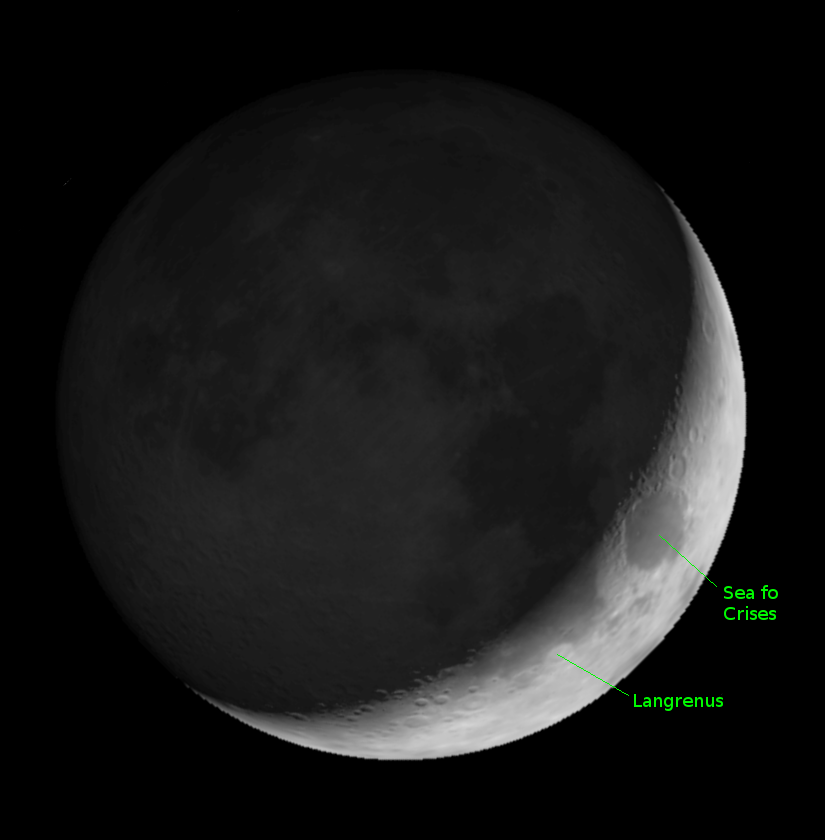
The moon rotated as if it were setting in the west showing the Sea of Crises (Mare Crisium) and the crater Langrenus. The image was enhanced to show Earth shine. Created using Virtual Moon Atlas.
The crater Langrenus as imaged by the Apollo 8 crew on their historic orbiting of the Moon Christmas Eve 1968. Credit: NASA.
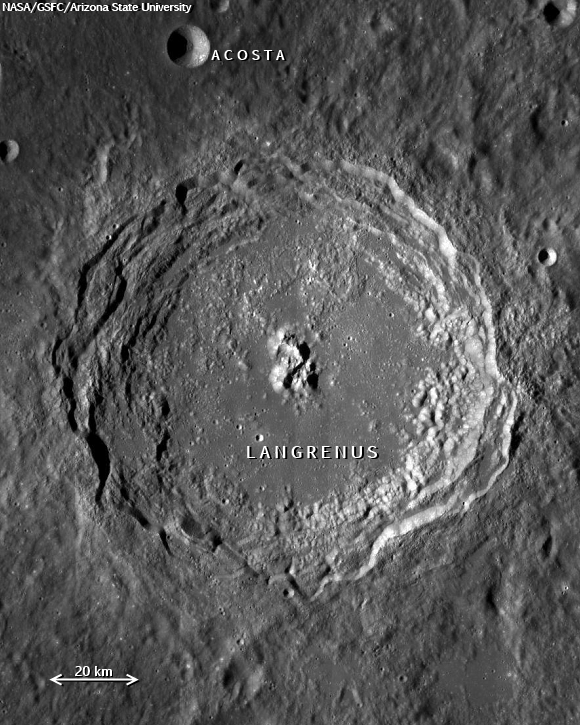
The crater Langrenus as imaged by the Lunar Reconnaissance Orbiter. Credit: NASA\GSFC\Arizona State University.
Note on credits: GSFC is the Goddard Space Flight Center.

