Archive
12/22/2014 – Ephemeris – Roman solstice festivals that seem like our holiday season
Ephemeris for Monday, December 22nd. The sun will rise at 8:16. It’ll be up for 8 hours and 48 minutes, setting at 5:05. The moon, 1 day past new, will set at 6:17 this evening.
The Romans, around the time of Christ knew that the Sun would turn northward after the winter solstice. Their ancestors may not have been. They had two festivals around this time of year. Saturnalia, from the 17th to the 23rd. A time of gift giving, parties, kind of like now. The feast of Sol Invictus or the Unconquerable Sun was set on December 25th the then date to have thought to be the winter solstice. I’m not sure if the Roman calendars were off 4 days or that it was the date they detected northward movement in the Sun. Anyway that’s the date the Christians decided to celebrate Christ’s birth. The Gospel of Luke with its shepherds being out all night guarding the sheep suggests that the birth was actually in the spring.
Times are for the Traverse City/Interlochen area of Michigan. They may be different for your location.
Addendum
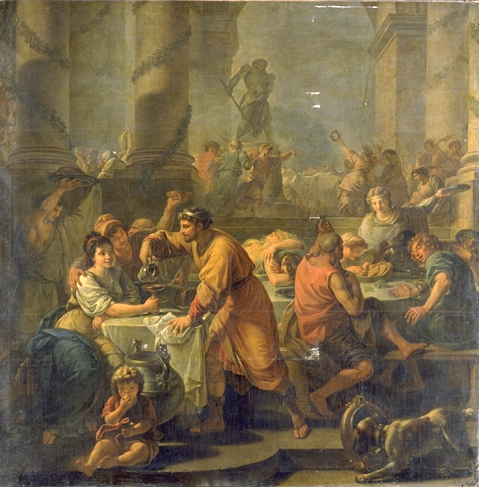
Saturnalia depiction.
Here’s your chance to name some craters on Mercury
Here’s a message from Heather Weir at NASA’s Goddard Space Center:
“TO HONOR THE ASTOUNDING ACHIEVEMENTS OF THE MESSENGER MISSION, THERE WILL BE AN INTERNATIONAL COMPETITION TO NAME A CRATER ON MERCURY!
“OPENS DECEMBER 15, 2014 (00:00 UTC) CLOSES JANUARY 15, 2015 (11:59 UTC)
“The MESSENGER Team is seeking help from all Earthlings to suggest names for five impact craters on Mercury. This is a chance to immortalize an important person in the Arts and Humanities from any nation or cultural group by having a crater on the planet Mercury named in their honor! We will accept submissions beginning midnight (00:00 UTC) December 15, 2014 until January 15, 2015 (23:59 UTC). All entries will be reviewed by Team representatives and expert panels. Then, 15 finalist names will be submitted to the International Astronomical Union (IAU) for selection of the 5 winners. Winning submissions will be announced by the IAU to coincide with MESSENGER’s End of Mission Operations in late March/April 2015. Full details are available on the MESSENGER web site http://namecraters.carnegiescience.edu/.”
As the MESSENGER mission to orbit and study the solar system’s innermost planet Mercury is coming to an end when the spacecraft runs out of fuel in a few more months, the MESSENGER team has selected five small but important craters that need names.
The link above will provide all the information needed to enter including rules, pictures, descriptions of the craters to be named and a list of craters already named.
The official naming rules for craters are these: “Deceased artists, musicians, painters, and authors who have made outstanding or fundamental contributions to their field and have been recognized as art historically significant figures for more than 50 years.”
Tip of the old astronomer’s observing cap to the NASA/JPL Solar System Ambassadors.Program.
12/19/2014 – Ephemeris – Winter starts on Sunday
Ephemeris for Friday, December 19th. The sun will rise at 8:15. It’ll be up for 8 hours and 49 minutes, setting at 5:04. The moon, 2 days before new, will rise at 6:27 tomorrow morning.
It’s looking like November and December should trade places in the calendar this year. And whatever the prognosis for a white Christmas this year winter will arrive on time at 6:03 p.m. Sunday the 21st. At that moment the Sun will hover over the Tropic of Capricorn before slowly beginning its journey northward. It is the winter of December solstice. In the sky the Sun will be moving about its fastest eastward near the border between Ophiuchus and Sagittarius along the great circle in the sky called the ecliptic that will bring it northward. The Sun’s motion will slowly bring longer daylight hours and a higher altitude that will counteract the cold generated in the last month or so, and will start to warm the northern hemisphere up again.
Times are for the Traverse City/Interlochen area of Michigan. They may be different for your location.
Addendum
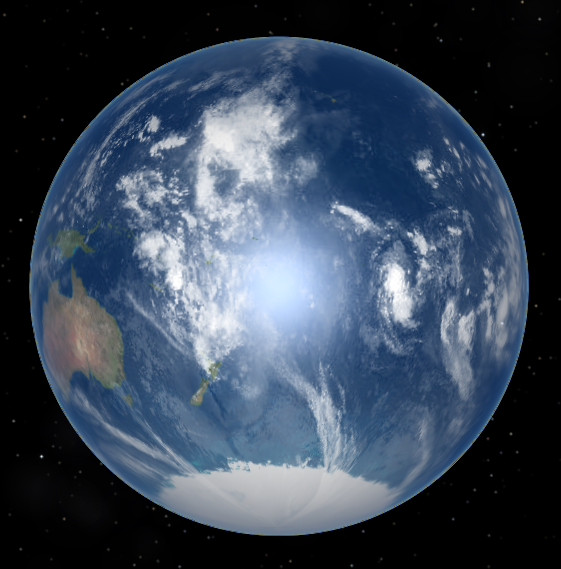
The Earth as seen from the direction of the Sun at 6:03 p.m. EST (23:03 UT) December 21, 2014. The sun would be overhead at 23.5 degrees south latitude in the South Pacific. Created using Celestia.
12/18/2014 – Ephemeris – Capella’s kids
Ephemeris for Thursday, December 18th. The sun will rise at 8:14. It’ll be up for 8 hours and 49 minutes, setting at 5:03. The moon, 3 days before new, will rise at 5:23 tomorrow morning.
Tuesday I talked about the bright star Capella in the constellation Auriga the charioteer, the brightest star in the eastern sky until Jupiter rises around 9:30. I mentioned a slim triangle of stars called the Kids, offspring of the mama goat Capella. The star at the tip of that slim triangle is designated by the Greek letter epsilon and so in known as Epsilon Aurigae. It was discovered to be variable in brightness in 1821. It turns out to be an eclipsing binary, where stars eclipse each other. Only the period between eclipses is 27 years, and the eclipses last about 2 years. Typical eclipsing binary stars have periods of days and the eclipses last hours. The eclipsing star has a large debris ring around it that’s also eclipsing the other star.
Times are for the Traverse City/Interlochen area of Michigan. They may be different for your location.
Addendum
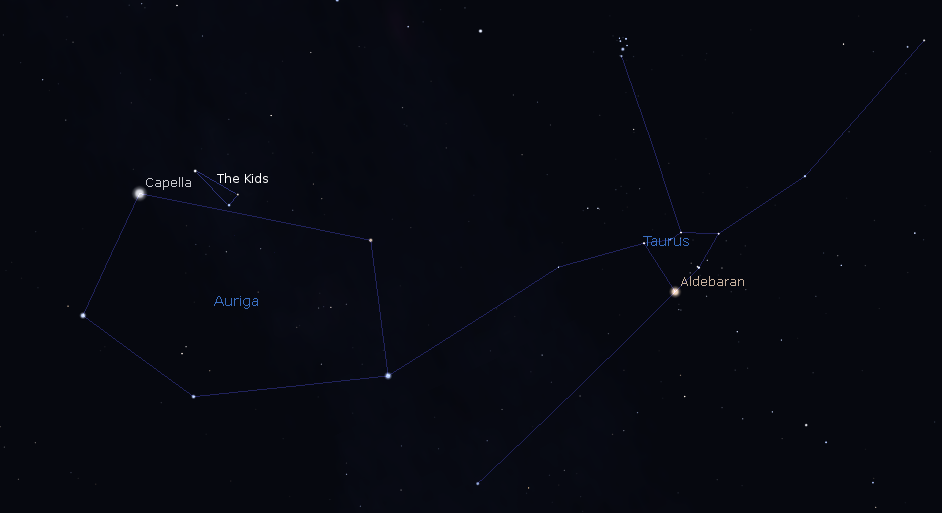
Capella and her kids. at 9 p.m. December 18, 2014. Created using Stellarium.
12/16/2014 – Ephemeris – Capella, the winter star that won’t set
Ephemeris for Tuesday, December 16th. The Sun will rise at 8:13. It’ll be up for 8 hours and 49 minutes, setting at 5:03. The moon, 2 days past last quarter, will rise at 3:17 tomorrow morning.
The bright star Capella is the only winter star I mention in the summer that still can be seen in the evening. That’s because it never sets for observers north of Ludington. It’s a constant reminder that winter is always just around the corner. Well this week it really is. It’s the brightest star in the eastern sky at 8 p.m. and for some time thereafter until Jupiter rises. Capella is in the constellation of Auriga the charioteer, a pentagonal constellation to my eyes. Capella means, essentially mama goat. Her three kids are the stars in a thin triangle to her right. Capella is actually a very close binary star, where the stars are too close to be optically separated. Breaking up the light with a spectroscope reveals its true nature.
Times are for the Traverse City/Interlochen area of Michigan. They may be different for your location.
Addendum
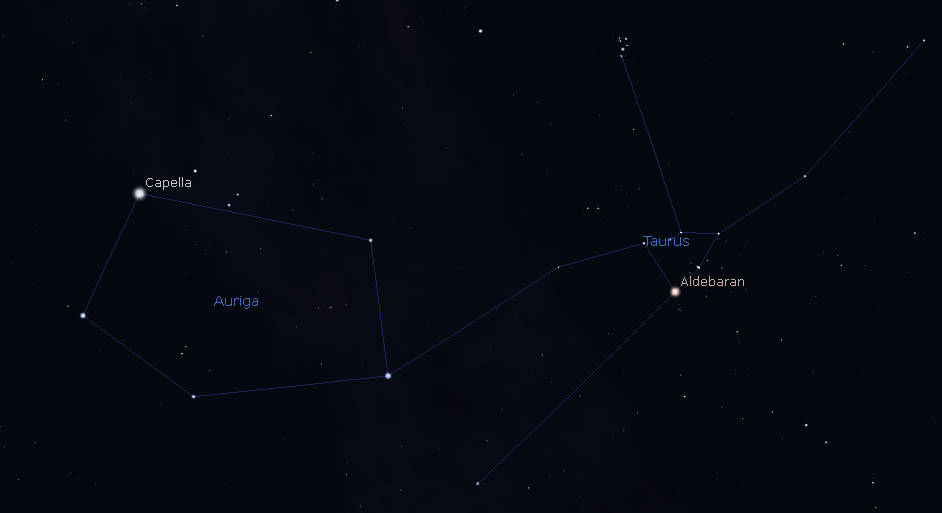
Capella in the constellation of Auriga at 9 p.m. on December 16, 2014. Created using Stellarium.
12/17/2014 – Ephemeris – Your weekly look at the bright planets
Ephemeris for Wednesday, December 17th. The sun will rise at 8:13. It’ll be up for 8 hours and 49 minutes, setting at 5:03. The moon, 3 days past last quarter, will rise at 4:19 tomorrow morning.
Venus is slowly moving from around the sun into the evening sky. It now sets at 5:55 p.m., 52 minutes after the sun. It will be tough to spot at all New Year’s Eve might be a good time to start to see it. Mars is still low in the southwest at 7 p.m. It’s now moving through the constellation of Capricornus and will set tonight at 8:32 p.m. Jupiter, which will be our Christmas Star this year will rise in the east at 9:32 p.m. It’s near the sickle-shaped head of Leo. Jupiter has just started to turn from eastward or direct motion to retrograde, or westward motion among the stars. This is an effect that happens because the Earth is passing Jupiter, a motion shared by all the planets that baffled the ancients who thought the Earth to be motionless. Saturn will rise in the east-southeast at 5:58 a.m.
Times are for the Traverse City/Interlochen area of Michigan. They may be different for your location.
Addendum
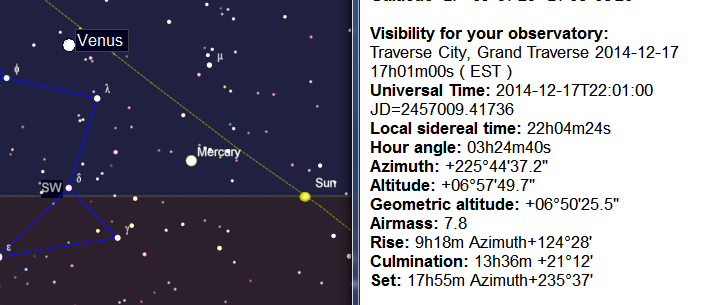
Venus at Sunset. Only 7 degrees above the horizon. Created using Cartes du Ceil (Sky Charts).
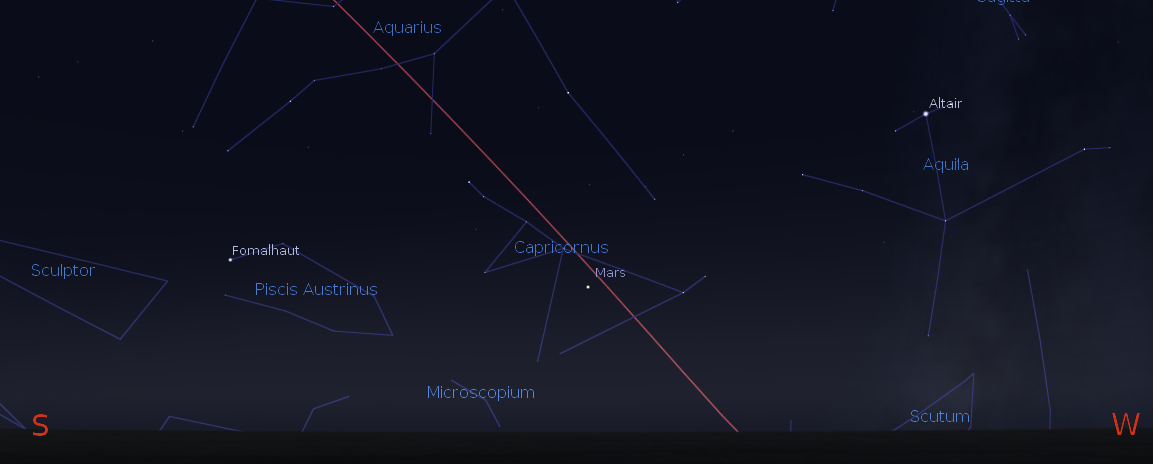
Mars and the constellations plus the ecliptic (red line) at 7 p.m. on December 17, 2014. Created using Stellarium.
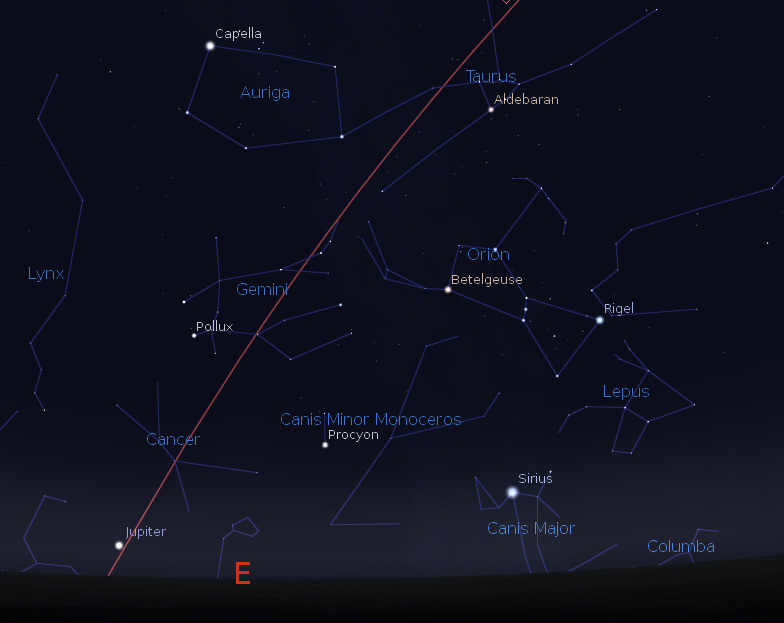
Jupiter and the winter constellations at 11 p.m. on December 17, 2014. Created using Stellarium.
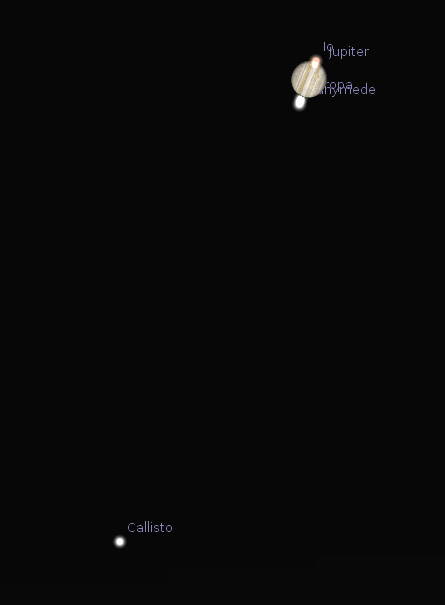
Jupiter and moons in a telescope. The moons Io, Europa and Ganymede all will be moving away from Jupiter over the evening and morning. Image as of 11 p.m. December 17, 2014. Created using Stellarium.
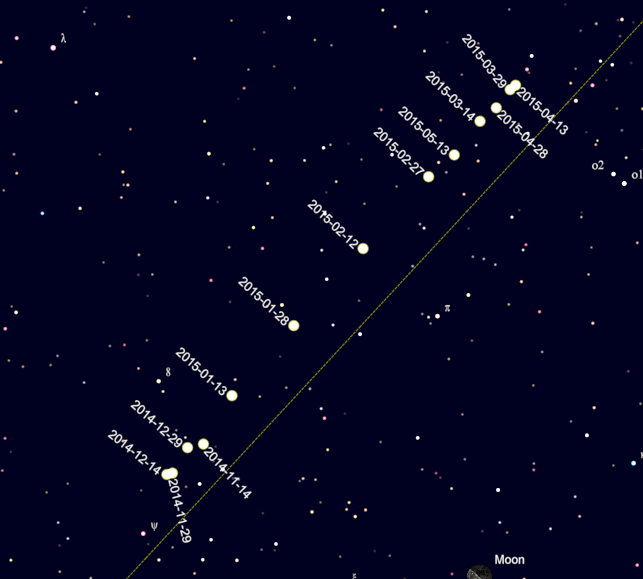
Jupiter’s Retrograde motion. Created using Cartes du Ceil (Sky Charts).
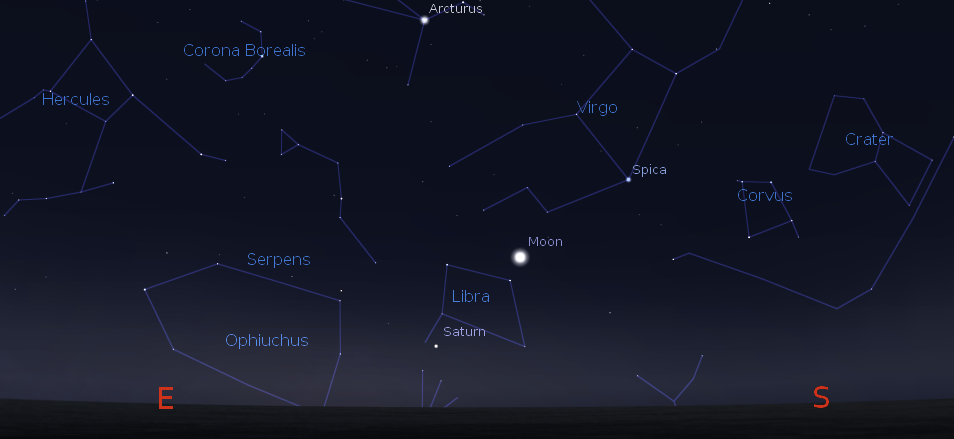
Saturn and the Moon at 7 a.m. on December 18, 2014. Created using Stellarium.
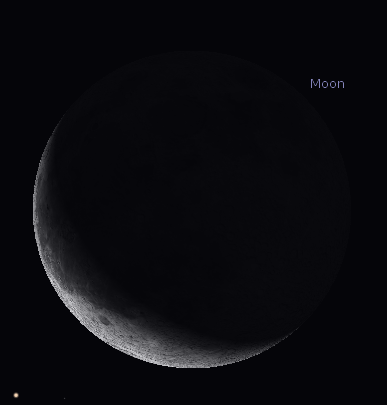
The Moon as it would appear in binoculars on December 18, 2014. Created using Stellarium.
12/15/2014 – Ephemeris – How to find Orion through the evening
Ephemeris for Monday, December 15th. The sun will rise at 8:12. It’ll be up for 8 hours and 50 minutes, setting at 5:02. The moon, 1 day past last quarter, will rise at 2:15 tomorrow morning.
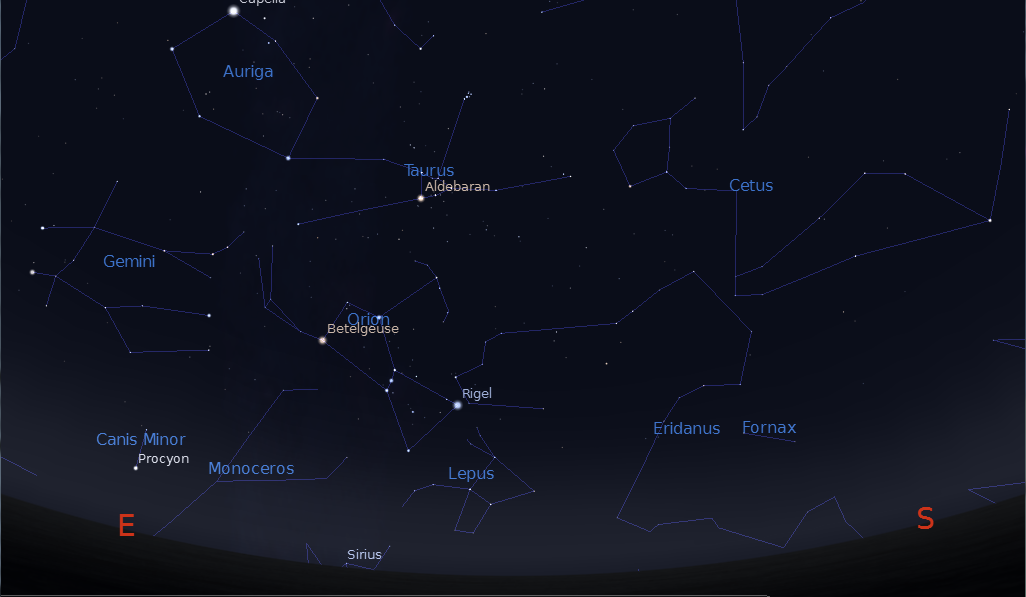
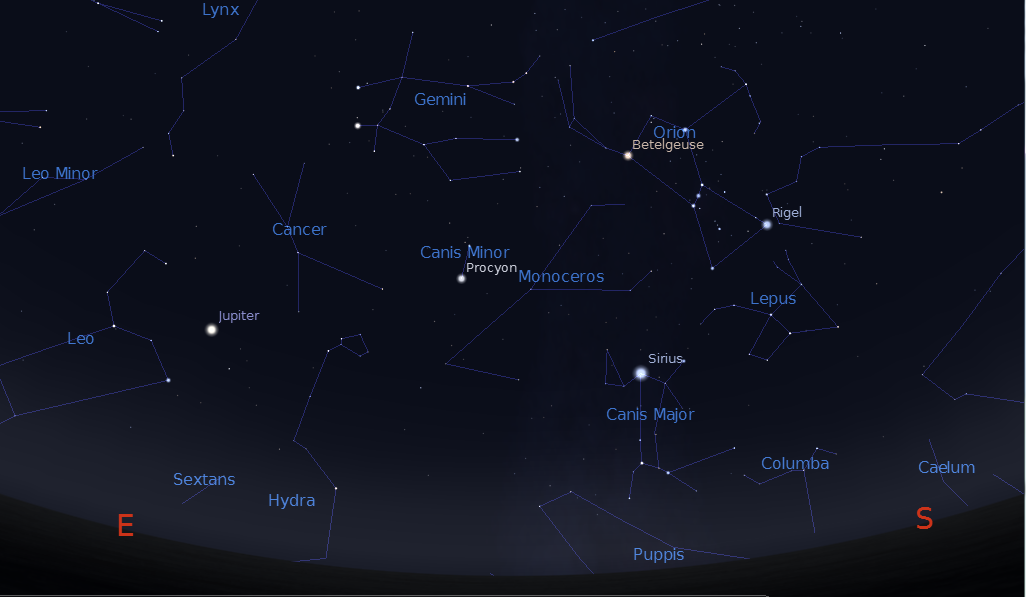
At 7 p.m. tonight the great central constellation of winter Orion is struggling to rise, with the top half of him in the eastern sky. By 9 p.m. he’s whole and low in the east-southeast. By midnight he has taken his rightful place as the central winter constellation. In the evening now his distinctive belt of three stars in a straight line, by which most folks can find him, is more or less vertical in the sky. His brightest stars are Betelgeuse a red star to the left of the belt and blue-white Rigel to the right. When Orion’s the highest in the south we’ll explore the wonders within this constellation, the most famous constellation world over. Parts of it can be seen at the north and south poles of the Earth. The Big Dipper, which isn’t a real constellation, doesn’t hold a candle to it.
Times are for the Traverse City/Interlochen area of Michigan. They may be different for your location.
Addendum
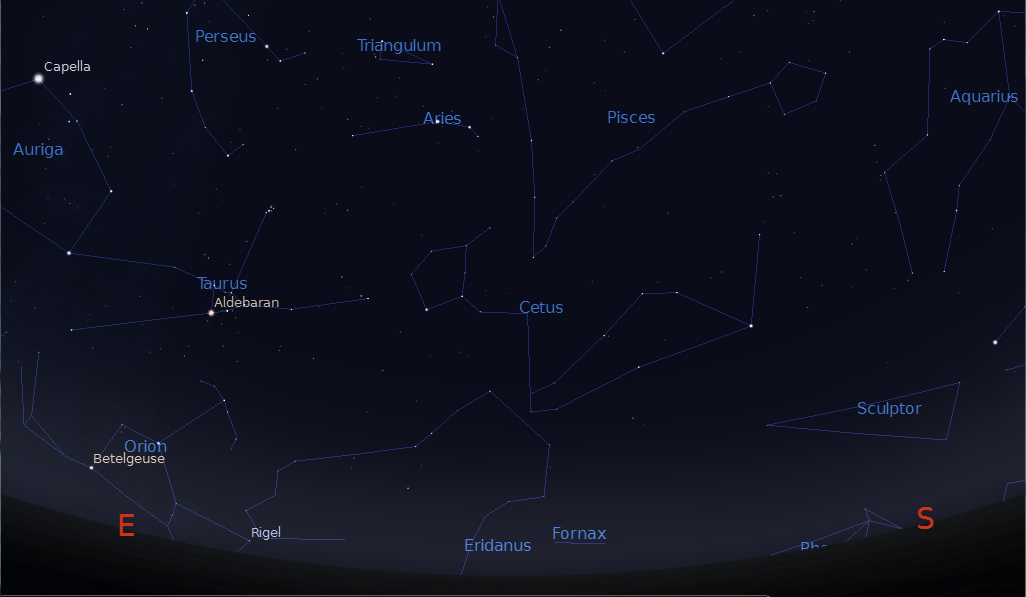
Orion rising at 7 p.m. December 15, 2014. Created using Stellarium.
Orion rising higher at 9 p.m. December 15, 2014. Created using Stellarium.
Orion close to the meridian at 12 midnight, December 16, 2014. There is distortion in this projection. Orion is standing straighter in the real sky than shown here. Created using Stellarium.
12/12/2014 – Ephemeris – The Geminids will zip through again this weekend
Ephemeris for Friday, December 12th. The sun will rise at 8:10. It’ll be up for 8 hours and 52 minutes, setting at 5:02. The moon, 2 days before last quarter, will rise at 11:19 this evening.
The Geminid meteor shower will reach its peak early Sunday morning, however the bright moon , rising after midnight will interfere. The Geminids, however do have a number of really bright fireballs for which the Moon won’t matter. The good news is that the Geminids will be visible all night. You don’t have to wait until the morning hours to see them. So around midnight Saturday night will probably be the best time to see them. Also the shower has a broad peak and there may be another peak on Monday or Tuesday night and morning. The peak numbers per hour for the Geminids will be close to 120. That’s the best for any year in and year out shower. To bad it occurs in such a cloudy month.
Times are for the Traverse City/Interlochen area of Michigan. They may be different for your location.
Addendum
The numbers of Geminids are already rising.

NASA’s Meteoroid Environment Office plots of fireball orbits for the night of December 10-11, 2014. The large number of yellow orbits oriented toward 2 o’clock are Geminids. Check spaceweather.com for each day’s fireball orbits. This plot includes 22 Geminid fireballs. Credit NASA via Spaceweather.com
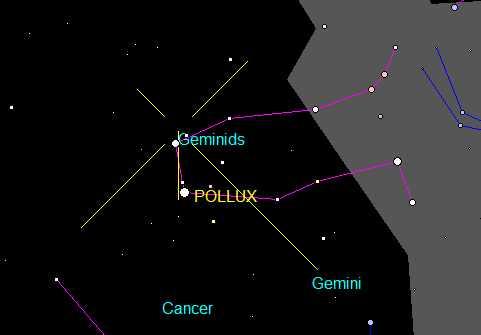
Geminid Radiant
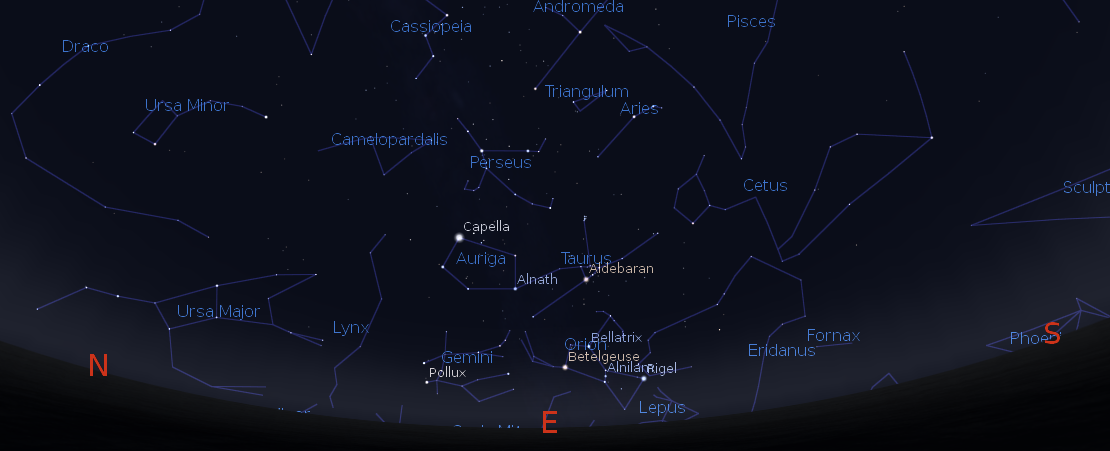
The Eastern sky got the Geminid meteor shower at 8 p.m. December 13, 2014. Created using Stellarium.
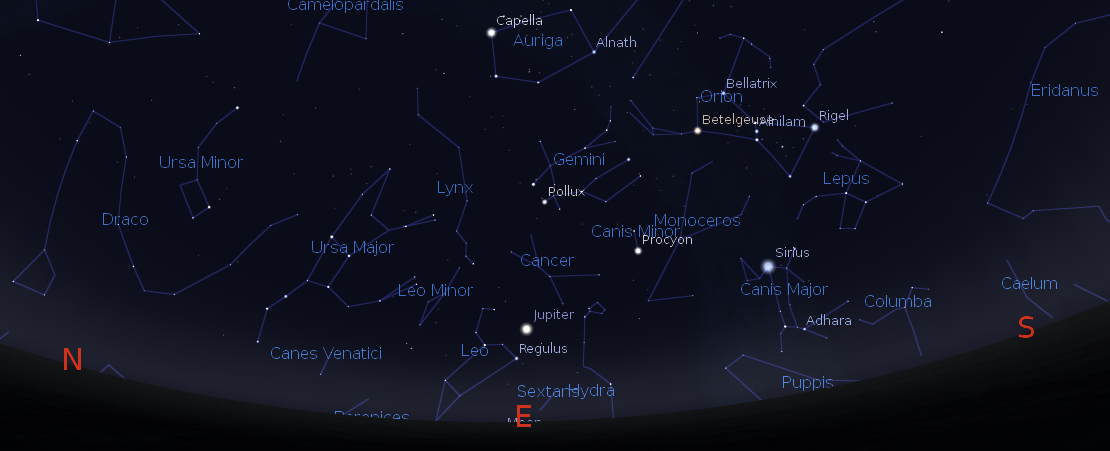
The Eastern sky got the Geminid meteor shower at midnight December 14, 2014. Created using Stellarium.
Remember Geminids can be seen all over the sky. It’s their streaks that can be extended back to the radiant.
12/11/2014 – Ephemeris – The Geminid meteors will reach peak numbers Saturday night to Sunday morning
Ephemeris for Thursday, December 11th. The sun will rise at 8:09. It’ll be up for 8 hours and 53 minutes, setting at 5:02. The moon, 3 days before last quarter, will rise at 10:21 this evening.
This weekend is the peak of the Geminid meteor shower. It is the best meteor shower of the year and it is getting more active over the years. The projected peak numbers is 120 meteors an hour spotted by a single observer when the radiant of the shower is overhead. It’s known as the zenithal hourly rate (ZHR). Anyway, the radiant is the point in space where the meteors seem to come from, which is near the star Castor in the constellation Gemini from which the shower gets its name. The meteors will be seen all over the sky, but they all can be traced back to the radiant. The body responsible for this meteor shower is an asteroid rather than a comet. It comes very close to the sun, so may crumble due to heat stress. I suppose I can’t resist this: That’s how the asteroid crumbles.
Times are for the Traverse City/Interlochen area of Michigan. They may be different for your location.
Addendum
Geminid Radiant. From my LookingUp program.
The Eastern sky got the Geminid meteor shower at 8 p.m. December 13, 2014. Created using Stellarium.
The Eastern sky got the Geminid meteor shower at midnight December 14, 2014. Created using Stellarium.
The Stellarium charts differ from mine at top in how the constellation lines are drawn, especially Gemini. In all charts Castor is not labeled. However it is the bright star above Pollux. The meteors will will appear all over the sky, but true Geminids can be traced back near Castor. Also when the radiant is lowest in the sky, thought the numbers of meteors will be low, the brighter meteors will produce long streaks, since the will hit our atmosphere at a glancing angle.
12/10/2014 – Ephemeris – Two holdout planets in the evening sky
Ephemeris for Wednesday, December 10th. The sun will rise at 8:08. It’ll be up for 8 hours and 53 minutes, setting at 5:02. The moon, half way from full to last quarter, will rise at 9:23 this evening.
In reviewing which planets are visible tonight, it looks like we’re still down to two. Venus, Saturn and Mercury are still hanging near the direction of the Sun. It will be a little while before we see them again. However we can see Mars, which will be low in the southwest at 7 p.m. It will set at 8:30 p.m. Mars’ setting time will slowly advance 5 minutes between now and the end of the year. Normal setting times for stars and planets decrease by 4 minutes a night or about a half hour a week. Mars is moving northeastward in the sky and is counteracting that. Jupiter will rise at 10 p.m. in the east-northeast. The best views in a telescope may have to wait for at least an hour after that. Jupiter is a wonderful sight in a telescope.
Times are for the Traverse City/Interlochen area of Michigan. They may be different for your location.
Addendum
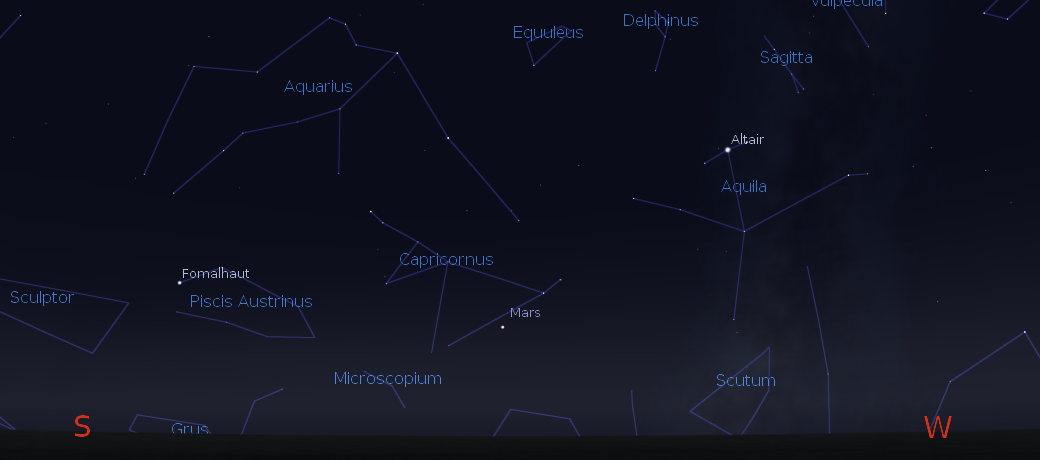
Mars low in the southwest at 7 p.m. December 10, 2014. Created using Stellarium.
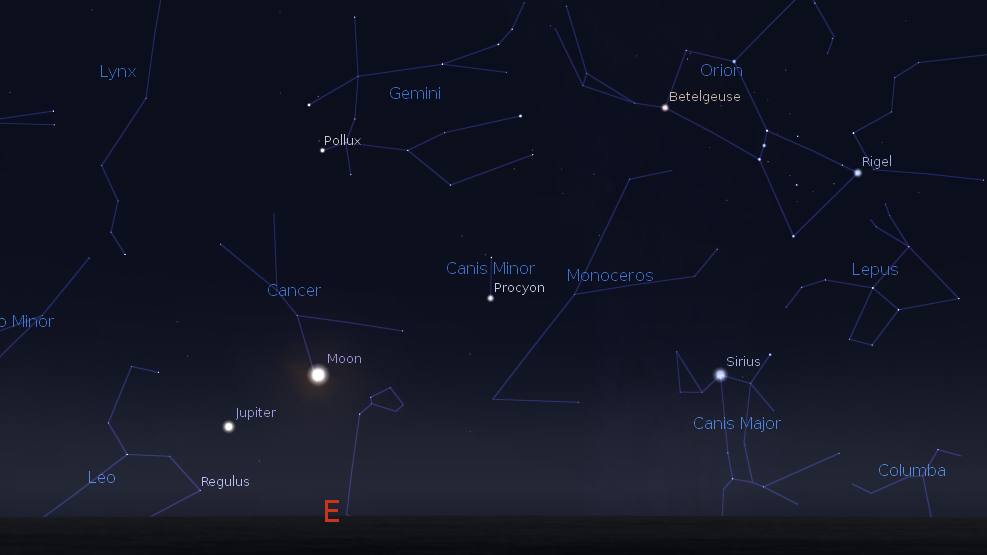
Jupiter and the Moon low in the east at 11 p.m. December 10, 2014. On the evening of the 11th the Moon will appear below Jupiter. Created using Stellarium.
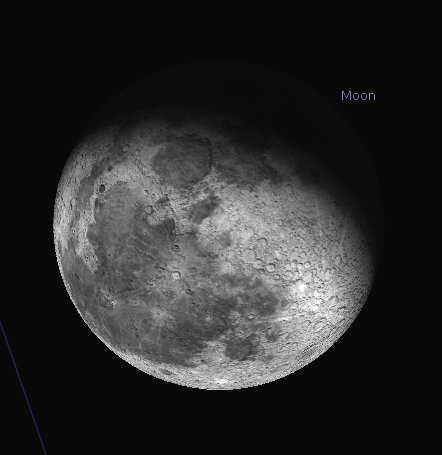
The moon as it would appear in binoculars at 11p.m. December 10, 2014. Created using Stellarium.
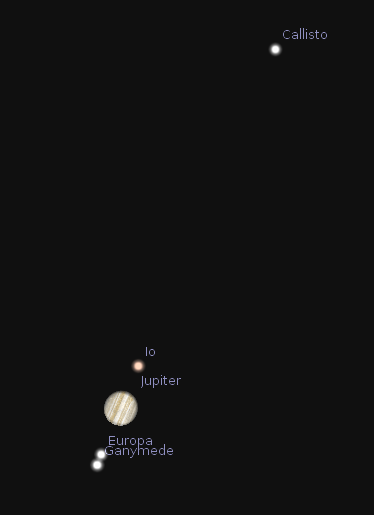
Jupiter and its moon as seen in a telescope. at 11 p.m. December 10, 2014. Note that Europa and Ganymede appear very close. They will move closer until 5 a.m. when they will appear at their closest. Created using Stellarium.
 Bob Moler's Ephemeris Blog