Archive
12/08/2014 – Ephemeris – Last week was a good week in space
Ephemeris for Tuesday, December 9th. The sun will rise at 8:07. It’ll be up for 8 hours and 54 minutes, setting at 5:02, officially the earliest sunset of the year. The moon, 3 days past full, will rise at 8:25 this evening.
Last month we had two space tragedies, the explosion of a Antares rocket on its way to resupply the International Space Station and the death of a pilot of SpaceShipTwo on a test flight. This past week good news, Tuesday (Wednesday Japan time) the launch in Japan of the Hyabusa 2 spacecraft to bring back samples of an asteroid. And on Friday the first test flight of an Orion Crew Module to test, mainly its heat shield, and if it could withstand the heat of reentry coming back from deep space. It will be nearly 4 more years before the Space Launch System, the rocket to be used with the Orion module, will be ready to be launched. If you’re wondering about the slow pace, well NASA doesn’t have the budget it did back in the 1960s.
Times are for the Traverse City/Interlochen area of Michigan. They may be different for your location.
Addendum
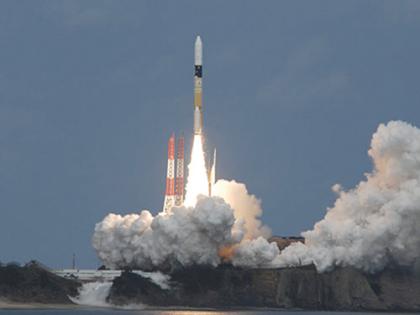
The launch of Hyabusa 2. Credit JAXA.
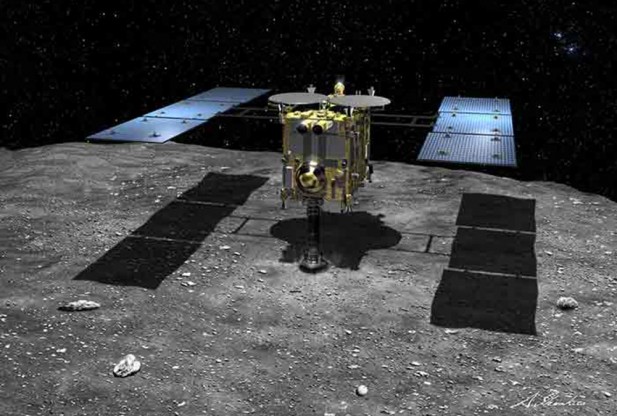
Artists rendition of Hyabusa 2 taking a sample from the asteroid. Credit: JAXA.
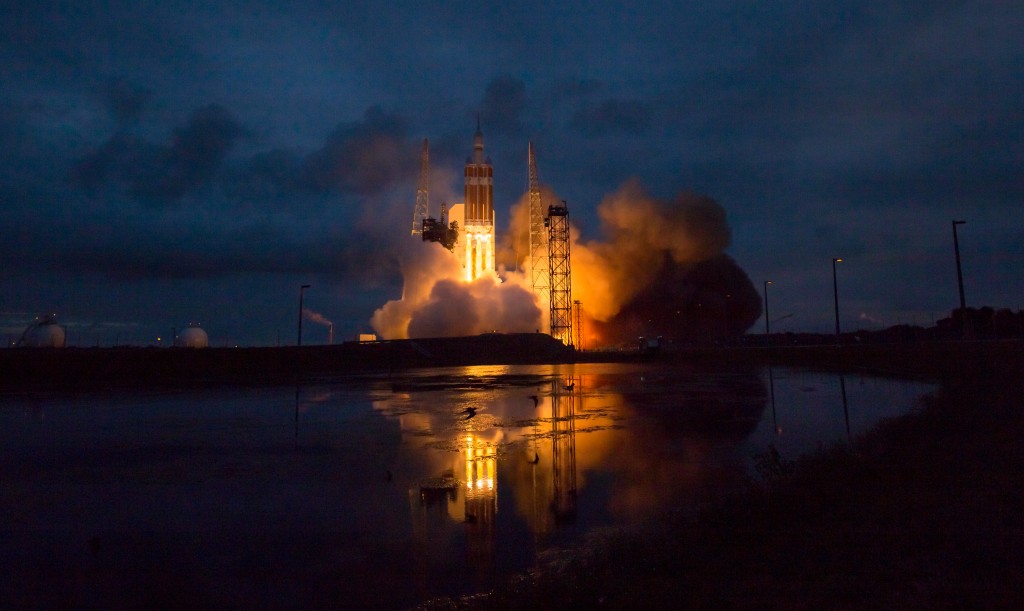
Orion Crew module being launched by a Delta 4 Heavy rocket. Credit: NASA.
12/08/2014 – Ephemeris – Looking forward to the Geminid meteor shower next weekend
Ephemeris for Monday, December 8th. The sun will rise at 8:06. It’ll be up for 8 hours and 55 minutes, setting at 5:02. The moon, 2 days past full, will rise at 7:28 this evening.
This upcoming weekend is the weekend of the greatest annual meteor shower of the year. They’re the Geminids. I confess to never having seen a Geminid. The reason is that it’s generally too cloudy, and for me too cold. They are now twice as active as the Perseid meteors of August with a 120 per hour peak, when the radiant point in Gemini is overhead. The body that was discovered to produce these meteors doesn’t appear to be a comet. It is designated as an asteroid 3200 Phaethon. Phaethon gets extremely close to the sun at 13 million miles (21 million km) and one of the STEREO Sun monitoring satellites caught it developing a tail when close to the Sun. Phaethon may then be the first known rock comet. I’ll have more later this week.
Times are for the Traverse City/Interlochen area of Michigan. They may be different for your location.
Addendum
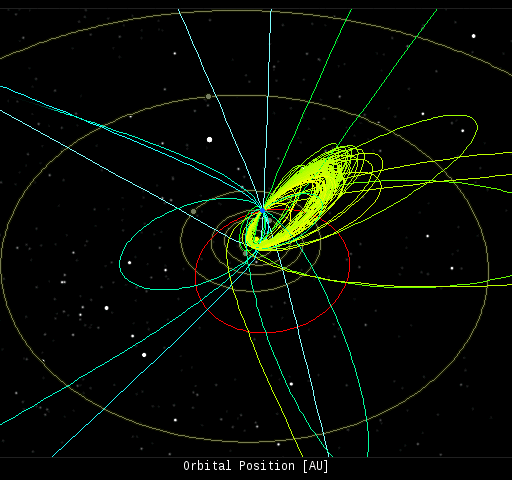
Orbits of last year’s fireballs on the night of December 13-14 as recorded by NASA’s All Sky Cameras. The preponderance of fireballs (bright meteors) are Geminids. These are published daily on Spaceweather.com. Credit: NASA and Spaceweather.com
12/05/2014 – Ephemeris – Search for the Star of Bethlehem will be presented tonight
Ephemeris for Friday, December 5th. The sun will rise at 8:03. It’ll be up for 8 hours and 59 minutes, setting at 5:02. The moon, 1 day before full, will set at 7:51 tomorrow morning.
The program In Search for the Star of Bethlehem, will be presented by yours truly at this evening’s meeting of the Grand Traverse Astronomical Society at Northwestern Michigan College’s Rogers Observatory starting at 8 p.m. This is a scientific rather than a religious quest, however the only clues to the star’s existence are found in Gospels of Matthew and Luke. 400 years ago Johannes Kepler’s discovery of a special conjunction of Jupiter and Saturn that would have occurred about that time started the search. Ancient Chinese records and ancient writers all contribute to the evidence. The program will be followed at 9 p.m. by the last star party of the year. The observatory’s located south of Traverse City on Birmley Road.
Times are for the Traverse City/Interlochen area of Michigan. They may be different for your location.
12/04/2014 – Ephemeris – What’s happening on the Sun this solar cycle
Ephemeris for Thursday, December 4th. The sun will rise at 8:02. It’ll be up for 9 hours even, setting at 5:02. The moon, 2 days before full, will set at 6:52 tomorrow morning.
It looks like maybe we’ve hit the peak of sunspots in this 11 year solar cycle. Actually this cycle had two peaks, the latter part of 2012 when the world ended. You do remember the world ending two years ago on December 21st. How soon we forget. The second peak in this solar cycle occurred in the first three months of this year. The sunspot cycle 24 so far appears to be the weakest since cycle 12 in the 1880s. The time of the peak can only be determined in hindsight. Of course this weak sunspot cycle produced the largest sunspot group, or active region, as they are now called, in 24 years, so I expect more surprises from this solar cycle. I expect to see more aurorae or northern lights as the sunspot numbers decline.
Times are for the Traverse City/Interlochen area of Michigan. They may be different for your location.
Addendum
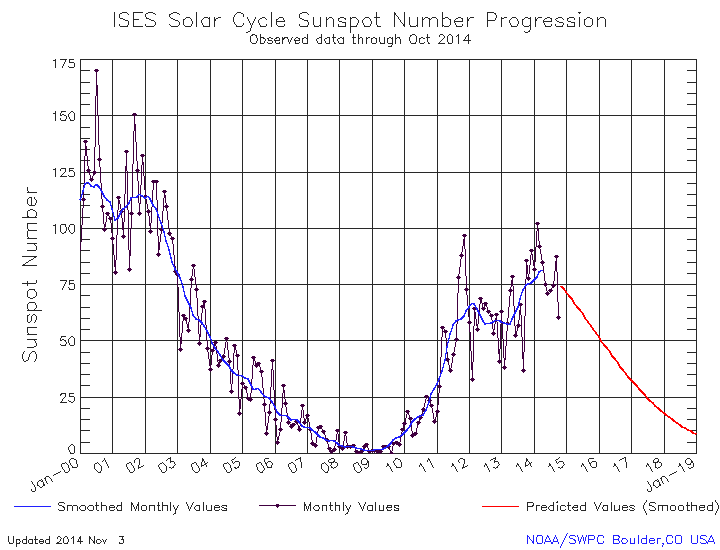
Sunspot cycle from 2000 until October 2014. Credit: NOAA/SWPC.
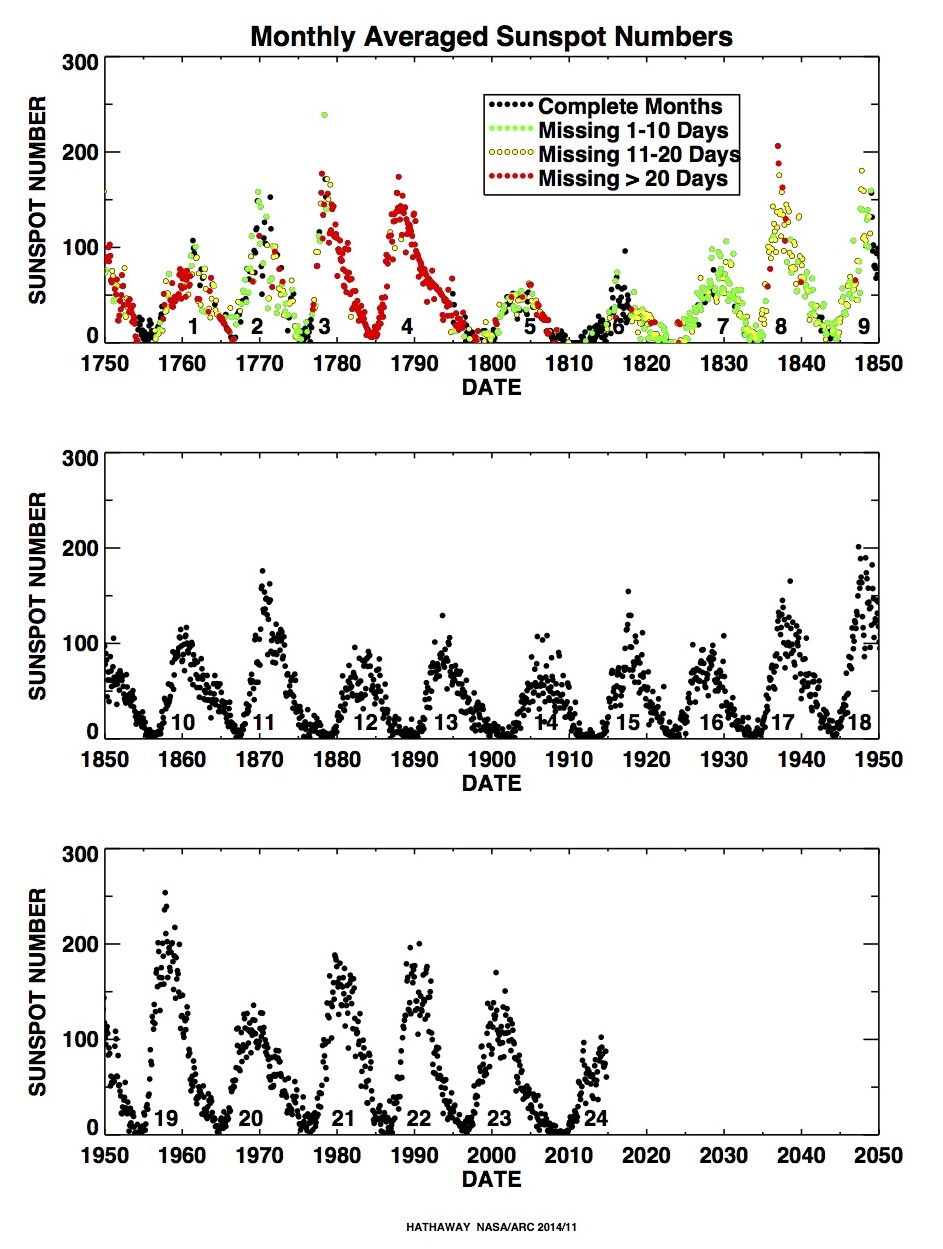
All the recorded sunspot cycles back to the 18th century. Credit: Dr. David Hathaway, NASA /ARC.
Here’s a link to NASA’s Sunspot Cycle page with a lot more information.
12/03/2014 – Ephemeris – Bright planets: One early and one late
Ephemeris for Wednesday, December 3rd. The sun will rise at 8:01. It’ll be up for 9 hours and 1 minute, setting at 5:03. The moon, 3 days before full, will set at 5:48 tomorrow morning.
In reviewing which planets are visible tonight, it looks like we’re still down to two. Venus, Saturn and Mercury are hanging around near the direction of the Sun. It will be a little while before we see them again. However we can see Mars, which will be low in the southwest at 7 p.m. It will set at 8:29 p.m. Mars’ setting time will slowly advance only 6 minutes between now and the end of the year. Jupiter will rise at 10:28 p.m. in the east-northeast. The best telescopic views will have to wait a couple of hours after that. So if you’re more of an early bird rather than a night owl it might be better to view Jupiter with a telescope in the morning. Jupiter has those four bright moons that change position daily, and sometimes while you watch.
Times are for the Traverse City/Interlochen area of Michigan. They may be different for your location.
Addendum
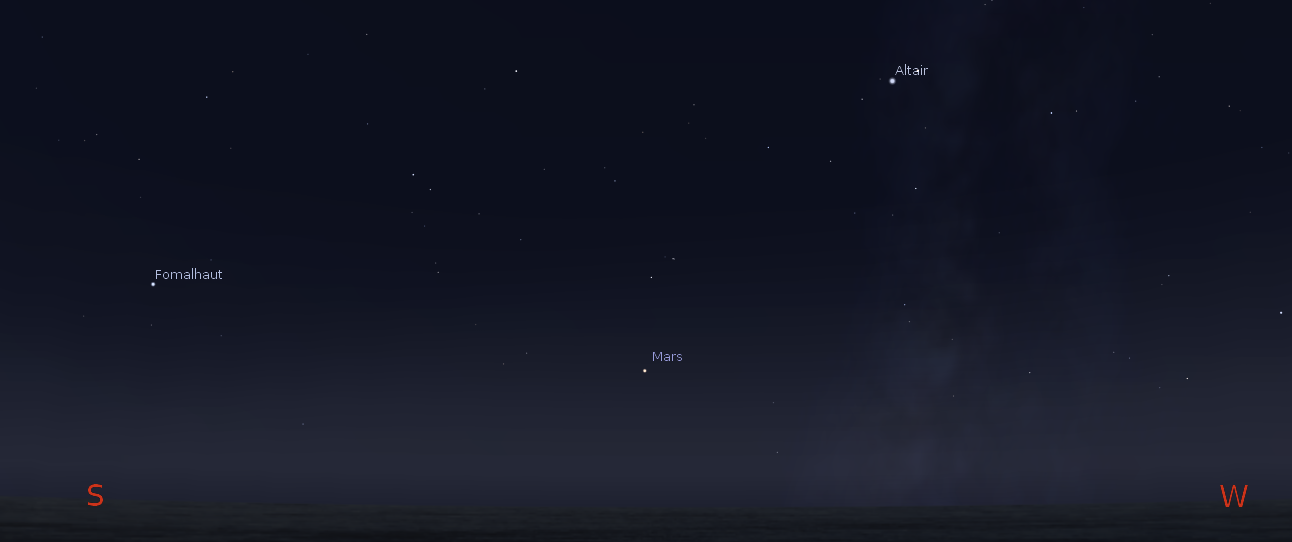
Mars in the southwest at 7 p.m. December 3, 2014. Created using Stellarium.
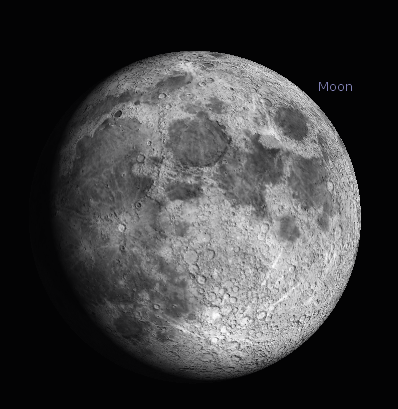
A binocular view of what the moon will look like at 7 p.m. December 3, 2014. Created using Stellarium.
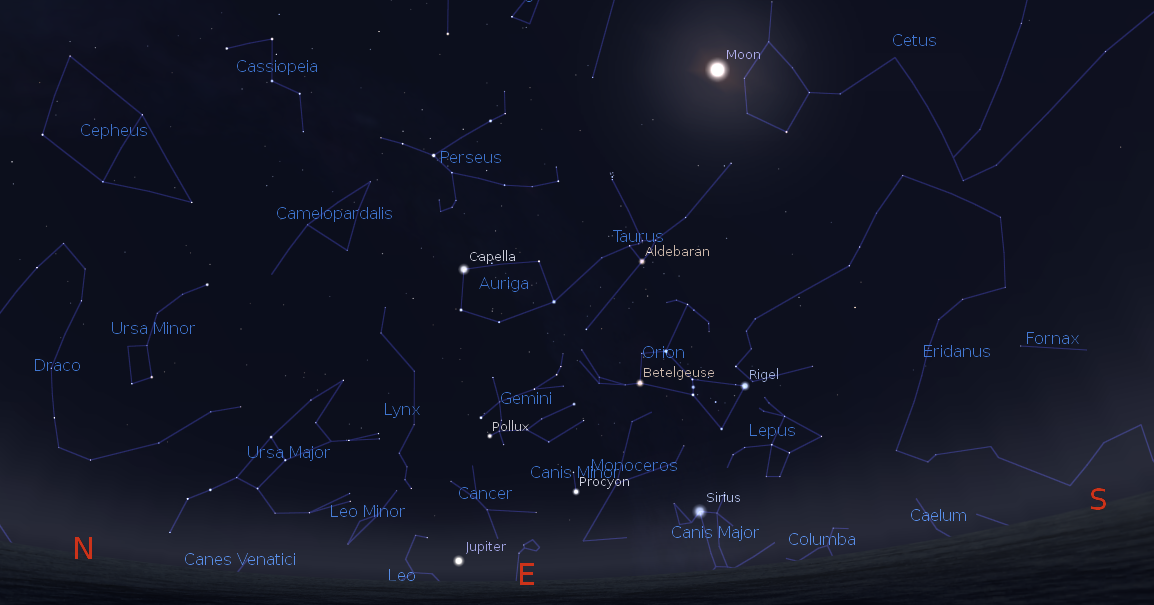
Jupiter rising with the winter constellations at 11 p.m., December 3, 2014. We’re actually looking at the eastern half of the sky. Created using Stellarium.
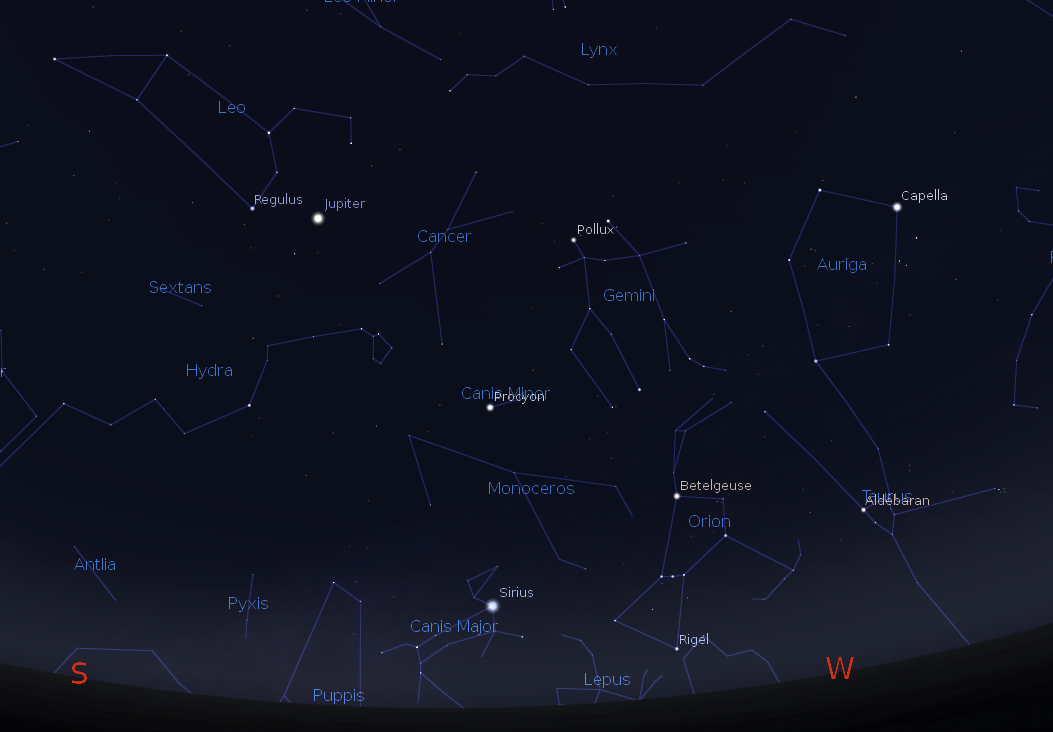
At 6 a.m. December 4, 2014 Jupiter and the winter constellations will swing into the southwest while out of the view the spring and early summer stars take over the eastern sky. Created using Stellarium.
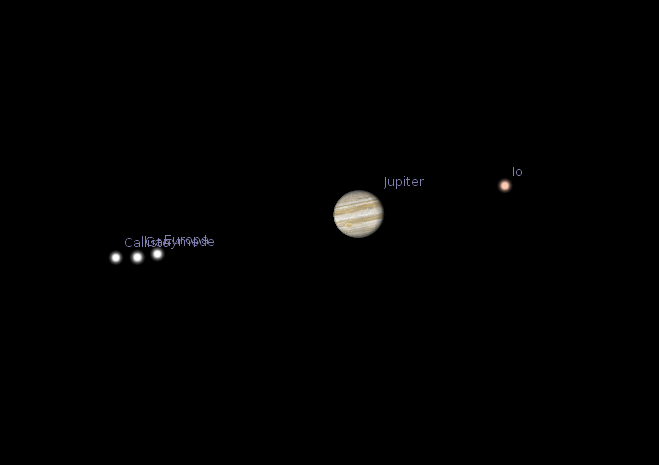
Telescopic view of Jupiter at 6 a.m. December 4, 2014. The moons on the left in order from left to right are Callisto, Ganymede and Europa. In the next hour the moons will appear to get even closer together, especially Ganymede and Callisto. Created using Stellarium.
12/02/2014 – Ephemeris – The unequal dates of latest sunrise and earliest sunset
Ephemeris for Tuesday, December 2nd. The sun will rise at 8:00. It’ll be up for 9 hours and 3 minutes, setting at 5:03. The moon, 3 days past first quarter, will set at 4:41 tomorrow morning.
This evening’s sunset is just a minute from the earliest sunset of the year. The Earliest sunset will actually be on the 9th. However the latest sunrise won’t occur until January 2nd. The reason combines the effects of the tilt of the earth’s axis and the fact that the Earth is only a month from perihelion, its closest to the Sun. Both these effects cause the sun to appear to move faster eastward than average, so the Earth has to rotate a bit farther each day to catch up with the Sun. This makes the sunrise and setting events later than one would expect, so they don’t occur together on the shortest day of the year, the 21st this year. Our sunrise this morning is still 19 minutes earlier than the latest sunrise on January 2nd, 2015.
Times are for the Traverse City/Interlochen area of Michigan. They may be different for your location.
Addendum
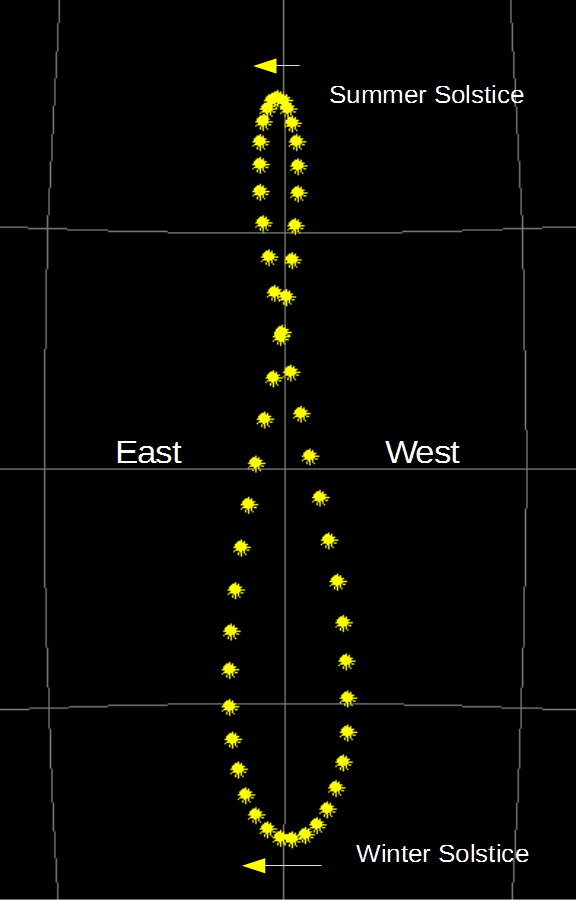
This figure 8 is called an analemma. One can find it on old globes in the Pacific Ocean. Explanation below. Created using my LookingUp program for Traverse City, MI near +45° latitude.
The analemma is a graphical representation of a daily value called the Equation of Time. It’s best known use is in corrections to sundial time. The vertical axis is the sun’s declination or north-south position. It is highest at summer solstice and lowest at winter solstice. It is the result of two effects: the tilt of the Earth’s axis to the plane of the Earth’s orbit around the Sun, and the change in the Earth’s velocity around the Sun as the Earth moves from perihelion, its closest to the Sun in early January to aphelion, its most distant in July.
If the Earth’s orbit were circular, and it orbited the Sun at the same speed. The analemma would be skinner and the north and south lobes would be of equal size. Since we’re closer to the Sun in the winter, we move faster than average around the Sun, so it appears to move faster eastward. That combines with the faster appearing movement of the sun crossing the closer hour lines at higher and lower declinations. In the diagram above note that the vertical hour lines are slightly closer together at the bottom and the top, so the Sun, moving eastward each day crosses them quicker. Near the winter solstice the two effects work together making sunrise and sunset trending to be later than normal. For the summer solstice the eastward speed of the sun is slower than normal, because we’re farther from the Sun. This works against the effect of the earth’s tilt but cannot completely negate it, making the top of the loop smaller than the one at the bottom. The arrows show the speed and direction of the Sun at the solstices.
To see real analemmas search for analemma images on the Internet. It takes a year to photograph one.
12/01/2014 – Ephemeris – Previewing December skies
Ephemeris for Monday, December 1st. The sun will rise at 7:59. It’ll be up for 9 hours and 4 minutes, setting at 5:03. The moon, 2 days past first quarter, will set at 3:32 tomorrow morning.
Let’s preview December’s skies. Winter will officially arrive on the 21st at 6:03 p.m., the winter solstice. The noontime sun will dip from 23 ½ degrees to a bit less than 22 degrees above the southern horizon on that day. There will be little movement in the sunset times: In the Traverse City/Interlochen area this will be from 5:03 today, down to 5:02 and then advancing to 5:11 at the end of the month. There is more movement in the sunrise times which will advance from 7:59 this morning to 8:19 on the 31st. The big event in December will be the Geminid meteor shower whose maximum is on the morning of the 14th. But will be hampered by the moon after 12:17 a.m that morning.
Times are for the Traverse City/Interlochen area of Michigan. They may be different for your location.
Addendum
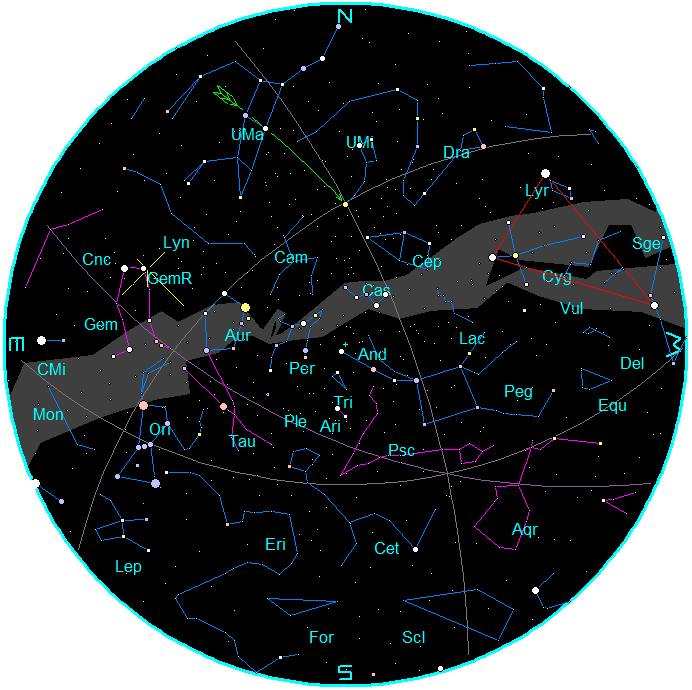
Star Chart for December 2014. Created using my LookingUp program.
The Moon is not plotted. The planets and stars are plotted for the 15th at 9 p.m. That is chart time.
Evening astronomical twilight ends at 6:48 p.m. on December 1st, decreasing one minute by the 9th and increasing to 6:57 p.m. on the 31st.
Morning astronomical twilight starts at 6:14 a.m. on December 1st, and increasing to 6:33 a.m. on the 31st.
Add a half hour to the chart time every week before the 15th and subtract and hour for every week after the 15th.
For a list of constellation names to go with the abbreviations click here.
Also shown is the Summer Triangle in red. Clockwise from the top star is Deneb in Cygnus, Vega in Lyra and Altair in Aquila.
The green pointer from the Big Dipper is:
- Pointer stars at the front of the bowl of the Big Dipper point to Polaris the North Star.
The Geminid radiant is shown in yellow and marked GemR.
 Bob Moler's Ephemeris Blog