Archive
02/16/2015 – Ephemeris – The Winter Circle
Feb 16. This is Bob Moler with Ephemeris for President’s Day, Monday, February 16th. The sun will rise at 7:42. It’ll be up for 10 hours and 30 minutes, setting at 6:12. The moon, 2 days before new, will rise at 6:25 tomorrow morning.
The winter skies are blessed with more first magnitude stars than any other season. That’s a full one-third of the total are seen is a relatively small area. Six of these stars lie in a large circle centered on the seventh. This circle is up at 9 p.m. Starting high overhead is Capella in Auriga the charioteer. Moving down clockwise is Aldebaran in the face of Taurus the Bull. Then down to Orion’s knee we find Rigel. Down and left is the brightest star of all Sirius the Dog Star in Canis Major, lowest of these stars in the south-southeast. Moving up and left is Procyon in Canis Minor, Above Procyon is Pollux in Gemini the twins. All these are centered on Betelgeuse the bright red star in Orion’s shoulder.
Times are for the Traverse City/Interlochen area of Michigan. They may be different for your location.
Addendum
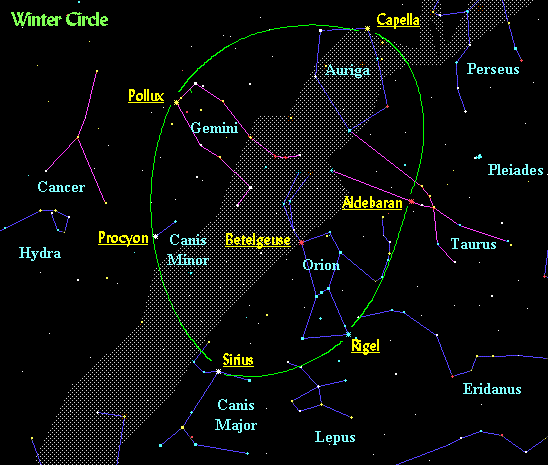
The Winter Circle of 1st magnitude stars
02/13/2015 – Ephemeris – The stars Castor and Pollux
Ephemeris for Friday, February 13th. The sun will rise at 7:46. It’ll be up for 10 hours and 21 minutes, setting at 6:08. The moon, 2 days past last quarter, will rise at 3:51 tomorrow morning.
At 9 p.m. the constellation of Gemini the twins will be seen high in the southeast. The namesake stars of the two lads are the two bright stars at the top of the constellation. Pollux the pugilist, or boxer, is the lower of the two, while Castor, the horseman, is the other star, or rather a six star system. In telescopes two close stars may be seen each is a spectroscopic binary, meaning the lines of two stars can be seen in the spectrum. A faint nearby spectroscopic binary also belongs. Pollux, though a single star, does have at least one planet, one over twice the mass of Jupiter orbiting the star at a distance somewhat greater than Mars is from the sun. Pollux is 34 light years away while Castor is 50 light years away. Not too far away as stars go.
Times are for the Traverse City/Interlochen area of Michigan. They may be different for your location.
Addendum
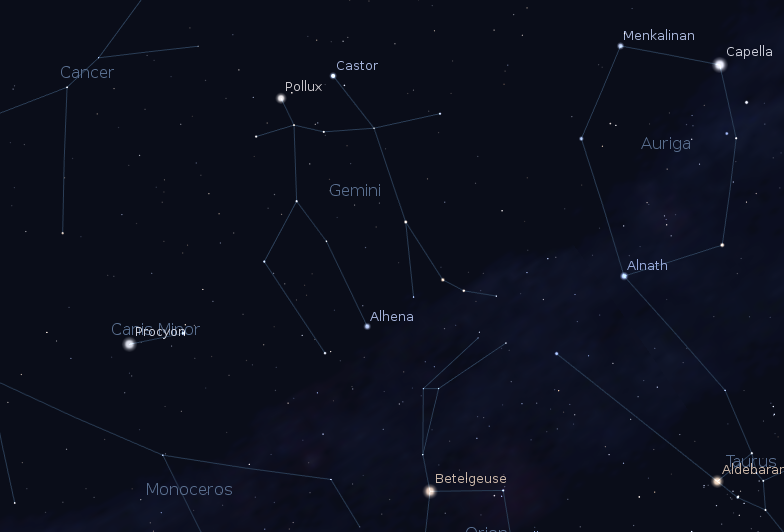
Gemini with the stars Castor and Pollux. Created using Stellarium.
02/12/2015 – Ephemeris – The brilliant blue star in Orion: Rigel
Ephemeris for Thursday, February 12th. The sun will rise at 7:47. It’ll be up for 10 hours and 18 minutes, setting at 6:06. The moon, 1 day past last quarter, will rise at 2:52 tomorrow morning.
Two days ago I talked about the star Betelgeuse the bright red star in the top left of Orion’s upright rectangle. Orion is seen in the south at 9 in the evening. The blue-white star in Orion’s opposite corner is usually brighter. It is Rigel whose longer Arabic name of which Rigel is the first part means Left Leg of the Giant. Rigel is a giant itself, actually a super giant star, which is more a measure of its mass than its size, that of 21 solar masses. Its surface temperature is more than twice as hot as the sun. It is 120 thousand times as bright as the sun and 78 times its diameter. Its distance is around 860 light years. Those with telescopes might be able to spot a close companion star to Rigel, just at the edge of the bright arc light image of Rigel itself.
Times are for the Traverse City/Interlochen area of Michigan. They may be different for your location.
Addendum
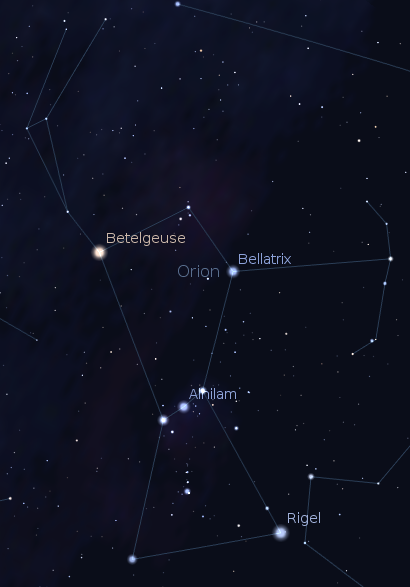
Orion upright and due south. Created using Stellarium.
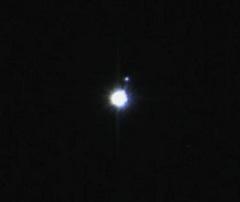
Rigel with its companion star as photographed through a telescope. No attribution. Source: http://washedoutastronomy.com/content/urban-orion?page=1
02/11/2015 – Ephemeris – Wednesday is bright planet day around here
Ephemeris for Wednesday, February 11th. The sun will rise at 7:49. It’ll be up for 10 hours and 16 minutes, setting at 6:05. The moon, at last quarter today, will rise at 1:52 tomorrow morning.
Lets take a look at the bright planets and a binocular comet for this week. Brilliant Venus is in the west-southwest by 7 p.m. It will set at 8:19 p.m. Mars appears above and left of Venus in the southwest. Venus is approaching Mars and they will be at their closest on the 22nd. The Red Planet will set tonight at 8:44 p.m. Jupiter will appear In the southeastern sky in the evening. It will be up all night, and will set just before sunrise. It’s near the sickle-shaped head of Leo the lion, and it’s the brightest star-like object in the sky. Early risers will be able to spot Saturn which will rise in the east-southeast at 2:41a.m. Comet Lovejoy, visible in binoculars, is about the width of a binocular field to the right of the star at the end of Andromeda, called Almaak.
Times are for the Traverse City/Interlochen area of Michigan. They may be different for your location.
Addendum
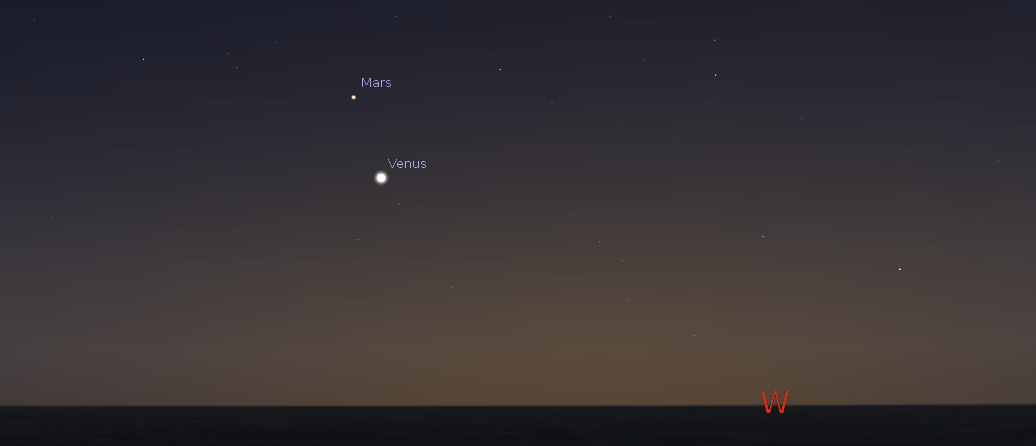
Venus and Mars low in the west at 7 p.m. on February 11, 2015. The crescent moon will be seen with the two planets on the evening of the 20th, and they will be in conjunction on the 22nd. Created using Stellarium.
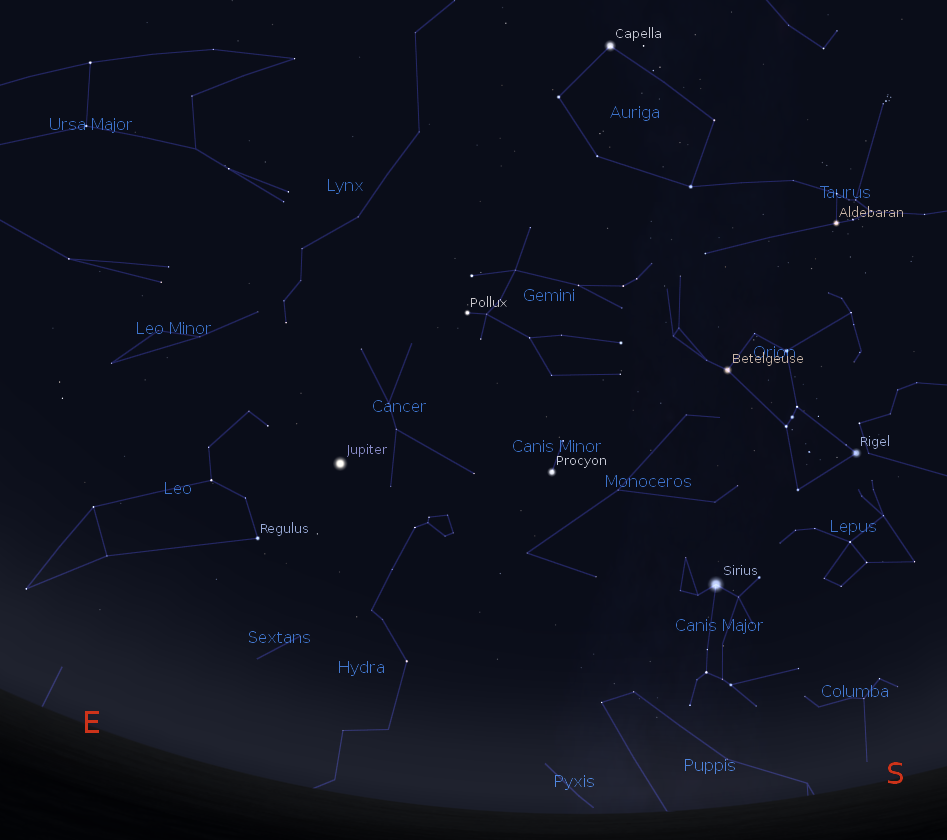
Jupiter and the bright winter stars at 9 p.m. on February 11, 2015. Created using Stellarium.
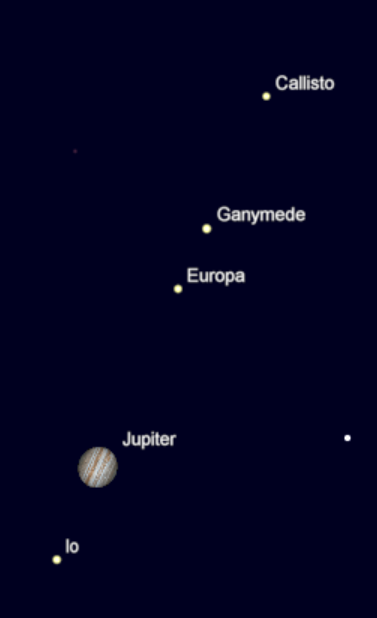
Jupiter and its moons as they might appear in a telescope tonight. Created using Cartes du Ceil (Sky Charts).
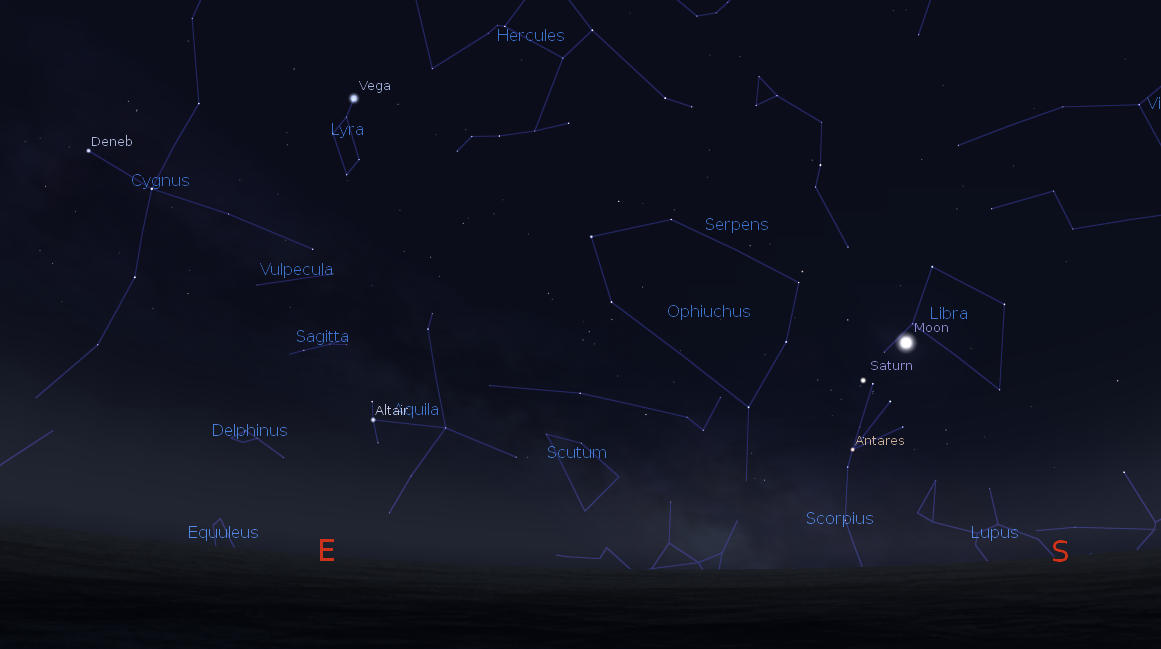
The Moon will appear near Saturn at 6 a.m. February 12, 2015. Created using Stellarium.
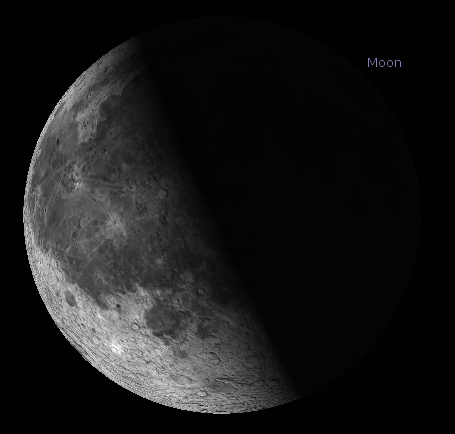
The Moon as it might appear in binoculars at 6 a.m. on February 12, 2015. Created using Stellarium.
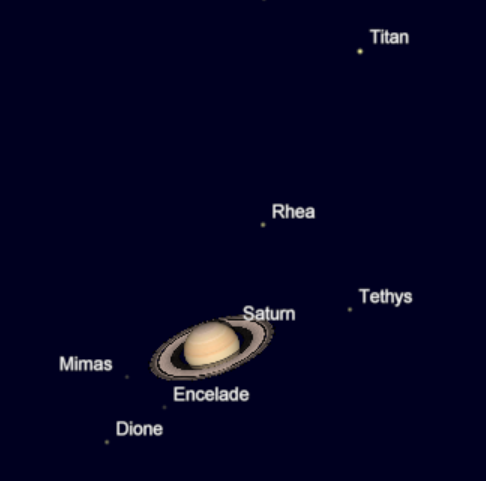
What Saturn and its moons might appear like in a telescope at 6 a.m., February 12, 2015. Small telescopes will show only the moon Titan. Created using Cartes du Ceil (Sky Charts).
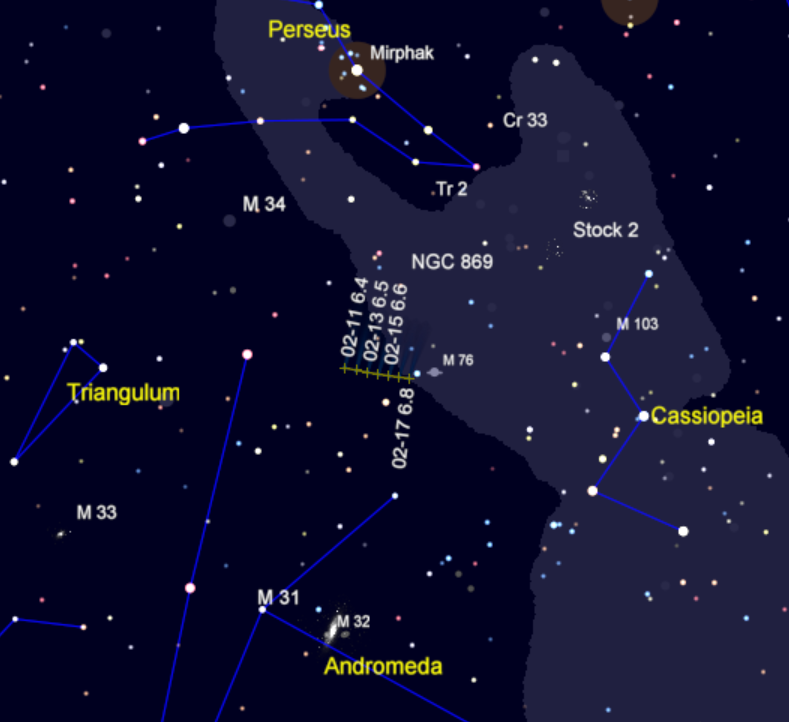
The track of Comet 2014 Q2 (Lovejoy) from 2/11/15 to 02/17/15 which will appear high in the west at 9 p.m. Toward the end of the period the comet will pass near M76, a 10th magnitude planetary nebula. It will be much dimmer than the comet. Created using Cartes du Ceil (Sky Charts).
Happiness is being a massive galaxy cluster
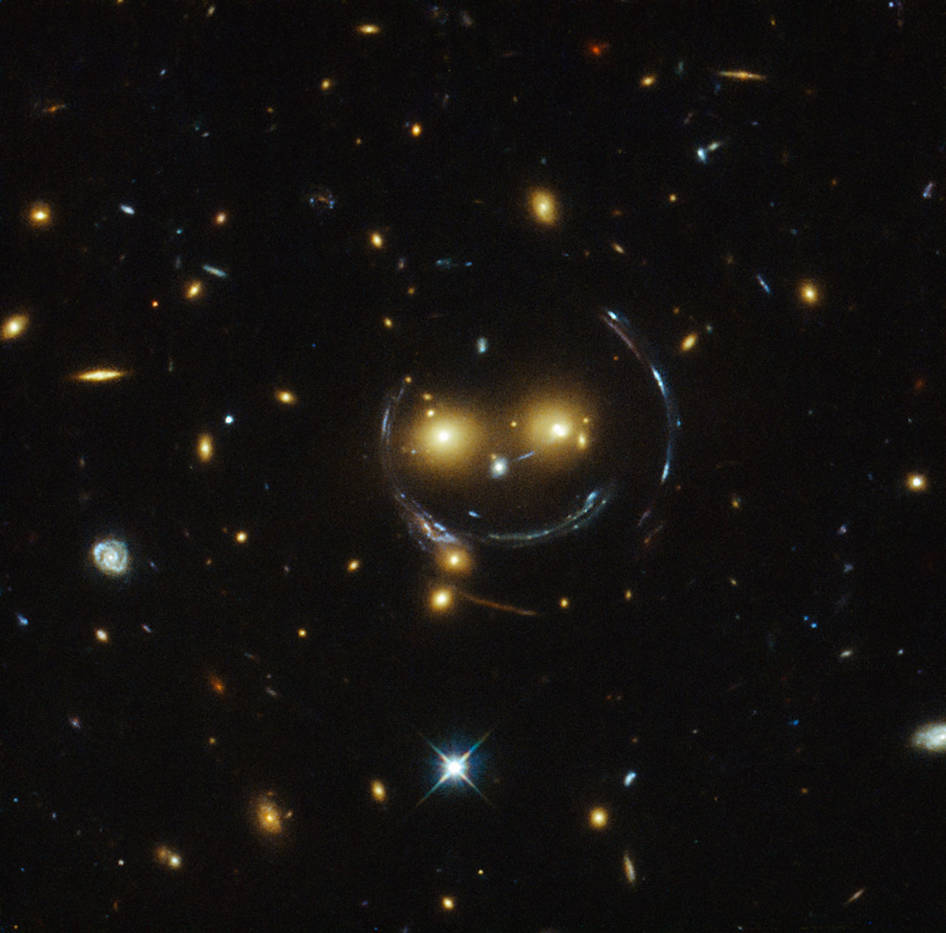
In the centre of this image, taken with the NASA/ESA Hubble Space Telescope, is the galaxy cluster SDSS J1038+4849 — and it seems to be smiling. You can make out its two orange eyes and white button nose. In the case of this “happy face”, the two eyes are very bright galaxies and the misleading smile lines are actually arcs caused by an effect known as strong gravitational lensing. Galaxy clusters are the most massive structures in the Universe and exert such a powerful gravitational pull that they warp the spacetime around them and act as cosmic lenses which can magnify, distort and bend the light behind them. This phenomenon, crucial to many of Hubble’s discoveries, can be explained by Einstein’s theory of general relativity. In this special case of gravitational lensing, a ring — known as an Einstein Ring — is produced from this bending of light, a consequence of the exact and symmetrical alignment of the source, lens and observer and resulting in the ring-like structure we see here. Hubble has provided astronomers with the tools to probe these massive galaxies and model their lensing effects, allowing us to peer further into the early Universe than ever before. This object was studied by Hubble’s Wide Field and Planetary Camera 2 (WFPC2) and Wide Field Camera 3 (WFC3) as part of a survey of strong lenses. A version of this image was entered into the Hubble’s Hidden Treasures image processing competition by contestant Judy Schmidt.
Credit: NASA/ESA
Caption: ESA
This image from the Hubble Space Telescope has been making the rounds. It shows how a massive cluster of galaxies can warp space-time and distort the images of the galaxies behind it into arcs. Here’s more from the Bad Astronomer Phil Plait. It comes in time for Valentine’s day to brighten the dreary month of February.
02/10/2015 – Ephemeris – Orion’s bright red star, Betelgeuse
Ephemeris for Tuesday, February 10th. The sun will rise at 7:50. It’ll be up for 10 hours and 13 minutes, setting at 6:03. The moon, 1 day before last quarter, will rise at 12:51 tomorrow morning.
The bright red star in constellation Orion’s shoulder is Betelgeuse, and its now thought to be about 640 light years away give or take a couple of hundred light years*. The name Betelgeuse means “Armpit of the central one” in Arabic. Orion is seen in the south at 9 in the evening. Even at Betelgeuse’ great distance it’s the star whose surface is easiest seen, after the sun of course. That’s because it’s so big. As large around as the size of the orbit of Jupiter. Betelgeuse is losing mass in a huge cloud around it. It is a massive star in the late stages of its life even though it’s only 7 million years old. Some astronomers speculate that it will explode in a massive supernova within the next million years.
Times are for the Traverse City/Interlochen area of Michigan. They may be different for your location.
Update
* I’m being a bit facetious here. See the addendum, and also by coincidence a post from EarthSky today How far is Betelgeuse?
Addendum
Orion upright and due south. Created using Stellarium.
Our estimates of the size, mass and luminosity of Betelgeuse depend on knowing its distance. The distance is not well-known because Betelgeuse is a single star, it is not a binary for which can be applied Newton’s laws to calculate these values. Therefore these values in the broadcast program, where I have 59 seconds total, appear more certain than they really are. Wait for Thursday’s program when I cover Rigel and see how close the values are between the two. But Rigel appears to be a different star altogether. Somebody’s wrong.
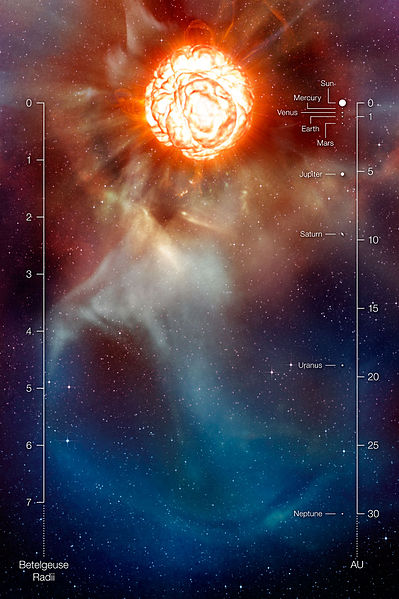
“This artist’s impression shows the supergiant star Betelgeuse as it was revealed thanks to different state-of-the-art techniques on ESO’s Very Large Telescope, which allowed two independent teams of astronomers to obtain the sharpest ever views of the supergiant star Betelgeuse. They show that the star has a vast plume of gas almost as large as our Solar System and a gigantic bubble boiling on its surface. These discoveries provide important clues to help explain how these mammoths shed material at such a tremendous rate. The scale in units of the radius of Betelgeuse as well as a comparison with the Solar System is also provided.” Credit: ESO/L. Calçada (ESO is the European Southern Observatory)
02/09/2015 – Ephemeris – How to find the constellation of Cancer the crab
Ephemeris for Monday, February 9th. The sun will rise at 7:52. It’ll be up for 10 hours and 10 minutes, setting at 6:02. The moon, 2 days before last quarter, will rise at 11:51 this evening.
A small, dim member of the zodiac is Cancer the crab. It’s dim stars make to my eyes and upside down letter Y. It lies between Gemini to the upper right and Leo to the lower left, especially as it is still rising in the southeastern sky at 9 p.m. Right now the bright planet Jupiter is about half way between it and Leo. It does have a relatively bright fuzzy object to the naked eye amongst it’s stars, positioned roughly in the center. It was discovered as a fuzzy spot before the invention of the telescope and called Praesepe, the manger. With the invention of the telescope it was discovered to be a loose group of stars in an open or galactic star cluster. This easy binocular object is best known now as the Beehive cluster or M44.
Times are for the Traverse City/Interlochen area of Michigan. They may be different for your location.
Addendum
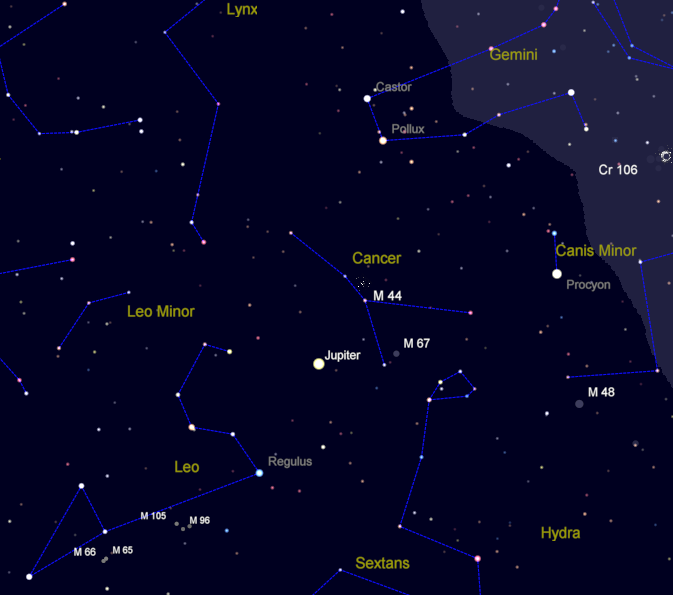
The zodiacal constellation Cancer with Jupiter nearby in the southeast at 9 p.m. February 9, 2015. Created using Cartes du Ceil (Sky Charts).
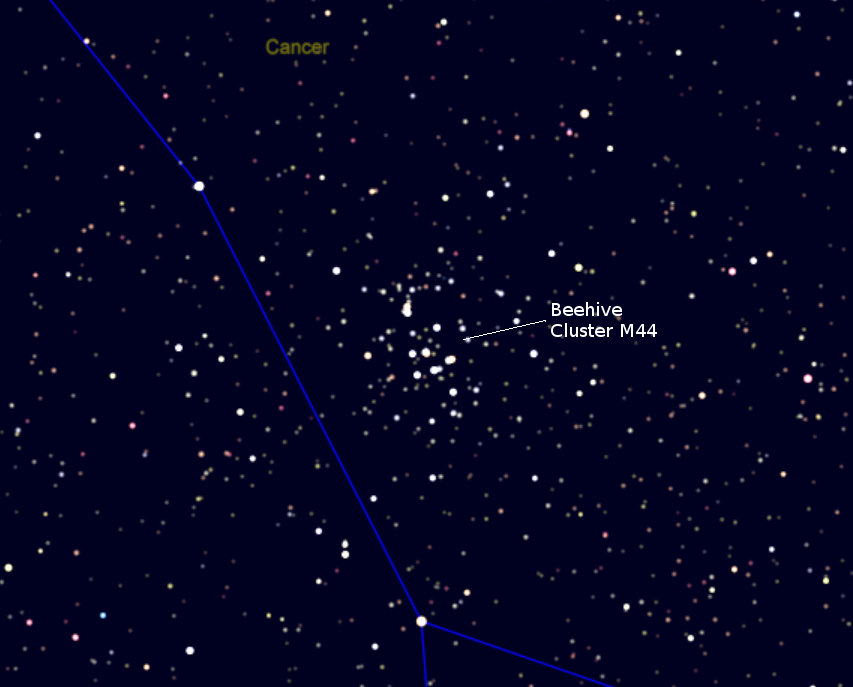
The Beehive star cluster, M44. Its ancient name was the Praesepe or manger when glimpsed by the naked eye. Created using Cartes du Ciel (Sky Charts).
M44 is a young star cluster, perhaps 600-700 million years old and only 577 light years away. It is an open or galactic star cluster. It only appears outside the band of the Milky Way because it’s close to us. The same cannot be said for M67.
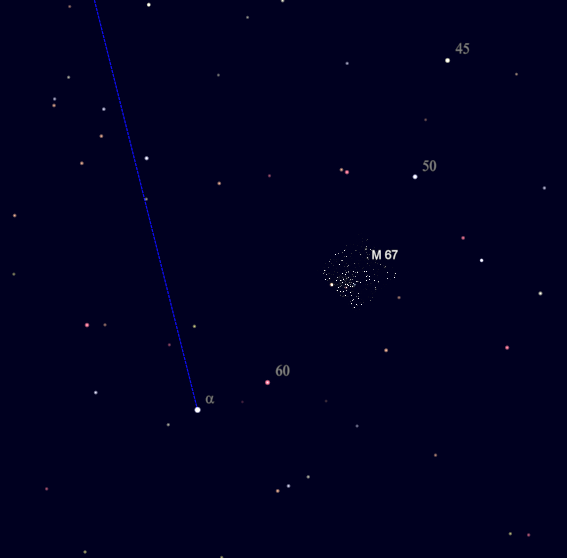
Finder Chart for open cluster M67, found just west of α Cancri, or Acubens. Created using Cartes du Ceil (Sky Charts).
M67 is a fuzzy spot in binoculars but really shows its beauty in telescopes. M67 is pretty old for an open star cluster, one of the oldest known, at about the age of the Sun or a bit younger. It’s nearly 3,000 light years away, so it really is out of the plane of the galaxy.
02/06/2015 – Ephemeris – The GTAS will entertain the NMC Students in a Star Bowl Quiz tonight
Ephemeris for Friday, February 6th. The sun will rise at 7:56. It’ll be up for 10 hours and 2 minutes, setting at 5:58. The moon, 3 days past full, will rise at 8:55 this evening.
Tonight the Grand Traverse Astronomical Society will have for its meeting at 8 p.m. at Northwestern Michigan College’s Rogers Observatory its nearly annual Star Bowl contest with The Northwestern Michigan College astronomy students, and NMC Astronomy Club members facing the returning champions, the GTAS. This Jeopardy style game will be hosted by NMC Professor Jerry Dobek. Come and watch or even take part if you’d like. At 9 p.m. the society will host a star party at the observatory with the Moon and Jupiter as featured objects. Folks can still bring in their telescopes for help during this time. The observatory is located south of Traverse City on Birmley Road between Garfield and Keystone roads.
Times are for the Traverse City/Interlochen area of Michigan. They may be different for your location.
Addendum
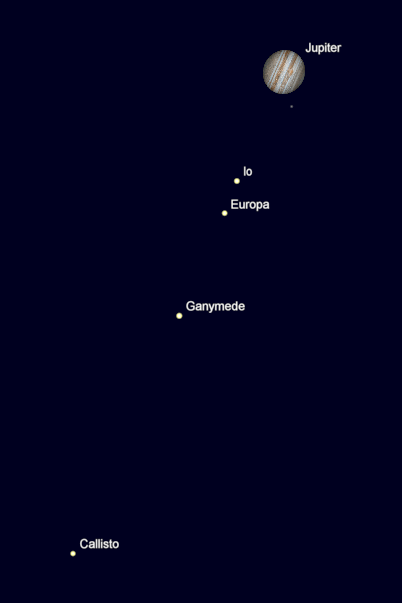
Jupiter through a telescope at 9 p.m. (EST), on February 6, 2015. The four Galilean moon will be stretched out on one side of Jupiter in order of their actual distances from the planet. Created using Cartes du Ceil (Sky Charts).
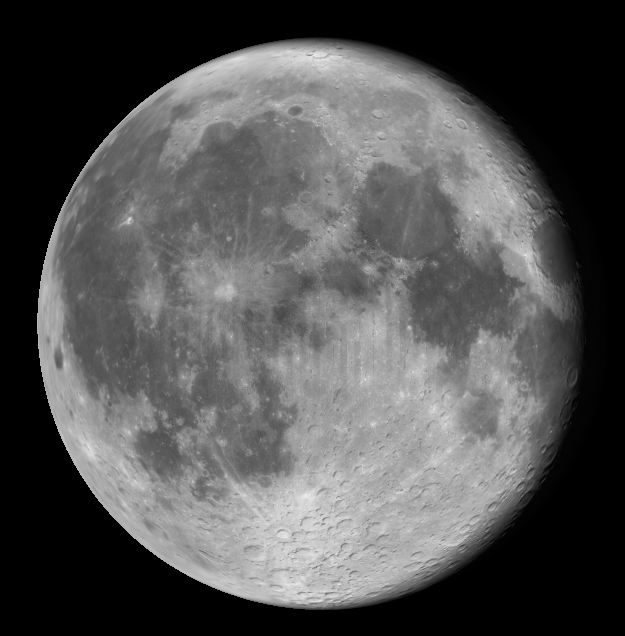
The Moon tonight (February 6, 2015). The Moon will rise shortly before the start of the Star Party. Created using Virtual Moon Atlas.
02/05/2015 – Ephemeris more about Jupiter it’s motion and mass
Thursday, February 5th. The sun will rise at 7:57. It’ll be up for 9 hours and 59 minutes, setting at 5:56. The moon, 2 days past full, will rise at 7:57 this evening.
Tomorrow the planet Jupiter will reach opposition from the Sun being about 180 degrees opposite the Sun in the sky. At opposition Jupiter is it’s closest to the earth, and appears its largest in a telescope, except for Venus when it is at its very closest to the Earth. This second brightest planet was named for the chief of the Roman gods, and takes a majestic 12 years to circumnavigate the sky staying in each zodiacal constellation for a year. It is currently between Cancer on the right and Leo on the left. In fact it crossed the astronomical boundary back into Cancer. Since we view all the other planets from our own moving planet, their apparent paths back up westward from their normal eastward motion when we are nearest them.
Times are for the Traverse City/Interlochen area of Michigan. They may be different for your location.
Addendum
I published this track of Jupiter’s motion for this Jovian viewing season a week ago, showing it’s backward or retrograde motion as we pass it.
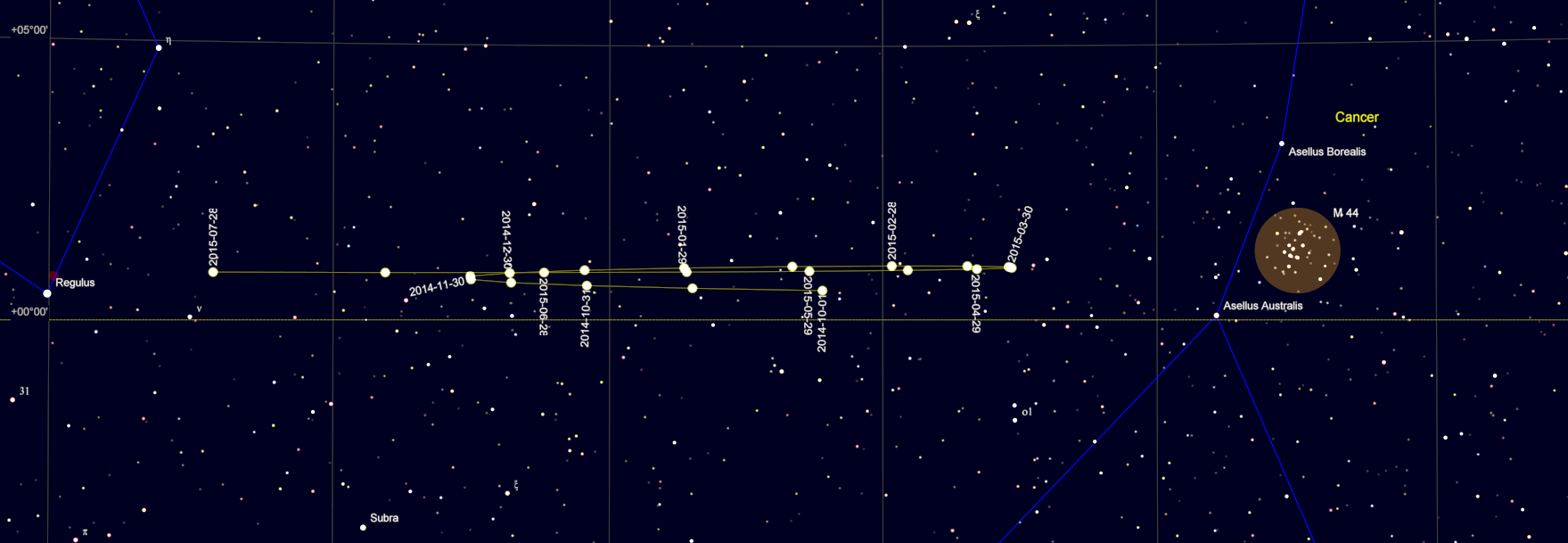
Jupiter’s retrograde path against the stars between Cancer and Leo October 2014 to July 2015. Created using Cartes du Ceil (Sky Charts). Click on the image to enlarge.
The planet Jupiter is the largest planet and also most massive. In fact Jupiter contains more mass than all the other planets of the solar system combined times 2.
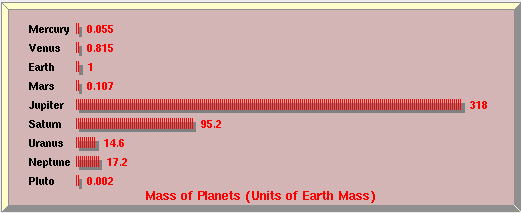
Masses of all the planets including the dwarf planet Pluto in terms of the Earth’s mass. Credit: University of Tennessee.
Or as the late great science and science fiction writer Isaac Asimov wrote: “The solar system is composed of the Sun, Jupiter and debris.”
Feeling small yet?
02/04/2015 – Ephemeris – We have 4 bright planets and a fading comet
Ephemeris for Wednesday, February 4th. The sun will rise at 7:58. It’ll be up for 9 hours and 56 minutes, setting at 5:55. The moon, 1 day past full, will rise at 6:59 this evening.
Lets take a look at the bright planets and a reasonably bright comet for this week. Brilliant Venus is in the west-southwest by 6:30 p.m. It will set at 8 p.m. Mars appears above and left of Venus in the southwest. Both of them are in the constellation of Aquarius. The Red Planet will set tonight at 8:43 p.m. Jupiter, 2 days from being in opposition from the sun, and opposite the sun in the sky, when it will be rising at sunset and setting at sunrise will rise tonight in the east at 5:49 p.m. It’s near the sickle-shaped head of Leo the lion. It will be seen above the Moon at 9 p.m. Early risers will be able to spot Saturn which will rise in the east-southeast at 3:06 a.m. Comet Lovejoy, visible in binoculars, is near the star at the end of Andromeda, called Almaak.
Times are for the Traverse City/Interlochen area of Michigan. They may be different for your location.
Addendum
Evening
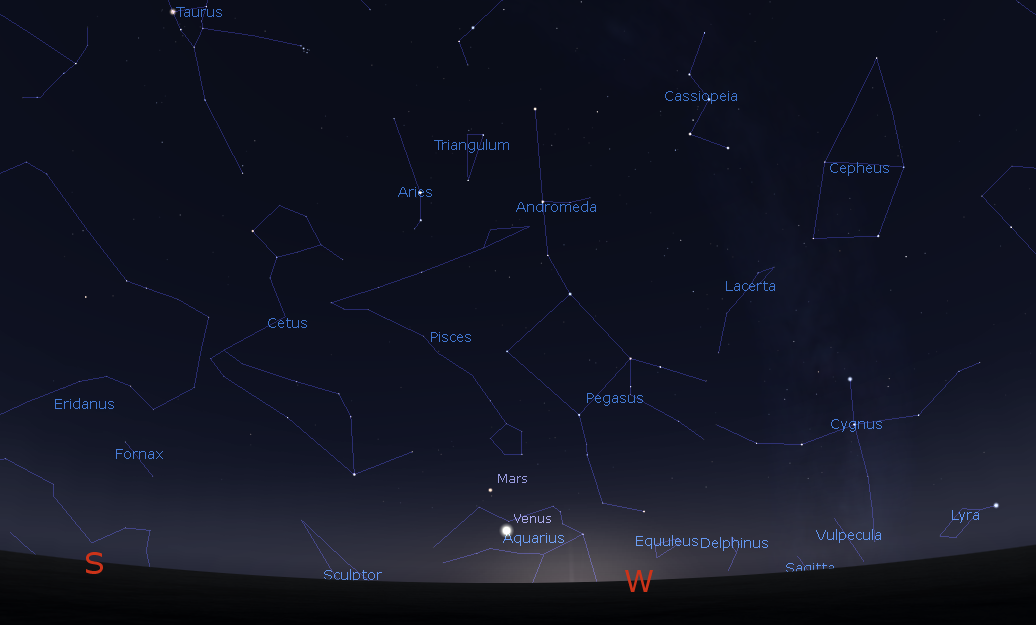
Venus and Mars low in the west with the setting autumn constellations and a few northern summer stars at 7 p.m. on February 4, 2015. Created using Stellarium.
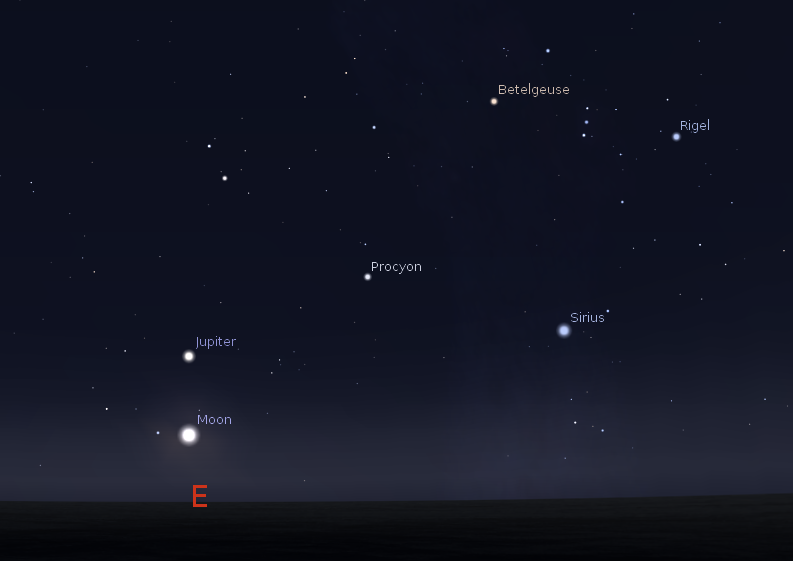
Jupiter the Moon and the bright winter stars at 8 p.m. on February 4, 2015. Created using Stellarium.
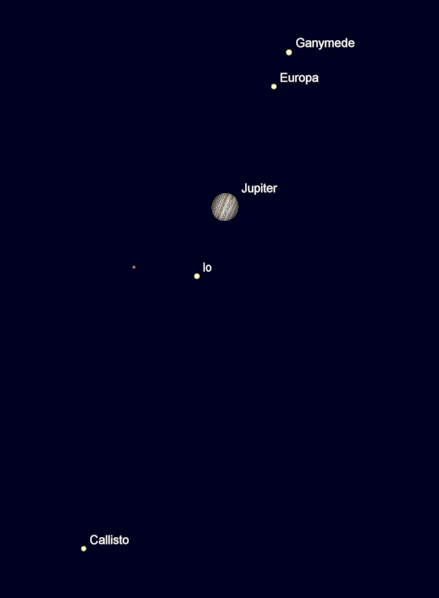
Jupiter and its Galilean moons as they might appear in a telescope. Created using Cartes du Ceil (Sky Charts).
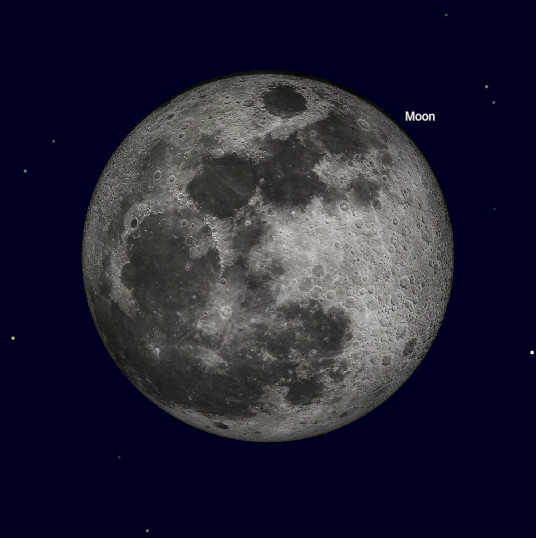
The Moon as it might appear in binoculars at 8 p.m. on February 4, 2015. Created using Cartes du Ceil (Sky Charts).
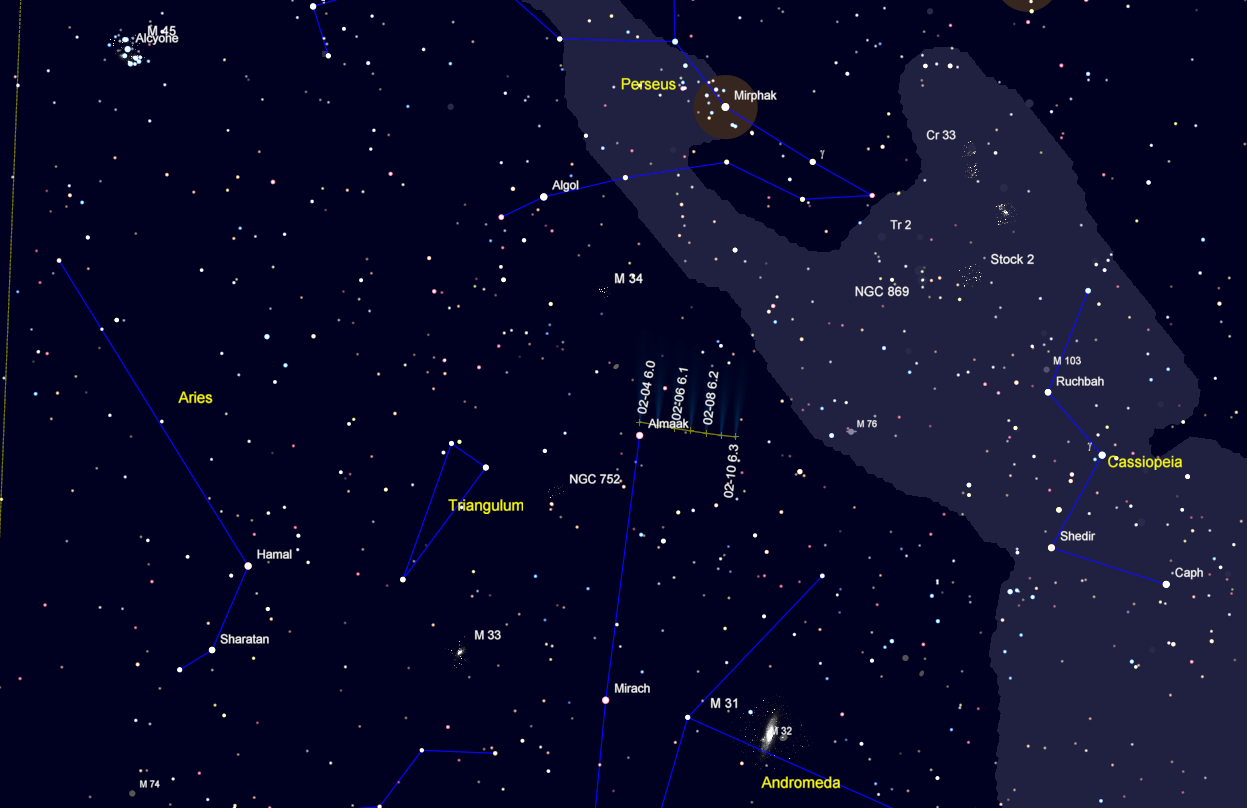
The track of Comet 2014 Q2 (Lovejoy) from 2/04/15 to 02/10/15 which will appear high in the west at 9 p.m. Created using Cartes du Ceil (Sky Charts).
Morning
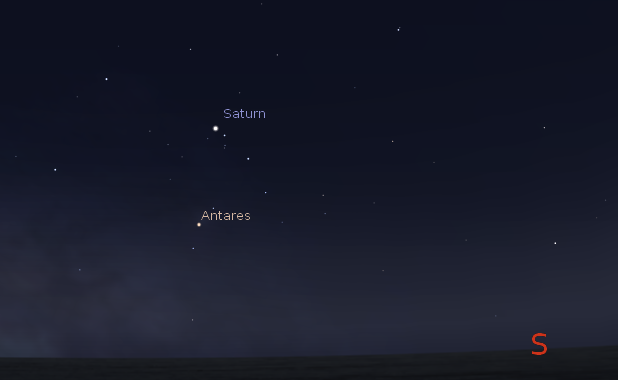
Saturn will appear above the red giant star Antares at 6 a.m. February 5, 2015. At this time Jupiter and the Moon will appear above the western horizon. Created using Cartes du Ceil (Sky Charts).
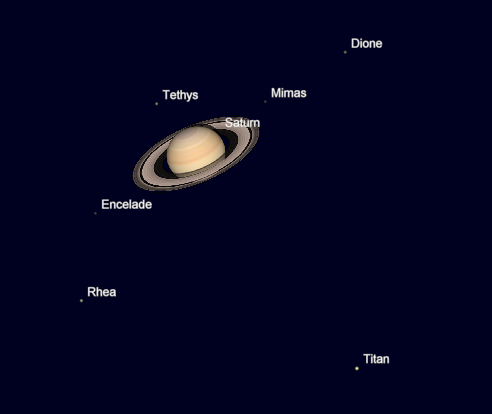
What Saturn and its moons might appear like in a telescope at 6 a.m., February 5, 2015. Small telescopes will show only the moon Titan. Created using Cartes du Ceil (Sky Charts).
 Bob Moler's Ephemeris Blog