Archive
09/30/2015 – Saturn is really alone in the evening sky now – Mercury is leaving today
Ephemeris for Wednesday, September 30th. The Sun will rise at 7:39. It’ll be up for 11 hours and 46 minutes, setting at 7:25. The Moon, 3 days past full, will rise at 9:20 this evening.
Lets look at the planets for this last day of September. Saturn is alone in the evening sky spotted by 8:30 p.m. low in the southwestern sky near the bright star Antares to its left. Antares has a reddish hue, while Saturn is brighter and yellowish. Both these colors are enhanced by being low to the horizon. Saturn will set at 9:47 p.m. The rest of the planet action has moved to the morning sky. Venus, the morning star, will rise at 4 a.m. a bit north of east. Much dimmer Mars will rise at 4:39 a.m. in the east-northeast. Jupiter is beginning to be visible in the morning sky and will rise at 5:17 in the east-northeast. The three will be closing together in the coming weeks. Mercury is at inferior conjunction with the Sun today.
Times are for the Traverse City/Interlochen area of Michigan. They may be different for your location.
Addendum
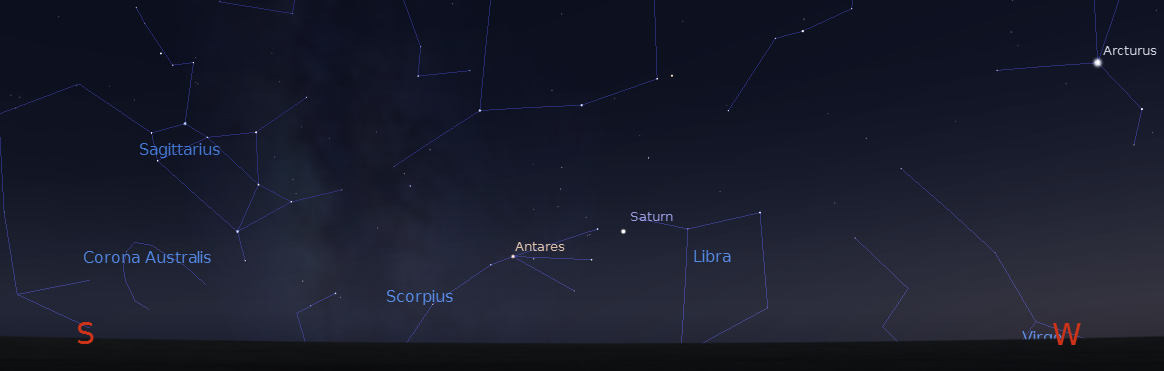
Saturn and two zodiacal constellations at October 1, 2015 Created using Stellarium.
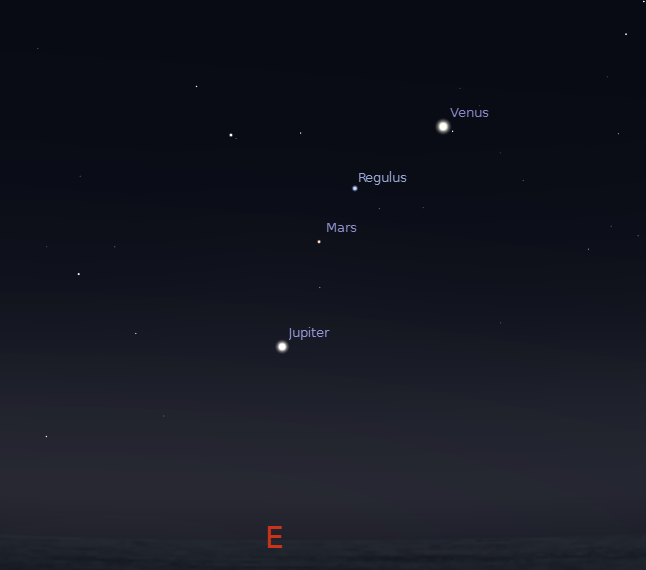
Venus, Mars and Jupiter and the bright st star Regulus at 6:30 a.m. October 1, 2015. Creating using Stellarium.
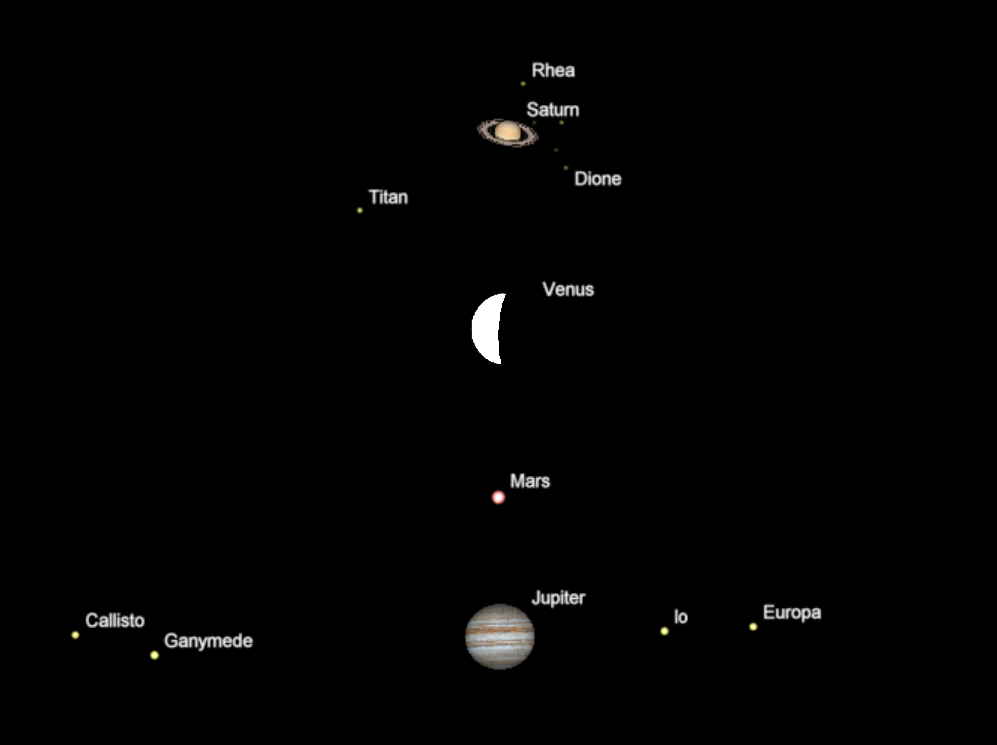
The Bright Planets, in order of appearance as seen with the same telescope magnification. Created using Cartes du Ciel.
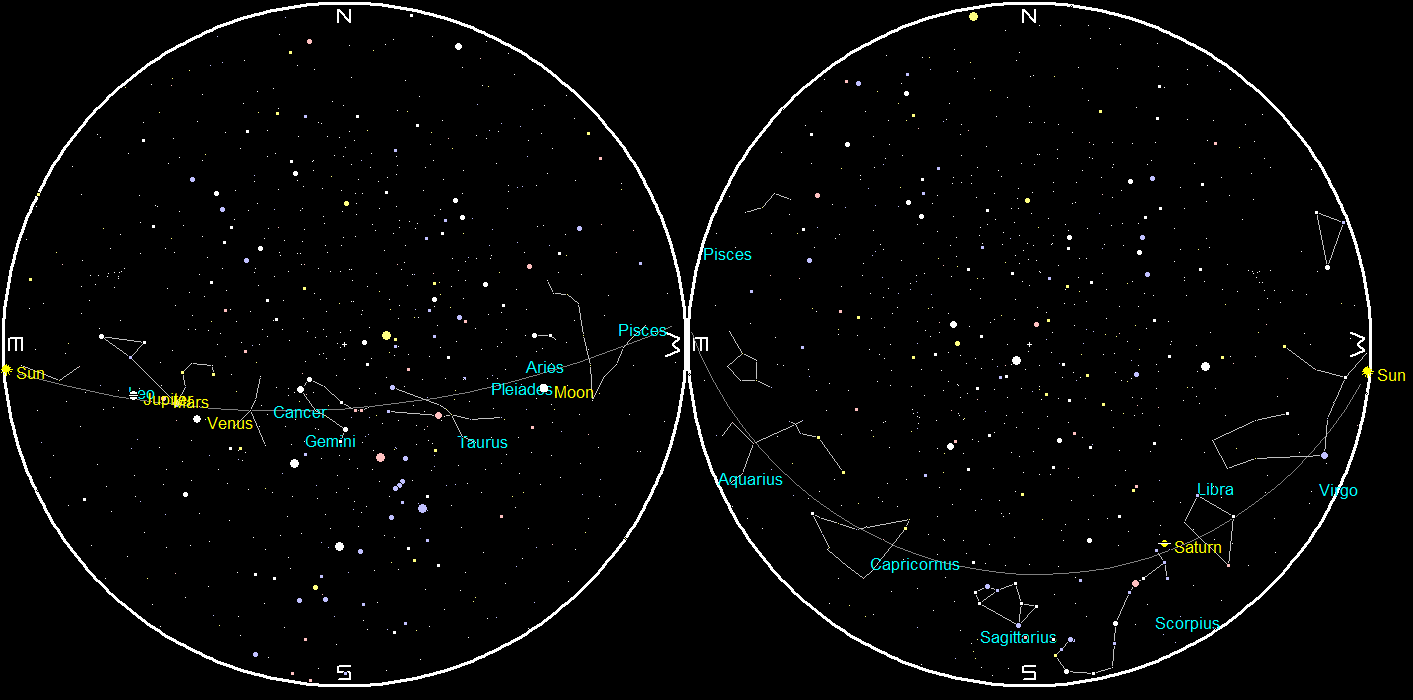
This is a chart showing the sunrise and sunset skies for September 30, 2015 showing the location of the planets and the Moon at that time. Created using my LookingUp program. Click on the image to enlarge.
09/29/2015 – Ephemeris – New Horizons is now downloading some really cool pictures to Earth
Ephemeris for Tuesday, September 29th. The Sun will rise at 7:38. It’ll be up for 11 hours and 49 minutes, setting at 7:27. The Moon, 2 days past full, will rise at 8:38 this evening.
Two and a half months ago the New Horizons spacecraft flew past Pluto, spending the day incommunicado, not wasting any time sending anything back to the Earth. Starting the next day came the flood of data including some highly compressed images. Starting Labor Day weekend the high-resolution, uncompressed images started to come down at one to two thousand bits per second. At that rate a 4 megapixel monochromatic image might take 36 hours to download. Now every Thursday or Friday the New Horizons Team puts several new processed images on the NASA and Johns Hopkins Applied Physics Laboratory websites, along with explanations of what is in the images and the questions they raise.
Times are for the Traverse City/Interlochen area of Michigan. They may be different for your location.
Addendum
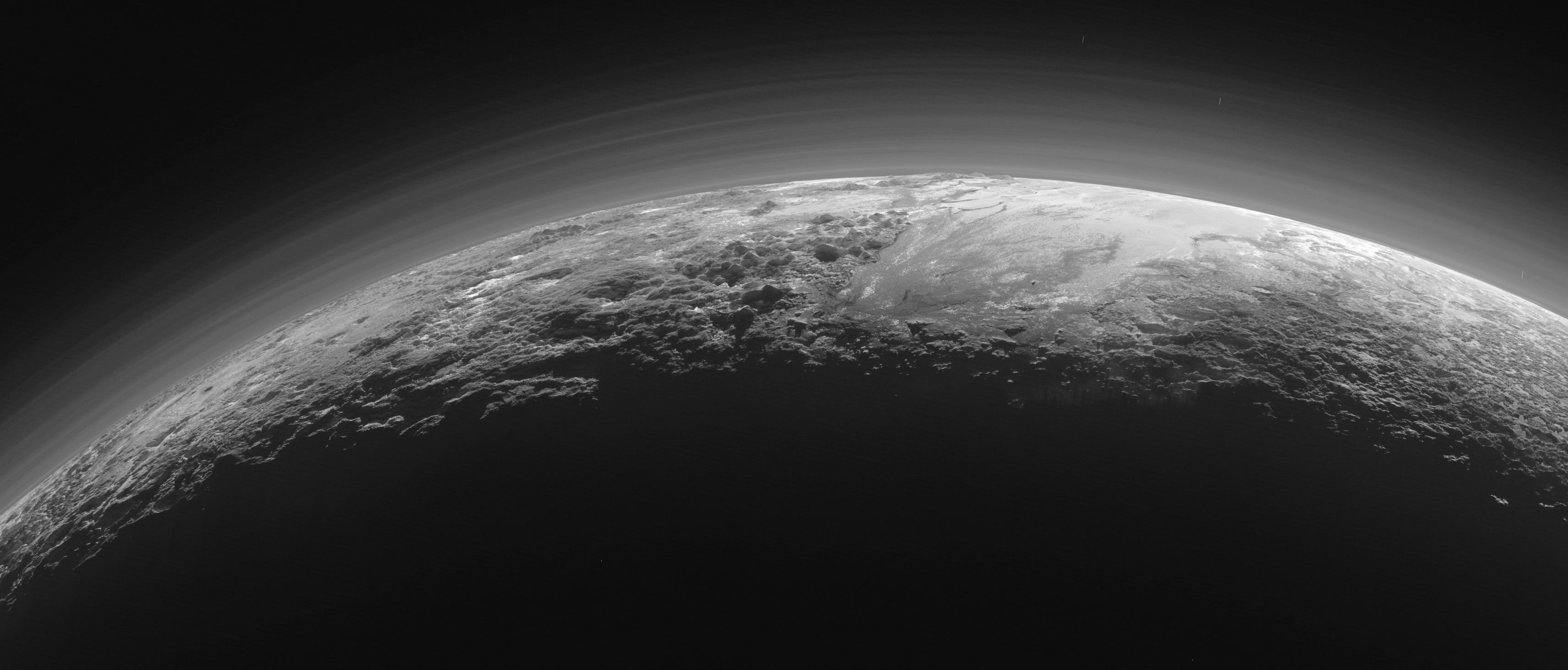
This image, taken just 15 minutes after the New Horizons spacecraft flew its closest to Pluto shows a low angle shot of the lands the spacecraft saw really close up. Check out too the many layers of the atmosphere. Credit: NASA/JHUAPL. Click on the image to enlarge.
I’ll be exploring this and the other amazing photos and other results from New Horizons this Friday at the Grand Traverse Astronomical Society meeting at 8 p.m. at Northwestern Michigan College’s Rogers Observatory south of Traverse City on Birmley Road.
My 9/27/2015 lunar eclipse experience
This is an elaboration of an email sent to a fellow amateur astronomer who was completely clouded out and asked how we did.
From mid-eclipse, about 10:45, to the end of totality it was almost perfectly clear, We had light clouds after that to the end of the partial phase. Then it clouded up again. My impressions of the eclipse brightness at totality was that it was a bit darker than usual, but I may be wrong. However, I have had wretched luck in being able to view lunar eclipses. We were virtually wiped out by clouds with the two lunar eclipses last year, and we’ve had the same luck for the many eclipses occurring before. I may be out of practice.
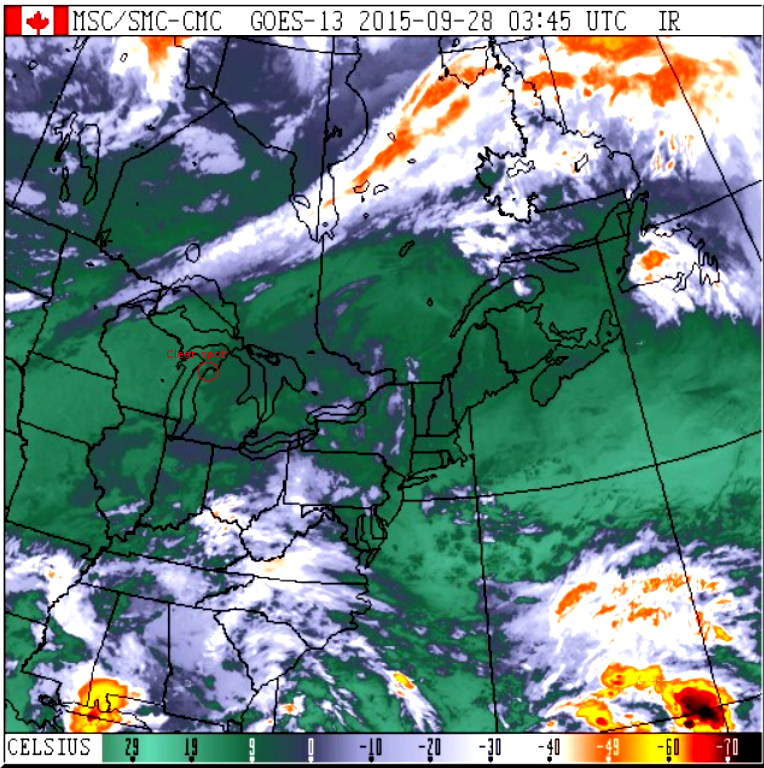
From the animation of the satellite images from Sunday night. The red circle points to the hole, really a notch in the clouds that allowed us to see the last part of the lunar eclipse. Our low clouds were warm in the infrared, so show as a very light gray. Credit NOAA/Environment Canada.
09/28/2015 – Ephemeris – The Harvest Moon effect
Ephemeris for Monday, September 28th. The Sun will rise at 7:36. It’ll be up for 11 hours and 52 minutes, setting at 7:29. The Moon, 1 day past full, will rise at 8:00 this evening.
Yesterday’s full moon was the famous Harvest Moon, the nearest full moon to the autumnal equinox. This is a time of the full and waning gibbous moons in the next few days rising in twilight. In the old days before electric lights it helped farmers by effectively lengthening the hours of light to gather in the crops. The Moon on average rises 50 minutes later each night. The interval between tonight’s moon rise and tomorrow’s will be 38 minutes. The interval between Tuesday and Wednesday will be 42 minutes. This year’s harvest moon effect is spoiled a bit because the Moon was at perigee Sunday, the so-called supermoon, so it’s moving faster in its orbit than average. Like the Sun, the Moon always appears orange or red near the horizon.
Times are for the Traverse City/Interlochen area of Michigan. They may be different for your location.
Addendum
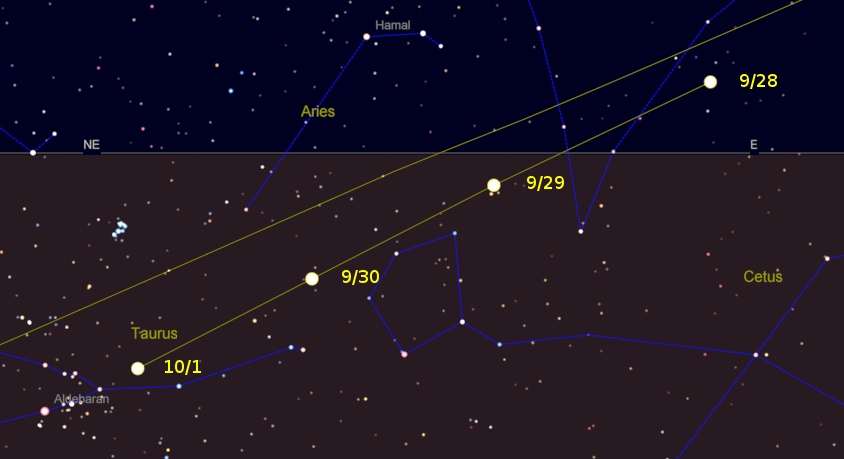
The positions of the Moon from September 28 to October 1, 2015. Note the path of the Moon. At Harvest Moon in northern Michigan time it makes less than a 45 degree angle with the horizon. For other latitudes it’s less than (90 – latitude). shorthand term for 90 – latitude is co-latitude. Created using Cartes du Ciel.
The closer to horizontal the Moon’s path is the shorter the difference in night-to-night rise times.
How to view tonight’s lunar eclipse if you are clouded out or on the wrong side of the planet
There will be a live webcast of the lunar eclipse from the Coca Cola Space Science Center in Columbus, Georgia if they’re not cloudy. Go here.
Tip of the old observer’s cap to spaceweather.com. If you haven’t yet subscribe to their free email notification service.
The partial phase of the eclipse starts at 9:07 p.m. EDT. Totality lasts from 10:11 p.m. to 11:23 p.m. when the ending partial phase commences. The partial phase will end at 12:27 a.m.
09/25/2015 – Ephemeris – There will be a great lunar eclipse Sunday night
Ephemeris for Friday, September 25th. The Sun will rise at 7:33. It’ll be up for 12 hours and 1 minute, setting at 7:35. The Moon, 2 days before full, will set at 5:34 tomorrow morning.
Lets check out Sunday’s total lunar eclipse. It will be visible from the entire contiguous 48 states, and in its entirety from Colorado, eastward. The partial phase will start at 9:07 p.m. Totality will begin at 10:11 p.m. and extend to 11:23 p.m. when the Moon should appear red in color, illuminated by the combined sunrises and sunsets occurring on the Earth at that moment. The eclipse will end at 12:27 a.m. The eclipse is perfectly viewable with the naked eye or binoculars. For those who want company and commentary as to what’s going on, the Grand Traverse Astronomical Society will provide two locations from which to view the eclipse. The NMC Observatory, south of Traverse City and Platte River Point, part of the Sleeping Bear Dunes National Lakeshore, both weather permitting.
Times are for the Traverse City/Interlochen area of Michigan. They may be different for your location.
Addendum
The next lunar eclipse visible from our area will be January 31, 2018 which will achieve totality just before the moon sets. The next lunar eclipse will be January 20-21, 2019 which will start late in the evening. The problem being that January is a pretty cloudy month around here.
We’re closer to the next solar eclipse, which will be a total eclipse visible at midday, and the center line of the path of totality which will pass from Oregon to South Carolina, passing just south of St. Louis Missouri and north of Nashville Tennessee. For more on the 2017 eclipse check out this NASA eclipse page.
09/24/2015 – Ephemeris – Looking forward to Sunday’s Lunar Eclipse
Ephemeris for Thursday, September 24th. The Sun will rise at 7:32. It’ll be up for 12 hours and 4 minutes, setting at 7:36. The Moon, half way from first quarter to full, will set at 4:20 tomorrow morning.
Lets check out Sunday’s total lunar eclipse. It will be visible from the entire contiguous United States, and in its entirety from Colorado, eastward. The partial phase will start at 9:07 p.m. The total phase will begin at 10:11 p.m. and extend to 11:23 p.m. when the ending partial phase will start. The eclipse will end at 12:27 a.m. The eclipse is perfectly viewable with the naked eye or binoculars. For those who want company and commentary as to what’s going on, the Grand Traverse Astronomical Society will provide two venues from which to view the eclipse: The Northwestern Michigan College’s Rogers Observatory, south of Traverse City on Birmley Rd. and Platte River Point at the end of Lake Michigan Road off M22, part of the Sleeping Bear Dunes National Lakeshore, weather permitting.
Times are for the Traverse City/Interlochen area of Michigan. They may be different for your location.
Addendum
The following is an excerpt from my September 1 post.
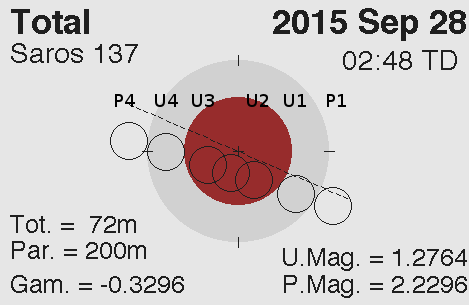
The eclipse occurs on the 28th for Universal Time. It’s the evening of the 27th for us. The Moon travels through the Earth’s shadow from right to left. What are seen are points of contact with the shadow and mid-eclipse. From Five Millennium Canon of Lunar Eclipses (Espenak & Meeus) NASA.
Contact times are labeled P1, U1, U2, U3, U4, and P4. P2 and P3 are omitted because they are synonymous with U1 and U4 respectively:
- P1 – 8:11:47 p.m. Enter the penumbra (unseen). By about 8:30 the duskiness on the left edge of the moon will start to be noticeable.
- U1 – 9:07:11 p.m. Enter the umbra (partial eclipse begins).
- U2 – 10:11:10 p.m. Totality begins.
- Mid eclipse 10:48:17 p.m.
- U3 – 11:23:05 p.m. Totality ends, egress partial phase begins.
- U4 – 12:27:03 a.m. Partial phase ends. The Moon’s upper right edge should appear dusky for the next half hour or so.
- P4 – 1:22:27 a.m. Penumbral phase ends (unseen).
Note: The duskiness of the penumbral phase of the eclipse can be enhanced by viewing through sunglasses.
During the total phase, light leaks in around the Earth due to the bending of light in the Earth’s atmosphere, so the Moon is illuminated by the collective sunrises and sunsets around the globe. This usually gives the Moon a coppery hue, that some are now calling a blood moon. Occasionally, due to volcanic eruptions the Moon can become very dark.
This full moon is also the Harvest Moon and for those who care, a supermoon, it having reached perigee earlier that day.
Weather permitting there will be two GTAS venues to view this eclipse. The first will be the NMC Rogers Observatory. The second will be at the Sleeping Bear Dunes National Lakeshore at Platte River Point at the end of Lake Michigan Road. The site will be open for the visible parts of the eclipse from 9 p.m. to 12:30 a.m.
09/23/2015 – Ephemeris – One planet visible in the evening and three in the morning
Ephemeris for Wednesday, September 23rd. The Sun will rise at 7:30. It’ll be up for 12 hours and 7 minutes, setting at 7:38. The Moon, 2 days past first quarter, will set at 3:09 tomorrow morning.
Lets look at the planets for this first day of autumn. Saturn is alone in the evening sky spotted by 9 p.m. low in the southwestern sky near the bright star Antares to its left. Antares has a reddish hue, while Saturn is brighter and yellowish. Both these colors are enhanced by being low to the horizon. Saturn will set at 10:13 p.m. The rest of the planet action has moved to the morning sky. Venus, the morning star, will rise at 4:09 a.m. a bit north of east. Much dimmer Mars will rise at 4:44 a.m. in the east-northeast. Jupiter is beginning to be visible in the morning sky and will rise at 5:37 in the east-northeast. Mercury, though in the evening sky, sets too soon after the Sun to be visible.
Times are for the Traverse City/Interlochen area of Michigan. They may be different for your location.
Addendum
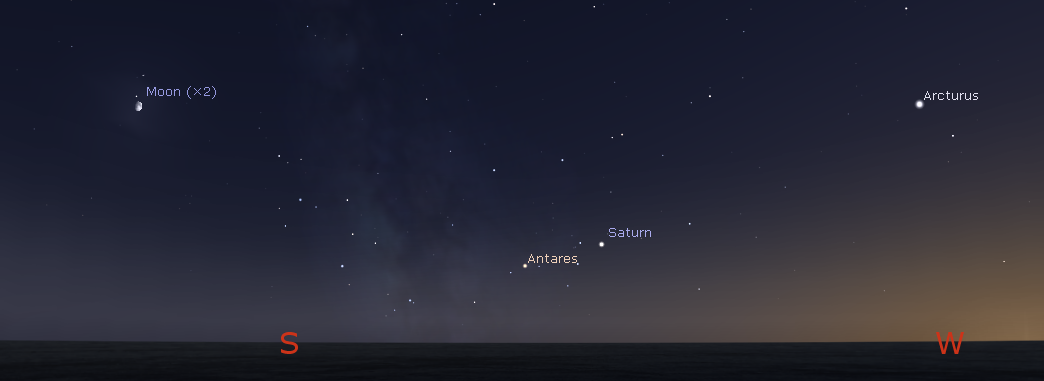
Saturn and the Moon with setting southern summer stars at 8:30 p.m. on September 23, 2015. The Moon is shown twice actual size. Created using Stellarium.
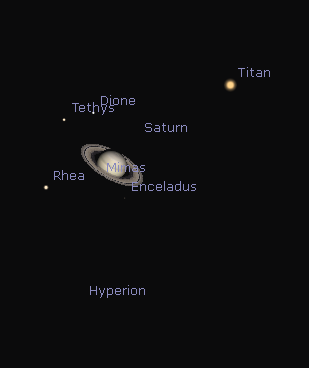
What Saturn and its moons might appear like in a telescope at 8:30 p.m., September 23, 2015. Small telescopes will show only the moon Titan. Created using Stellarium. The telescopic planet charts are all displayed at the same scale.
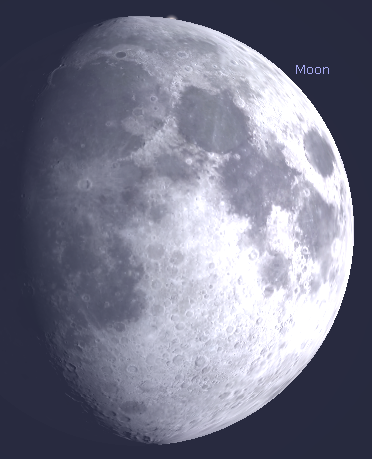
The Moon as it might be seen in binoculars at 8:30 p.m. September 23, 2015. Created using Stellarium.
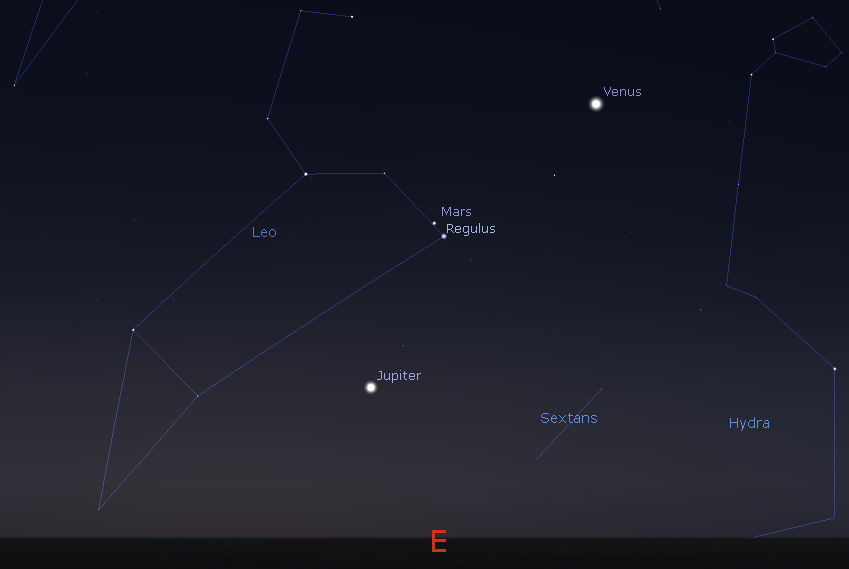
Venus, Mars and Jupiter with the constellation Leo at 6:30 a.m. September 24, 2015. Created using Stellarium.
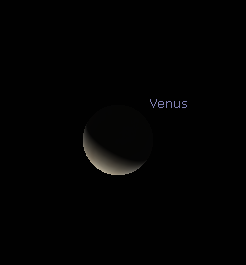
Venus in a telescope at 6:30 a.m. September 24, 2015. Created using Stellarium.
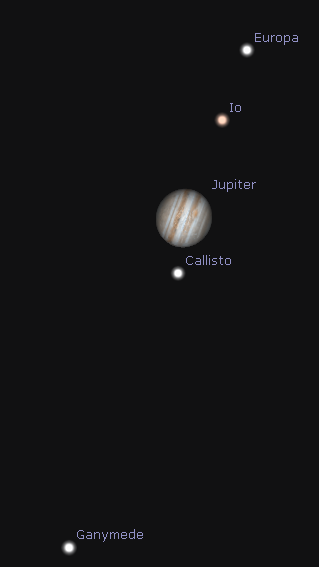
Jupiter and moons in a telescope at 6:30 a.m. September 24, 2015. Created using Stellarium.
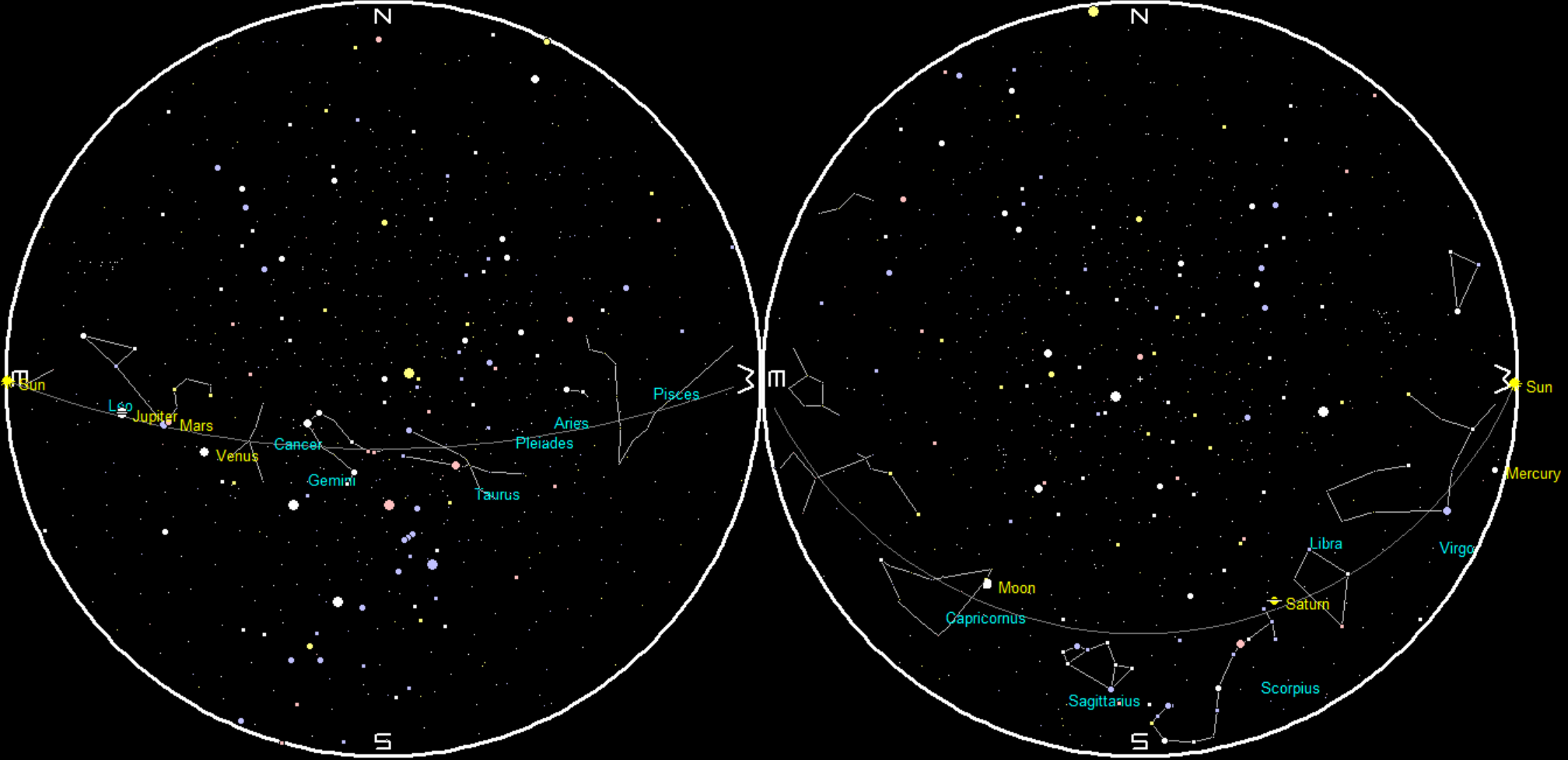
This is a chart showing the sunrise and sunset skies for September 23, 2015 showing the location of the planets and the Moon at that time. Created using my LookingUp program. Click on the image to enlarge.
09/22/2015 – Ephemeris – Equinox tomorrow and September 27th Moon’s triple whammy
Ephemeris for Tuesday, September 22nd. The Sun will rise at 7:29. It’ll be up for 12 hours and 11 minutes, setting at 7:40. The Moon, 1 day past first quarter, will set at 2:02 tomorrow morning.
Tomorrow at 4:20 a.m. before most of us wake up summer will officially end and Autumn will start. That’s the exact time of the autumnal equinox. We are noticing that the days or rather daylight hours are getting noticeably shorter day by day. Autumn will end when the days will stop getting shorter on the first day of winter, December 21st. The full moon this Sunday is triply important. Most important is that a total lunar eclipse will happen. Second, it is the Harvest Moon, the nearest full moon to the autumnal equinox, more on that next week. Also it is the closest the Moon gets to the Earth all year. Yup it’s a so-called supermoon. If the Moon were a 2 inch ball it would be 20 feet from an 8 inch Earth. The supermoon is a foot closer.
Times are for the Traverse City/Interlochen area of Michigan. They may be different for your location.
Addendum
That last bit about the Moon being a two-inch ball will come in handy if you come to the Girl Scout Badge Bash at ECCO in Traverse City Thursday night.
09/21/2015 – Ephemeris – Next Sunday’s total lunar eclipse
Ephemeris for Monday, September 21st. The Sun will rise at 7:28. It’ll be up for 12 hours and 14 minutes, setting at 7:42. The Moon, at first quarter today, will set at 1:02 tomorrow morning.
It’s six days to the total lunar eclipse next Sunday night. The eclipse starts just after 9 p.m. and ends shortly before 12:30 a.m. Of the remarkable four eclipse string at every possible lunar eclipse opportunity, this last one is the best for us, in that it occurs in the evening. The others were in the morning our time or occurred around the time of moon set around here. So if clear skies prevail we will have a wonderful and beautiful total lunar eclipse. Lunar eclipses occur at full moon when the Sun, Earth and Moon line up close enough for the Moon to enter the Earth’s shadow. Generally this only occurs about 1 out of 6 full moons. Eclipses of the Sun and Moon normally appear in pairs. The solar eclipse already occurred 8 days ago.
Times are for the Traverse City/Interlochen area of Michigan. They may be different for your location.
Addendum
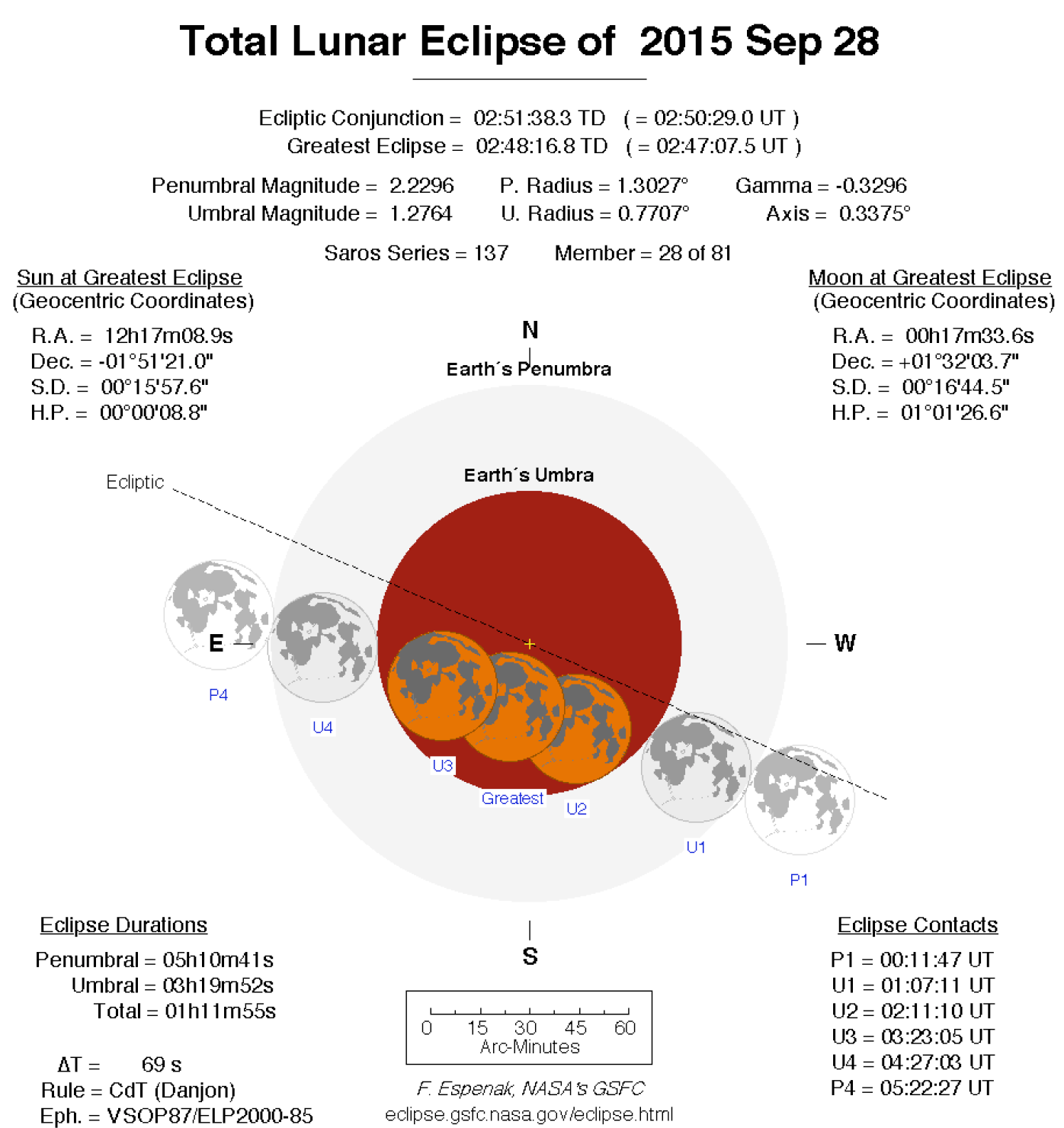
NASA eclipse chart portion. In the eastern US the Date will be September 27. Subtract 4 hours from UT to get EDT (Eastern Daylight Time) Credit: NASA/ Fred Espanek.
Here’s the link to the full chart.
 Bob Moler's Ephemeris Blog