Archive
12/04/2015 – Ephemeris – Yours truly will survey ancient and pre-scientific cosmologies tonight
Ephemeris for Friday, December 4th. The Sun will rise at 8:02. It’ll be up for 8 hours and 59 minutes, setting at 5:02. The Moon, 1 day past last quarter, will rise at 2:09 tomorrow morning.
This evening’s meeting of the Grand Traverse Astronomical Society starting at 8 p.m. at Northwestern Michigan College’s Rogers Observatory will be a traditional December program. This program alternates with a program on the Star of Bethlehem which will be revamped for next year. This year I’m presenting Ancient Cosmologies, a look at the cosmologies or world views of many mostly pre-scientific cultures, including how the Biblical world view was influenced by one of them. Then we’ll see the beginnings of Greek scientific thought that codified by Ptolemy in the second century AD, held sway for 1,500 years. Also I’ll look at Monday’s occultation of Venus and Comet Catalina. At 9 p.m. there will be a star party at the observatory with another program. All are welcome.
I’ll post more on the Occultation of Venus on the blog tomorrow and Monday
Times are for the Traverse City/Interlochen area of Michigan. They may be different for your location.
12/03/2015 – Ephemeris – The Moon will pass by the morning planets in the next few days
Ephemeris for Thursday, December 3rd. The Sun will rise at 8:01. It’ll be up for 9 hours and 1 minute, setting at 5:03. The Moon, at last quarter today, will rise at 1:11 tomorrow morning.
The Moon will be making a grand procession by the morning planets in the next few days, culminating with passing in front of Venus just after noon on Monday. This morning the Moon is approaching Jupiter to its lower left. By tomorrow morning Jupiter will be just above the Moon. Saturday morning the Moon will be approaching Mars, 12 of its diameters to its lower left. Sunday morning finds the crescent Moon between Mars and Venus with Mars 8 diameters above and right of the Moon. Monday Morning at 6 a.m. the Moon will be closing on Venus, with the brilliant planet just 4 moon diameters below left of the thin crescent Moon. Sharp eyed binocular and telescopic observers will be able see the Moon occult Venus after noon.
Times are for the Traverse City/Interlochen area of Michigan. They may be different for your location.
Addendum
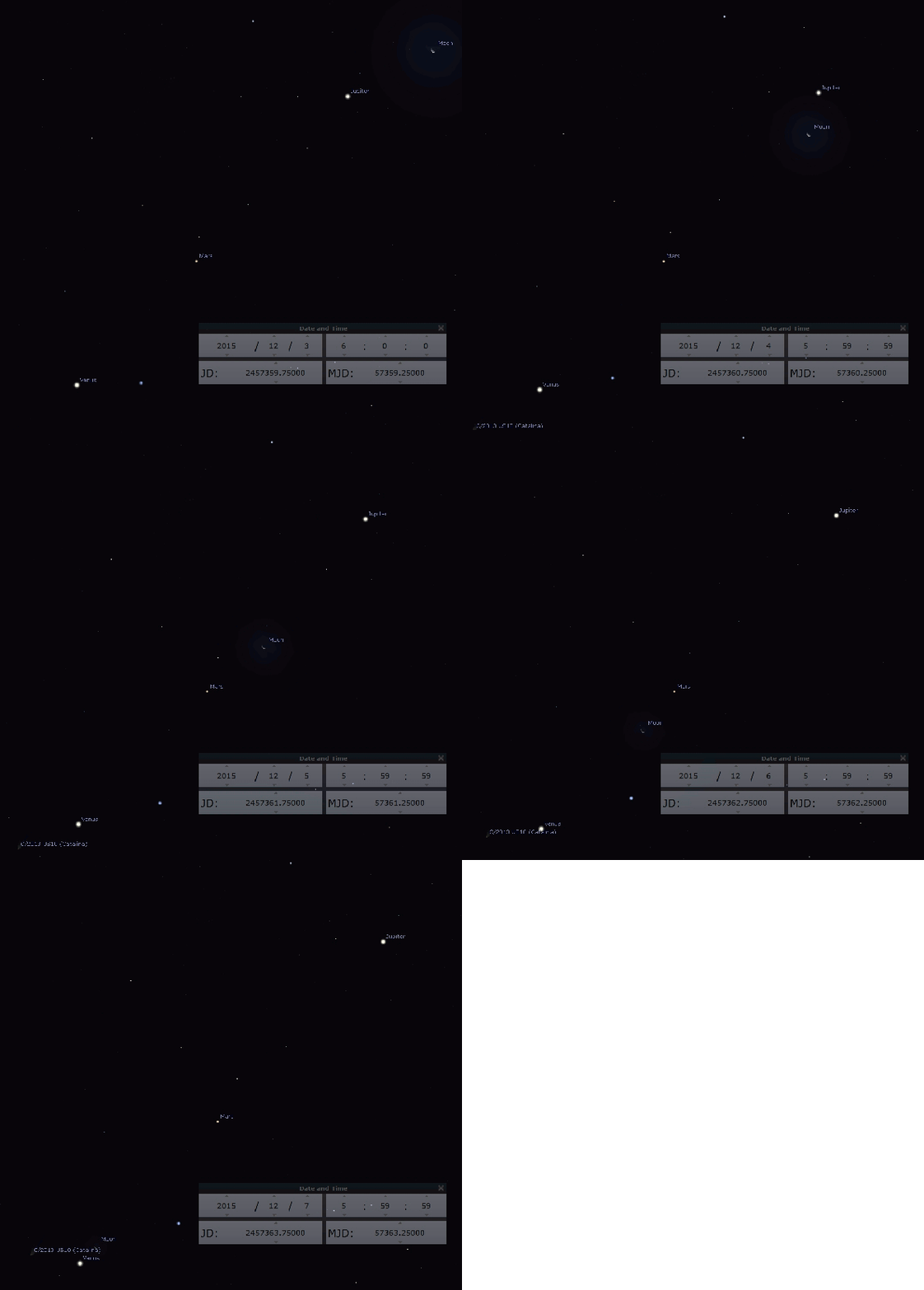
Animation of the Moon’s passage by the morning planets and Comet Catalina from December 2nd through the 7th, 2015. Created using Stellarium and GIMP.
12/02/2015 – Ephemeris – All the bright planet action is in the morning
Ephemeris for Wednesday, December 2nd. The Sun will rise at 8:00. It’ll be up for 9 hours and 2 minutes, setting at 5:03. The Moon, 1 day before last quarter, will rise at 12:12 tomorrow morning.
Let’s check out the whereabouts of the bright naked eye planets. Saturn and Mercury are too close to the direction of the Sun to be seen now. In the morning sky there are three bright planets. Jupiter will be the first to rise, at 1:03 a.m. in the east. Mars will rise next at 2:52 a.m. in the east, followed by Venus at 4:13 a.m. also in the east. Mars lies in line between Venus below and Jupiter above, almost halfway between Venus and Jupiter. The Moon will pass each of these planets in the next few days culminating by passing in front of Venus Monday. Comet Catalina will be about the width of a fist held at arm’s length below and left of Venus and will slowly be moving to the upper left and be level with Venus on the 6th.
Times are for the Traverse City/Interlochen area of Michigan. They may be different for your location.
Addendum
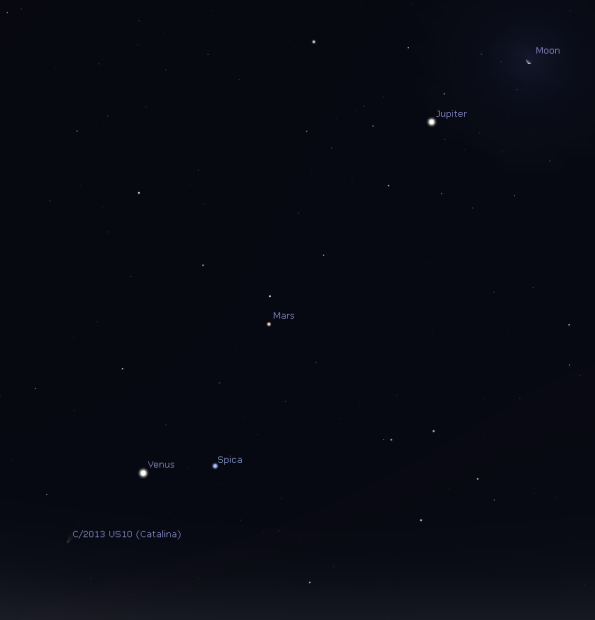
The Moon, Jupiter, Mars and Venus appear in the southeast at 6 a.m., December 3, 2015. Note that Comet Catalina is near Venus. Created using Stellarium.
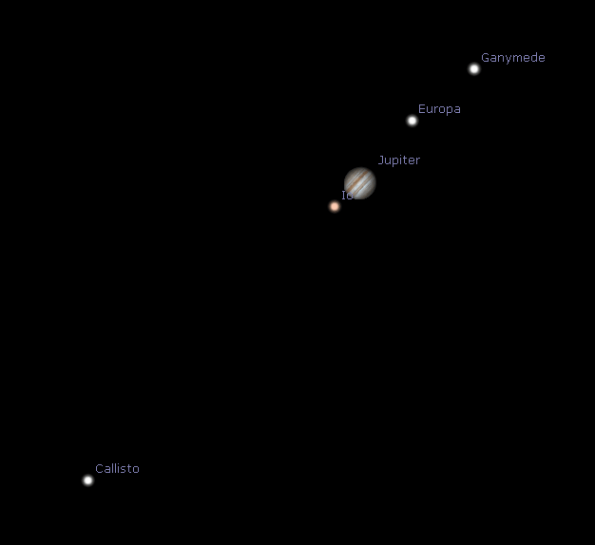
Jupiter and moons in a telescope at 6 a.m. December 3, 2015. Created using Stellarium.
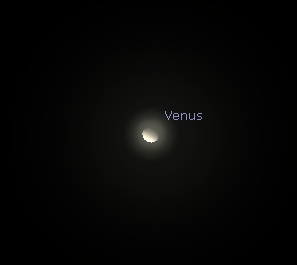
Venus as seen in a telescope as seen at the same magnification as Jupiter above, at 6 a,m. December 3, 2015. Created using Stellarium.
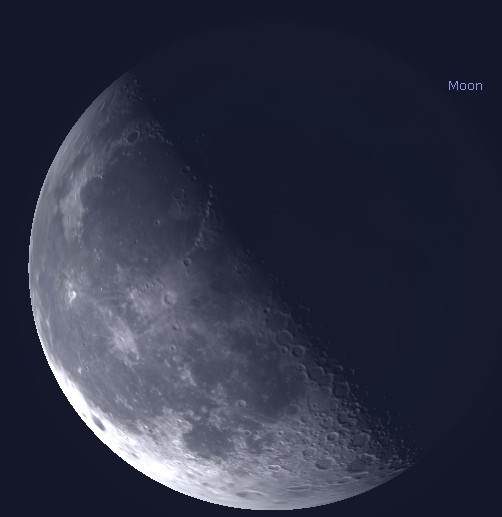
The Moon as seen in a binoculars or small telescope at 6 a,m. December 3, 2015. Created using Stellarium.
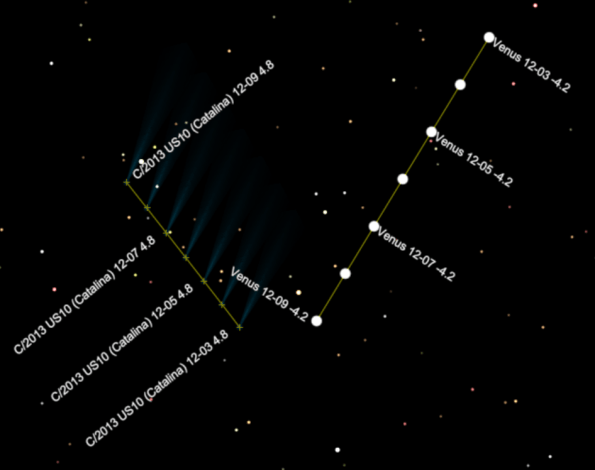
Comet Catalina and Venus for the next week. Note the magnitudes for the comet are about 2 magnitude too bright. It will take binoculars or a small telescope to spot the comet.
12/01/2015 – Ephemeris – Previewing December skies
Ephemeris for Tuesday, December 1st. The Sun will rise at 7:59. It’ll be up for 9 hours and 4 minutes, setting at 5:03. The Moon, 2 days before last quarter, will rise at 11:13 this evening.
December is the month with the shortest daylight hours. Winter will officially arrive at the winter solstice on the 21st at 11:48 p.m. There will be little movement in the sunset times: In the Traverse City/Interlochen area this will be from 5:03 tonight, down to 5:02 and then advancing to 5:11 at the end of the month. There is more movement in the sunrise times which will advance from 7:59 today to 8:20 on the 31st. There is also little movement of daylight hours. The noontime sun will hang around 22 to 23 degrees above the southern horizon all month. We have some great events this month, from an occultation of Venus by the moon on the 7th, to the Geminid meteors on the 14th and Comet Catalina will be seen in binoculars on mornings all this month.
Times are for the Traverse City/Interlochen area of Michigan. They may be different for your location.
Addenda
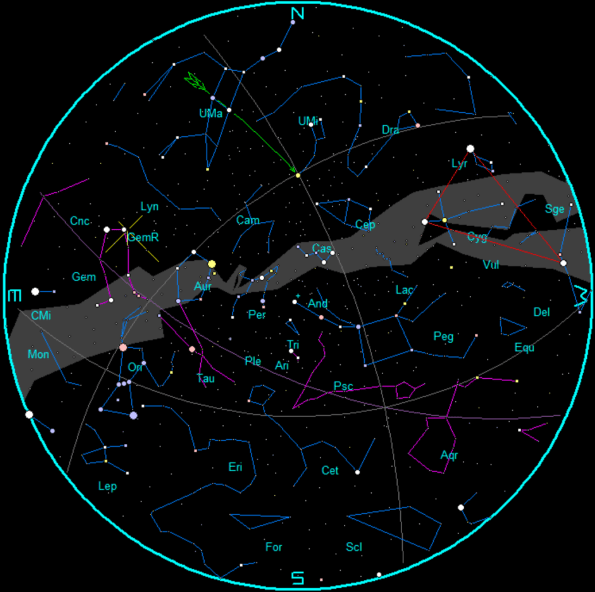
Star Chart for December 2015. Created using my LookingUp program. Click on image to enlarge.
The planets and stars are plotted for the 15th at 9 p.m. EST. That is chart time. Note, Traverse City is located 45 minutes behind our time meridian. To duplicate the star positions on a planisphere you may have to set it to 45 minutes earlier than the current time.
Evening astronomical twilight ends at 6:48 p.m. EST on December 1st, decreasing a minute 9 days later before increasing to 6:57 p.m. EST on the 31st.
Morning astronomical twilight starts at 6:15 a.m. EST on December 1st, and increasing to 6:34 a.m. EST on the 31st.
Add a half hour to the chart time every week before the 15th and subtract and hour for every week after the 15th.
For a list of constellation names to go with the abbreviations click here.
- Pointer stars at the front of the bowl of the Big Dipper point to Polaris the North Star.
- The Summer Triangle is still up and is shown in red.
- GemR is the Geminid meteor shower radiant
Calendar of Planetary Events
Credit: Sky Events Calendar by Fred Espenak and Sumit Dutta (NASA’s GSFC)
To generate your own calendar go to http://eclipse.gsfc.nasa.gov/SKYCAL/SKYCAL.html
Times are Eastern Daylight Time. Some additions made to aid clarity.
Date	   Local  Event
           Time EST
Dec 01 Tu         Venus: 43.3° W
    03 Th  2:41am Last Quarter
    04 Fr  1:21am Moon-Jupiter: 2° N
    04 Fr  1:33pm Moon Ascending Node
    05 Sa  9:56am Moon Apogee: 404800 km
    05 Sa  9:40pm Moon-Mars: 0.1° N - Occultation **
    07 Mo 11:55am Moon-Venus: 0.7° S - Occultation *
    11 Fr  5:29am New Moon
    12 Sa  3:15am Moon South Dec.: 18.4° S
    14 Mo 12:48pm Geminid Shower: ZHR = 120
    17 Th  9:32pm Saturn-Antares: 6.2° N
    18 Fr 10:13am Moon Descending Node
    18 Fr 10:14am First Quarter
    21 Mo  3:53am Moon Perigee: 368400 km
    21 Mo 11:48pm Winter Solstice
    22 Tu  9:00pm Ursid Shower: ZHR = 10
    23 We  9:16pm Mars-Spica: 3.5° N
    23 We  2:09pm Moon-Aldebaran: 0.7° S
    25 Fr  2:30am Moon North Dec.: 18.4° N
    25 Fr  6:11am Full Moon
    28 Mo  9:59pm Mercury Elongation: 19.7° E
    29 Tu  3:30pm Moon-Regulus: 2.9° N
    31 Th 12:55pm Moon-Jupiter: 1.6° N
    31 Th  3:19am Moon Ascending Node
Jan 01 Fr         Venus: 37.9° W
* The occultation will be visible in the US, except extreme southwestern Alaska and Hawai’i; and Canada down to Panama. In the Grand Traverse area of Michigan the occultation starts around 12:20 p.m. and ends around 1:27 p.m. This is a daytime event for most of the US. Note that the actual time depends on your exact location. I’ll have more information in a non Ephemeris post on Saturday the 5th. The Occultation map is here.
** On December the 5th there will be an occultation of Mars visible across the Indian Ocean and much of Australia. That occultation map is here.
Estimating occultation timings for your location
I used Cartes du Ciel the free software that I have a link to on the right. Make sure that the program is set for topocentric positions under Setup/Solar System. And you have entered your position under Setup/Observatory. You can find your location in Google Earth, or your GPS device or smart phone.
You can also use Stellarium. Just make sure the Moon is normal sized.
In both programs you can lock the Moon or Aldebaran in the center of the screen Pick a time in advance of the occultation and using the set time window walk the star towards the Moon, mark the time. Then walk the star out from the Moon and record the reappearance time. That’s it.
This should work with other planetarium programs too.
For better accuracy go to the International Occultation Timing Association (IOTA) website. Download and install their Occult4 program for Windows computers. Follow the instructions. When I ran the program for my location, the location I use for Interlochen/Traverse City (Since I live approximately half-way between the two). I got results within a half-minute of the IOTA Occult4 program results. So the approximation method using planetarium programs is valid.
Comet C/2013 US10 (Catalina)
This comet has been hiding for the last two years after its discovery, moving into the far southern hemisphere of the sky. However this month it has emerged into our morning sky. This comet is a one time visitor from the Oort Cloud to the inner solar system and will be ejected into interstellar space. It passed perihelion on November 15th, coming just inside the Earth’s orbit on the other side of the Sun from us. It’s orbit will be headed northward and a bit toward us, so it will keep its brightness steady.
The position marks in the chart have the date and the magnitude. However the comet is currently appearing one magnitude dimmer than shown. So instead of appearing as nearly 5th magnitude, it will really be 6th magnitude. It’s definitely a binocular or telescopic object.
According to the brightness graph the comet began to under perform in brightness back in September, however, according to a new brightness formula the comet may increase in brightness by a magnitude by late February when it will be well placed for viewing all night. To monitor the brightness reports from observers go to http://www.aerith.net/comet/catalog/2013US10/2013US10.html.
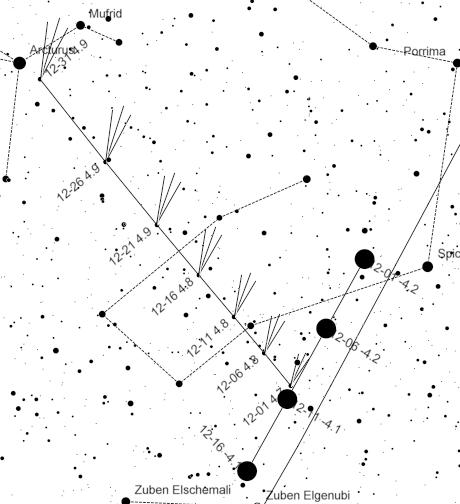
The tracks of Comet C/2013 US10 (Catalina) for December 2015 along with part of Venus’ track. Created using Cartes du Ciel (Sky Charts).
 Bob Moler's Ephemeris Blog