Archive
11/30/2016 – Ephemeris – The bright planets this morning and tonight
Ephemeris for Wednesday, November 30th. The Sun will rise at 7:59. It’ll be up for 9 hours and 4 minutes, setting at 5:03. The Moon, 1 day past new, will set at 6:23 this evening.
In the east-southeast before 7:30 these mornings. Jupiter can be glimpsed in the morning twilight. Jupiter will rise tomorrow at 3:23 a.m. We are approaching Jupiter as it appears to move away from the Sun. We will pass it on April 7th next year. Venus and Mars are in the evening sky. At 6 p.m. these planets will be seen in the southwest and low in the sky. Venus will be the lower and brighter of the two, Mars will be higher to the left. Venus will set at 7:59. Mars will hang on a bit longer and will set at 10:09. Mars’ setting time hasn’t changed much in the last month and a half. It’s losing to the Sun by only a little bit each day. Venus is slowly heading northward for the rest of it’s evening appearance, and is moving higher in the sky.
Times are for the Traverse City/Interlochen area of Michigan. They may be different for your location.
Addendum
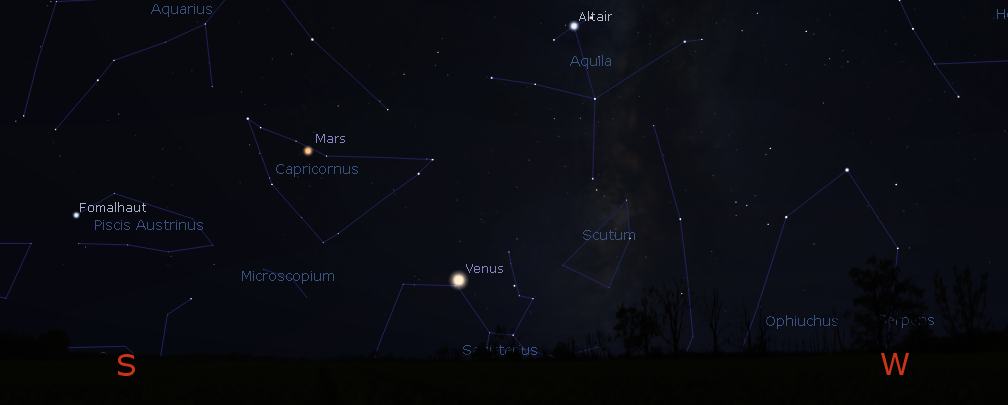
The evening planets of Venus and Mars at 6:30 p.m., November 30, 2016. Click on image to enlarge. Created using Stellarium.
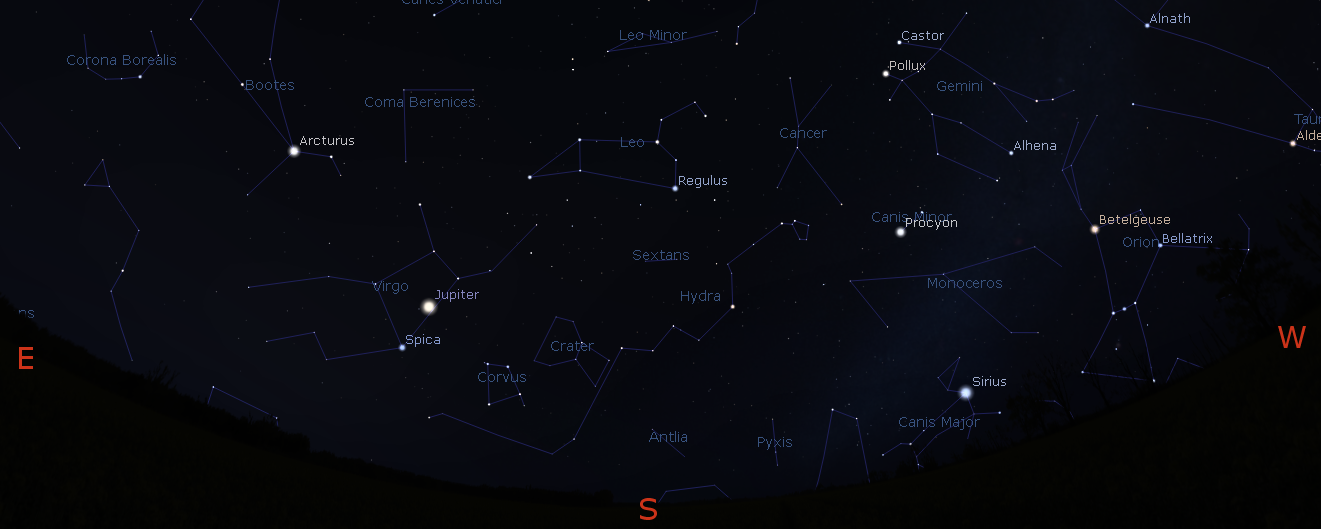
Jupiter with the coming spring constellations and the setting winter ones at 6:30 a.m., December 1, 2016. Click on image to enlarge. Created using Stellarium.
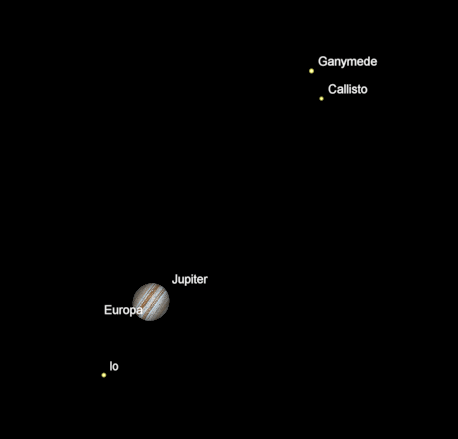
Jupiter and Galilean satellites at 6:30 a.m., December 1, 2016. Europa is labeled, but just behind the planet. It will appear at 6:43 a.m. Created using Cartes du Ciel (Sky Charts).
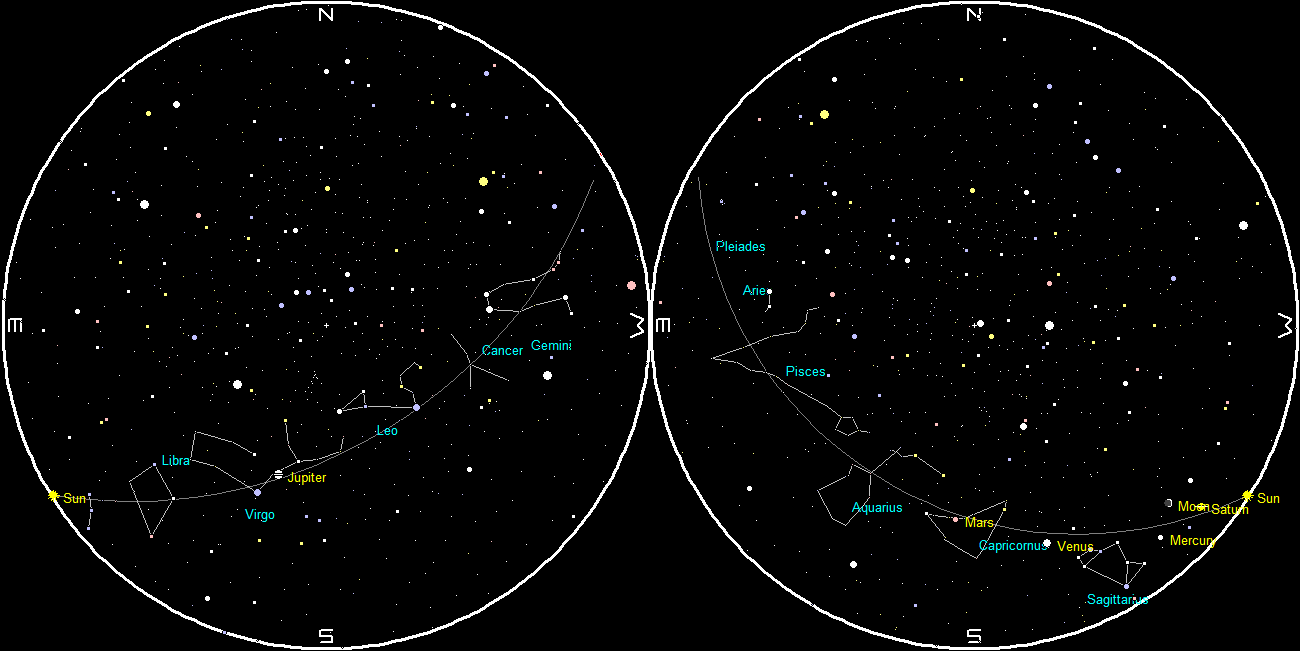
Planets and Moon at sunset and sunrise of a single night starting with sunset on the right on November 30, 2016. The night ends on the left with sunrise on December 1. Click on image to enlarge. Created using my LookingUp program.
11/29/2016 – Ephemeris – Heads up: Friday’s on the possible origins of the Star of Bethlehem
Ephemeris for Tuesday, November 29th. The Sun will rise at 7:58. It’ll be up for 9 hours and 6 minutes, setting at 5:04. The Moon is new today, and won’t be visible.
This Friday the 2nd at 8 p.m. I will be giving a talk investigating the origin of the Star of Bethlehem. This will be during December’s monthly meeting of the Grand Traverse Astronomical Society, at Northwestern Michigan College’s Joseph H. Rogers observatory located south of Traverse City on Birmley Road. The talk is a scientific treatment of the subject, rather than a religious one. We’ll look at what the Gospel writers got right and possibly got wrong. We’ll look at historical writings and oriental observations of the heavens around that time. These will be augmented by computer simulations of what have been important celestial events visible around that time. There is no admission charge. There will be viewing of the skies afterward if it’s clear.
Times are for the Traverse City/Interlochen area of Michigan. They may be different for your location.
Addendum

Title Slide for Friday’s program
Friday with this post I’ll add the article I’ve written for our newsletter about the program.
11/28/2016 – Ephemeris – The Hyades the star cluster in the face of Taurus the bull
Ephemeris for Monday, November 28th. The Sun will rise at 7:57. It’ll be up for 9 hours and 7 minutes, setting at 5:04. The Moon, 1 day before new, will rise at 7:45 tomorrow morning.
Rising in the east now is the bright star Aldebaran an orange star that’s at one end of the sideways letter V of stars that is the head of Taurus the bull. Above it is the jewel-like Pleiades or Seven Sisters star cluster. There’s more to Taurus, like it’s freakishly long horns and front part of its body. But you can say you’ve seem Taurus, if you can spot his face. That V of stars is actually a star cluster called the Hyades, and in Greek Myth were the half-sisters of the Pleiades, also fathered by the god Atlas. Both the Hyades and Pleiades are being pursued by Orion, which as Robert Frost put it is throwing a leg over the eastern horizon at 8 to 9 pm. He isn’t the only one following the Pleiades, the name Aldebaran means “The Follower”.
Times are for the Traverse City/Interlochen area of Michigan. They may be different for your location.
Addendum
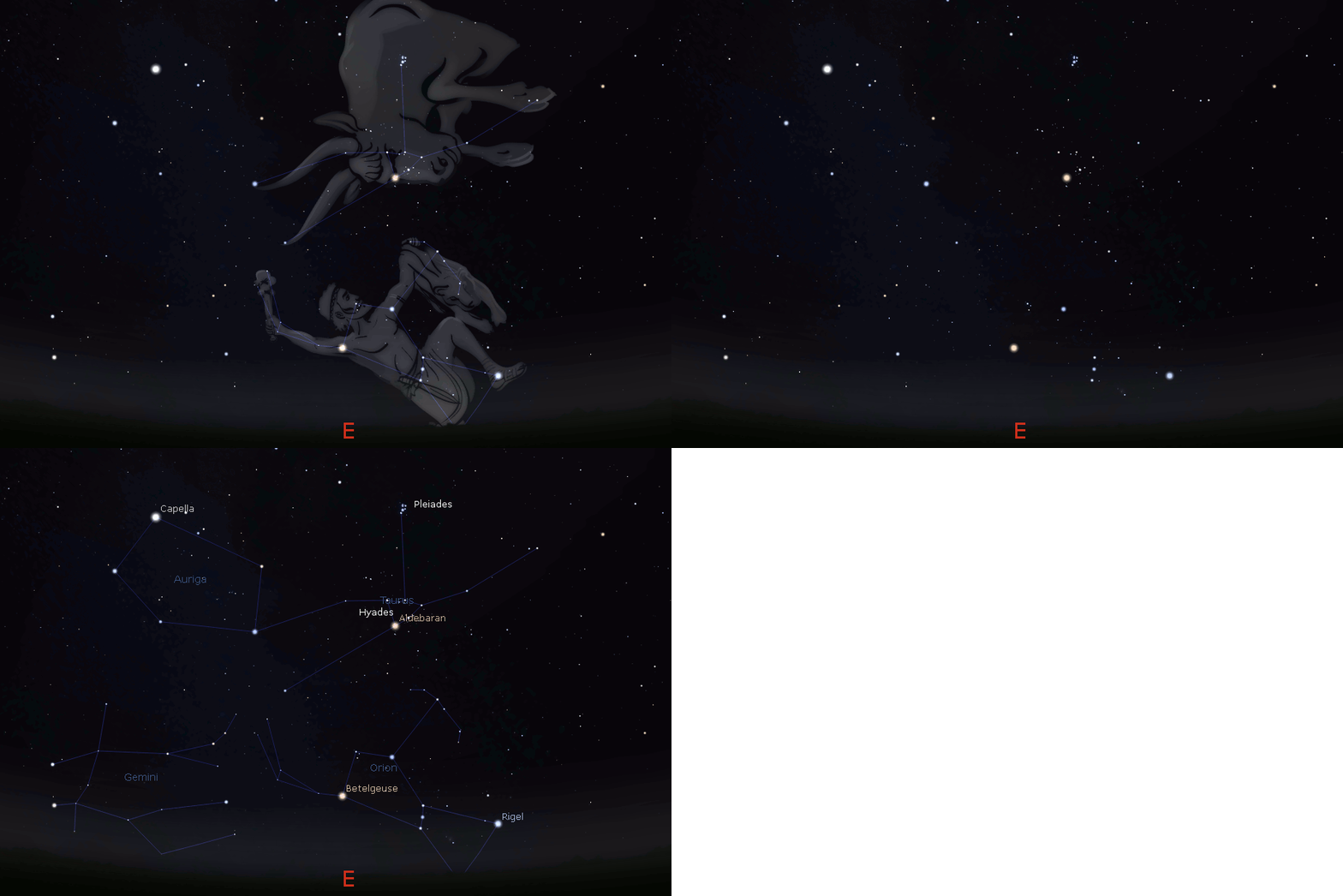
An animation showing the Hyades, Taurus, Orion and the Pleiades. Created using Stellarium and GIMP. Click on image to enlarge.
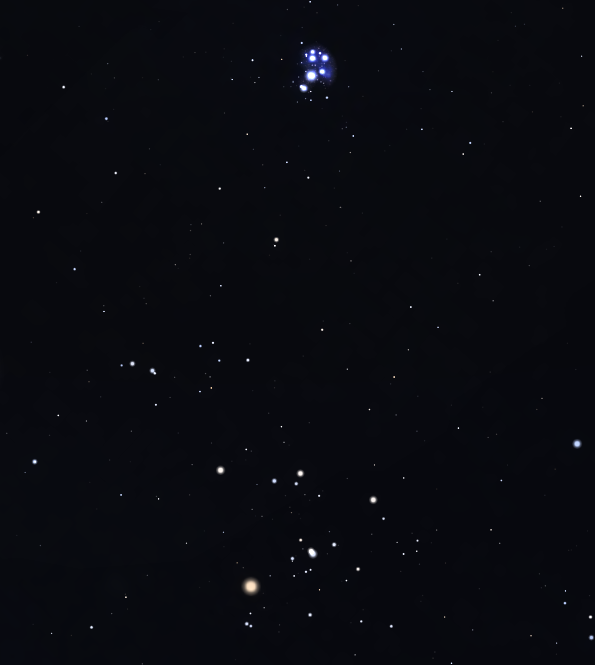
Closeup of the Hyades and the Pleiades. Created using Stellarium.
11/25/2016 – Ephemeris – The Moon is near Jupiter this morning
Ephemeris for Friday, November 25th. The Sun will rise at 7:53. It’ll be up for 9 hours and 12 minutes, setting at 5:06. The Moon, half way from last quarter to new, will rise at 4:53 tomorrow morning.
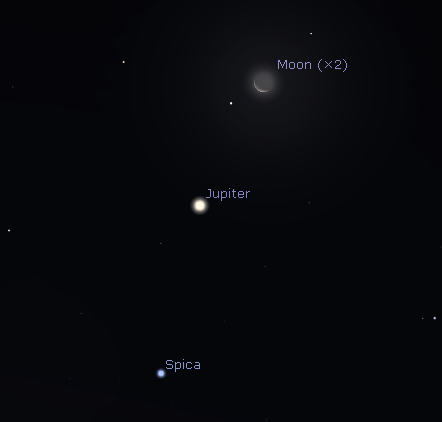
The Moon passed Jupiter about 9 last night, and so this morning is to the left and a bit below the bright planet. The Moon is a waning crescent a bit less than 10% illuminated by the Sun from our vantage point. Or maybe it’s more proper to say we see less than 10% of its day lit side. The Earth is the only close object to it that can illuminate it’s night side, and that might be visible this morning as Earth shine. For the Moon the Earth is 90% illuminated by the Sun, exactly opposite its phase to us. It’s area in the Moon’s sky is 16 times the Moon’s area in our sky. On top of that the Earth is much more reflective than the Moon, which is dirty gray. So Earth light in the Moon is much brighter than moonlight on the Earth.
Times are for the Traverse City/Interlochen area of Michigan. They may be different for your location.
Addendum
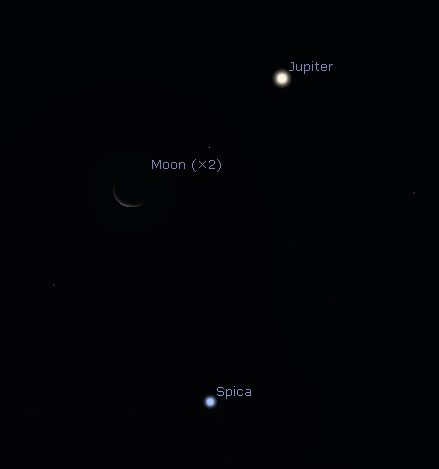
Jupiter, the Moon, and the star Spica at 6:30 this morning, November 25, 2016. The Moon is shown twice actual size. Created using Stellarium.
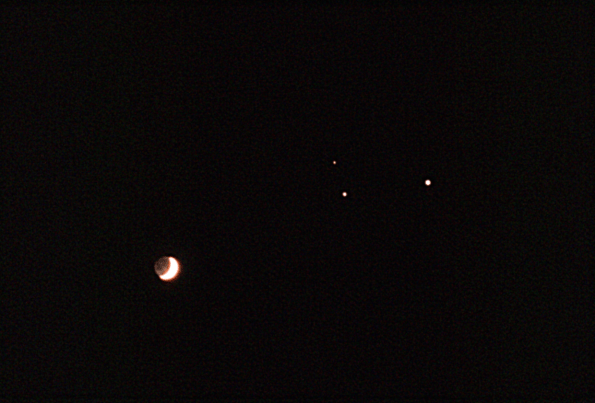
The Moon with Earth shine with a confluence of planets (Venus, Jupiter, Mars) on June 15, 1991). Credit Bob Moler.
11/24/2016 – Ephemeris – The little constellation that used to start the seasonal year
Ephemeris for Thanksgiving Day, Thursday, November 24th. The Sun will rise at 7:52. It’ll be up for 9 hours and 14 minutes, setting at 5:06. The Moon, 3 days past last quarter, will rise at 3:54 tomorrow morning.
From antiquity, the first constellation of the Zodiac has been Aries the ram. That’s the constellation the Sun entered on the first day of spring, or the vernal equinox. Well that was a couple of thousand years ago. Currently the vernal equinox point is in western Pisces. This is due to the wobbling of the Earth’s axis called precession. The spinning Earth like and top or gyroscope wobbles when force is applied to it. In this case the Sun and Moon. One wobble takes 26,000 years to complete. Anyway, Aries is a small constellation of four stars in a bent line, below the triangular constellation of Triangulum, which is itself below Andromeda. It’s a bit west or right of the Pleiades or Seven Sisters star cluster.
Times are for the Traverse City/Interlochen area of Michigan. They may be different for your location.
Addendum
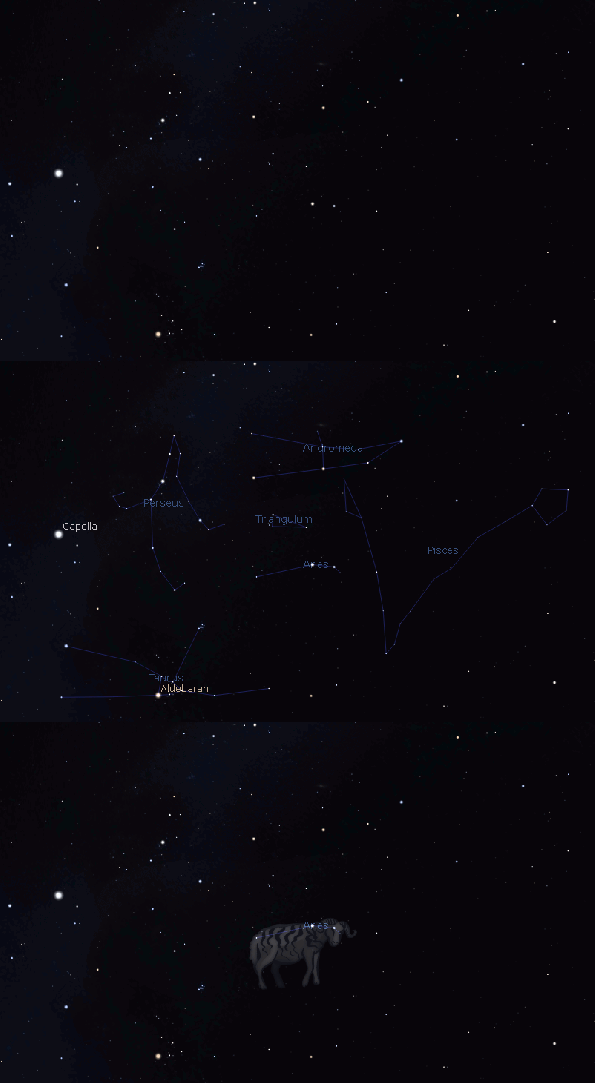
Aries the ram animated finder chart for 9 p.m. November 24, 2016. Created using Stellarium and GIMP.
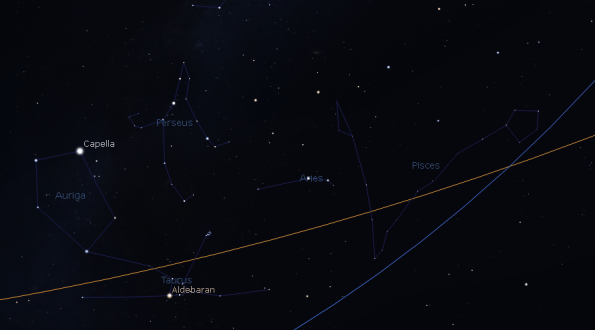
The vernal equinox today, where the blue line, the celestial equator and the orange line, the ecliptic or path of the Sun cross. The Sun is where these lines cross on the first day of spring (March 20th around here). Note that the vernal equinox is now in western Pisces. Created using Stellarium.
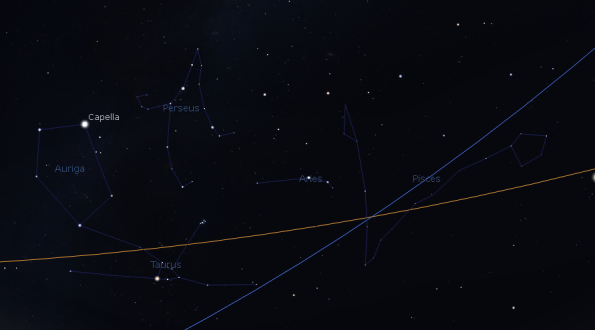
The vernal equinox back in AD 100, where the blue line, the celestial equator and the orange line, the ecliptic or path of the Sun cross. The Sun is where these lines cross on the first day of spring. Note that the vernal equinox was at the east edge of Pisces. Created using Stellarium.
11/23/2016 – Ephemeris – Now it’s two bright planets in the evening and one in the morning
Ephemeris for Wednesday, November 23rd. The Sun will rise at 7:50. It’ll be up for 9 hours and 16 minutes, setting at 5:07. The Moon, 2 days past last quarter, will rise at 2:55 tomorrow morning.
In the east-southeast before 7:30 these mornings. Jupiter can be glimpsed in the morning twilight. Jupiter will rise tomorrow at 3:44 a.m. We are approaching Jupiter as it appears to move away from the Sun. We will pass it on April 7th next year. Venus and Mars are in the evening sky. At 6 p.m. these planets will be seen in the southwest and low in the sky. Venus will be the lower and brighter of the two, Mars will be higher to the left. Venus will set at 7:45. Mars will hang on a bit longer and will set at 10:08. Mars’ setting time hasn’t changed much in the last month. It’s losing to the Sun by only a little bit each day. Venus is slowly heading northward for the rest of it’s evening appearance, and will be moving higher in the sky.
Times are for the Traverse City/Interlochen area of Michigan. They may be different for your location.
Addendum
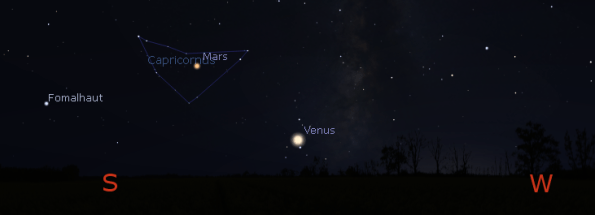
Venus, Mars and the constellation Capricornus at 6:30 p.m., November 23, 2016. Created using Stellarium.
Jupiter and the Moon tomorrow morning, November 24, 2016. The Moon will pass Jupiter Thursday the 24th. With Friday’s post we’ll see that the Moon has passed Jupiter. Created using Stellarium.
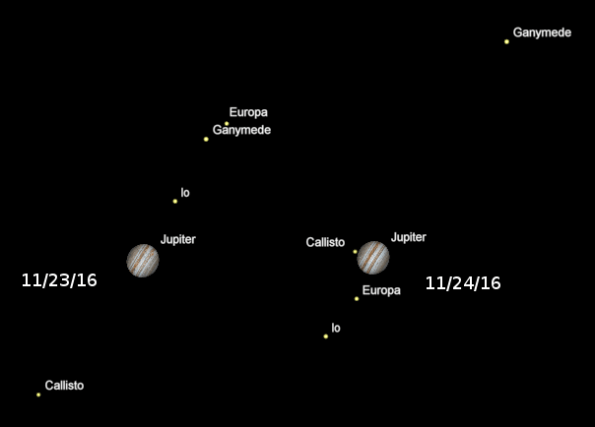
Jupiter and its satellites this morning and tomorrow morning at 6:30.. Created using Cartes du Ciel (Sky Charts).
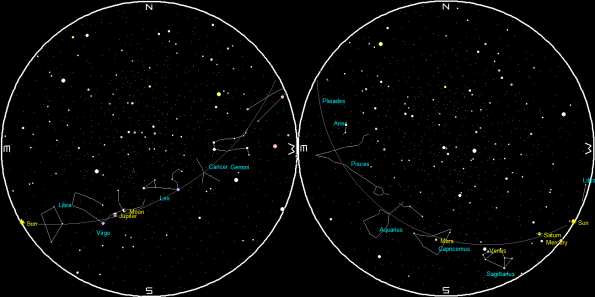
Planets and Moon at sunset and sunrise of a single night starting with sunset on the right on November 23, 2016. The night ends on the left with sunrise on November 24. If you are using Firefox right-click on the image and select View Image to enlarge the image. That goes for all the large images. Created using my LookingUp program.
1122/2016 – Cepheus the king and its one really important star
Ephemeris for Tuesday, November 22nd. The Sun will rise at 7:49. It’ll be up for 9 hours and 18 minutes, setting at 5:08. The Moon, 1 day past last quarter, will rise at 1:56 tomorrow morning. | There’s a faint constellation in the north above Polaris. It’s a nearly upside down church steeple of a constellation called Cepheus the king, and husband of queen Cassiopeia the W shaped constellation right of it. Cepheus’ claim to astronomical fame is that one of its stars, Delta (δ) Cephei, is the archetype for the important Cepheid variable stars. Delta is in a trio of stars at the top corner of the constellation, and the one on the right. In the early 20th century Henrietta Leavitt discovered that Cepheids in the nearby galaxy the Large Magellanic Cloud varied in brightness with a period that was related to their average brightness. This meant that Cepheids could be used as standard candles to measure great distances to other galaxies.
Times are for the Traverse City/Interlochen area of Michigan. They may be different for your location.
Addendum
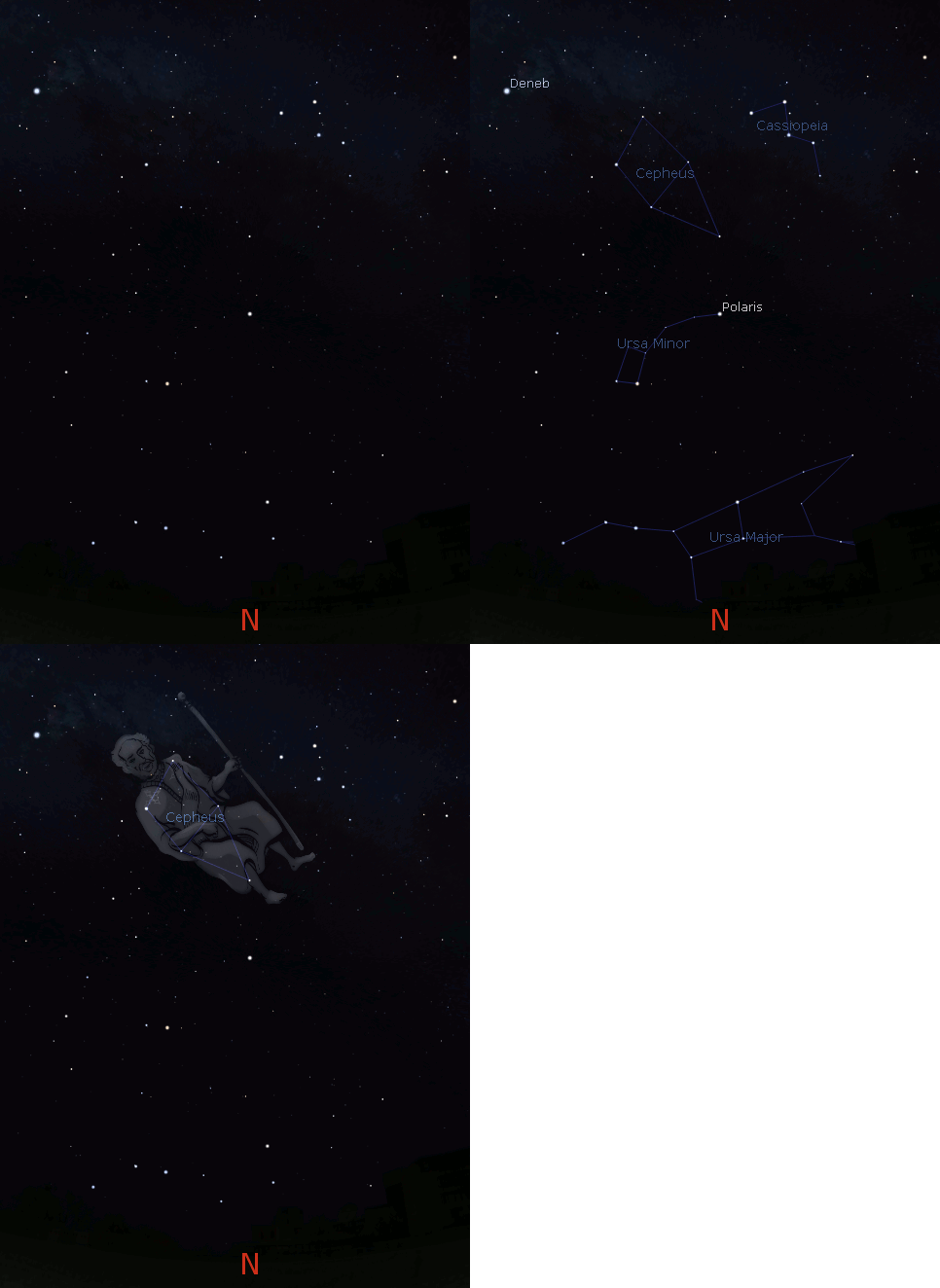
Cepheus animated finder chart for 8 p.m. November 22, 2016. Created using Stellarium and GIMP.
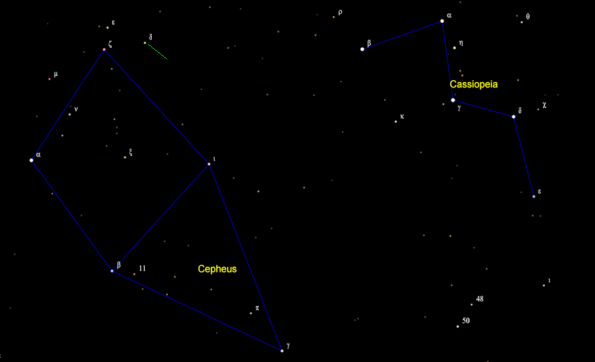
Delta Cephei finder chart. This is the same orientation as the chart above, but created using Cartes du Ciel (Sky Charts). A green line points to Delta (δ) Cephei.
A word about star designations in the chart above. In general only the brightest stars have proper names. And those usually come from antiquity, and most of those are Arabic. Star designations which are Greek lower case letters come from Johann Bayer’s Uranometria star atlas from 1603. He designated the stars by order of brightness. In constellations with a lot of stars he moved to the Latin alphabet after running out of Greek letters. These were, of course, naked eye stars; the atlas being produced a few years before the invention of the telescope. Stars with numbers are Flamsteed designations from John Flamsteed’s 1725 star catalog. He numbered his stars from west to east in a particular constellation, but only those stars that could be seen from Great Britain. A single star can have many catalog designations. For instance the bright star Vega in Lyra the harp is Alpha (α) Lyrae, Bayer designation; 3 Lyrae, Flamsteed designation; HD 172167, Henry Draper catalog; BD +38 3238, Bonner Durchmusterung, a German catalog; HIP 91262, Hipparcos catalog, and so on.
11/21/2016 – Ephemeris – The two fishies of Pisces
Ephemeris for Monday, November 21st. The Sun will rise at 7:48. It’ll be up for 9 hours and 20 minutes, setting at 5:08. The Moon, at last quarter today, will rise at 12:54 tomorrow morning.
High in the south-southeast at 9 p.m. are the four bright stars of the Great Square of Pegasus, the upside down flying horse. Lying along the left and bottom sides of the great square is the constellation of Pisces the fish, one of the 12 constellations of the Zodiac that lie along the path of the sun, moon and planets. Even though the constellation is called the fish, the fish themselves are not represented in the stars. What can be traced in the stars is the rope, that’s tied to their tails, anchored at the extreme southeastern part of the constellation that is seen in the stars. The right or western end of Pisces is the asterism, or informal constellation, of the Circlet. It’s the loop of 5 stars, the rope around the tail of one of the two fish.
Times are for the Traverse City/Interlochen area of Michigan. They may be different for your location.
Addendum
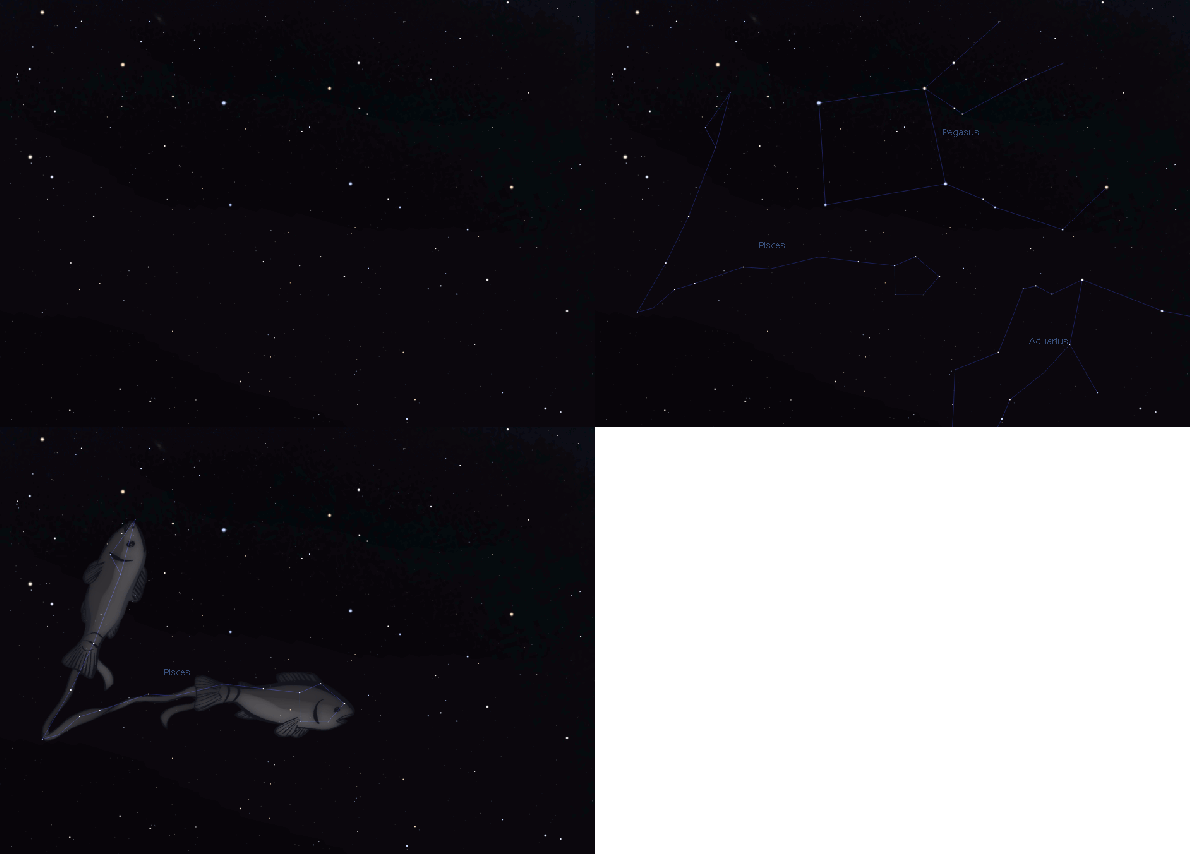
An animation of the constellation of Pisces the fish, showing first the stars, then the constellation outline including those of Pegasus, and Aquarius, then an artist rendering. Created using Stellarium and GIMP.
I don’t care what the artists think, I still think the circlet is a loop around the western fish’s tail.
11/18/2016 – Ephemeris – Aquarius the water spiller
Ephemeris for Friday, November 18th. The Sun will rise at 7:44. It’ll be up for 9 hours and 26 minutes, setting at 5:11. The Moon, 3 days before last quarter, will rise at 9:43 this evening.
One of the constellations of the zodiac is in the south-southwestern sky at 8 in the evening. It’s the constellation of Aquarius the water bearer. The image that is supposed to be depicted in the stars is that of a hapless fellow spilling a stone jar of water across the sky. Aquarius is fairly hard to spot because it is made of faint stars. One part of him, though, is easy to spot. That is the Water Jar, an asterism or informal constellation. It is a distinctive small nearly equilateral triangle of stars with another star in the center. Stars extending to the right from the water jar are he yoke he’s holding the water jar with. The Water jar is just below the top of the head of the upside down Pegasus the flying horse. The water is flowing down a vertical line of stars.
Times are for the Traverse City/Interlochen area of Michigan. They may be different for your location.
Addendum
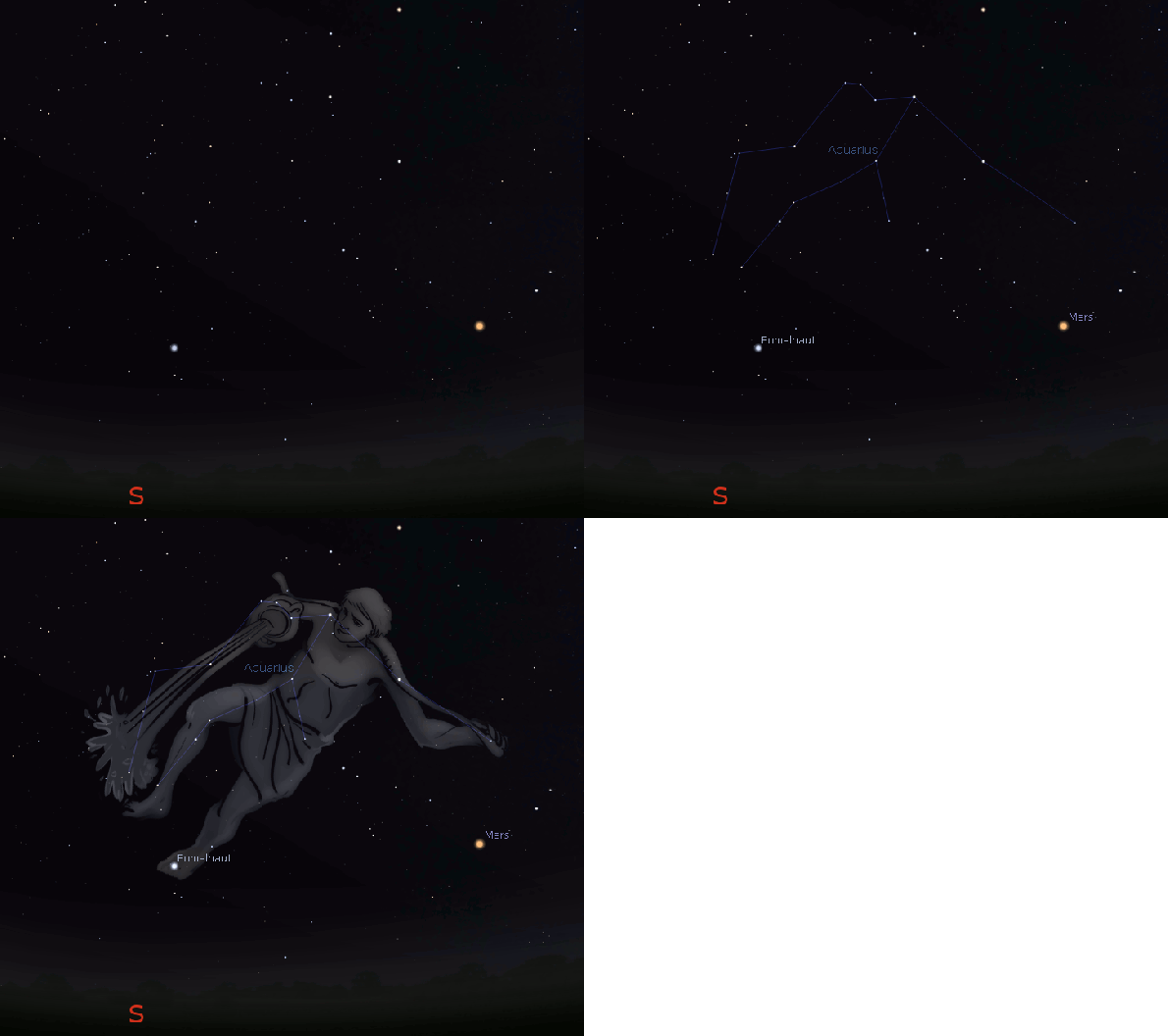
Aquarius the water bearer or rather spiller at 8 p.m. tonight, November 18. Note that Mars is in the next constellation west, Capricornus, and will enter Aquarius about mid-December. Created using Stellarium and GIMP. If you’re using the Firefox browser you can right-click on the image and display the enlarged version.
The triangle of stars with another star in the center is an asterism called the Water Jar, right where the artist drew it.
11/17/2016 – Ephemeris – The Leonid meteor shower will be hampered by the Moon tomorrow morning
Ephemeris for Thursday, November 17th. The Sun will rise at 7:43. It’ll be up for 9 hours and 29 minutes, setting at 5:12. The Moon, 3 days past full, will rise at 8:39 this evening.
The Leonid meteor shower, which reaches peak activity today is going to be washed out by the bright Moon. The International Meteor Organization doesn’t have anything specific on it this year. On most years, it produces only 15 meteors an hour tops. However about every 33 years or so all heaven breaks loose. From the predictions I’ve seen the fun starts in 2034 and lasts a few years. The reason for the spectacular meteor storms, as they call them, is that the responsible comet, 55P Tempel-Tuttle, has a debris clump that hasn’t fanned out much along its orbit, so we get intense meteor activity when the comet again enters the inner solar system. It’s expected back in 2031 with its main cloud of meteoroids a couple of years later.
Times are for the Traverse City/Interlochen area of Michigan. They may be different for your location.
Addendum
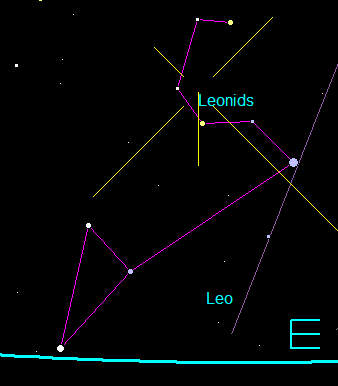
Leonid meteor radiant at about 2 a.m. from Traverse City. Credit: My LookingUp program.
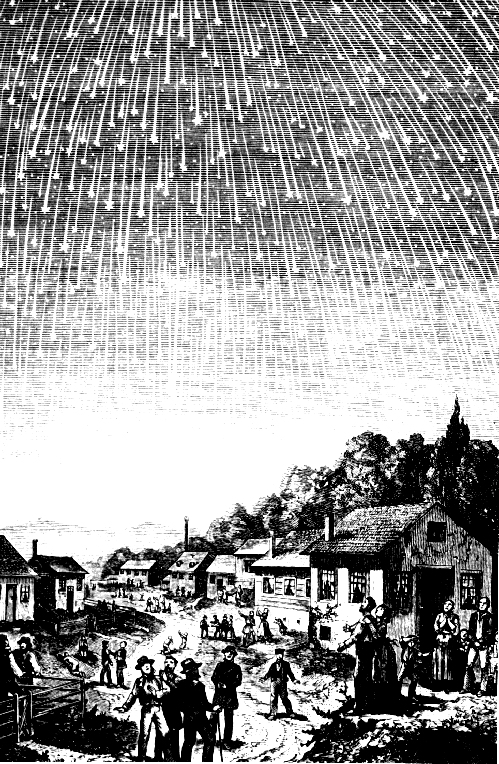
A famous woodcut of the 1833 Leonid meteor storm.
 Bob Moler's Ephemeris Blog