Archive
11/16/2016 – Ephemeris – Where are the bright planets now?
Ephemeris for Wednesday, November 16th. The Sun will rise at 7:41. It’ll be up for 9 hours and 31 minutes, setting at 5:13. The Moon, 2 days past full, will rise at 7:38 this evening.
Low in the east-southeast before 7:15 a.m. Jupiter can be glimpsed in the morning twilight. Jupiter will rise tomorrow at 4:05 a.m. We are approaching Jupiter, though it’s 5 times Earth’s distance from the Sun and will pass it April 7th. Venus, Saturn and Mars are in the evening sky. At 6 p.m. these planets will be seen in the southwest and low in the sky. Venus will be the brightest, Saturn might be picked out of the twilight to the right and below Venus, and Mars will be higher to the left. Saturn will set first at 6:30, with Venus setting at 7:33. Mars will hang on a bit longer and will set at 10:07. Mars’ setting time hasn’t changed from last week. Venus is slowly heading northward for the rest of it’s evening appearance.
Times are for the Traverse City/Interlochen area of Michigan. They may be different for your location.
Addendum
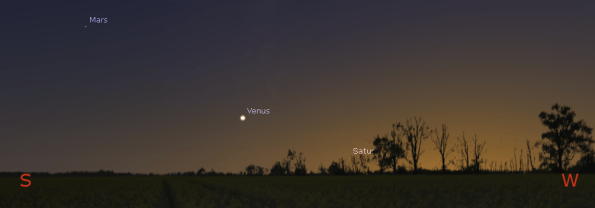
The evening planets in twilight in the southwestern sky at 6 p.m. Created using Stellarium.
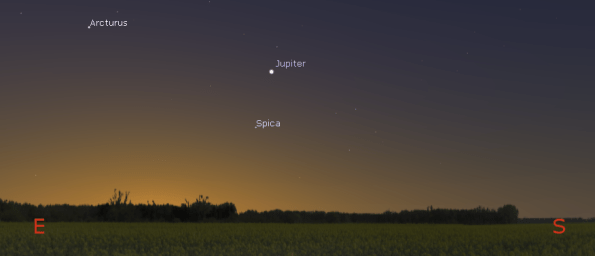
Jupiter rising in the morning sky this morning at 7 a.m. November 19, 2016. Created using Stellarium.
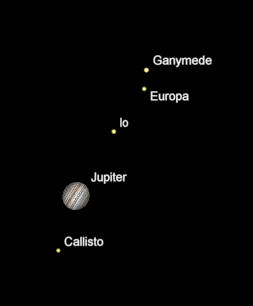
Jupiter and its Galilean moons, as they might be seen in a telescope at 7 a.m., this morning, November 16, 2016. Created using Cartes du Ciel (Sky Charts).
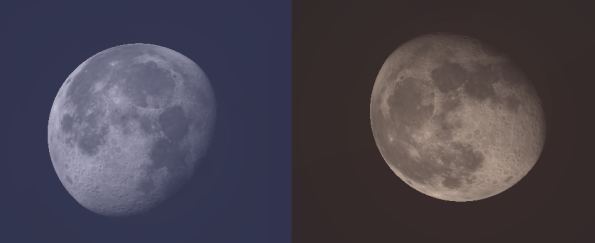
The Moon is visible both in the evening and the next morning. At right is the evening Moon at 8 p.m. On the left is the Moon at 7 a.m. A sharp-eyed person, with binoculars, can notice a slight change in the sunset terminator in the 11 hours between the two views. Created using Stellarium.
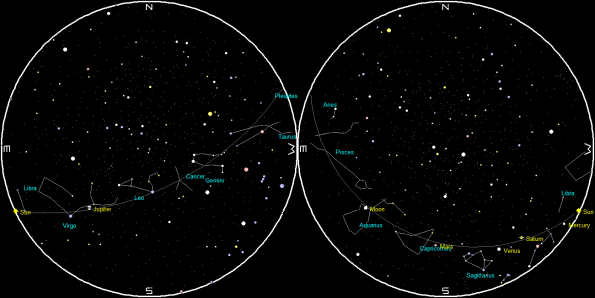
Planets and Moon at sunset and sunrise of a single night starting with sunset on the right on November 16, 2016. The night ends on the left with sunrise on November 17. If you are using Firefox right-click on the image and select View Image to enlarge the image. That goes for all the large images. Created using my LookingUp program.
11/15/2016 – Ephemeris – Imaging exoplanets from the ground
Ephemeris for Tuesday, November 15th. The Sun will rise at 7:40. It’ll be up for 9 hours and 33 minutes, setting at 5:14. The Moon, 1 day past full, will rise at 6:43 this evening.
There’s something I never thought I’d see in my lifetime was a telescope on the ground that could image planets around other stars. Remember that planets shine by reflecting the light of their host stars, and due to their distance of many trillion of miles away, that there would be no hope of separating the planet from the star which is billions of times brighter. My lifetime includes the launch of Sputnik, the first artificial satellite when I was in the 11th grade. However with huge telescopes with adaptive optics that take the wiggle out of the atmosphere. Added to that is the CHARIS instrument on the 8.2 meter Subaru telescope on Mauna Kea in Hawai’i, which not only can see exoplanets around stars, but take their spectra, to analyze chemical compounds in their atmospheres.
Times are for the Traverse City/Interlochen area of Michigan. They may be different for your location.
Addendum
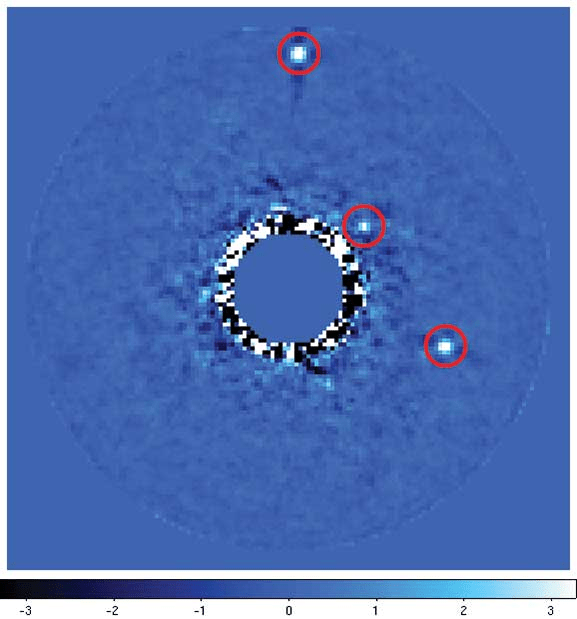
A plot of data from CHARIS shows planets located around a star in the planetary system HR8799. (Images courtesy of N. Jeremy Kasdin and the research team)
The story is here:
http://www.princeton.edu/main/news/archive/S47/82/89C62/?section=topstories
11/14/2016 – Ephemeris – Watch the setting of the super moon this morning
Ephemeris for Monday, November 14th. The Sun will rise at 7:39. It’ll be up for 9 hours and 36 minutes, setting at 5:15. The Moon, at full today, will set this morning at 7:23 and will rise again at 5:53 this evening.
During the 6 to 7 o’clock hour this morning the Moon will be officially the closest super moon, most likely of your lifetime unless your 68 or older. Super moon’s apparently only count when the Moon is closest to the Earth at full moon. The Moon passes perigee, its closest point to the Earth once a month, but not always at full moon. It happens that both October and December’s full moons are also super moons. Rising and setting moon’s work the same way, to make the Moon appear even larger than it is. This is an optical illusion, but go with it. The Moon will be slightly farther away when it rises this evening. Moon set will occur at 7:23 or thereabouts this morning while moon rise will be at 5:53 this evening, somewhat earlier east of Traverse City, later west. Get out early if it’s clear.
Times are for the Traverse City/Interlochen area of Michigan. They may be different for your location.
Addendum
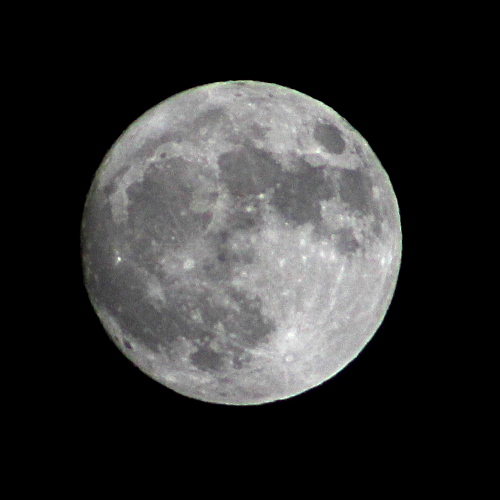
The nearly full super moon at 8 p..m. EST (1 hr UT) last night. The fact that the moon is not quite full is the dullness on the Moon’s left side and a hint of a crater shadow. The Moon will be as full as it gets at 8:52 a.m. EST (13:52 UT). Credit Bob Moler
For more facts on the super moon check out these links:
http://scienceblogs.com/startswithabang/2016/11/11/supermoon-fact-vs-fiction-synopsis/
11/11/2016 – Ephemeris – Two Taurid meteor showers active now
Ephemeris for Veteran’s Day, Friday, November 11th. The Sun will rise at 7:35. It’ll be up for 9 hours and 43 minutes, setting at 5:18. The Moon, 3 days before full, will set at 4:49 tomorrow morning.
We are situated between two supposed peaks of two meteor showers, the South Taurids and the Northern Taurids. Their radiant points are roughly north and south of the face of Taurus the bull, which looks like the letter V of stars lying on its side. Both meteoroid streams belong to Encke’s Comet, the comet with the shortest known period of 3.3 years. The far end of the streams end up near Jupiter’s orbit, which allow the giant planet to split and broaden the meteoroid streams. Another feature of these streams is that they seem to be made of small pebbles rather than grains. When these pebbles hit our atmosphere at 17 miles (28 km) per second they will appear very bright. Really bright meteors are called Fireballs.
Times are for the Traverse City/Interlochen area of Michigan. They may be different for your location.
Addendum
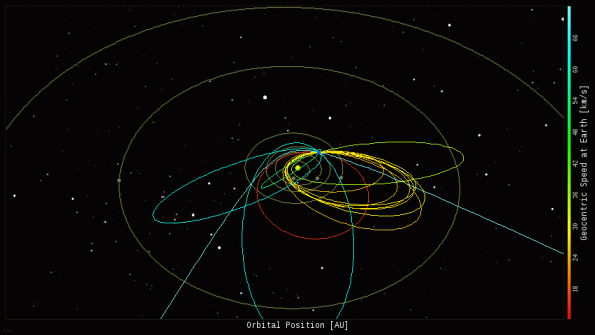
Fireball orbits traced back from November 9, 2016. The orbits marked in yellow sticking out o the right toward Jupiter’s orbit are the Taurids. Credit NASA All-sky Fireball Network via spaceweather.com.
NASA has three widely spaced sets of all-sky cameras which allow it to get 3-D views of fireballs entering the Earth’s atmosphere. which allow the measurement of velocity of the object and the determination of the meteoroid’s orbit before it hit Earth’s atmosphere. For more information go to: http://fireballs.ndc.nasa.gov/
11/10/16 – Ephemeris – Sunrise on Aristarchus
Ephemeris for Thursday, November 10th. The Sun will rise at 7:33. It’ll be up for 9 hours and 45 minutes, setting at 5:19. The Moon, 3 days past first quarter, will set at 3:35 tomorrow morning.
Tuesday I discussed the fact that the Moon appears to rock back and forth over the month due to it’s uneven motion around the Earth. Currently it’s still facing the direction of the Sun by nearly as far as it was on Tuesday, which is revealing a crater on the northeastern side of the Moon about a day earlier than average in the lunar monthly cycle. That crater is the brightest spot on the Moon, though it’s not that bright right now because that crater, called Aristarchus, is filled with shadow. That shadow will go away in a day or two. Aristarchus is visible in binoculars at the terminator, the advancing sunrise line on the Moon. Aristarchus is located on the flat lava plains that early telescopic astronomers thought were seas filled with water.
Times are for the Traverse City/Interlochen area of Michigan. They may be different for your location.
Addendum
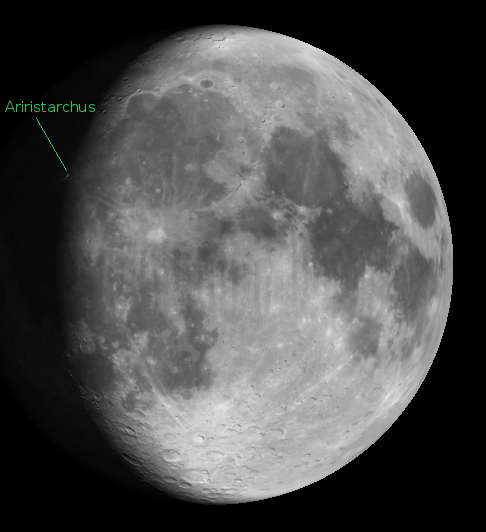
The moon with the Crater Aristarchus on the sunrise terminator at 9 p.m. November 10, 2016. Created using Virtual Moon Atlas.
11/09/2016 – Ephemeris – Your mid-week bright planet report
Ephemeris for Wednesday, November 9th. The Sun will rise at 7:32. It’ll be up for 9 hours and 48 minutes, setting at 5:20. The Moon, 2 days past first quarter, will set at 2:23 tomorrow morning.
Low in the east-southeast at 6 a.m. Jupiter can be glimpsed in the morning twilight. Jupiter will rise tomorrow at 4:25 a.m. We are approaching Jupiter, though it’s 5 times Earth’s distance from the Sun and will pass it April 7th. Venus, Saturn and Mars are in the evening sky. At 6 p.m. these planets will be seen in the southwest and low in the sky. Venus will be the brightest, Saturn might be picked out of the twilight to the right and a bit below Venus, and Mars will be higher to the left. Saturn will set first at 6:54, with Venus setting a half and hour later at 7:24. Mars will hang on a bit longer and will set at 10:07. Venus is almost at its farthest south in the sky, and will be slowly heading northward for the rest of it’s evening appearance.
Times are for the Traverse City/Interlochen area of Michigan. They may be different for your location.
Addendum
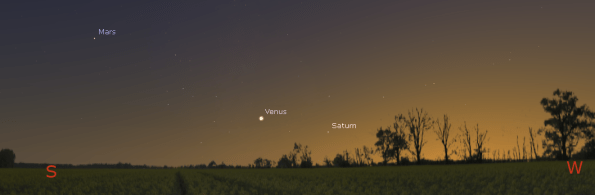
The evening planets in twilight in the southwestern sky at 6 p.m. November 9, 2016. Created using Stellarium.
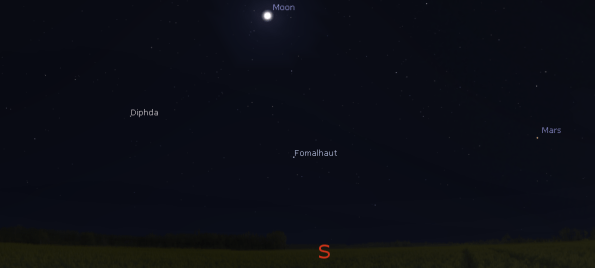
Looking south at Mars, two bright stars, and the Moon at 8 p.m. November 9, 2016. Created using Stellarium.
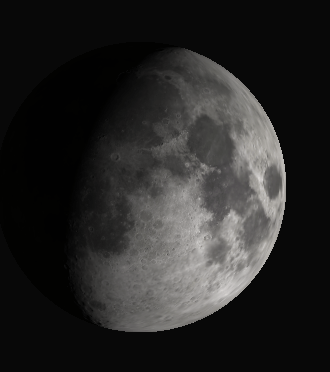
The Moon as it might be seen in binoculars at 8 p.m. November 9, 2016. Created using Stellarium.
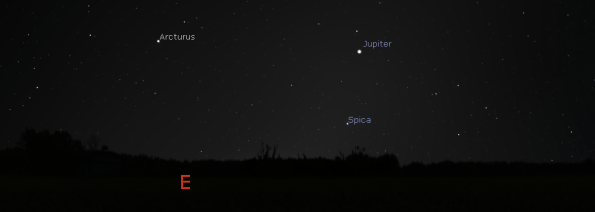
Jupiter in the morning sky at 6:30 a.m. November 10, 2016. Created using Stellarium.
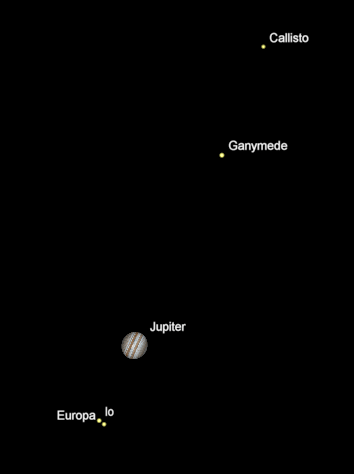
Jupiter and its Galilean moons, as they might be seen in a telescope at 6 a.m. November 11, 2016. Created using Cartes du Ciel (Sky Charts). Note the image is not inverted.
Planets and Moon at sunset and sunrise of a single night starting with sunset on the right on November 9, 2016. The night ends on the left with sunrise on November 10. If you are using Firefox right-click on the image and select View Image to enlarge the image. That goes for all the large images. Created using my LookingUp program.
11/08/2016 – Ephemeris – As the Moon wobbles
Ephemeris for Election Day, Tuesday, November 8th. The Sun will rise at 7:31. It’ll be up for 9 hours and 50 minutes, setting at 5:21. The Moon, 1 day past first quarter, will set at 1:14 tomorrow morning.
Tonight’s Moon bears close examination. The Moon has an elliptical orbit of the Earth, so its motion around the Earth moves fastest when nearer and slower when farther from the Earth. The Moon’s rotational speed, however is constant, Because of this the Moon appears to wobble back and forth. It also nods a bit. The effect is called libration. As of yesterday the Moon was rotated its greatest to the right for the month. It’s a small amount, only 8 degrees. On the 18th only 10 days from now the moon will nod 8 degrees to the left. A good way to tell the state of this libration for the waxing Moon is to check the position of the small gray sea near the right edge of the Moon, the Sea of Crises. Now it’s right at the edge of the Moon.
Times are for the Traverse City/Interlochen area of Michigan. They may be different for your location.
Addendum
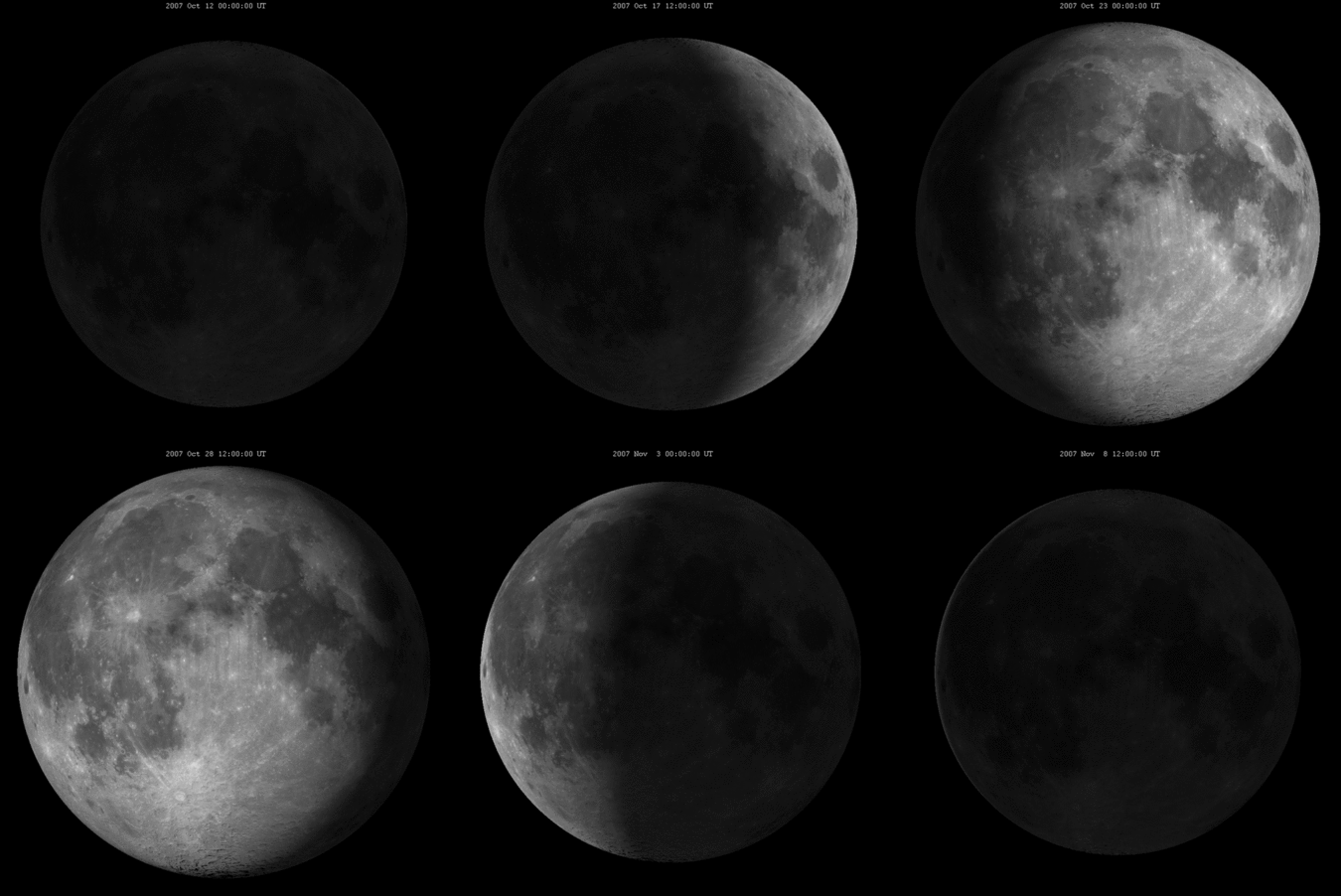
Simulation of the Moon’s phase and libration for October 2007 by Tomruen. Image is in the Public Domain. Downloaded from the Wikipedia entry for the Moon.
You can run a continuous simulation like this using the free program Virtual Moon Atlas.
11/07/2016 – Ephemeris – Standard time returns for a few months
Ephemeris for Monday, November 7th. The Sun will rise at 7:29. It’ll be up for 9 hours and 53 minutes, setting at 5:22. The Moon, at first quarter today, will set at 12:09 tomorrow morning.
In these programs I usually talk about the evening sky. Now with the Sun rising later the morning sky is also accessible. Of course I have to mention it a day after sunrise was jerked back an hour by falling back to standard time, However sunrise will advance back to near what it was last week by Christmas time. The sky we’re seeing in the morning now is what we would see in the evening in late March or early April. In the morning we seen nearly in the opposite direction as in the evening, which is why we would see the stars as the will look nearly six months from now, as we orbit the Sun. In the morning, as we orbit the Sun we are looking to where we’re going on this nearly circular race track. We see Jupiter move away from the Sun as we start to overtake it. So in the evening sky we’re looking to where we’ve been, seeing Saturn falling behind, and Venus slowly overtaking us from the rear.
Times are for the Traverse City/Interlochen area of Michigan. They may be different for your location.
Addendum
Check out my November 1st post for the morning star chart.
Also check out my Ephemeris Calendar for how the time change affects the rising and setting events of the Sun and Moon.
Ephemeris Extra – Autumn telescopic wonders
This is an updated article I wrote from the October 1998 issue of the Grand Traverse Astronomical Society’ newsletter the Stellar Sentinel
18 years ago Judy, my late wife, and I bought a telescope from Enerdyne. Officially it was Judy’s telescope and is a Celestron 11 inch (280 mm) Star Hopper Dobsonian. After over 20 years of relying on the telescopes at the Lanphier and Rogers observatories, we felt the need again for a personal backyard telescope again. This was also brought home by the appearance of the comets Hyakutake and Hale-Bopp in the 1996 and 1997.
Though large in diameter, the telescope has a focal length of 49.5 inches (1260 mm), much closer to the telescopes I’ve made and used in the past, and a third to a half the diameter of the C14s at the observatories above. So the scope gives bright low power views of galaxies and nebulae. The diameter allows the resolution of some globular clusters. I was also quite pleasantly surprised at the scope’s ability to see detail on Jupiter and Saturn. Jupiter’s Great Red (currently a pale pink) Spot and on Saturn: a cloud band, ring shadows and Cassini’s Division.
Soon after obtaining the telescope I surveyed the dim wonders of the autumn sky beyond the solar system. Here are the results:
Galaxies
- M31, M32 and M110 Better known as the Great Andromeda Galaxy and its companion galaxies, the view is made to order for the smaller telescope. M31’s glowing nucleus spans the eyepiece field. The galaxy is larger than out own and lies at a distance 2.5 million light years. The brightness falls off sharply along the north side of it’s elliptical minor axis. The nearly spherical M32 is seen nearby, while the faint elliptical galaxy M110 is barely visible on the other side of M31. I used to know M110 only as NGC205. It was added to Messier’s list in 1967, 11 years after I first observed the galaxy.
A note about The M designations. They are from a catalog started by French comet hunter Charles Messier (1730-1817) who made a list of fuzzy objects in the sky that could be confused as being comets because they didn’t move against the stars. He officially discovered or co-discovered a dozen comets. As can be seen by the inclusion Of M110, it has been extended by other astronomers. - M33 The Triangulum galaxy is seen nearby off the point Triangulum is about as close as M31, but smaller than M31 with a small nucleus and large faint disk. It has a very low surface brightness and requires a dark sky.
- M74 Is located in Pisces near Aries. It is a face-on galaxy like M33 but a lot smaller and fainter. I saw no central condensation.
- M77 is a different story, a galaxy with a bright nucleus. M77 is located is Cetus located just below the head of the monster or tail of the whale, however you see him.
Globular star clusters
- M15 is a globular cluster found by extending the nose of Pegasus. The 11 inch telescope could resolve the cluster’s outer stars. It was a smaller, dimmer version of M13, the grand globular in Hercules.
- M2 is a more distant globular located due south of M15 and at an equal declination as (α)Alpha Aquarii or Sadal Melik. It earns its inclusion as Messier’s object number 2, for it looks for all the world like a tailless comet. On a second look at it the 11 inch could resolve a few stars.
- M30 seems the same size as M2 and located farther south just right of the star (ζ)Zeta Capricorni. However the 11 inch can resolve a handful of its brighter stars.
As we move outward from the galactic center in Sagittarius the globular clusters thin out dramatically. The next Messier globular is located in Lepus the hare below Orion a winter constellation.
Open or galactic clusters
- M34 is a large but sparse open or galactic star cluster located just west of the star Algol in Perseus.
- M103 is a faint triangular-shaped cluster located just east of the star (δ)Delta Casseopeiae. The triangular arrangement of its stars reminds me of a smaller version of the Beehive Cluster (M44) in Cancer.
- M52 is a faint but populous cluster located between Cassiopeia and Cepheus.
- The Double Cluster is a great view in a low power eyepiece. The two clusters do not have Messier designations. But they do have NGC numbers: 869 and 884. NGC is the “New General Catalog” and is not so new. It’s over 100 years old.
- M45 or the Pleiades is best seen in a pair of binoculars. Also known as the Seven Sisters, the Pleiades is close as star clusters go at 400 light years.
- Melotte 25 or Collinder 50: The Hyades, the face of Taurus the Bull, is the closest star cluster of all at about 153 light years. Sparse and big, it is almost too large to view in a pair of binoculars. The Hyades is the key to finding distances to the ends of the universe. It is close enough to get good parallax data for triangulation. Its many stars of known brightness and distance can be matched to other star clusters beyond the reach of the parallax method to ascertain their distances.
M76 is the only planetary nebula in our group. Called the Little Dumbbell Nebula or the Barbell Nebula, it has a shape of one of those Milk Bone dog biscuits.
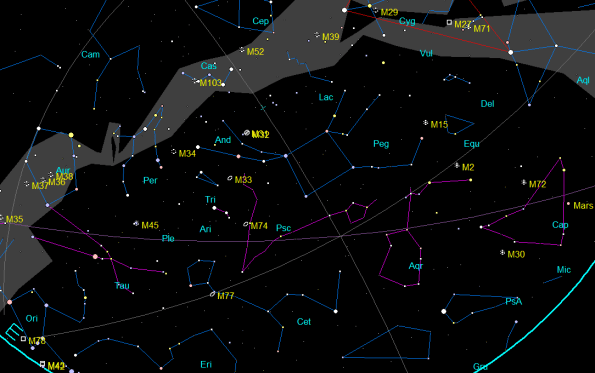
A star chart covering the autumn constellations and the objects described in this article. In Andromeda (And) the overprinted captions are for M31 and M32. The Double Cluster is not shown, not being a Messier object. It’s approximately half way between the northernmost star of Perseus (Per) and M103 in Cassiopeia (Cas). The article doesn’t cover the Messier objects M35, 26, 37 ,38, 42/3 and 78. Which I may do for winter. The star chart was created using the author’s program LookingUp.
11/03/2016 – Ephemeris – Capricornus, a very strange goat
Ephemeris for Thursday, November 3rd. The Sun will rise at 8:24. It’ll be up for 10 hours and 3 minutes, setting at 6:28. The Moon, half way from new to first quarter, will set at 9:25 this evening.
The planet Mars is just to the right of the stars of Capricornus, one of the constellations of the zodiac. Astronomers and others who draw the constellations by drawing lines between stars like a dot to dot puzzle have a hard time getting a sea-goat emerge from its stars. The sea-goat has the front part of a goat and the back half like a fishes tail. Kind of like a mergoat, instead of a mermaid. To me, the constellation looks like a large sagging triangle, just above-left of Mars right now. It will take Mars only to mid December to cross Capricornus to enter Aquarius, just east of it. A couple of thousand years ago Capricornus was the location of the winter solstice point in the sky, for which the Tropic of Capricorn was named. That point is now on the Ophiuchus-Sagittarius border.
Times are for the Traverse City/Interlochen area of Michigan. They may be different for your location.
Addendum
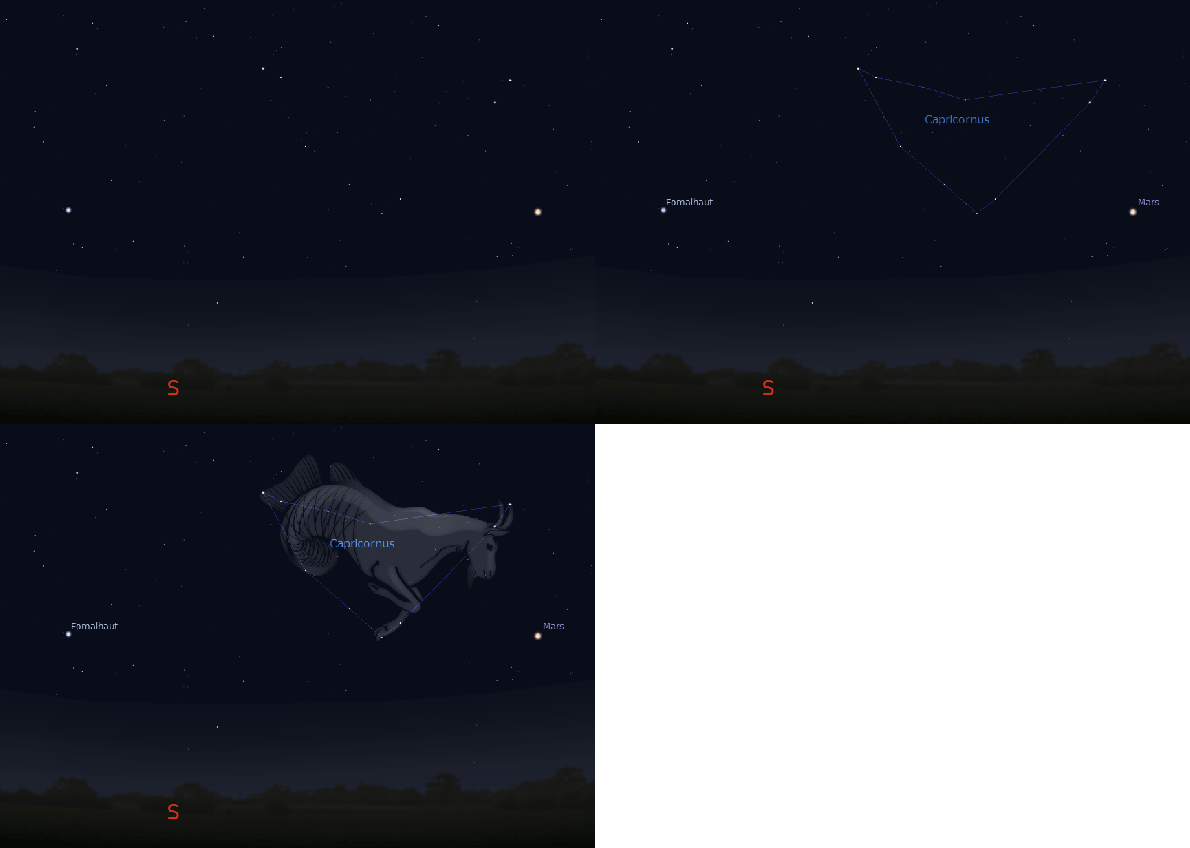
Animated GIF of Capricornus in the sky. Time 9 p.m. November 3, 2016. Created using Stellarium ans GIMP.
 Bob Moler's Ephemeris Blog