Archive
01/17/2017 – Ephemeris – Denial is not a river in the sky
Ephemeris for Tuesday, January 17th. The Sun will rise at 8:14. It’ll be up for 9 hours and 16 minutes, setting at 5:31. The Moon, 2 days before last quarter, will rise at 11:32 this evening.
One of the more obscure constellations around is Eridanus, which depicts a river. At 9 p.m. the river starts near the lower right corner of Orion, near the bright star Rigel and flows to the right then zigzags down to the left, then down to the right near the southern horizon, then it heads south below the horizon. One has to travel to the far south to see the southern terminus of the river, the bright star Achernar. Writers over the ages have seen here the Nile and the world circling river Ocean of the flat Earth days. Achernar was recently discovered to be the flattest star known, due to its rapid spin. The dimensions of Achernar have been determined to be twice as wide across its equator than from pole to pole. It’s 139 light years away.
Times are for the Traverse City/Interlochen area of Michigan. They may be different for your location.
Addendum
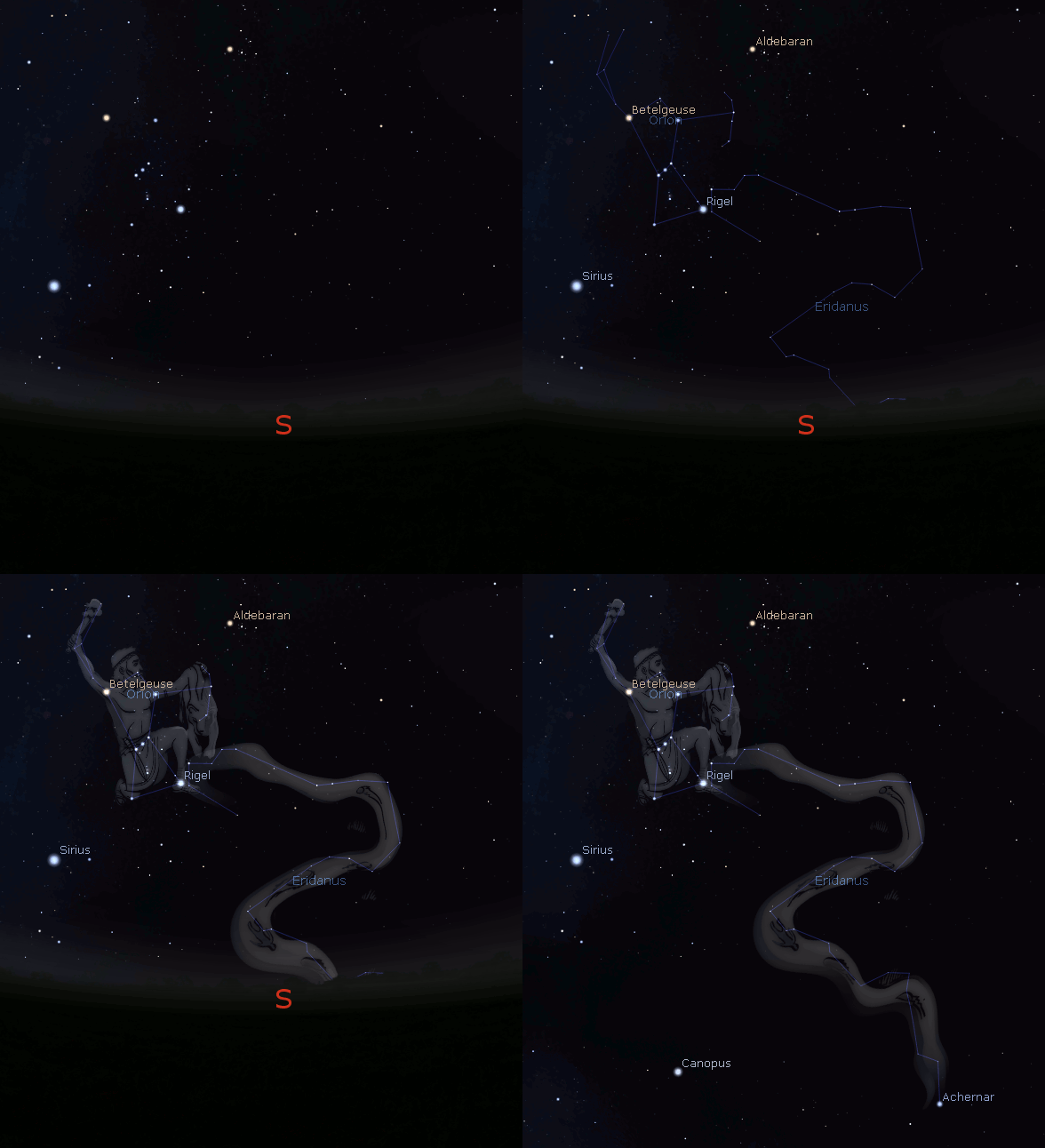
An animation of the constellation Eridanus which is a river that flows from Rigel in Orion to the star Achernar below our southern horizon at latitude 45 degrees north. Create using Stellarium and GIMP.
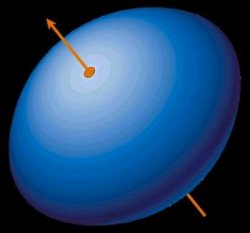
A model of Achernar by the European Southern Observatory (ESO).
01/16/2017 – Ephemeris – The bright cloud in Orion, the Great Orion Nebula
Ephemeris for Martin Luther King Day, Monday, January 16th. The Sun will rise at 8:15. It’ll be up for 9 hours and 14 minutes, setting at 5:30. The Moon, 3 days before last quarter, will rise at 10:30 this evening.
The constellation Orion the hunter, which is in the south-southeast at 9 p.m., is the brightest of constellations with 2 first magnitude stars and 5 second magnitude stars in its torso. Orion’s most famous feature is the Great Orion Nebula which lies in and around the stars of his sword. It is bright, and lies about 1,344 light years away. By the way, the word nebula is Latin and means cloud or haze. The plural of nebula is nebulae. It can be seen with binoculars as a haze around what to the naked eye looks like the center of the three stars of Orion’s sword. It is the lit end of a large dark cloud where stars are being formed. It is illuminated by a clutch of four young stars in a tiny group called the Trapezium.
Times are for the Traverse City/Interlochen area of Michigan. They may be different for your location.
Addendum
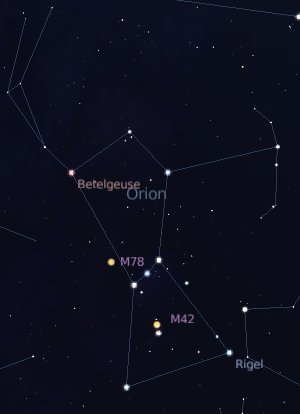
Orion with two nebulae. The Great Orion Nebula is M42. M78 is another small nebula. Created using Stellarium.
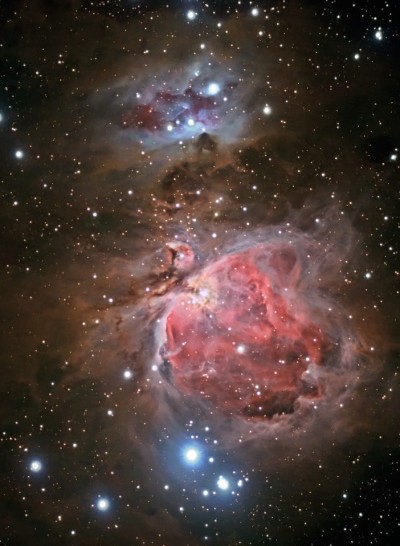
The Great Orion Nebula (M42) long exposure photograph by Scott Anttila. Includes all the sword stars.
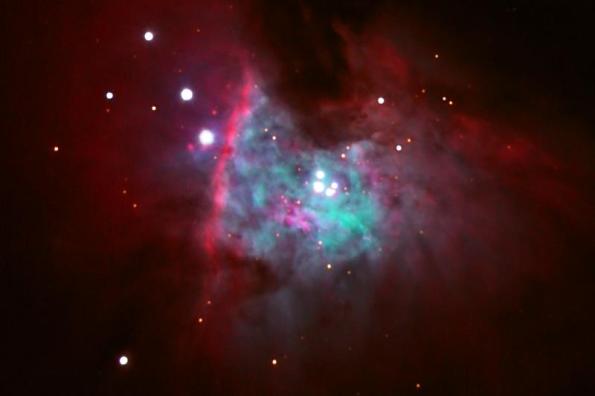
Inner part of the Great Orion Nebula with the four stars of the Trapezium. Image by Scott Anttila.
01/13/2017 – Ephemeris – Perhaps we’ll see a nova in 5 years, 2022
Jan 13. This is Bob Moler with Ephemeris for Friday, January 13th. The Sun will rise at 8:16. It’ll be up for 9 hours and 9 minutes, setting at 5:26. The Moon, 1 day past full, will rise at 7:12 this evening.
Professor Larry Molnar from Calvin College in my home town of Grand Rapids and his students discovered that a star, [KIC 9832227,] that was monitored by the Kepler exoplanet finding satellite in the northern constellation of Cygnus the Swan may explode in about 5 years. The star is actually two so close that they share their outer atmospheres, someone described it as two peanuts in one shell. The two orbit each other in 11 hours now, and the period is shortening at an accelerated rate as the two approach each other. Astronomers think that it will repeat the fate of a star that exploded in 2008 in the constellation of Scorpius. Such explosions, when seen are called Novae. A Nova like this could make the star briefly 10,000 times brighter than it originally was. [Current magnitude is 12, which is visible in moderate sized (6″ or 150 mm) diameter telescopes. 10,000 times brighter equals a 10 magnitude bump, which would make the star 2nd magnitude. Magnitudes are like golf scores the lower the magnitude the brighter the object. Blame Hipparchus.]
Times are for the Traverse City/Interlochen area of Michigan. They may be different for your location.
Note: The text in brackets omitted in the broadcast.
Addendum
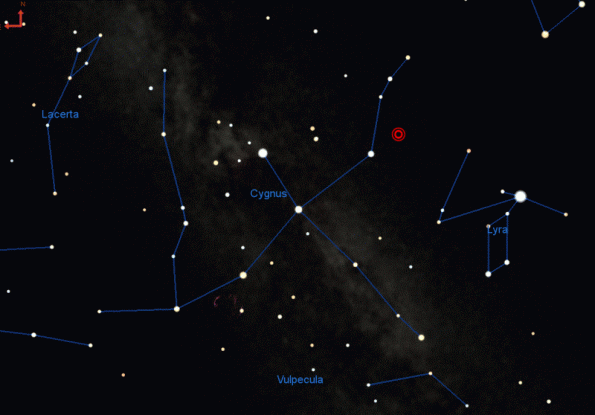
Finder Chart for KIC 9832227. It’s in the red bulls eye. Credit: Calvin College.
The position of KIC 9832227 is circumpolar or nearly so for northern Michigan. So it’s up all or most of the 24 hour day, so no matter the time of year this baby blows, we should be able to see it.
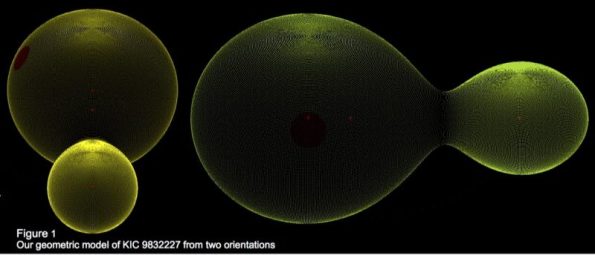
Two computer generated views of KIC 9832227. The large star is about twice the Sun’s diameter, while the smaller star is a bit less than the Sun’s size. Credit: Calvin College.
For more information click here: https://calvin.edu/news/archive/astronomy-prof-student-predict-explosion-that-will-change-the-night-sky.
01/12/17 – Ephemeris – Venus is at greatest eastern elongation today
Ephemeris for Thursday, January 12th. The Sun will rise at 8:17. It’ll be up for 9 hours and 7 minutes, setting at 5:25. The Moon, at full today, will rise at 6:04 this evening.
Today, around 8 a.m. the planet Venus will reach its greatest eastern elongation from the Sun. What that means in simple terms is that Venus will appear as far east of the Sun that it can get. The angle between it and the Sun will be 47.1 degrees. Venus, like Mercury orbits the Sun inside the Earth’s orbit, so is always seen close to the Sun. In telescopes Venus will look like a tiny half illuminated orb, like a first quarter Moon. That’s for the same reason. The Sun is illuminating half of the side we can see. Venus is moving directly toward us now, at a distance of 63 million miles (102 million km). As Venus approaches us, it will grow in size in telescopes, becoming larger in appearance than Jupiter the largest planet. It will leave the evening sky, passing between the Earth and the Sun, only 26 million miles away on March 25th.
Times are for the Traverse City/Interlochen area of Michigan. They may be different for your location.
Addendum
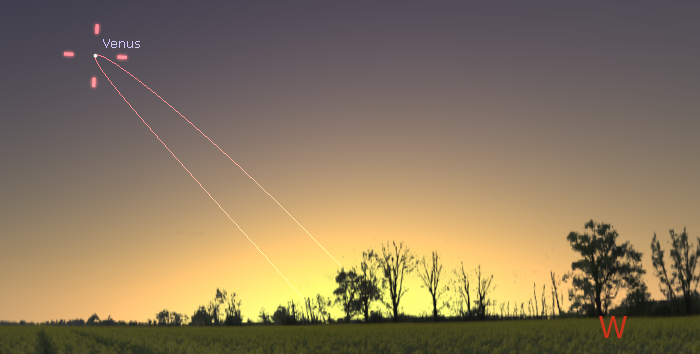
Venus at 5:30 p.m. January 12, 2017 also displaying its orbit. Created using Stellarium.
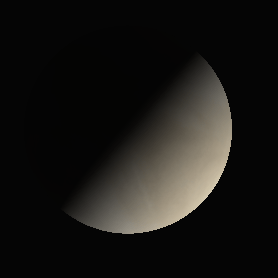
Venus in a telescope showing it half illuminated at greatest eastern elongation. Created using Stellarium.
There’s an odd phase effect called the “Venus Dichotomy” where at the instant of greatest elongation that Venus’ phase is not exactly half illuminated. Half phase may differ by several hours. The actual time of greatest eastern elongation according to NASA’s SKYCAL Calendar at https://eclipse.gsfc.nasa.gov/SKYCAL/SKYCAL.html is January 12 at 7:59 a.m. EST or 12:59 UT.
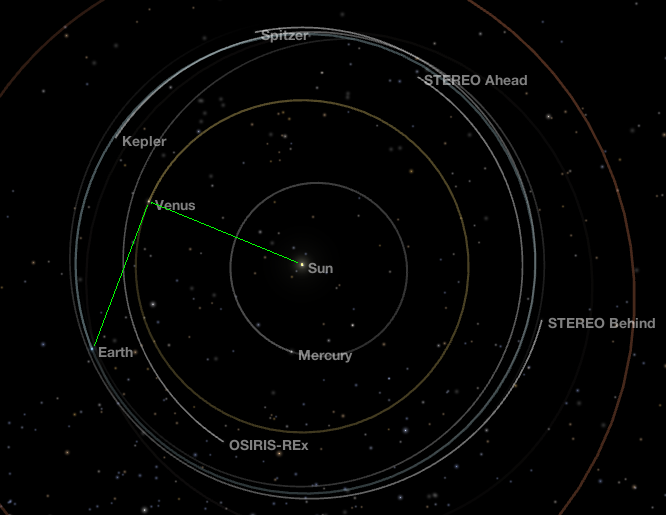
Inner solar system showing the relationship of Venus and the Earth. At greatest elongation The angle between Venus-Sun line and Venus-Earth line is 90 degrees. which is why Venus shows as half illuminated. Created using the application NASA’s Eyes.
Note that the chart above also shows NASA’s inner solar system missions. To download the app, created by the Jet Propulsion Laboratory (JPL), go to https://eyes.nasa.gov/. Use it to follow the progress of NASA solar system missions.
01/11/2017 – Ephemeris – Three bright planets in the morning, two in the evening
Ephemeris for Wednesday, January 11th. The Sun will rise at 8:17. It’ll be up for 9 hours and 6 minutes, setting at 5:23. The Moon, 1 day before full, will set at 8:06 tomorrow morning.
Let’s check out the bright planets for this week. Saturn can be glimpsed now in the morning, rising at 6:13 in the east-southeast. Mercury is following Saturn and very hard to spot, rising at 6:40 this morning. Jupiter can be glimpsed even as the sky brightens at 7 a.m. this morning when it’s in the south above the star Spica in Virgo. Jupiter will rise tomorrow at 1:05 a.m. Venus and Mars are in the evening sky. At 6:30 p.m. these planets will be seen in the southwestern sky. Venus is unmistakable as the brilliant evening star, Mars will be above and left of it and much dimmer and will set at 10:13.. Venus itself will set at 9:28 p.m. Venus is slowly heading northward for the rest of it’s evening appearance, and is moving higher in the sky, and will reach its greatest eastern elongation or separation from the Sun tomorrow.
Times are for the Traverse City/Interlochen area of Michigan. They may be different for your location.
Addendum
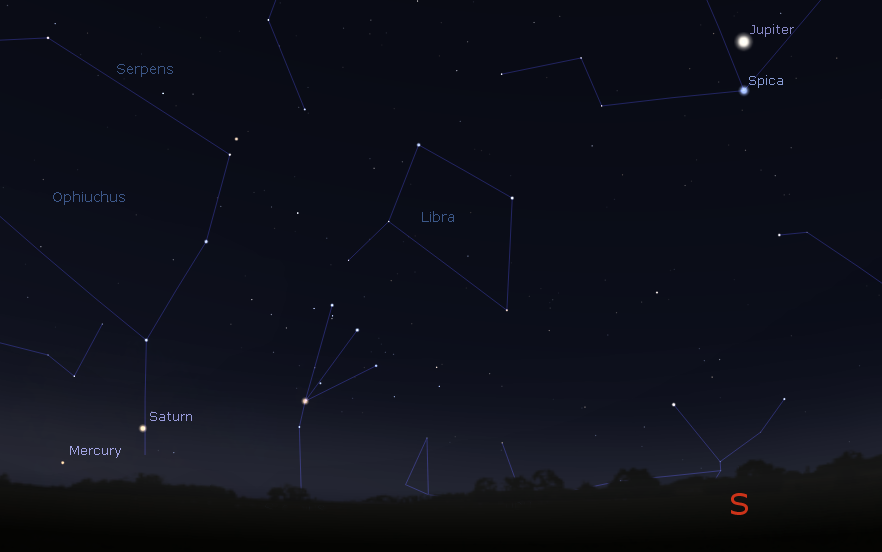
Jupiter in the south above the star Spica with Saturn and Mercury peeking over the horizon in the southeast at 7 a.m. this morning, January 11, 2017. Created using Stellarium.
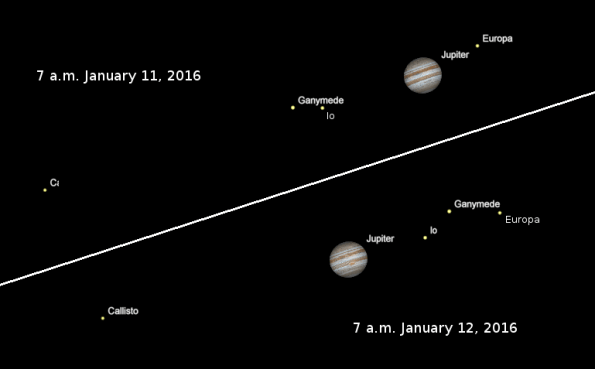
Jupiter and its moons this morning and tomorrow morning, Created using Stellarium.
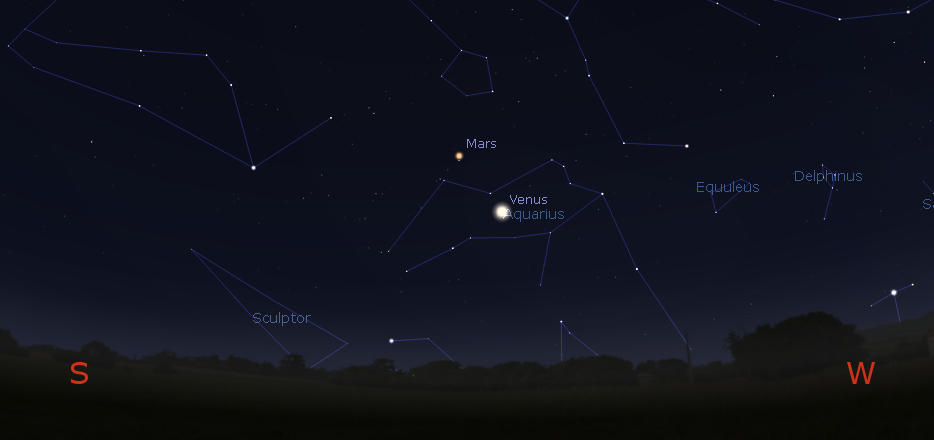
Venus, and Mars in the evening twilight of about an hour and three-quarters after sunset. 7 p.m. January 11, 2017. The Moon is out of the frame in the east. Created using Stellarium.
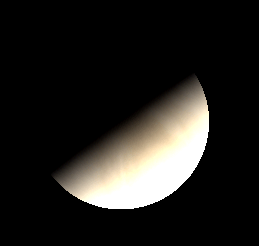
Venus in a telescope a few hours before its greatest apparent separation from the Sun. Tonight at 7 p.m. January 11, 2017. Created using Stellarium.
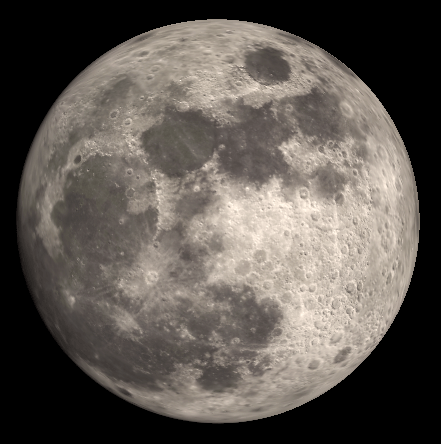
The Moon as it might be seen tonight, January 11, 2017. Created using Stellarium.
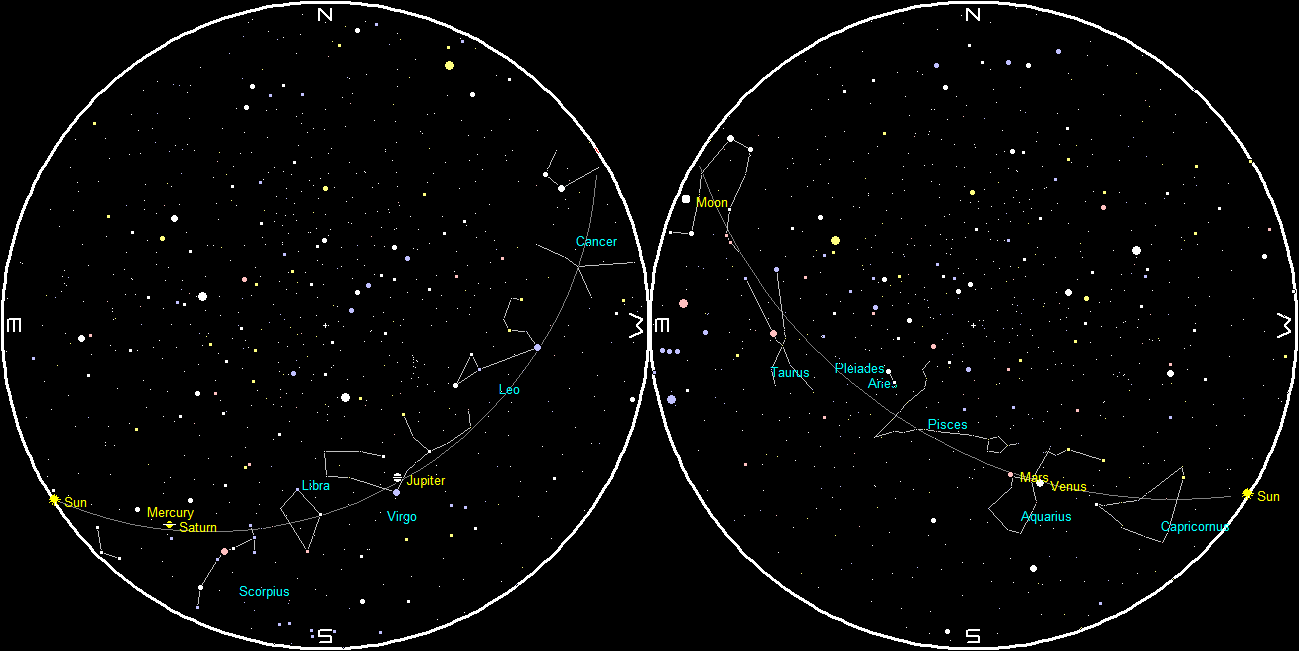
Planets and Moon at sunset and sunrise of a single night starting with sunset on the right on January 11, 2017. The night ends on the left with sunrise on January 12. Click on image to enlarge. Created using my LookingUp program.
01/10/2017 – Ephemeris – Rigel, the blue super-giant in Orion
Ephemeris for Tuesday, January 10th. The Sun will rise at 8:17. It’ll be up for 9 hours and 4 minutes, setting at 5:22. The Moon, 2 days before full, will set at 7:10 tomorrow morning.
Yesterday I talked about the star Betelgeuse the bright red star in the top left of Orion’s upright rectangle. Orion is seen in the southeast at 9 in the evening. The blue-white star in Orion’s opposite corner is usually brighter. It is Rigel whose longer Arabic name of which Rigel is the first part means Left Leg of the Giant. Rigel is a giant itself, actually a super giant star, which is more a measure of its mass than its size, that of 23 solar masses. Its surface temperature is twice as hot as the Sun. It is 120 thousand times as bright as the sun and 79 times its diameter. Its distance is around 860 light years. Those with telescopes might be able to spot a close companion star to Rigel, just at the edge of the bright arc light image of Rigel itself.
Times are for the Traverse City/Interlochen area of Michigan. They may be different for your location.
Addendum
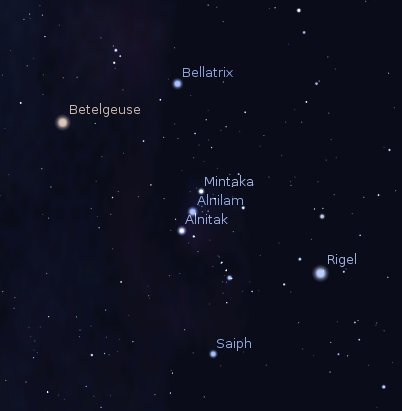
The named stars of Orion. Created using Stellarium.
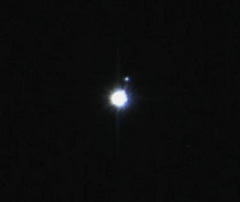
Rigel with its companion star as photographed through a telescope. No attribution. The source website no longer exists.
01/09/2017 – Ephemeris – Betelgeuse the bright red star in Orion
Ephemeris for Monday, January 9th. The Sun will rise at 8:18. It’ll be up for 9 hours and 3 minutes, setting at 5:21. The Moon, 3 days before full, will set at 6:06 tomorrow morning.
The bright red star in constellation Orion’s shoulder is Betelgeuse, 643 light years away give or take 146 light years. Betelgeuse is a shortened form of an Arabic phrase that means “Armpit of the central one”. Orion is seen in the south in the evening. Even at its great distance it’s the star whose surface is easiest seen, after the sun of course. That’s because it’s so big. Possibly larger around than the orbit of Jupiter, though that’s hard to determine. Recent telescopic observations of Betelgeuse have shown shells of gas surrounding the star. A star like Betelgeuse is so bloated that it can be described as a red-hot vacuum, thus its edge or limb is much darker than its center. The sun has limb darkening too, but it is much less noticeable.
Times are for the Traverse City/Interlochen area of Michigan. They may be different for your location.
Addendum
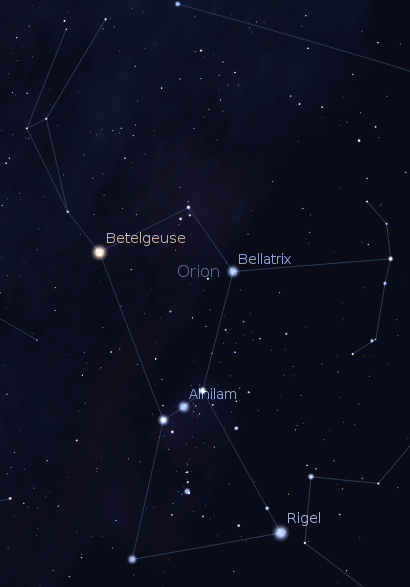
Orion upright and due south. Created using Stellarium.
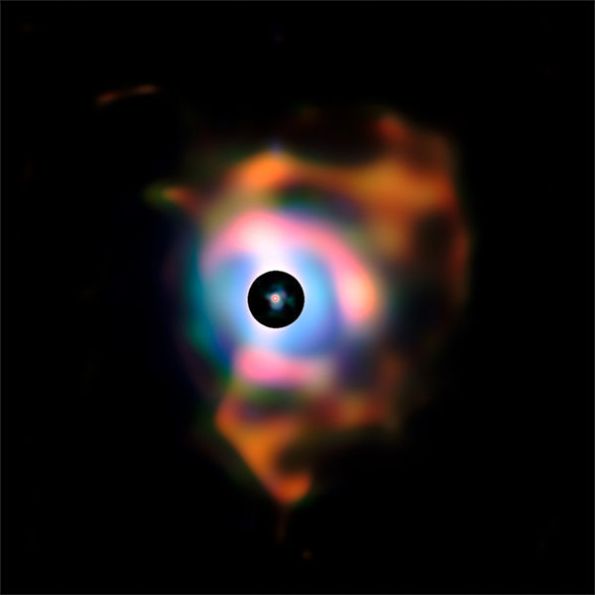
Betelgeuse and its nebula. From European Southern Observatory’s Very Large Telescope.
Betelgeuse is a single star like the Sun there is evidence that Betelgeuse may have eaten its companion star 100,000 years ago, yum! http://phys.org/news/2016-12-famous-red-star-betelgeuse-faster.html
01/06/2017 – Ephemeris – Telescope Clinic tonight at the NMC Observatory
Ephemeris for Friday, January 6th. The Sun will rise at 8:19. It’ll be up for 8 hours and 59 minutes, setting at 5:18. The Moon, 1 day past first quarter, will set at 2:34 tomorrow morning.
If you’ve received a telescope for Christmas and are having trouble setting it up, or have an unused one in a closet, basement or attic, bring them to Northwestern Michigan College’s Rogers Observatory tonight at 8 p.m. The Grand Traverse Astronomical Society will be holding their annual telescope clinic to help you understand and use your telescope. The clinic will extend through the period that will be set aside for a star party if it’s clear, to test the telescopes and show the owners how to use them. Like anything telescopes take some time to learn how to use them and find celestial objects. It took me 15 minutes to find Saturn with a telescope the first time I tried, and I knew where it was in the sky. The observatory is south of Traverse City on Birmley Road.
Times are for the Traverse City/Interlochen area of Michigan. They may be different for your location.
In Memorium
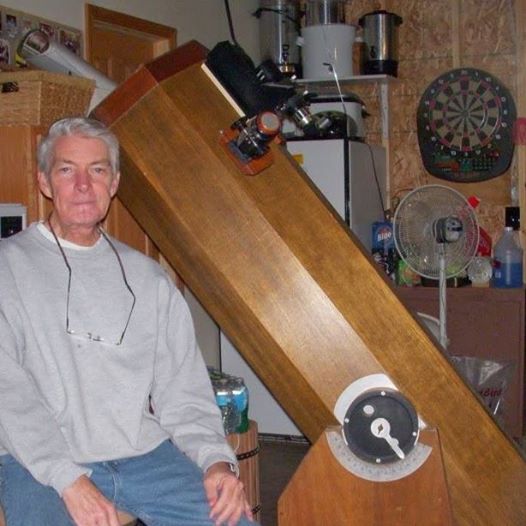
Emmett Holmes passed away last night (January 5th, 2017) after a long ordeal in attempting to have stem cells from his sister infused into his blood to rebuild his bone marrow. We at the Grand Traverse Astronomical Society knew him for a few short years, but in the time we benefited greatly from his expertise with telescopes and, helping out with star parties.. In the picture is his 13″ telescope with its distinctive tube that he built. Just recently he was elected to the Board of Directors of the Society.
We at the GTAS express our condolences to his wife Karen and the rest of his family. Emmett, rest in peace.
01/05/2017 – Ephemeris – About Ephemeris rise and set times, an annual confession
Thursday, January 5th. The Sun will rise at 8:19. It’ll be up for 8 hours and 58 minutes, setting at 5:17. The Moon, at first quarter today, will set at 1:23 tomorrow morning.
Lets talk about the Ephemeris program itself. The format has changed little in the 41 ½ years it’s been on the air. The problem with talking about rising and setting phenomenon is that back when I started IPR has only one transmitter and that was next to the studio Now it has transmitters covering just about all of the northwestern part of the Lower Peninsula of Michigan. So your rise and set time can be quite different. On my Ephemeris website I have the times listed for the year for several locations in the IPR listening area under calendars. On any search engine search for Bob Moler Ephemeris. The Ephemeris Blog ( you’re already here) contains transcripts of the programs with illustrations and more in depth explanations.
Times are for the Traverse City/Interlochen area of Michigan. They may be different for your location.
Addendum
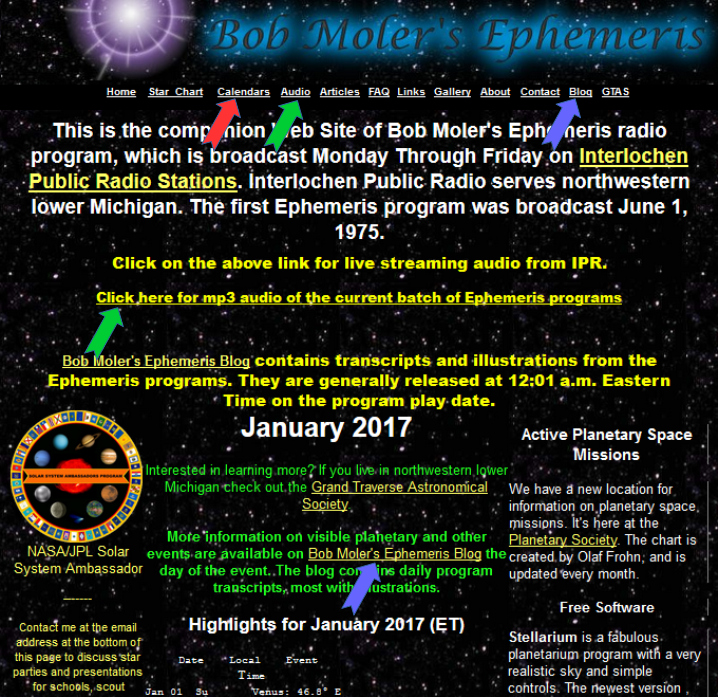
Bob Moler’s Ephemeris main web page. http://ephemeris.bjmoler.org.
The red arrow points to the calendars for some locations, The green arrows point to program mp3s for the current week. The blue arrows point to links to this blog.
Calendars currently available:
Cadillac
Interlochen/Traverse City (Source for the times on the Ephemeris program)
Ludington
Mackinaw City
Petoskey
Eagle Harbor – Keweenaw Peninsula
Houghton Lake
Earth’s Equator at the Prime Meridian (Just for fun. See how the daylight hours stay pretty much at 12 hours)
01/04/17 – Ephemeris – Saturn is poking its head up into the morning twilight
Ephemeris for Wednesday, January 4th. The Sun will rise at 8:19. It’ll be up for 8 hours and 56 minutes, setting at 5:16. The Moon, 1 day before first quarter, will set at 12:14 tomorrow morning.
Let’s take our first look at the bright planets for 2017. Saturn can be glimpsed now in the morning, rising at 6:40 in the east-southeast. Jupiter can be glimpsed even as the sky brightens. It’s in the south at 7 a.m.. Jupiter will rise tomorrow at 1:29 a.m. Venus and Mars are in the evening sky. At 6:30 p.m. these planets will be seen in the southwestern sky. Venus is unmistakable as the brilliant evening star, Mars will be above and left of it and much dimmer and will set at 10:13.. Venus will set at 9:15 p.m. Venus is slowly heading northward for the rest of it’s evening appearance, and is moving higher in the sky, and is only 8 days from reaching it’s greatest eastern elongation or separation from the Sun.
Times are for the Traverse City/Interlochen area of Michigan. They may be different for your location.
Addendum
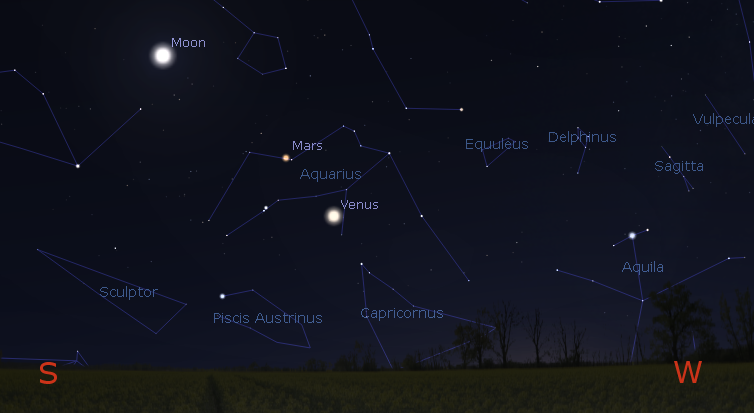
Venus, Mars and the Moon in the evening twilight of about an hour and three-quarters after sunset. 7 p.m. January 4, 2017. Created using Stellarium.
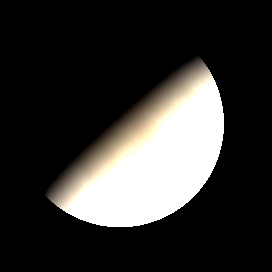
Venus in a telescope at near half phase as it approaches its greatest apparent separation from the Sun, tonight January 4, 2017. Created using Stellarium.
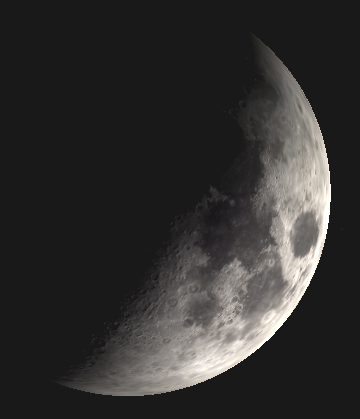
The Moon as it might be seen tonight through binoculars, January 4, 2017. Created using Stellarium.
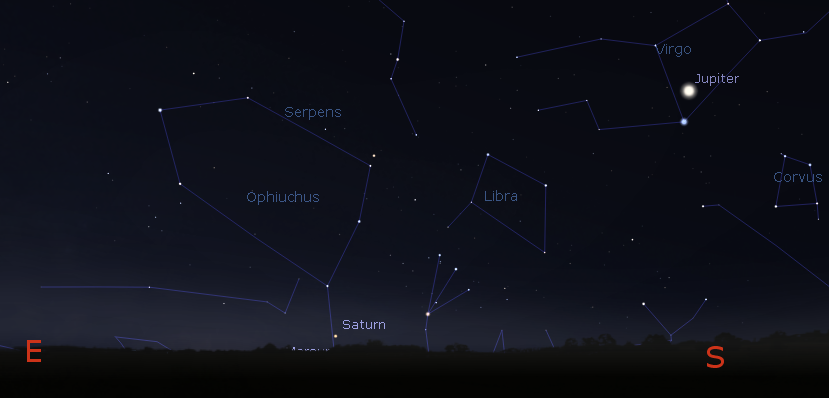
Jupiter in the south with Saturn peeking over the horizon in the southeast at 7 a.m. this morning, January 4, 2017. Created using Stellarium.
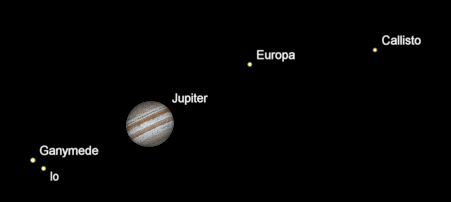
Jupiter and its moons this morning, January 4, 2017. Created using Stellarium.
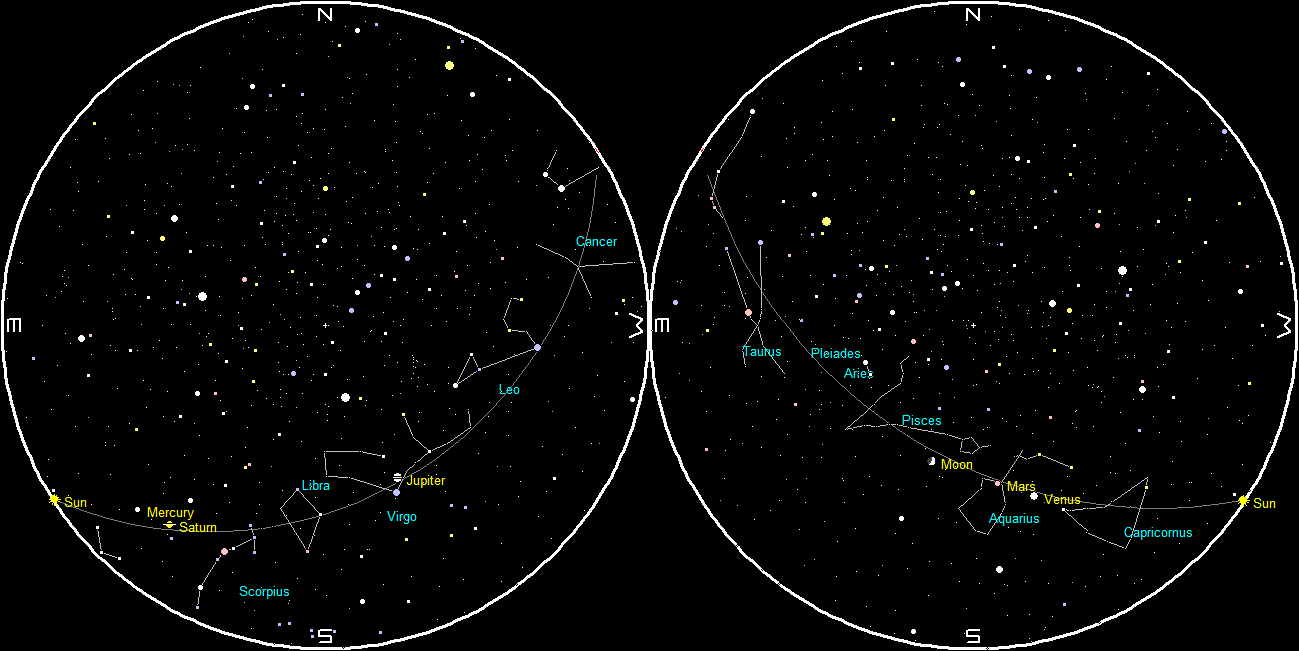
Planets and Moon at sunset and sunrise of a single night starting with sunset on the right on January 4, 2017. The night ends on the left with sunrise on January 5. Click on image to enlarge. Created using my LookingUp program.
 Bob Moler's Ephemeris Blog