Archive
02/28/2017 – Ephemeris – Previewing the skies of March 2017
Ephemeris for Fat Tuesday, February 28th. The Sun will rise at 7:21. It’ll be up for 11 hours and 8 minutes, setting at 6:29. The Moon, 2 days past new, will set at 9:03 this evening.
Let’s preview the month of March which begins tomorrow. In March the increase in daylight hours is at its greatest, with Spring 3 weeks away. Daylight hours will increase from 11 hours and 11 minutes tomorrow to 12 hours and 44 minutes on the 31st. Along with that the altitude of the sun at local noon will increase from 38 degrees today to 49 ½ degrees at month’s end. The big astronomical event of this month will be a near grazing occultation of the bright star Aldebaran by the Moon. Aldebaran is the bright star in the face of Taurus the bull. This will occur just after 11 p.m. Saturday night the 4th. The southern half of the IPR listening area will be able to see it. See bobmoler.wordpress.com for more information.
Times are for the Traverse City/Interlochen area of Michigan. They may be different for your location.
Addenda
March Star Charts
Evening
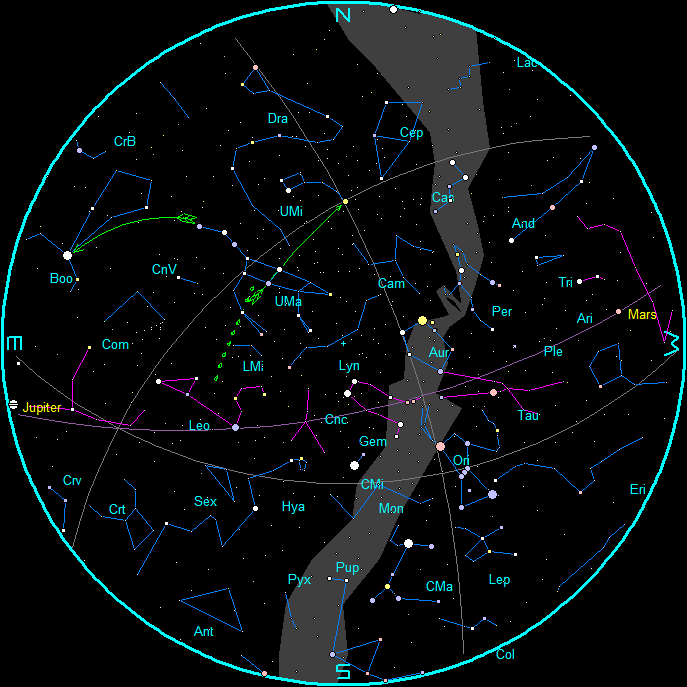
Star Chart for March 2017. Created using my LookingUp program. Click on image to enlarge.
Morning
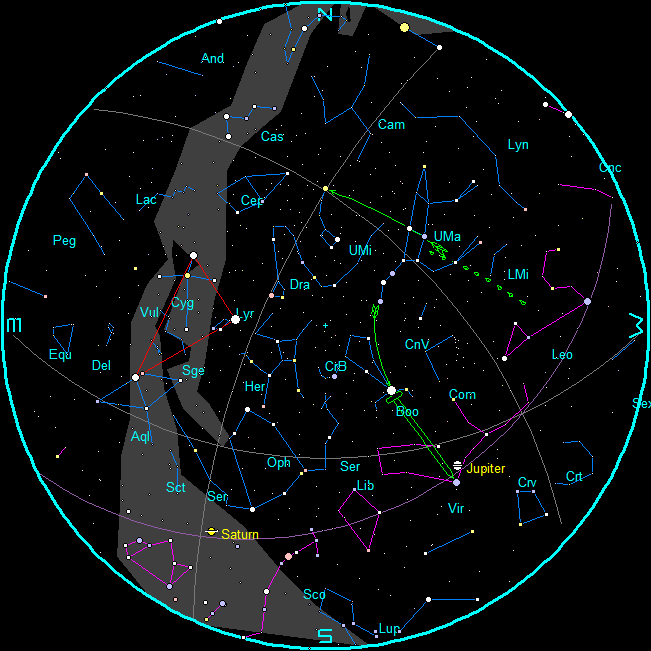
Star Chart for March 2017 mornings. Created using my LookingUp program. Click on image to enlarge.
The planets and stars are plotted for the 15th at 10 p.m. EDT, and again at 6 a.m. Those are chart times. Note, Traverse City is located approximately 45 minutes behind our time meridian. (An hour 45 minutes behind our daylight saving time meridian. during EDT and 45 minutes behind our daylight standard time meridian. during EST). To duplicate the star positions on a planisphere you may have to set it to 1:45 or 0:45 earlier than the current time if you were near your time meridian.
For a list of constellation names to go with the abbreviations click here.
- Pointer stars at the front of the bowl of the Big Dipper point to Polaris the North Star
- Follow the arc of the handle of the Big Dipper to the star Arcturus, and
- Straighten to a spike to Spica
- The Summer Triangle is shown in red
Evening nautical twilight ends at 7:32 p.m. EST on the 1st, increasing to 9:16 p.m. EDT on the 31st.
Evening astronomical twilight ends at 8:06 p.m. EST on the 1st, increasing to 9:53 p.m. EDT on the 31st.
Morning astronomical twilight starts at 5:43 a.m. EST on the 1st, and increasing to 5:48 a.m. EDT on the 31st.
Morning nautical twilight starts at 6:17 a.m. EST on the 1st, and Increasing to 6:25 a.m. EDT on the 31st.
NASA Calendar of Planetary Events
Credit: Sky Events Calendar by Fred Espenak and Sumit Dutta (NASA’s GSFC)
To generate your own calendar go to http://eclipse.gsfc.nasa.gov/SKYCAL/SKYCAL.html
Times are Eastern Time and follow the time change dates.
Date        Time    Event
Mar 01  We          Venus: 32.5° E
    01  We  1:58 am Moon-Mars: 4.4° N
    01  We  9:22 pm Neptune Conjunction
    03  Fr  2:24 am Moon Perigee: 369100 km
    04  Sa  9:38 pm Moon-Aldebaran: 0.2° S  Occultation!
    05  Su  6:32 am First Quarter
    06  Mo  7:08 pm Mercury Superior Conjunction with the Sun
    06  Mo  7:43 pm Moon North Dec.: 18.9° N
    10  Fr  5:20 pm Moon-Regulus: 0.9° N
    10  Fr 11:17 pm Moon Ascending Node
    12  Su  2:00 am Daylight Saving Time starts (Spring Forward)
    12  Su 10:54 am Full Moon
    14  Tu  4:04 pm Moon-Jupiter: 2.7° S
    18  Sa  1:25 pm Moon Apogee: 404700 km
    20  Mo  6:29 am Vernal Equinox. Spring starts
    20  Mo  6:49 am Moon-Saturn: 3.8° S
    20  Mo 11:58 am Last Quarter
    21  Tu  1:22 am Moon South Dec.: 18.9° S
    25  Sa  6:31 am Venus Inferior Conjunction with the Sun
    25  Sa 11:41 am Moon Descending Node
    27  Mo 10:57 pm New Moon
    30  Th  8:39 am Moon Perigee: 363900 km
Apr 01  Sa          Venus: 13.4° W
March 2017 Calendar
LU                  Ephemeris of Sky Events for Interlochen/TC
March, 2017    Local time zone: EST
+-----------------------------------------------------------------------+
| DATE |  SUN     SUN  DAYLIGHT|   TWILIGHT*    |MOON  RISE OR    ILLUM |
|      |  RISE    SET    HOURS |  END    START  |PHASE SET** TIME FRACTN|
+=======================================================================+
|Wed  1| 07:19a  06:30p  11:11 | 07:34p  06:16a |      Set  10:15p   14%|
|Thu  2| 07:18a  06:32p  11:14 | 07:35p  06:15a |      Set  11:26p   23%|
|Fri  3| 07:16a  06:33p  11:17 | 07:36p  06:13a |      Set  12:37a   33%|
|Sat  4| 07:14a  06:34p  11:20 | 07:37p  06:11a |      Set  01:45a   44%|
+------+-----------------------+----------------+-----------------------+
|Sun  5| 07:12a  06:36p  11:23 | 07:39p  06:09a |F Qtr Set  02:50a   56%|
|Mon  6| 07:11a  06:37p  11:26 | 07:40p  06:08a |      Set  03:48a   67%|
|Tue  7| 07:09a  06:38p  11:29 | 07:41p  06:06a |      Set  04:40a   77%|
|Wed  8| 07:07a  06:40p  11:32 | 07:43p  06:04a |      Set  05:25a   86%|
|Thu  9| 07:05a  06:41p  11:35 | 07:44p  06:02a |      Set  06:04a   92%|
|Fri 10| 07:03a  06:42p  11:38 | 07:45p  06:00a |      Set  06:38a   97%|
|Sat 11| 07:02a  06:44p  11:42 | 07:47p  05:59a |      Set  07:09a  100%|
+------+-----------------------+----------------+-----------------------+
| EDT  |      Time Change      |                |                       |
|Sun 12| 08:00a  07:45p  11:45 | 08:48p  06:57a |Full  Rise 08:00p  100%|
|Mon 13| 07:58a  07:46p  11:48 | 08:49p  06:55a |      Rise 09:03p   98%|
|Tue 14| 07:56a  07:47p  11:51 | 08:51p  06:53a |      Rise 10:05p   94%|
|Wed 15| 07:54a  07:49p  11:54 | 08:52p  06:51a |      Rise 11:05p   89%|
|Thu 16| 07:52a  07:50p  11:57 | 08:53p  06:49a |      Rise 12:04a   82%|
|Fri 17| 07:51a  07:51p  12:00 | 08:55p  06:47a |      Rise 01:01a   74%|
|Sat 18| 07:49a  07:53p  12:03 | 08:56p  06:46a |      Rise 01:57a   66%|
+------+-----------------------+----------------+-----------------------+
|Sun 19| 07:47a  07:54p  12:07 | 08:57p  06:44a |      Rise 02:50a   56%|
|Mon 20| 07:45a  07:55p  12:10 | 08:59p  06:42a |L Qtr Rise 03:40a   47%|
|Tue 21| 07:43a  07:56p  12:13 | 09:00p  06:40a |      Rise 04:27a   37%|
|Wed 22| 07:41a  07:58p  12:16 | 09:01p  06:38a |      Rise 05:09a   28%|
|Thu 23| 07:39a  07:59p  12:19 | 09:03p  06:36a |      Rise 05:48a   19%|
|Fri 24| 07:38a  08:00p  12:22 | 09:04p  06:34a |      Rise 06:24a   12%|
|Sat 25| 07:36a  08:01p  12:25 | 09:05p  06:32a |      Rise 06:58a    6%|
+------+-----------------------+----------------+-----------------------+
|Sun 26| 07:34a  08:03p  12:28 | 09:07p  06:30a |      Rise 07:31a    2%|
|Mon 27| 07:32a  08:04p  12:32 | 09:08p  06:28a |New   Set  07:43p    0%|
|Tue 28| 07:30a  08:05p  12:35 | 09:10p  06:26a |      Set  08:56p    1%|
|Wed 29| 07:28a  08:06p  12:38 | 09:11p  06:24a |      Set  10:10p    5%|
|Thu 30| 07:26a  08:08p  12:41 | 09:12p  06:22a |      Set  11:24p   11%|
|Fri 31| 07:25a  08:09p  12:44 | 09:14p  06:20a |      Set  12:36a   20%|
+-----------------------------------------------------------------------+
* Nautical Twilight
** Moonrise or moonset, whichever occurs between sunrise and sunset
Grazing Occultation of Aldebaran March 4 or 5, 2017 (Depending on your location)
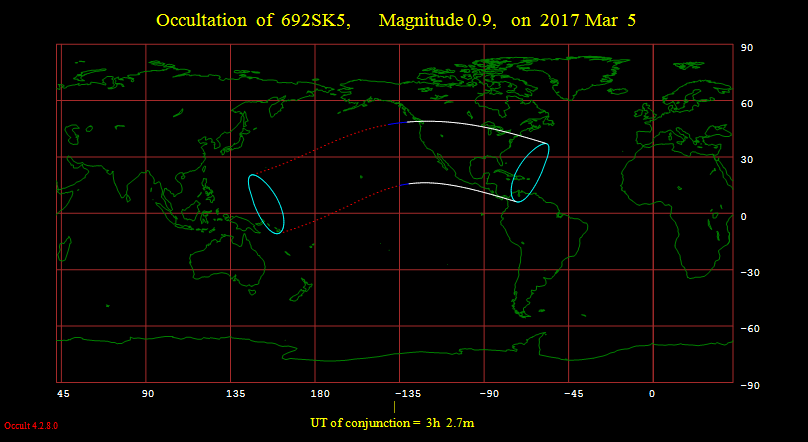
Path of the occultation of Aldebaran for March 4-5, 2017. Note where the top edge of the path goes. Right through northern Michigan.
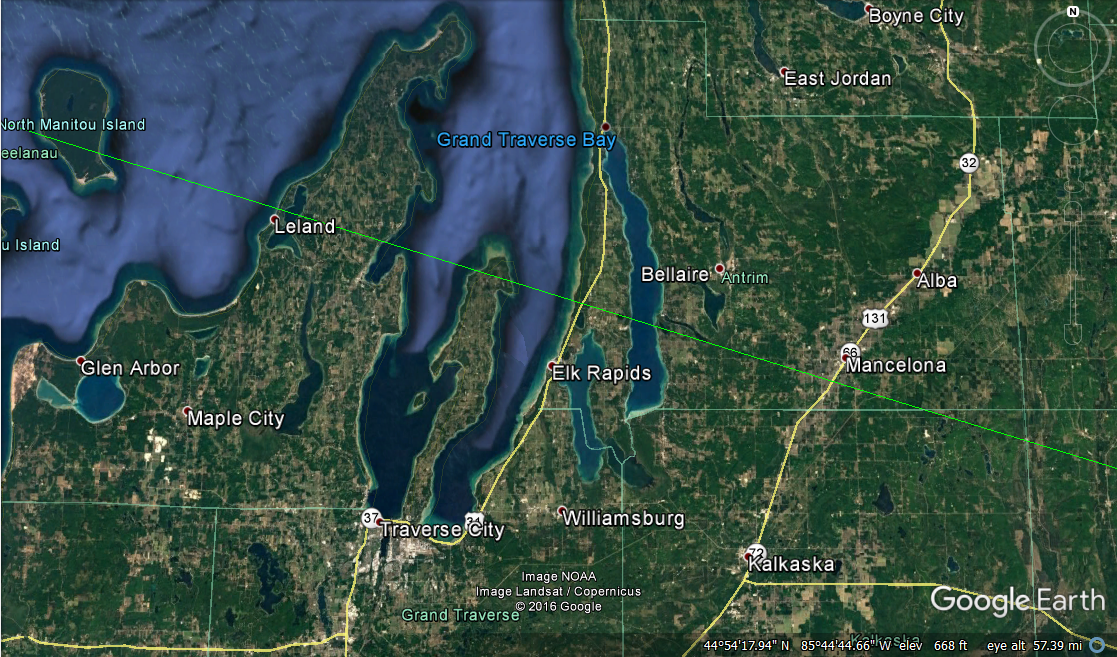
Here’s the line where the limit of the occultation passes in northwestern lower Michigan. Occult4 kml file plotted on Google Earth.
The central time of the occultation is 11:13 p.m. Start viewing the Moon before 11 p.m. The farther south one is of the line the earlier the occultation starts and the longer it lasts. I’ll have lots more information in Thursday’s post.
02/27/2017 – Ephemeris – The Great American Eclipse, August 21, 2017
Ephemeris for Monday, February 27th. The Sun will rise at 7:22. It’ll be up for 11 hours and 5 minutes, setting at 6:28. The Moon, 1 day past new, will set at 7:52 this evening.
We didn’t get a chance to see yesterday’s annular eclipse of the Sun, since it occurred mostly in the South Atlantic Ocean. But it’s a wake up call for those of us who chase the Moon’s shadow, that the Great American Eclipse is a bit less than 6 months away. August 21st to be exact. Here in northern Michigan the Sun will be 75% or so covered by the Moon at peak. For me it’s 100% or nothing. The path where the Sun will be totally eclipsed will run from Oregon to South Carolina. I’ve seen totality four times from 1963 to 1979 and accumulated 8 ½ minutes of time basking under the shade of the Moon. Well not basking, for those were hectic magical times, not to be missed. And come hell or high water I will strive to add another 2 plus minutes to that total.
Times are for the Traverse City/Interlochen area of Michigan. They may be different for your location.
Addendum
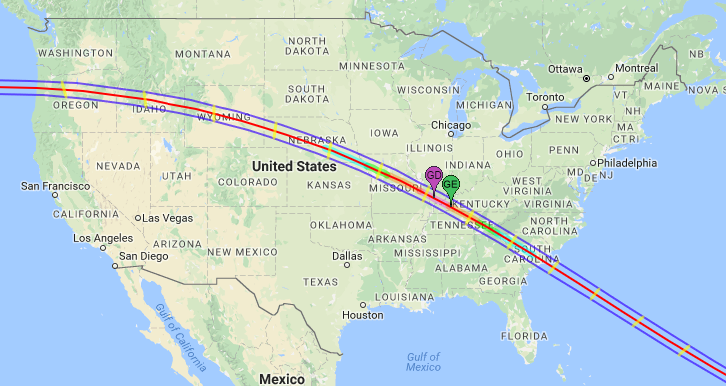
A screen cap of the map showing the path of totality of the August 21, 2017 total solar eclipse from NASA’s eclipse page. Credit: NASA and Google Maps.
NASA’s Eclipse page: https://eclipse2017.nasa.gov/
02/24/2017 – Ephemeris – Winter star party at the Sleeping Near Dunes tomorrow night
Ephemeris for Friday, February 24th. The Sun will rise at 7:27. It’ll be up for 10 hours and 56 minutes, setting at 6:23. The Moon, 2 days before new, will rise at 6:53 tomorrow morning.
Tomorrow night the Grand Traverse Astronomical Society and the Rangers of the Sleeping Bear Dunes National Lakeshore will hold a star party at the Dune Climb parking lot from 7 to 9 p.m. but only if it is clear. Last Saturday night it happened to be clear, so I went out there to do some photography of the heavens, and the sky was spectacular with the brilliant constellation Orion dominating the southern sky. Its great star forming region, the Great Orion Nebula displaying its bright heart and wispy outer tendrils of gas and dust heading away from that nest of bright baby stars that are illuminating it. Venus is a shining beacon in the west until it sets into the dune. We might even be able to spot the faint Zodiacal Light in the west.
Times are for the Traverse City/Interlochen area of Michigan. They may be different for your location.
Addendum
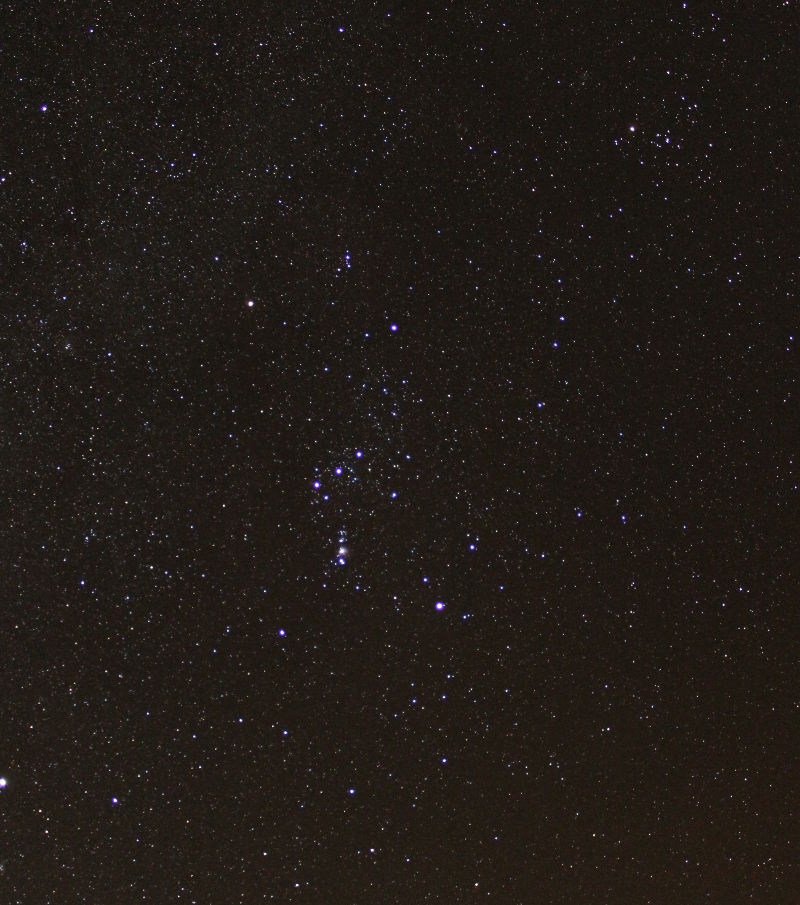
Orion in a 30 second exposure taken at the Sleeping Bear Dunes National Lakeshore Dune Climb February, 18, 2017 by Bob Moler. Click on image to enlarge a bit.
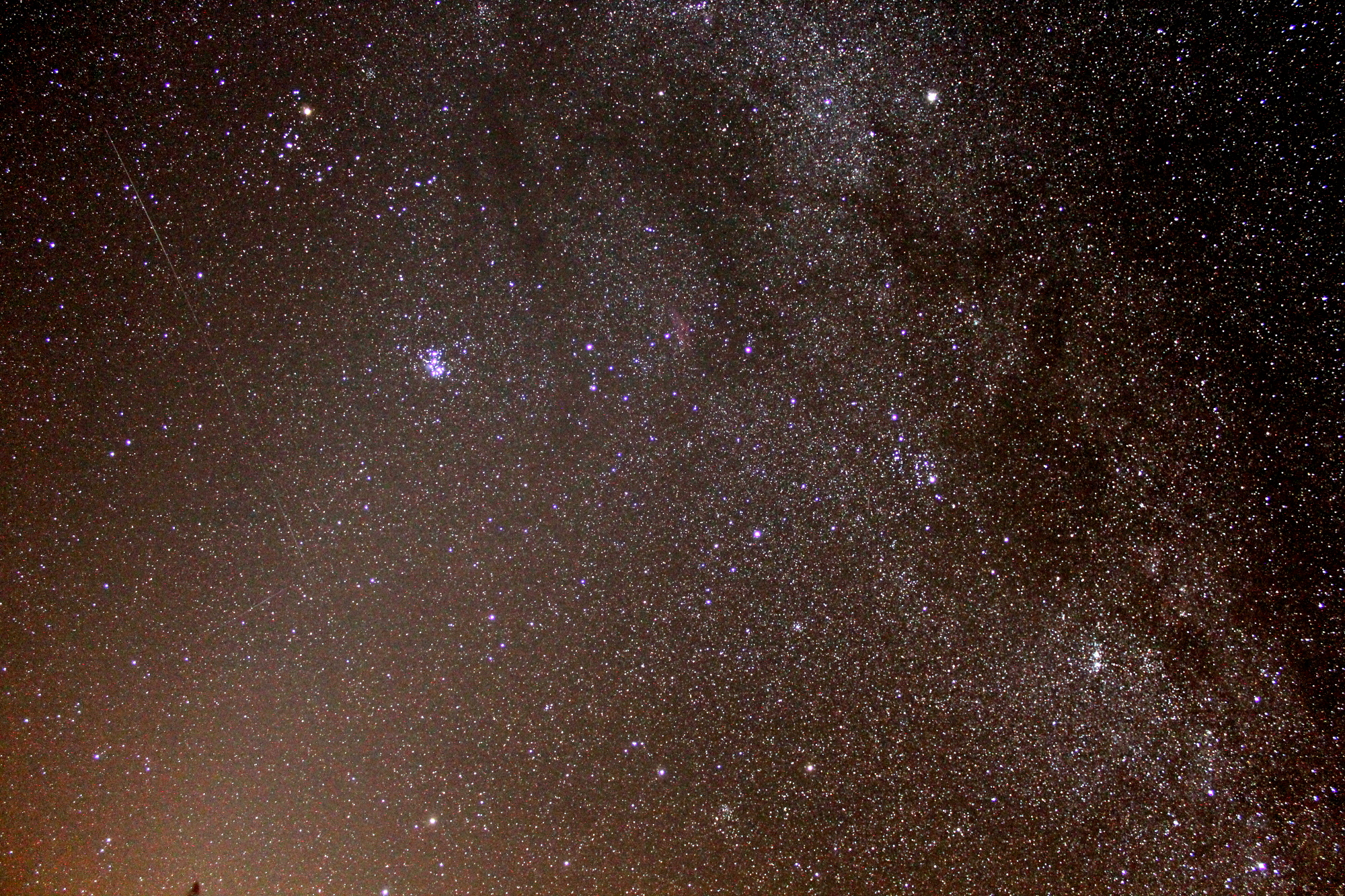
Area of the sky from the Hyades and Pleiades on the left to the Double Cluster on the right. While processing the image for this post I discovered two possible meteor trails on the left and below center. A 2 minute exposure taken at the Sleeping Bear Dunes National Lakeshore Dune Climb February, 18, 2017 by Bob Moler. Click on image to enlarge and see all the deep sky goodies in it..
02/23/2017 – Ephemeris – The Evening Star’s days are numbered
Ephemeris for Thursday, February 23rd. The Sun will rise at 7:29. It’ll be up for 10 hours and 53 minutes, setting at 6:22. The Moon, 3 days before new, will rise at 6:15 tomorrow morning.
The brilliant Evening Star, the planet Venus entered our evening sky last June. It seemed it took forever to move far enough away from the Sun to be easily seen after sunset. The summer and autumn time is a hard time to spot a planet near the Sun after sunset, because they appear more to the left of the Sun than above it. Now, in late winter Venus is high in the west after sunset. But that won’t last. It’s nearly 9 month’s reign as the Evening Star are about up. In 27 days it will be gone, out of the evening sky as it rapidly passes between the Earth and the Sun. Venus will be only 26 million miles (42 million km) from the Earth. Back is 2012 it crossed the face of the sun at conjunction, On March 25th it will be 16 Sun diameters north of our star.
Times are for the Traverse City/Interlochen area of Michigan. They may be different for your location.
Addendum
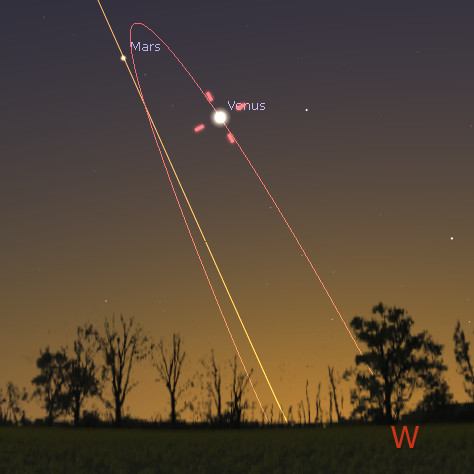
Venus and Mars showing Venus’ orbit showing how far north it will get above the ecliptic, the yellow line, which is the path of the Sun. Created using Stellarium.
02/22/2017 – Ephemeris – The planets this morning and tonight
Ephemeris for Wednesday, February 22nd. The Sun will rise at 7:31. It’ll be up for 10 hours and 50 minutes, setting at 6:21. The Moon, half way from last quarter to new, will rise at 5:33 tomorrow morning.
Let’s check out the bright planets for this week. Saturn can be glimpsed this morning in the southeast before 7 a.m. It will rise tomorrow at 3:45 a.m. in the east-southeast. Jupiter can be seen in the south-southwest this morning above the star Spica. The giant planet will rise tonight in the east at 10:22 p.m. Venus and Mars are in the evening sky. At 7 p.m. these planets will be seen in the western sky. Venus is unmistakable as the brilliant evening star, Mars will be left and above it and much dimmer. Venus will set at 9:45 p.m. while Mars will set at 10:13. Venus exhibits a dazzling crescent in small telescopes now, but a month from now it will be too close to the Sun to be seen.
Times are for the Traverse City/Interlochen area of Michigan. They may be different for your location.
Addendum
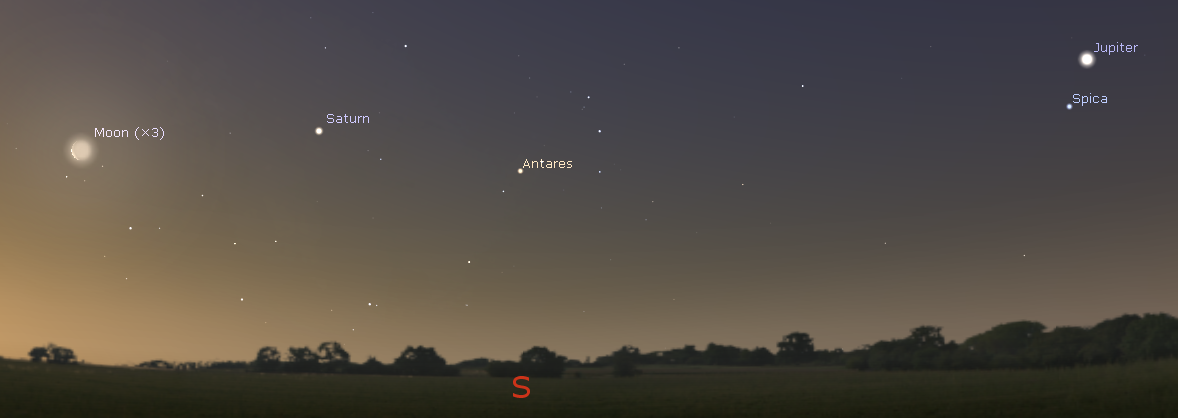
Jupiter in the south above the star Spica with Saturn in the southeast and the crescent Moon further to the left at 7 a.m. this morning, February 22, 2017. Created using Stellarium.
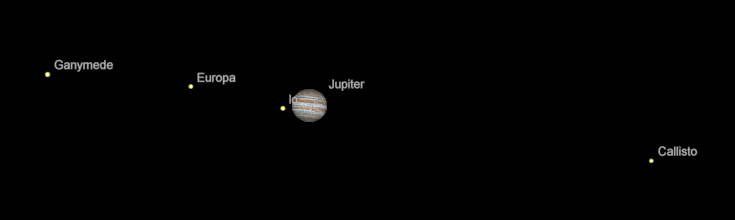
Jupiter and its moons as they might appear in telescopes this morning at 6:30 a.m. February 22, 2017. Created using Cartes du Ciel (Sky Charts).
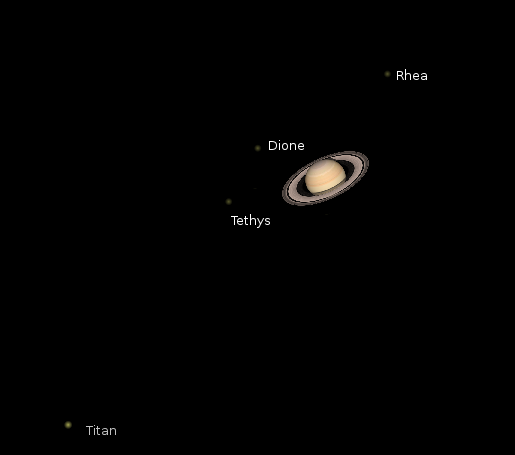
Saturn and its brightest moons as they might appear in telescopes this morning at 6:30 a.m. February 22, 2017. Created using Cartes du Ciel (Sky Charts).
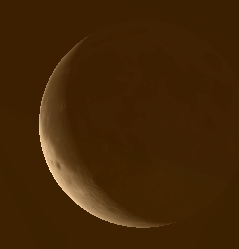
The Moon as it might appear in binoculars at 6:30 a.m. this morning February 22, 2017. Created using Stellarium.
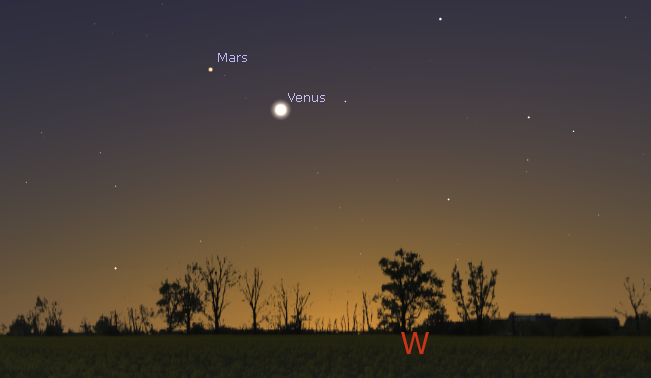
Venus and Mars in the evening twilight of about an hour after sunset. at 7 p.m. tonight February 22, 2017. Venus is now drawing away from Mars as it heads toward and north of the Sun. Their apparent paths won’t cross again until October in the morning sky. Created using Stellarium.
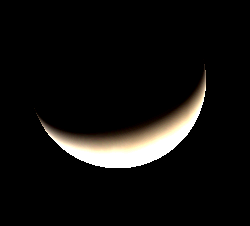
Venus as it might appear in a telescope tonight February 22, 2017. I processed the image to overexpose it as it would appear in a telescope. Created using Stellarium.
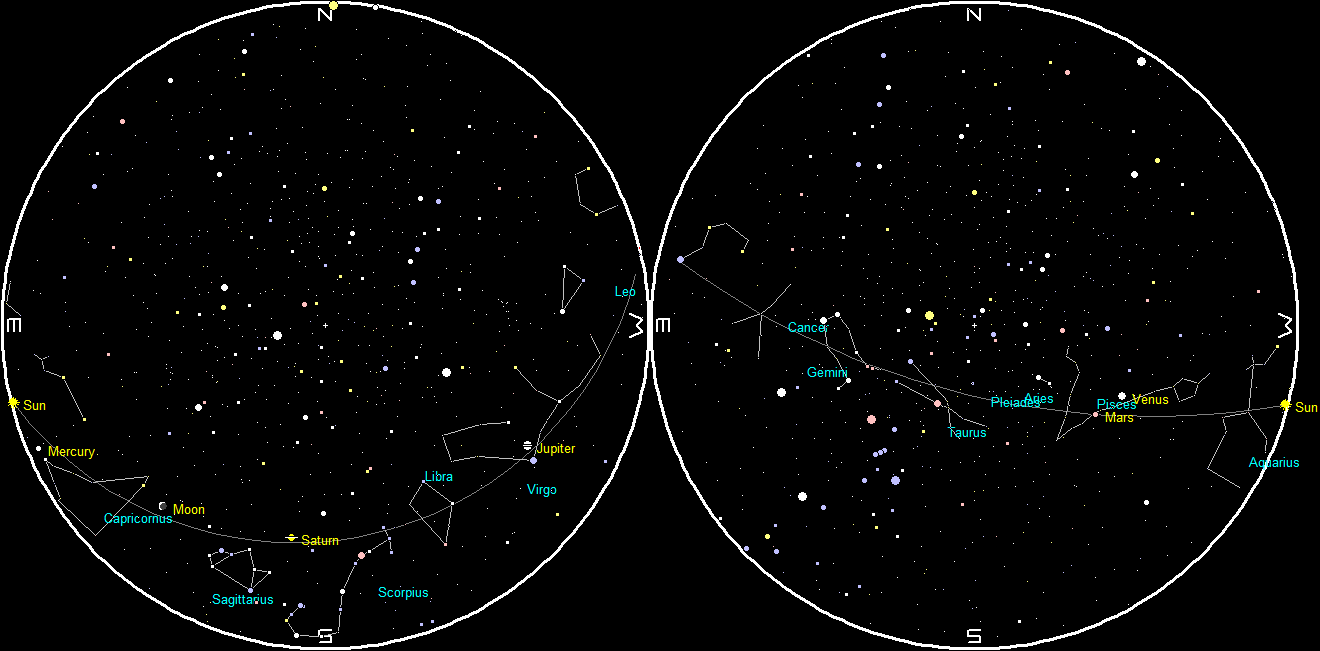
Planets and Moon at sunset and sunrise of a single night starting with sunset on the right on February 22, 2017. The night ends on the left with sunrise on February 23. Click on image to enlarge. Created using my LookingUp program.
02/21/2017 – Ephemeris – Finding Saturn this morning and Cassini’s future
Ephemeris for Tuesday, February 21st. The Sun will rise at 7:32. It’ll be up for 10 hours and 47 minutes, setting at 6:19. The Moon, 3 days past last quarter, will rise at 4:48 tomorrow morning.
This morning the crescent Moon will act as a pointer to the planet Saturn. The ringed planet will appear to the right of our Moon. Saturn’s rings will show in any telescope with 20 times magnification or greater. Out at Saturn for the last 13 years and for the next 7 months the robot spacecraft Cassini has been orbiting the ringed planet using gravity assists from the giant moon Titan as a fulcrum to leverage itself into many different orbits to study Saturn’s rings and collection of moons. In a bit over seven months it’s fantastic journey will be over. Low on fuel, it will plunge between the rings and the cloud tops, spiraling in towards its doom September 30th into the planet’s atmosphere so as not to contaminate the icy moons which could possibly harbor life.
Times are for the Traverse City/Interlochen area of Michigan. They may be different for your location.
Addendum
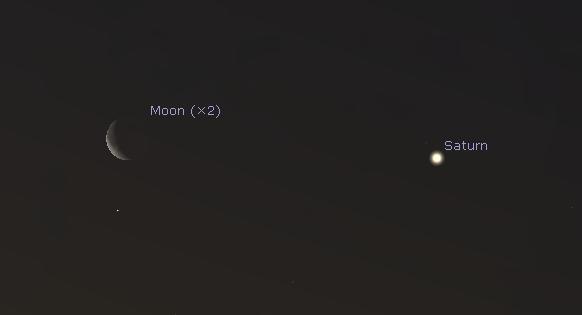
Using the Moon to locate Saturn in the southeast at 7 a.m. or earlier on February 21, 2017. The Moon is enlarged to show it better. Created using Stellarium.
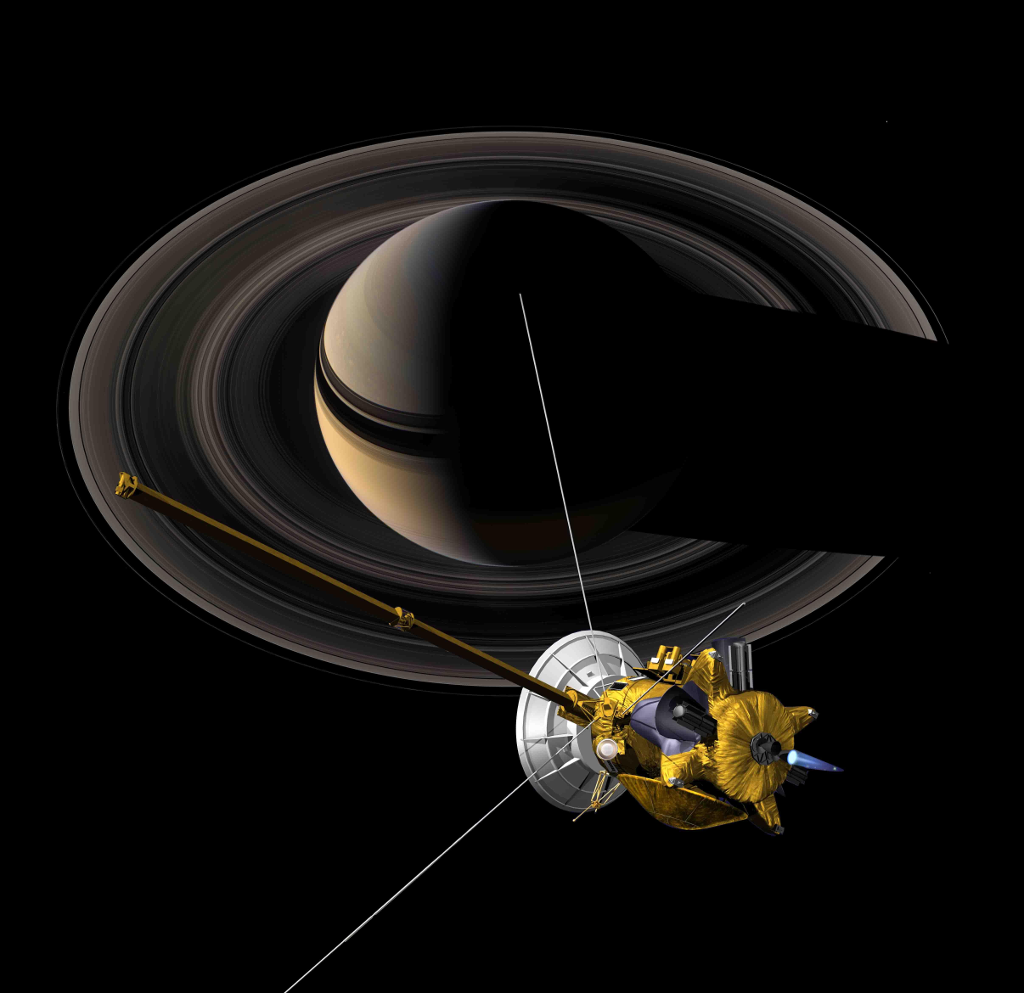
The Cassini spacecraft at Saturn. Credit: NASA/JPL.
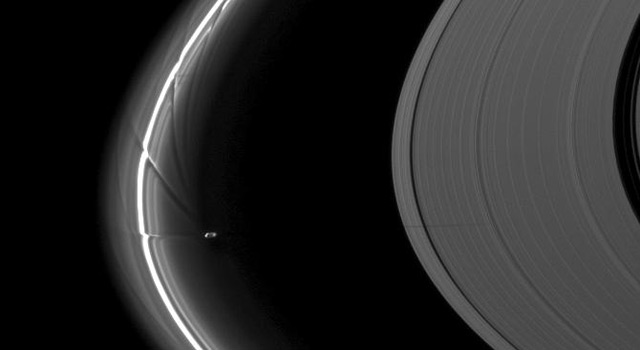
The shepherd satellite Prometheus leaving a wake in Saturn’s outer F Ring. Credit: NASA/JPL.
02/20/2017 – Ephemeris – The spring constellations are rising
Ephemeris for President’s Day, Monday, February 20th. The Sun will rise at 7:34. It’ll be up for 10 hours and 44 minutes, setting at 6:18. The Moon, 2 days past last quarter, will rise at 3:59 tomorrow morning.
With spring only a month away, lets turn our eyes eastward in the evening to the rising spring stars. In contrast to the brilliant stars of the winter skies still holding forth in the south, and running along the Milky Way overhead and to the northwest, the stars to the east are rather sparse and dull. The only exception is the Big Dipper to the northeast. The one bright star in the east is Regulus, whose rank as a first magnitude star is dead last in brightness. It is in the heart of the constellation of Leo the lion, and as such has gained a great amount of fame. Regulus is at the base of a backward question mark of stars that is informally known a the Sickle. It is also the characteristic head and mane of a male lion. A triangle of stars to the lower left are his back end ending with Leo’s second brightest star Denebola, literally “Lion’s Tail”.
Times are for the Traverse City/Interlochen area of Michigan. They may be different for your location.
Addendum
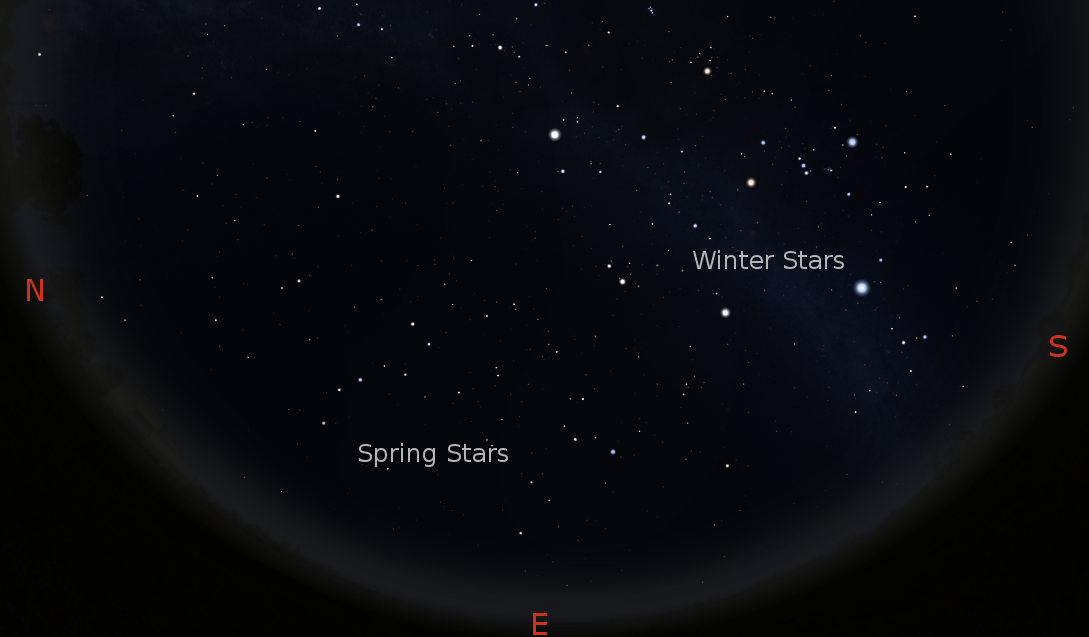
Comparison of winter stars vs. spring stars. Created using Stellarium.
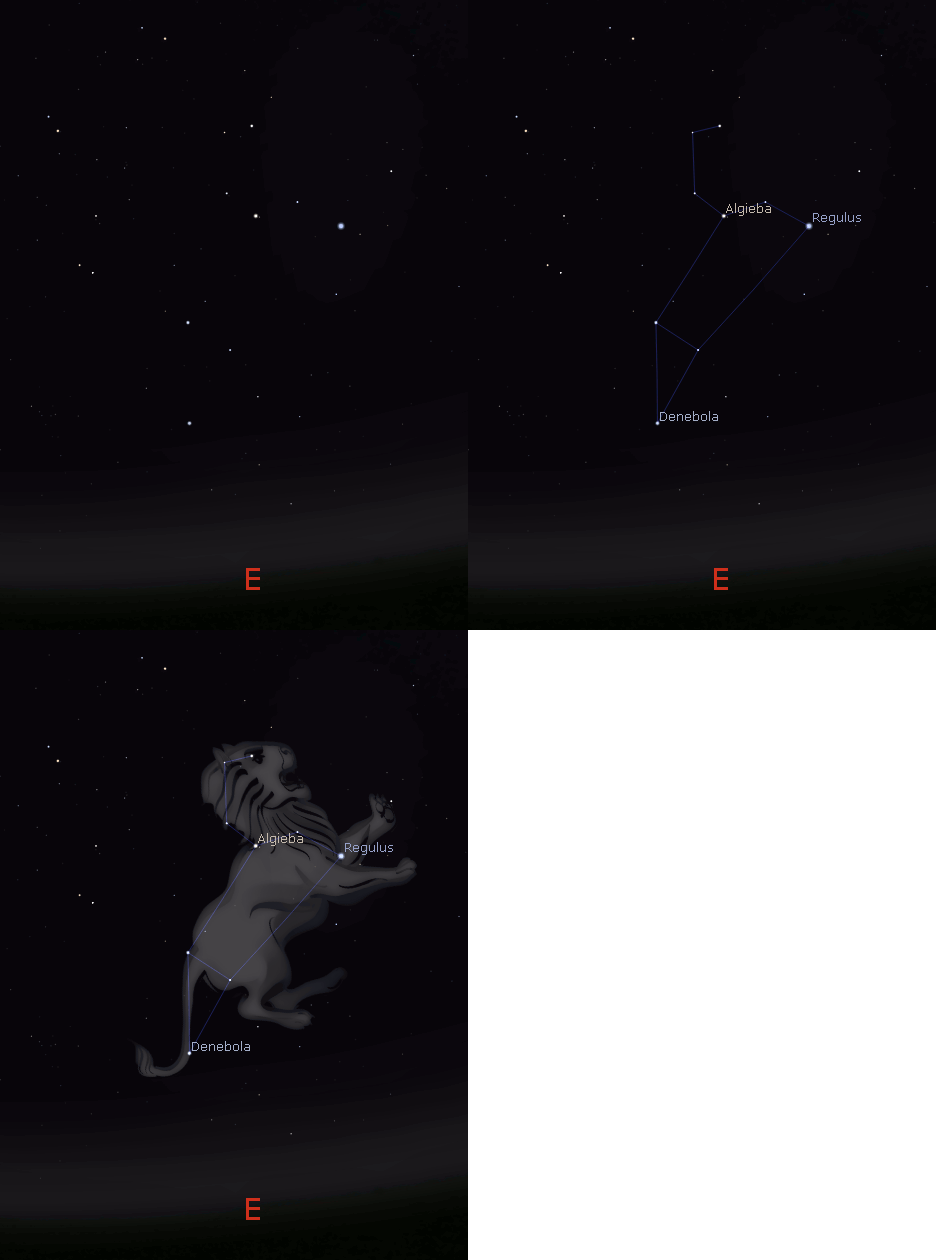
The constellation Leo animation. Created using Stellarium and GIMP.
02/17/2017 – Ephemeris – The stars of the Belt of Orion
Ephemeris for Friday, February 17th. The Sun will rise at 7:39. It’ll be up for 10 hours and 35 minutes, setting at 6:14. The Moon, 1 day before last quarter, will rise at 1:15 tomorrow morning.
Let’s take a closer look at the central constellation of the winter sky, the giant hunter Orion. His most remarkable feature in his Belt of three stars in a straight line. It’s the brightest, straightest and most equidistant line of stars I know of. It points down and left to the brightest star Sirius the dog star and up to the right of Aldebaran the angry bloodshot eye in Taurus the bull. The star names as taught to me by Grand Rapids Public Museum curator Evelyn Grebel in my youth in the 1950s was from left to right Alnitak, Alnilam and Mintaka. All the names reference a belt or girdle. Alnitak lights up a faint cloud that can sometimes be glimpsed with binoculars called the Flame Nebula, Just below it and invisible except in photographs is the Horsehead Nebula.
Times are for the Traverse City/Interlochen area of Michigan. They may be different for your location.
Addendum
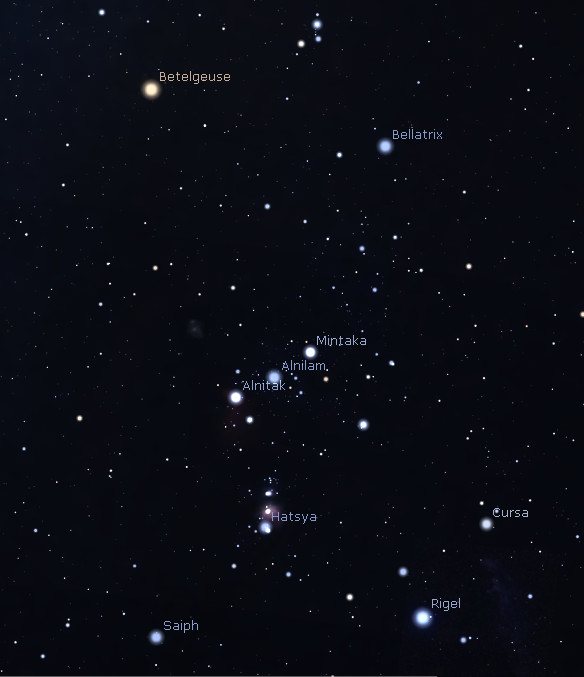
Orion’s named stars including the belt stars. Created using Stellarium.
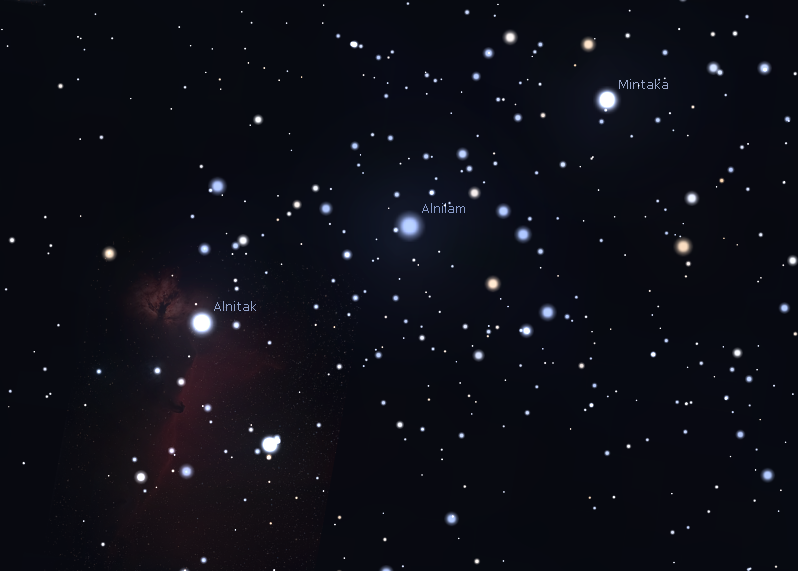
Orion’s belt stars showing the nebulae illuminated by Alnitak. The Flame Nebula above left of it and the Horsehead Nebula below. At this scale the horse’s head figure appears as a dark bump into the left edge of the red glow.
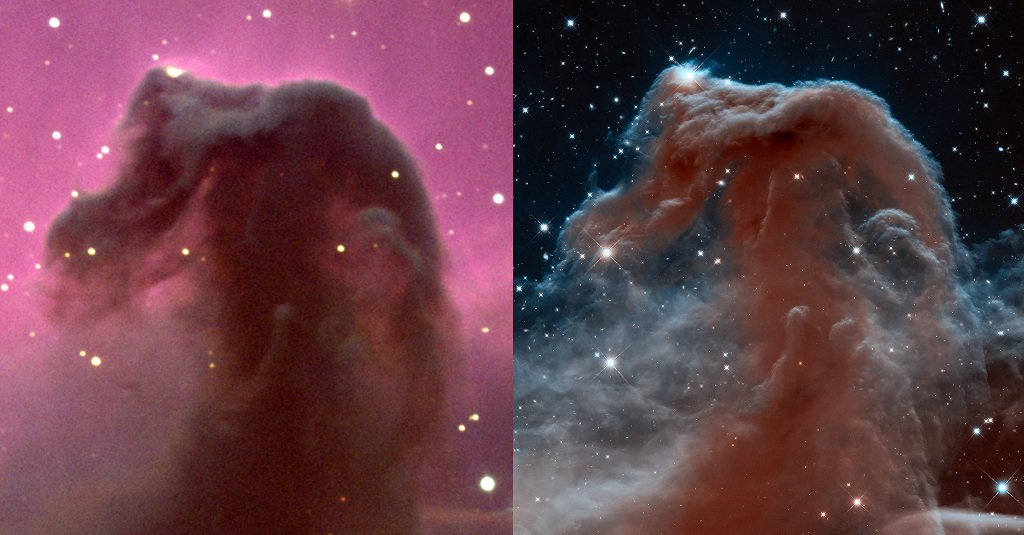
The Horsehead Nebula: On the left in visible light from the National Optical Astronomy Observatory, while the image on the right is from the Hubble Space Telescope’s near infrared camera. Infrared light penetrated dust and gas better than visible light. This image is rotated about 90 degrees counterclockwise from the above image.
02/16/2017 – Ephemeris – The Winter Circle
Ephemeris for Thursday, February 16th. The Sun will rise at 7:40. It’ll be up for 10 hours and 32 minutes, setting at 6:12. The Moon, 2 days before last quarter, will rise at 12:17 tomorrow morning.
The winter skies are blessed with more first magnitude stars than any other season. These are the twenty-one brightest stars in the sky. Six of these stars lie in a large circle centered on the seventh. This circle is up all evening now that we are in the heart of winter. Starting high overhead is Capella in Auriga the charioteer. Moving clockwise, we come to Aldebaran in the face of Taurus the Bull. Then down to Orion’s knee we find Rigel. Down and left is the brightest star of all Sirius the Dog Star in Canis Major Orion’s large hunting dog, lowest of these stars in the south. Moving up and left there is Procyon in Canis Minor, Then above it is Pollux in Gemini the twins. All are centered on Betelgeuse in Orion.
Times are for the Traverse City/Interlochen area of Michigan. They may be different for your location.
Addendum
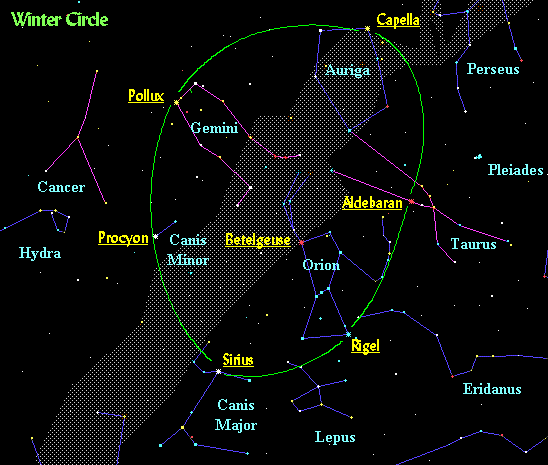
The Winter Circle of 1st magnitude stars. Created using my LookingUp program.
02/15/2017 – Ephemeris – Your weekly look at the bright planets
Ephemeris for Wednesday, February 15th. The Sun will rise at 7:42. It’ll be up for 10 hours and 29 minutes, setting at 6:11. The Moon, 3 days before last quarter, will rise at 11:18 this evening.
Let’s check out the bright planets for this week. Saturn can be glimpsed this morning in the southeast at 7 a.m. It will rise tomorrow at 4:10 a.m. in the east-southeast. Jupiter can be seen in the south-southwest this morning above the star Spica in Virgo and below left of the Moon. Jupiter will rise tonight in the east at 10:47 p.m. Venus and Mars are in the evening sky. At 7 p.m. these planets will be seen in the west-southwestern sky. Venus is unmistakable as the brilliant evening star, Mars will be left and above it and much dimmer. Venus will set at 9:52 p.m. while Mars will set at 10:14. Venus exhibits a dazzling crescent in small telescopes now, but a month from now as it gets closer to Earth the thinning crescent will be big enough to be seen in binoculars.
Times are for the Traverse City/Interlochen area of Michigan. They may be different for your location.
Addendum
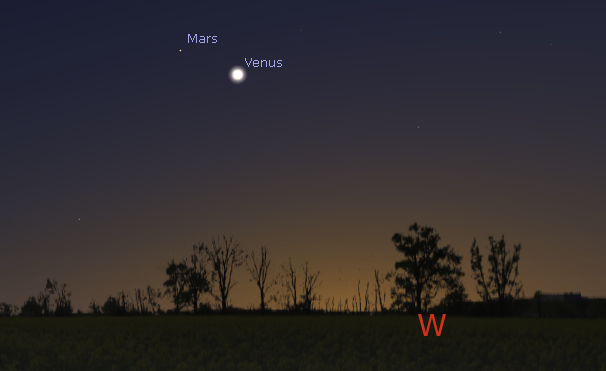
Venus and Mars in the evening twilight of about an hour after sunset. 7 p.m. February 15, 2017. Venus is now drawing away from Mars as it heads toward the Sun faster than Mars. Their apparent paths won’t cross again until October in the morning sky. Created using Stellarium.
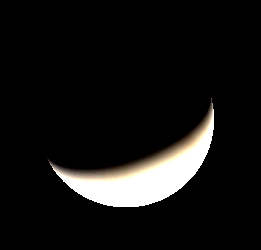
Venus as it might appear in a telescope tonight February 15, 2017. I processed the image to overexpose it as it would appear in a telescope. Venus is getting closer to the Earth at 40.5 million miles, 65.2 million km. It is 38.3″ (arc seconds) in diameter, slightly smaller that Jupiter’s apparent diameter. Created using Stellarium.
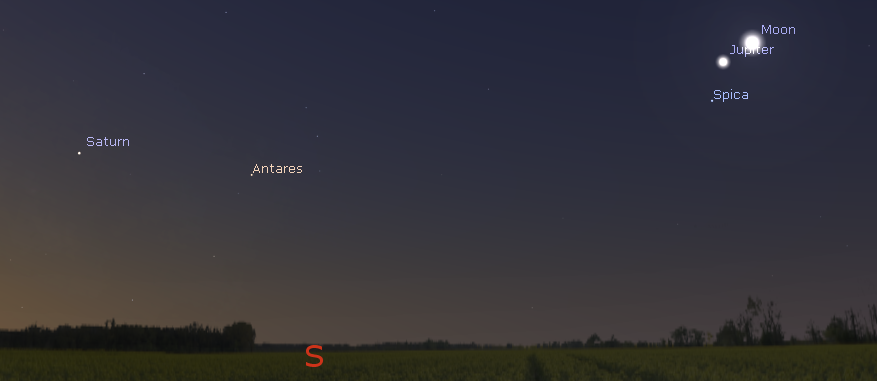
Jupiter in the south above the star Spica and the waning gibbous Moon to the right with Saturn in the southeast at 7 a.m. this morning, February 15, 2017. Created using Stellarium.
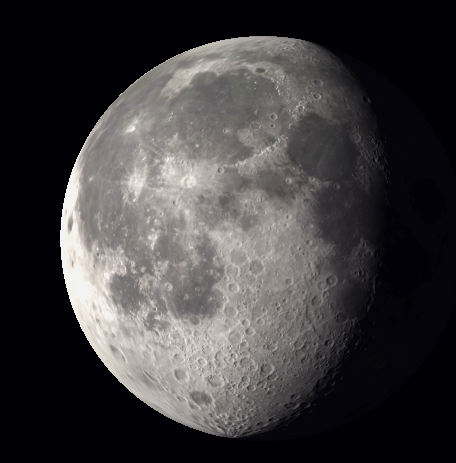
What the waning gibbous Moon might look like in binoculars this morning at 7 a.m. February 15, 2017. Created using Stellarium.
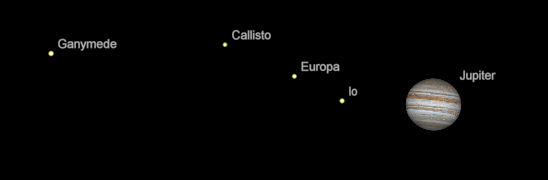
Jupiter and its moons hanging on the east side of the planet as they might appear in telescopes this morning at 7 a.m. February 15, 2017. Created using Cartes du Ciel (Sky Charts).
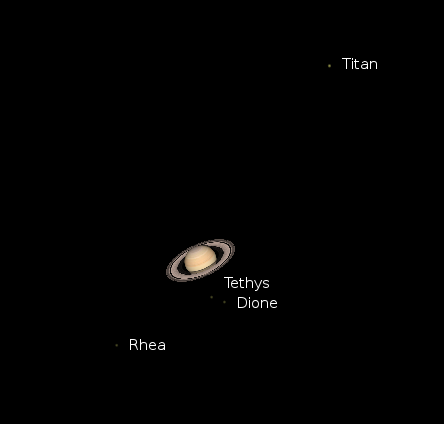
Saturn and its brightest moons as they might appear in telescopes this morning at 7 a.m. February 15, 2017. Created using Cartes du Ciel (Sky Charts).
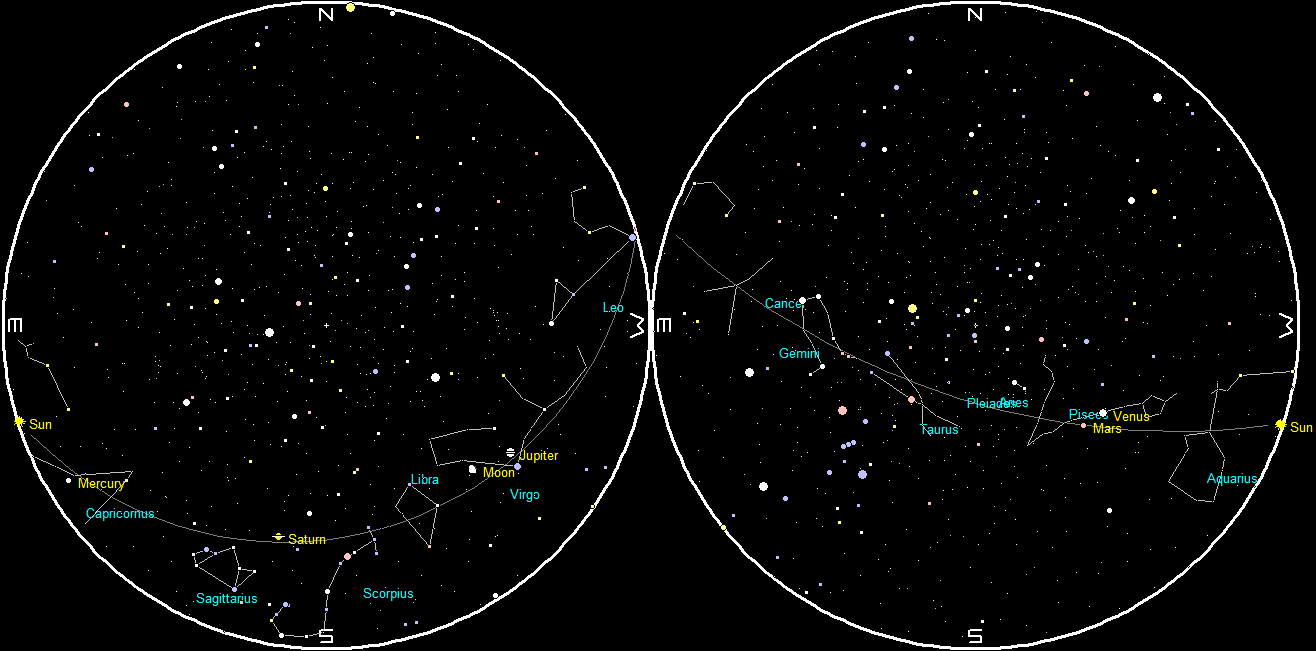
Planets and Moon at sunset and sunrise of a single night starting with sunset on the right on February 15, 2017. The night ends on the left with sunrise on February 16. Click on image to enlarge. Created using my LookingUp program.
 Bob Moler's Ephemeris Blog