Archive
04/28/2017 – Ephemeris – Astronomy Day star party tomorrow night
Ephemeris for Arbor Day, Friday, April 28th. The Sun rises at 6:36. It’ll be up for 14 hours and 7 minutes, setting at 8:43. The Moon, 2 days past new, will set at 11:28 this evening.
Tomorrow is Astronomy Day, the Grand Traverse Astronomical Society will hold a special star party at the Northwestern Michigan College’s Joseph H. Rogers Observatory from 9 to 11 p.m. Featured objects will be the three day old Moon, the planet Jupiter, its four largest moons and planet girdling cloud bands. As it gets darker some spring star clusters will become visible, and maybe some galaxies, because in the spring we are looking out the thin side of our Milky Way galaxy, with the milky band banished to near the northern horizon. Two of these star clusters are even visible to the naked eye. One, the Beehive cluster is a feast for the small telescope, the other an entire constellation of Coma Berenices, or Berenices hair. The observatory is located south of Traverse City, MI on Birmley Road which is between Garfield and Keystone roads.
The times given are for the Traverse City/Interlochen area of Michigan. They may be different for your location.
04/27/2017 – Ephemeris – A constellation story on why crows are black
Ephemeris for Thursday, April 27th. The Sun rises at 6:38. It’ll be up for 14 hours and 4 minutes, setting at 8:42. The Moon, 1 day past new, will set at 10:16 this evening.
The small constellation of Corvus the crow is located low in the south-southeast at 10:30 this evening. It’s made of 5 dim stars, but the pattern is a distinctive distorted box with two stars at the upper left marking that corner. To the right is a fainter constellation of a thick stemmed goblet called Crater. Both appear above the long constellation of Hydra the water snake who is slithering just above the southern horizon.. In Greek mythology Corvus, then white, was the god Apollo’s pet. Apollo once bid Corvus to take a cup and fetch him some water. Corvus however dallied and waited for an unripe fig to ripen. Corvus grabbed a snake and returned with a story as to how the snake had delayed him. The angry Apollo turned the crow and all crows to this day black.
The times given are for the Traverse City/Interlochen area of Michigan. They may be different for your location.
Addendum
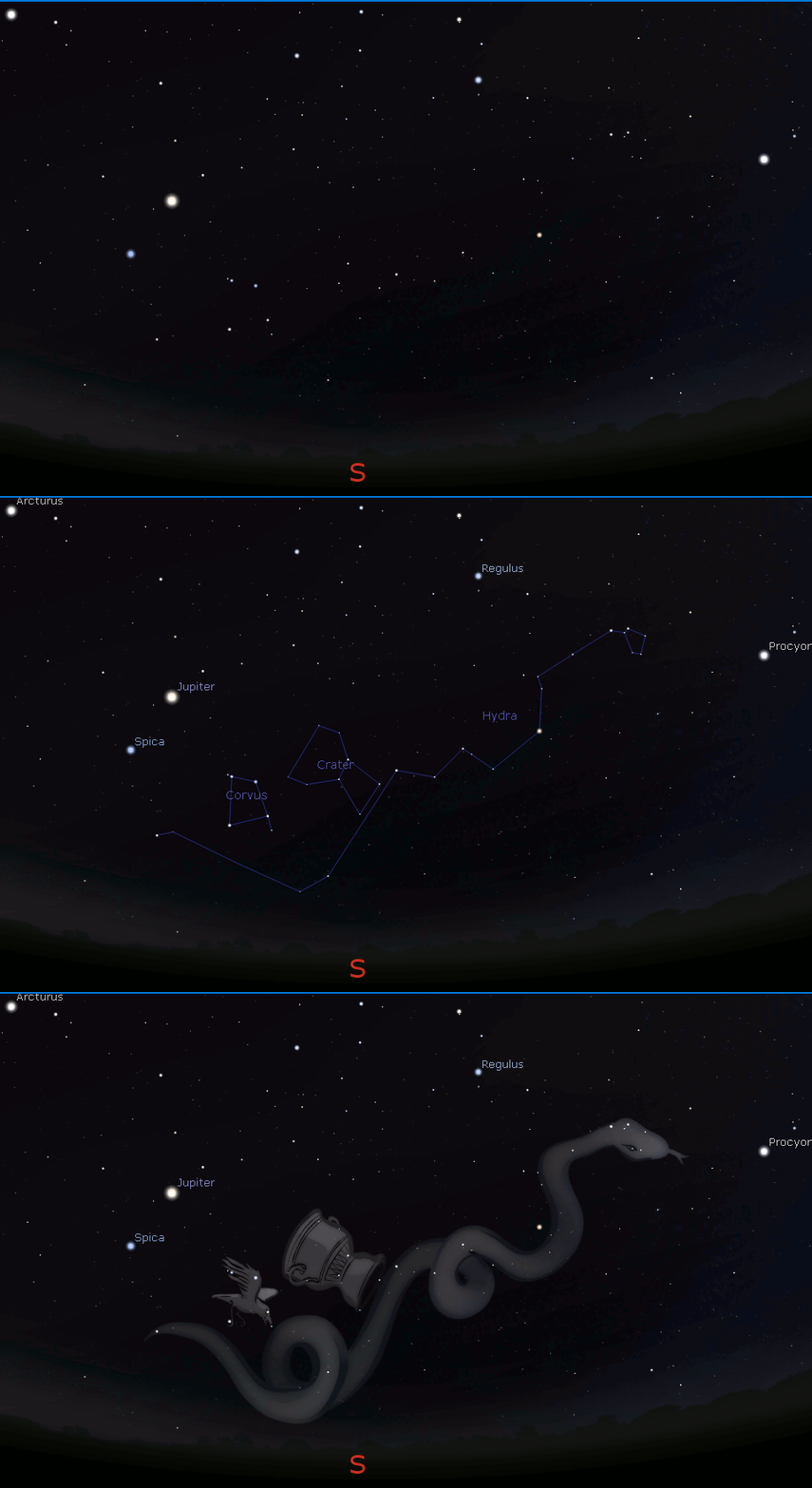
Corvus, Crater and Hydra finder chart for 10:30 p.m. April 27, 2017. Created using Stellarium and GIMP.
04/26/2017 – Ephemeris – Let’s take our weekly look at the bright planets
Ephemeris for Wednesday, April 26th. The Sun rises at 6:39. It’ll be up for 14 hours and 1 minute, setting at 8:41. The Moon is new today, and won’t be visible.
Let’s take our Wednesday weekly look at the bright planets. Mars is still in the west after sunset and fading. It’s near the Pleiades star cluster now. It will set at 11:04 p.m. Coming to dominate the evening sky low in the southeast in evening twilight is Jupiter. It’s seen above the bright blue-white star Spica in the early evening. In even the smallest telescopes Jupiter’s four largest moons can be seen. They shift positions night to night and even as you watch. Jupiter will set at 6:09 a.m. At 6 a.m. Saturn will appear to be a bit to the west of south compass point. It will rise in the east-southeast at 12:41 a.m. tomorrow. Venus will be low in the east at 6 a.m. tomorrow morning after rising at 5:06 a.m. It will appear as a tiny crescent moon in binoculars and telescopes.
The times given are for the Traverse City/Interlochen area of Michigan. They may be different for your location.
Addendum
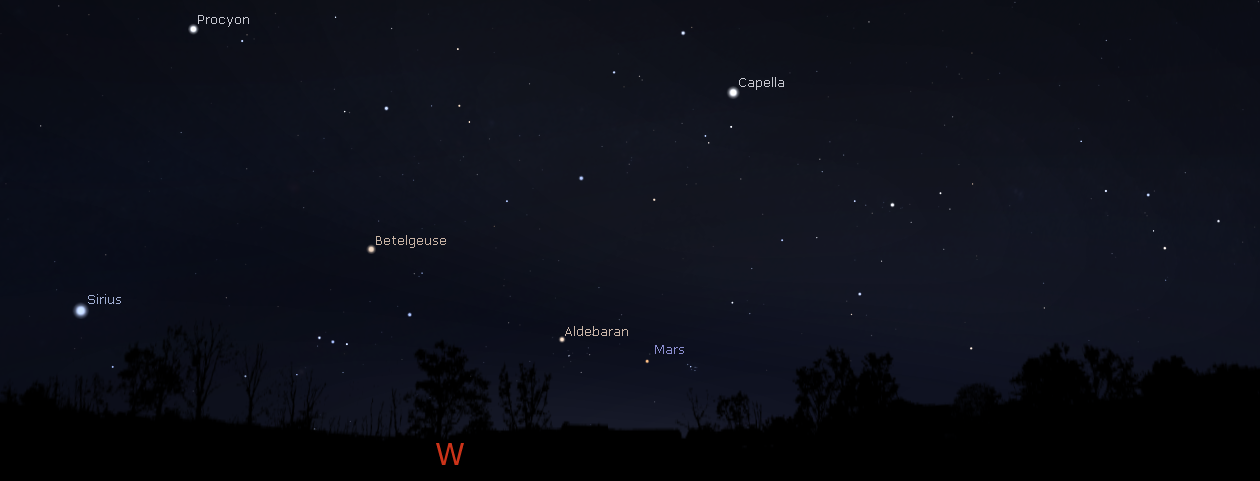
Mars in the west with bright stars at 10 p.m. April 26, 2017. Creating this image reminded me of the fantastic star party at the Sleeping Bear Dunes last Saturday, seeing over the large dune in the west to Sirius in the southwest to Cassiopeia in the northwest. Created using Stellarium.
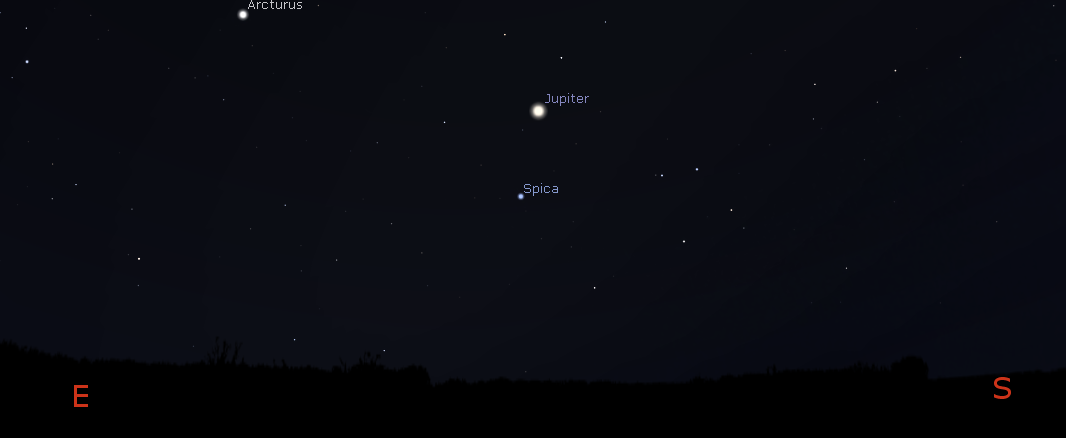
Jupiter above Spica and other stars in the southeast at 10 p.m. April 26, 2017. Created using Stellarium.
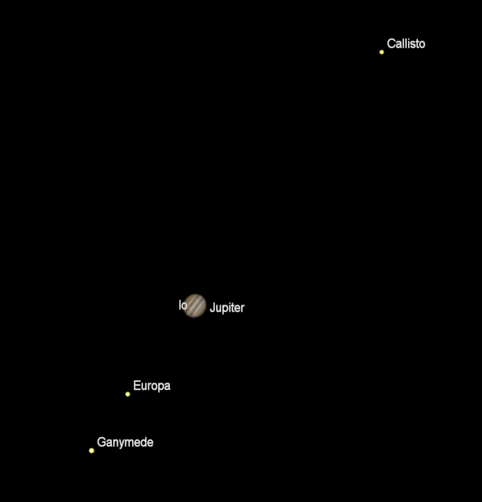
Jupiter and its moons at 10 p.m. April 26, 2017. The moon Io is behind Jupiter and in its shadow at that time. It will reappear at 11:04 p.m. (3:04 UT). Created using Cartes du Ciel (Sky Charts).
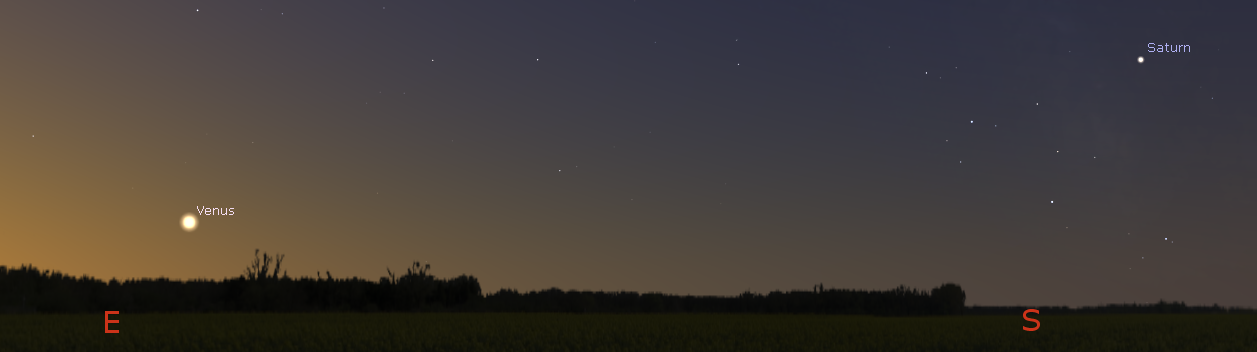
Saturn and Venus at 6 a.m. April 27, 2017 in morning twilight. Created using Stellarium.
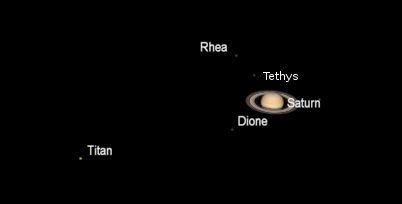
Saturn and its moons at 6 a.m. April 27, 2017. Created using Cartes du Ciel.
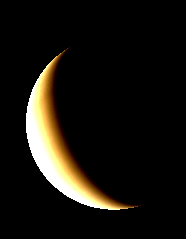
Venus as seen in a telescope at 6 a.m., April 27, 2017. Magnified much more than the other planet images seen here. Created using Stellarium.
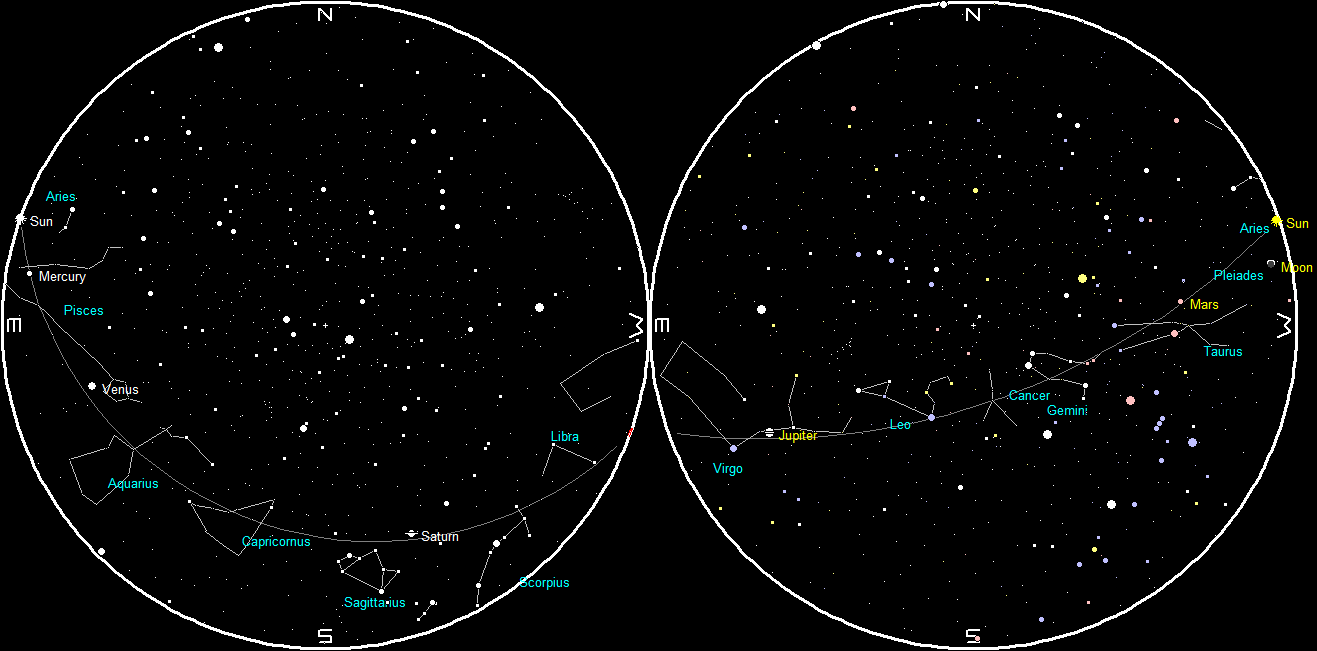
Planets and the Moon at sunset and sunrise of a single night starting with sunset on the right on April 26, 2017. The night ends on the left with sunrise on April 27. Click on the image to enlarge. Created using my LookingUp program.
04/25/2017 – Ephemeris – The Cassini spacecraft is on its last 22 orbits of Saturn
Ephemeris for Tuesday, April 25th. The Sun rises at 6:41. It’ll be up for 13 hours and 58 minutes, setting at 8:40. The Moon, 1 day before new, will rise at 7:08 tomorrow morning.
In the early hours of last Saturday, Earth Day, The Cassini spacecraft, orbiting Saturn for the last nearly 13 years, made its last pass of Saturn’s giant moon Titan. Over the past 13 years Cassini has been using Titan as a kind of fulcrum to leverage its orbits of Saturn, returning time and time again to both study this strange moon and to propel it via gravity assists into a myriad of orbits. This time however, with one last gravitational assist, Cassini was flung into a series of 22 daring orbits which will take it into a couple of thousand mile gap between the rings and the planet. On orbit 22, if it doesn’t collide with an errant ring particle, Cassini will burn up in Saturn’s atmosphere, going something like 70,000 miles an hour on September 15th.
The times given are for the Traverse City/Interlochen area of Michigan. They may be different for your location.
Addendum
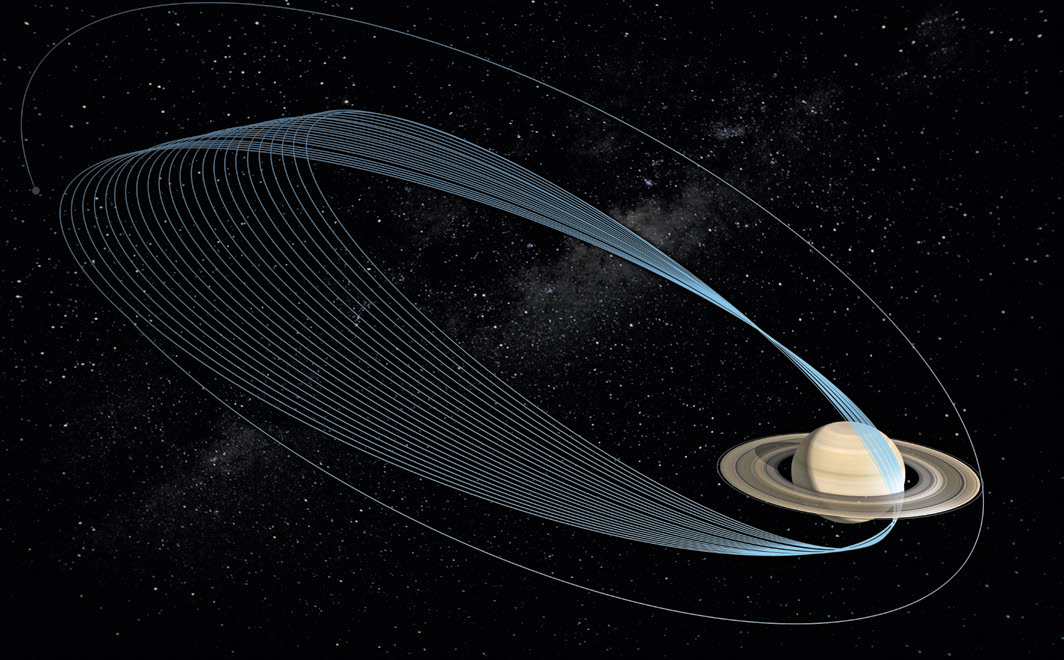
In its planned last 22 orbits of Saturn, the Cassini spacecraft will pass between the innermost ring and the planet itself. Credit NASA, JPL.
04/24/2017 – Ephemeris – A story of the Great Bear, Ursa Major
Ephemeris for Monday, April 24th. The Sun rises at 6:42. It’ll be up for 13 hours and 55 minutes, setting at 8:38. The Moon, 2 days before new, will rise at 6:32 tomorrow morning.
Appearing in the eastern sky at 10 p.m. tonight is the kite shaped constellation of Boötes the herdsman. The bright star Arcturus is at the bottom of the kite to the right, pointed to by the arc of the handle of the Big Dipper, higher in the east. In one story Boötes represents a young hunter named Arcas, son of Callisto, a beautiful young lady who had the misfortune of being loved by Zeus the chief of the Greek gods. Zeus’ wife Hera, found out about the affair, and since she couldn’t punish Zeus, turned the poor woman into an ugly bear. Arcas, many years later, unaware of the events surrounding his mother’s disappearance was about to kill the bear when Zeus intervened and placed them both in the sky to save her, as he continues to chase her across the sky nightly.
The times given are for the Traverse City/Interlochen area of Michigan. They may be different for your location.
Addendum
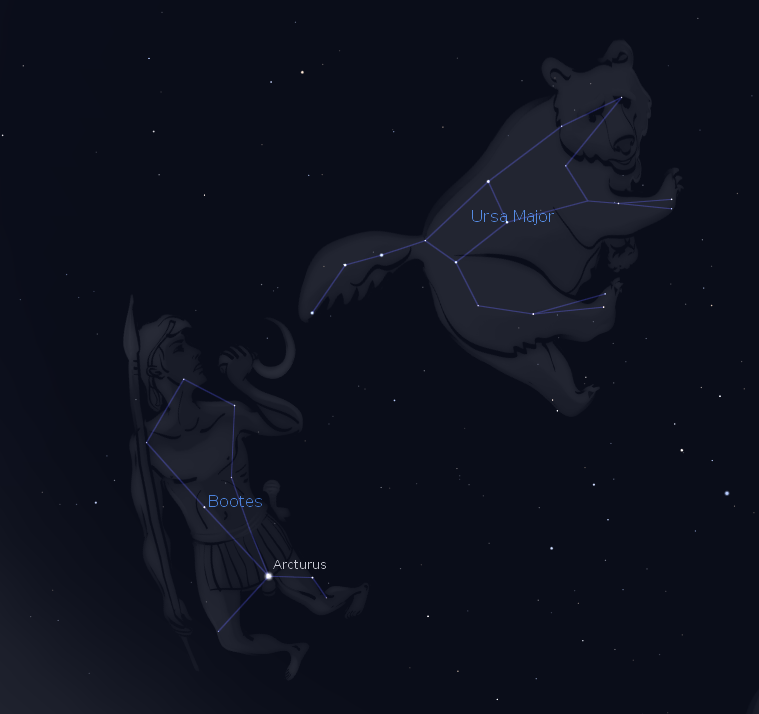
Bootes and Ursa Major aka Arcas chasing Callisto around the pole of the sky. Created using Stellarium.
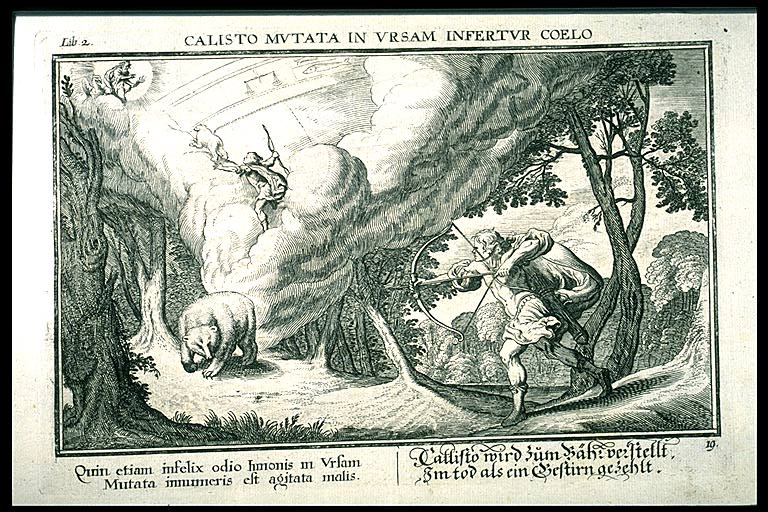
Arcas about to slay the bear by the 17th century artist Baur. Source: University of Virginia Electronic Text Center
04/21/2017 – Ephemeris – Mars is passing south of the Pleiades today
Ephemeris for Friday, April 21st. The Sun rises at 6:47. It’ll be up for 13 hours and 47 minutes, setting at 8:35. The Moon, 2 days past last quarter, will rise at 4:54 tomorrow morning.
Mars in its ever eastward trek through the constellations of the Zodiac is now just south of the Pleiades or Seven Sisters star cluster in the western evening twilight. By 10 p.m. Mars will be 10 degrees above the western horizon. That’s the width of a fist held at arm’s length. Because of our location on the Earth, the setting sky is tilted, so Mars being south of the Pleiades is to the lower left of it. The bright star Aldebaran, now brighter than Mars is to the left of it with the V-shaped star cluster called the Hyades, in mythology, half sisters of the Pleiades, filling out the face of Taurus the bull. Mars will finally be overtaken by the Sun on July 26th. After that it will spend more than a year to come closer to us than at any time since August 2003.
First star party of the year at the Sleeping Bear Dunes National Lakeshore
Tomorrow night the Rangers of the Sleeping Bear Dunes National Lakeshore and the Grand Traverse Astronomical Society will host a Star Party at the Dune Climb featuring the planet Jupiter, and the stars of spring. It starts at 9 p.m.
The times given are for the Traverse City/Interlochen area of Michigan. They may be different for your location.
Addendum
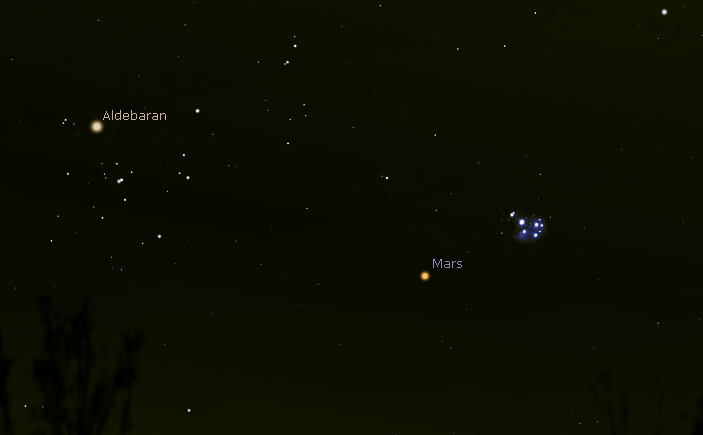
Mars and the Pleiades at 10 p.m. April 21, 2017. Aldebaran and the Hyades which is the face of Taurus the bull is to the left of them. Created using Stellarium.
Note that the nebulosity in the Pleiades exists, but is not visible to the naked eye.
04/20/2017 – Ephemeris – The Lyrid meteors are reaching their peak now
Ephemeris for Thursday, April 20th. The Sun rises at 6:49. It’ll be up for 13 hours and 44 minutes, setting at 8:33. The Moon, 1 day past last quarter, will rise at 4:20 tomorrow morning.
We are in a period where the Lyrid meteors appear. This capricious shower peaks at various times and with a variety of peak numbers from 14 to 90 per hour. The expected peak will be April 22nd at 8 a.m. The radiant point, from where the meteors seem to come, lies between the constellation Lyra and its bright star Vega and Hercules to the west of it. The radiant point starts the evening low in the northeast and moves nearly overhead when the Moon finally rises. The meteors, sometimes called falling stars will appear all over the sky, but can be traced back to that radiant point. The best time to see these or any meteor shower is when the radiant point is highest in the sky. That will be Saturday morning.
The times given are for the Traverse City/Interlochen area of Michigan. They may be different for your location.
Addendum
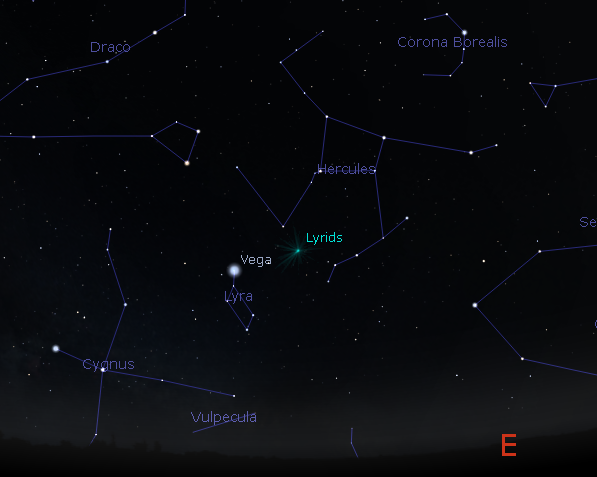
Location of the Lyrid meteor radiant at midnight. Note that the radiant point is a spot that the meteors can be back tracked to. The meteors will appear all over the sky. If they appear near the radiant they will appear to move the slowest, since their actual motion is mostly toward the observer. Created using Stellarium.
The display of meteor shower radiants is a plug-in in the latest versions of Stellarium.
04/19/2017 – Ephemeris – Let’s take our weekly look at the bright planets
Ephemeris for Wednesday, April 19th. The Sun rises at 6:51. It’ll be up for 13 hours and 41 minutes, setting at 8:32. The Moon, at last quarter today, will rise at 3:44 tomorrow morning.
Let’s take our Wednesday weekly look at the bright planets. Mars is still in the west after sunset and fading. It’s near the Pleiades star cluster now. It will set at 11:06 p.m. Coming to dominate the evening sky low in the southeast in evening twilight is Jupiter. It’s seen near the bright blue-white star Spica this year. At 6 a.m. Jupiter is still hanging on very low on the western horizon, and will set at 6:36 a.m. At the same time Saturn be about due south. It will rise in the east-southeast at 1:38 a.m. tomorrow. The Moon will be seen in the southeast at that hour. Venus will be low in the east at 6 a.m. tomorrow morning after rising at 5:22 a.m. It will appear as a tiny crescent moon in binoculars.
The times given are for the Traverse City/Interlochen area of Michigan. They may be different for your location.
Addendum
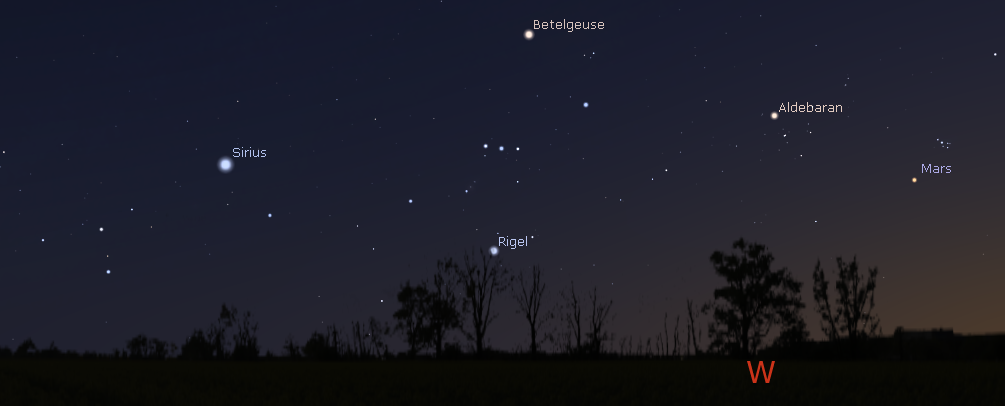
Mars in the west with bright stars at 9:30 p.m. April 19, 2017. Created using Stellarium.
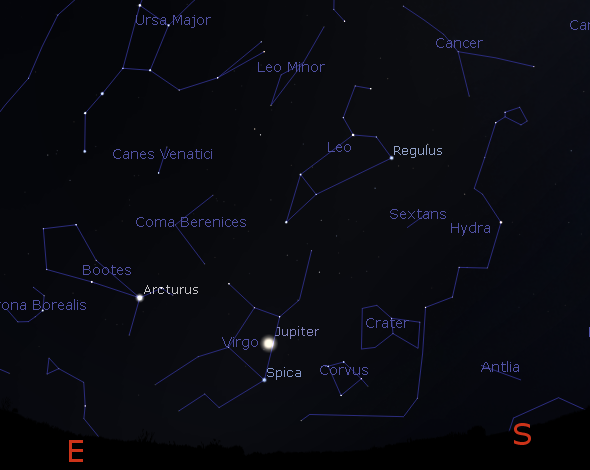
Jupiter in dark skies with some southern spring constellations on April 19, 2017 at 10 p.m. Created using Stellarium.
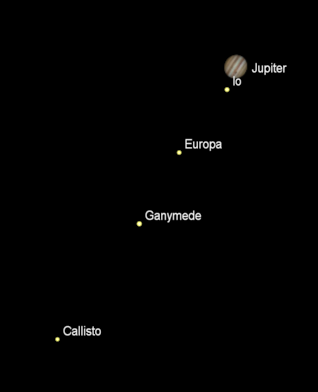
Jupiter and moons at 10 p.m. April 19, 2017. Created using Cartes du Ciel (Sky Charts).
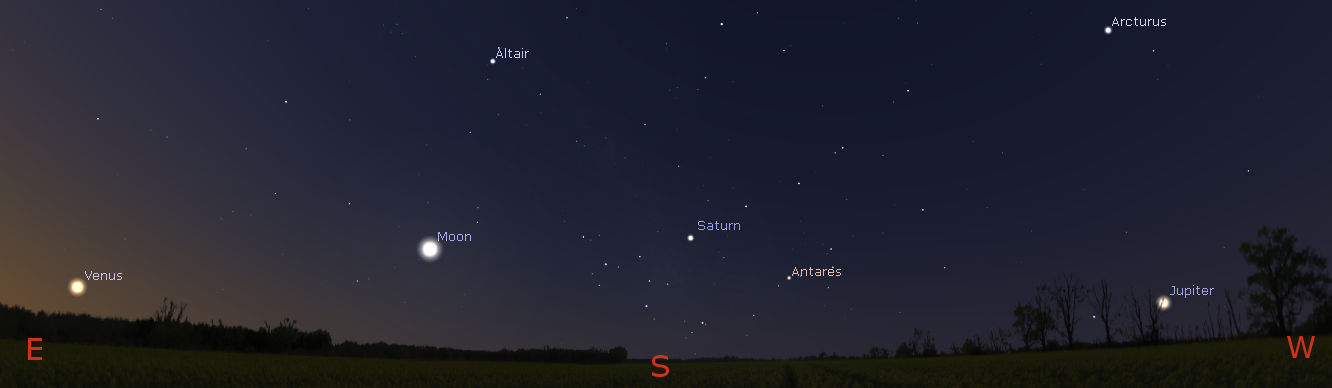
Jupiter, Saturn, the Moon, and Venus at the eastern horizon at 6 a.m. April 20, 2017. Created using Stellarium.
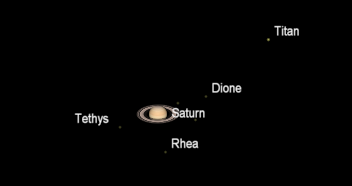
Saturn and moons in telescopes at 6 a.m. April 20, 2017. Created using Cartes du Ciel (Sky Charts).
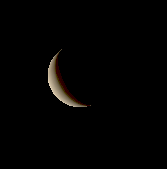
Telescopic Venus as created with Stellarium for early morning April 20, 2017. Stellarium is coloring Venus as it would be colored low in the sky.
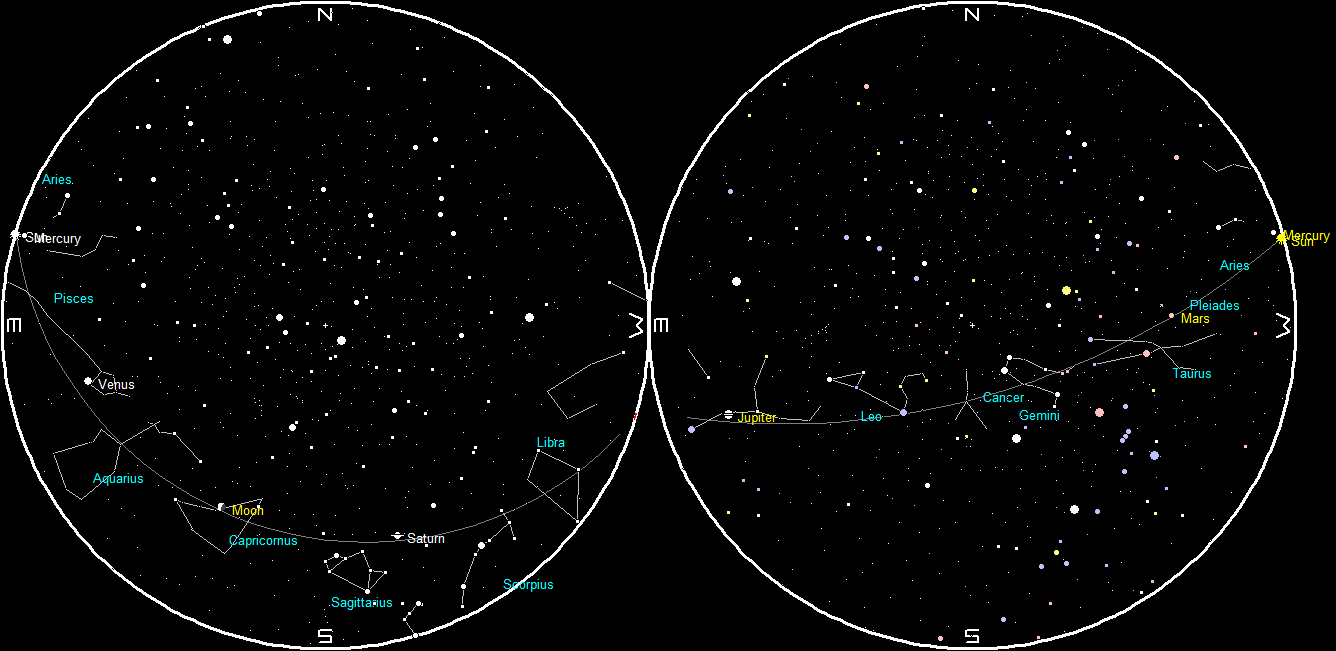
Planets and the Moon at sunset and sunrise of a single night starting with sunset on the right on April 19, 2017. The night ends on the left with sunrise on April 20. Click on the image to enlarge. Created using my LookingUp program.
04/18/2017 – Ephemeris – How Queen Berenice lost her hair
Ephemeris for Tuesday, April 18th. The Sun rises at 6:52. It’ll be up for 13 hours and 38 minutes, setting at 8:31. The Moon, 1 day before last quarter, will rise at 3:04 tomorrow morning.
High in the east-southeast at 10 p.m. is the tiny and faint constellation of Coma Berenices, or Berenice’s Hair. In it are lots of faint stars that look like several strands of hair. The whole group will fit in the field of a pair of binoculars, which will also show many more stars. The star cluster is 280 light years away, nearly twice as far as the Hyades, the face of Taurus the Bull setting in the west. The story behind it was that Berenice was the Queen of Egypt, whose husband was away at war. She offered her golden tresses to the gods for the king’s safe return. The hair, was placed in a temple. However the offering disappeared when the king returned. Ever since the constellation of Coma Berenices has been seen to commemorate the queen’s sacrifice.
The times given are for the Traverse City/Interlochen area of Michigan. They may be different for your location.
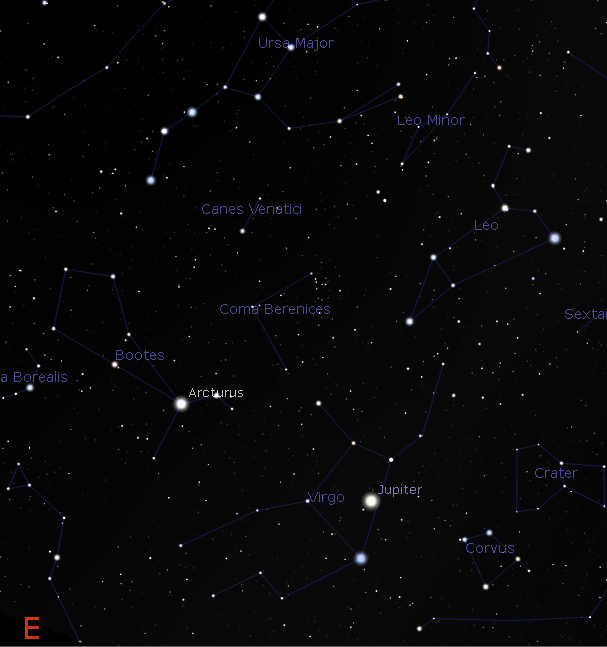
Coma Berenices finder chart for 10 p.m. April 18, 2017. Created using Stellarium.
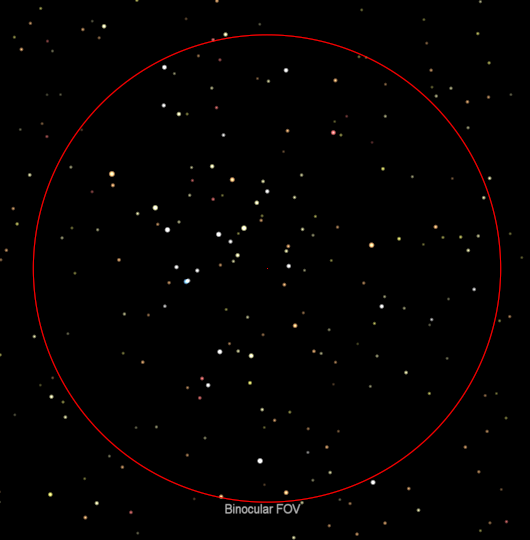
Approximate 7 power binocular field of view of the Coma Berenices Cluster. Created using Carted du Ciel (Sky Charts).
Addendum
04/17/2017 – Ephemeris – How to find the stars Arcturus and Spica from the Big Dipper
Ephemeris for Monday, April 17th. The Sun rises at 6:54. It’ll be up for 13 hours and 35 minutes, setting at 8:30. The Moon, 2 days before last quarter, will rise at 2:21 tomorrow morning.
The Big Dipper, now nearing the zenith at 10 p.m. points to several stars and constellations. It’s handle points to two bright stars. First we follow the arc of the handle to the bright orange star Arcturus, the 4th brightest night-time star. The reason I say night-time is that the sun is a star also but by definition is not out at night. The arc to Arcturus is a how to find Arcturus and a clue to its name. Arcturus, midway up the sky in the east, lies at the base point of the kite shaped constellation of Boötes the herdsman. From Arcturus, straighten out the arc to a spike and one soon arrives at Spica a blue-white star in Virgo the virgin, now low in the southeast. It is below Jupiter this year. Spica is also sometimes pronounced ‘Speeka’.
The times given are for the Traverse City/Interlochen area of Michigan. They may be different for your location.
Addendum
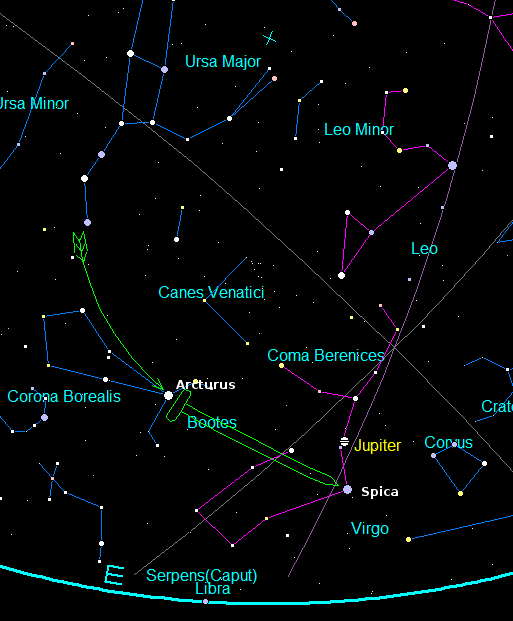
How to find the stars Arcturus and Spica from the Big Dipper in April 2017. Created using my LookingUp program.
 Bob Moler's Ephemeris Blog