Archive
06/16/2017 – Ephemeris – Two astronomy events this weekend
Ephemeris for Friday, June 16th. Today the Sun will be up for 15 hours and 33 minutes, setting at 9:29, and it will rise tomorrow at 5:56. The Moon, 1 day before last quarter, will rise at 1:58 tomorrow morning.
There are two astronomy events in the Grand Traverse region this weekend, starting tonight with a twilight talk and a star party at the Betsie Valley District Library in Thompsonville. It starts at 9 p.m. with a talk about how to safely view the August 21st eclipse of the Sun from this area and from the path of totality, 600 miles south of here. After which Jupiter and Saturn will be visible. If cloudy, the talk will go on as scheduled, though the observing part will be canceled.
Tomorrow, Saturday there, will be viewing at the Northwestern Michigan College’s Rogers Observatory starting at 9 p.m. Jupiter and Saturn will be featured there too. The Observatory is located south of Traverse City on Birmley road.
The times given are for the Traverse City/Interlochen area of Michigan. They may be different for your location.
06/15/2017 – Ephemeris – Saturn is at opposition from the Sun today
Ephemeris for Thursday, June 15th. Today the Sun will be up for 15 hours and 32 minutes, setting at 9:29, and it will rise tomorrow at 5:56. The Moon, 2 days before last quarter, will rise at 1:28 tomorrow morning.
The Planet Saturn was in opposition with the Sun at 5:15 (09:15 UT) this morning. That means that it was 180 degrees from the Sun, well 178.6 degrees to be exact, because the Earth is a bit south of the Sun-Saturn line. This is a time when the shadows of the rings on the planet and planet on the rings almost disappear, due to our vantage point. Saturn is also closest now at 842 million miles (1.356 billion km). It average distance being about 940 million miles (1.5 billion km). In three months our emissary to Saturn, the Cassini spacecraft will dive beneath Saturn’s clouds to burn up after using up almost all its maneuvering fuel. Then we with our telescopes on and around Earth will remain the only link to the ringed planet.
The times given are for the Traverse City/Interlochen area of Michigan. They may be different for your location.
Addendum
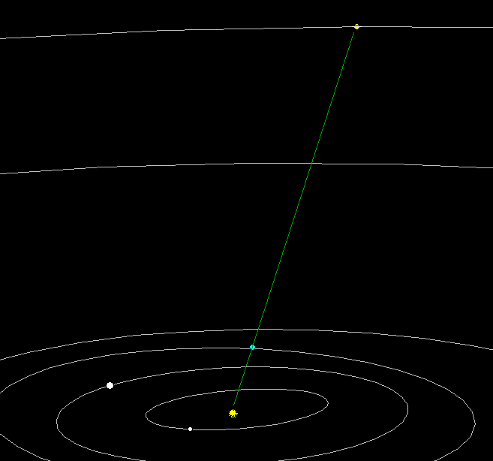
Saturn at opposition in a perspective view of the solar system which compresses the fact that Saturn is 10 times farther from the Sun as the Earth. Created using my LookingUp program.
06/14/2017 – Ephemeris – Let’s take our weekly look at the bright planets
Ephemeris for Flag Day, Wednesday, June 14th. Today the Sun will be up for 15 hours and 32 minutes, setting at 9:29, and it will rise tomorrow at 5:56. The Moon, 3 days before last quarter, will rise at 12:56 tomorrow morning.
Let’s take our weekly look at the bright planets. Dominating the evening sky now is Jupiter in the south-southwest. The bright blue-white star Spica, which pales in comparison to it, is seen left and below it. In even the smallest telescopes Jupiter’s four largest moons can be seen. They shift positions night from to night and sometimes even as you watch. Jupiter will set at 2:46 a.m. Saturn can now be seen in the evening as twilight fades in the southeast. Saturn will reach opposition from the Sun early tomorrow morning. At 5 a.m. both Saturn and Venus will be in the morning twilight. Brilliant Venus will be low in the east tomorrow morning after rising at 3:45 a.m.
The times given are for the Traverse City/Interlochen area of Michigan. They may be different for your location.
Addendum
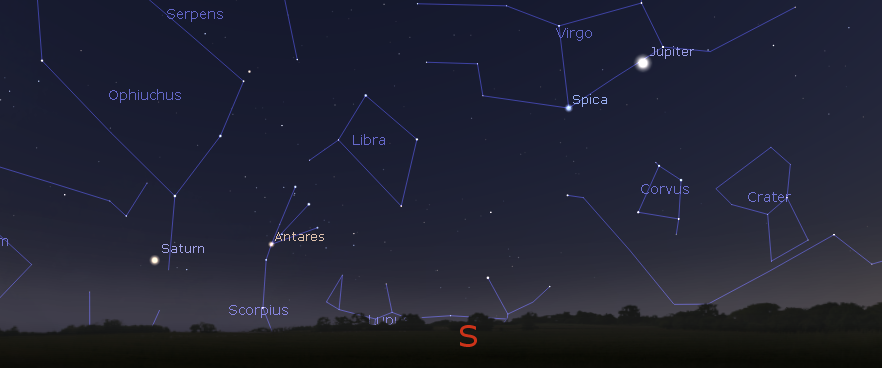
Jupiter and Saturn and the southern evening constellations at 10:30 p.m., June 14, 2017. Created using Stellarium.

Jupiter and its four Galilean moons as they might be seen in a telescope at 10:30 p.m,. June 14, 2017. Created using Cartes du Ciel (Sky Charts).
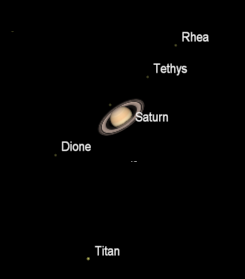
Saturn and its brightest moons overnight June 14/15, 2017. Created using Cartes du Ciel (Sky Charts).
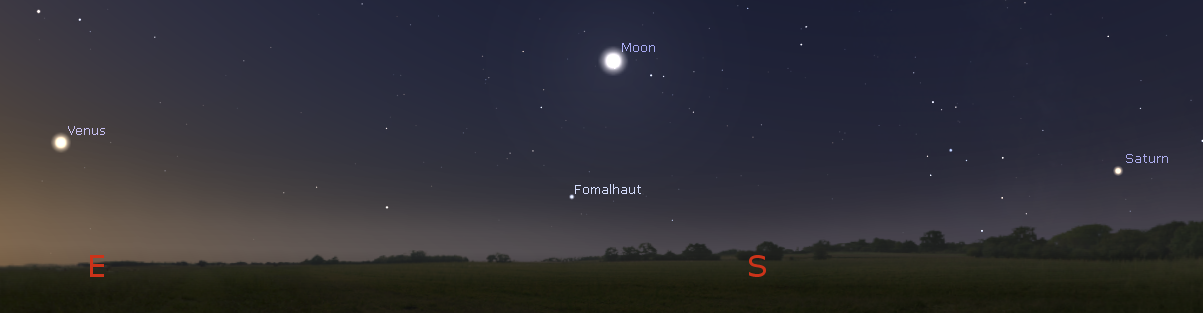
Venus, Saturn and the Moon at 5 a.m. June 15, 2017. Created using Stellarium. Click on the image to expand.
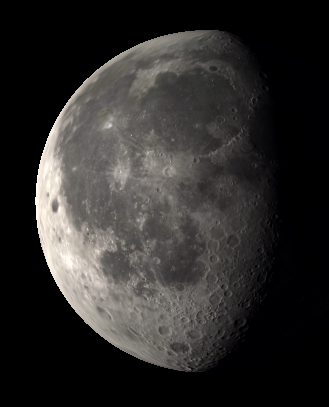
The moon as it might be seen in binoculars, at 5 a.m., June 15, 2017. Created using Stellarium.
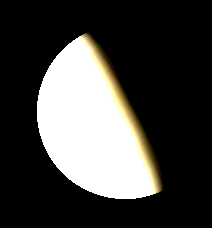
Venus as it might be seen through a telescope at 5 a.m. June 15, 2017. This is displayed at a larger scale/magnification than the Jupiter or Saturn images above. Created using Stellarium.
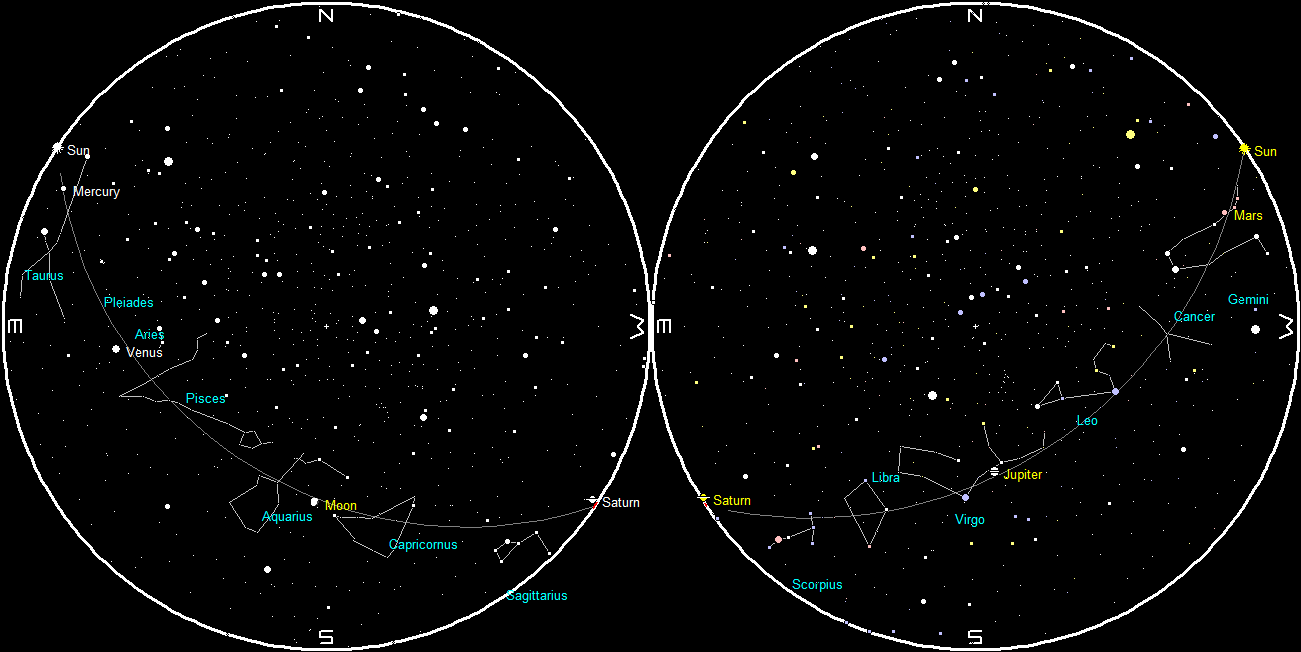
Planets at sunset and sunrise of a single night starting with sunset on the right on June 14, 2017. The night ends on the left with sunrise on June 15. Click on the image to enlarge. Created using my LookingUp program.
06/13/2017 – Ephemeris – I call Antares the UFO star
Ephemeris for Tuesday, June 13th. Today the Sun will be up for 15 hours and 31 minutes, setting at 9:28, and it will rise tomorrow at 5:56. The Moon, half way from full to last quarter, will rise at 12:22 tomorrow morning.
Last week I was observing and showing another person the sky when she remarked about that star low in the sky. That star happened to be Antares, which I call the UFO star. This is a red giant star which in Interlochen and Traverse City never rises above 19 degrees over the southern horizon. It is located in the heart of the constellation Scorpius the Scorpion. With the turbulence in the Earth’s atmosphere, being more marked for objects low in the sky, Antares twinkles mightily. And also being low in the sky, the atmosphere also breaks Antares’ light into a rainbow of colors which, under binocular and telescopic magnification can give the appearance of a multicolored sparkler.
The times given are for the Traverse City/Interlochen area of Michigan. They may be different for your location.
Addendum
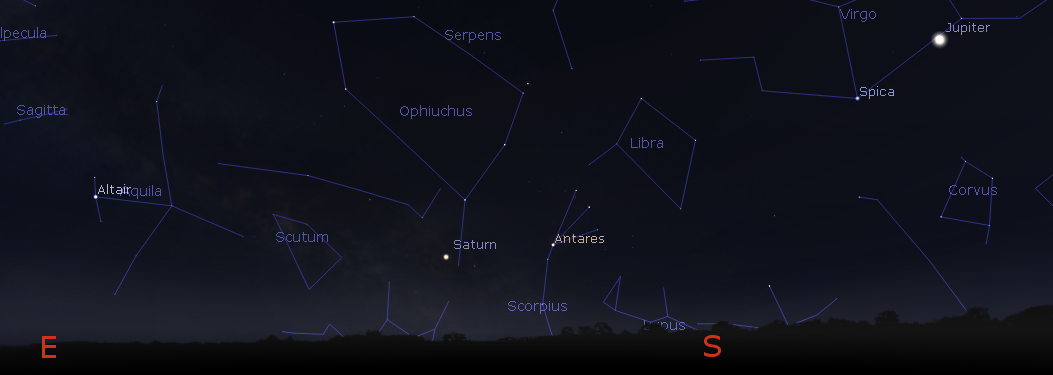
The star Antares in the heart of Scorpius and the planets Saturn and Jupiter at 11 p.m., June 1, 2017. Created using Stellarium.
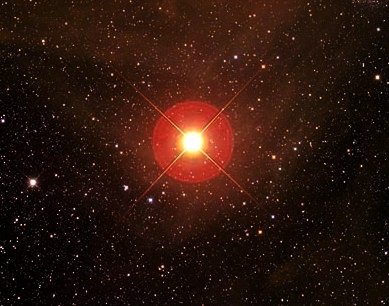
The star Antares in long exposure in this image probably taken from farther south than here. Source unknown, however because the star has four diffraction spikes the photograph was taken with a reflector telescope whose secondary mirror is supported by a 4 vane “spider”.
06/12/2017 – Ephemeris – Now is a great time to view Saturn
Ephemeris for Monday, June 12th. Today the Sun will be up for 15 hours and 31 minutes, setting at 9:28, and it will rise tomorrow at 5:56. The Moon, 3 days past full, will rise at 11:44 this evening.
In three days the planet Saturn will be opposite the Sun in the sky. Astronomers simply call it opposition. It’s the time Saturn will be closest to us, and appear biggest in telescopes. That’s not a big a deal as for a closer, smaller planet like Mars or Venus. Being ten times farther from the Sun than the Earth Saturn’s distance and thus it’s size varies by only plus or minus 10%. Another event happened on Saturn last month, Summer started in it’s northern hemisphere. Saturn’s rings orbit the planet over it’s equator, and Saturn’s axial tilt of obliquity is 26 degrees, similar to the Earth’s actually. This summer solstice means that the rings are at their most open because we are viewing Saturn from near the Sun, so a first glance through a telescope Saturn looks elliptical, with the planetary ball completely within the rings.
The times given are for the Traverse City/Interlochen area of Michigan. They may be different for your location.
Addendum
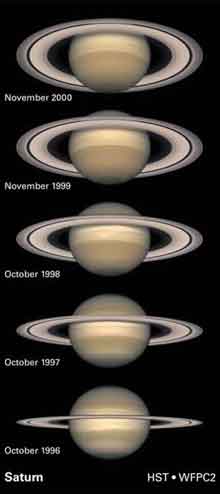
Saturn’s Rings over time as they closed. Credit NASA/HST/WFPC2
Now the rings are opened to their maximum extent with the northern hemisphere of Saturn uncovered by the rings and the southern hemisphere covered by them, the reverse of the top image.
06/09/2017 – Ephemeris – Watch the mini moon rise tonight
Ephemeris for Friday, June 9th. Today the Sun will be up for 15 hours and 29 minutes, setting at 9:26, and it will rise tomorrow at 5:57. The Moon, at full today, will rise at 9:26 this evening.
In recent years we’ve talked about the super moon, when the full Moon appears especially large because it’s at perigee, or closest to the Earth at that time. Well tonight’s full Moon will be a the opposite, a mini Moon. The Moon reached apogee, its farthest from the Earth in it’s orbit at 6:21 last night, and 15 hours later, at 9:10 this morning the Moon was full. However I bet that when the Moon rises tonight that it will appear just as big as it always does, especially if you forget that it’s supposed to be a mini moon. The Moon is in an elliptical orbit of the Earth that this month varies from 252,500 miles (406,400 km) yesterday down to 222,400 miles (357,900 km) on the 23rd. Thanks to the Sun, and especially Jupiter and Venus, those distances change a bit every month. Tonight Saturn will be seen just below the moon.
The times given are for the Traverse City/Interlochen area of Michigan. They may be different for your location.
Addendum
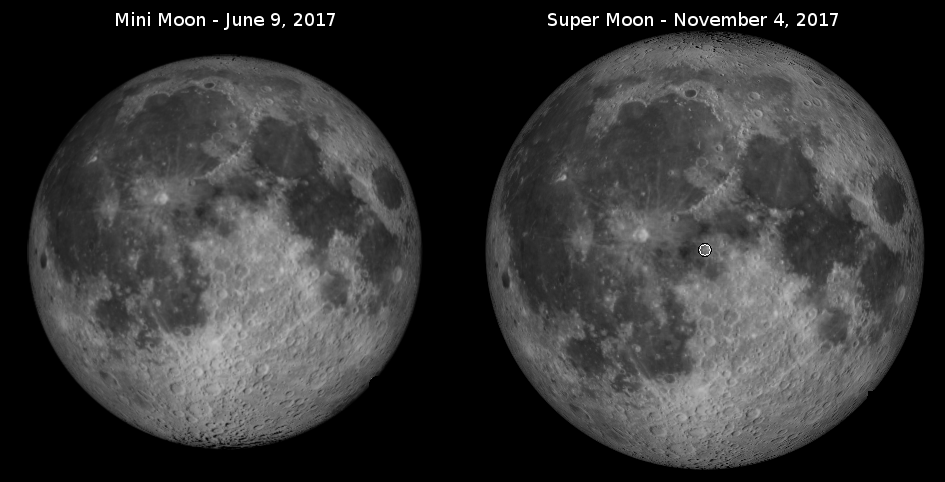
Mini Moon and Super Moon for 2017. Created using Cartes du Ciel (Sky Charts).
06/08/2017 – Ephemeris – The late heavy bombardment of the inner planets
Ephemeris for Thursday, June 8th. Today the Sun will be up for 15 hours and 28 minutes, setting at 9:25, and it will rise tomorrow at 5:57. The Moon, 1 day before full, will set at 6:22 tomorrow morning.
The Moon and many bodies of the inner solar system have many craters which bear witness to many meteorite hits. In studying lunar samples brought back by the Apollo astronauts, from Russian lunar sample return missions and meteorites found on Earth that came from the Moon planetary scientists found that many of their ages correspond to a narrow range of dates of 3.8 to 4.1 billion years ago. Radioisotope dating of rocks would date them to the last time they were molten. This lead to the hypothesis that about a half billion years after the planets were formed, the inner solar system bodies were pelted with millions of asteroids in what is known as the late heavy bombardment. The reason is not completely understood, but one hypothesis is that the outer planets migrated destabilizing the asteroid belt causing the solar system to be a shooting gallery.
The times given are for the Traverse City/Interlochen area of Michigan. They may be different for your location.
Addendum
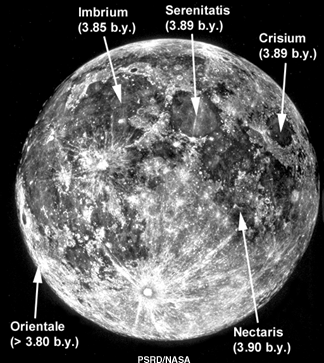
Lunar seas and their ages. Credit NASA.
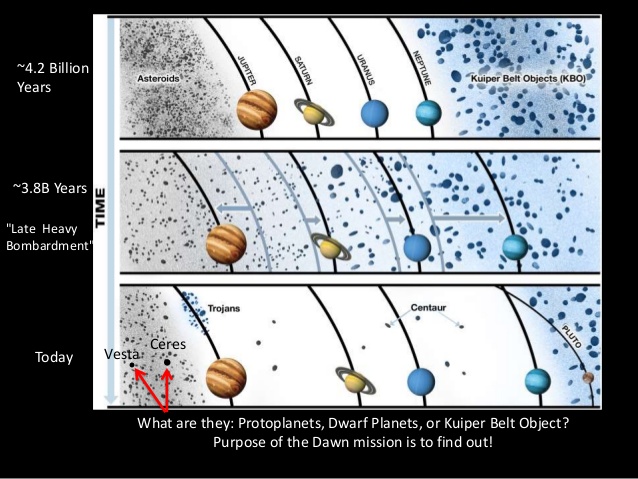
How the migration of the outer planets caused the Late Heavy Bombardment. Credit James Green, Director Planetary Science, NASA.
06/07/2017 – Ephemeris – It’s Wednesday and time to look at this week’s planets
Ephemeris for Wednesday, June 7th. Today the Sun will be up for 15 hours and 27 minutes, setting at 9:25, and it will rise tomorrow at 5:57. The Moon, 2 days before full, will set at 5:44 tomorrow morning.
Let’s take our weekly look at the bright planets. I’m no longer going to cover Mars until it’s back in the morning sky next year. It’s too dim in twilight t really spot. Though next year July it will be closer to us than it’s been since 2003. Dominating the evening sky now besides the Moon is Jupiter in the south-southwest. The bright blue-white star Spica is seen left and below it. In even the smallest telescopes Jupiter’s four largest moons can be seen. They shift positions night from to night and sometimes even as you watch. Jupiter will set at 3:13 a.m. Saturn can now be seen late in the evening after it rises in the east-southeast at 9:46 p.m. At 5 a.m. both Saturn and Venus will be in the morning twilight. Brilliant Venus will be low in the east tomorrow morning after rising at 3:33 a.m.
The times given are for the Traverse City/Interlochen area of Michigan. They may be different for your location.
Addendum
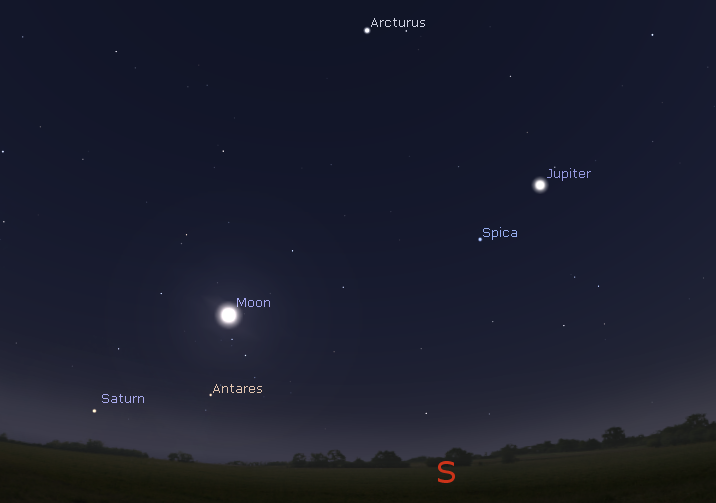
Jupiter and the Moon in twilight at 10:30 p.m., June 7, 2017. Created using Stellarium.
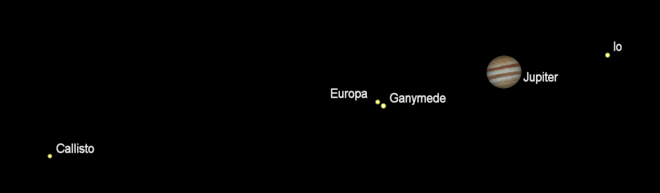
Jupiter and its four Galilean moons as they might be seen in a telescope at 10:30 p.m,. June 7, 2017. Created using Cartes du Ciel (Sky Charts).
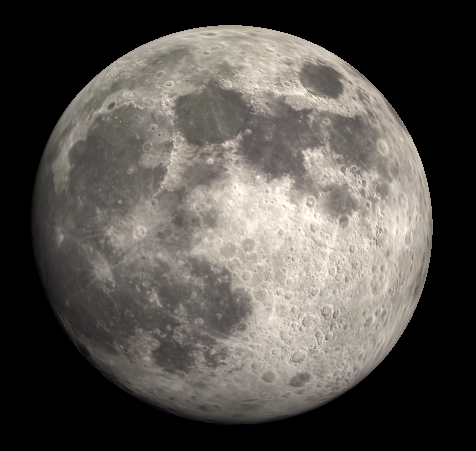
The moon as seen in binoculars, tonight at 10:30 p.m., June 7, 2017. Created using Stellarium.
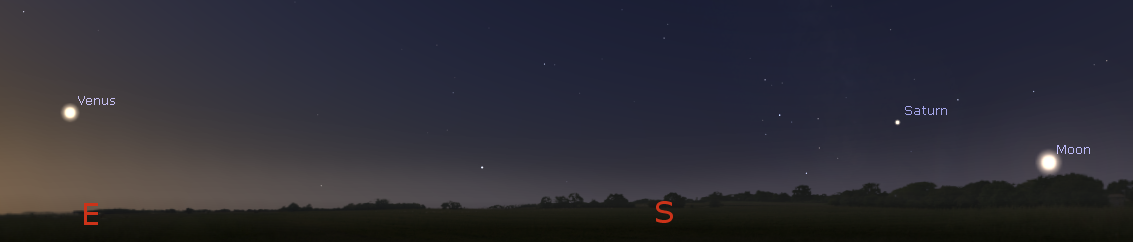
Venus, Saturn and the setting Moon at 5 a.m. June 8, 2017. Created using Stellarium. Click on the image to expand.
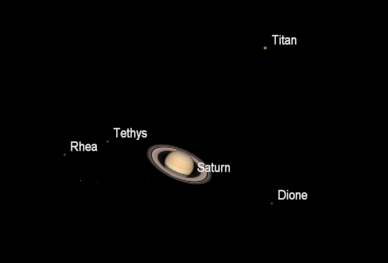
Saturn and its brightest moons overnight June 7/8, 2017. Created using Cartes du Ciel (Sky Charts).
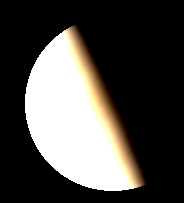
Venus as it might be seen through a telescope at 5 a.m. June 8, 2017. This is displayed at a larger scale/magnification than the Jupiter or Saturn images above. Created using Stellarium.
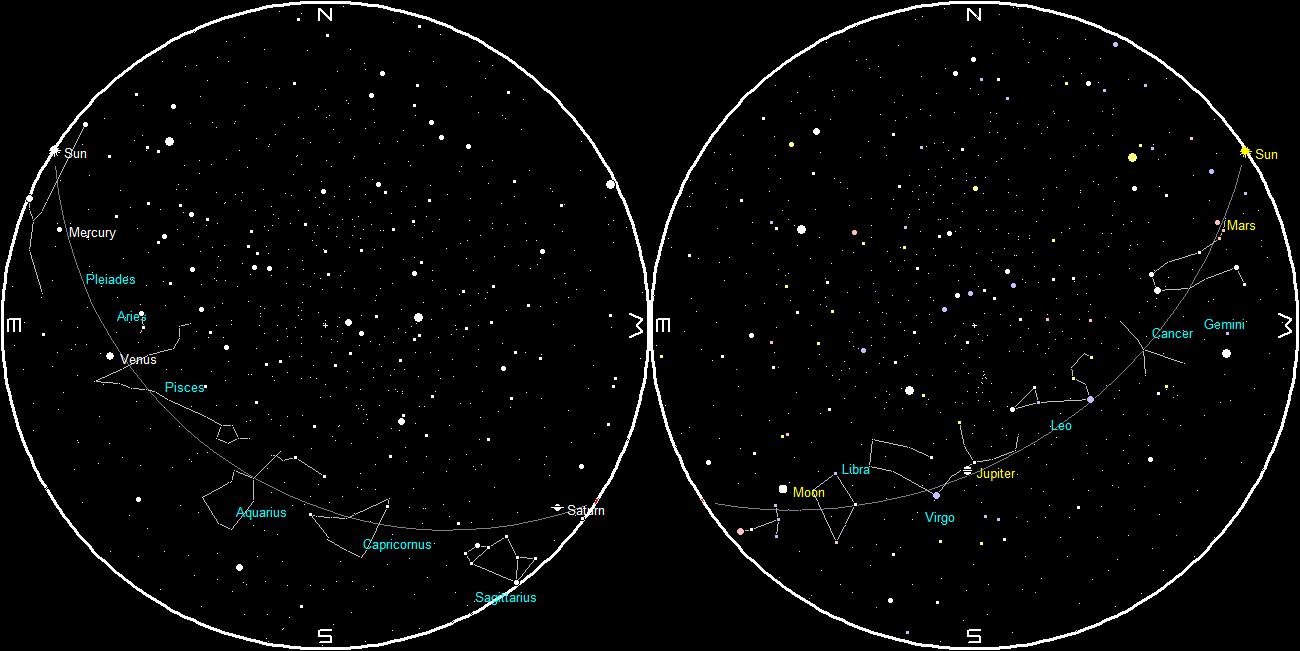
Planets at sunset and sunrise of a single night starting with sunset on the right on June 7, 2017. The night ends on the left with sunrise on June 8. Click on the image to enlarge. Created using my LookingUp program.
06/06/2017 – Ephemeris – Where did the Moon come from?
Ephemeris for Tuesday, June 6th. Today the Sun will be up for 15 hours and 26 minutes, setting at 9:24, and it will rise tomorrow at 5:57. The Moon, 3 days before full, will set at 5:10 tomorrow morning.
The origin of the Moon is a question that has vexed astronomers for years. Did it break off the molten Earth like a cell dividing? Was it captured by passing too close to the Earth? Neither is satisfactory. Chemical elements have different isotopes depending on the number of neutrons in their nucleus. The rocks brought back by the Apollo astronauts show that the isotopes of the elements in the rocks is that same as for the Earth. We know that Mars and the asteroids have different isotope ratios. The hypothesis that seems most likely is that another planet, the size of Mars collided with the 100 million year old Earth in a glancing blow that gave rise to a disk of material that eventually coalesced into the Moon.
The times given are for the Traverse City/Interlochen area of Michigan. They may be different for your location.
Addendum
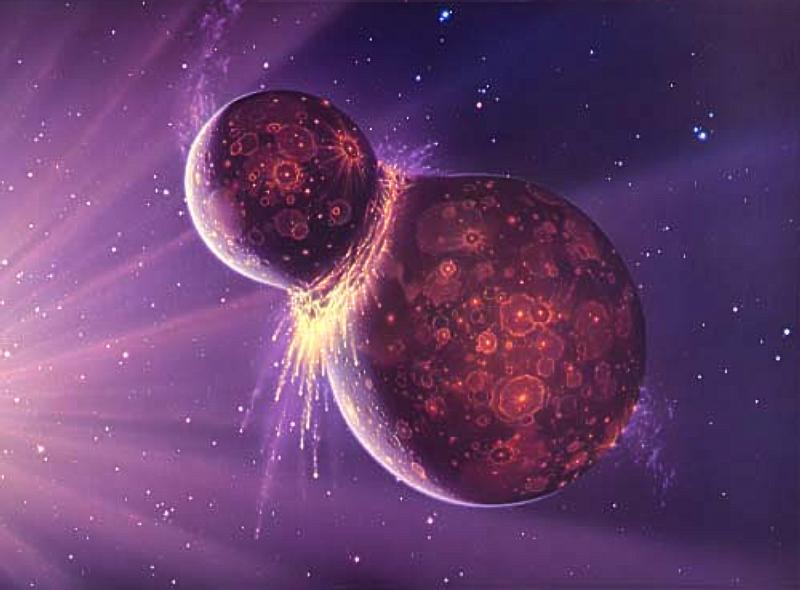
The hypothetical collision of a Mars sized body with the young Earth. Credit: Joe Tucciarone via NASA
06/05/2017 – Ephemeris – Why Venus is low in the eastern sky
Ephemeris for Monday, June 5th. Today the Sun will be up for 15 hours and 25 minutes, setting at 9:23, and it will rise tomorrow at 5:58. The Moon, half way from first quarter to full, will set at 4:40 tomorrow morning.
Saturday the planet Venus was at greatest western elongation from the Sun, That is it is the farthest west it will appear from the Sun. It’s still not very high in our sky. However for those in the southern hemisphere Venus will appear very high in the east. There is a rule about this: Planets which are east of the Sun, like Mars is now are easiest seen on spring evenings. Planets which are west of the Sun, like Venus is now are easiest seen on autumn mornings. Since the southern hemisphere has the opposite seasons as the north, this is their autumn, and morning planets are easiest seen. This is especially true for Mercury, which is even closer to the Sun than Venus. Generally it’s only seen when it appears on spring evenings and autumn mornings.
The times given are for the Traverse City/Interlochen area of Michigan. They may be different for your location.
Addendum
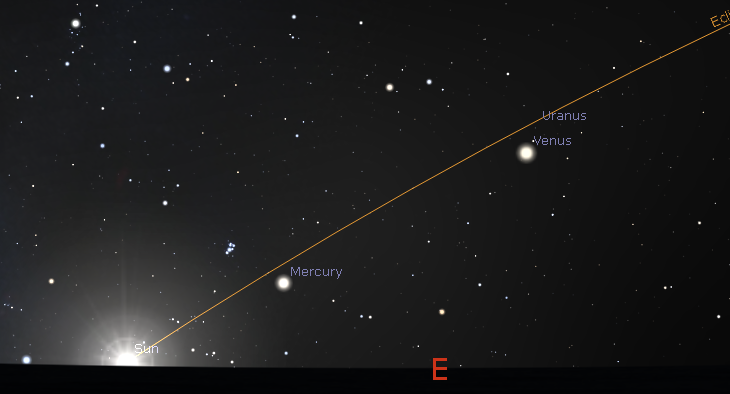
Venus’ low morning appearance is due to the fact that on spring mornings the ecliptic (red line path of the Sun in the sky and nearly that of the planets) lies low to the horizon. Created using Stellarium.
 Bob Moler's Ephemeris Blog