Archive
08/31/2017 – Ephemeris – Looking ahead at the month of September
Ephemeris for Thursday, August 31st. The Sun will rise at 7:04. It’ll be up for 13 hours and 16 minutes, setting at 8:20. The Moon, 2 days past first quarter, will set at 2:24 tomorrow morning.
Let’s look at the skies for the month of September. The sun will moving at its greatest speed in its retreat to the south. Daylight hours in the Interlochen/Traverse City area and will drop from 13 hours and 13 minutes tomorrow to 11 hours 44 minutes on the 30th. The altitude of the sun above the southern horizon at local noon will be 54 degrees tomorrow, and will descend to 42 degrees on the 30th. The season of summer is getting short, so enjoy it while you can. Summer ends and autumn begins at 4:02 p.m. on September 22nd. We are losing Jupiter in the evening sky in September, but this month, but on the 12th Mercury will be at its greatest separation from the Sun in the morning sky and relatively easy to spot.
The times given are for the Traverse City/Interlochen area of Michigan. They may be different for your location.
Addenda
September Evening Sky Chart
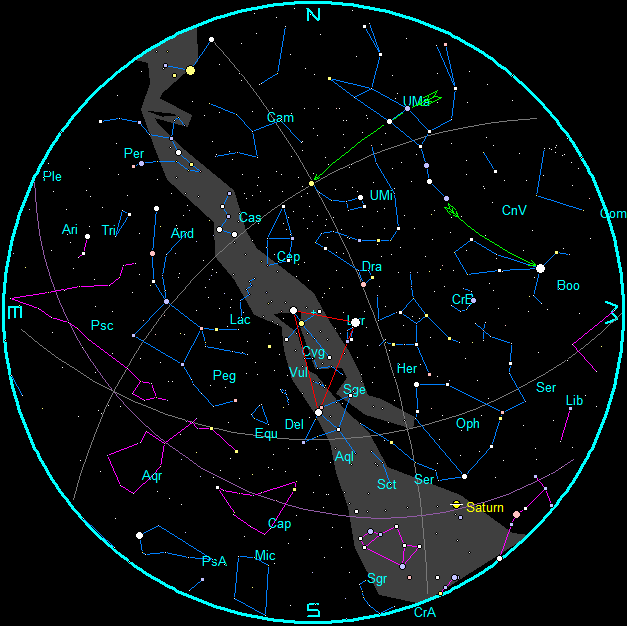
Star Chart for September 2017 (10 p.m. September 15, 2017). Created using my LookingUp program. Click on image to enlarge.
The planets and stars are plotted for the 15th at 10 p.m. EDT in the evening and 6 a.m. for the morning chart. These are the chart times. Note that Traverse City is located approximately 45 minutes behind our time meridian. (An hour 45 minutes behind our daylight saving time meridian. during EDT and 45 minutes behind our daylight standard time meridian. during EST). To duplicate the star positions on a planisphere you may have to set it to 1 hour 45 minutes (Daylight Time) or 45 minutes (Standard Time) earlier than the current time if you are near your time meridian.
Note the chart times of 10 p.m. and 6 a.m. are for the 15th. For each week before the 15th add ½ hour. For each week after the 15th subtract ½ hour. The planet positions are updated each Wednesday on this blog.
September Morning Star Chart
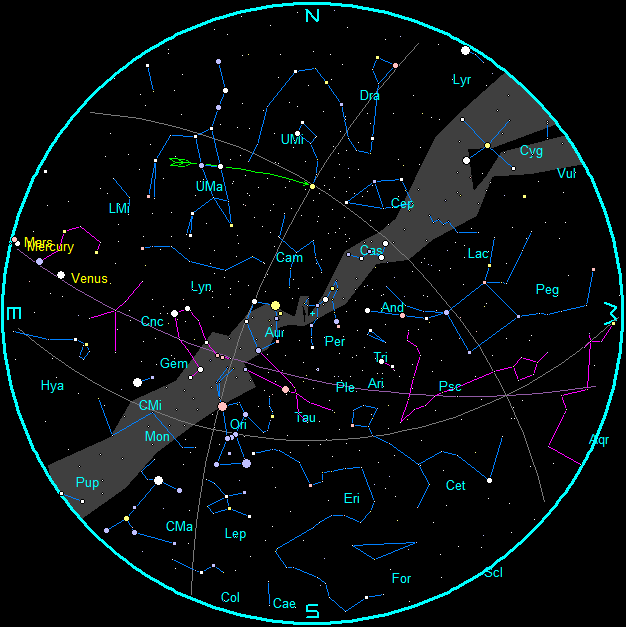
Star Chart for September 2017 mornings based on 6 a.m. September 15th. Created using my LookingUp program. Click on image to enlarge.
For a list of constellation names to go with the abbreviations click here.
- Pointer stars at the front of the bowl of the Big Dipper point to Polaris the North Star
- Leaky Big Dipper drips on Leo
- Follow the arc of the handle of the Big Dipper to the star Arcturus,
- The Summer Triangle is in red
Evening nautical twilight ends at 9:28 p.m. EDT on the 1st, decreasing to 8:31 p.m. EDT on the 30th.
Evening astronomical twilight ends at 10:06 p.m. EDT on the 1st, decreasing to 9:05 p.m. EDT on the 30th.
Morning astronomical twilight starts at 5:26 a.m. EDT on the 1st, and increasing to 6:07 a.m. EDT on the 30th.
Morning nautical twilight starts at 6:04 a.m. EDT on the 1st, and increasing to 6:42 a.m. EDT on the 30th.
NASA Calendar of Planetary Events
Sep 01  Fr          Venus: 31.7° W
    01  Fr  2:10 am Venus-Beehive: 1.5° S
    04  Mo  2:41 pm Moon Descending Node
    05  Tu 12:18 am Neptune Opposition
    06  We  3:03 am Full Moon
    10  Su  1:30 am Mercury-Regulus: 0.7° S
    10  Su  5:39 pm Jupiter-Spica: 3.1° N
    12  Tu  5:59 am Mercury Elongation: 17.9° W
    12  Tu  8:09 am Moon-Aldebaran: 0.4° S
    13  We  2:25 am Last Quarter
    13  We 12:04 pm Moon Perigee: 369900 km
    14  Th  9:00 am Moon North Dec.: 19.4° N
    16  Sa 10:50 am Moon-Beehive: 3.2° N
    16  Sa  2:26 pm Mercury-Mars Conjunction: 0.1° N
    17  Su  2:28 pm Moon Ascending Node
    17  Su  8:56 pm Moon-Venus: 0.6° N
    18  Mo 12:32 am Moon-Regulus: 0.1° S
    19  Tu  5:30 pm Venus-Regulus: 0.5° N
    20  We  1:30 am New Moon
    22  Fr  3:51 am Moon-Jupiter: 4° S
    22  Fr  4:02 pm  Autumnal Equinox
    26  Tu  8:09 pm Moon-Saturn: 3.8° S
    27  We  2:49 am Moon Apogee: 404300 km
    27  We 10:54 pm First Quarter
    28  Th  6:06 am Moon South Dec.: 19.5° S
Oct 01  Su          Venus: 24.5° W
Sky Events Calendar by Fred Espenak and Sumit Dutta (NASA’s GSFC),
http://eclipse.gsfc.nasa.gov/SKYCAL/SKYCAL.html
If you go to the above site you can print out a list like the above for the entire year
or calendar pages for your time zone.
August Sun and Moon Rising and Setting Events
LU                Ephemeris of Sky Events for Interlochen/TC
September, 2017    Local time zone: EDT
+-----------------------------------------------------------------------+
| DATE |  SUN     SUN  DAYLIGHT|   TWILIGHT*    |MOON  RISE OR    ILLUM |
|      |  RISE    SET    HOURS |  END    START  |PHASE SET** TIME FRACTN|
+=======================================================================+
|Fri  1| 07:05a  08:18p  13:13 | 09:25p  05:59a |      Set  03:16a   82%|
|Sat  2| 07:06a  08:17p  13:10 | 09:23p  06:00a |      Set  04:13a   89%|
+------+-----------------------+----------------+-----------------------+
|Sun  3| 07:07a  08:15p  13:07 | 09:21p  06:01a |      Set  05:13a   94%|
|Mon  4| 07:09a  08:13p  13:04 | 09:19p  06:03a |      Set  06:17a   98%|
|Tue  5| 07:10a  08:11p  13:01 | 09:17p  06:04a |      Set  07:22a  100%|
|Wed  6| 07:11a  08:09p  12:58 | 09:14p  06:05a |Full  Rise 08:38p   99%|
|Thu  7| 07:12a  08:07p  12:55 | 09:12p  06:07a |      Rise 09:08p   97%|
|Fri  8| 07:13a  08:06p  12:52 | 09:10p  06:08a |      Rise 09:39p   91%|
|Sat  9| 07:14a  08:04p  12:49 | 09:08p  06:09a |      Rise 10:11p   84%|
+------+-----------------------+----------------+-----------------------+
|Sun 10| 07:16a  08:02p  12:46 | 09:06p  06:11a |      Rise 10:47p   75%|
|Mon 11| 07:17a  08:00p  12:43 | 09:04p  06:12a |      Rise 11:27p   64%|
|Tue 12| 07:18a  07:58p  12:40 | 09:02p  06:13a |      Rise 12:13a   53%|
|Wed 13| 07:19a  07:56p  12:37 | 09:00p  06:15a |L Qtr Rise 01:05a   42%|
|Thu 14| 07:20a  07:54p  12:34 | 08:58p  06:16a |      Rise 02:05a   31%|
|Fri 15| 07:21a  07:52p  12:30 | 08:56p  06:17a |      Rise 03:10a   21%|
|Sat 16| 07:23a  07:51p  12:27 | 08:54p  06:19a |      Rise 04:18a   12%|
+------+-----------------------+----------------+-----------------------+
|Sun 17| 07:24a  07:49p  12:24 | 08:52p  06:20a |      Rise 05:27a    6%|
|Mon 18| 07:25a  07:47p  12:21 | 08:50p  06:21a |      Rise 06:36a    2%|
|Tue 19| 07:26a  07:45p  12:18 | 08:48p  06:22a |      Rise 07:43a    0%|
|Wed 20| 07:27a  07:43p  12:15 | 08:46p  06:24a |New   Set  08:17p    1%|
|Thu 21| 07:29a  07:41p  12:12 | 08:44p  06:25a |      Set  08:45p    4%|
|Fri 22| 07:30a  07:39p  12:09 | 08:42p  06:26a |      Set  09:14p    8%|
|Sat 23| 07:31a  07:37p  12:06 | 08:41p  06:28a |      Set  09:44p   15%|
+------+-----------------------+----------------+-----------------------+
|Sun 24| 07:32a  07:35p  12:03 | 08:39p  06:29a |      Set  10:17p   22%|
|Mon 25| 07:33a  07:34p  12:00 | 08:37p  06:30a |      Set  10:52p   30%|
|Tue 26| 07:35a  07:32p  11:57 | 08:35p  06:31a |      Set  11:32p   39%|
|Wed 27| 07:36a  07:30p  11:54 | 08:33p  06:33a |F Qtr Set  12:16a   49%|
|Thu 28| 07:37a  07:28p  11:50 | 08:31p  06:34a |      Set  01:05a   58%|
|Fri 29| 07:38a  07:26p  11:47 | 08:29p  06:35a |      Set  01:59a   68%|
|Sat 30| 07:39a  07:24p  11:44 | 08:27p  06:36a |      Set  02:58a   76%|
+-----------------------------------------------------------------------+
* Nautical Twilight
** Moonrise or moonset, whichever occurs between sunset and sunrise
08/30/2017 – Ephemeris – Checking upon the bright planets for this week
Ephemeris for Wednesday, August 30th. The Sun will rise at 7:02. It’ll be up for 13 hours and 19 minutes, setting at 8:22. The Moon, 1 day past first quarter, will set at 1:38 tomorrow morning.
Let’s take our weekly look at the bright planets. Jupiter is sinking really low in the west-southwest setting before the end of twilight. The bright blue-white star Spica, which pales in comparison to Jupiter, is seen below and left of it. Jupiter is moving eastward towards Spica now. It will pass north of Spica on September 11th. Jupiter will set at 10 p.m. Saturn can be seen tonight below, right of the Moon in the southern sky. The reddish star Antares is off to the right of Saturn. Saturn’s rings are spectacular in telescopes. The planet will set at 12:56 a.m. In the morning sky, brilliant Venus will rise at 4:15 a.m. and be visible until about 6:45 tomorrow morning. Mars and Mercury are now too close to the Sun for us to spot.
The times given are for the Traverse City/Interlochen area of Michigan. They may be different for your location.
Addendum
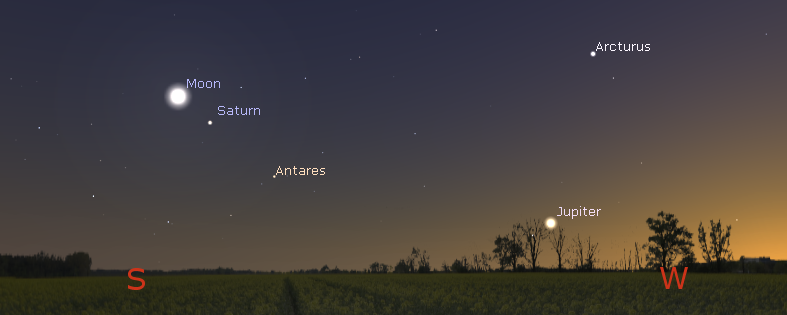
The setting Jupiter and Saturn near the Moon at 9 p.m., August 30, 2017. Created using Stellarium. Click on image to enlarge.
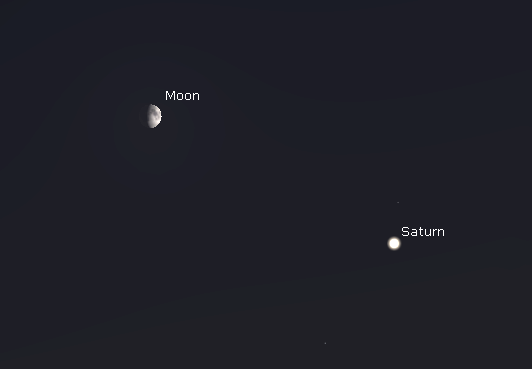
The Moon and Saturn at 9 p.m. August 30, 2017. Create using Stellarium.
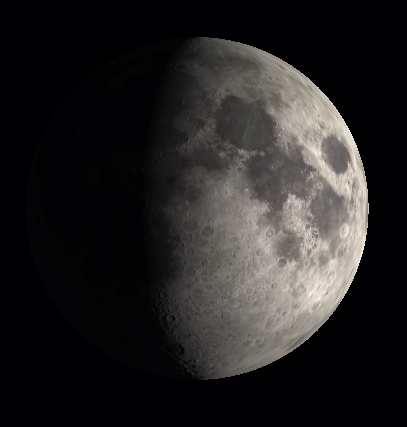
Moon as it might be seen in binoculars at 9 p.m., August 30, 2017. Created using Stellarium.
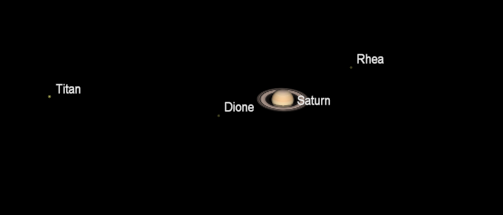
Saturn and its brightest moons overnight August 30/31, 2017. Created using Cartes du Ciel (Sky Charts).
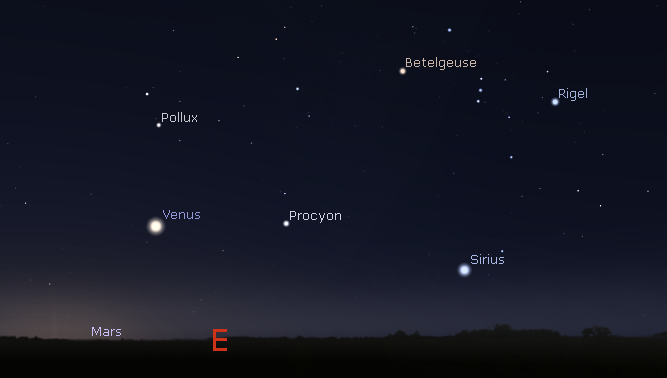
Venus at 6 a.m. August 31, 2017. Created using Stellarium.
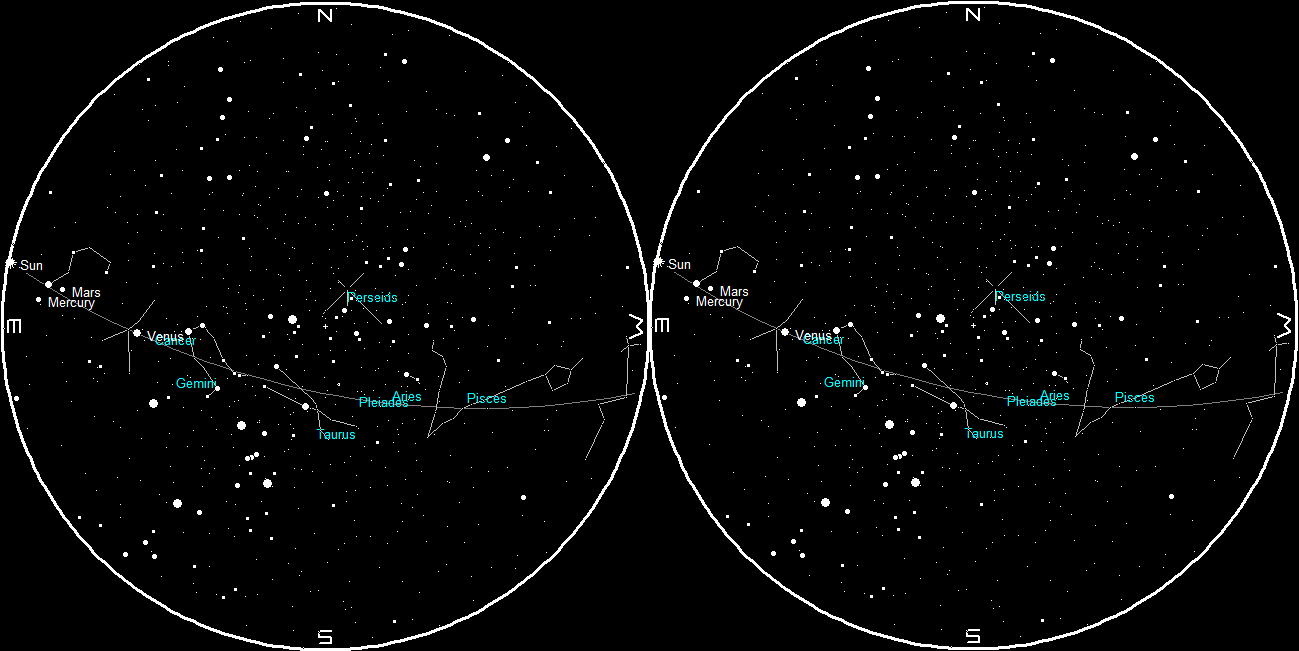
Planets at sunset and sunrise of a single night starting with sunset on the right on August 30, 2017. The night ends on the left with sunrise on August 31. Click on the image to enlarge. Created using my LookingUp program.
08/29/2017 – Ephemeris – My excellent eclipse adventure
Ephemeris for Tuesday, August 29th. The Sun will rise at 7:01. It’ll be up for 13 hours and 22 minutes, setting at 8:23. The Moon, at first quarter today, will set at 12:56 tomorrow morning.
This is the first program I’ve recorded since viewing the total solar eclipse 8 days ago. My daughter, youngest granddaughter and I ended up at the Howard County Fairgrounds just outside Fayette, Missouri at an event run by the University of Missouri Extension Service. There wasn’t a big crowd there and the travel there was pretty clear, since it was in the early morning. The day started fairly clear, but became cloudy. Telephoto photography was out, but I made a video of the time around totality that was quite fascinating showing the Moon’s shadow going over. The inner corona of the Sun was visible at totality. The story is on this blog here as an Ephemeris Extra posting for last Thursday, including the videos. Friday I’ll tell where you can learn more.
The times given are for the Traverse City/Interlochen area of Michigan. They may be different for your location.
08/28/2017 – Ephemeris – Polaris the North Star
Ephemeris for Monday, August 28th. The Sun will rise at 7:00. It’ll be up for 13 hours and 25 minutes, setting at 8:25. The Moon, 1 day before first quarter, will set at 12:19 tomorrow morning.
The bright star Polaris is a very important star. It is also known as the North Star and the Pole Star. Its unique position is nearly directly at the zenith at the Earth’s north pole, making it a very important navigational star. It’s about 40 minutes of arc, or about one and a third Moon diameters away from the extension of the Earth’s axis into the sky. As a rule of thumb, it’s angular altitude above the northern horizon is approximately one’s latitude, and it stands about at the due north compass point. Polaris is found using the Big Dipper, using the two stars at the front of the dipper bowl to point to it. It’s located at the tip of the handle of the very dim Little Dipper, which this time of year in the evening appears to standing on its handle.
The times given are for the Traverse City/Interlochen area of Michigan. They may be different for your location.
Addendum
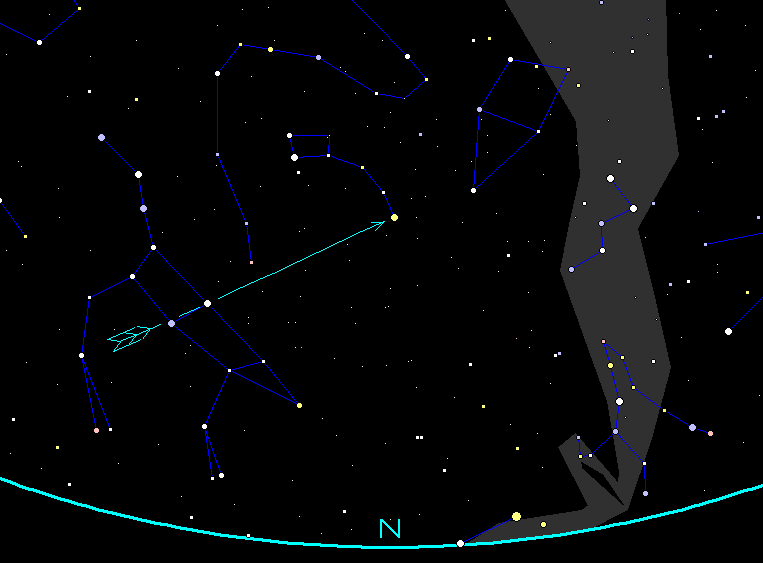
Polaris finder chart for 10 p.m., August 28th. Created using my LookingUp program
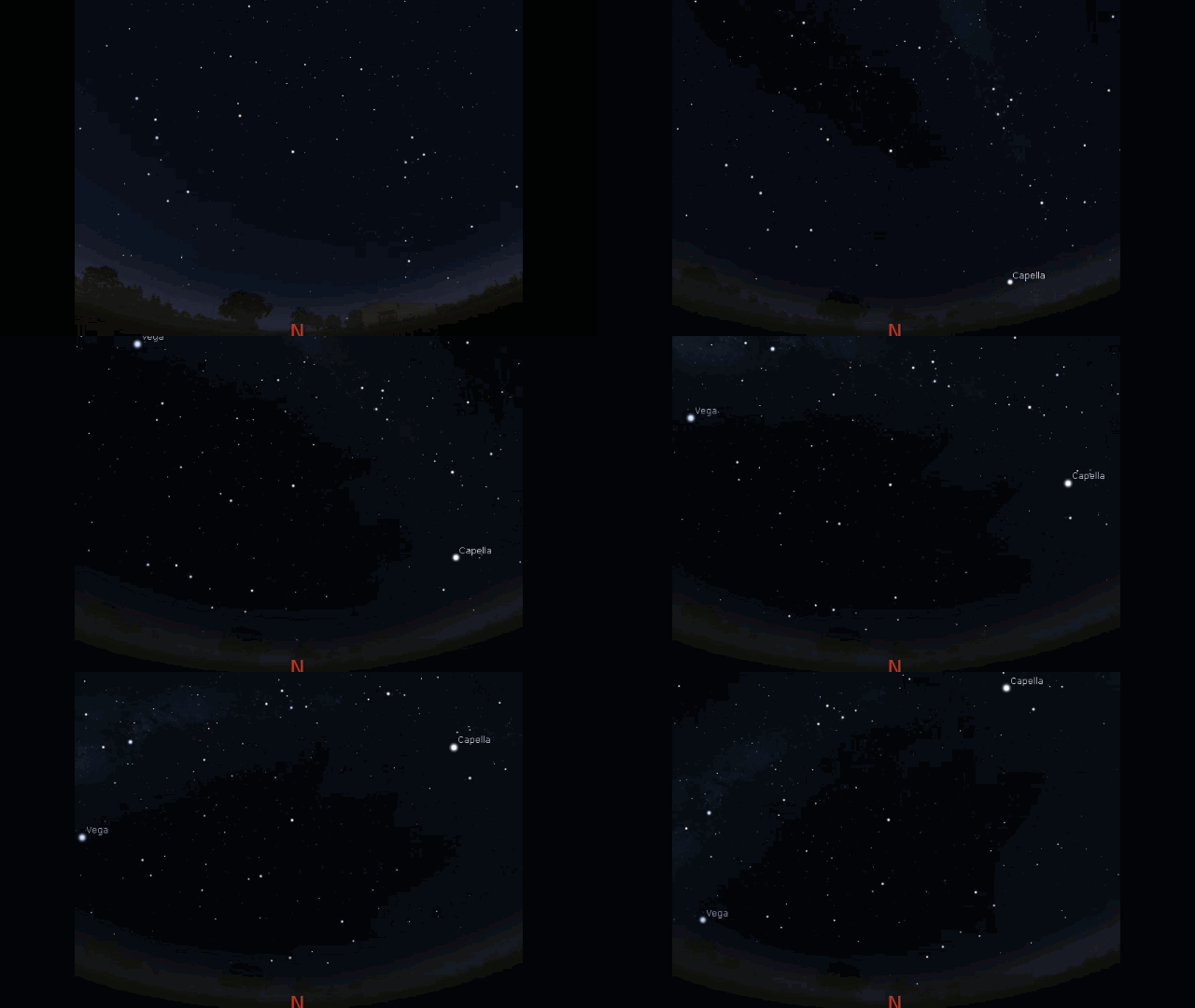
Animation of the rotation of the sky around Polaris on the night of August 28/29, 2017. Created using Stellarium and Filmora.
I’ve left the constellation lines off. The Big Dipper is seen easily as is Cassiopeia’s “W” opposite it around the stationary Polaris.
08/25/2017 – Ephemeris – Last Friday Night Live of the year
Ephemeris for Friday, August 25th. The Sun rises at 6:57. It’ll be up for 13 hours and 33 minutes, setting at 8:30. The Moon, half way from new to first quarter, will set at 10:46 this evening.
The Grand Traverse Astronomical Society will be at Friday Night Live on Front Street this evening after 5:30 p.m. Members will be showing the Sun if it’s clear, and early, maybe a peek at the Moon in the day time sky. Also if it’s clear after Friday Night Live is over the telescopes will be pulled back on the sidewalk to view Saturn and its fabulous rings. Tonight’s Friday night Live appearance by the Grand Traverse Astronomical Society will be the 32nd event hosted or attended this year. Everyone is welcome free of charge to the society’s meetings at Northwestern Michigan College’s Joseph H. Rogers Observatory on the first Friday of the month at 8 p.m., before one of the monthly star parties.
The times given are for the Traverse City/Interlochen area of Michigan. They may be different for your location.
Addendum

Viewing the Sun with a while light filter at Friday Night Live using Ron Uthe’s telescope at Friday Night Live. Credit Bob Moler.
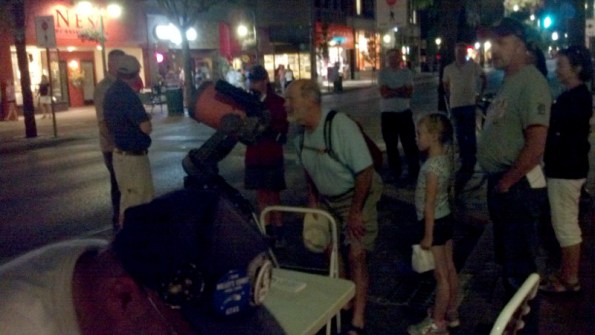
Passers by look at the Moon through Gary Carlisle’s telescope at a 2013 Friday Night Live. Credit mine.
Ephemeris Extra: My report of the total solar eclipse August 21, 2017
In planning for this eclipse my main goal was to keep away from crowds and traffic as much as possible. I originally wanted to stay in Springfield, IL, so I could go west or south. Earlier in the previous week I talked with the University of Missouri Extension service, and offered my services, so I felt kind of was obligated if the weather was half way decent. They were set up at the Howard County Fairgrounds in Fayette, MO. It turned out that we couldn’t get a room in Springfield, but could 60 miles north in Bloomington. One of the enticements to placate my granddaughter about the trip, was to visit some Lincoln sites in Springfield, which we did on Sunday the 20th. On Saturday and Sunday the 19th & 20th the weather forecast for Fayette looked bad with clouds and rain in the afternoon. So I made plans and checked routes in the direction of Paducah, KY.

Traffic heading south on I-55 by Springfield. Photo by Stephany Farrell.
I decided, after seeing the traffic heading down to south Illinois on I-55, that if the weather forecast improved for Fayette, MO I’d head there instead. By 11 p.m. the forecast for Fayette improved markedly. It was for partly cloudy skies, and the rain forecast for the afternoon was moved to Tuesday.
We headed out from our Bloomington, IL motel at 3 a.m. The sun came out just before we entered Missouri. The sky was mostly clear with cirrus and some stratus clouds, mostly in the south and west. There was no unusual traffic all the way there.
We were the first to arrive at 8 a.m. About a half hour later we were joined by folks in two cars from Ottumwa, IA. We all stuck pretty much together for the day, away from the building where most of the people, and entertainment was. All in all there were no more than a hundred people there.
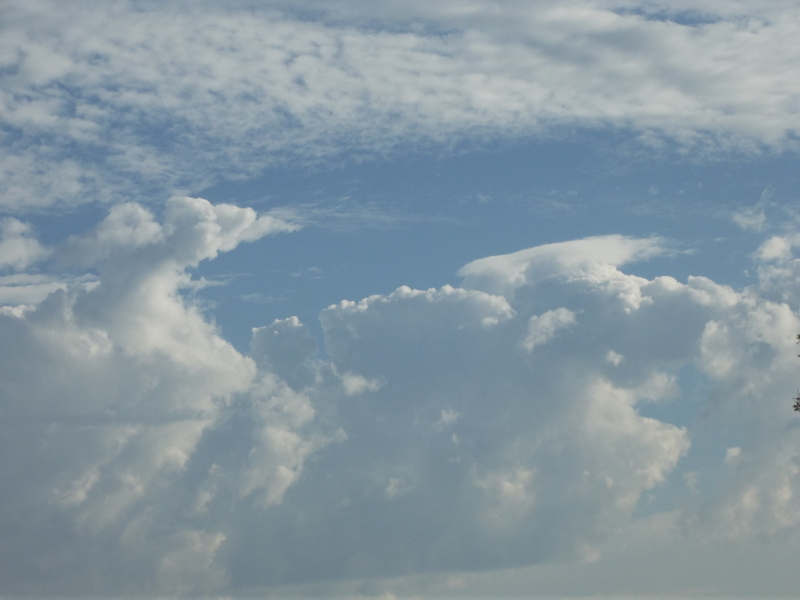
Beautiful, but not so friendly clouds. Photo by Stephany Farrell.
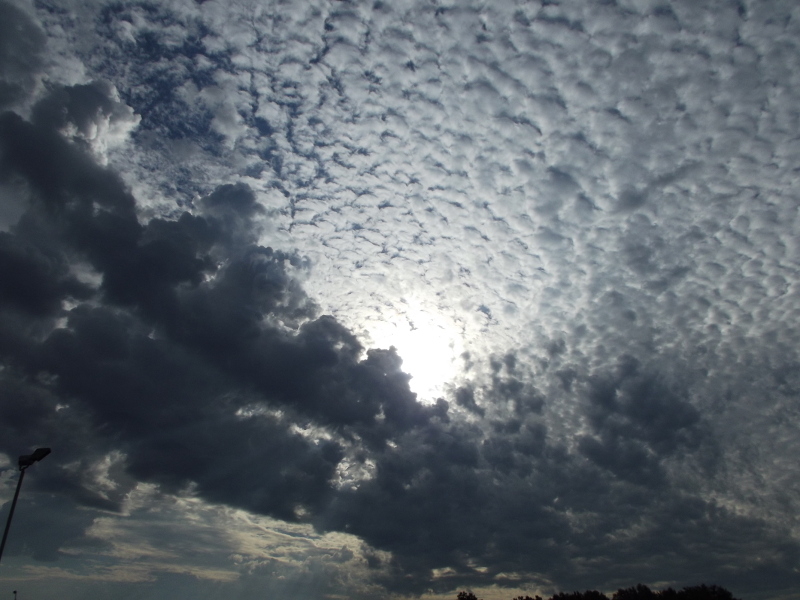
Definitely unfriendly clouds. Photo by Stephany Farrell.
As first contact approached it got progressively cloudier. After first contact I went over to the big shed where the entertainment was and some vendors, and gave a short talk on what to expect as totality approached. We had a $5 hamburger lunch provided by the Howard County Cattlemen’s Association. And bought $10 eclipse T-shirts. For the most part the Sun was visible through the clouds, if hazily. After first contact the skies worsened, eventually losing the Sun at one point, but then the Sun’s image improved, and continually so up to 4th contact. At totality the Sun’s inner corona was visible, but nothing beyond that. So my grand photographic plans were for naught.
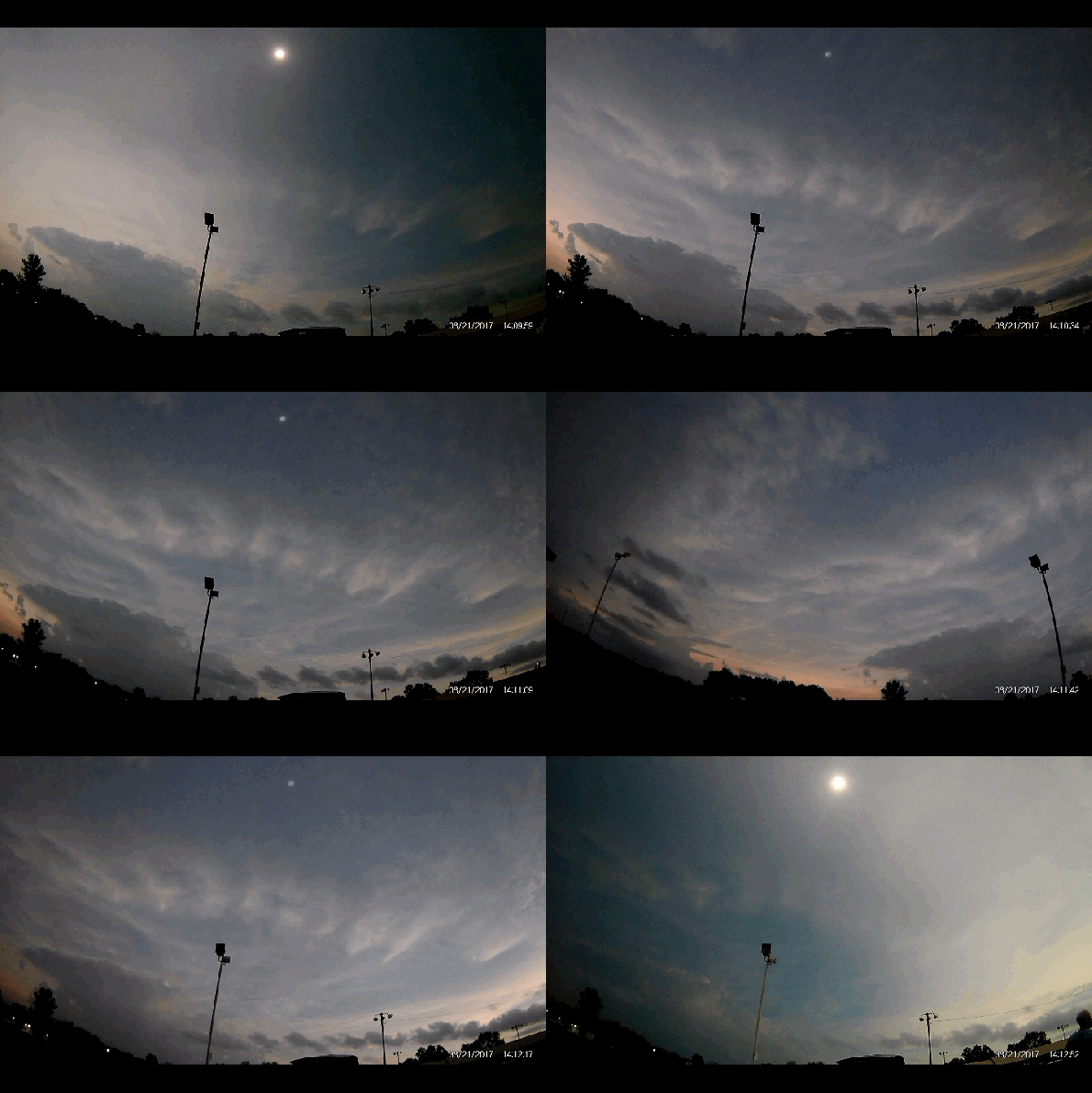
However, my little action camera recorded the sky for 45 minutes or so around the time of totality. And with playing it back yesterday, found that it recorded the Moon’s shadow going over very well. From it I’ve created 2 videos, one showing totality in real time, the other a time-lapse 2-minute video of 20 minutes centered on totality, in which the shadow of the Moon can be seen passing over us, darkening the translucent clouds from west to east. See the update below.
I gave my granddaughter, Bernadette (Bea) the job of recording the temperatures as the eclipse progressed. Here is a chart made from her data:
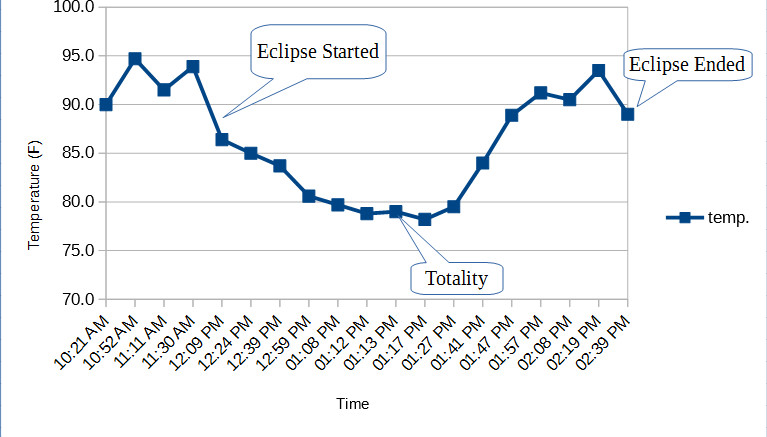
Bea’s temperature chart. From data taken by Bernadette Farrell.
The high temperature going in was 94.7 degrees, and the lowest was 78.2 degrees just after totality ended. It was stinking hot going in. But around totality there was a cool breeze coming from the southwest. It was refreshing.
I was going to spend more time soaking up the ambiance of the surreal world of totality this time, instead of staring at the Sun and sky. Well, I got it.
My videos of the eclipse are here: http://ephemeris.bjmoler.org/EclipseVideos_08-21-17.html.
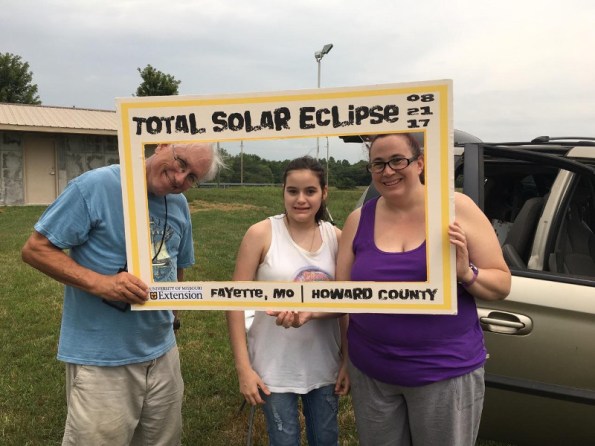
The eclipse crew: Left to Right – Bob, Bea and Stef.
Update: Below is an 11 MB animated GIF file of totality with the action camera mentioned above Starts at 14:09:59 and loops to 14:12:59. The eclipsed sun is the donut at the top of the image. Around mid-eclipse I pivot the camera up the eclipse path to the northwest, then pivot down the eclipse path to the southeast, before returning it to the sunward view.
Updated for spelling and grammar, 02/21/2024.
08/24/2017 – Ephemeris – Centaur or Teapot?
Ephemeris for Thursday, August 24th. The Sun rises at 6:55. It’ll be up for 13 hours and 36 minutes, setting at 8:32. The Moon, 3 days past new, will set at 10:17 this evening.
This time of year when the bright Moon near full is reluctant leave the evening sky the Moon after New is taking its time to enter the evening sky. Three days after new and the Moon sets at the end of twilight. At that time the constellation of Sagittarius the archer is low and due south in our sky. Sagittarius is a centaur, one of two in the sky. These half man and half horse creatures are rarely seen outside of Harry Potter movies. Since we’re more familiar with teapots, the stars here make a very passable stout little teapot of the children’s song. The Milky Way even looks like steam rising from the spout. And as the night progresses or the days go by, the teapot will tilt to pour its tea on the southwestern horizon.
The times given are for the Traverse City/Interlochen area of Michigan. They may be different for your location.
Addendum
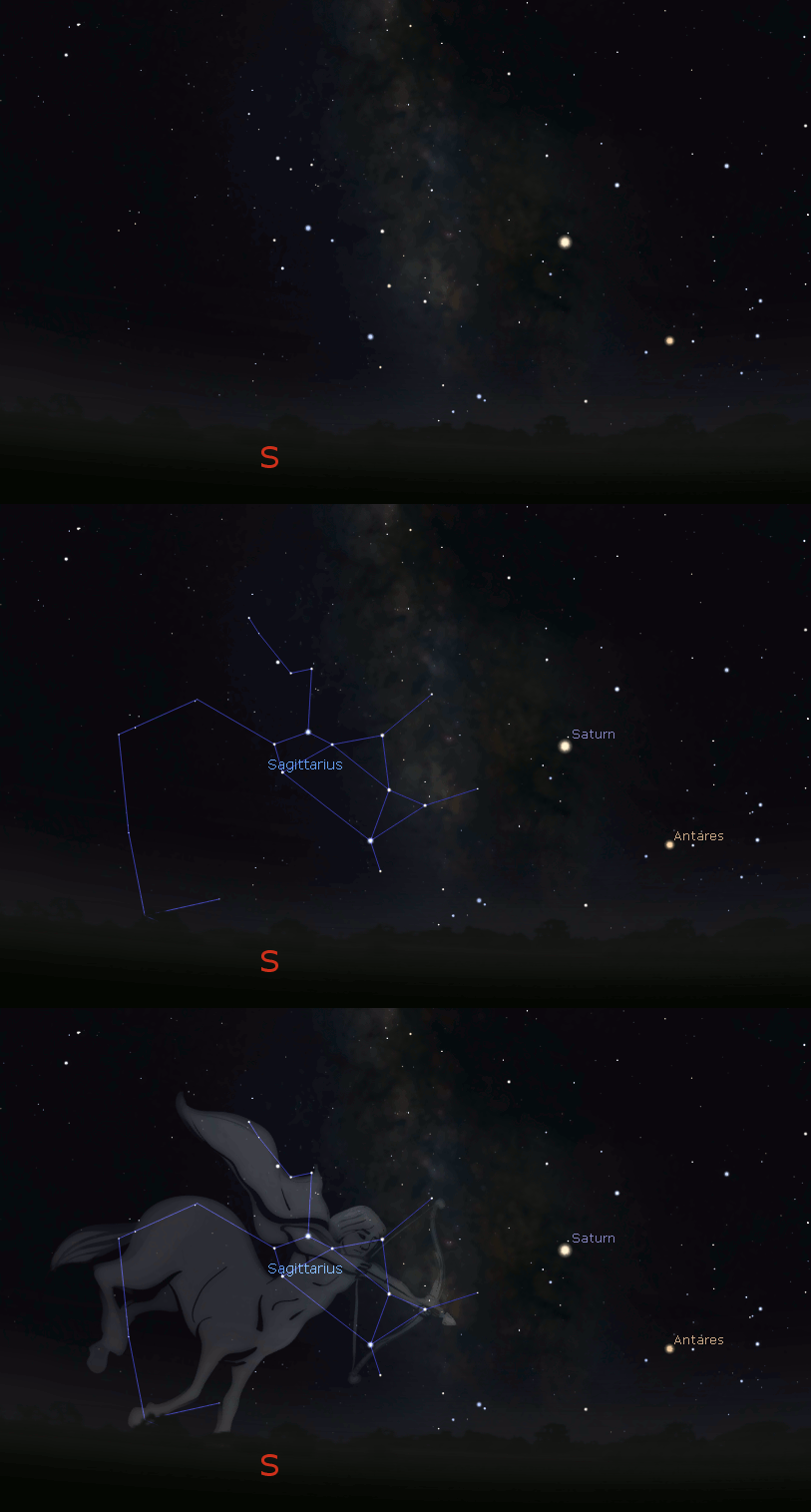
Sagittarius finder animation for 2017 with Saturn nearby. Created using Stellarium and GIMP
08/23/2017 – Ephemeris – Our weekly check on the bright planets
Wednesday, August 23rd. The Sun rises at 6:54. It’ll be up for 13 hours and 39 minutes, setting at 8:34. The Moon, 2 days past new, will set at 9:48 this evening.
Let’s take our weekly look at the bright planets. Jupiter is sinking really low in the west-southwest as it gets dark in the evening. The bright blue-white star Spica, which pales in comparison to Jupiter, is seen left of it. Jupiter is moving eastward towards Spica now. It will pass north of Spica on September 11th. Jupiter will set at 10:25 p.m. Saturn can now be seen in the south-southwest as evening twilight fades. The reddish star Antares is off to the right of Saturn. Saturn’s rings are spectacular in telescopes, and it will set at 1:24 a.m. In the morning sky, brilliant Venus will rise at 4:01 a.m. and be visible until about 6:15 tomorrow morning. Mars and Mercury are now too close to the Sun for us to spot.
The times given are for the Traverse City/Interlochen area of Michigan. They may be different for your location.
08/22/2017 – Ephemeris – Future Eclipses visible around northern Michigan
Ephemeris for Tuesday, August 22nd. The Sun rises at 6:53. It’ll be up for 13 hours and 42 minutes, setting at 8:36. The Moon, 1 day past new, will set at 9:17 this evening. | OK, now that some of you have eclipse fever and want to see more, let’s see when the next solar eclipses will occur near us. Four years from now on June 10, 2021 the Sun will rise already in eclipse for us here. This annular eclipse will best be seen in western Ontario Provence, just north of Minnesota. The Moon will be too small to completely cover the Sun. After that is another Great American Eclipse, where the path of totality runs from Texas to Maine, clipping a few miles into the southeast corner of Michigan. That will be April 8, 2024. Around here nearly 87% of the Sun will be covered at maximum. If you want to travel, there are two total eclipses in Chile and Argentina on July 2nd, 2019 near sunset and December 14th, 2020 at midday.
The times given are for the Traverse City/Interlochen area of Michigan. They may be different for your location.
Addendum
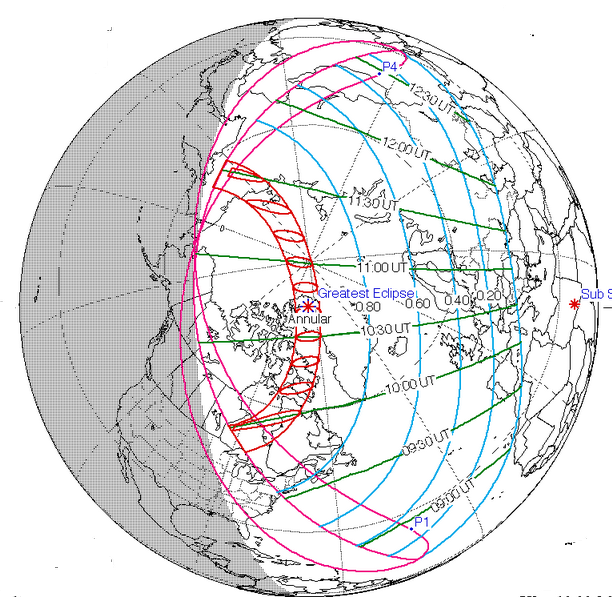
June 10, 2021 Annular Solar Eclipse track. Credit NASA/GSFC – Fred Espanek
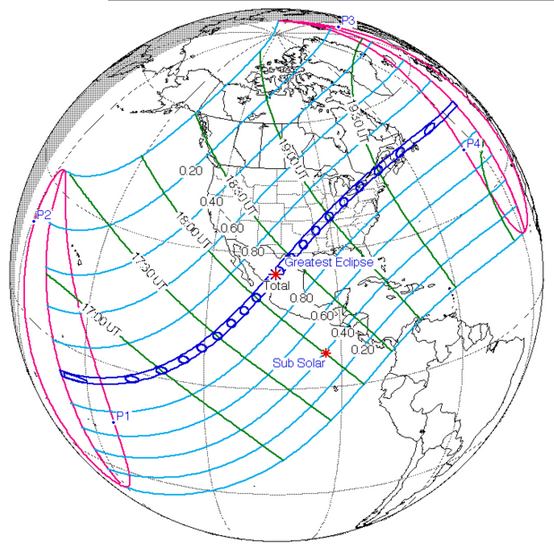
April 8, 2014 Total Solar Eclipse track. Credit NASA/GSFC – Fred Espanek
08/21/2017 – Ephemeris – Today’s the day of the solar eclipse!
Ephemeris for Monday, August 21st. The Sun rises at 6:52. It’ll be up for 13 hours and 45 minutes, setting at 8:37. The Moon is new today, and won’t be visible, except when it’s covering the Sun.
This is it! Later today, we will see, clouds willing, the Great American Solar Eclipse. The Grand Traverse Astronomical Society and the Sleeping Bear Dunes National Lakeshore will host an eclipse watch at the Dachow farm on M-22 at Port Oneida Road. There will be telescopes to view the eclipse and one to project the eclipse on a screen. The first 100 or so visitors can get a pair of eclipse glasses. The times, if you are in the Grand Traverse area, say near Traverse City and Interlochen, are these: The eclipse starts at a couple of minutes before 1 p.m., The maximum eclipse will be at 2:20 when nearly 75% of the Sun will be covered by the Moon. The eclipse will end about 3:40 p.m. These times are within a few minutes for other locations in northern Michigan.
The times given are for the Traverse City/Interlochen area of Michigan. They may be different for your location.
Addendum
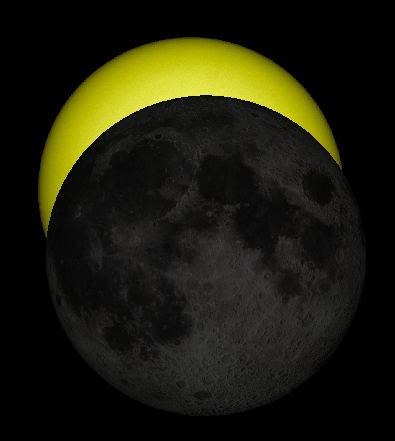
What the maximum eclipse would look like with proper filtering in the Grand Traverse area. Created using Stellarium.
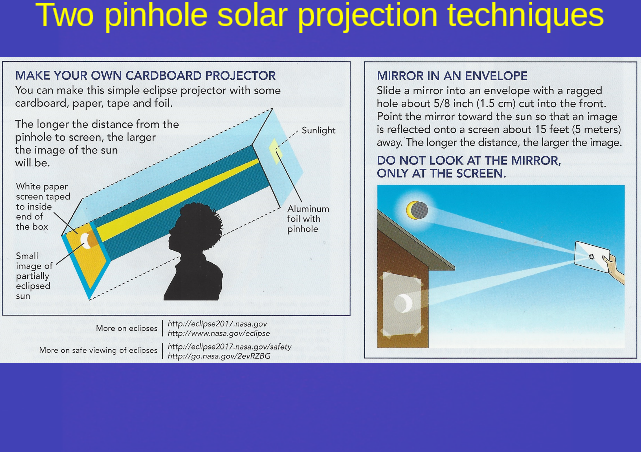
Pinhole projection is the simplest way to project the Sun’s image.
A long box can be used to project the image inside. The diameter of the pin hole is a compromise between sharpness and brightness of the image.
The farther the image is projected the larger it is.
The throw of the image can be increased by using a mirror masked with a quarter of a inch or larger hole and sending the image 10 or more feet away.
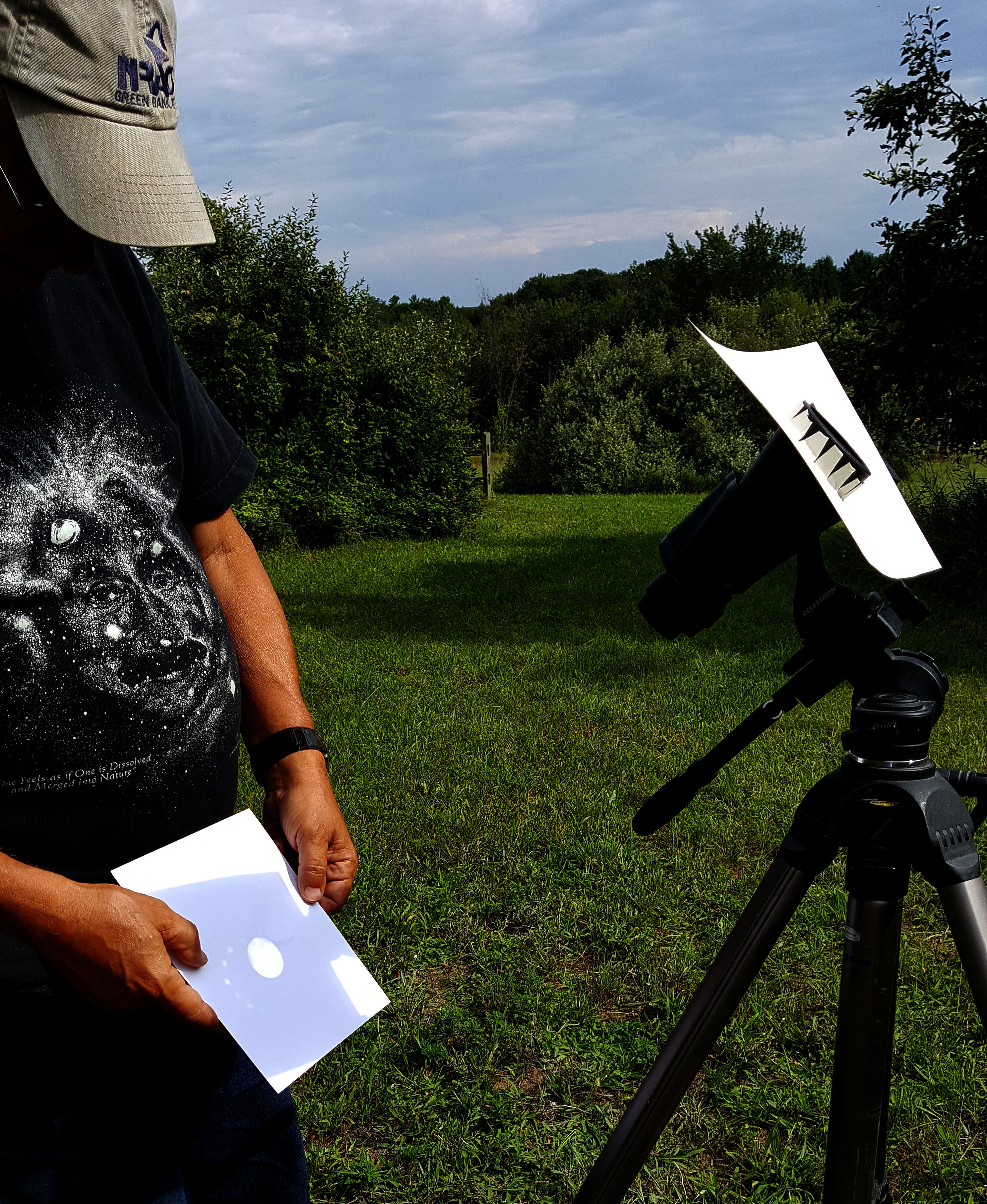
I’m demonstrating using binoculars to project the Sun. Photo by Bea Farrell (granddaughter).
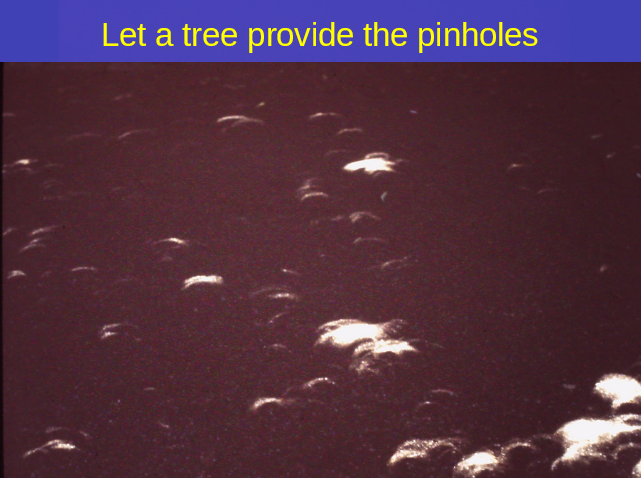
Let nature provide the pinholes.
Sit under in the shade.
Stay cool,
And watch the Sun’s images on the ground.
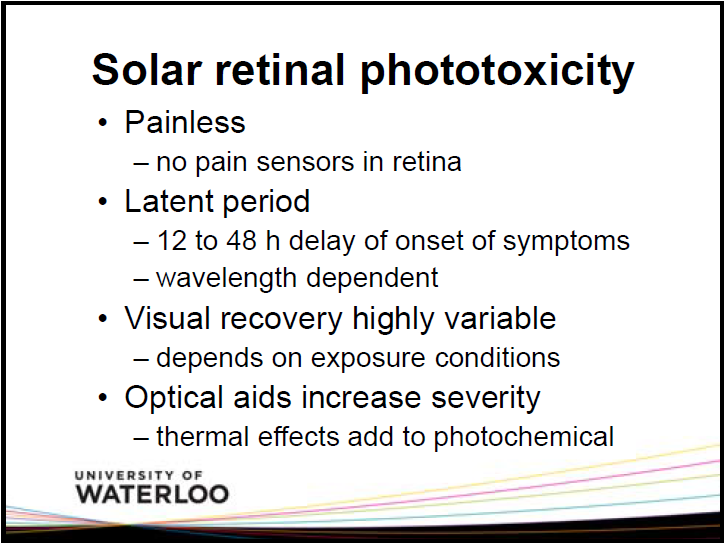
The danger with looking at the Sun without proper filter. Credit: University of Waterloo.
 Bob Moler's Ephemeris Blog