Archive
08/18/2017 – Ephemeris – More eclipse information
Ephemeris for Friday, August 18th. The Sun rises at 6:48. It’ll be up for 13 hours and 53 minutes, setting at 8:42. The Moon, 3 days before new, will rise at 4:16 tomorrow morning.
OK here you are 3 days before the solar eclipse, where to you go and when do you look to see it. Circle next Monday, August 21st. The times, if you are in the Grand Traverse area, say near Traverse City and Interlochen, are these: The eclipse starts at a couple of minutes before 1 p.m., The maximum eclipse will be at 2:20 when nearly 75% of the Sun will be covered by the Moon. The eclipse will end about 3:40 p.m. For locations south and west of Traverse City the eclipse will start up to a few minutes earlier, to the north and east, up to a few minutes later. The Grand Traverse Astronomical Society and the Sleeping Bear Dunes National Lakeshore will host an eclipse watch at the Dachow farm on M-22 at Port Oneida Road.
We’ll be at Friday night Live night on the 200 block of Front Street, in front of Orvis Streamside, in Traverse City to demonstrate these methods. Come between 5:30 and 7:30 p.m. for demonstrations if it’s clear.
The times given are for the Traverse City/Interlochen area of Michigan. They may be different for your location.
Addendum
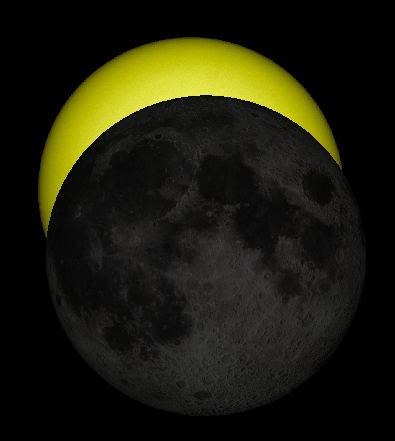
What the maximum eclipse would look like with proper filtering in the Grand Traverse area. Created using Stellarium.
08/17/2017 – Ephemeris – How do you view the solar eclipse if you don’t have eclipse glasses?
Ephemeris for Thursday, August 17th. The Sun rises at 6:47. It’ll be up for 13 hours and 56 minutes, setting at 8:44. The Moon, 3 days past last quarter, will rise at 3:13 tomorrow morning.
OK here you are 4 days before the solar eclipse and you can’t find any eclipse glasses. What do you do? The answer is project the Sun’s image. I personally do not use eclipse glasses. The projected image is bigger and I don’t get a crick in my neck. The Sun is bright enough to project itself on a screen. A telescope with a low power eyepiece or one side of a pair of binoculars project a wonderful image of the Sun. An envelope with a quarter to half-inch hole holding a mirror, can project the Sun on the side of a building some feet away. If worst come to worst take a colander, and use the holes to project a multitude of Suns. We’ll be at Friday Night Live tomorrow on Front Street in Traverse City to demonstrate these methods. Come between 5:30 and 7:30 p.m. for demonstrations if it’s clear.
The times given are for the Traverse City/Interlochen area of Michigan. They may be different for your location.
Addendum
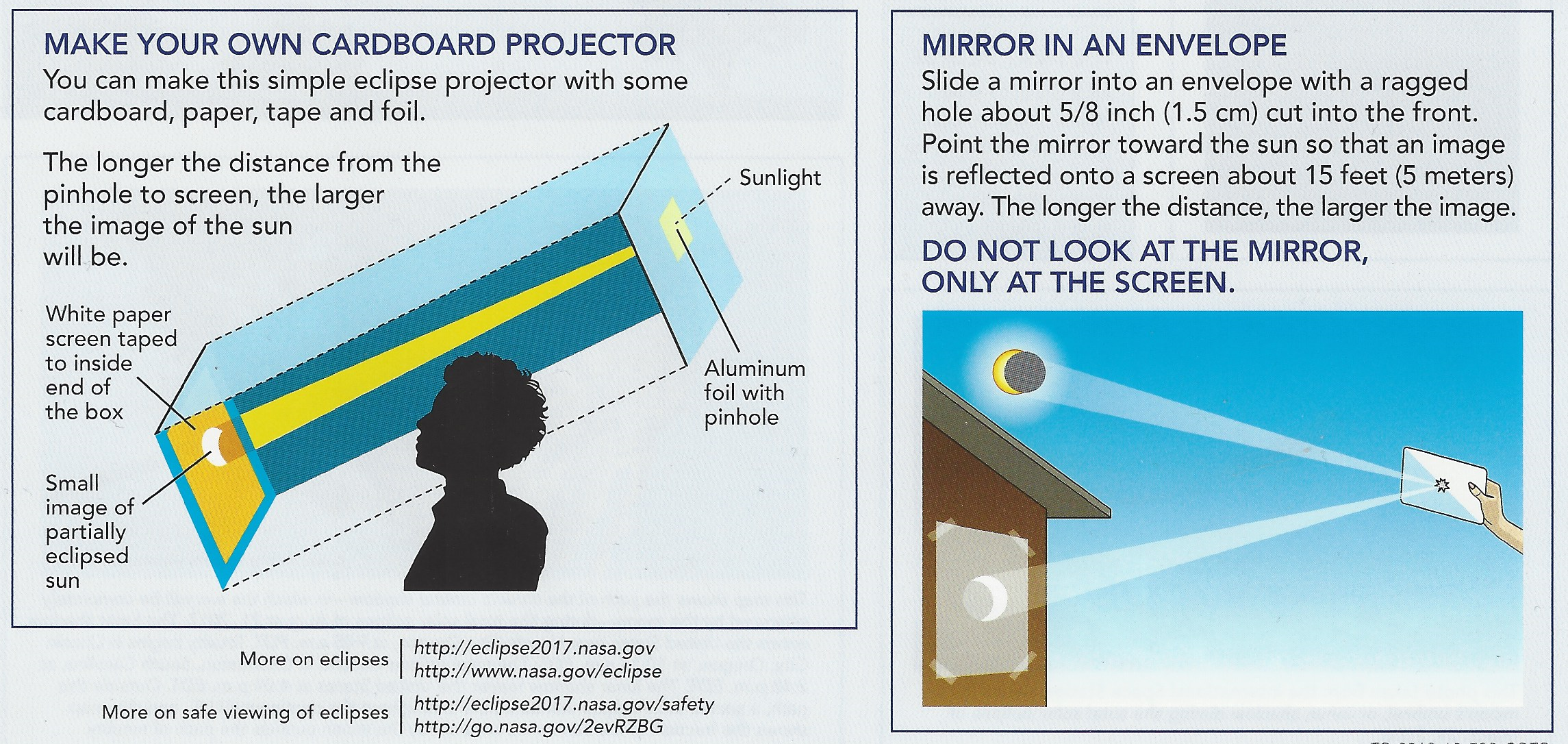
Two pinhole solar projection methods. Credit NASA.
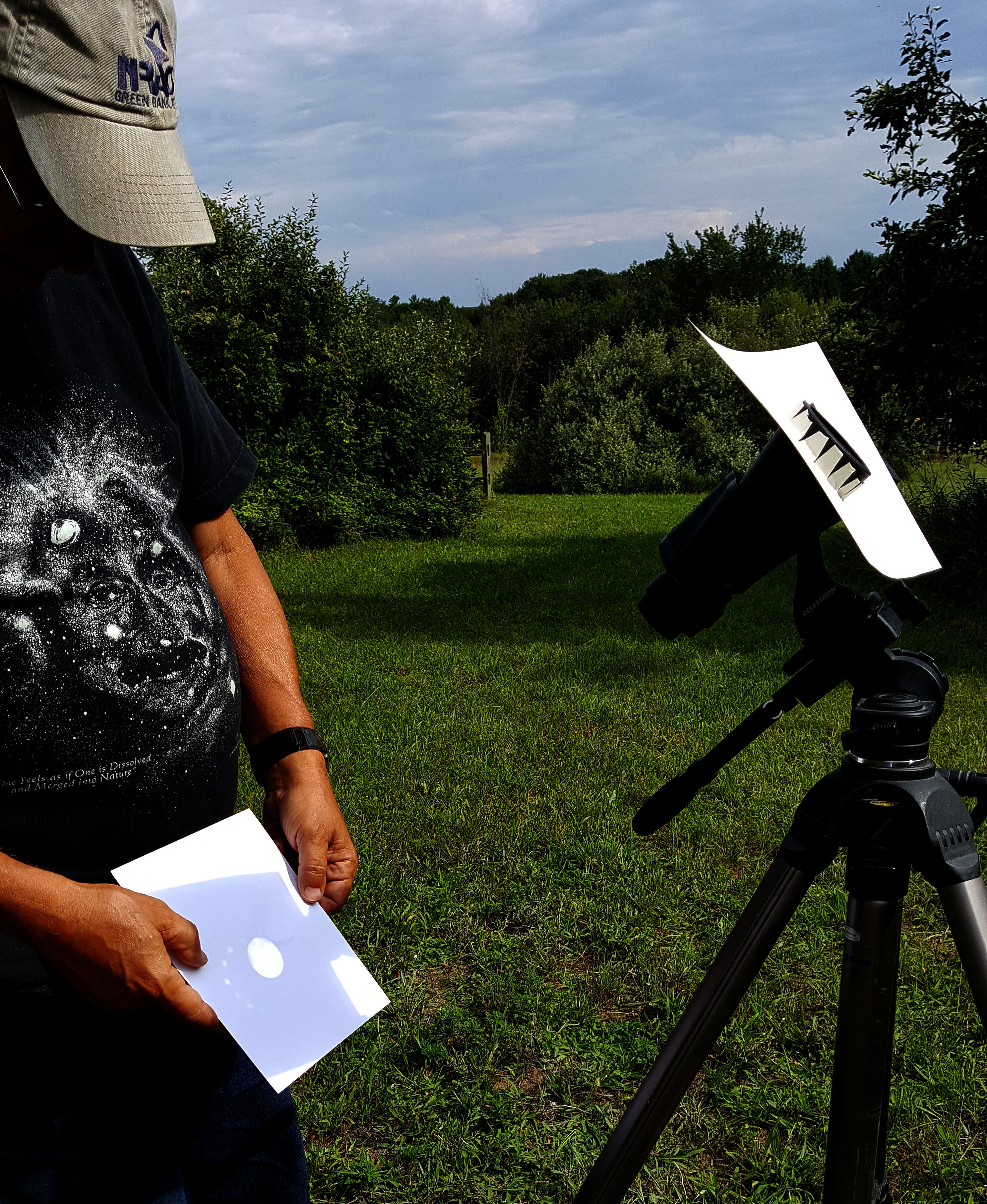
I’m demonstrating using binoculars to project the Sun. The lens cap is on the unused side. The shade in front creates a shadow to project the Sun in. Be careful to not let anyone attempt to look through the projection side. A kid tried to do it when I was demonstrating the technique at the last Sun ‘n Star Party. I had to push him away before he was able to look. Photo by Bea Farrell (granddaughter).
08/16/2017 – Ephemeris – Looking for the whereabouts of the bright planets
Ephemeris for Wednesday, August 16th. The Sun rises at 6:46. It’ll be up for 13 hours and 59 minutes, setting at 8:45. The Moon, 2 days past last quarter, will rise at 2:16 tomorrow morning.
Let’s take our weekly look at the bright planets. Jupiter is sinking in the west-southwest as it gets dark in the evening. The bright blue-white star Spica, which pales in comparison to Jupiter, is seen left of it. Jupiter is moving eastward towards Spica now. It will pass north of Spica on September 11th. Jupiter will set at 10:50 p.m. Saturn can now be seen in the south as evening twilight fades. The reddish star Antares is off to the right of Saturn. Saturn’s rings are spectacular in telescopes. It will set at 1:52 a.m. In the morning sky, brilliant Venus will rise at 3:48 a.m. and be visible until about 6:15 tomorrow morning. Mars and Mercury are now too close to the Sun for us to see, unless the moon completely covers the Sun for you next Monday.
The times given are for the Traverse City/Interlochen area of Michigan. They may be different for your location.
Addendum
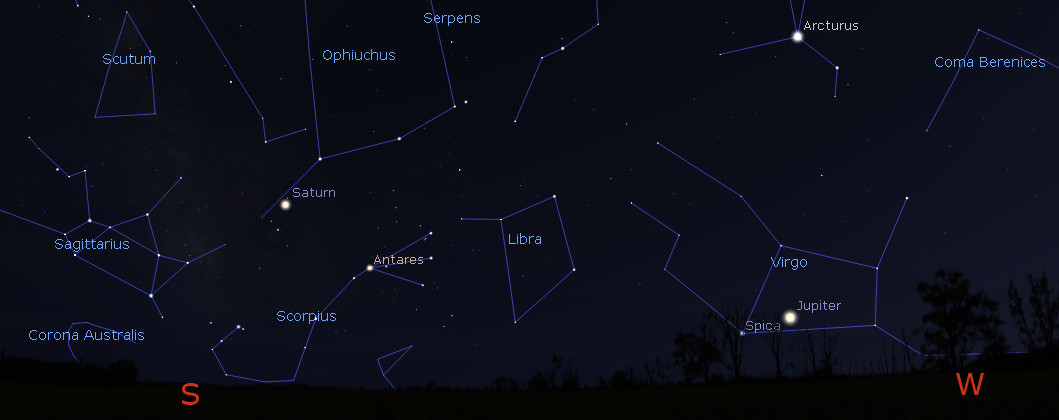
Jupiter and Saturn and southern summer constellations at 10 p.m. August 17, 2017. Created using Stellarium.
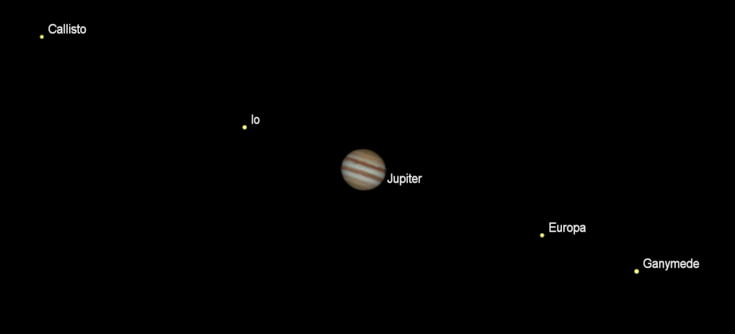
Jupiter and its moons at 10 p.m. August 16, 2017. Created using Cartes du Ciel (Sky Charts).
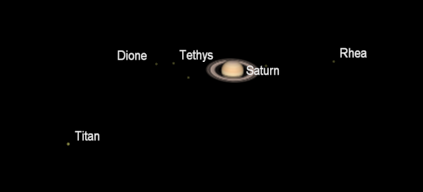
Saturn and its brightest moons overnight August 16/17, 2017. Created using Cartes du Ciel (Sky Charts).
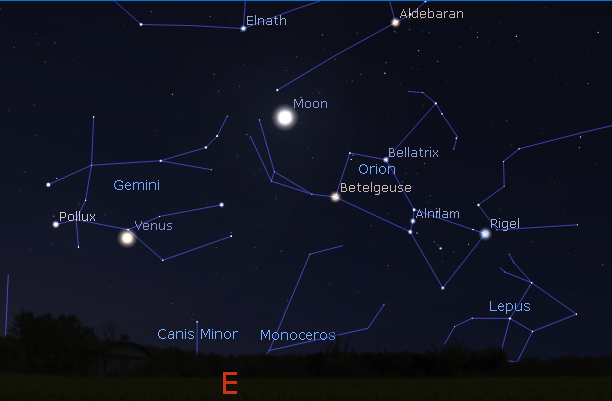
The Moon and Venus at 5:30 a.m. August 17, 2017. Created using Stellarium.
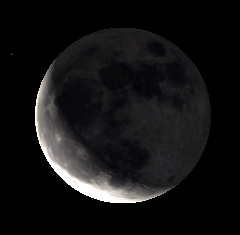
The Moon as it might be seen in binoculars at 5:30 p.m. August 17, 2017. Created using Stellarium.
Venus is becoming almost to small to view its gibbous shape in telescopes. It’s disk is only 13 seconds of arc in diameter, smaller than Saturn’s disk, so I’m discontinuing showing it’s disk.
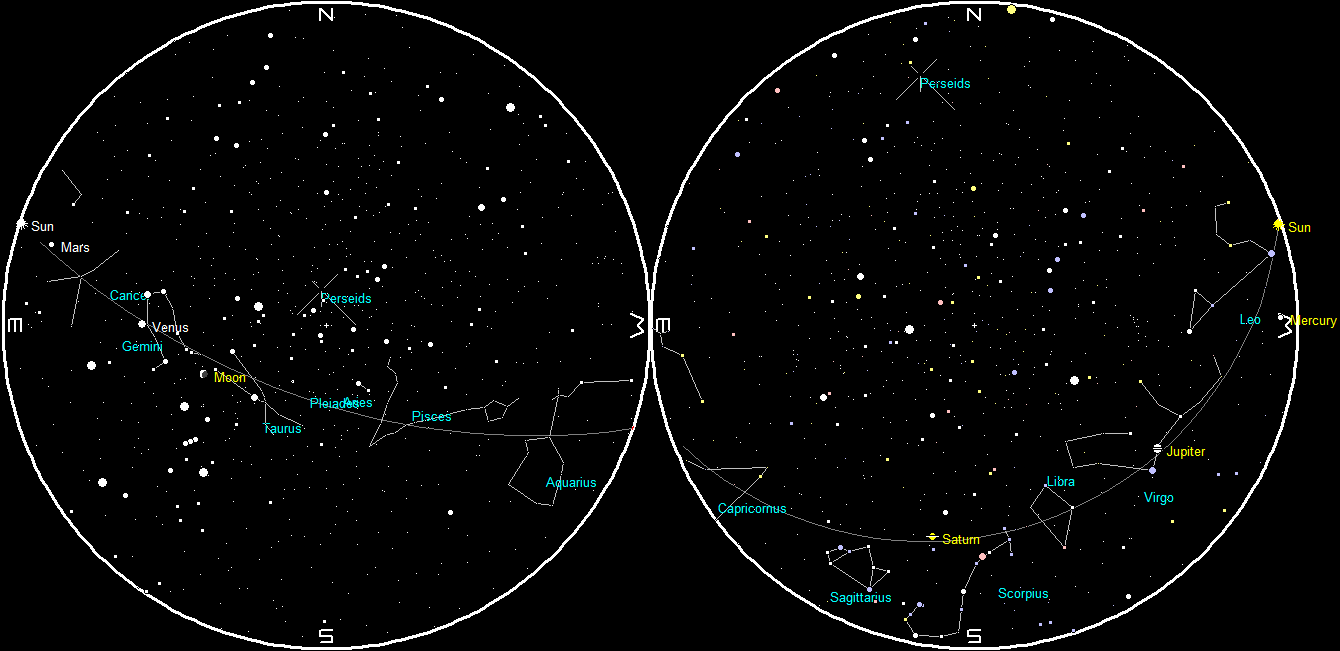
Planets at sunset and sunrise of a single night starting with sunset on the right on August 16, 2017. The night ends on the left with sunrise on August 17. Click on the image to enlarge. Created using my LookingUp program.
08/15/2017 – Ephemeris – Looking for safe eclipse glasses? Good luck.
Ephemeris for Tuesday, August 15th. The Sun rises at 6:45. It’ll be up for 14 hours and 2 minutes, setting at 8:47. The Moon, 1 day past last quarter, will rise at 1:28 tomorrow morning.
Only six days before the big solar eclipse event. Are you ready. If you decide to project the Sun’s image, good for you. I’ll talk about that method on Thursday. However if you want to view the eclipse with eclipse glasses and you haven’t gotten them yet, beware there are fake eclipse glasses out there. The is a list of reputable manufacturers and chains that sell them at the American Astronomical Society website at aas.org. Chains that are supposed to sell the genuine article are 7-Eleven, Best Buy, Lowe’s, Toys “R” Us, and Wal-Mart. Not all stores carry them, or have them in stock. Locally Enerdyne in Suttons Bay does carry them, but again could be sold out. Call first. Around the Grand Traverse Area the eclipse will be visible from 1 to 3:40 p.m. on the 21st. On Thursday I’ll explain how to project the Sun safely. No wonky filters needed.
The times given are for the Traverse City/Interlochen area of Michigan. They may be different for your location.
Addendum
News note: Amazon recalls suspect eclipse glasses
From PBS: http://www.pbs.org/newshour/rundown/amazon-recalls-potentially-hazardous-solar-eclipse-glasses/
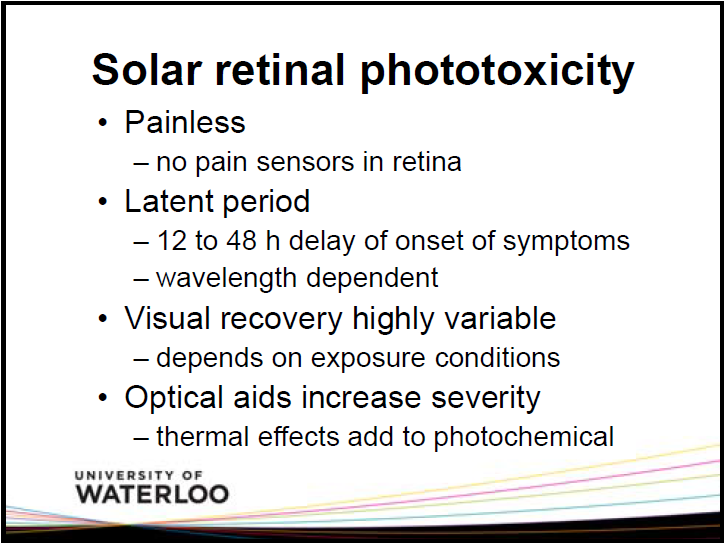
The danger with looking at the Sun without proper filter. Credit: University of Waterloo.
08/14/2017 – Ephemeris – Safe ways to view the eclipse
Ephemeris for Monday, August 14th. The Sun rises at 6:44. It’ll be up for 14 hours and 4 minutes, setting at 8:49. The Moon, at last quarter today, will rise at 12:46 tomorrow morning.
It is one week to the Great American Eclipse, next Monday August 21st. Whether you’re heading out to the path of totality, or staying here it is imperative that you view the Sun safely. Solar filters may be purchased from some reputable stores. But there are some unsafe solar filters being sold out there. Beware. Also never use eclipse glasses to view the Sun with binoculars. The concentrated sunlight coming out of the eyepiece will burn through the plastic of the solar filter in an instant. The best method is to project the Sun’s image with a pinhole in a box or place a mirror in an envelope with a quarter-inch or so hole in it, and project the Sun on the shady side of a building. There’s plenty of Internet links at http://www.gtastro.org.
The times given are for the Traverse City/Interlochen area of Michigan. They may be different for your location.
Addendum
Two pinhole solar projection methods. Credit NASA.
The danger at looking at the Sun without proper filter. Credit: University of Waterloo.
08/11/2017 – Ephemeris – The Perseid meteors plus a star party wraps up the Port Oneida Fair tomorrow
Ephemeris for Friday, August 11th. The Sun rises at 6:40. It’ll be up for 14 hours and 12 minutes, setting at 8:53. The Moon, 3 days before last quarter, will rise at 11:06 this evening.
The most famous meteor shower year in and year out is the Perseid meteor shower of August. There are more active meteor showers, but none in the warm nights of summer. The Perseids will be reaching peak tomorrow afternoon. It’s a bit early for us and the Moon will interfere after rising at 11:36 p.m. There have been some erroneous reports out there that this year’s meteor shower will be super spectacular. It will not. Besides the Moon will be up during the best morning viewing times. The meteors will appear to come from the northeastern part of the sky, but will be visible all over the sky. I like the evening meteor show, with the radiant low in the sky. The meteor trails are long as the meteoroids skim the Earth’s atmosphere.*
It’s a busy weekend for the Grand Traverse Astronomical Society. Members will be on Front Street in Traverse City tonight for Friday Night Live with views of the Sun and later a look at the planet Saturn and its rings, weather permitting. On Saturday, again weather permitting members will be part of Sleeping Bear Dunes Port Oneida Fair with a Sun ‘n Star Party from 4 to 6 p.m. and from 9 to 11 p.m. , though members will still be there informally. The location for that event is the Thoreson Farm on South Thoreson Road off M22, near Port Oneida Road. On tap will be Jupiter, Saturn and some of the Perseid meteors on it’s peak night, and some of the deep sky wonders of the summer Milky Way beyond the solar system.
The times given are for the Traverse City/Interlochen area of Michigan. They may be different for your location.
* This paragraph is really from the Thursday August 10th program, not what I posted for August 10th (yesterday) as the program transcript. I double checked it and everything. I may be getting too old for this. I think I’ll have a lie down now.
08/10/2017 – Ephemeris – The brief wonderland of Totality, my second total eclipse
Ephemeris for Thursday, August 3rd. The Sun rises at 6:31. It’ll be up for 14 hours and 33 minutes, setting at 9:04. The Moon, half way from first quarter to full, will set at 3:43 tomorrow morning.
The brief world of solar eclipse totality is one everyone should experience at least once in their lifetime. For this eclipse Totality will last from 2 minutes, and 5 seconds on the Oregon coast to 2 minutes 40 seconds in Kentucky, down to 2 minutes 35 seconds on the South Carolina coast. And this is for the center of the path of totality. The duration of totality is so brief that one cannot really absorb it all. As the Moon covers the last of the Sun’s bright photosphere there is a chill as the Sun’s heat is extinguished. Darkness of a deep twilight descends. Street lights come on, cocks will crow, as animals take the darkness as the approach of night. The approaching shadow of the Moon can be seen. During totality the Sun’s corona can be seen as a silvery apparition around the black spot of the Moon that’s covering the Sun’s disk. Bright planets and some stars will appear in a surreal image in the darkened sky, but the horizon is bright. Then suddenly the diamond ring appears and it’s over.
The times given are for the Traverse City/Interlochen area of Michigan. They may be different for your location.
Addendum
Somehow this is a repeat of last Thursday’s program. I’ve added a sentence or two in the text above and I’ve added different content below.
This the story of my second total eclipse, March 7, 1970.
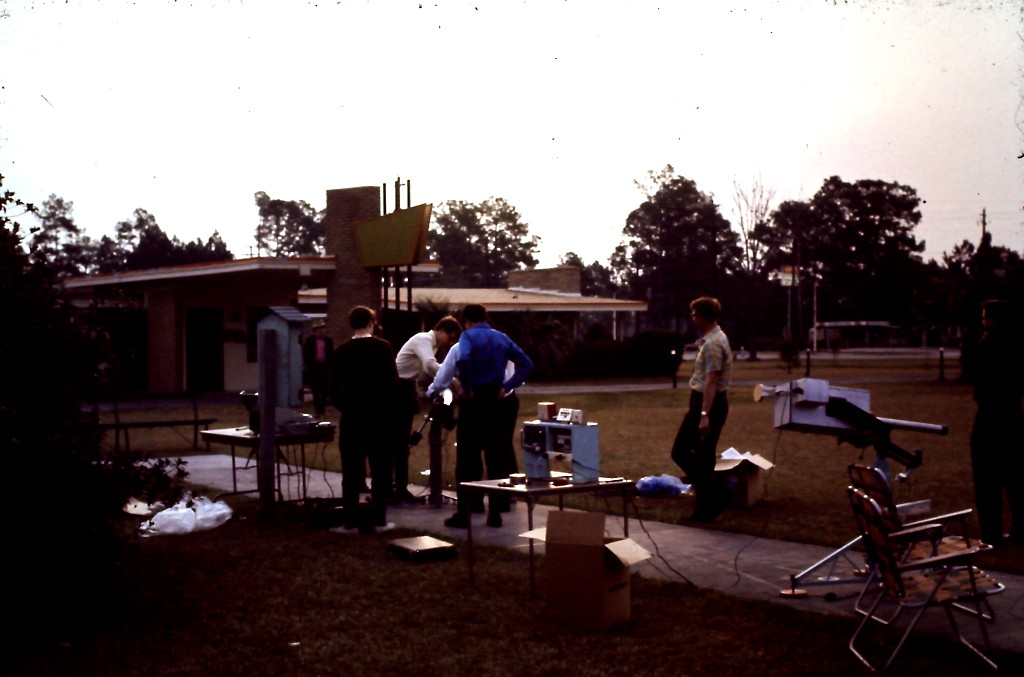
Setting up the day before the eclipse at a motel in Waycross Georgia. My automated equipment is on the right with the controller on the near table. My photo.
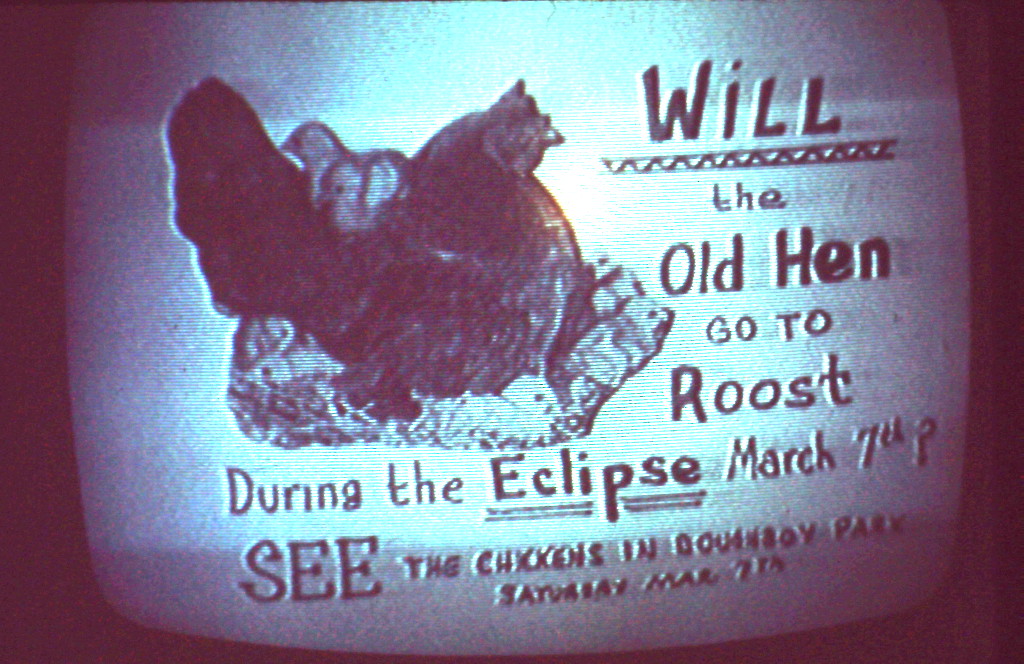
For this eclipse the path of totality ran parallel to the east coast of the US from Florida to Virginia. Perry, Florida proclaimed itself “Eclipse Capital of the World”, and attracted lots of folks down there. Waycross was lower key. This is what they ran on their weather channel:
 The local baseball park hosted a menagerie of chickens and other animals for folks could watch their eclipse antics. Also there was an ABC television crew, whose normal job was to televise golf tournaments. The big TV camera, they were big in those days, was placed on a fork lift to tilt it back far enough to reach the Sun. Scattered on the ground were lots of 2×2 inch black squares with holes in them. It turns out they were neutral density filters that they were inserting in the camera, near the focal plane. Of course the concentrated sunlight near the focal plane would burn through the filter in nothing flat. Some of the younger members in our group had created exposed x-ray film for filters, and showed the TV crew how to fasten the filters in front of the camera lens. It worked, but the guys in the TV van outside the stadium complained that something was wrong with the filters, because there were black spots on the Sun. They were of course sunspots.
All day that day, the sky was slowly clouding up, with high cirrus. There was a storm front moving up the eclipse path,
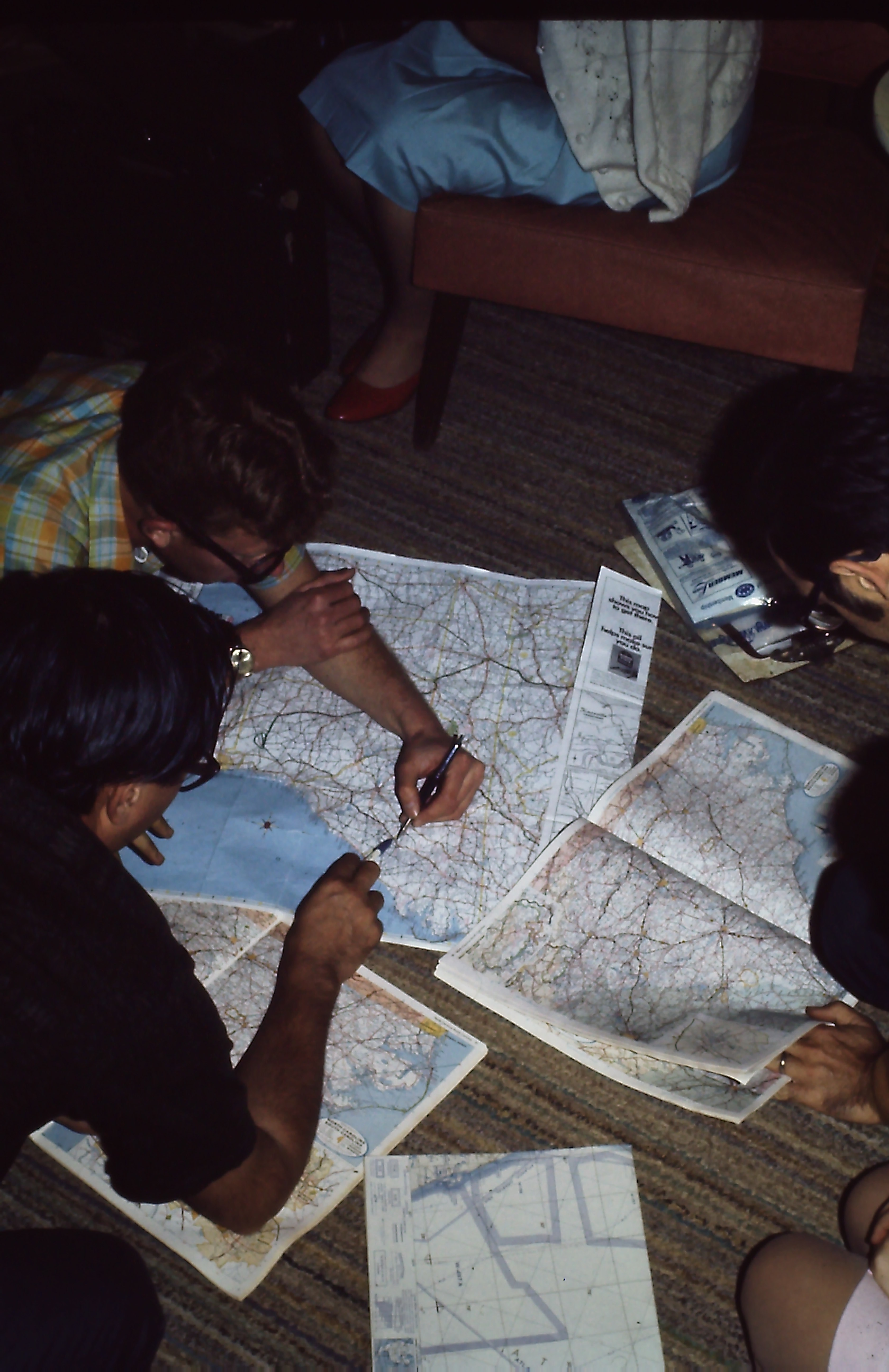
The maps came out to plot a move up the eclipse path. My photo.
The plan was to leave at midnight and drive to Florence, South Carolina and meet up for breakfast and pick a final location. We all met at a restaurant in Florence, and decided on Bladenboro NC as the spot view the eclipse from. Up to this point I drove. I turned the wheel over to my wife Judy and slipped into the back seat to recompute the eclipse timing, since I set my photographic program to start one minute before totality.
We finally ended up in a corn field, filled with corn stubble just outside the town.
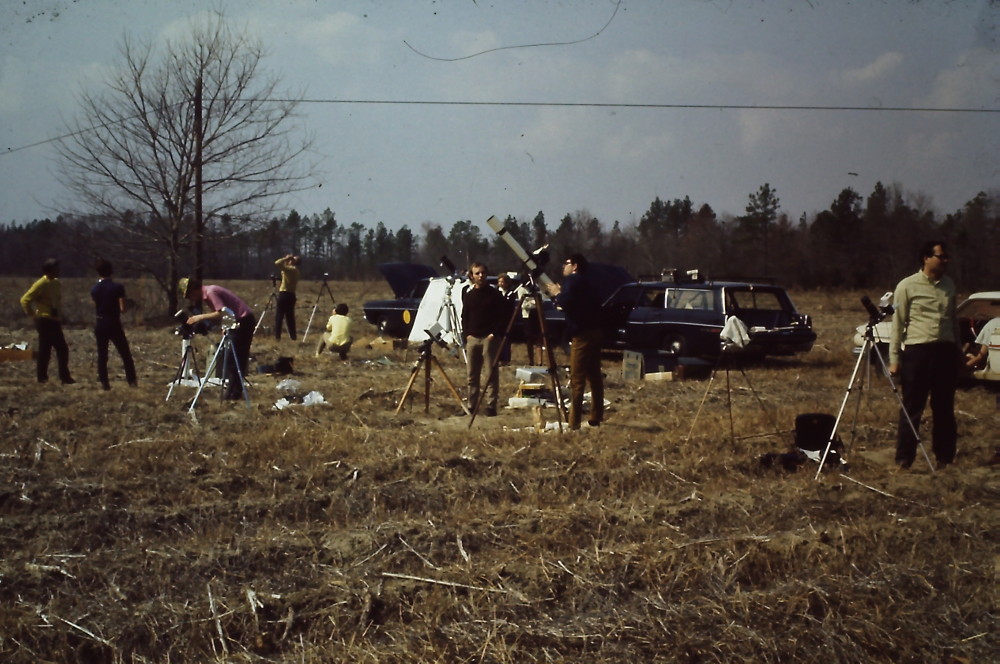
Everyone Else’s setup in the corn field. My equipment is off to the right out of sight. My photo.
We had students from the University of Michigan, Grand Valley State University, the Detroit Observational and Astrophotographic Association, and the Grand Rapids Amateur Astronomical Association, of which I was a member at that time. The farmer, whose land we were on, was quite drunk and was spending his time harassing the red-headed member of our group Dave DeBruyn while he was trying to set up his equipment.
It turned out that we didn’t quite escape the clouds.
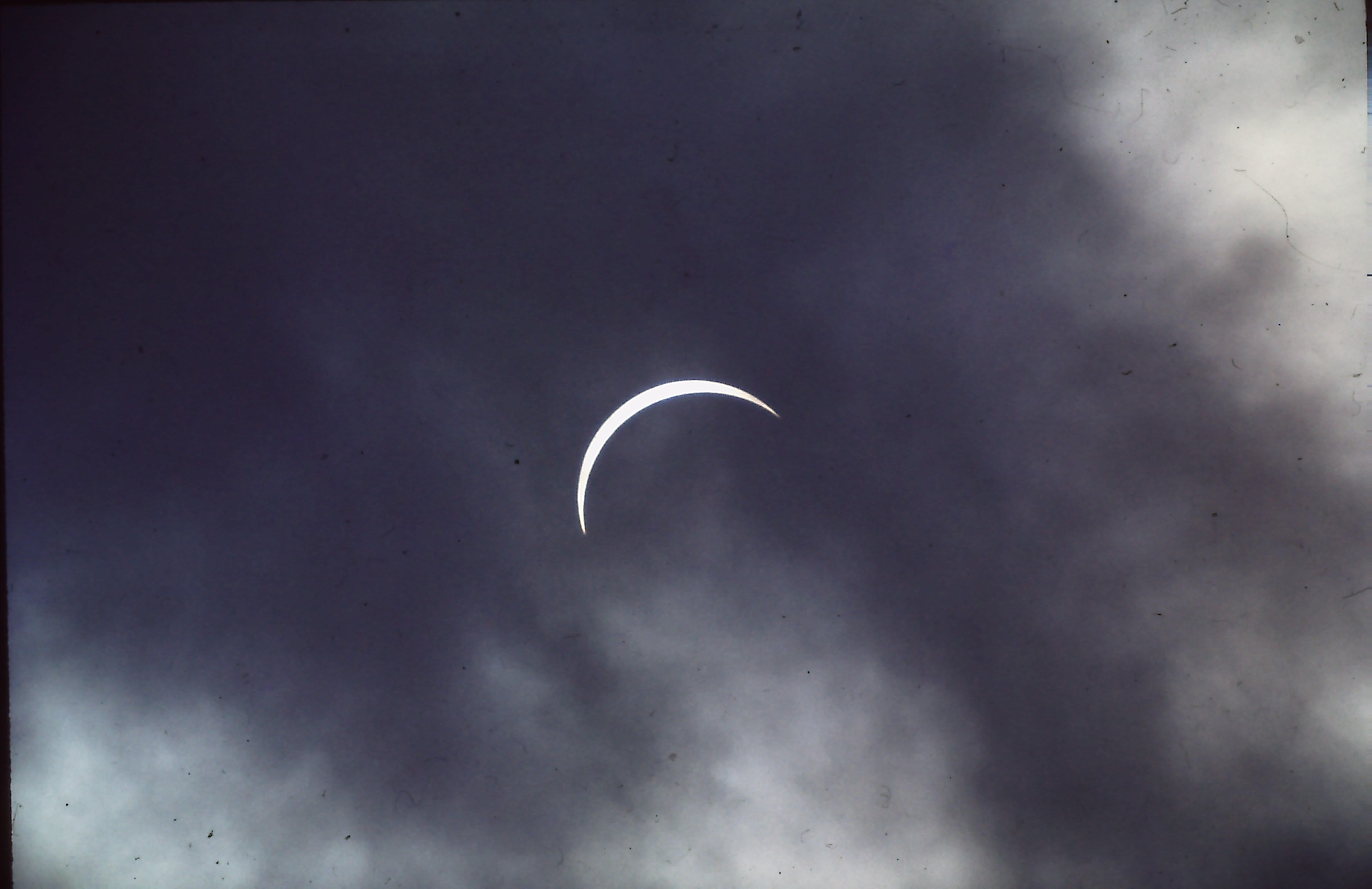
The Sun a few minutes before Totality taken through clouds and no filter. My photo.
It did eventually clear enough to see the eclipse, helped by all of us shouting at the clouds. Moving to the corn field meant no electricity. I did have an inverter, however I didn’t really test it, thinking we’d have power at our motel location. However the inverter couldn’t hold up its voltage under load and a relay meant to act as a safety for a problem I had at my first eclipse, dropped and made the camera inoperative. However I came prepared. I built what I called a contingency camera, with which I took the above photo, and got some good photos as seen below.
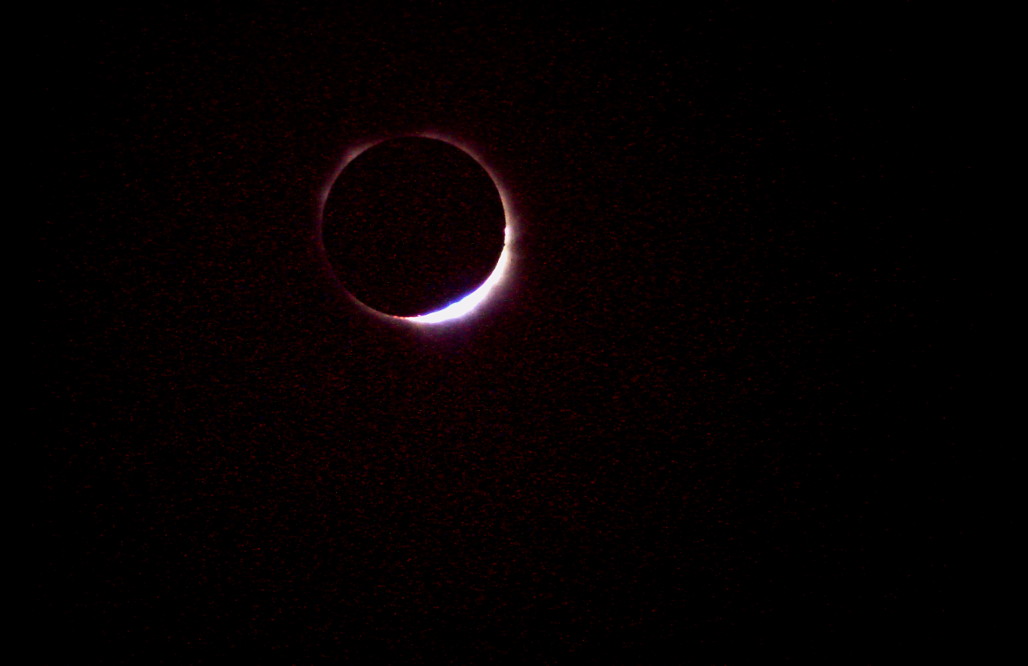
Inner corona. My photo.
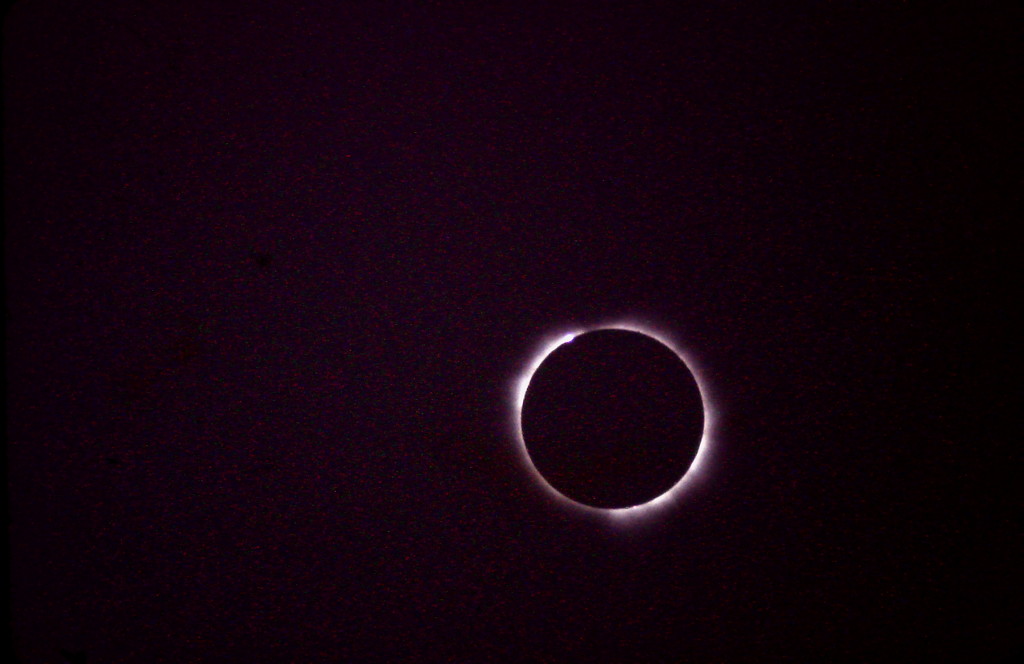
Inner corona near the center of totality. My photo.
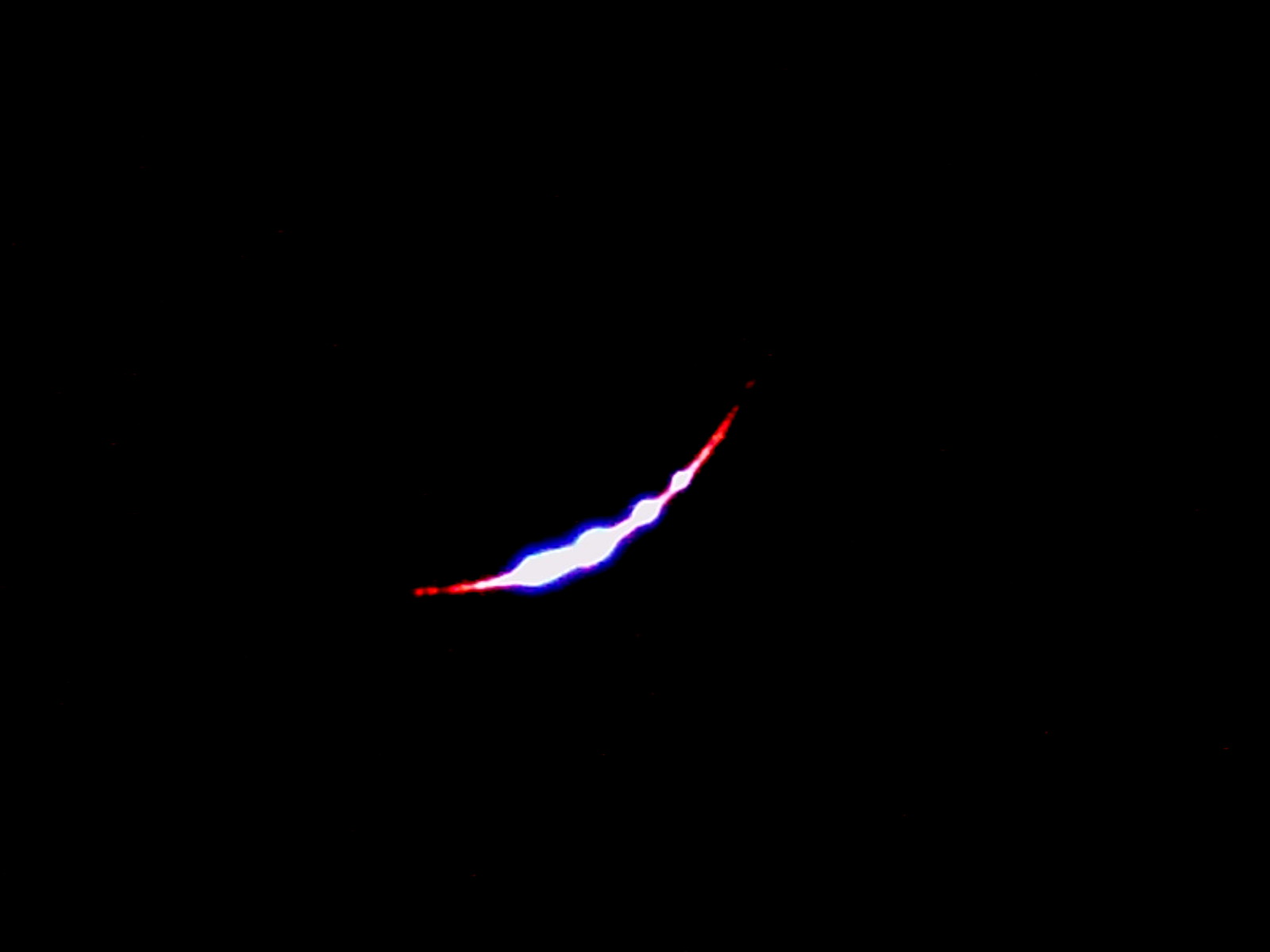
My best photo. Baily’s Beads and chromosphere as totality ends. My photo.
Some of our group decided to stay in Waycross, and were able to see the eclipse. Perry FL, the Eclipse Capital, had the eclipse rained out. That’s another proof of Moler’s First Law of Eclipses: Where the most crowds gather to see an eclipse, so do the clouds.
The story of my first total solar eclipse is here: https://bobmoler.wordpress.com/2017/07/20/07202017-ephemeris-only-one-month-and-a-day-to-the-great-american-eclipse-and-a-personal-note/
08/09/2017 – Ephemeris – Where are the bright planets tonight?
Ephemeris for Wednesday, August 9th. The Sun rises at 6:38. It’ll be up for 14 hours and 18 minutes, setting at 8:56. The Moon, 2 days past full, will rise at 10:06 this evening.
Let’s take our weekly look at the bright planets. Jupiter is sinking in the west-southwest as it gets dark in the evening. The bright blue-white star Spica, which pales in comparison to Jupiter, is seen left of it. In even the smallest telescopes Jupiter’s four largest moons can be seen. They shift positions from night to night. Jupiter will set at 11:15 p.m. Saturn can now be seen in the south as evening as twilight fades. The reddish star Antares is off to the right of Saturn. Saturn’s rings are spectacular in telescopes. It will set at 2:20 a.m. In the morning sky, brilliant Venus will rise at 3:38 a.m. and be visible until about 6 tomorrow morning. Mars and Mercury are now too close to the Sun for us to see.
The times given are for the Traverse City/Interlochen area of Michigan. They may be different for your location.
Addendum
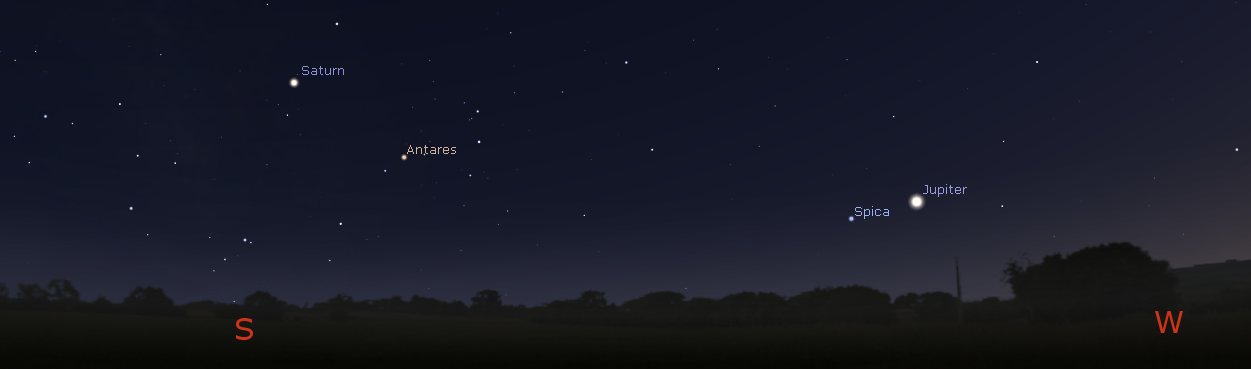
Jupiter and Saturn at 10 p.m. August 9, 2017. Jupiter is slowly approaching Saturn in our skies and will pass Saturn on December 21, 2020, and every 20 years for the rest of this century. Created using Stellarium. Click on the image to enlarge.
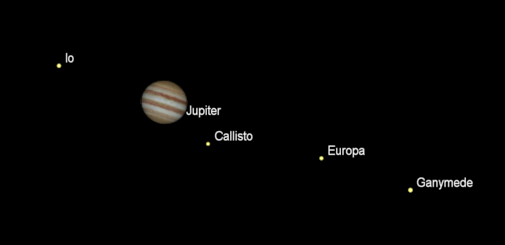
Jupiter and its moons at 10 p.m. August 9, 2017. Created using Cartes du Ciel (Sky Charts).
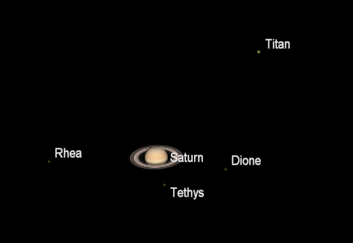
Saturn and its brightest moons overnight August 9/10, 2017. Created using Cartes du Ciel (Sky Charts).
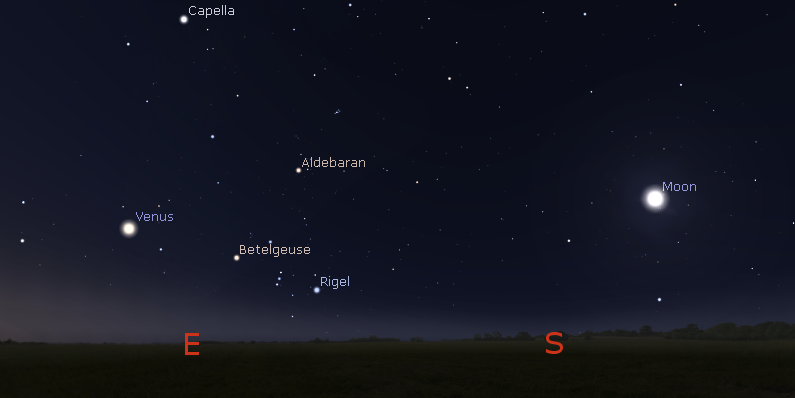
The Moon and Venus at 5:30 a.m. August 10, 2017. Created using Stellarium.
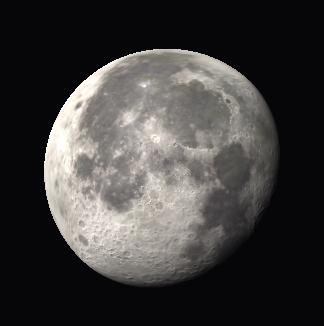
The Moon as it might be seen in binoculars at 5:30 p.m. August 10, 2017. Created using Stellarium.
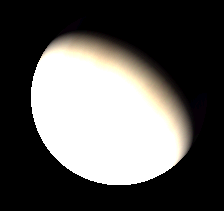
Venus in a telescope on the morning of August 10, 2017. It is greatly enlarged here to show its phase. Created using Stellarium.
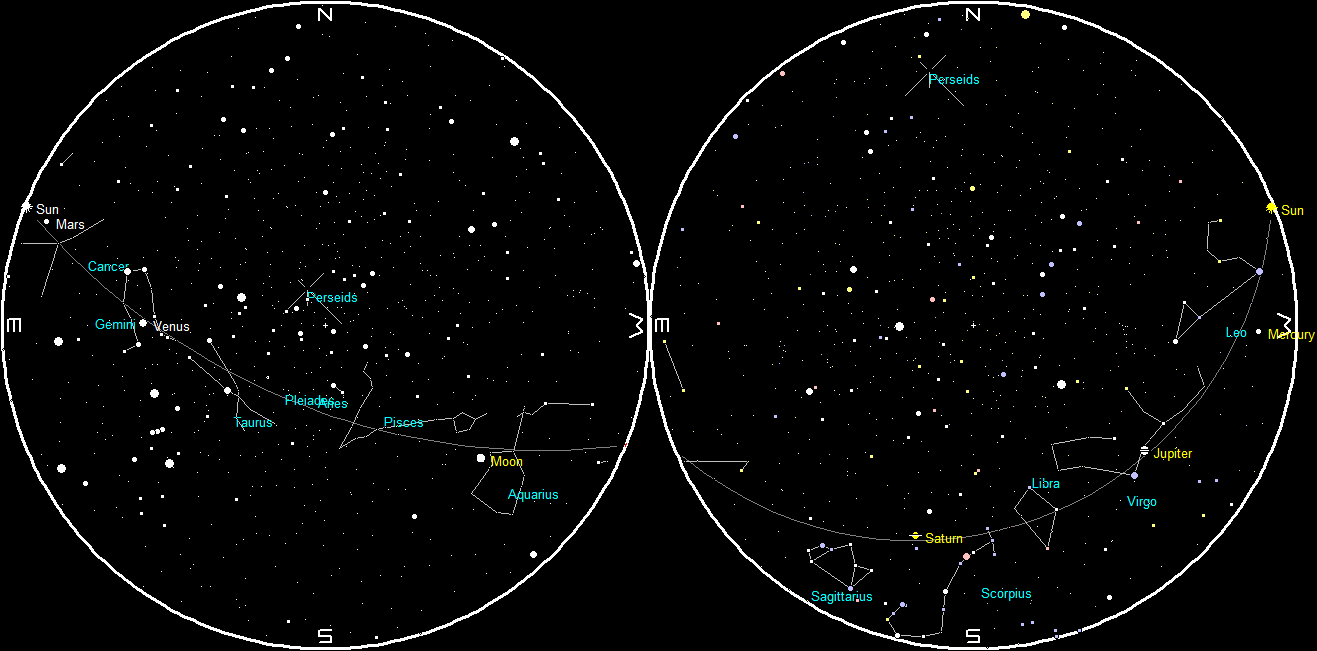
Planets at sunset and sunrise of a single night starting with sunset on the right on August 9, 2017. The night ends on the left with sunrise on August 10. Click on the image to enlarge. Created using my LookingUp program.
08/08/2017 – Ephemeris – The Harvest Moon effect starts showing up 2 months early
Ephemeris for Tuesday, August 8th. The Sun rises at 6:37. It’ll be up for 14 hours and 20 minutes, setting at 8:58. The Moon, 1 day past full, will rise at 9:34 this evening.
The Harvest moon is nearly 2 months away, but some of its effects are starting to be felt now. I call it the Harvest Moon Effect. The Harvest Moon is a bit late this year, October 5th. It’s defined as the nearest full moon to the autumnal equinox. However from August to October the rising times of the full Moon and nights after for the next week don’t advance very fast. On average the Moon rises 50 minutes later each night. Between tonight and tomorrow night the interval will be 32 minutes. This is kind of a bummer this weekend when the Perseid meteor shower reaches peak. As with most meteor showers, the most meteors seen are after midnight. Saturday night’s Perseid peak has the Moon, six days after full rising at 11:36 p.m.
The times given are for the Traverse City/Interlochen area of Michigan. They may be different for your location.
Addendum
Moonrise time intervals for the rest of this week:
| Date | Moonrise | Difference |
| 08/08/17 | 9:34 p.m. | |
| 32 minutes | ||
| 08/09/17 | 10:06 p.m. | |
| 30 minutes | ||
| 08/10/17 | 10:36 p.m. | |
| 30 minutes | ||
| 08/11/17 | 11:06 p.m. | |
| 30 minutes | ||
| 08/12/17 | 11:36 p.m. | |
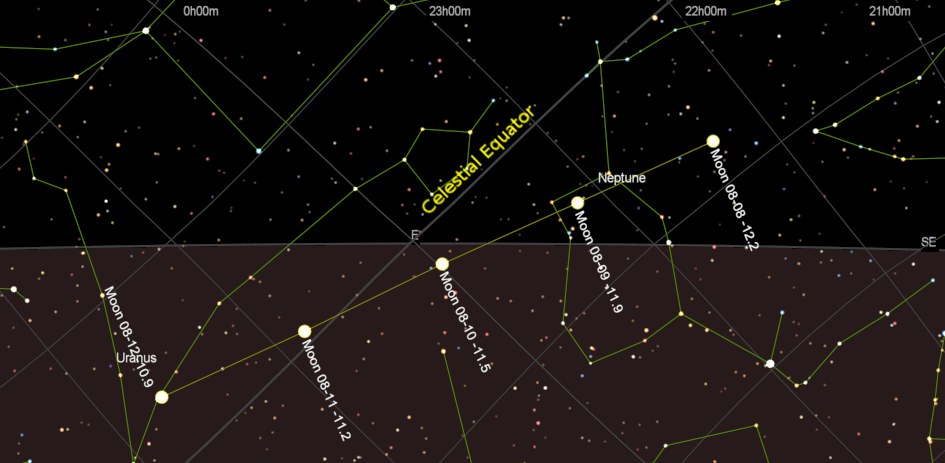
Harvest Moon Effect for this week. Note how shallow the path of the Moon is in relation to the eastern horizon. I’ve made the earth transparent so we can see the Moon below the horizon. As the Earth rotates the Moon will rise in a direction parallel to the celestial equator. In contrast the Moon’s path around March is steeper than average, so the interval in consecutive lunar rise times is much longer than the 50 minute average. Created using Cartes du Ciel (Sky Charts).
08/08/2017 – Ephemeris – Eclipse seasons
Ephemeris for Monday, August 7th. The Sun rises at 6:36. It’ll be up for 14 hours and 23 minutes, setting at 8:59. The Moon, at full today, will rise at 9:00 this evening.
At two weeks before the great solar eclipse, the world is experiencing another eclipse, this one is a partial lunar eclipse where the Moon will just clip the northern part of the Earth’s shadow this afternoon our time. It will be mainly visible from Asia. Eclipses occur in seasons of about a month long that occur at a bit less than six month intervals, so eclipses will occur a little earlier next year to the this. That’s because the crossing points of the Moon’s and the Earth’s orbital planes regress slowly westward. In an eclipse season two eclipses will occur: a solar and a lunar eclipse. On rare occasion when a lunar eclipse occurs in the center of a season a partial solar eclipse can occur two weeks before and again after the lunar eclipse, but they will affect the opposite polar regions of the Earth.
The times given are for the Traverse City/Interlochen area of Michigan. They may be different for your location.
Addendum
Table of this and next three eclipse seasons
| Date | Eclipse Type | Notes |
| 08/07/2017 | Lunar Eclipse – partial | Moon clips northern part of Earth’s umbra |
| 08/21/2017 | Solar Eclipse – total | Path of totality crosses US |
| 01/31/2018 | Lunar Eclipse – total | Moon crosses just south of center of umbra |
| 02/15/2018 | Solar Eclipse – partial | Visible mostly from Antarctica |
| 07/13/2018 | Solar Eclipse – partial | Seen from southern Australia |
| 07/27/2018 | Lunar Eclipse – total | Moon crosses center of umbra |
| 08/11/2018 | Solar Eclipse – partial | Seen from northern Europe, Asia |
| 01/06/2019 | Solar Eclipse – partial | Seen mostly from northern Pacific Ocean |
| 01/21/2019 | Lunar Eclipse – total | Moon crosses just north of center of umbra |
 Bob Moler's Ephemeris Blog