Archive
11/16/2017 – Ephemeris – The Leonid meteors will reach their peak numbers tonight and tomorrow
Ephemeris for Thursday, November 16th. The Sun will rise at 7:40. It’ll be up for 9 hours and 32 minutes, setting at 5:13. The Moon, 2 days before new, will rise at 6:33 tomorrow morning.
The Famous Leonid meteor shower, which has had spectacular displays about every 33 years is forecast to reach two peaks this year, near noon our time, today and tomorrow. So the numbers of meteors, forecast during those peaks, of about 10 per hour near dawn our time probably won’t pan out, but you never know. None of these meteors will be seen before midnight. The last great 33 year peak was in 1998, so we’re a ways away from the next one. The responsible body for these meteors is the comet Tempel-Tuttle. Every time the comet passes through the inner solar system the sun’s heat liberates gas, dust and small grains of rock. These small grains end up in close orbits to the comet, and like the comet, return again and again.
The times given are for the Traverse City/Interlochen area of Michigan. They may be different for your location.
Addendum
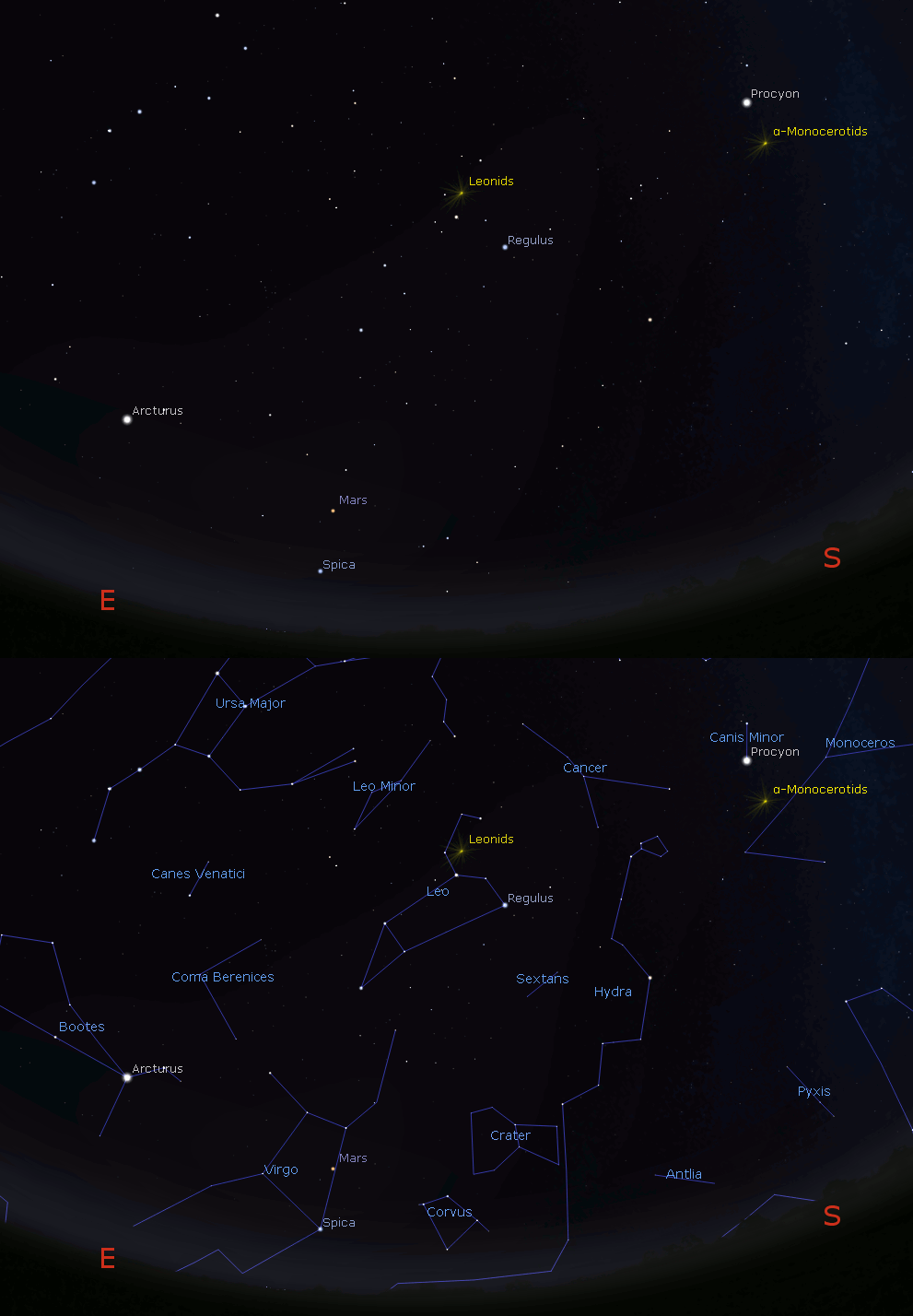
Leonid Meteor Shower Radiant finder chart fir 6 a.m., November 17, 2017. Click on image to enlarge. Created using Stellarium ans GIMP.
Note that there is another meteor shower radiant in the image, below the star Procyon. It’s the Alpha Monocerotids. It will reach its peak on the 21st. with an expected zenithal hourly rate (ZHR) of only 5 meteors an hour. By the way the zenithal hourly rate is the expected rate if the radiant was directly overhead, at the zenith. In 1995 this shower had for five minutes an estimated ZHR of 460, which was within a 30 minute outburst. The next big outburst isn’t expected until 2043, but not very much is known about this meteor shower. So keep an eye out, it could surprise us.
The radiant point wasn’t well known before the 1995 outburst, when it was thought to be closer to α Monocerotis, the unnamed bottom star in Monoceros the unicorn. There was a meteor shower called the Monocerotids listed before this shower was identified. So even though the radiant is actually in Canis Minor we are stuck with its name.
Much of the above information comes from the International Meteor Organization 2017 Meteor Shower Calendar. This and next years calendars are located at https://www.imo.net/resources/calendar/.
11/15/2017 – Ephemeris – All the bright planets are visible for observers at both dusk and dawn
Ephemeris for Wednesday, November 15th. The Sun will rise at 7:39. It’ll be up for 9 hours and 34 minutes, setting at 5:14. The Moon, 3 days before new, will rise at 5:32 tomorrow morning.
Let’s take our weekly look at the bright planets. Mercury is briefly visible in binoculars in the southwest in the evening, setting at 6:06 p.m., and will reach it’s greatest elongation from the Sun in 8 days. Saturn is sinking low in the southwestern sky. Saturn’s rings are still spectacular in telescopes, but since Saturn is so low in the sky the thick atmosphere makes Saturn fuzzy and seemingly to go in and out of focus. Saturn will set at 7:12 p.m. Tomorrow in the morning sky, Mars, heading away from the Sun will rise in the east at 4:16 a.m., Jupiter, also moving away from the Sun, will rise at in the east-southeast at 6:14, leaving Venus behind after their conjunction two days ago, which will rise at 6:30.
The times given are for the Traverse City/Interlochen area of Michigan. They may be different for your location.
Addendum
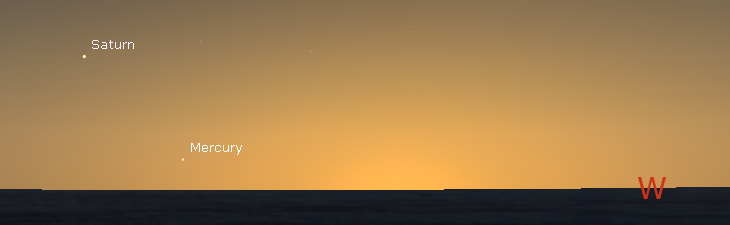
Saturn and Mercury very low in the southwest at 6:45p.m. November 15, 2017. That’s about half an hour after sunset. Click on the image to enlarge. Created using Stellarium.
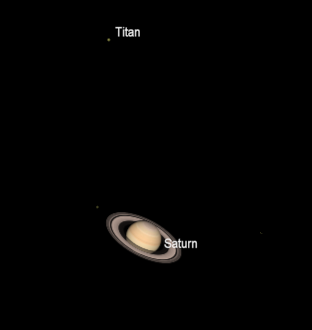
Saturn and its brightest moon Titan in the evening November 15, 2017. Created using Cartes du Ciel (Sky Charts).
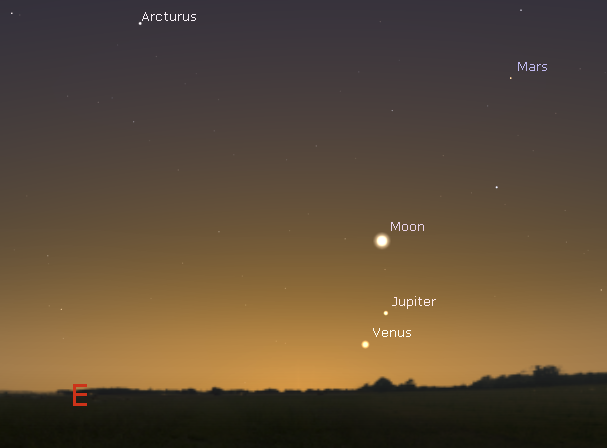
Mars Jupiter Venus and the Moon at 7 a.m., November 16, 2017. The Moon is actually a thin crescent as seen below. Created using Stellarium.
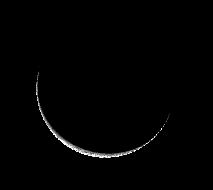
The Moon as it might be seen in binoculars. This was created using Hallo Northern Sky. However it doesn’t show earth shine that should easily be seen in binoculars.
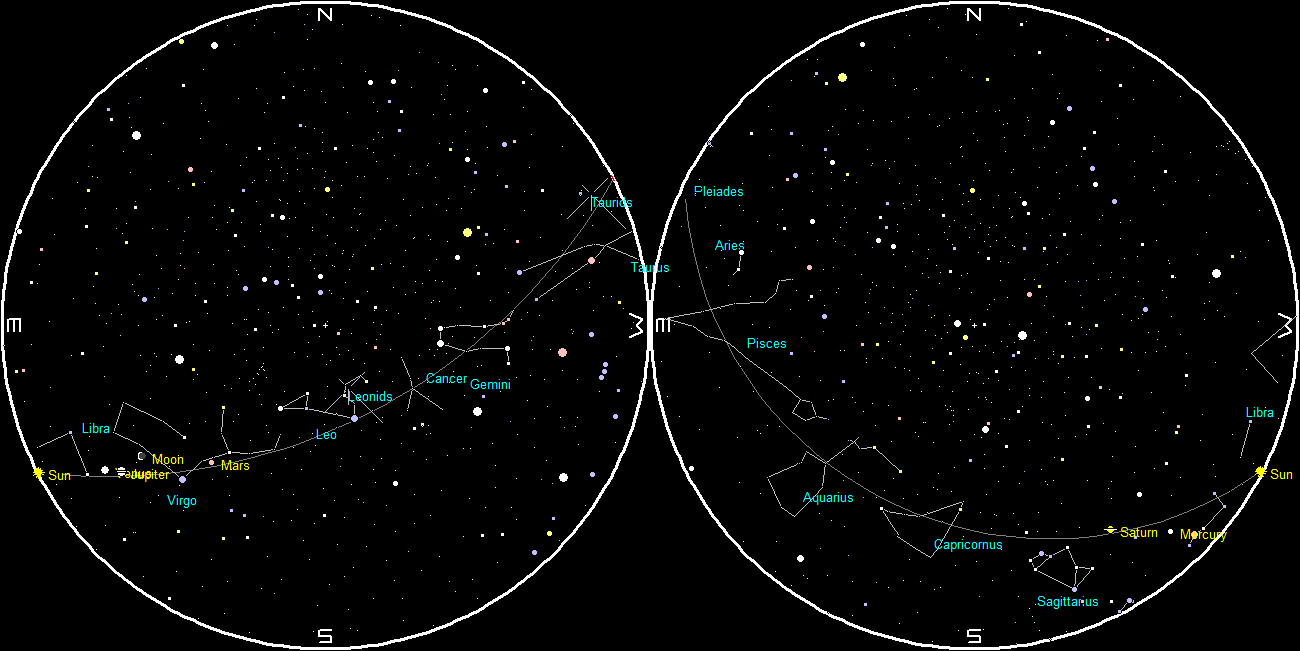
Planets at sunset and sunrise of a single night starting with sunset on the right on November 15, 2017. The night ends on the left with sunrise on the 16th. Click on the image to enlarge. Created using my LookingUp program.
11/14/2017 – Ephemeris – The constellation of Perseus the hero
Ephemeris for Tuesday, November 14th. The Sun will rise at 7:38. It’ll be up for 9 hours and 37 minutes, setting at 5:15. The Moon, half way from last quarter to new, will rise at 4:29 tomorrow morning.
About half way up from the east northeastern horizon to the zenith at 9 p.m. and below the letter W shaped constellation of Cassiopeia the queen is Perseus the hero. It’s kind of an odd shape for a hero, To me it looks like a maybe the cartoon road runner running along the road. To those who’s imagination doesn’t run to Loony Tunes, its shape is also like the Greek letter pi. It’s two brightest stars are Mirfak and Algol the demon star. Look at the area around Mirfak with binoculars and you will see a large group of stars just below naked eye visibility. It’s called the Alpha Persei association. That because Mirfak is Alpha Persei. The group is about 557 light years away, which means, is quite close, but farther away than the Pleiades, below and right of them.
The times given are for the Traverse City/Interlochen area of Michigan. They may be different for your location.
Addendum
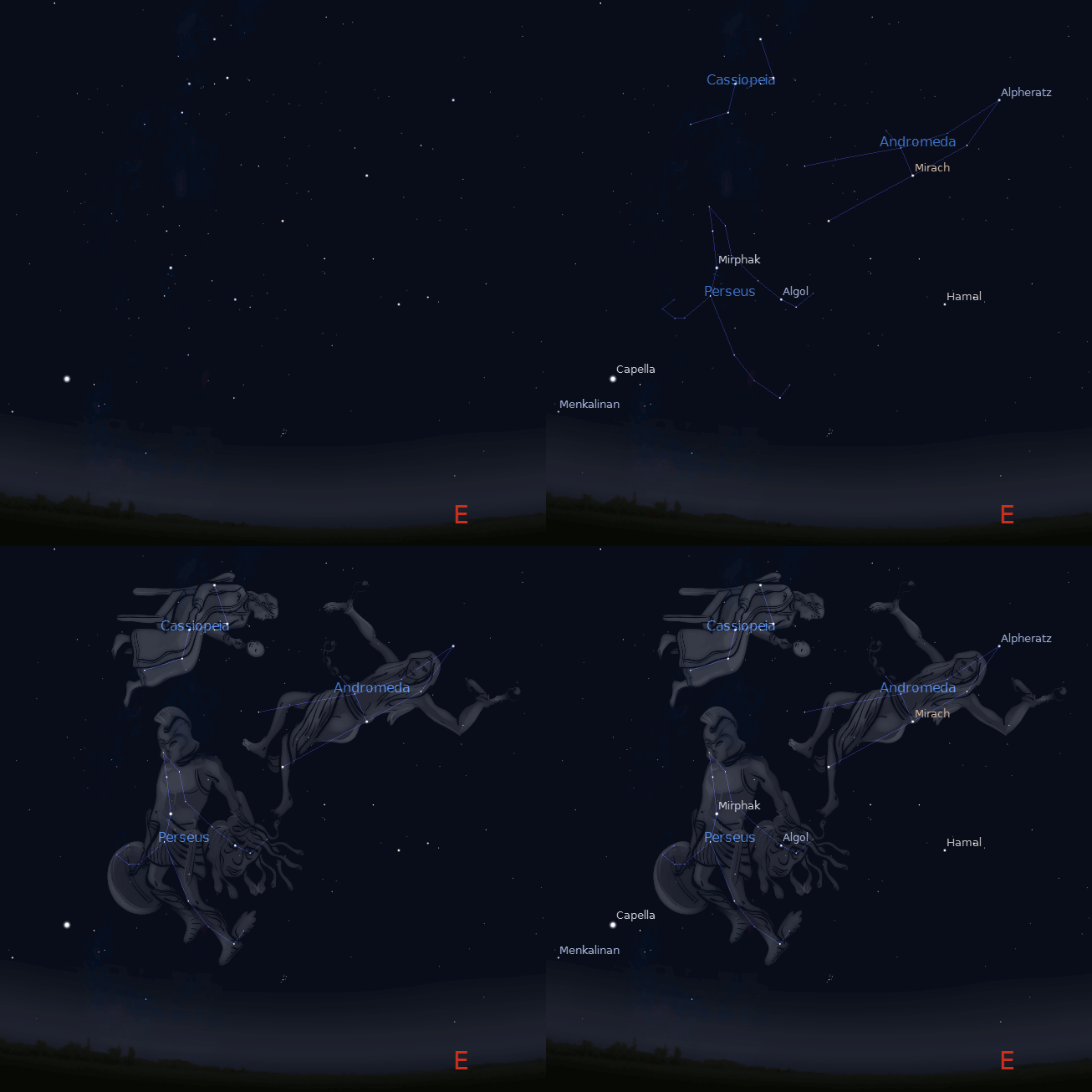
Perseus with Cassiopeia and Andromeda in the northeast at 9 p.m. Created using Stellarium and GIMP.
11/13/2017 – Ephemeris – Close conjunction of Venus and Jupiter is visible this morning
Ephemeris for Monday, November 13th. The Sun will rise at 7:36. It’ll be up for 9 hours and 39 minutes, setting at 5:16. The Moon, 3 days past last quarter, will rise at 3:26 tomorrow morning.
This morning the planets Venus and Jupiter will appear a bit less than the moon apart after rising at 6:22 a.m. Venus is heading back to the Sun, actually around the back of the Sun. Jupiter is separating itself from the Sun. The velocity of a planet in its orbit decreases the farther from the Sun it is. This was discovered by Johannes Kepler back in he 17th century. Venus is closer to the Sun than the Earth, so after it passed the Earth back on March 25th passing between us and the Sun. It moved ahead of us reaching its greatest western separation from the Sun on June 3rd, is now heading around the bend, so to speak, behind the Sun, on January 9th. The Earth moves faster than Jupiter, so it is appearing to move away from the Sun.
The times given are for the Traverse City/Interlochen area of Michigan. They may be different for your location.
Addendum
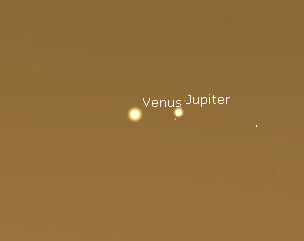
Venus and Jupiter in conjunction at 7 a.m. November 13, 2017. Venus will be 6 times brighter than Jupiter. They will appear half the width of the Moon apart. Created using Stellarium
11/12/2017 – Ephemeris Extra – Venus and Jupiter will appear together tomorrow morning
Just a quick note. I’ll talk about it in more detail tomorrow on the program, but this post will get you a full day heads up. Venus and Jupiter have been approaching one another, at least from the Earth’s point of view for some time. Monday morning their path’s will seem to cross, with Jupiter heading away from the Sun and Venus heading toward the Sun.
Venus and Jupiter in conjunction at 7 a.m. November 13, 2017. Venus will be 6 times brighter than Jupiter. They will appear half the width of the Moon apart. Created using Stellarium.
These planets will rise at 6:22 a.m., a bit more than an hour before sunrise, at 7:36 a.m.
The times given are for the Traverse City/Interlochen area of Michigan. They may be different for your location.
11/10/2017 – Ephemeris – The North Taurid Meteors are reaching peak this weekend
Ephemeris for Friday, November 10th. The Sun will rise at 7:32. It’ll be up for 9 hours and 46 minutes, setting at 5:19. The Moon, at last quarter today, will rise at 12:07 tomorrow morning.
One of the little known meteor showers for most of us are the North and South Taurid meteor showers. The shower that will reach peak this weekend is the North Taurids. They may show only 5 an hour when their radiants are overhead, but they are reported to be very bright. The radiant, the place where the meteors will appear to come from is just south of the Pleiades, will be up just about all night. Saturday night the Moon will rise at 1:15 a.m. Sunday night it will rise at 2:21 a.m. Both Taurid meteor showers are thought to be related to Encke’s Comet, the periodic comet with a period of only 3.3 years, the shortest known. A posting on Space.com about this years shower talked about the possibility that one of these meteorites might reach the ground.
Space.com has an excellent article about the Taurid meteor showers: https://www.space.com/34587-taurid-meteor-shower-guide.html
The times given are for the Traverse City/Interlochen area of Michigan. They may be different for your location.
Addendum
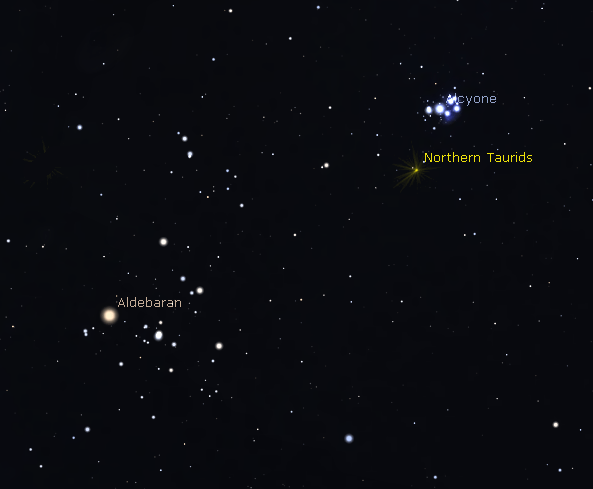
Northern Taurid meteor radiant near the Pleiades in Taurus the bull. Note the face of Taurus, the letter V or stars and Aldebaran. The stars in the face without Aldebaran is a star cluster called the Hyades. Created using Stellarium.
11/09/2017 – Ephemeris – Cassiopeia the queen and her husband
Ephemeris for Thursday, November 9th. The Sun will rise at 7:31. It’ll be up for 9 hours and 49 minutes, setting at 5:20. The Moon, 1 day before last quarter, will rise at 10:59 this evening.
The stars of the autumn skies hold forth now, but one prominent autumn constellation never leaves us, here in northern Michigan. Look high in the northeastern sky by 8 p.m. and you can find the W shaped constellation of Cassiopeia the queen. It is opposite the pole star Polaris from the Big Dipper, slinking low in the north-northwest. There’s a dim star that appears above the middle star of the W which turns the W into a very crooked backed chair. Above and left of Cassiopeia is a dim upside down church steeple shaped constellation of Cepheus the king. The Milky Way flows through a corner of Cepheus and Cassiopeia toward the northeastern horizon and through the constellation of Perseus the hero, and the bright star Capella in Auriga the Charioteer.
The times given are for the Traverse City/Interlochen area of Michigan. They may be different for your location.
Addendum
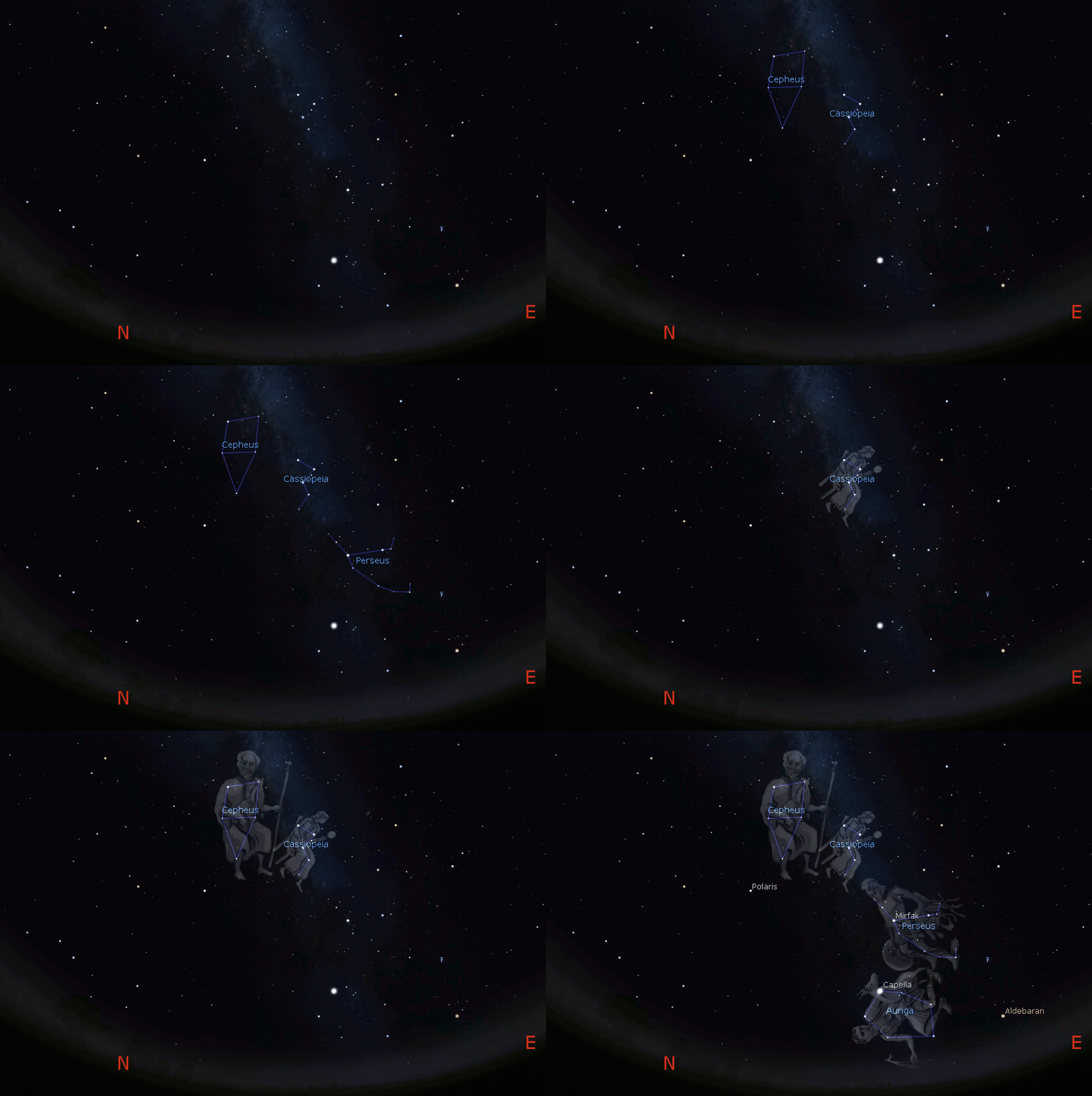
Cassiopeia and constellations along the Milky Way in the northeast these autumn evenings. (8 p.m. November 9, 2017). Click on image to enlarge. Created using Stellarium and GIMP.
11/08/2017 – Ephemeris – Jupiter becomes visible in the morning (The bright planets this week)
Ephemeris for Wednesday, November 8th. The Sun will rise at 7:30. It’ll be up for 9 hours and 51 minutes, setting at 5:21. The Moon, 2 days before last quarter, will rise at 9:52 this evening.
Let’s take our weekly look at the bright planets. Saturn is sinking low in the southwestern sky in the evening. Saturn’s rings are still spectacular in telescopes, but since Saturn is so low in the sky the turbulence of the thick atmosphere makes Saturn fuzzy and seemingly to go in and out of focus. Saturn will set at 7:37 p.m. Tomorrow in the morning sky, Mars, heading away from the Sun will rise in the east at 4:20 a.m., Venus, is heading closer to the Sun, will rise at 6:11 in the east-southeast. Jupiter is in the morning sky but lower than Venus, rising in the east-southeast at 6:33. Mercury has moved into the evening sky and will reach it’s greatest elongation from the Sun in 15 days, but will not be easily visible even then.
The times given are for the Traverse City/Interlochen area of Michigan. They may be different for your location.
Addendum
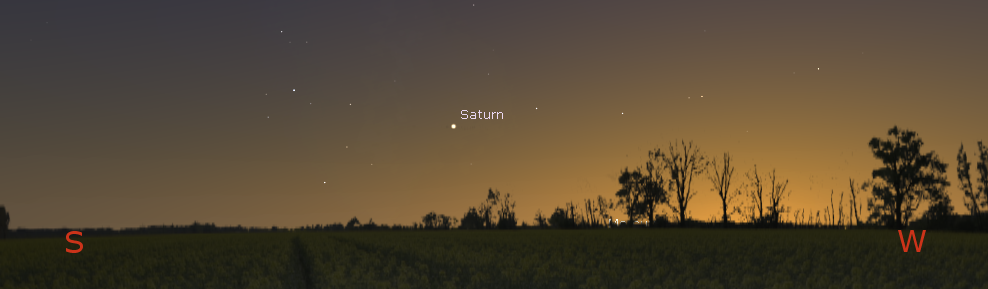
Saturn with Mercury (unlabeled) at the horizon at 6 p.m., November 8, 2017. Click on the image to enlarge. Create using Stellarium.
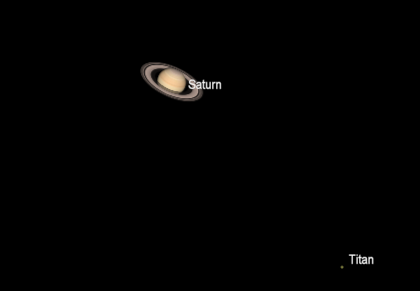
Saturn and its brightest moon Titan in the evening November 8, 2017. Created using Cartes du Ciel (Sky Charts).
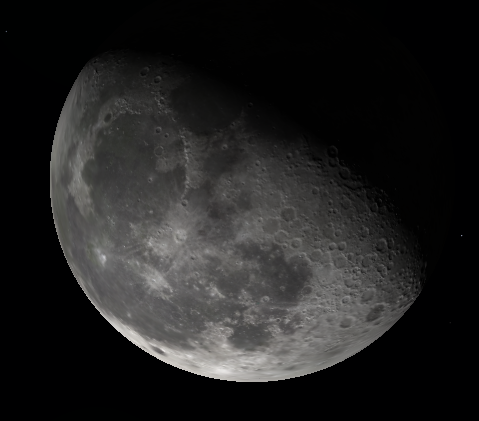
The Moon as it might be seen in binoculars at 10:30 p.m., November 8, 2017. Created using Stellarium.
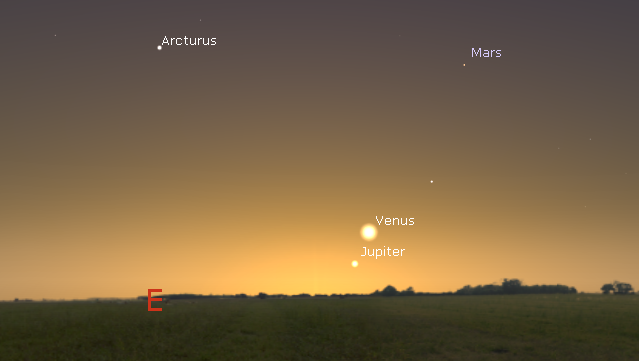
Mars, Venus and Jupiter at 7 a.m., November 9, 2017. Jupiter will come abreast of Venus on the morning of the 13th. when they will be less than the width of the Moon apart. Created using Stellarium.
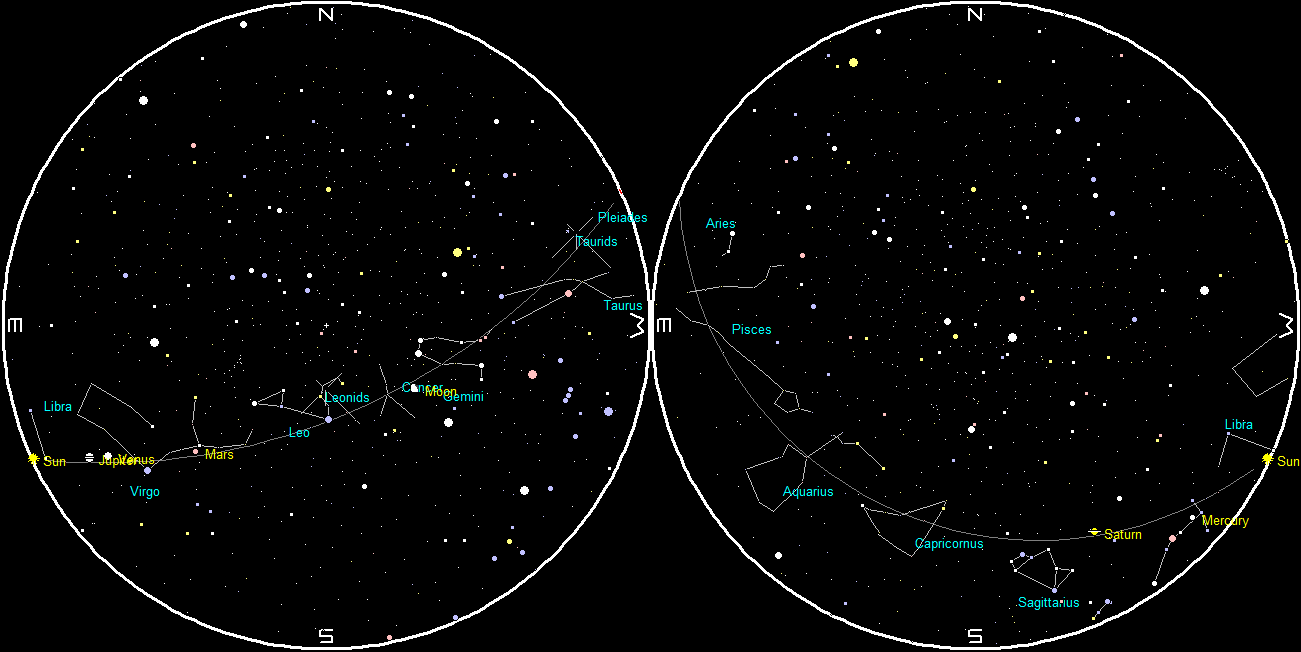
Planets at sunset and sunrise of a single night starting with sunset on the right on November 8, 2017. The night ends on the left with sunrise on the 9th. Click on the image to enlarge. Created using my LookingUp program.
11/07/2017 – Ephemeris Extra – G2 Geomagnetic Storm in progress
There an enhanced chance for auroras (northern lights) tonight.
check out http://spaceweather.com/ or http://www.swpc.noaa.gov/.
11/07/2017 – Ephemeris – The autumn constellations are all visible in the early evening
Ephemeris for Election Day for some folks, Tuesday, November 7th. The Sun will rise at 7:28. It’ll be up for 9 hours and 54 minutes, setting at 5:23. The Moon, 3 days before last quarter, will rise at 8:49 this evening.
We’ll have about an hour and a half of reasonably dark skies between 6:30 and nearly 9 p.m. – At 8 p.m. all the autumn constellations are visible. The Zodiacal constellations from Capricornus in the southwest through Aquarius, Pisces and Aries, all relatively faint to Taurus rising in the east northeast. Pegasus the flying horse is seen in the high south-southeast. It and the connected constellation of Andromeda the chained princess are seen above Aquarius through Aries. The bright star Fomalhaut holds a lonely vigil low in the south, High in the northeast is the W shaped constellation of Cassiopeia the queen, under which is Perseus, her son-in-law and hero down to the bright star Capella.
The times given are for the Traverse City/Interlochen area of Michigan. They may be different for your location.
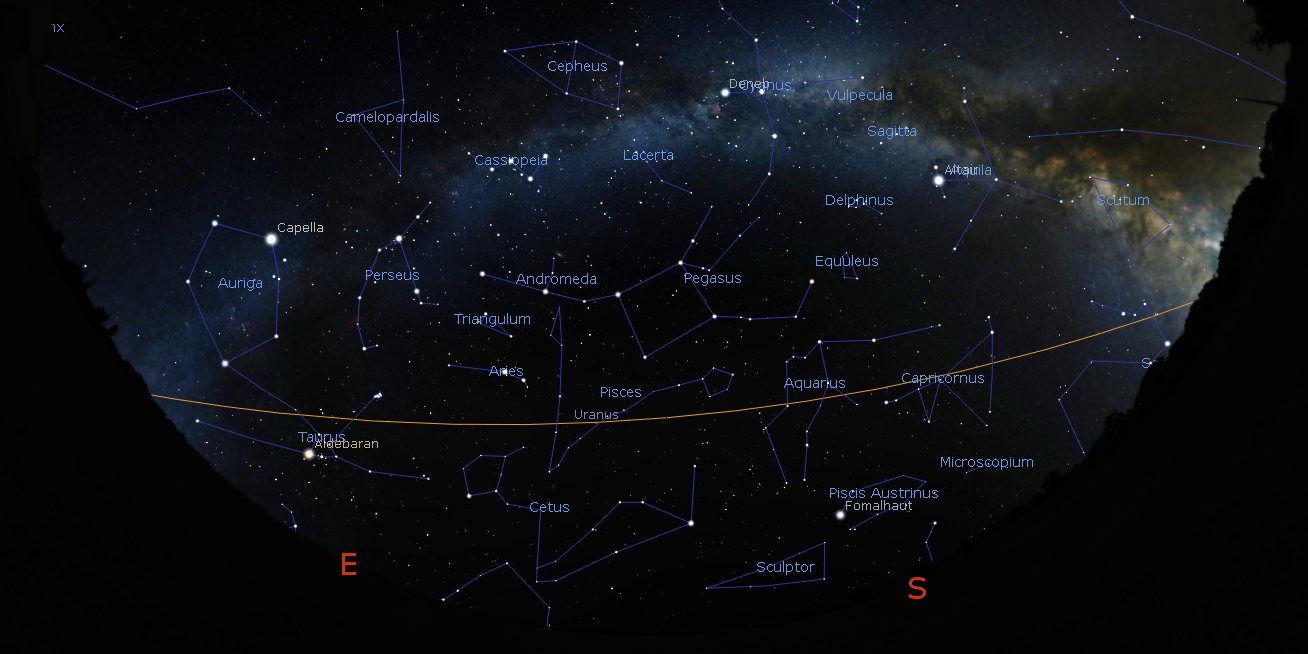
The sky at 8 p.m. November 7, 2017 showing the autumn constellations, centered on the southeastern sky. Click on the image to enlarge. The Milky Way has been brightened to show its passage through Perseus better. The red line is the ecliptic, the path of the Sun through the Zodiac. Created using Stellarium.
Addendum
 Bob Moler's Ephemeris Blog