Archive
07/31/2018 – Ephemeris – Previewing August skies
Ephemeris for Tuesday, July 31st. The Sun rises at 6:27. It’ll be up for 14 hours and 41 minutes, setting at 9:09. The Moon, half way from full to last quarter, will rise at 11:17 this evening.
Let’s look ahead at the month of August in the skies. Daylight hours will decrease from 14 hours and 39 minutes tomorrow to 13 hours 17 minutes on the 31st. The altitude of the sun at local noon, that is degrees of angle above the horizon will decrease from 63 degrees tomorrow to just over 53 degrees on the 31st. Straits area listeners can subtract one more degree from those angles. Local noon, when the Sun is due south, is about 1:43 p.m. The Perseid meteor shower will reach its peak all night on the 12th. It will be a dark night with the one day old moon setting at 10 p.m. The radiant point, where the meteors will seem to come from, will be rising higher in the northeastern sky all night. On the 17th Venus will reach ts greatest separation from the Sun in the evening sky.
The times given are for the Traverse City/Interlochen area of Michigan. They may be different for your location.
Addendum
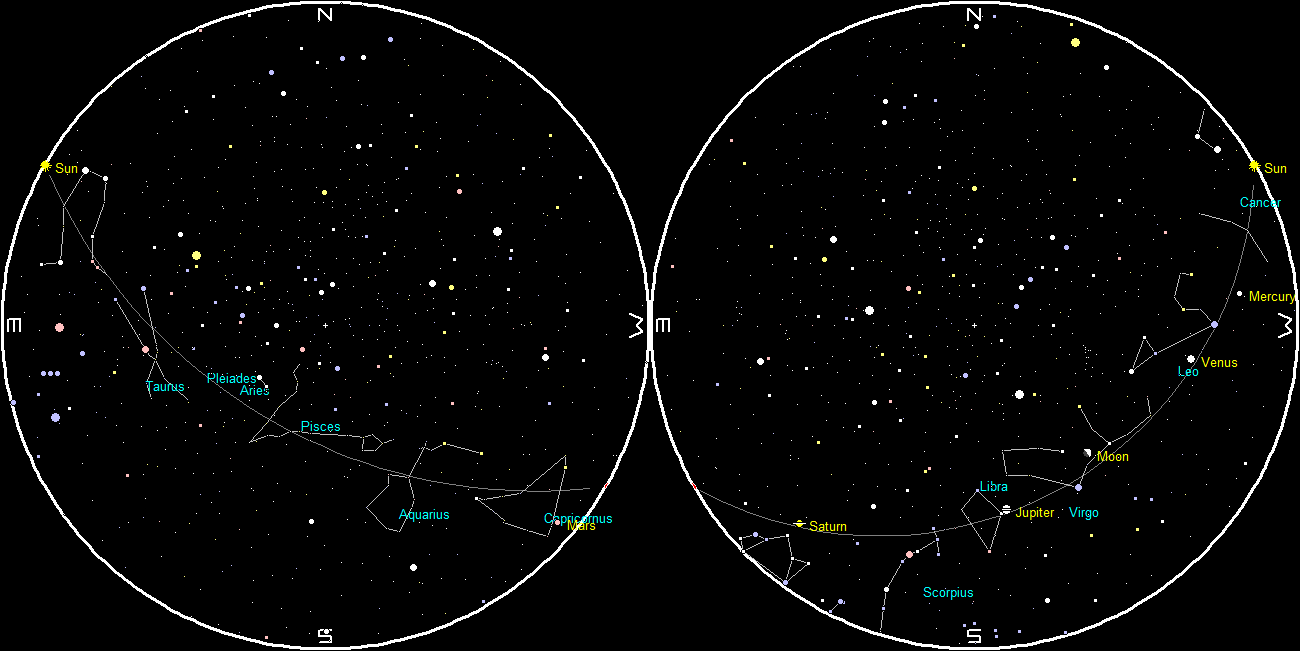
August Evening Star Chart
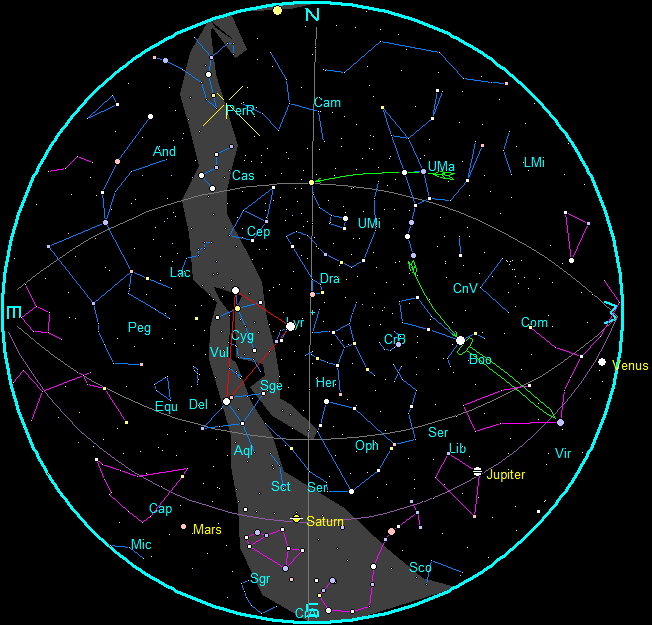
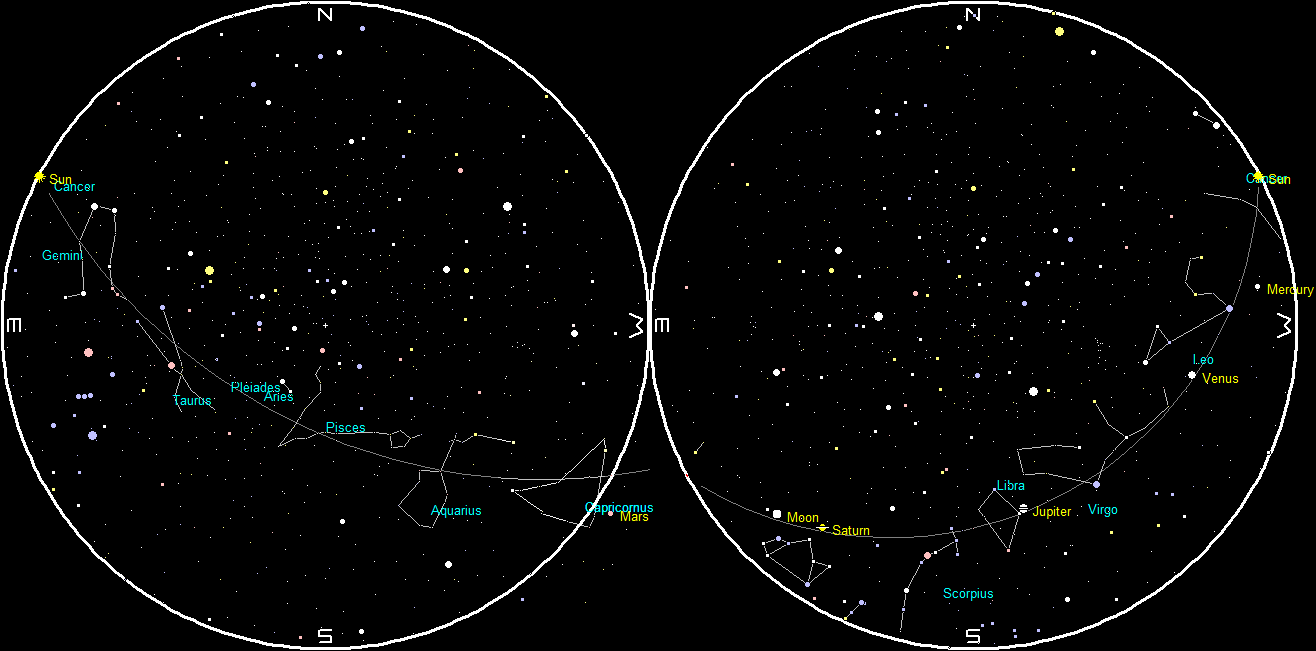
Star Chart for August 2018 (10 p.m. EDT August 15, 2018). Created using my LookingUp program. Click on image to enlarge.
The planets and stars are plotted for the 15th at 10 p.m. EDT in the evening and 4:30 a.m. for the morning chart. These are the chart times. Note that Traverse City is located approximately 45 minutes behind our time meridian. (An hour 45 minutes behind our daylight saving time meridian during EDT). To duplicate the star positions on a planisphere you may have to set it to 1 hour 45 minutes earlier than the current time.
Note the chart times of 10 p.m. and 4:30 a.m. are for the 15th. For each week before the 15th add ½ hour (28 minutes if you’re picky). For each week after the 15th subtract ½ hour. The planet positions are updated each Wednesday on this blog. For planet positions on dates other than the 15th, check the Wednesday planet posts on this blog.
August Morning Star Chart
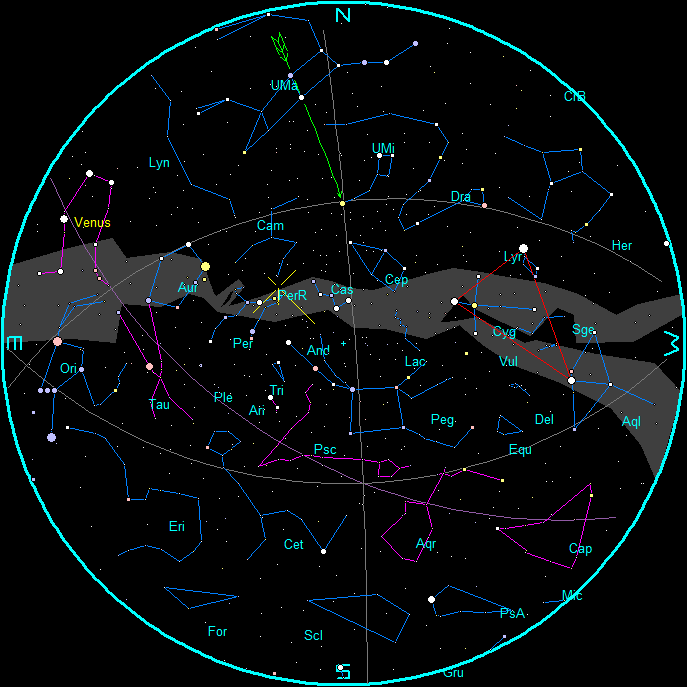
Star Chart for August 2018 mornings based on 4:30 a.m. August 15th. Created using my LookingUp program. Click on image to enlarge.
For a list of constellation names to go with the abbreviations click here.
- Pointer stars at the front of the bowl of the Big Dipper point to Polaris the North Star.
- Leaky Big Dipper drips on Leo.
- Follow the arc of the handle of the Big Dipper to the star Arcturus and
- Continue with a spike to Spica.
- The Summer Triangle is in red.
- PerR – Perseid meteor shower radiant
Twilight
| Morning | Twilight | Evening | Twilight | Dark | Night | Moon | |
| Date | Astronomical | Nautical | Nautical | Astronomical | Start | End | Illum. |
| 2018-07-31 | 4h28m | 5h17m | 22h28m | 23h17m | 23h17m | 23h17m | 0.89 |
| 2018-08-01 | 4h30m | 5h18m | 22h27m | 23h15m | 23h15m | 23h43m | 0.82 |
| 2018-08-02 | 4h32m | 5h20m | 22h25m | 23h13m | 23h13m | – | 0.74 |
| 2018-08-03 | 4h34m | 5h21m | 22h24m | 23h11m | 23h11m | 0h09m | 0.64 |
| 2018-08-04 | 4h36m | 5h23m | 22h22m | 23h09m | 23h09m | 0h37m | 0.53 |
| 2018-08-05 | 4h38m | 5h24m | 22h20m | 23h07m | 23h07m | 1h08m | 0.42 |
| 2018-08-06 | 4h40m | 5h26m | 22h18m | 23h05m | 23h05m | 1h44m | 0.31 |
| 2018-08-07 | 4h42m | 5h27m | 22h17m | 23h03m | 23h03m | 2h26m | 0.20 |
| 2018-08-08 | 4h43m | 5h29m | 22h15m | 23h00m | 23h00m | 3h18m | 0.11 |
| 2018-08-09 | 4h45m | 5h30m | 22h13m | 22h58m | 22h58m | 4h19m | 0.05 |
| 2018-08-10 | 4h47m | 5h32m | 22h11m | 22h56m | 22h56m | 4h47m | 0.01 |
| 2018-08-11 | 4h49m | 5h33m | 22h10m | 22h54m | 22h54m | 4h49m | 0.00 |
| 2018-08-12 | 4h51m | 5h35m | 22h08m | 22h52m | 22h52m | 4h51m | 0.03 |
| 2018-08-13 | 4h53m | 5h36m | 22h06m | 22h49m | 22h49m | 4h53m | 0.08 |
| 2018-08-14 | 4h55m | 5h38m | 22h04m | 22h47m | 23h01m | 4h55m | 0.16 |
| 2018-08-15 | 4h56m | 5h39m | 22h02m | 22h45m | 23h29m | 4h56m | 0.26 |
| 2018-08-16 | 4h58m | 5h41m | 22h00m | 22h43m | 23h59m | 4h58m | 0.36 |
| 2018-08-17 | 5h00m | 5h42m | 21h58m | 22h41m | – | 5h00m | 0.47 |
| 2018-08-18 | 5h02m | 5h44m | 21h56m | 22h38m | 0h30m | 5h02m | 0.57 |
| 2018-08-19 | 5h04m | 5h45m | 21h54m | 22h36m | 1h03m | 5h04m | 0.67 |
| 2018-08-20 | 5h05m | 5h47m | 21h53m | 22h34m | 1h40m | 5h05m | 0.76 |
| 2018-08-21 | 5h07m | 5h48m | 21h51m | 22h32m | 2h22m | 5h07m | 0.84 |
| 2018-08-22 | 5h09m | 5h50m | 21h49m | 22h29m | 3h09m | 5h09m | 0.90 |
| 2018-08-23 | 5h11m | 5h51m | 21h47m | 22h27m | 4h00m | 5h11m | 0.90 |
| 2018-08-24 | 5h12m | 5h53m | 21h45m | 22h25m | 4h56m | 5h12m | 0.95 |
| 2018-08-25 | 5h14m | 5h54m | 21h43m | 22h23m | – | – | 0.99 |
| 2018-08-26 | 5h16m | 5h55m | 21h41m | 22h20m | – | – | 1.00 |
| 2018-08-27 | 5h17m | 5h57m | 21h39m | 22h18m | – | – | 0.99 |
| 2018-08-28 | 5h19m | 5h58m | 21h37m | 22h16m | – | – | 0.97 |
| 2018-08-29 | 5h21m | 6h00m | 21h35m | 22h14m | – | – | 0.92 |
| 2018-08-30 | 5h22m | 6h01m | 21h33m | 22h11m | 22h11m | 22h40m | 0.86 |
| 2018-08-31 | 5h24m | 6h02m | 21h31m | 22h09m | 22h09m | 23h09m | 0.78 |
Twilight calendar was generated in Cartes du Ciel.
NASA Calendar of Planetary Events
Date        Time    Event
Aug 01  We          Venus: 45.1° E
    04  Sa  2:18 pm Last Quarter
    06  Mo  2:35 pm Moon-Aldebaran: 1.1° S
    08  We  6:33 pm Moon North Dec.: 20.8° N
    08  We  9:59 pm Mercury Inferior Conj.
    10  Fr  9:40 am Moon Ascending Node
    10  Fr  2:05 pm Moon Perigee: 358100 km
    11  Sa  5:47 am Partial Solar Eclipse (NE Canada to Asia)
    11  Sa  5:58 am New Moon
    12  Su  8:44 pm Perseid Meteor Shower: ZHR = 90
    14  Tu  9:35 am Moon-Venus: 6.4° S
    17  Fr  6:38 am Moon-Jupiter: 4.8° S
    17  Fr 11:59 am Venus Greatest Elongation: 45.9° E
    18  Sa  3:49 am First Quarter
    20  Mo 10:07 pm Mercury-Beehive: 5.9° S
    21  Tu  5:55 am Moon-Saturn: 2.4° S
    21  Tu 10:58 pm Moon South Dec.: 20.8° S
    23  Th  7:23 am Moon Apogee: 405700 km
    24  Fr 12:51 am Moon Descending Node
    26  Su  7:56 am Full Moon
    26  Su  3:59 pm Mercury Greatest Elongation: 18.3° W
Sep 01  Sa          Venus: 45° E
Sky Events Calendar by Fred Espenak and Sumit Dutta (NASA’s GSFC),
http://eclipse.gsfc.nasa.gov/SKYCAL/SKYCAL.html
If you go to the above site you can print out a list like the above for the entire year
or calendar pages for your time zone.
Sun and Moon Rising and Setting Events
     LU              Ephemeris of Sky Events for Interlochen/TC
     August, 2018    Local time zone: EDT
     +-----------------------------------------------------------------------+
     | DATE |  SUN     SUN  DAYLIGHT|   TWILIGHT*    |MOON  RISE OR    ILLUM |
     |      |  RISE    SET    HOURS |  END    START  |PHASE SET** TIME FRACTN|
     +=======================================================================+
     |Wed  1| 06:29a  09:08p  14:39 | 10:23p  05:13a |      Rise 11:43p   77%|
     |Thu  2| 06:30a  09:07p  14:37 | 10:22p  05:14a |      Rise 12:09a   68%|
     |Fri  3| 06:31a  09:05p  14:34 | 10:20p  05:16a |      Rise 12:37a   58%|
     |Sat  4| 06:32a  09:04p  14:32 | 10:18p  05:17a |L Qtr Rise 01:08a   47%|
     +------+-----------------------+----------------+-----------------------+
     |Sun  5| 06:33a  09:03p  14:29 | 10:17p  05:19a |      Rise 01:44a   37%|
     |Mon  6| 06:34a  09:01p  14:27 | 10:15p  05:20a |      Rise 02:27a   26%|
     |Tue  7| 06:35a  09:00p  14:24 | 10:13p  05:22a |      Rise 03:18a   17%|
     |Wed  8| 06:37a  08:59p  14:22 | 10:11p  05:23a |      Rise 04:20a    9%|
     |Thu  9| 06:38a  08:57p  14:19 | 10:10p  05:25a |      Rise 05:30a    3%|
     |Fri 10| 06:39a  08:56p  14:16 | 10:08p  05:26a |      Rise 06:45a    0%|
     |Sat 11| 06:40a  08:54p  14:14 | 10:06p  05:28a |New   Set  09:21p    1%|
     +------+-----------------------+----------------+-----------------------+
     |Sun 12| 06:41a  08:53p  14:11 | 10:04p  05:29a |      Set  09:58p    4%|
     |Mon 13| 06:42a  08:51p  14:08 | 10:02p  05:31a |      Set  10:30p   10%|
     |Tue 14| 06:44a  08:50p  14:06 | 10:00p  05:32a |      Set  11:00p   17%|
     |Wed 15| 06:45a  08:48p  14:03 | 09:59p  05:34a |      Set  11:29p   27%|
     |Thu 16| 06:46a  08:46p  14:00 | 09:57p  05:35a |      Set  11:59p   36%|
     |Fri 17| 06:47a  08:45p  13:57 | 09:55p  05:37a |      Set  12:29a   47%|
     |Sat 18| 06:48a  08:43p  13:54 | 09:53p  05:38a |F Qtr Set  01:03a   57%|
     +------+-----------------------+----------------+-----------------------+
     |Sun 19| 06:49a  08:42p  13:52 | 09:51p  05:40a |      Set  01:40a   66%|
     |Mon 20| 06:51a  08:40p  13:49 | 09:49p  05:41a |      Set  02:22a   75%|
     |Tue 21| 06:52a  08:38p  13:46 | 09:47p  05:43a |      Set  03:09a   83%|
     |Wed 22| 06:53a  08:37p  13:43 | 09:45p  05:44a |      Set  04:00a   89%|
     |Thu 23| 06:54a  08:35p  13:40 | 09:43p  05:46a |      Set  04:56a   94%|
     |Fri 24| 06:55a  08:33p  13:37 | 09:41p  05:47a |      Set  05:54a   98%|
     |Sat 25| 06:56a  08:31p  13:34 | 09:39p  05:48a |      Set  06:54a  100%|
     +------+-----------------------+----------------+-----------------------+
     |Sun 26| 06:58a  08:30p  13:31 | 09:37p  05:50a |Full  Rise 08:54p  100%|
     |Mon 27| 06:59a  08:28p  13:29 | 09:35p  05:51a |      Rise 09:21p   98%|
     |Tue 28| 07:00a  08:26p  13:26 | 09:33p  05:53a |      Rise 09:47p   94%|
     |Wed 29| 07:01a  08:24p  13:23 | 09:31p  05:54a |      Rise 10:13p   88%|
     |Thu 30| 07:02a  08:23p  13:20 | 09:29p  05:56a |      Rise 10:40p   81%|
     |Fri 31| 07:04a  08:21p  13:17 | 09:27p  05:57a |      Rise 11:09p   72%|
     +-----------------------------------------------------------------------+
     * Nautical Twilight
     ** Moon rise or moon set, whichever occurs between sunrise and sunset
Ephemeris of Sky Events is created with my DOS version LookingUp program.
07/30/2018 – Ephemeris – Early tomorrow morning Mars will be the closest to is in 15 years
Ephemeris for Monday, July 30th. The Sun rises at 6:26. It’ll be up for 14 hours and 44 minutes, setting at 9:10. The Moon, 3 days past full, will rise at 10:51 this evening.
Mars’ closest approach to the Earth since August 27, 2003 is tomorrow at about 3:51 a.m. at a distance of 35.8 million miles (57.6 million km). The last really close approach of Mars was on August 27, 2003 when it was about 600 thousand miles (a million km) closer. That close approach was probably the closest in 50 thousand years. Mars and the Earth get close in their orbits about every 26 months. But because Mars has a much more elliptical orbit than the Earth, the very best close encounters occur every 15 or 17 years. Despite the fact that we have satellites that orbit Mars and two rovers operating on its surface, amateur astronomers still challenge themselves to observe and photograph Mars at its very closest.
The times given are for the Traverse City/Interlochen area of Michigan. They may be different for your location.
Addendum
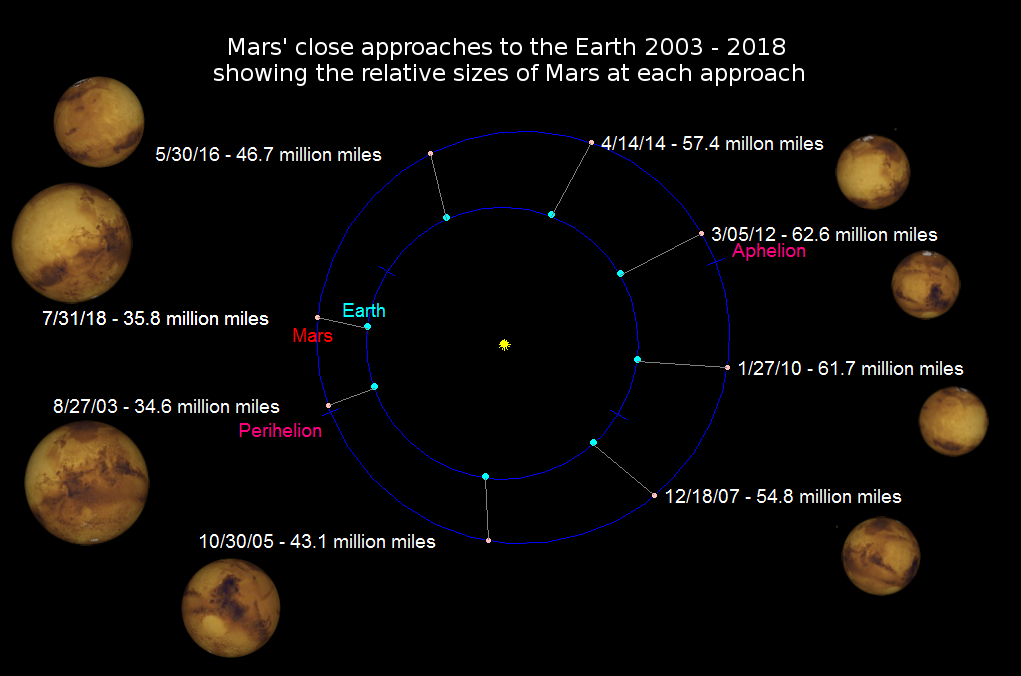
Mars’ closest approaches to the Earth in the period 2003 to 2018 also showing the apparent sizes of the planet at each approach. Click on image to enlarge. Created using my LookingUp program and Cartes du Ciel (Sky Charts).
07/27/2018 – Ephemeris – Mars is at opposition from the Sun today
Ephemeris for Friday, July 27th. The Sun rises at 6:23. It’ll be up for 14 hours and 50 minutes, setting at 9:14. The Moon, at full today, will rise at 9:16 this evening.
The planet Mars was at opposition with the Sun early this morning, that is opposite the Sun in the sky. It is a time when a planet rises at sunset and sets at sunrise. For us it will rise tonight at 9:40 p.m. 26 minutes after sunset and will set tomorrow at 6 a.m., 24 minutes before sunrise. This odd behavior is due to the fact that Mars is actually south of a lime from the Sun through the Earth. Mars’ orbit is tilted to the Earths’ so it will appear lower in the sky as one would expect for a planet in its position. Today Mars is 35.9 million miles (57.7 million km) away. In four days it will be a bit closer to us due to its elliptical orbit taking it a bit closer to the Sun. How much closer? About 93,000 miles (150,000 km) to us.
The times given are for the Traverse City/Interlochen area of Michigan. They may be different for your location.
Addendum
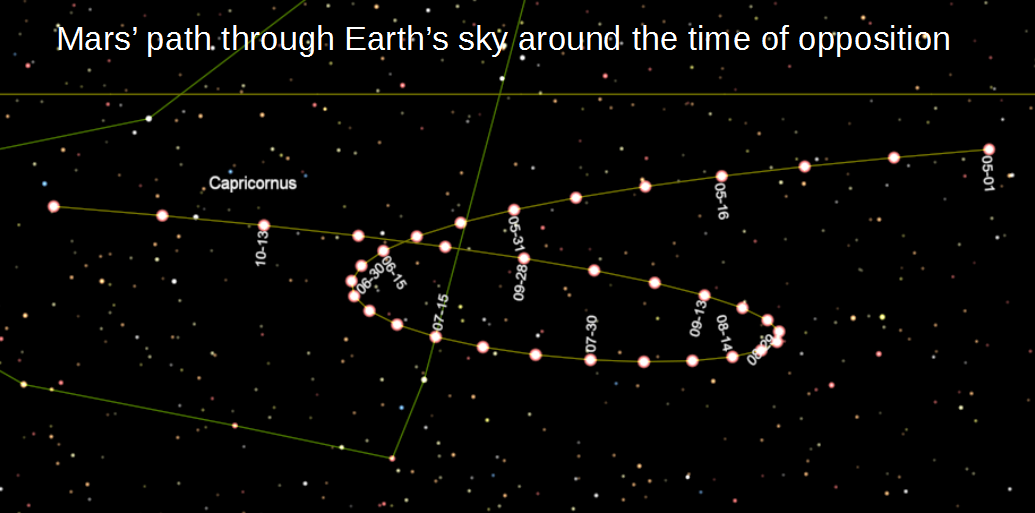
This chart is shown with the horizontal being parallel to the ecliptic, which is the horizontal line near the top of the image. Created using Cartes du Ciel (Sky Charts).
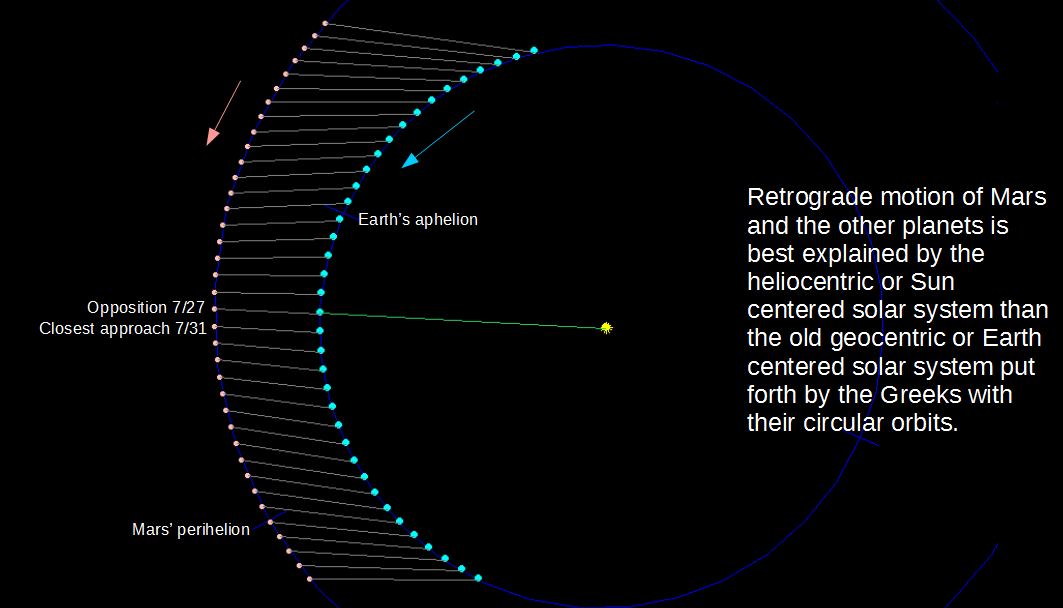
Created using Cartes du Ciel (Sky Charts).
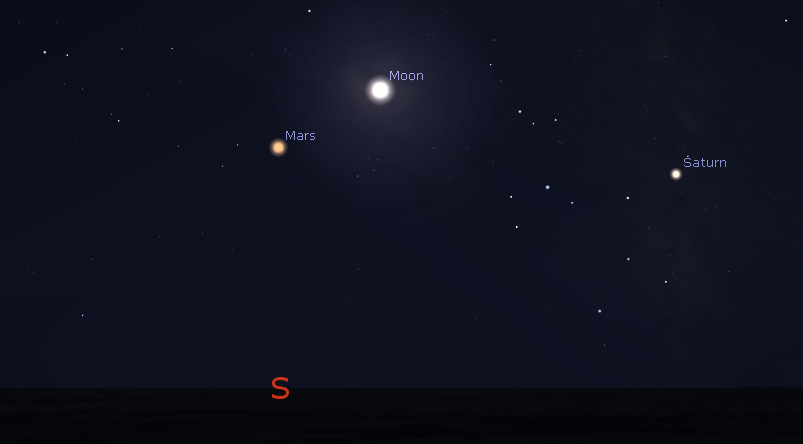
Mars on opposition day, July 27, 2018 at 1:55 a.m. as it crossed the meridian due south. In the Interlochen/Traverse City area a bit south of 45 degrees north latitude. Mars appears a an altitude of slightly less than 20 degrees altitude. Created using Stellarium.
Update
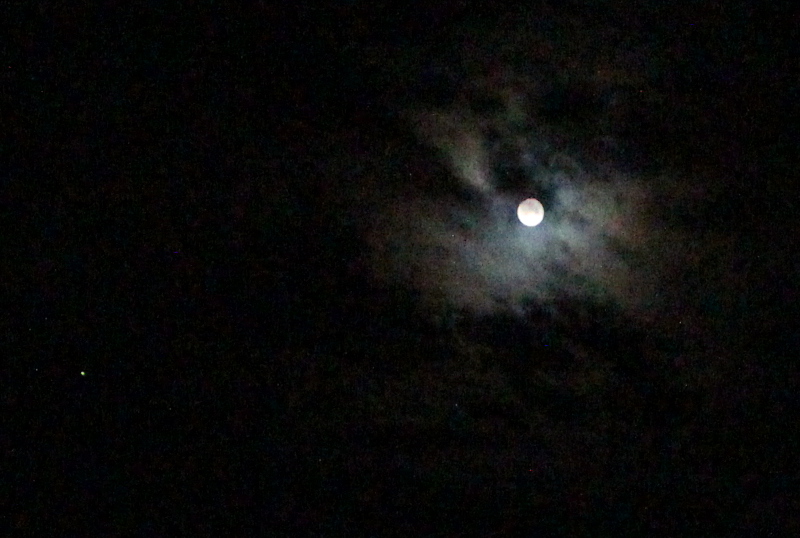
Mars at opposition and the full Moon at 2:01 a.m. July 27, 2018. I thought I’d go out near the Mars transit time this morning and photograph the Moon and Mars. Earlier we had a pop-up rain shower, and the clouds were clearing out. Got a lucky shot.
07/26/2018 – Ephemeris – How can you get to Mars – the Hohmann transfer orbit
Ephemeris for Thursday, July 26th. The Sun rises at 6:22. It’ll be up for 14 hours and 53 minutes, setting at 9:15. The Moon, 1 day before full, will set at 6:06 tomorrow morning.
How does one get a spacecraft to another planet, like Mars? One might think to wait until the two planets are closest and zip across. That would take more energy than we are capable of. We cab barely escape the Earth and get a spacecraft into solar orbit. Also one needs energy to slow down to be captured by the planet if one wants to orbit it. The most economical way was devised way before the space age by Walter Hohmann, a German scientist in 1925. The idea is to launch a spacecraft with enough velocity to reach the other planet half way around the Sun, so the transfer orbit is tangent to both the Earth’s and the planet’s orbit. Transit times to Mars would be in the range of 7 months. The InSight lander is currently on such a trajectory.
The times given are for the Traverse City/Interlochen area of Michigan. They may be different for your location.
Addendum
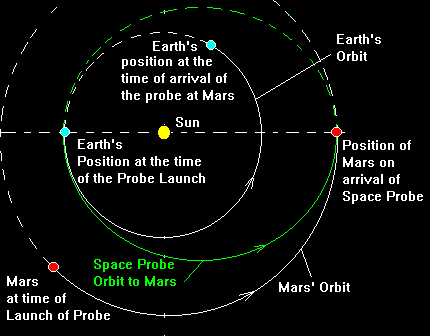
Hohmann transfer orbit. Credit Planetary Society-Myron Kayton
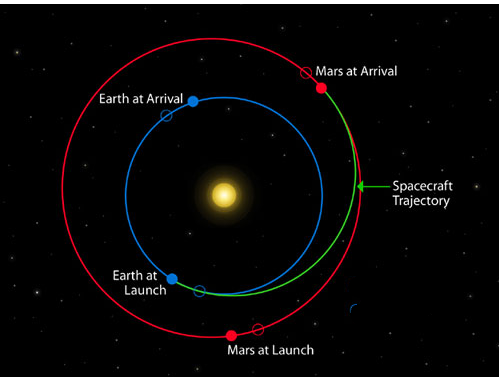
A Hohmann lowest energy transfer orbit to Mars. This diagram is for the Mars Exploration Rovers Spirit and Opportunity orbits, launched in 2003, arrived in 2004. Solid planets, Spirit launch and arrival. Ghost planets, Opportunity launch and arrival. Credit NASA/JPL.
07/25/2018 – Ephemeris – The bright planets this week
Ephemeris for Wednesday, July 25th. The Sun rises at 6:21. It’ll be up for 14 hours and 55 minutes, setting at 9:16. The Moon, 2 days before full, will set at 5:13 tomorrow morning.
It’s Wednesday and time to look for and at the bright planets. Three of them are visible in the evening sky. The brilliant beacon of Venus will be visible in the western twilight from about 9:40 p.m. until it sets at 11:07 p.m. Mercury, is now too close to the Sun be seen. Jupiter will be in the south-southwest as it gets dark. It is only outshone by Venus, the Moon, and for a few weeks by Mars at its closest. Jupiter will set at 1:15 a.m. Saturn will start the evening low in the southeast and will stay relatively low, above the Teapot of Sagittarius. It will be due south at 11:45 p.m. and will set at 4:10 a.m.. Mars will rise at 9:49 p.m. and is now only 36.0 million miles (57.9 million km) away. It will reach opposition early Friday morning.
The times given are for the Traverse City/Interlochen area of Michigan. They may be different for your location.
Addendum
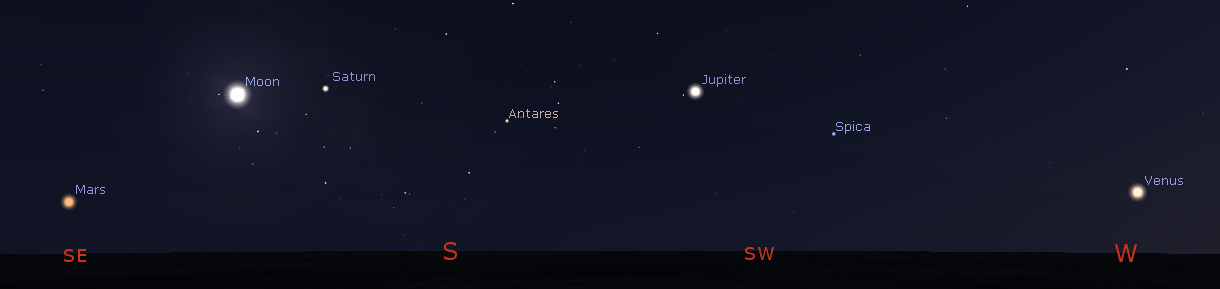
Evening planets from Venus to Saturn plus Moon and the officially morning planet (for two more days) Mars at 10:30 p.m., July 25, 2018. Click on image to enlarge. Created using Stellarium.
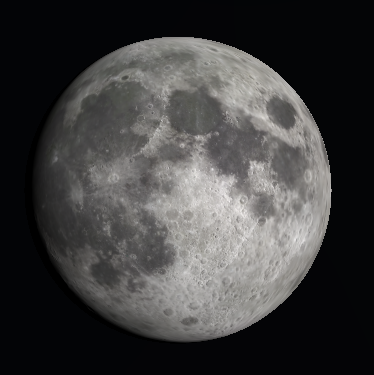
The Moon as it might be seen in binoculars this evening. Created using Stellarium.
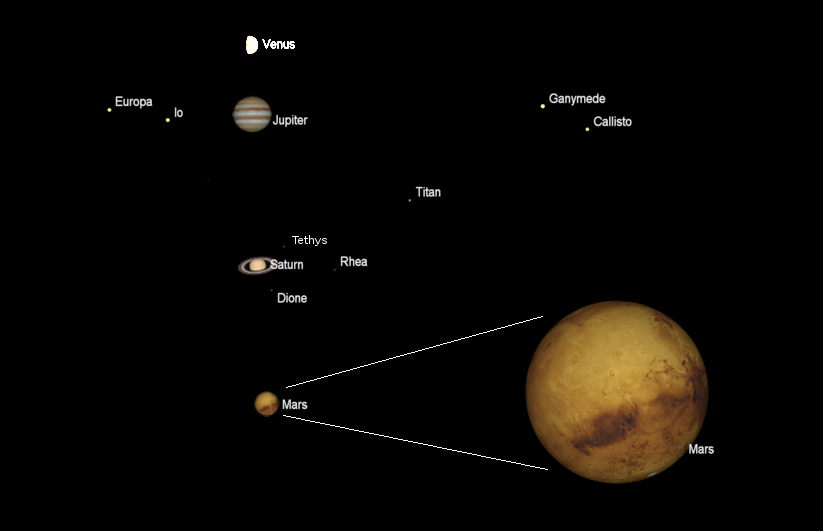
Venus, Jupiter, Saturn and Mars with the same magnification at 10:30 p.m. July 25, 2018.
Mars is also shown enlarged. It seems that the global dust storm may be abating according to one report I saw on Twitter. Created using Cartes du Ciel (Sky Charts).
Planets and the Moon at sunset and sunrise of a single night starting with sunset on the right on July 25, 2018. The night ends on the left with sunrise on the 26th. Mars, being close to opposition and very much south of the ecliptic is not in the sky at either sunrise or sunset, I showed a patch of sky with Mars in it in the morning that was below the horizon. Click on the image to enlarge. Created using my LookingUp program.
07/24/2018 – Ephemeris – What about those martian canals
Ephemeris for Tuesday, July 24th. The Sun rises at 6:20. It’ll be up for 14 hours and 57 minutes, setting at 9:17. The Moon, 3 days before full, will set at 4:25 tomorrow morning.
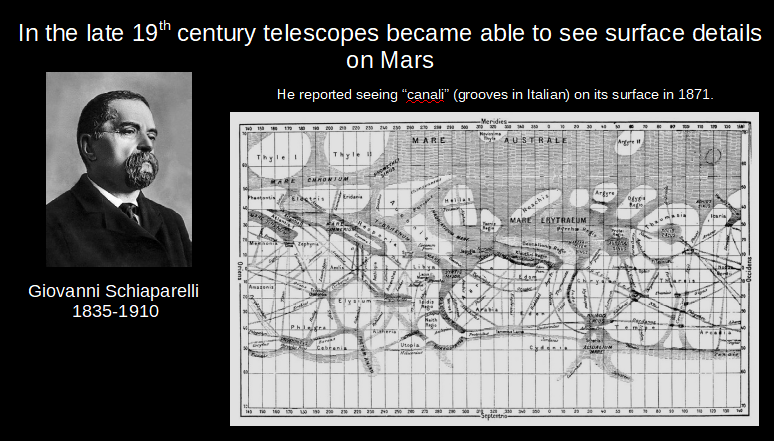
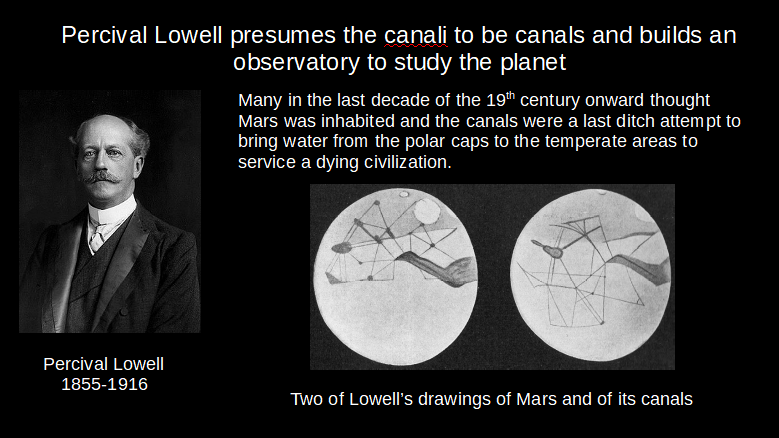
The greatest mystery of the late 19th and early 20th century of Mars was the discovery of fine linear marking seen by visual observers of Mars. They were first reported by an Italian astronomer Giovanni Schiaparelli in 1871 as grooves, canali in Italian. It was turned into canals by the English language newspapers of the day. Canals are artificial constructions. Thus one Percival Lowell of Massachusetts built an observatory in Flagstaff Arizona to observe and map Mars for himself, dying in 1916 still believing in an ancient martian civilization bringing water from the polar caps to the equatorial region by canals in order to survive. Alas, there are no canals. Mars is a barren world, whose secrets we now probe below its red dust.
The times given are for the Traverse City/Interlochen area of Michigan. They may be different for your location.
Addendum
The source if the images below is the talk “Mars 2018” I gave at the Betsie Valley District Library, July, 20, 2018.
***
07/23/2018 – Ephemeris – The importance of Mars in determining the nature of the solar system
Monday, July 23rd. The Sun rises at 6:19. It’ll be up for 14 hours and 59 minutes, setting at 9:18. The Moon, half way from first quarter to full, will set at 3:41 tomorrow morning.
The accurate observational positions of Mars by Tycho Brahe allowed Johannes Kepler in the early 17th century to discover his three laws of planetary motion. Tycho was the last and greatest of the naked eye astronomers. Kepler befriended Tycho who jealously guarded his observations. It was only after his death in 1601 that Kepler took possession of Tycho’s data. Until then it was believed that planets moved with uniform circular motion, even though they didn’t look like it. Astronomers added circle after circle, called epicycles, to attempt to make their system work. Mars was the worst case. Kepler finally determined that Mars, and indeed all the planets, orbited the Sun in elliptical orbits. That was his first law of planetary motion.
The times given are for the Traverse City/Interlochen area of Michigan. They may be different for your location.
Addendum
The source if the images below is the talk “Mars 2018” I gave at the Betsie Valley District Library, July, 20, 2018.
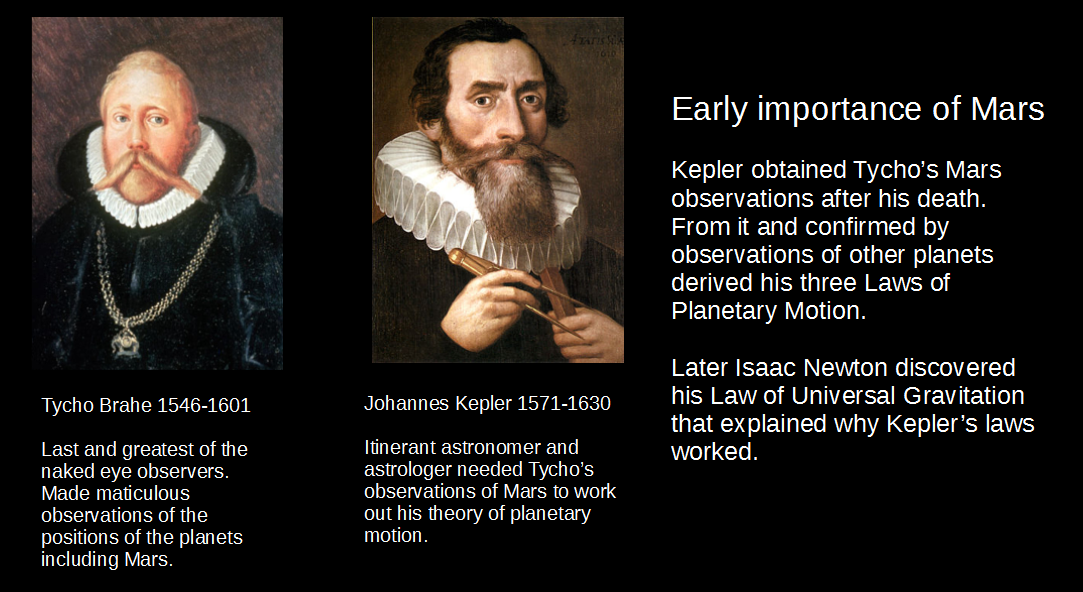
Tycho and Kepler. Artist for Tycho: Eduard Ender (1822-1883). Artist for Kepler, unknown. Source: Wikipedia.
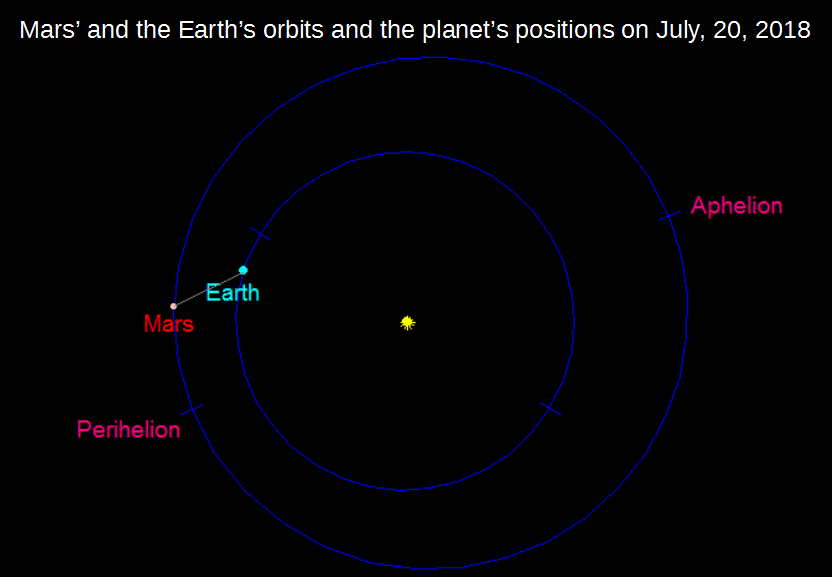
Mars’ and Earth’s orbits to scale and positions of the Earth and Mars July 20, 2018, one week before opposition. Note that Mars’ orbit is decidedly not circular. Credit my LookingUp program.
Created using Cartes du Ciel (Sky Charts).
Created using Cartes du Ciel (Sky Charts).
07/20/2018 – Ephemeris – Two astronomy events this weekend
Ephemeris for Friday, July 20th. Today the Sun will be up for 15 hours and 5 minutes, setting at 9:21, and it will rise tomorrow at 6:17. The Moon, 1 day past first quarter, will set at 1:57 tomorrow morning.
There are two astronomy events in the Grand Traverse region this weekend, starting tonight with a twilight talk and a star party at the Betsie Valley District Library in Thompsonville. It starts at 8:30 p.m. with a talk about Mars throughout history and how it has fascinated astronomers and the public alike through the ages. After which Jupiter and Saturn will be visible. If cloudy, the talk will go on as scheduled, though the observing part will be rescheduled to a later date. Tomorrow, Saturday there, will be viewing at the Northwestern Michigan College’s Rogers Observatory starting at 9 p.m. Jupiter and Saturn will be featured there too. The Observatory is located south of Traverse City on Birmley road.
The times given are for the Traverse City/Interlochen area of Michigan. They may be different for your location.
Addendum
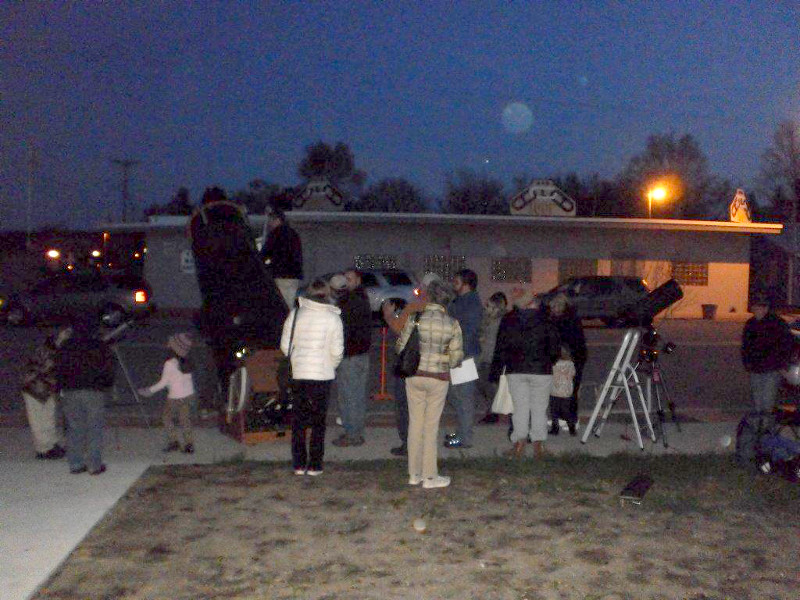
A group of folks out to see the planets with the member’s and society’s telescopes. Credit staff of the Betsie Valley District Library.
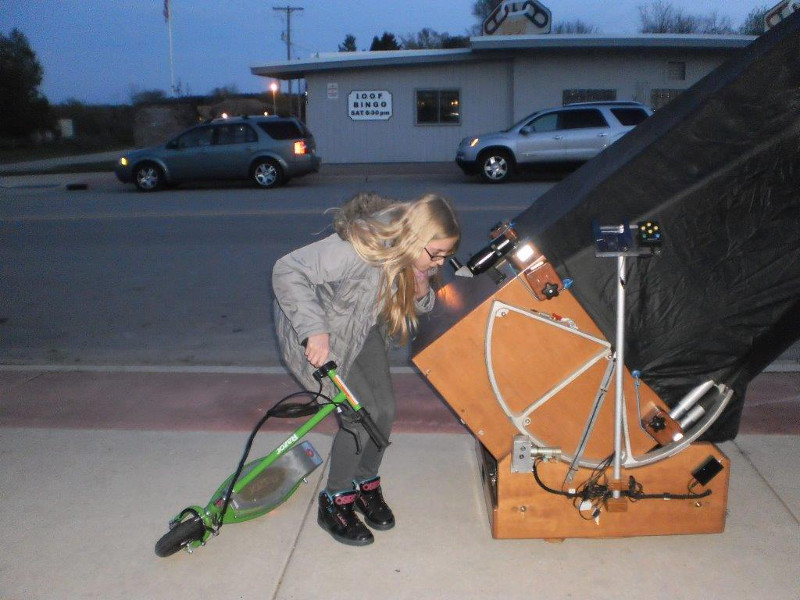
Scooter girl checking out the view through the rear finder of the society’s 25″ “Dobinator”. Credit staff of the Betsie Valley District Library.
07/19/2018 – Ephemeris – The Moon passes the evening planets one by one over the next week
Ephemeris for Thursday, July 19th. Today the Sun will be up for 15 hours and 7 minutes, setting at 9:22, and it will rise tomorrow at 6:16. The Moon, at first quarter today, will set at 1:29 tomorrow morning.
The Moon is making its monthly journey around the sky. Tonight it will be west or to the right of Jupiter. Tomorrow night Jupiter will be directly below the Moon. Next Tuesday night Saturn will appear below and left of the Moon. Next Thursday night Mars will appear below and to the left of the Moon. Mars at that time will be actually far south of the Moon, so that event usually doesn’t show in almanacs. Mars, being very close to us is in a part of its orbit that takes it south of the Earth’s orbital plane. We see that plane as the ecliptic or path of the Sun. We see the same situation when Venus is close to the Earth, and it is north or south of the ecliptic. The Moon can pass them without being listed as a conjunction.
The times given are for the Traverse City/Interlochen area of Michigan. They may be different for your location.
Addendum
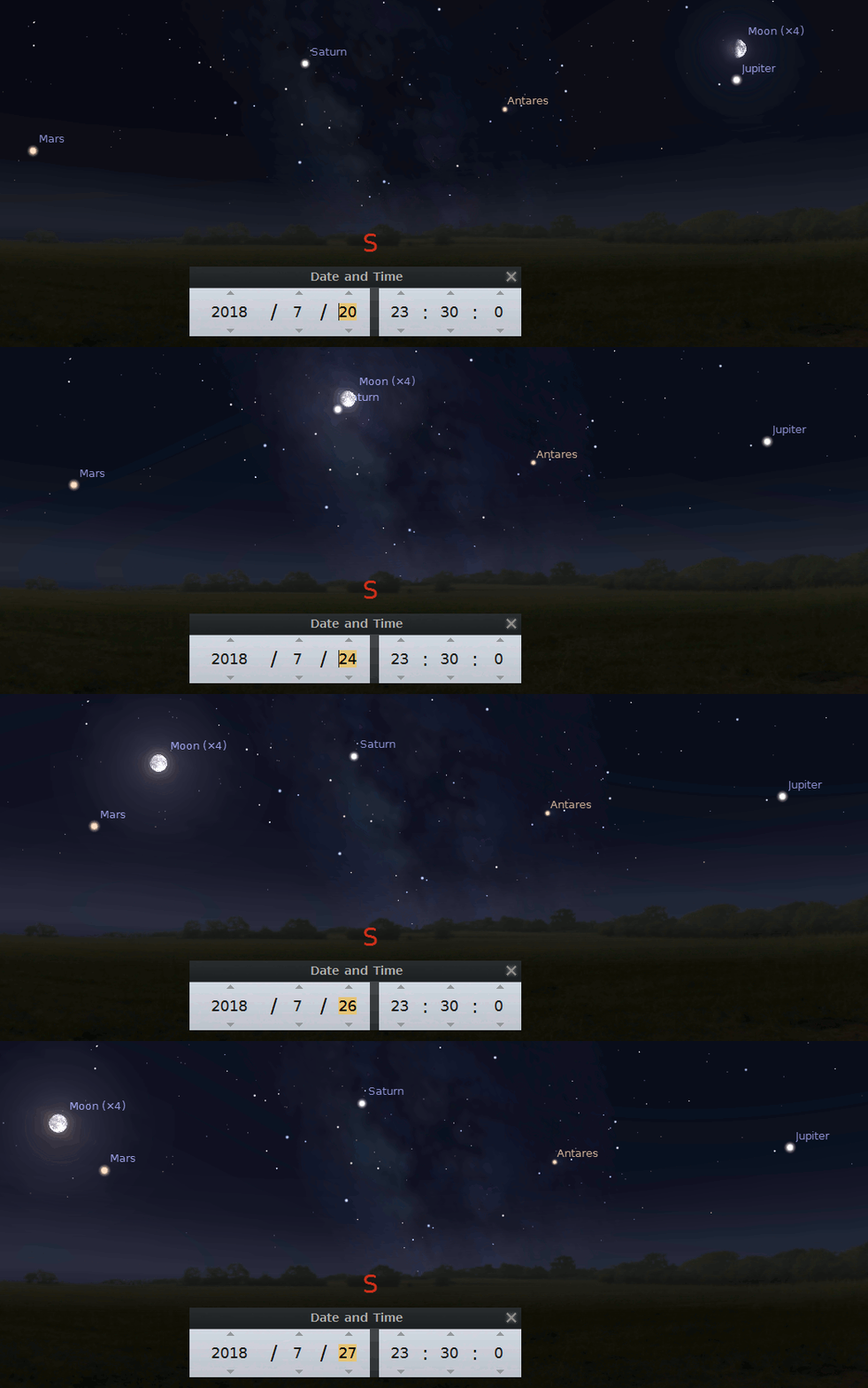
Here’s the Moon passing each of the superior evening planets in the 8 days from July 20 to July 27 2018. By the time the Mon will pass Mars it will truly be an evening planet. Mars will be at opposition with the Sun that day. Note that the Moon’s size is exaggerated by a factor of 4 to show its phase at this scale. Created using Stellarium and GIMP.
07/18/2018 – Ephemeris – Our weekly look at the bright planets
Ephemeris for Wednesday, July 18th. Today the Sun will be up for 15 hours and 8 minutes, setting at 9:23, and it will rise tomorrow at 6:15. The Moon, 1 day before first quarter, will set at 1:01 tomorrow morning.
It’s Wednesday and time to look for and at the bright planets. Four of them are in the evening sky. The brilliant beacon of Venus will be visible in the western twilight from about 9:40 p.m. until it sets at 11:21 p.m. Mercury, is fading and is far below and right of Venus, setting at 10:18 p.m. Jupiter will be in the south as it gets dark. It is only outshone by Venus, the Moon, and for a few weeks by Mars at its closest. Jupiter will set at 1:42 a.m. Saturn will start the evening low in the southeast and will stay relatively low, above the Teapot of Sagittarius. It will be due south at 12:14 a.m. and will set at 4:40 a.m.. Mars will rise at 10:20 p.m. and is now only 36.8 million miles (59.2 million km) away, in telescopes it appear to be 23.7″ (seconds of arc) in diameter. It will be due south and at its highest in the sky at 2:35 a.m. at 21 degrees altitude.
The times given are for the Traverse City/Interlochen area of Michigan. They may be different for your location.
Addendum
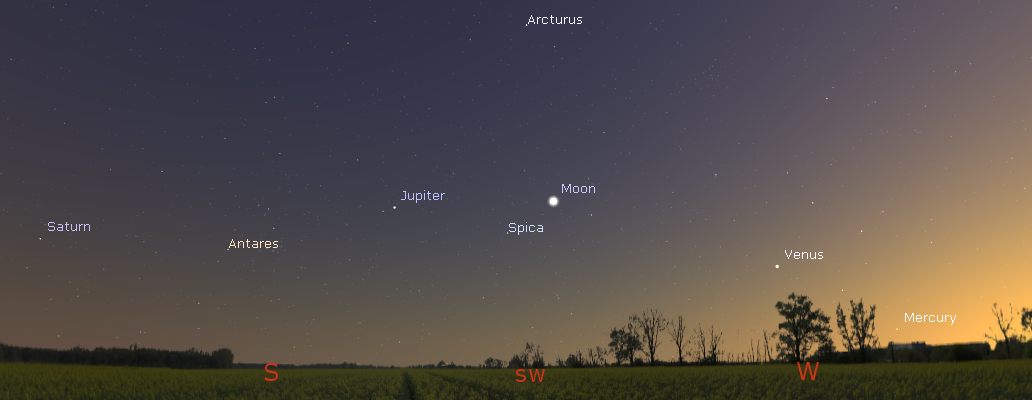
Evening planets from Mercury to Saturn and Moon at 9:50 p.m., July 18, 2018. Click on image to enlarge. Created using Stellarium.
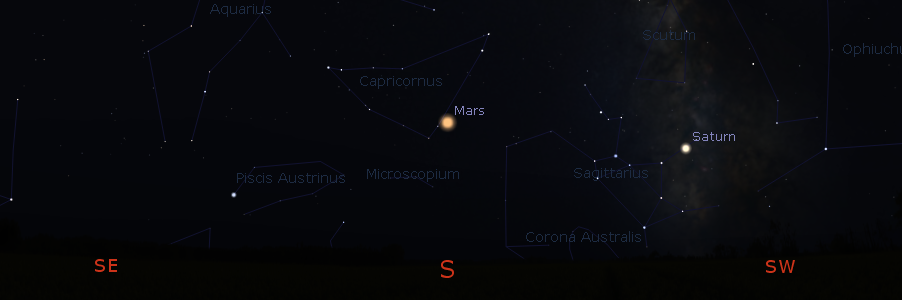
Mars at its highest in the south with Saturn at 2:35 a.m. Click on image to enlarge. Created using Stellarium.
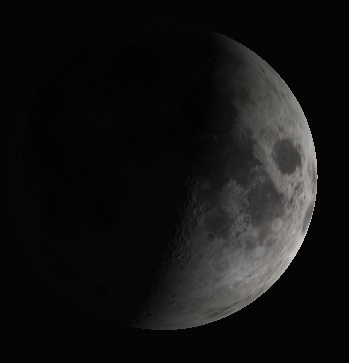
The moon as it might be seen in binoculars this evening. Created using Stellarium.
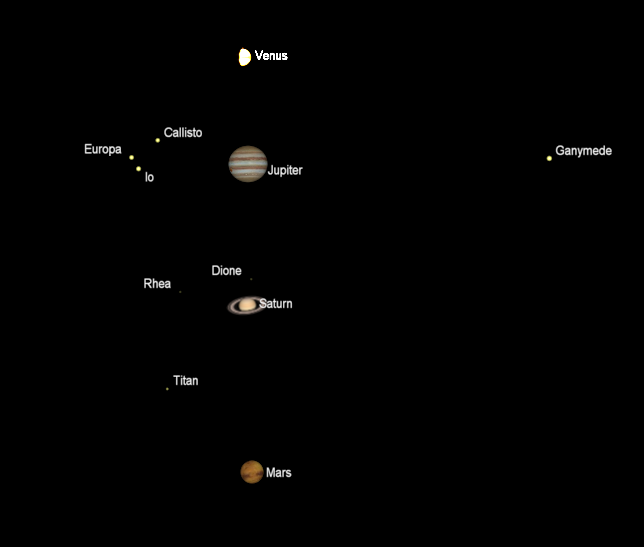
Telescopic view of Jupiter, Saturn and Mars at 11 p.m. on July 18. All at the same magnification. Created using Cartes du Ciel (Sky Charts).
Planets and the Moon at sunset and sunrise of a single night starting with sunset on the right on July 18, 2018. The night ends on the left with sunrise on the 19th. Click on the image to enlarge. Created using my LookingUp program.
 Bob Moler's Ephemeris Blog