Archive
01/31/2019 – Ephemeris – Previewing February’s skies
Ephemeris for Thursday, January 31st. Today the Sun will be up for 9 hours and 46 minutes, setting at 5:49, and it will rise tomorrow at 8:02. The Moon, half way from last quarter to new, will rise at 5:50 tomorrow morning.
February is the shortest month, even so the daylight hours throughout the month will be getting longer. Daylight hours will increase from 9 hours and 49 minutes tomorrow the first to 11 hours and 6 minutes on the 28th. The sunrise time will decrease from 8:02 tomorrow to 7:22 at month’s end. The sunset times will increase from 5:51 tomorrow to 6:28 on the 28th. Along with that the altitude of the sun at noon will increase from 28 degrees tomorrow to nearly 38 degrees at month’s end. Local noon, by the way for Interlochen and Traverse City is about 12:55 p.m. Mercury has just entered the evening sky and will be visible in twilight after sunset later this month.
The times given are for the Traverse City/Interlochen area of Michigan. They may be different for your location.
Addenda
February Evening Star Chart
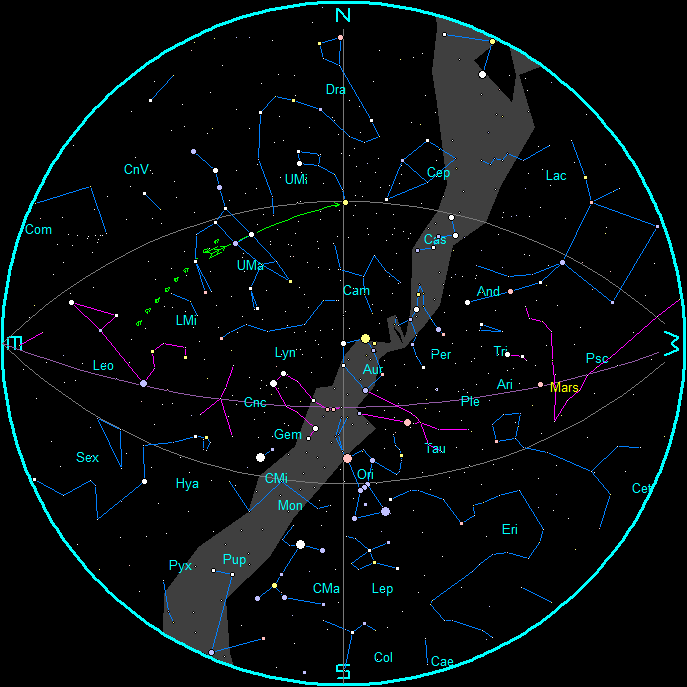
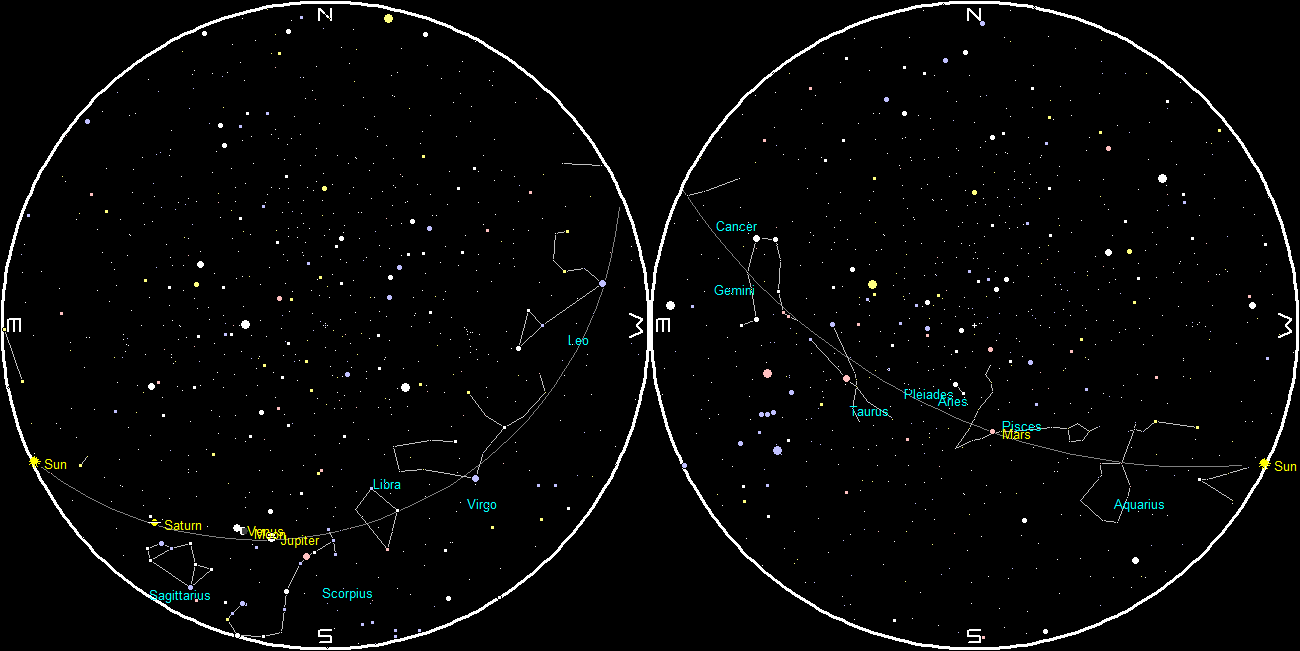
Star Chart for February 2019 (9 p.m. EST February 15, 2019). Created using my LookingUp program. Click on image to enlarge.
The planets and stars are plotted for the 15th at 9 p.m. EST in the evening and 6 a.m. for the morning chart. These are the chart times. Note that Traverse City is located approximately 45 minutes behind our time meridian. (An hour 45 minutes behind our daylight saving time meridian during EDT). To duplicate the star positions on a planisphere you may have to set it to 1 hour 45 minutes earlier than the current time.
Note the chart times of 9 p.m. and 6 a.m. are for the 15th. For each week before the 15th add ½ hour (28 minutes if you’re picky). For each week after the 15th subtract ½ hour. The planet positions are updated each Wednesday on this blog. For planet positions on dates other than the 15th, check the Wednesday planet posts on this blog.
February Morning Star Chart
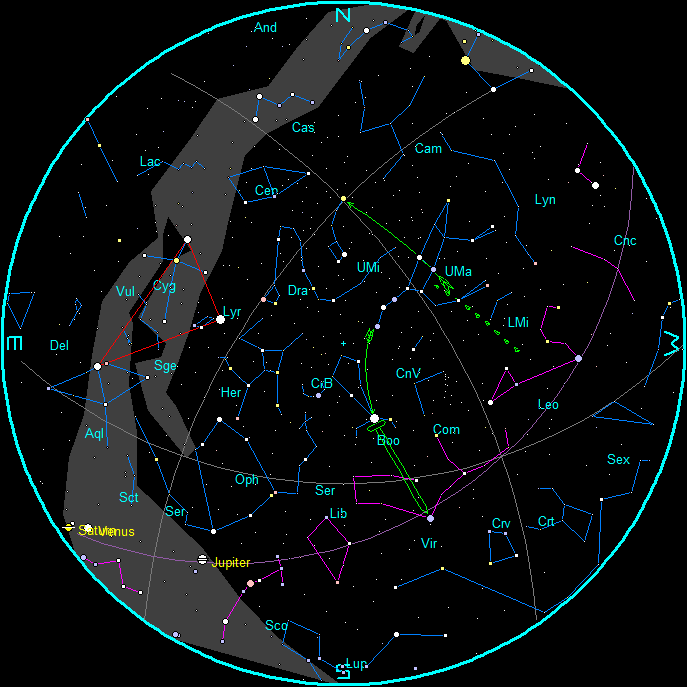
Star Chart for February mornings 2019 (6 a.m. EST February 15, 2019). Created using my LookingUp program. Click on image to enlarge.
For a list of constellation names to go with the abbreviations click here.
- Pointer stars at the front of the bowl of the Big Dipper point to Polaris the North Star.
- Follow the arc of the handle of the Big Dipper to the star Arcturus, and
- Extend like a spike to Spica,
- The Summer Triangle is in red.
Twilight Limits, Nautical and Astronomical
| Traverse City | Morning twilight | Evening twilight | Dark night | Moon | |||
| Date | Astro. | Nautical | Nautical | Astro. | Start | End | Illum. |
| 2019-02-01 | 6h22m | 6h56m | 18h55m | 19h30m | 19h30m | 5h51m | 0.09 |
| 2019-02-02 | 6h21m | 6h55m | 18h57m | 19h31m | 19h31m | 6h21m | 0.04 |
| 2019-02-03 | 6h20m | 6h54m | 18h58m | 19h32m | 19h32m | 6h20m | 0.01 |
| 2019-02-04 | 6h19m | 6h53m | 18h59m | 19h33m | 19h33m | 6h19m | 0 |
| 2019-02-05 | 6h18m | 6h52m | 19h01m | 19h35m | 19h35m | 6h18m | 0.01 |
| 2019-02-06 | 6h17m | 6h51m | 19h02m | 19h36m | 19h48m | 6h17m | 0.03 |
| 2019-02-07 | 6h16m | 6h50m | 19h03m | 19h37m | 20h48m | 6h16m | 0.08 |
| 2019-02-08 | 6h15m | 6h49m | 19h04m | 19h38m | 21h49m | 6h15m | 0.14 |
| 2019-02-09 | 6h14m | 6h47m | 19h06m | 19h40m | 22h50m | 6h14m | 0.21 |
| 2019-02-10 | 6h12m | 6h46m | 19h07m | 19h41m | 23h53m | 6h12m | 0.3 |
| 2019-02-11 | 6h11m | 6h45m | 19h08m | 19h42m | – | 6h11m | 0.4 |
| 2019-02-12 | 6h10m | 6h44m | 19h10m | 19h43m | 0h57m | 6h10m | 0.51 |
| 2019-02-13 | 6h08m | 6h42m | 19h11m | 19h45m | 2h03m | 6h08m | 0.62 |
| 2019-02-14 | 6h07m | 6h41m | 19h12m | 19h46m | 3h11m | 6h07m | 0.73 |
| 2019-02-15 | 6h06m | 6h40m | 19h13m | 19h47m | 4h18m | 6h06m | 0.83 |
| 2019-02-16 | 6h04m | 6h38m | 19h15m | 19h48m | 5h22m | 6h04m | 0.91 |
| 2019-02-17 | 6h03m | 6h37m | 19h16m | 19h50m | – | – | 0.97 |
| 2019-02-18 | 6h02m | 6h35m | 19h17m | 19h51m | – | – | 0.97 |
| 2019-02-19 | 6h00m | 6h34m | 19h19m | 19h52m | – | – | 1 |
| 2019-02-20 | 5h59m | 6h32m | 19h20m | 19h54m | – | – | 0.99 |
| 2019-02-21 | 5h57m | 6h31m | 19h21m | 19h55m | 19h55m | 21h05m | 0.96 |
| 2019-02-22 | 5h55m | 6h29m | 19h22m | 19h56m | 19h56m | 22h19m | 0.9 |
| 2019-02-23 | 5h54m | 6h28m | 19h24m | 19h57m | 19h57m | 23h31m | 0.81 |
| 2019-02-24 | 5h52m | 6h26m | 19h25m | 19h59m | 19h59m | – | 0.71 |
| 2019-02-25 | 5h51m | 6h24m | 19h26m | 20h00m | 20h00m | 0h41m | 0.61 |
| 2019-02-26 | 5h49m | 6h23m | 19h28m | 20h01m | 20h01m | 1h47m | 0.5 |
| 2019-02-27 | 5h47m | 6h21m | 19h29m | 20h03m | 20h03m | 2h49m | 0.4 |
| 2019-02-28 | 5h46m | 6h20m | 19h30m | 20h04m | 20h04m | 3h46m | 0.3 |
Twilight calendar was generated using Cartes du Ciel (Sky Charts).
See my blog post: Twilight Zone for the definitions of the different periods of twilight here: https://bobmoler.wordpress.com/2019/09/27/
NASA Calendar of Planetary Events
| Date | Local Time | Event | ||
| Feb | 1 | Fr | Venus: 45.1° W | |
| 1 | Fr | 7:48 PM | Moon South Dec.: 21.5° S | |
| 2 | Sa | 2:18 AM | Moon-Saturn: 0.7° S | |
| 3 | Su | 1:35 AM | Moon Descending Node | |
| 4 | Mo | 4:04 PM | New Moon | |
| 5 | Tu | 4:26 AM | Moon Apogee: 406600 km | |
| 12 | Tu | 5:26 PM | First Quarter | |
| 13 | We | 10:29 PM | Moon-Aldebaran: 1.7° S | |
| 16 | Sa | 4:56 AM | Moon North Dec.: 21.6° N | |
| 17 | Su | 4:42 AM | Moon Ascending Node | |
| 17 | Su | 10:05 PM | Moon-Beehive: 0.6° N | |
| 18 | Mo | 9:16 AM | Venus-Saturn: 1.1° N | |
| 19 | Tu | 4:06 AM | Moon Perigee: 356800 km | |
| 19 | Tu | 8:08 AM | Moon-Regulus: 2.4° S | |
| 19 | Tu | 10:53 AM | Full Moon | |
| 26 | Tu | 6:28 AM | Last Quarter | |
| 26 | Tu | 7:59 PM | Mercury Greatest Elongation: 18.1° E | |
| 27 | We | 9:17 AM | Moon-Jupiter: 2.5° S | |
| Mar | 1 | Fr | Venus 40.8° W |
All event times are given for UTC-5:00: Eastern Standard or Daylight Time
Sky Events Calendar by Fred Espenak and Sumit Dutta (NASA’s GSFC),
http://eclipse.gsfc.nasa.gov/SKYCAL/SKYCAL.html
If you go to the above site you can print out a list like the above for the entire year or calendar pages for your time zone.
Sun and Moon Rising and Setting Events
Ephemeris of Sky Events for Interlochen/TC |
||||||||||
| February, 2019 – Local time zone: EST | ||||||||||
|---|---|---|---|---|---|---|---|---|---|---|
| Date | Sun | Twilight* | Moon | Illum | ||||||
| Rise | Set | Hours | End | Start | Phase | R/S** | Time | Fractn | ||
| Fri | 1 | 08:02a | 05:51p | 09:49 | 06:57p | 06:56a | Rise | 06:40a | 7% | |
| Sat | 2 | 08:00a | 05:52p | 09:51 | 06:58p | 06:55a | Rise | 07:24a | 3% | |
| Sun | 3 | 07:59a | 05:54p | 09:54 | 06:59p | 06:53a | Rise | 08:01a | 1% | |
| Mon | 4 | 07:58a | 05:55p | 09:56 | 07:01p | 06:52a | New | Set | 05:48p | 0% |
| Tue | 5 | 07:57a | 05:56p | 09:59 | 07:02p | 06:51a | Set | 06:47p | 1% | |
| Wed | 6 | 07:56a | 05:58p | 10:02 | 07:03p | 06:50a | Set | 07:47p | 4% | |
| Thu | 7 | 07:54a | 05:59p | 10:04 | 07:04p | 06:49a | Set | 08:48p | 9% | |
| Fri | 8 | 07:53a | 06:01p | 10:07 | 07:06p | 06:48a | Set | 09:48p | 15% | |
| Sat | 9 | 07:52a | 06:02p | 10:10 | 07:07p | 06:47a | Set | 10:50p | 22% | |
| Sun | 10 | 07:50a | 06:03p | 10:13 | 07:08p | 06:45a | Set | 11:52p | 31% | |
| Mon | 11 | 07:49a | 06:05p | 10:16 | 07:10p | 06:44a | Set | 12:57a | 40% | |
| Tue | 12 | 07:47a | 06:06p | 10:18 | 07:11p | 06:43a | F Qtr | Set | 02:03a | 51% |
| Wed | 13 | 07:46a | 06:08p | 10:21 | 07:12p | 06:41a | Set | 03:10a | 61% | |
| Thu | 14 | 07:44a | 06:09p | 10:24 | 07:14p | 06:40a | Set | 04:18a | 72% | |
| Fri | 15 | 07:43a | 06:11p | 10:27 | 07:15p | 06:39a | Set | 05:21a | 81% | |
| Sat | 16 | 07:41a | 06:12p | 10:30 | 07:16p | 06:37a | Set | 06:19a | 90% | |
| Sun | 17 | 07:40a | 06:13p | 10:33 | 07:17p | 06:36a | Set | 07:09a | 96% | |
| Mon | 18 | 07:38a | 06:15p | 10:36 | 07:19p | 06:34a | Set | 07:52a | 99% | |
| Tue | 19 | 07:37a | 06:16p | 10:39 | 07:20p | 06:33a | Full | Rise | 06:28p | 100% |
| Wed | 20 | 07:35a | 06:18p | 10:42 | 07:21p | 06:32a | Rise | 07:47p | 97% | |
| Thu | 21 | 07:34a | 06:19p | 10:45 | 07:23p | 06:30a | Rise | 09:05p | 92% | |
| Fri | 22 | 07:32a | 06:20p | 10:48 | 07:24p | 06:28a | Rise | 10:19p | 84% | |
| Sat | 23 | 07:30a | 06:22p | 10:51 | 07:25p | 06:27a | Rise | 11:31p | 75% | |
| Sun | 24 | 07:29a | 06:23p | 10:54 | 07:26p | 06:25a | Rise | 12:40a | 65% | |
| Mon | 25 | 07:27a | 06:24p | 10:57 | 07:28p | 06:24a | Rise | 01:46a | 55% | |
| Tue | 26 | 07:25a | 06:26p | 11:00 | 07:29p | 06:22a | L Qtr | Rise | 02:49a | 45% |
| Wed | 27 | 07:24a | 06:27p | 11:03 | 07:30p | 06:20a | Rise | 03:46a | 35% | |
| Thu | 28 | 07:22a | 06:28p | 11:06 | 07:32p | 06:19a | Rise | 04:38a | 26% | |
| * Nautical Twilight | ||||||||||
| ** Moonrise or moonset, whichever occurs between sunset and sunrise | ||||||||||
Created using my LookingUp for DOS output as HTML.
01/30/2019 – Ephemeris – Looking for the bright planets for this week
Ephemeris for Wednesday, January 30th. Today the Sun will be up for 9 hours and 44 minutes, setting at 5:48, and it will rise tomorrow at 8:03. The Moon, 3 days past last quarter, will rise at 4:55 tomorrow morning.
Let’s look at the planets for this week. Our only evening planet Mars will be in the southwestern sky this evening and will set at 11:53 p.m. It’s too far away to see much detail in a small telescope. In the morning sky we have Jupiter which will rise tomorrow at 4:39 a.m. It is second to Venus in brightness, and now is west of Venus. In small telescopes up to four of Jupiter’s moons are visible. The waning crescent Moon will be between the two planets tomorrow morning. Venus will rise at 5:08 a.m. tomorrow. In small telescopes it is a featureless slightly gibbous moon shape. Its phase will now grow more toward full as its size shrinks as it continues its long journey around and behind the Sun.
The times given are for the Traverse City/Interlochen area of Michigan. They may be different for your location.
Addendum
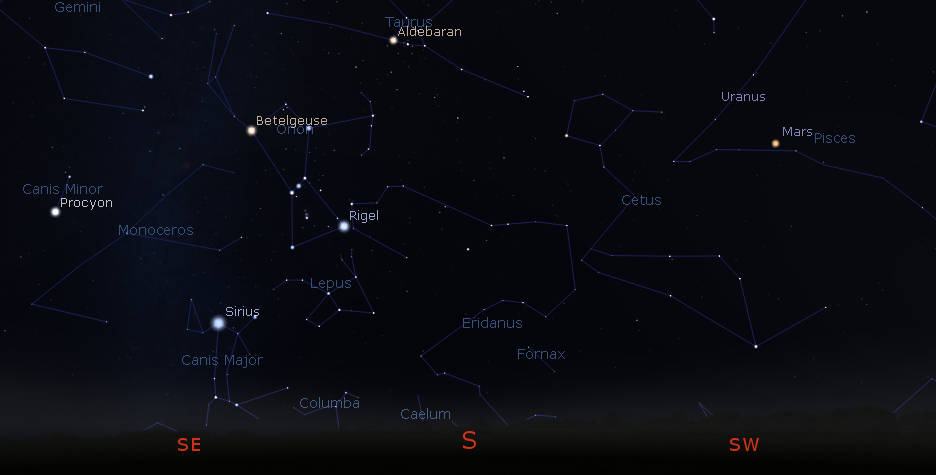
Mars and the evening constellations tonight at 8 p.m. January 30, 2019. Click on the image to enlarge. Created using Stellarium.
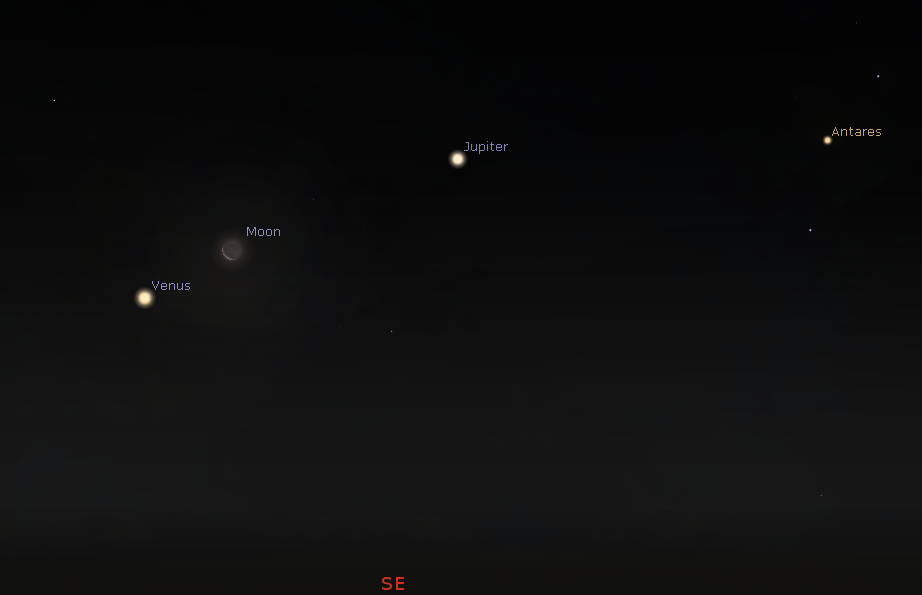
Venus, the Moon and Jupiter in the morning at 6 a.m. tomorrow morning January 31, 2019. Saturn will rise at 6:37 tomorrow morning into twilight. It will make our morning planet view next week. Click on the image to enlarge. Created using Stellarium.
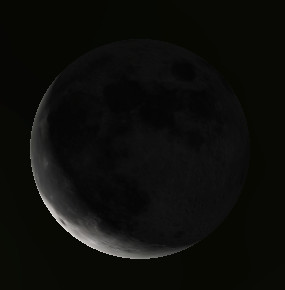
The waning crescent Moon as it should appear tomorrow morning, January 31, 2019, with earthshine in binoculars. Created using Stellarium.
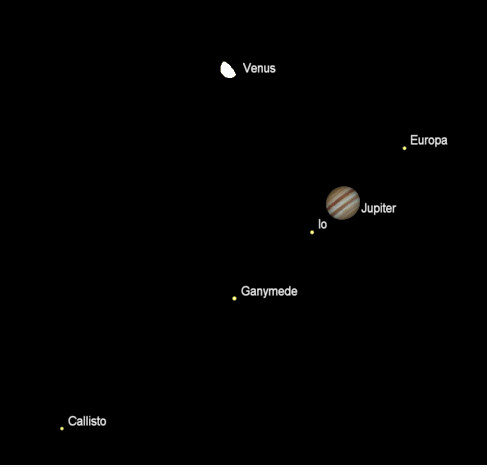
Venus and Jupiter with the same magnification at 6 a.m. tomorrow morning January 31, 2019. Created using Cartes du Ciel (Sky Charts).
Planets and the Moon at sunset and sunrise of a single night starting with sunset on the right on January 30, 2019. The night ends on the left with sunrise on the 31st. Mercury does not show on these charts because it is south of the Sun, having passed superior conjunction on the 29th. Click on the image to enlarge. Created using my LookingUp program.
01/29/2019 – Ephemeris – The rabbit that got away
Ephemeris for Tuesday, January 29th. Today the Sun will be up for 9 hours and 41 minutes, setting at 5:46, and it will rise tomorrow at 8:04. The Moon, 2 days past last quarter, will rise at 3:55 tomorrow morning.
Orion, the central winter constellation is seen in the south at 9 p.m. He is a hunter, but he’s preoccupied with the charge of Taurus the bull from the upper right. At Orion’s feet, and unnoticed by him is the small constellation of Lepus the hare. It’s very hard to see a rabbit in its eight dim stars: however, I do see a rabbit’s head ears and shoulders. A misshapen box is the head and face of this critter facing to the left. His ears extend upwards from the upper right star of the box, and the bend forward a bit. Two stars to the right of the box and a bit farther apart hint at the front part of the body. In Lepus telescopes can find M79, a distant globular star cluster, one of the few of these compact star clusters visible in the winter sky.
Addendum

An animation showing the stars, constellations and artwork of Lepus, Orion and Taurus. Created using Stellarium and GIMP.
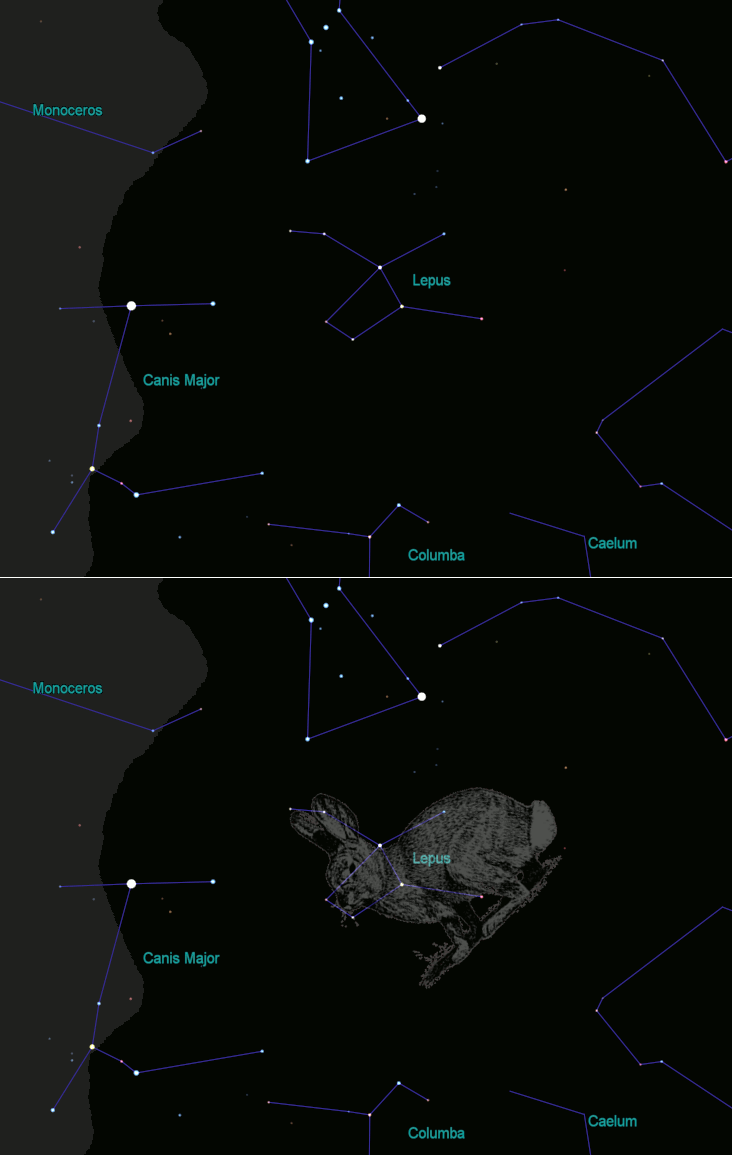
My view of Lepus the hare. Star field from Cartes du Ciel. Desert Cottontail drawing from Arizona-Senora Desert Museum website. Superimposed with GIMP.
01/28/2019 – Ephemeris – The celestial unicorn
Ephemeris for Monday, January 28th. Today the Sun will be up for 9 hours and 39 minutes, setting at 5:45, and it will rise tomorrow at 8:05. The Moon, 1 day past last quarter, will rise at 2:52 tomorrow morning.
Within a triangle bounded by stars Betelgeuse in Orion, Sirius in Canis Major and Procyon in Canis Minor, called the Winter Triangle appears a nearly starless patch of sky to the naked eye. In here is the constellation Monoceros, the unicorn. Unfortunately for observers without optical aid Monoceros, though large, is devoid of any but the faintest stars. Maybe that’s why no one sees unicorns anymore. It has many faint stars because the Milky Way runs through it. To the telescope it is a feast of faint nebulae or clouds of gas and dust, the birth place of stars, including the red rose of the Rosette Nebula, and the strange and tiny Hubble’s Variable Nebula. It also contains beautiful telescopic triple star system, Beta (β) Monocerotis.
The times given are for the Traverse City/Interlochen area of Michigan. They may be different for your location.
Addendum
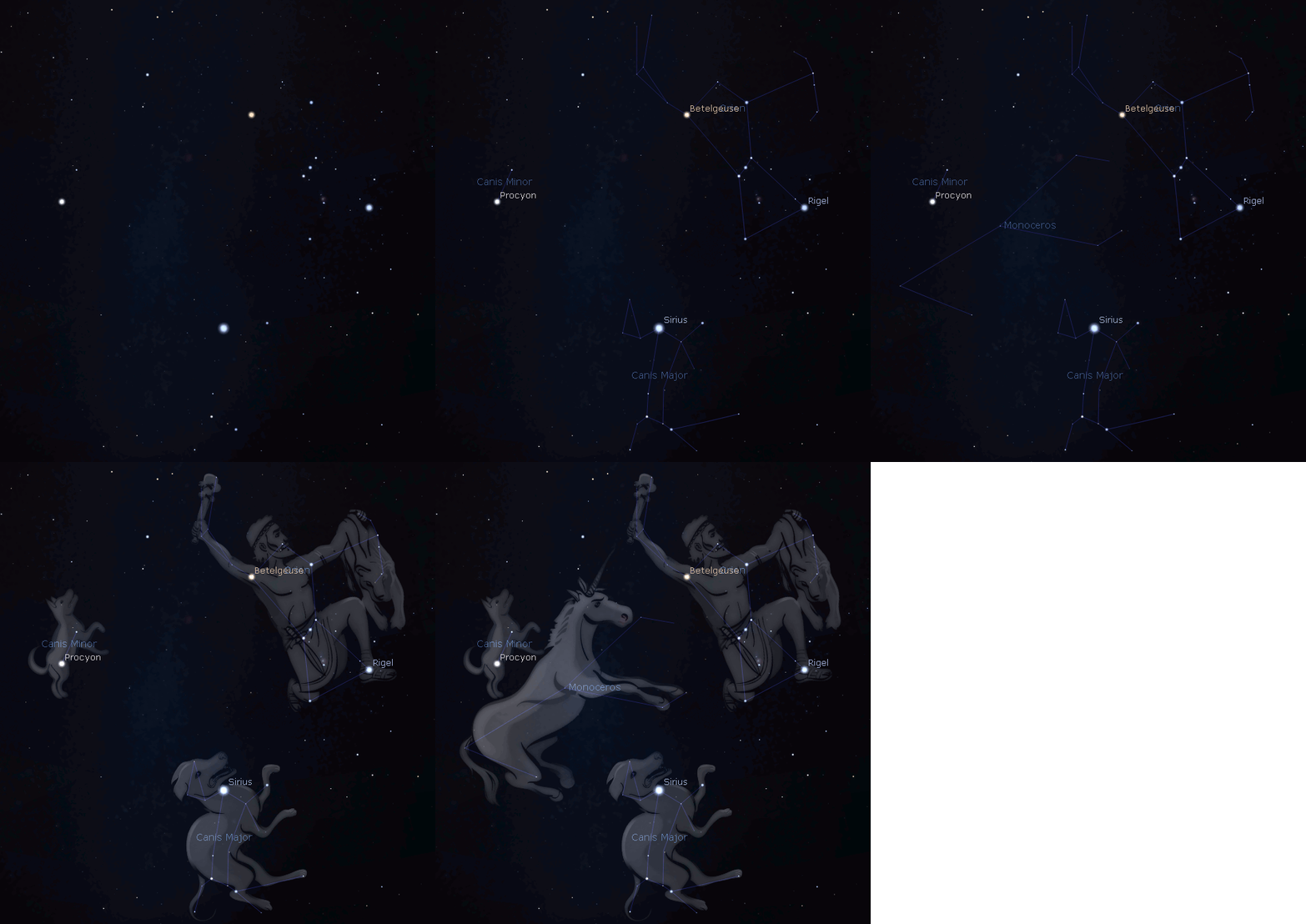
Monoceros finder chart animation. Created using Stellarium and GIMP.
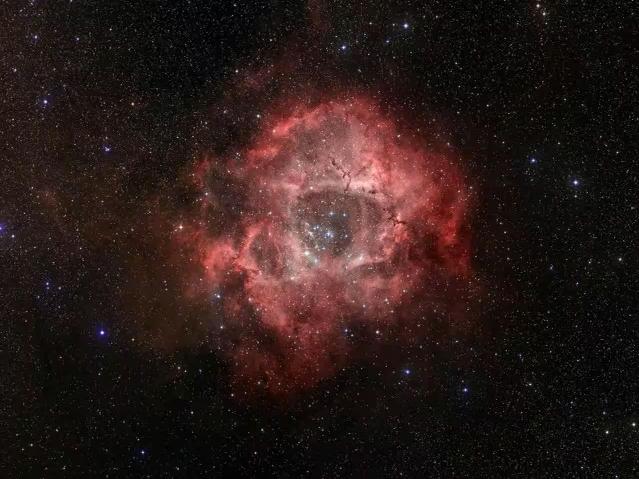
Rosette Nebula in the infrared from the Spitzer Space Telescope. Credit: NASA/JPL/Caltech
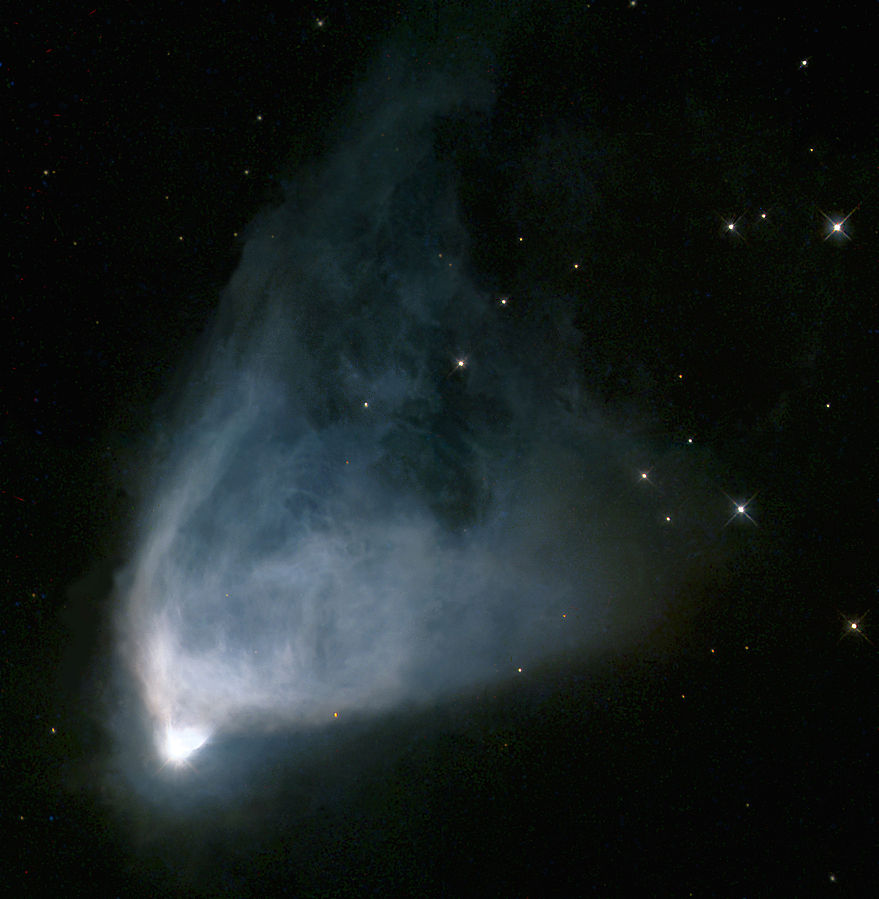
Hubble’s Variable Nebula photographed appropriately enough by the Hubble Space Telescope. Credit: NASA/ESA and The Hubble Heritage Team (AURA/STScI).
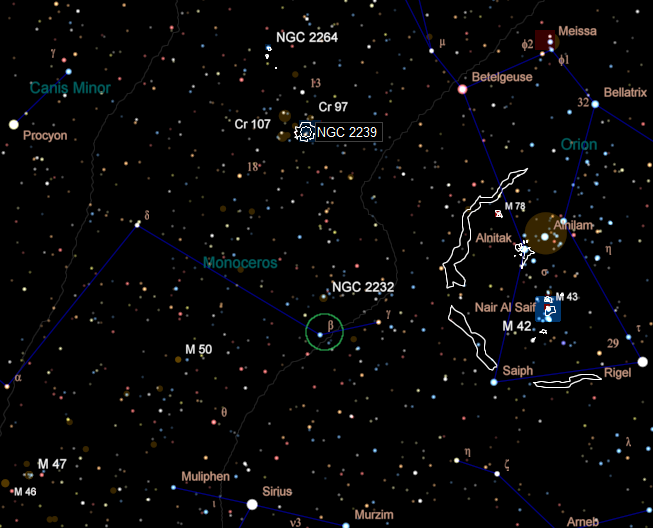
Looking at some faint objects in Monoceros. NGC 2239 is the star cluster in the center of the Rosette Nebula. The nebula itself is extremely faint. It shows in photographs, but I’ve never seen it visually. The green circle shows Beta Monocerotis, the triple star. All these stars are extremely blue-white hot. Created using Cartes du Ciel (Sky Charts).
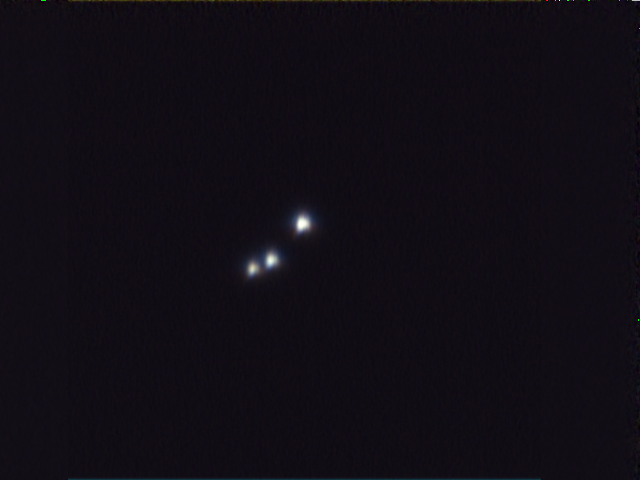
Telescopic Beta Monocerotis. William Hershel, discoverer of Uranus, said that it was “One of the most beautiful sights in the heavens.” Credit: F. Ringwald, Fresno State.
01/25/2019 – Ephemeris – Let’s find Orion’s hunting dogs
Ephemeris for Friday, January 25th. Today the Sun will be up for 9 hours and 32 minutes, setting at 5:41, and it will rise tomorrow at 8:08. The Moon, 2 days before last quarter, will rise at 11:27 this evening.
The great winter constellation or star group Orion the Hunter, is located in the south-southeastern sky at 9 p.m. His elongated rectangle of a torso is tilting toward the vertical. In the center of the rectangle are three stars in a line that make his belt. As a hunter, especially one of old, he has two hunting dogs. The larger, Canis Major can be found by following the three belt stars of Orion down and to the left. There lies the brilliant star called Sirius, also known as the Dog Star. It’s in the heart of a stick figure dog low in the southeast facing Orion that appears to be begging. Canis Minor is just two stars found by extending Orion’s shoulder stars eastward where we find bright Procyon, the little dog star.
The times given are for the Traverse City/Interlochen area of Michigan. They may be different for your location.
Addendum
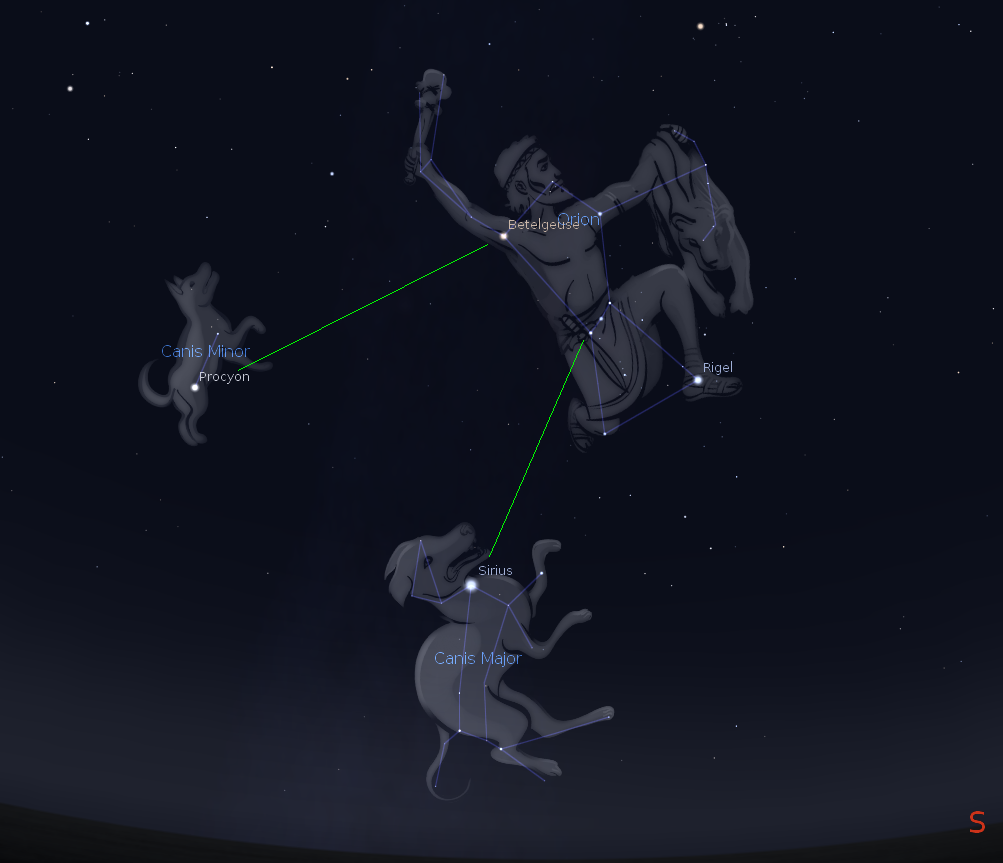
Orion and his hunting dogs with pointers as seen at 9 p.m. in late January . Created using Stellarium.
01/24/2019 – Ephemeris – Taurus the bull
Ephemeris for Thursday, January 24th. Today the Sun will be up for 9 hours and 29 minutes, setting at 5:40, and it will rise tomorrow at 8:09. The Moon, half way from full to last quarter, will rise at 10:14 this evening.
Midway up the sky in the southeast at 8 p.m. is the constellation of the giant hunter Orion. Above him, to the right is Taurus the bull. His face is a letter V shape of stars lying on its side, the star cluster Hyades, with the bright orange-red star Aldebaran at one tip of the V as its angry blood-shot eye, but actually about half way between us and the cluster. Orion is depicted in the sky facing, with club in one hand and a shield in the other, the charging Taurus. The Pleiades star cluster is in his shoulder. Taurus in Greek mythology was the form the god Zeus when he carried off the maiden Europa. Europa’s still with him as the intriguing satellite orbiting Zeus’ Roman equivalent the planet Jupiter.
The times given are for the Traverse City/Interlochen area of Michigan. They may be different for your location.
Addendum
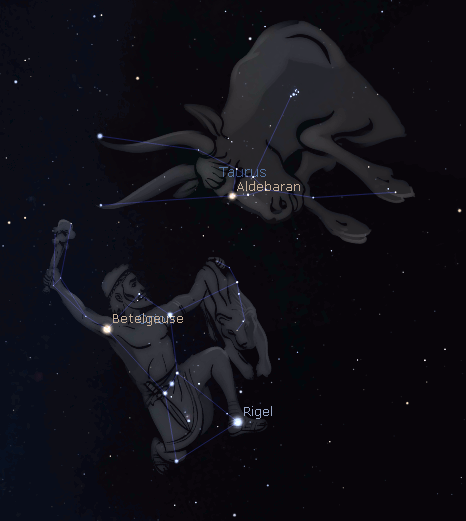
Taurus and Europa at 8 p.m. January 24, 2019. Created using Stellarium.
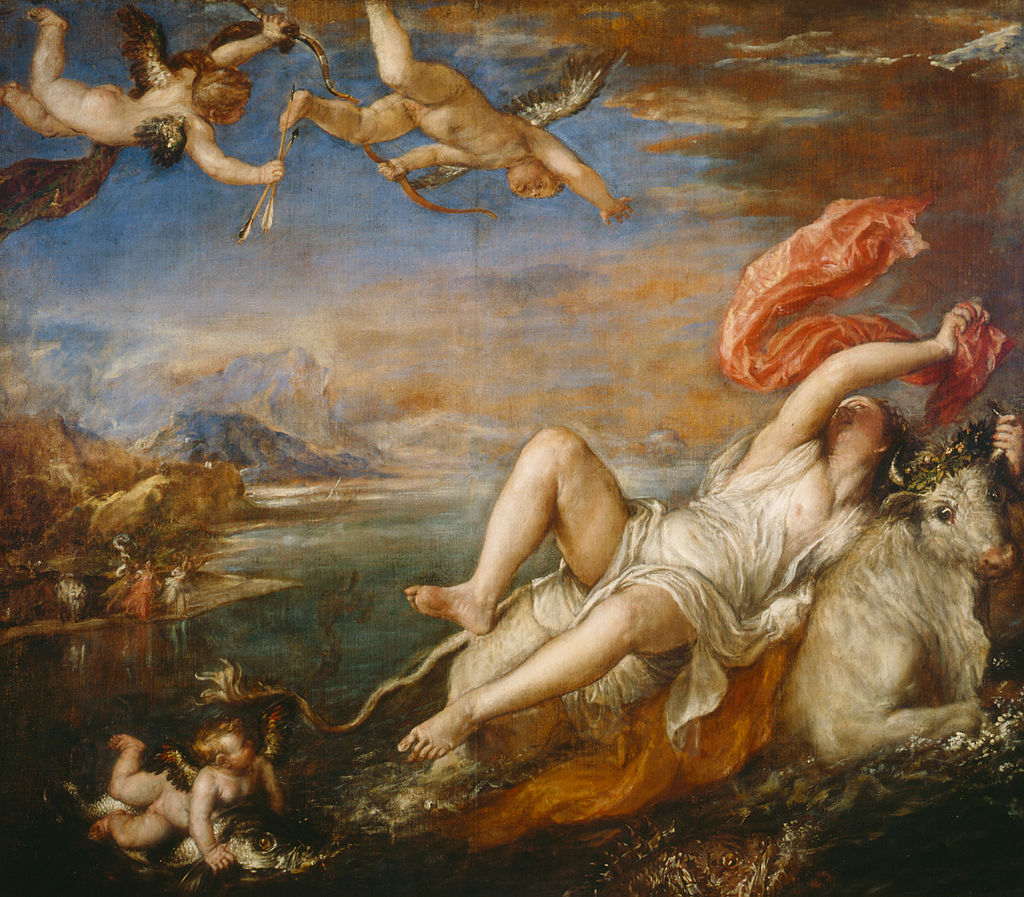
The Rape of Europa by Titian. According to the story Zeus as a bull abducted Europa and swam to Crete, where she became the first queen of that island, and bore him three sons. Other paintings of this subject are by Rembrandt and de Troy. This painting belongs to the Isabella Stewart Gardener Museum in Boston, MA. Click on the image to enlarge.
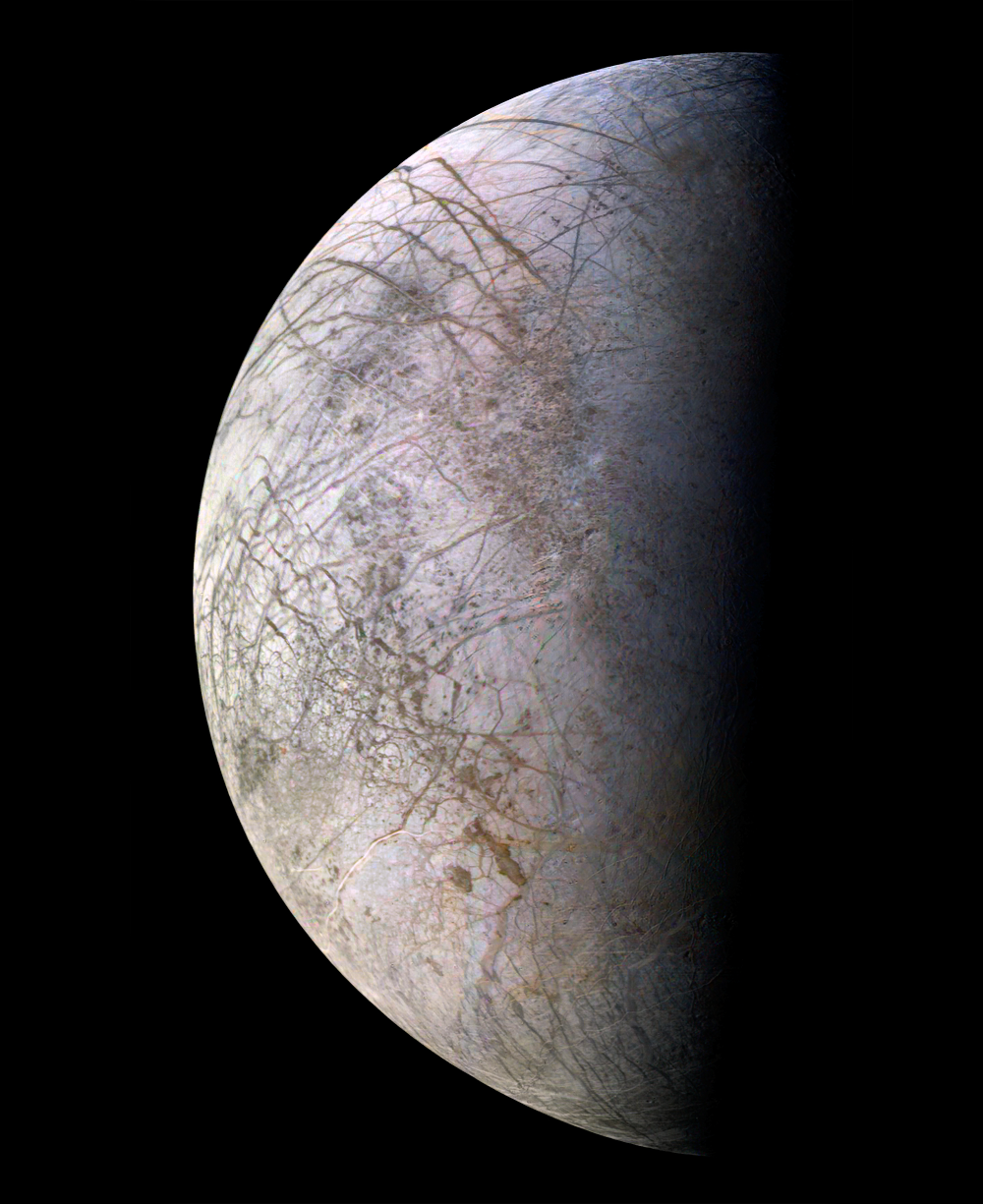
Jupiter’s satellite Europa, slightly smaller than the Earth’s moon, has a fresh ice surface with very little cratering. The ice floats on a deep water ocean supposedly containing more water than all the Earth’s oceans. Click on the image to enlarge. This is a place NASA will send a spacecraft to look for the chemistry of life. Credit NASA/JPL, Ted Stryk.
01/23/2019 – Ephemeris – Let’s check out where the bright planets are for this week
Ephemeris for Wednesday, January 23rd. Today the Sun will be up for 9 hours and 27 minutes, setting at 5:38, and it will rise tomorrow at 8:10. The Moon, 2 days past full, will rise at 8:59 this evening.
Let’s look at the planets for this week. Our only evening planet Mars will be in the southwestern sky this evening and will set at 11:55 p.m. It’s too far away to see much detail in a small telescope. In the morning sky we have Venus rising at 4:59 a.m. tomorrow and is prominent in the southeastern sky as our morning star. In small telescopes it is a featureless slight gibbous moon shape. Its phase will now grow more gibbous as its size shrinks as it continues its long journey around and behind the Sun. Jupiter will rise tomorrow at 5:01 a.m. It is second to Venus in brightness, and is west of Venus, but south, so Venus still rises first by 2 minutes. They will appear nearly side by side as they rise.
The times given are for the Traverse City/Interlochen area of Michigan. They may be different for your location.
Addendum
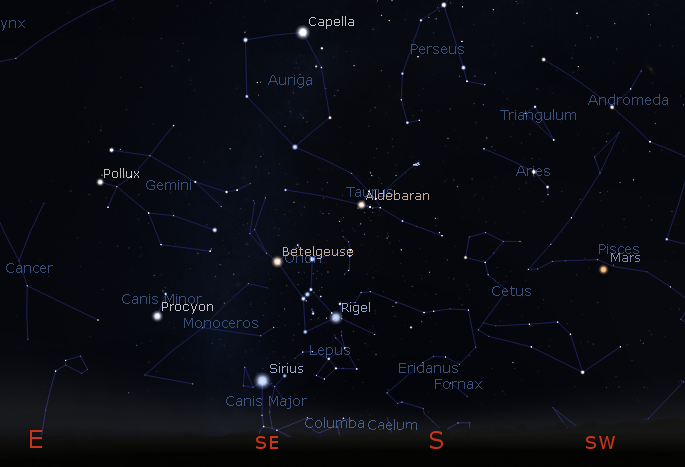
Mars with the evening stars and constellations tonight at 8 p.m. January 23, 2019. Click on the image to enlarge. Created using Stellarium.
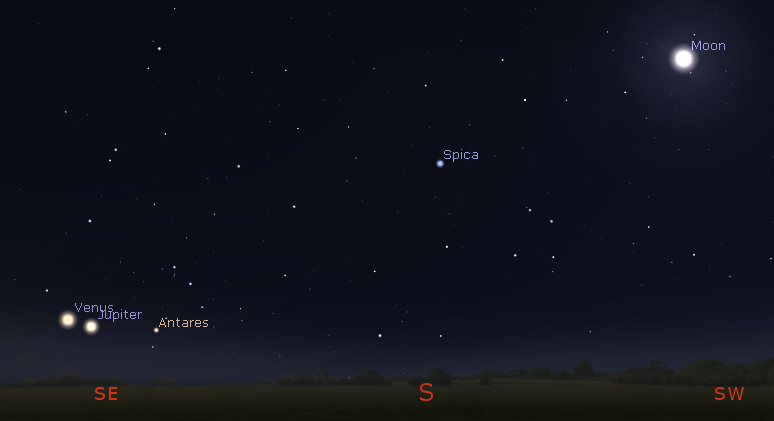
Venus, Jupiter and the Moon in the morning at 6 a.m. tomorrow morning January 24, 2019. Created using Stellarium.
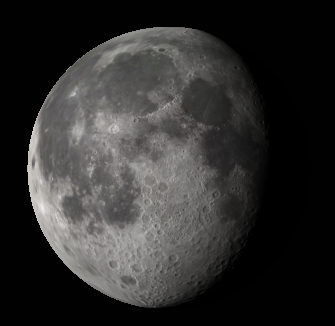
The waning gibbous Moon as it should appear tomorrow morning with binoculars. Created using Stellarium.
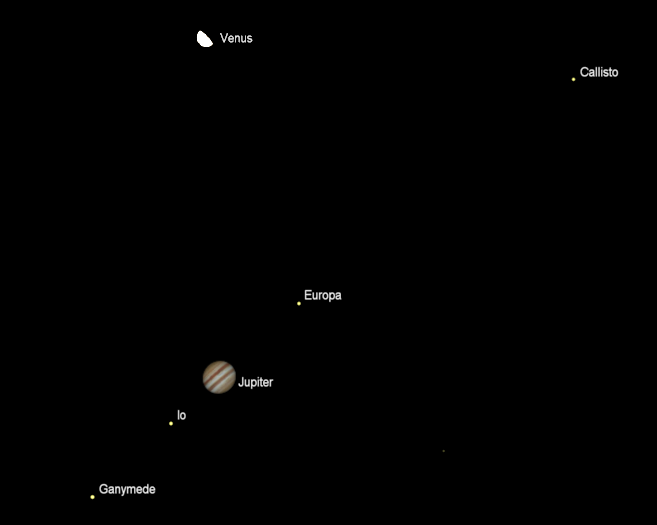
Venus and Jupiter with the same magnification at 6 a.m. tomorrow morning January 24, 2019. Created using Cartes du Ciel (Sky Charts).
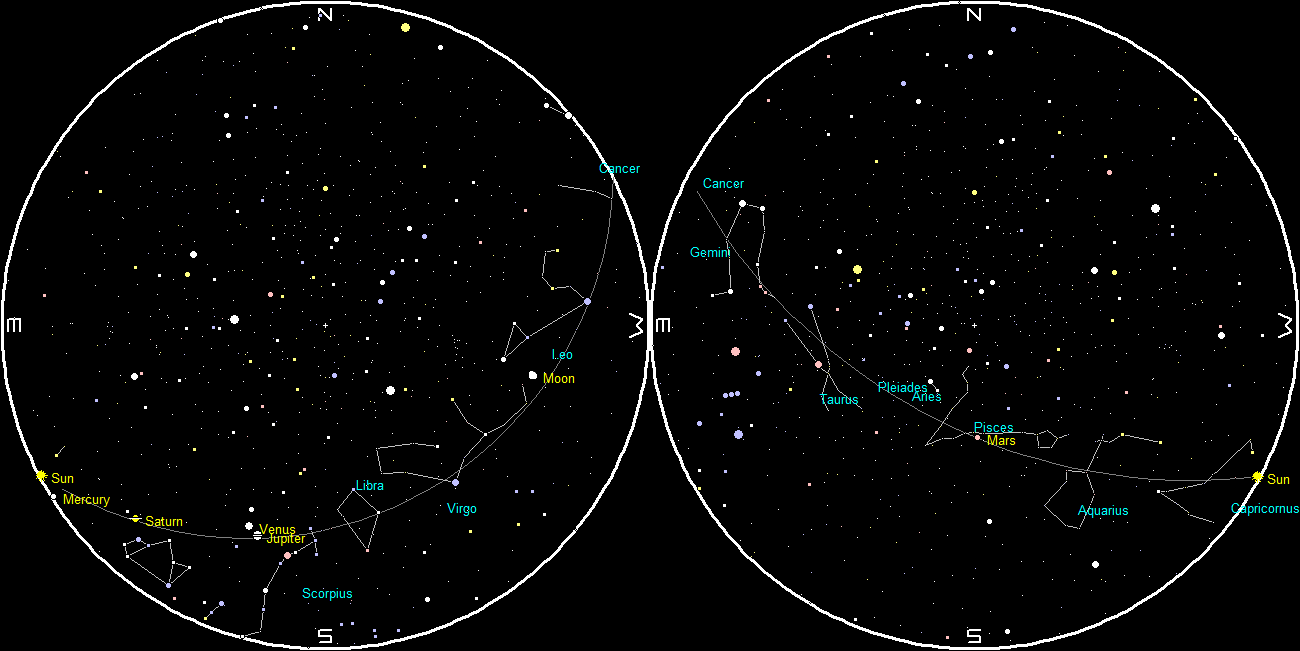
Planets and the Moon at sunset and sunrise of a single night starting with sunset on the right on January 23, 2019. The night ends on the left with sunrise on the 24th. Click on the image to enlarge. Created using my LookingUp program.
01/22/2019 – Ephemeris – What the heck is an ephemeris?
Ephemeris for Tuesday, January 22nd. Today the Sun will be up for 9 hours and 25 minutes, setting at 5:37, and it will rise tomorrow at 8:11. The Moon, 1 day past full, will rise at 7:41 this evening.
What the heck is an ephemeris? According to Wikipedia: “In astronomy and celestial navigation, an ephemeris (plural: ephemerides; from Latin ephemeris, meaning ‘diary’, from the Greek,… meaning ‘diary, <or> journal’) gives the positions of… astronomical objects… at a given time or times. Historically, positions were given as printed tables of values, given at regular intervals of date and time.” My tables are now databases which I generate for the year during the prior December from published algorithms. I will show all on my blog today: It’s at bobmoler.wordpress.com. (You are already here) I used to have to interpolate values from printed ephemerides.
The times given are for the Traverse City/Interlochen area of Michigan. They may be different for your location.
Addendum
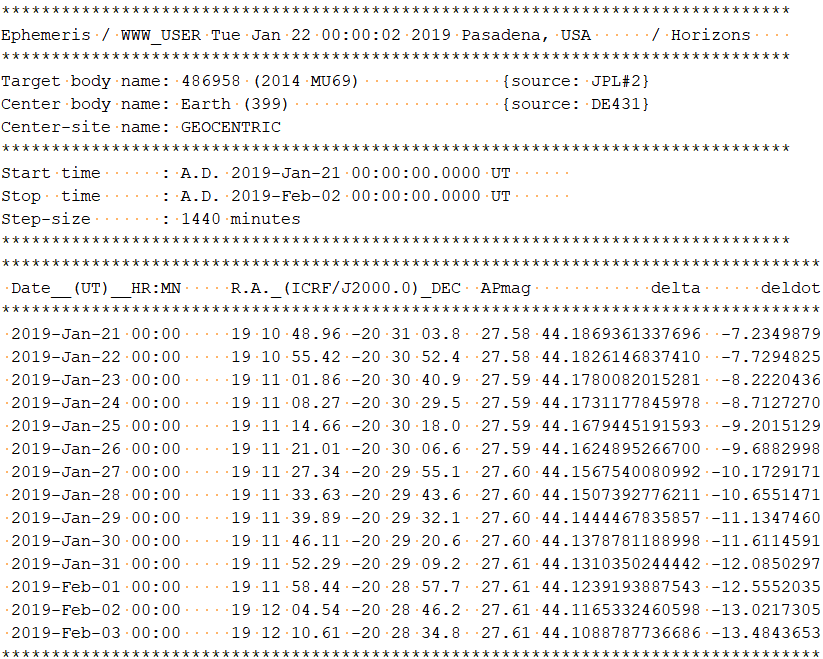
Here are sections of an ephemeris of the positions of 2014 MU69, Ultima Thule that the New Horizons flew past on New Years day. Created by JPL’s Horizons web site.
R.A. is right ascension – East-west position in the sky, like longitude on the Earth, only it’s in hours, minutes and seconds. One hour = 15 degrees.
DEC is declination – North-south position, in the sky, exactly like latitude on the Earth in degrees, minutes and seconds.
J2000.0 means that the above coordinates are based on where the vernal equinox point in the sky was on January 1, 12:00 Terrestrial Time, 2000. Or January 1, 2000, 11:58:55.816 UTC as reported in Wikipedia.
APmag – Apparent visual magnitude. Magnitudes are like golf scores. The higher magnitude the dimmer the object. It’s really, really, really dim.
delta – Distance from the Earth in terms of Astronomical Units (AU). 1 AU is Earth’s mean distance from the Sun.
deldot – The change in delta. Note that is negative. 5 days after New Horizons passed Ultima Thule that spacecraft and Ultima Thule passed behind the Sun. Now the Earth in its orbit is approaching Ultima as we are coming around the Sun.
How my data is created
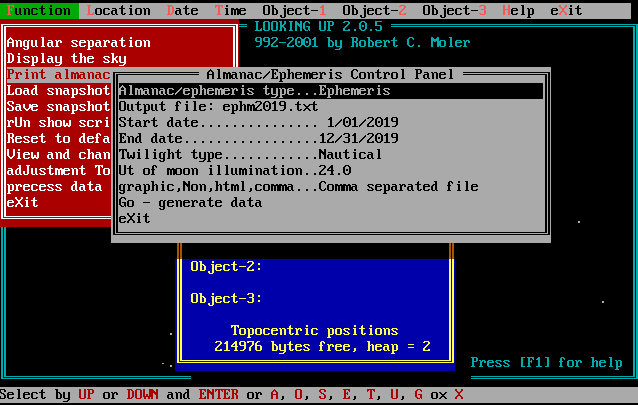
I use my LookingUp for DOS program to generate sunrise/sunset, moonrise/moonset tables for the year. I also create planetary ephemeris tables here.
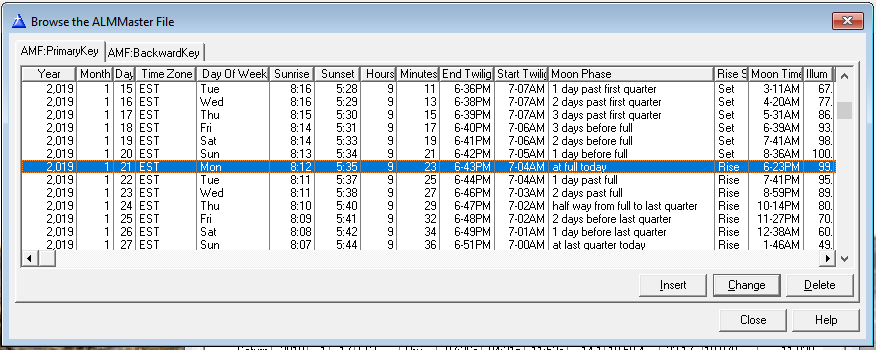
My Ephemeris Helper program massages the raw data from the above program to create this Almanac Master table.
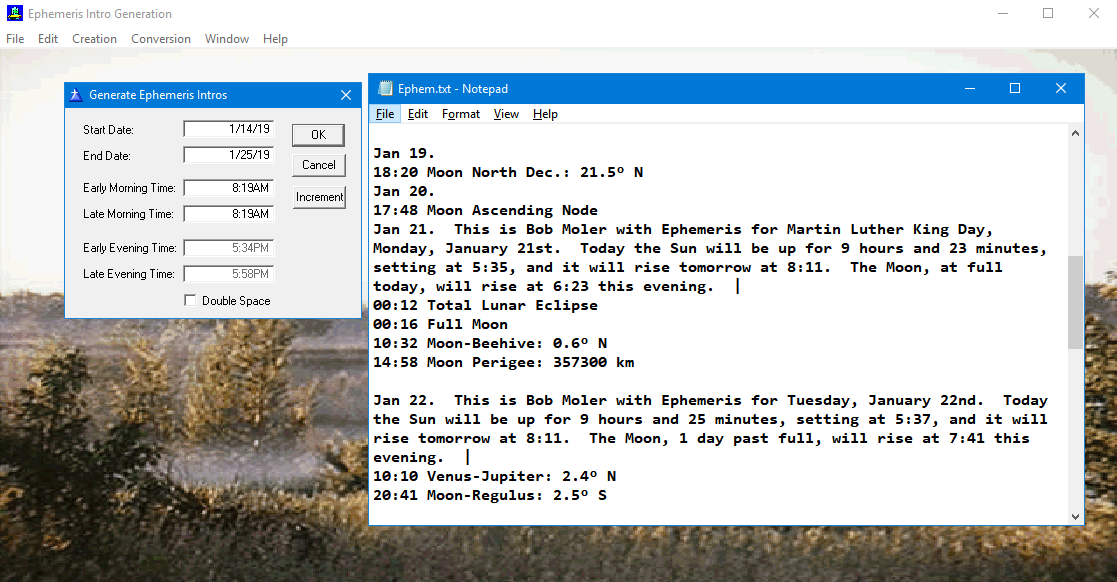
The first 15 or so seconds of the Ephemeris program is created by the Ephemeris Helper program from the Almanac Master, a Holiday Table, A One Time Event Table created from NASA’s SKYCAL Calendar Table, and Reoccurring Events Table.
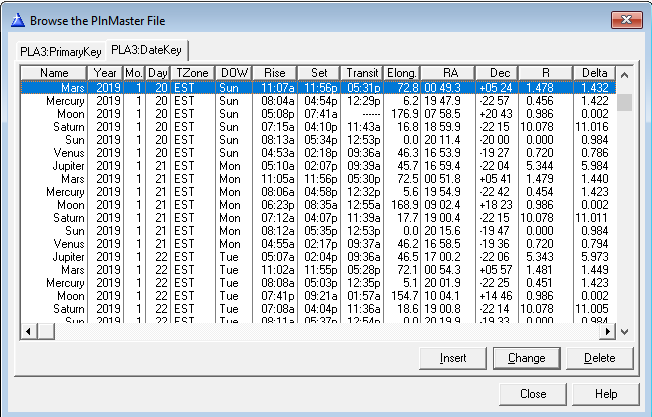
The Planet Master table in the Ephemeris Helper program which I use each Wednesday for planet positions.
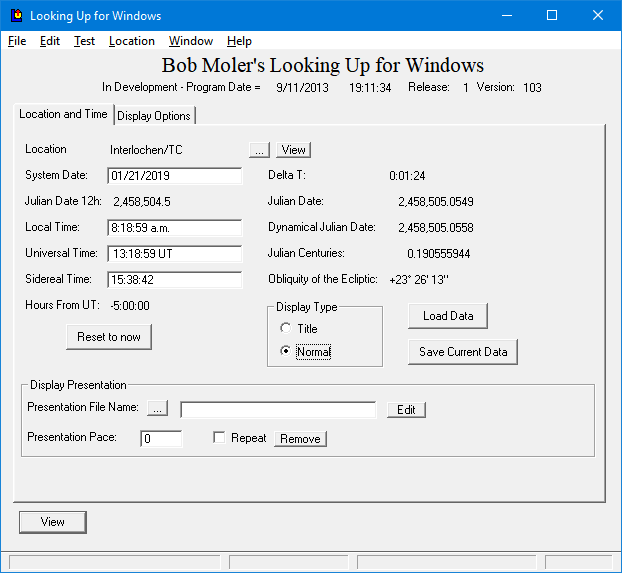
First tab of the LookingUp for Windows program which I don’t use much for the radio program but has uses on this blog and for illustrations for the Stellar Sentinel, the newsletter for the Grand Traverse Astronomical Society, that I edit, which is sent to members and distributed free via email to educators.
Source for the algorithms that I use is Astronomical Algorithms by Jean Meeus, Willmann-Bell 1991.
01/21/2019 – Ephemeris – Venus and Jupiter will pass each other tomorrow morning
Ephemeris for Martin Luther King Jr. Day, Monday, January 21st. Today the Sun will be up for 9 hours and 23 minutes, setting at 5:35, and it will rise tomorrow at 8:11. The Moon, at full today, will rise at 6:23 this evening.
I hope you’ve been noticing the bright planets Venus and Jupiter in the morning this month on the few mornings that have been clear. Jupiter and Venus have been drawing together. And tomorrow morning they will pass each other. The event is called a conjunction. To astronomers it’s a cool looking event, where the planets happen to be along the same line of sight. They are nowhere near each other in actuality. Venus is 76 million miles (120 million km) away, while Jupiter is 555 million miles (894 million km) away. It doesn’t affect anything on the Earth. It’s just cool looking. After this, Jupiter will move farther and farther from the Sun, while Venus will appear to fall back towards the Sun, even though they both are traveling eastward against the stars.
The times given are for the Traverse City/Interlochen area of Michigan. They may be different for your location.
Addendum
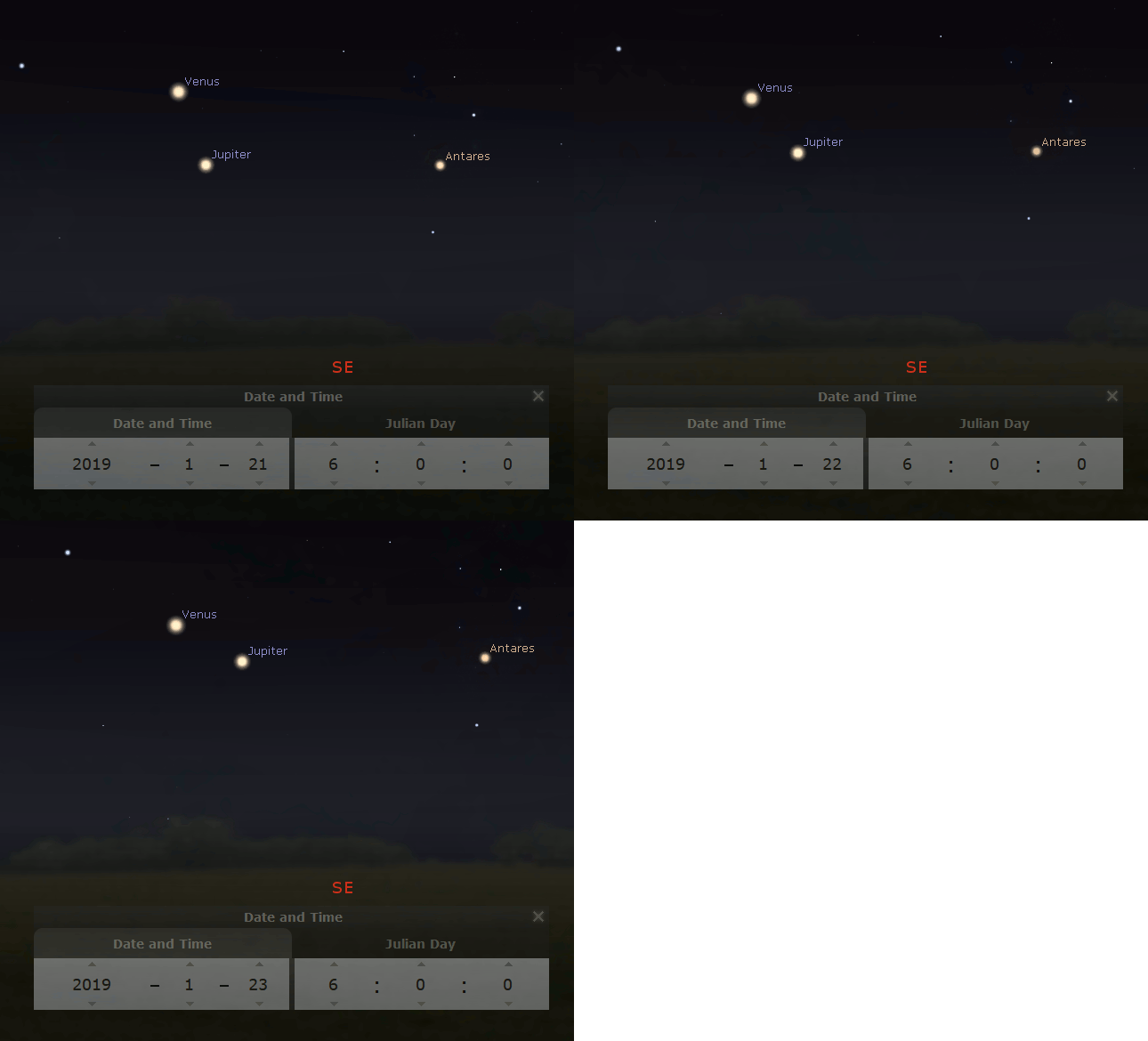
Three day animation of Venus and Jupiter on the 21st, 22nd, and 23rd of January 2019. Created using Stellarium and GIMP.
01/20/2019 – Ephemeris lunar Eclipse extra
For those of us who may be socked in tonight we have a link to the livestream of the eclipse.
I subscribe to their email notices, which explains the end of the URL.
You can go to their main site: http://griffithobservatory.org/ and scroll down to Upcoming Activities and Total Lunar Eclipse then Watch live online. That connection is real slow now.
Update 9:p.m. EST:
Looks like they are having clouds over LA. However we (Interlochen/Traverse City, MI) are partly cloudy with more clear spots than clouds, and the clouds seem to be thin. The GOES satellite is showing a thin lake effect flow from the north. So maybe we might pull this one off.
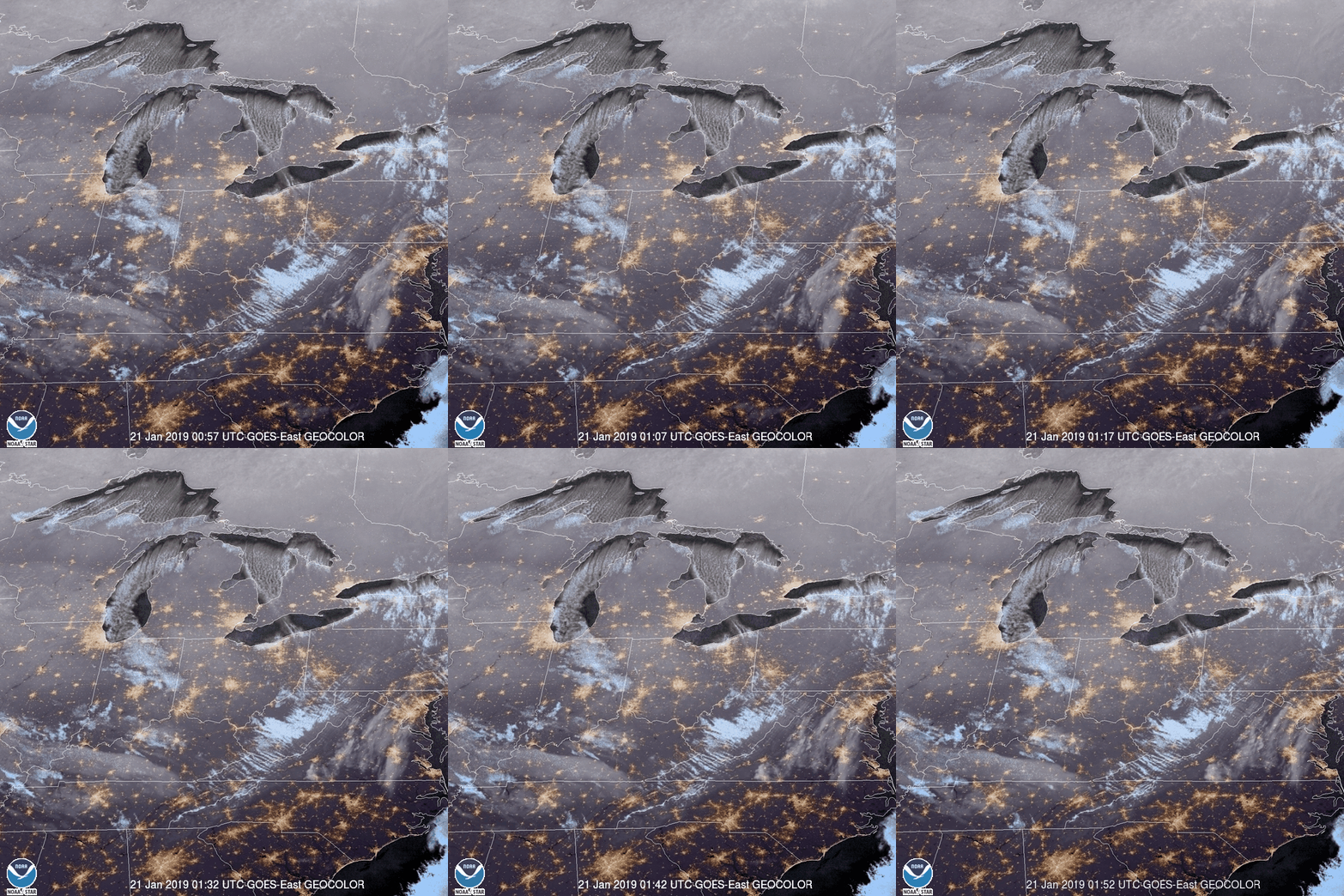
GOES Great Lakes cloud animation for 9 p.m. Credit NOAA.
 Bob Moler's Ephemeris Blog