Archive
05/16/2019 – Ephemeris – Looking back at the Ranger program: Getting really close up pictures of the Moon
Ephemeris for Thursday, May 16th. Today the Sun will be up for 14 hours and 51 minutes, setting at 9:05, and it will rise tomorrow at 6:12. The Moon, 2 days before full, will set at 5:51 tomorrow morning.
The reconnaissance missions that had to be accomplished before the United Stated could land on the Moon in 1969 started with the Ranger program. The idea was to send a spacecraft to crash on the Moon taking and transmitting television pictures all the way down. In addition to the camera some Ranger spacecraft had a lunar capsule with a seismometer with a retro rocket to slow that package down and survive the landing. That feature never worked. Nine Rangers were launched. Only the last three were successful in returning images. Each returned thousands of images each returning detail down to 20 inches. One surprise, the rays we see from craters like Copernicus are actually chains of craterlets caused by ejecta from the impact.
The times given are for the Traverse City/Interlochen area of Michigan. They may be different for your location.
Addendum
Here’s a time lapse video of Ranger 9 hitting the crater Alphonsus. 17 minutes collapsed into 13 seconds: https://www.youtube.com/watch?v=hpFifHgZyrg
05/15/2019 – Ephemeris – The bright planets this week
Ephemeris for Wednesday, May 15th. Today the Sun will be up for 14 hours and 49 minutes, setting at 9:04, and it will rise tomorrow at 6:13. The Moon, 3 days before full, will set at 5:22 tomorrow morning.
Let’s look at the planets for this week. Mars will be in the western sky this evening, entering Gemini near Castor’s foot. It will set at 12:04 a.m. In the morning sky we have Jupiter, in Ophiuchus, which will actually rise at 11:09 tonight in the east-southeast. Jupiter won’t be considered an evening planet until it rises before sunset, which will occur after June 10th. Saturn will be next to rise at 1:04 a.m., also in the east-southeast. It’s in Sagittarius. Both planets are easily visible in as morning twilight grows. Venus will rise 53 minutes before the Sun in the east. It will remain in our morning sky, though too close to the rising Sun to be easily glimpsed. In August it will pass behind the Sun to enter the evening sky.
The times given are for the Traverse City/Interlochen area of Michigan. They may be different for your location.
Addendum
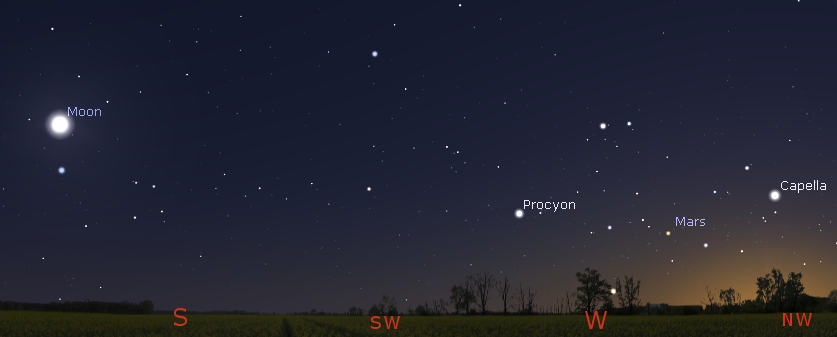
Mars and the Moon tonight at 10 p.m. May 15, 2019. Click on the image to enlarge. Created using Stellarium.
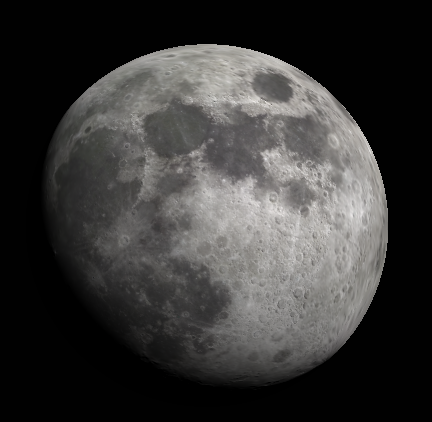
The waxing gibbous nearly full Moon at 10 p.m. May 15, 2019. Created using Stellarium.
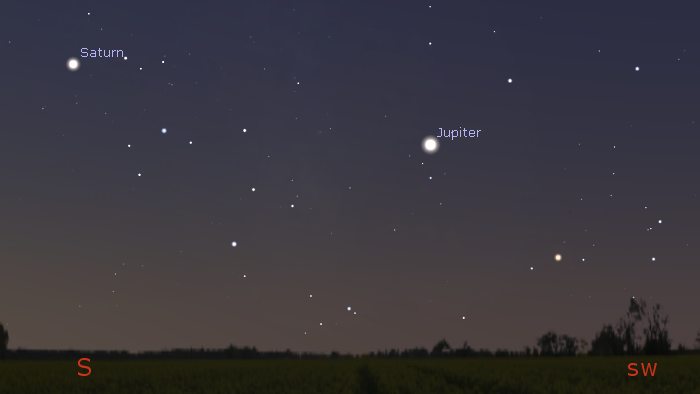
Morning planets at 5:30 a.m. May 16, 2019. Click on the image to enlarge. Created using Stellarium.
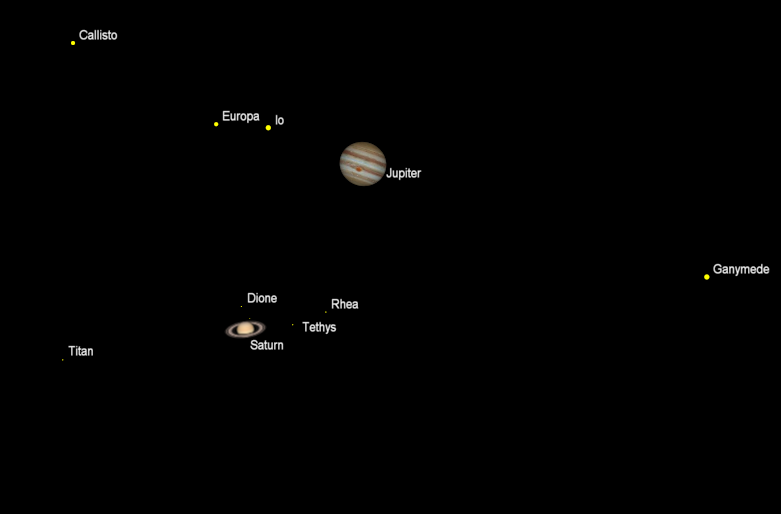
Jupiter and Saturn with the same magnification at 5:30 a.m. tomorrow morning May 16, 2019. Created using Cartes du Ciel (Sky Charts).
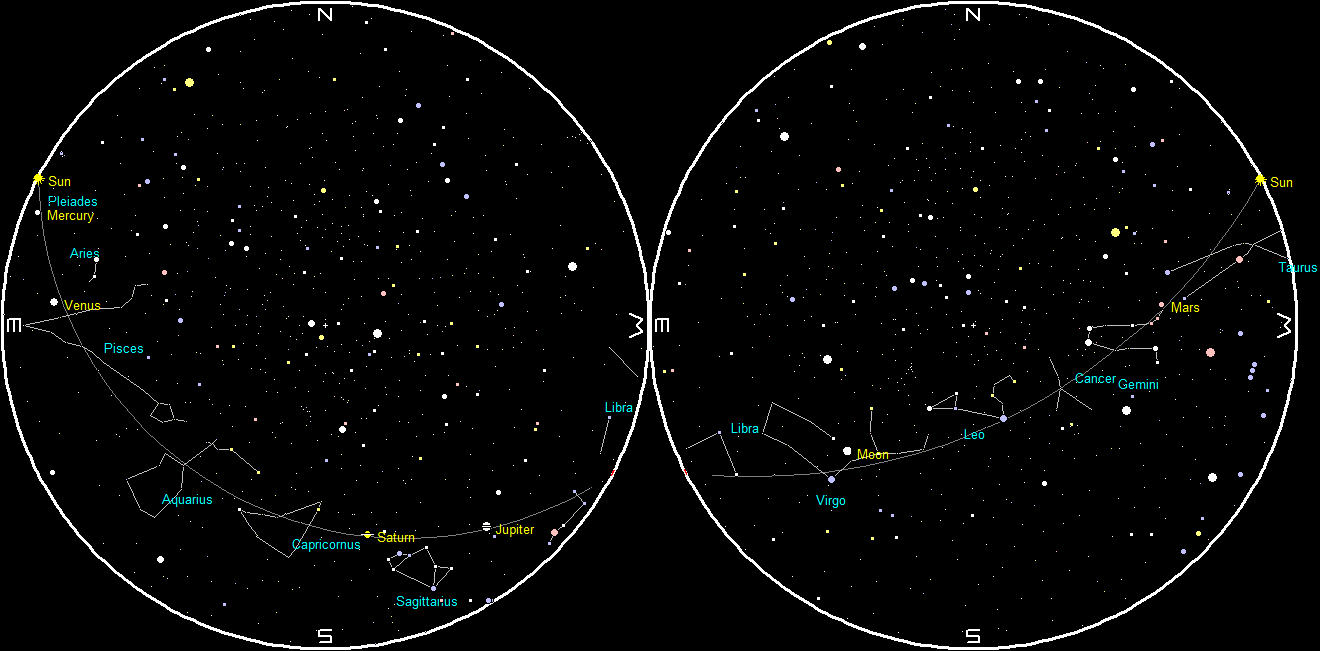
Planets and the Moon at sunset and sunrise of a single night starting with sunset on the right on May 15, 2019. The night ends on the left with sunrise on the 16th. Click on the image to enlarge. Created using my LookingUp program.
05/14/2019 – Ephemeris – The Apollo 11 crew weren’t alone at the Moon
Ephemeris for Tuesday, May 14th. Today the Sun will be up for 14 hours and 47 minutes, setting at 9:03, and it will rise tomorrow at 6:14. The Moon, 3 days past first quarter, will set at 4:54 tomorrow morning.
By the time Apollo 11 launched on July 16th, 1969 the Soviet union had its two launch failures of their massive lunar rocket the N-1 that year. In a last ditch attempt to scoop the United States, literally, the Soviet Union launched their Lunar 15 spacecraft that was to return a sample of the lunar surface material before Apollo 11 could return from the Moon with theirs. The Soviets launched Luna 15 on July 13th, and entered lunar orbit on the 17th. It descended to the lunar surface while Armstrong and Aldrin were still on the Moon. However communication was lost during descent and it crashed into the Sea of Crises several hundred miles northeast of where the Eagle had landed. The US was kept apprised of the Lunar 15 mission by the Soviets.
The times given are for the Traverse City/Interlochen area of Michigan. They may be different for your location.
Addendum

Luna-15 type vehicle the Soviets sent to the Moon to bring back surface samples. Credit NASA.
05/13/2019 – Ephemeris – The Moon Rockets
Ephemeris for Monday, May 13th. Today the Sun will be up for 14 hours and 44 minutes, setting at 9:01, and it will rise tomorrow at 6:15. The Moon, 2 days past first quarter, will set at 4:26 tomorrow morning.
In the race to the Moon in the 1960s we never really knew what the Soviet Union was doing, or of how far they progressed. We knew that we seemed to be behind because we would get glimpses of their progress when they pulled off some first, some long duration record, or the first woman in space. We never heard of their failures until after the Soviet Union fell in 1991. Their answer to the Saturn V rocket was the N-1, the first test of which was several months before Apollo 11 was launched. In all four N-1 launch attempts were made, none successful. However their counterpart to the Apollo Command and Service Modules still lives after 5 decades, it’s call the Soyuz, used to carry cosmonauts and astronauts to the International Space Station.
The times given are for the Traverse City/Interlochen area of Michigan. They may be different for your location.
Addendum
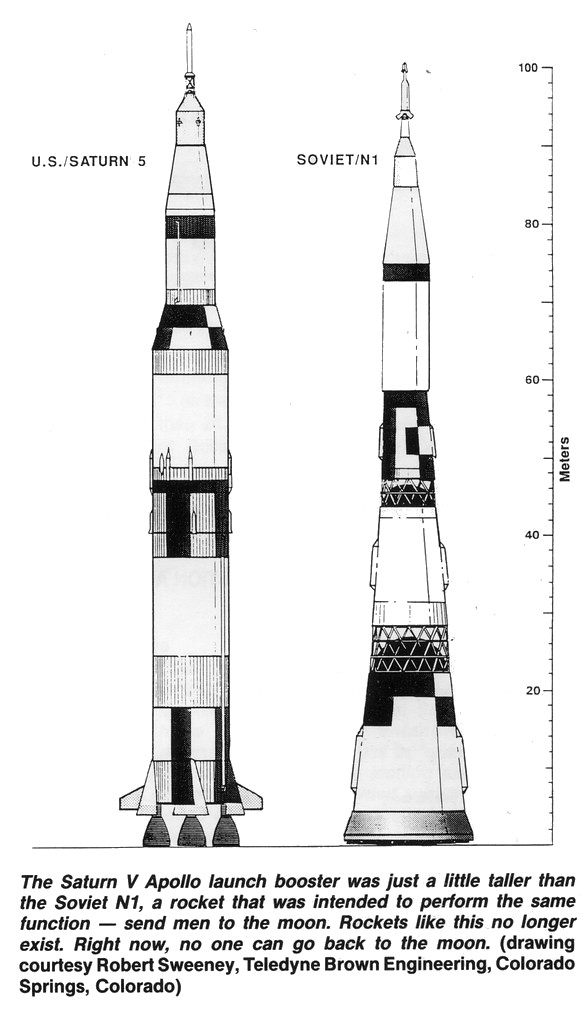
Comparison between The United States Saturn V and the Soviet N-1. Credit: Griffith Observer, the magazine of Griffith Observatory.
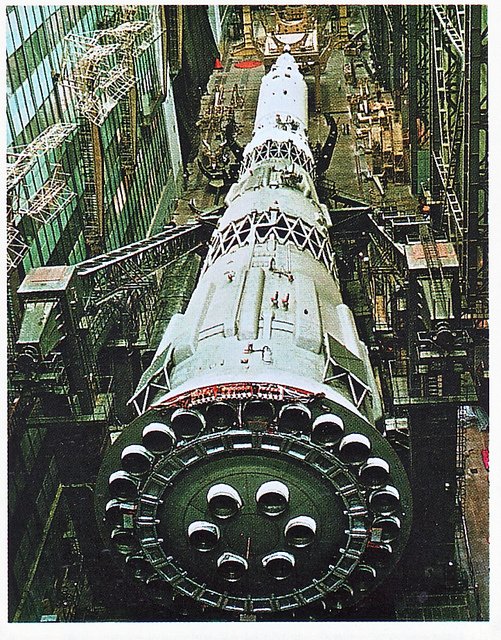
Base of the N-1 and its 36 rocket engines. The N-1 is assembled horizontally while the Saturn V was assembled vertically.
05/10/2019 – Ephemeris – The Astronomy Day event in the Grand Traverse Region
Ephemeris for Friday, May 10th. Today the Sun will be up for 14 hours and 37 minutes, setting at 8:58, and it will rise tomorrow at 6:19. The Moon, 1 day before first quarter, will set at 2:41 tomorrow morning.
The Grand Traverse Astronomical Society will host a public viewing night for International Astronomy Day tomorrow night, that’s Saturday the 11th, starting at 9 p.m. It will be at Northwestern Michigan College’s Joseph Rogers Observatory. If its clear the first quarter Moon will be featured along with other wonders of the spring sky. The observatory is located south of Traverse City, on Birmley Road between Garfield and Keystone roads. For the society members these, normally monthly star parties at the observatory are part of their outreach. They include sidewalk astronomy outings like Friday Night Live, and International Observe the Moon Night, to the Sleeping Bear Dunes National Lakeshore and other locations.
The times given are for the Traverse City/Interlochen area of Michigan. They may be different for your location.
05/09/2019 – Ephemeris – The USA: Step by step to the Moon
Ephemeris for Thursday, May 9th. Today the Sun will be up for 14 hours and 35 minutes, setting at 8:57, and it will rise tomorrow at 6:20. The Moon, 2 days before first quarter, will set at 1:54 tomorrow morning.
The Apollo 11 manned landing on the Moon 50 years ago was the culmination of a series of incremental steps. The Mercury program was in progress when President Kennedy announce the goal to land on the Moon. Following that was Gemini a two man capsule to test long duration flight, rendezvous and docking of two spacecraft, and EVA’s or spacewalks. There was the Ranger program attempted to photograph the Moon close up by sending probes to crash into the Moon. The Lunar Orbiter program to map the entire Moon, the Surveyor program to soft land on the Moon and test its surface. All this leading up to the three man Apollo program to test out the strategy and equipment and to land humans on the Moon.
The times given are for the Traverse City/Interlochen area of Michigan. They may be different for your location.
Addendum
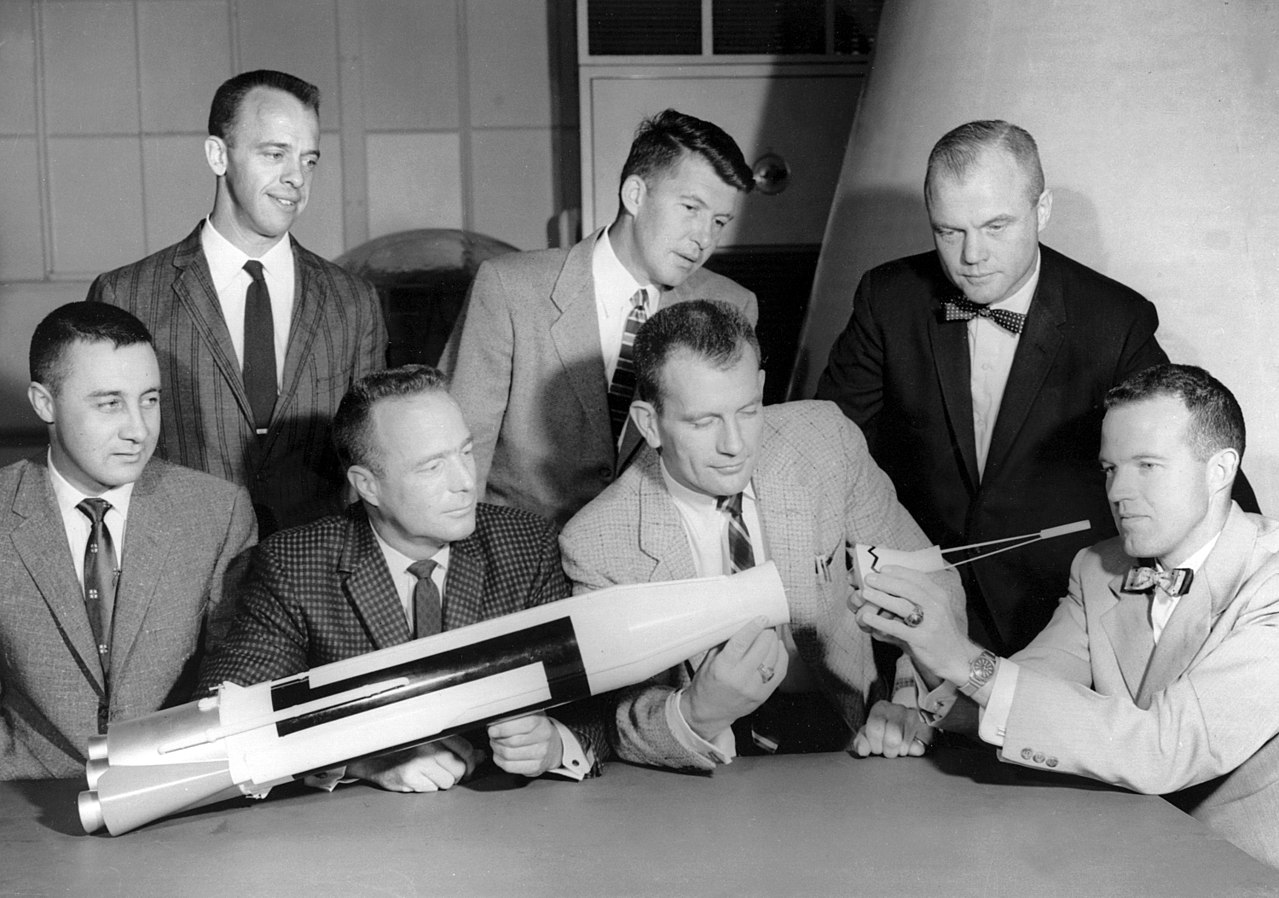
Project Mercury astronauts and a model of the Mercury-Atlas rocket and capsule. Left to right: Grissom, Shepard, Carpenter, Schirra, Slayton, Glenn and Cooper, in 1962. Click on the image to enlarge. Credit NASA.
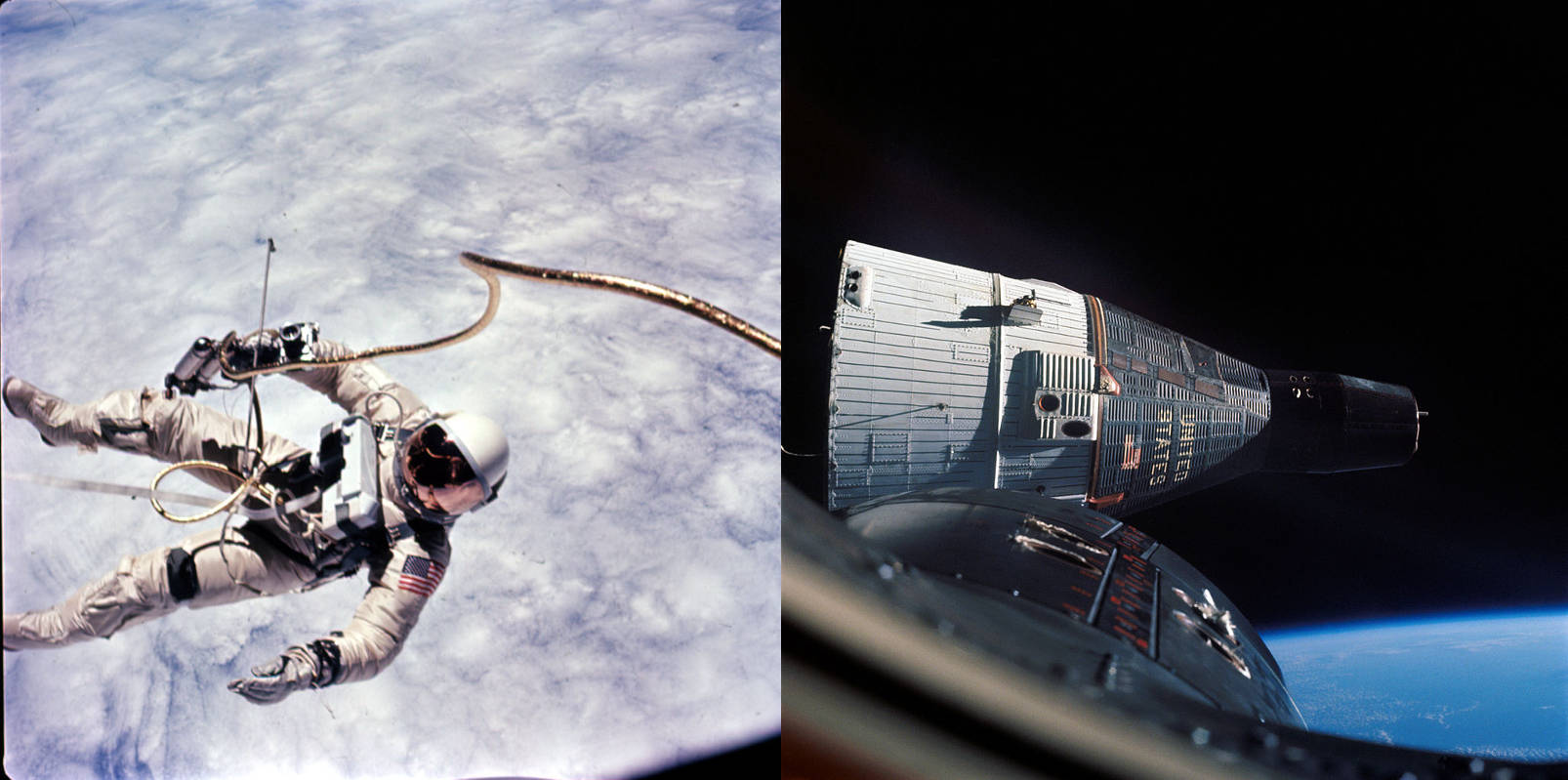
Project Gemini: Left Ed White during the US first space walk during Gemini 4 in June of 1965. Right The rendezvous of Gemini 6 & 7 in December of 1965. Click on the image to enlarge. Credit NASA.
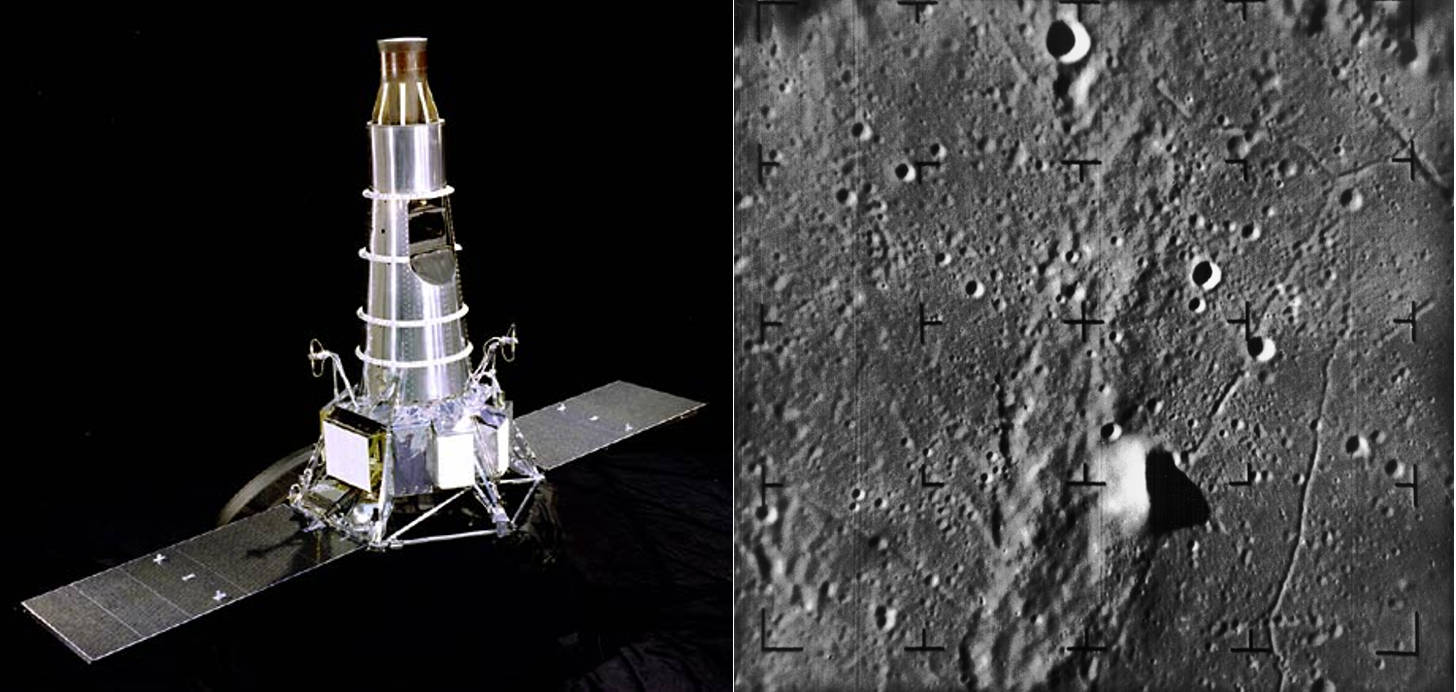
Left: The Ranger spacecraft. Right: The floor of the crater Alphonsus from Ranger 9. Only the last 3 spacecraft were successful. They transmitted images all the way down as they crashed into the Moon. Click on the image to enlarge. Credit NASA.
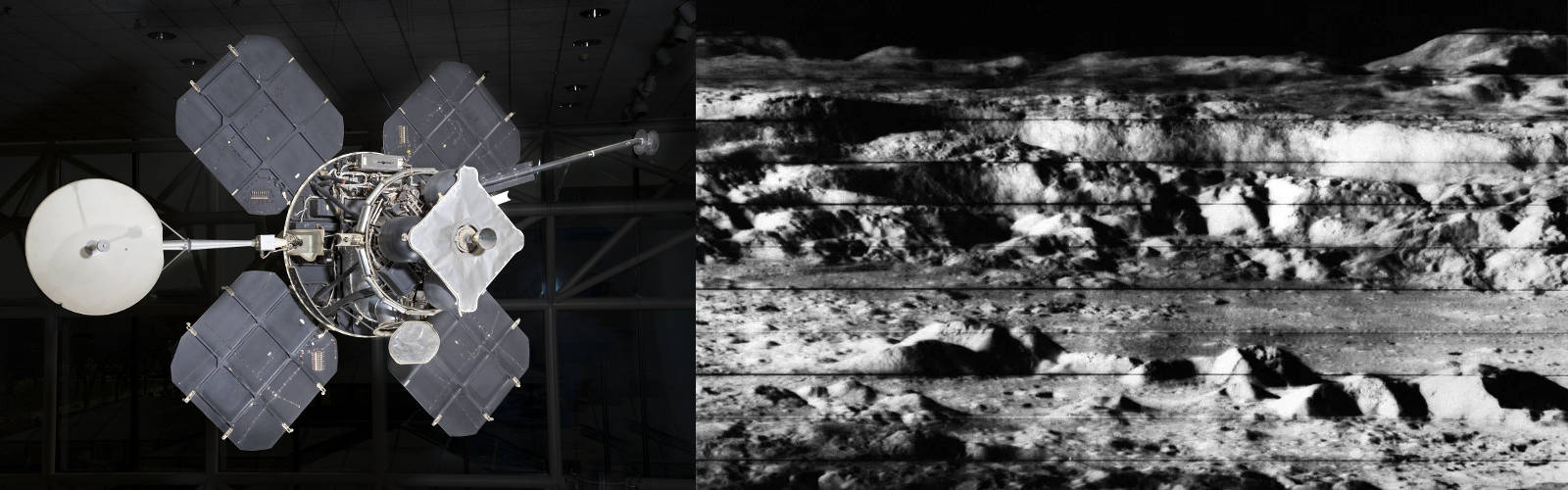
In the most unheralded of the lunar programs the 5 successful Lunar Orbiter satellites photographed 99% of the Moon. from 1966 to 1967. The Moon was photographed on film in strips, developed and the images scanned and transmitted back to Earth. Right: The oblique view of the crater Copernicus was dubbed at the time “The Picture of the Century”. Click on the image to enlarge. Credit NASA.
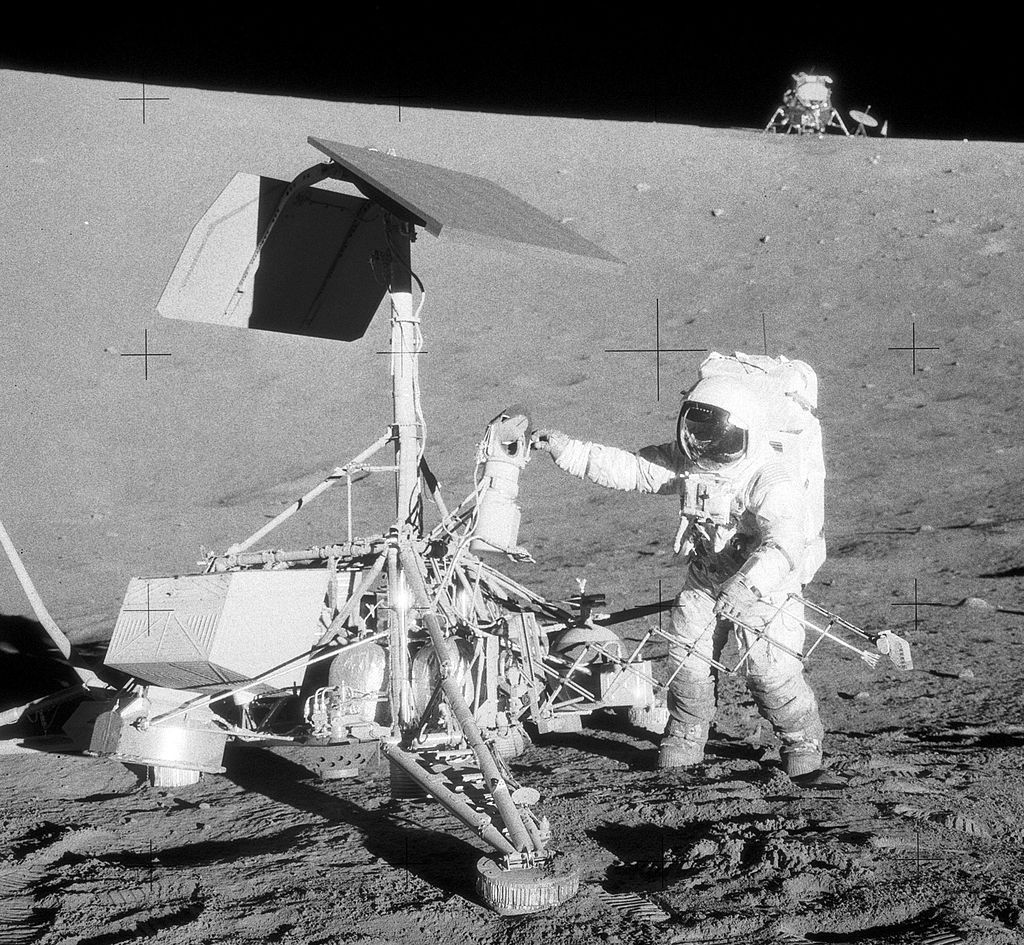
Surveyor 3, visited by astronaut Pete Conrad during the Apollo 12 mission. Click on the image to enlarge. Credit: NASA / Alan Bean.
05/08/2019 – Ephemeris – Let’s look at the bright planets for this week
Ephemeris for Wednesday, May 8th. Today the Sun will be up for 14 hours and 32 minutes, setting at 8:55, and it will rise tomorrow at 6:22. The Moon, 3 days before first quarter, will set at 12:59 tomorrow morning.
Let’s look at the planets for this week. Mars will be in the western sky this evening, between Gemini and Taurus the bull. It will set at 12:07 a.m. In the morning sky we have Jupiter, in Ophiuchus, which will actually rise at 11:40 tonight in the east-southeast. Saturn will be next to rise at 1:32 a.m., also in the east-southeast. It’s in Sagittarius. Both planets are easily visible in the morning twilight. Venus will rise 53 minutes before the Sun in the east. It will remain in our morning sky, though too close to the rising Sun to be easily glimpsed. In August it will pass behind the Sun to enter the evening sky. It will be in position later this year to be our bright evening Christmas Star.
The times given are for the Traverse City/Interlochen area of Michigan. They may be different for your location.
Addendum
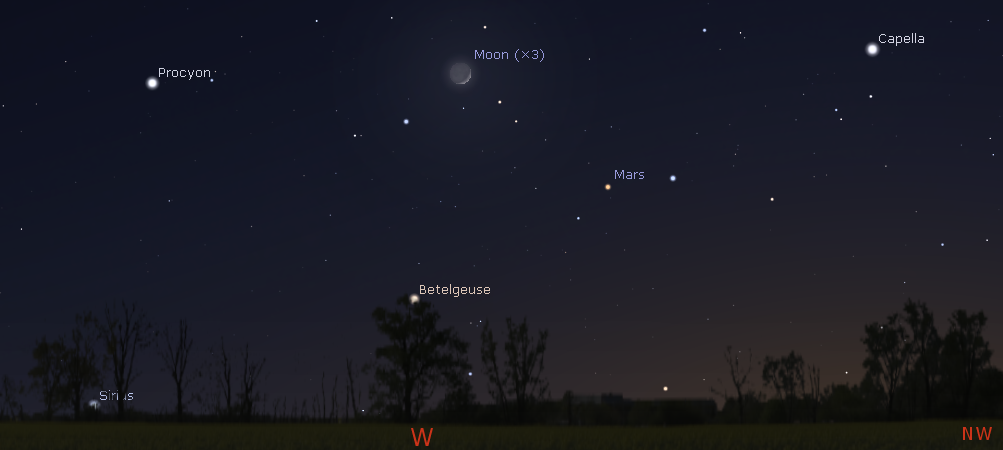
Mars and the Moon (at 3 times its actual size) tonight at 10 p.m. May 8, 2019. Click on the image to enlarge. Created using Stellarium.
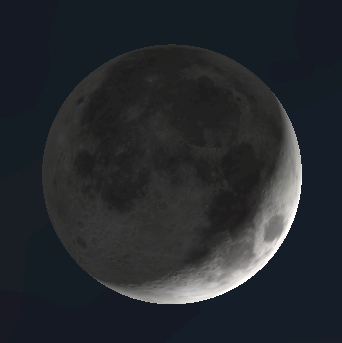
The Moon as it might appear in binoculars or a small telescope tonight at 10 p.m. May 8, 2019. Created using Stellarium.
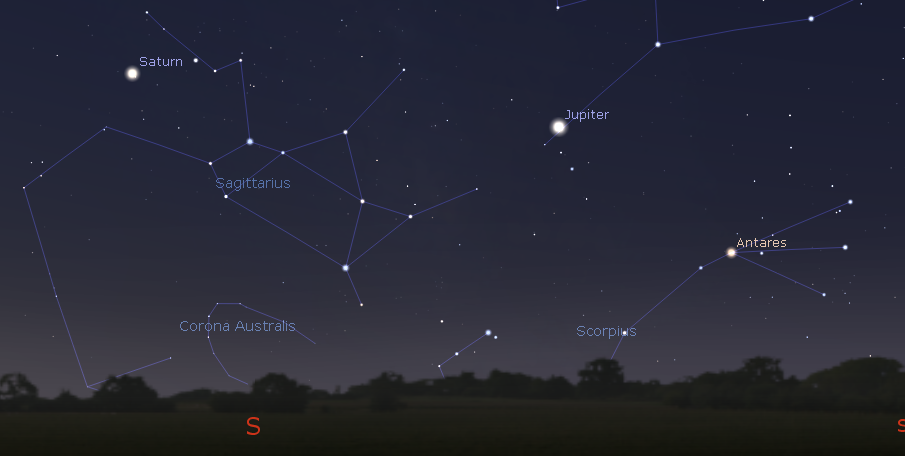
Morning planets and Moon at 5:30 a.m. May 9, 2019. Click on the image to enlarge. Created using Stellarium.
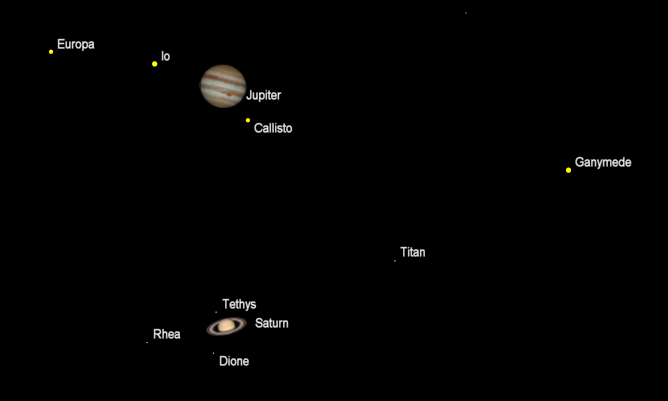
Jupiter and Saturn with the same magnification at 5:30 a.m. tomorrow morning May 9, 2019. Created using Cartes du Ciel (Sky Charts).
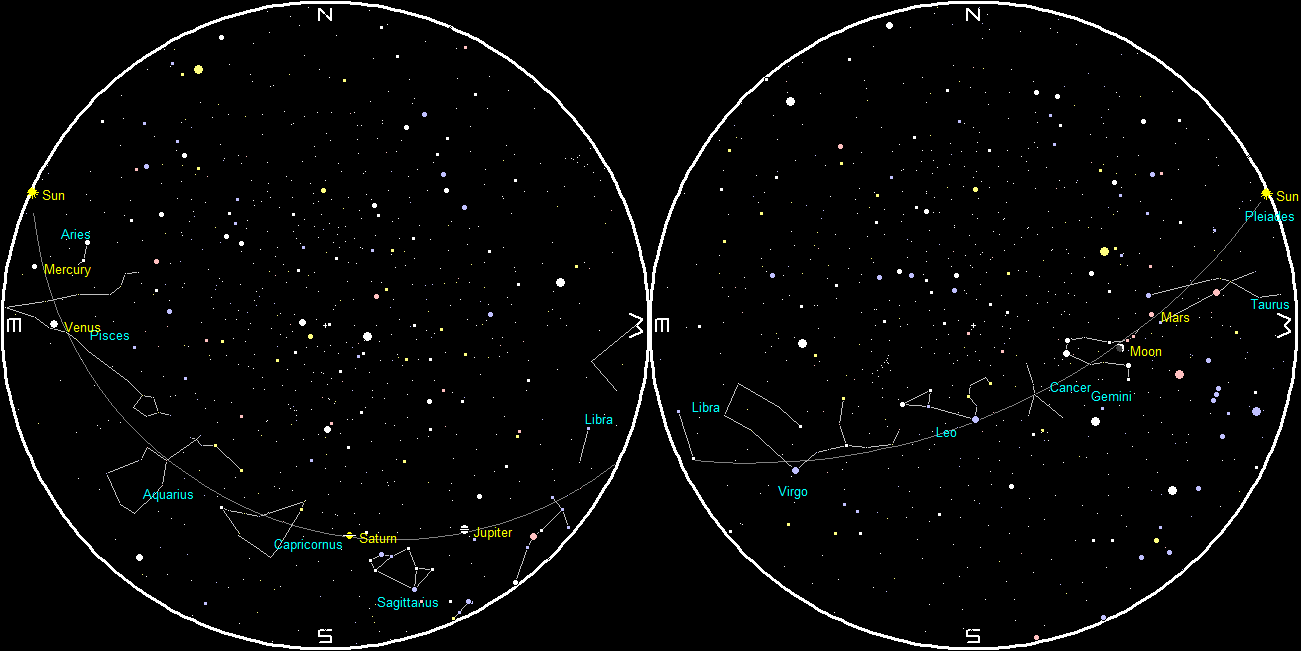
Planets and the Moon at sunset and sunrise of a single night starting with sunset on the right on May 8, 2019. The night ends on the left with sunrise on the 9th. Click on the image to enlarge. Created using my LookingUp program.
05/07/2019 – Ephemeris – We’re starting to look at the race to the Moon that culminated 50 years ago
Ephemeris for Tuesday, May 7th. Today the Sun will be up for 14 hours and 30 minutes, setting at 8:54, and it will rise tomorrow at 6:23. The Moon, 3 days past new, will set at 11:58 this evening.
As we look at the Moon near the planet Mars tonight, we recall that fifty years ago today the United States was one week from launching Apollo 10, the penultimate lunar mission to test out the Lunar Module shortened to LM pronounced “Lem” in the vicinity of the Moon. President Kennedy announced the goal in 1961 to send a man to the Moon and return him safely by the end of the decade. This required a lot of learning steps and in the end a huge rocket, the Saturn V. That rocket’s chief designer was Wernher von Braun an ex-Nazi officer who designed the German V-2 during World War II. His counterpart on the Soviet side was Sergei Korolev, though we didn’t know his name until after he died in 1966. His death hampered the development of the Soviet’s N-1 moon rocket.
The times given are for the Traverse City/Interlochen area of Michigan. They may be different for your location.
Addendum

Wernher von Braun around 1960. Image is in the public domain.

Sergei Korolev, undated image published after his death. Image is in the public domain.
A fascinating look of the Soviet side of the moon race can be found here: https://www.nasa.gov/connect/ebooks/rockets_people_vol4_detail.html. The ebook Rockets and People Volume IV, The Moon Race by Korolev’s deputy Boris Chertok. It’s available in epub, mobi and pdf formats. Volume 3 covers from 1961 to 1967. There are links to all the other volumes from that page.
05/06/2019 – Ephemeris – The Eta Aquariid meteor shower
Ephemeris for Monday, May 6th. Today the Sun will be up for 14 hours and 27 minutes, setting at 8:53, and it will rise tomorrow at 6:24. The Moon, 2 days past new, will set at 10:52 this evening.
The Earth is now passing through a stream of bits of rock that were shed from Halley’s Comet on its many previous passes of the inner solar system. The Earth gets to pass through this stream twice, Once in late October as the stream passes the Earth’s orbit heading in, and in early May as the stream is departing. The peak of this meteor shower, the Eta Aquariids, lasts several days. But since the meteoroids are coming from nearer the direction of the Sun, there is only a short period when these meteors are visible. Actually only an hour between 3:30 a.m. and 4:30 a.m. or a little bit later in the Grand Traverse region as twilight begins to interfere with the display. The radiant, from where the meteors will seem to come will stay low in the east-southeast, but they will be seen all over the sky. The farther south one is on the earth the longer each morning the meteors will be visible. We’re at a disadvantage being 45º north latitude.
The times given are for the Traverse City/Interlochen area of Michigan. They may be different for your location.
Addendum
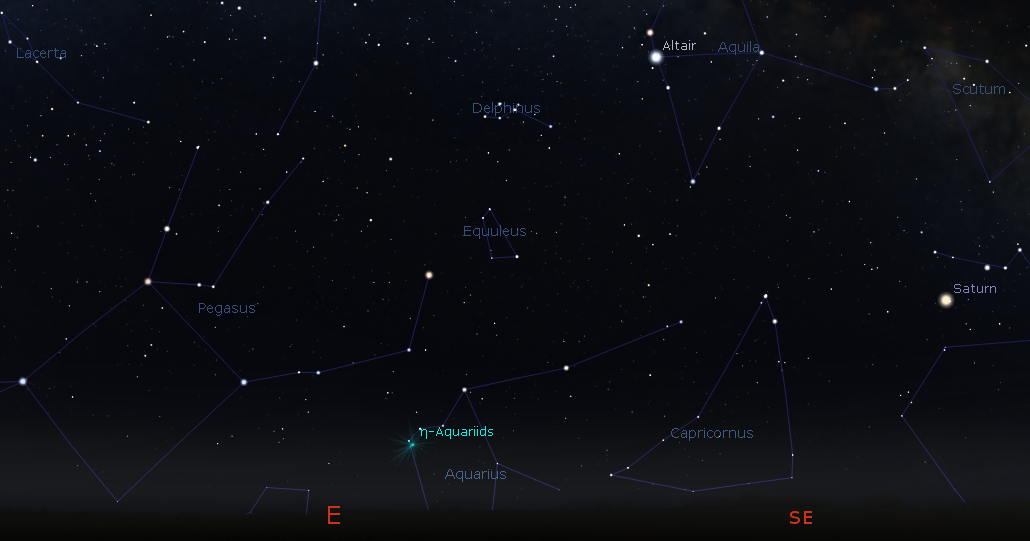
The sky at 4 a.m. tomorrow looking eastward at the Eta Aquariid radiant. Click on the image to enlarge. Created using Stellarium.
 Bob Moler's Ephemeris Blog