Archive
05/06/2019 – Ephemeris Extra – The Eta Aquariids – Halley’s Comet never really left
In 1986 Halley’s Comet swam through our skies for the 28th time since the Chinese first recorded it in 240 BCE. It was not especially impressive, considering the week when my family met a group of Leelanau School students in the Florida Keys the week in April 1986 to view and photograph the comet at it’s closest to the Earth of 44 million miles. It turned out that that week the comet lost its tail, probably due to a coronal mass ejection from the Sun. Halley’s Comet was much more impressive a month later. I’ve seen more impressive comets before and since.
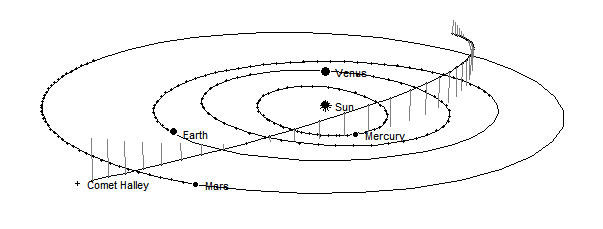
Comet Halley’s path through the inner solar system in 1985-86. Created using my LookingUp program.
Halley’s Comet has been swinging around the Sun countless times before the Chinese first recorded it. The illustration above shows the last time the comet entered the inner solar system in 1986. The comet’s path is from upper right to lower left. When the comet passes within about 3 astronomical units of the Sun, that is 3 times the Earth’s distance from the Sun, the ices in the comet begin to sublimate, escaping from the comet’s nucleus which liberates dust and larger solid material. The gasses and dust form the comet’s ion and dust tails. The larger material, gravel sized bits, end up in and around the comet’s orbit, and over time are spread out around and near the comet’s orbit. Halley’s orbit crosses the Earth’s orbit twice, inbound and outbound. In both cases these crossings are close enough to the plane of the Earth’s orbit to produce meteor showers.
On the inboard leg of the orbit it produces the Orionid meteor shower that peaks on October 22nd. A meteor shower is generally named for the point in the sky they seem to come from, be it a constellation or star. The point, called the radiant, moves during the days or weeks the shower is visible. The Orionids are named for the constellation Orion. The radiant is near his upraised arm.
The center of the outbound meteoroid stream crosses the Earth’s orbit where the Earth is on May 6th. Though they have a broad peak of about 5 days. This meteor shower is visible from April 19th to May28th. During that period the radiant points drifts quite a bit to the east. There are several meteor shower radiants in Aquarius, so they are named for the nearest star at peak.
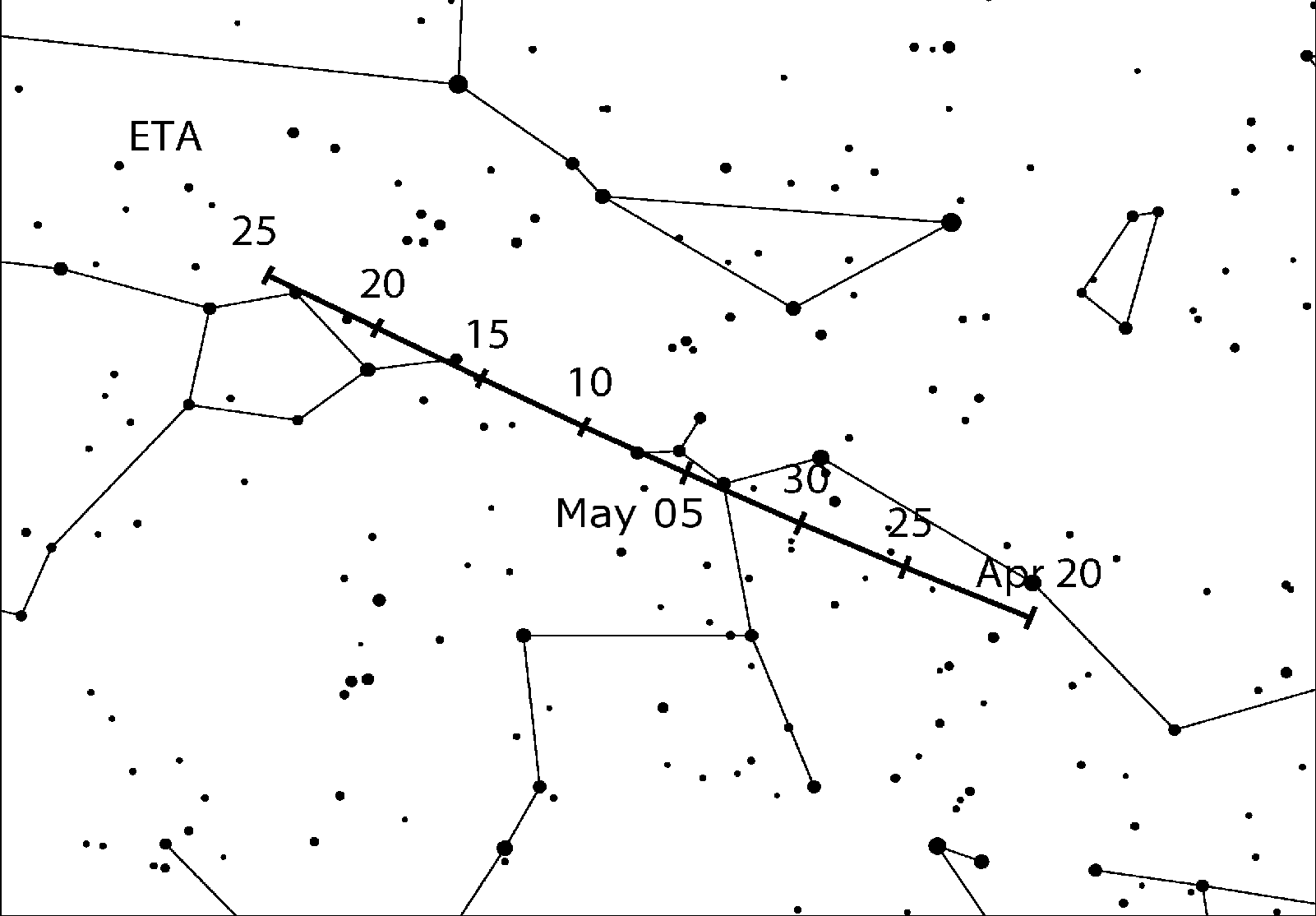
Motion of the Eta Aquariid radiant from April 20 to May 25. The triangle with the star near the center near May 05 is the asterism the Water Jar, a part of Aquarius. Eta Aquarii is the triangle star to the left. Source: PDF version of the International Meteor Organization 2019 Meteor Shower Calendar: https://www.imo.net/resources/calendar/
Though the Moon is new for this shower, the meteoroids are coming from near the direction of the Sun, so there is only an hour where the Eta Aquariids are best seen. For Northern Michigan the radiant rises at 3:30 a.m. on May 6th. Astronomical twilight begins at 4:30 a.m. when the sky begins to brighten. This meteor shower is best seen from the southern hemisphere.
05/03/2019 – Ephemeris – How do you take a picture of a black hole? Find out tonight.
Ephemeris for Friday, May 3rd. Today the Sun will be up for 14 hours and 19 minutes, setting at 8:49, and it will rise tomorrow at 6:28. The Moon, 1 day before new, will rise at 6:44 tomorrow morning.
Nearly a month ago the world was presented with the news and the image that the Earth spanning Event Horizon Telescope captured a picture of a black hole 55 million light years away. Tonight NMC Professor Jerry Dobek will explain how it was done at tonight’s meeting of the Grand Traverse Astronomical Society at Northwestern Michigan College’s Rogers Observatory starting at 8 p.m. He will explain how simultaneous observations of the black hole by 8 separate sub-millimeter radio telescopes that were separately recorded on disk. The disks were brought and processed together to produce the image. Starting at 9 p.m. if it’s clear there will be a star party featuring the brighter wonders of the darkening sky.
The times given are for the Traverse City/Interlochen area of Michigan. They may be different for your location.
Addendum
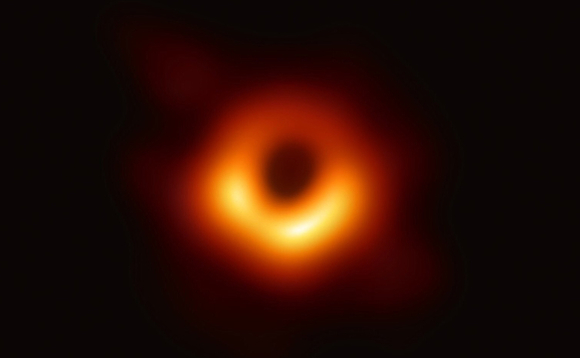
The first image of the black hole in M87. Credit Event Horizon Telescope.
05/02/2019 – Ephemeris – Apollo and the constellations of Corvus, Crater and Hydra
Ephemeris for Thursday, May 2nd. Today the Sun will be up for 14 hours and 17 minutes, setting at 8:48, and it will rise tomorrow at 6:30. The Moon, 2 days before new, will rise at 6:18 tomorrow morning.
The small constellation of Corvus the crow is located low in the south at 10:30 this evening. It’s made of 5 dim stars, but the pattern is a distinctive distorted box with two stars at the upper left marking that corner. To the right is a fainter constellation of a thick stemmed goblet called Crater. Both appear above the long constellation of Hydra the water snake who is slithering just above the southern horizon. In Greek mythology Corvus, then white, was the god Apollo’s pet. He once bid Corvus to take a cup and fetch him some water. Corvus however dallied and waited for a green fig to ripen. Corvus grabbed a snake and returned with a story on how the snake had delayed him. The angry Apollo turned the crow and all crows to this day black.
The times given are for the Traverse City/Interlochen area of Michigan. They may be different for your location.
Addendum
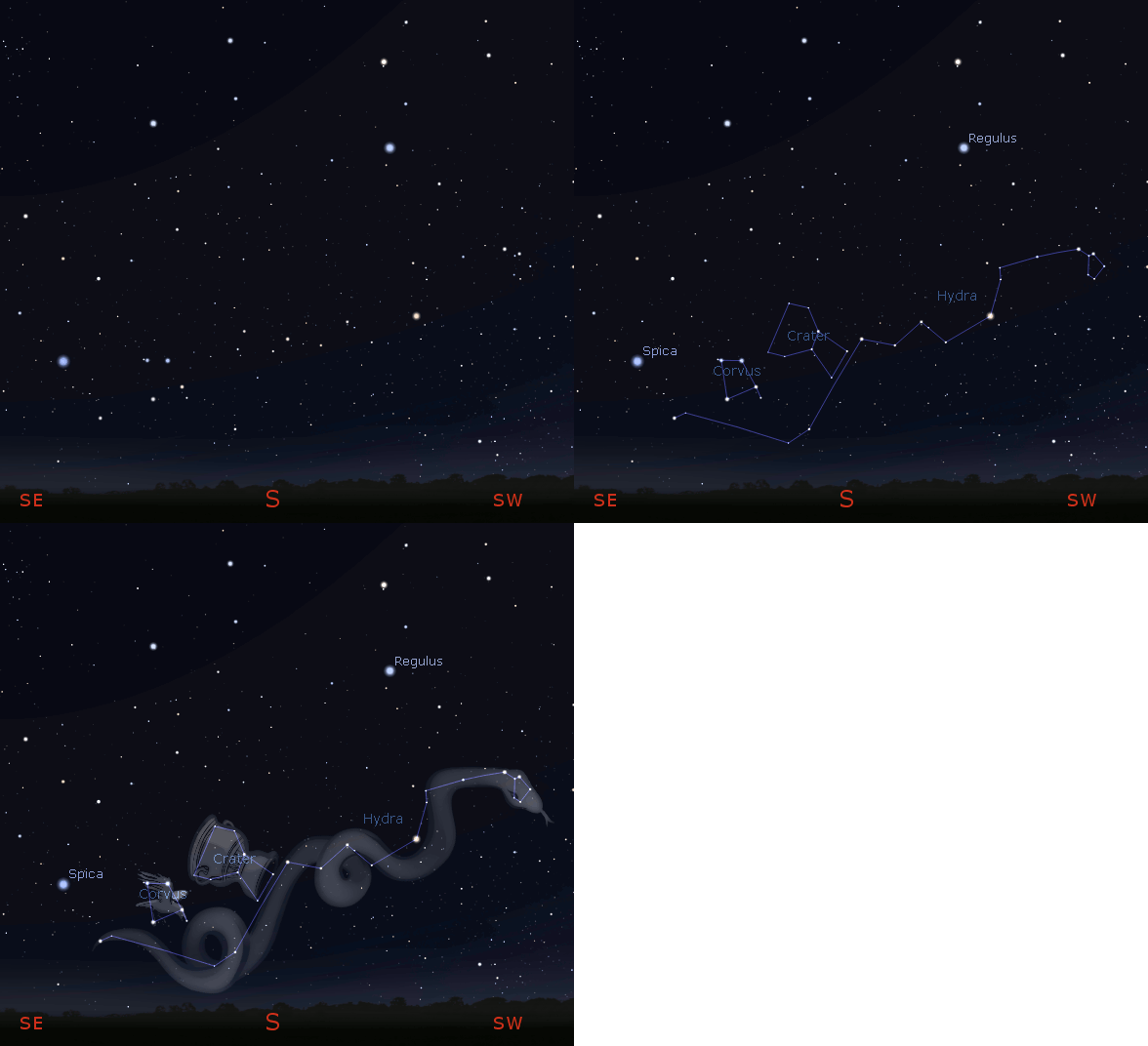
Corvus, Crater and Hydra finder chart for 10 p.m. May 2, 2019. Created using Stellarium and GIMP.
05/01/2019 – Ephemeris – Checking out the bright planets for May Day
Ephemeris for Wednesday, May 1st. Today the Sun will be up for 14 hours and 14 minutes, setting at 8:47, and it will rise tomorrow at 6:31. The Moon, 3 days before new, will rise at 5:54 tomorrow morning.
Let’s look at the planets for this first day of May. Mars will be in the western sky this evening, in the horns above the V-shaped stars of the face of Taurus the bull. It will set at 12:13 a.m. In the morning sky we have Jupiter, in Ophiuchus, which will rise tomorrow at 12:09 a.m. in the east-southeast. Saturn will be next to rise at 2 a.m., also in the east-southeast. It is in Sagittarius. Venus will rise 57 minutes before the Sun in the east. It will remain in our morning sky, though too close to the rising Sun to be easily glimpsed. In August it will pass behind the Sun to enter the evening sky. It will be in position later this year to be our bright evening Christmas Star. Mercury will rise only 32 minutes before the Sun.
The times given are for the Traverse City/Interlochen area of Michigan. They may be different for your location.
Addendum
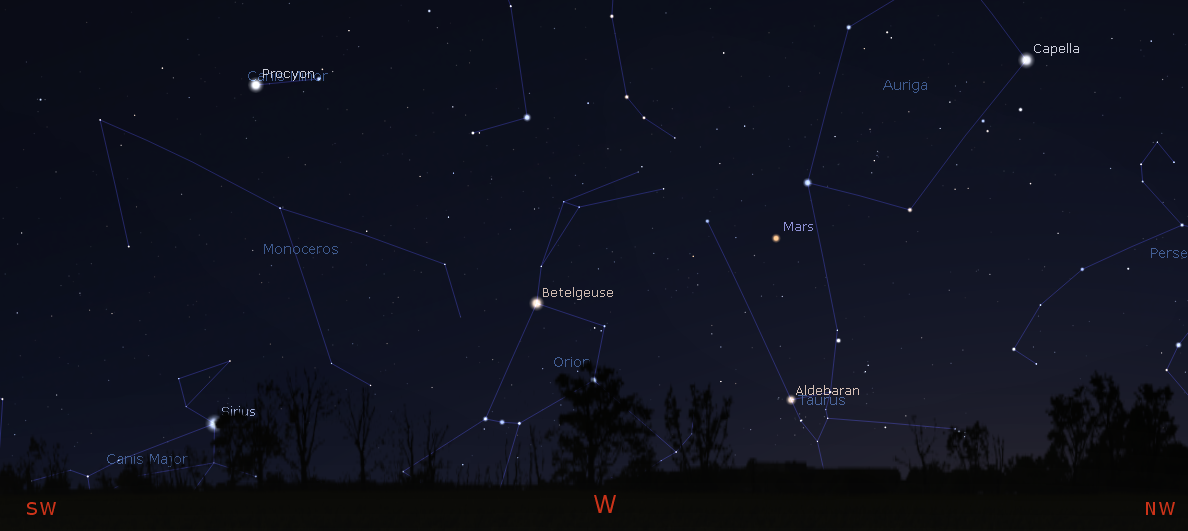
Mars and the setting winter stars tonight at 10 p.m. May 1, 2019. Click on the image to enlarge. Created using Stellarium.
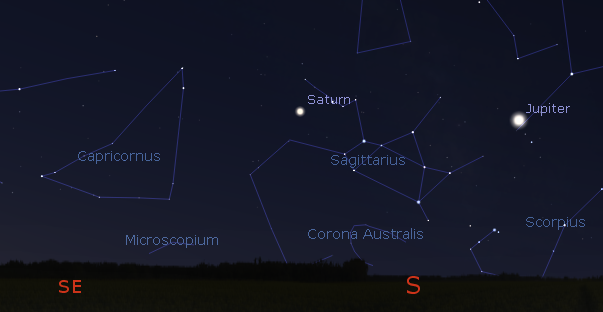
Morning planets and Moon at 5:30 a.m. May 1, 2019. Click on the image to enlarge. Note that at this time for the Grand Traverse area the International Space Station will be visible, crossing from the southwest starting at 5:25 and ending in the east-northeast at 5:31 a.m. Created using Stellarium.
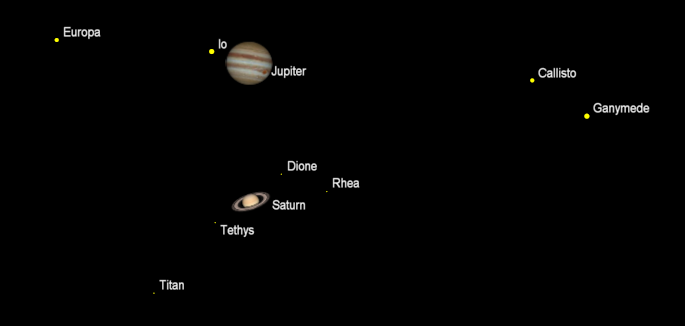
Jupiter and Saturn with the same magnification at 5:30 a.m. tomorrow morning May 2, 2019. Created using Cartes du Ciel (Sky Charts).
Io’s shadow will start to cross Jupiter’s disk at 9:27 UT or 5:27 a.m. EDT.
Io’s will start to transit the planet at 10:19 UT or 6:19 a.m. EDT.
Io events for observers west of here can be accessed from Project Pluto: https://www.projectpluto.com/jevent.htm#may.
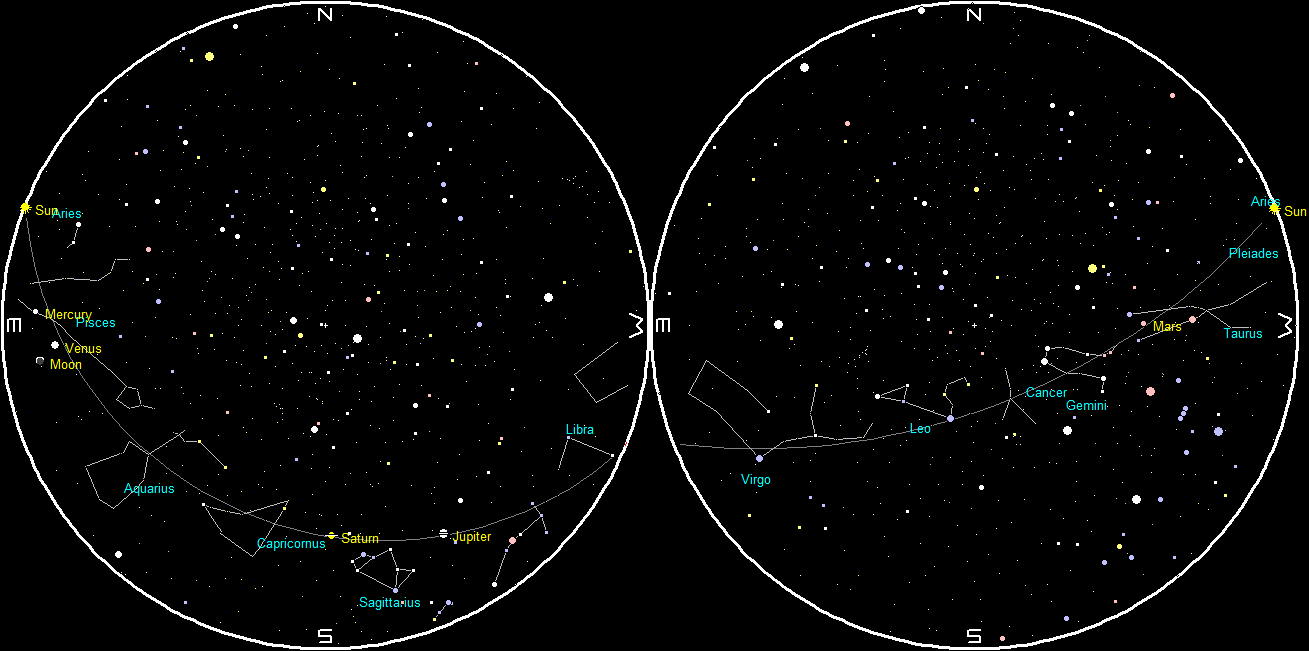
Planets and the Moon at sunset and sunrise of a single night starting with sunset on the right on May 1, 2019. The night ends on the left with sunrise on the 2nd. Click on the image to enlarge. Created using my LookingUp program.
 Bob Moler's Ephemeris Blog