Archive
09/17/2019 – Ephemeris – It looks like another interstellar object has been found passing through the solar system
Ephemeris for Tuesday, September 17th. Today the Sun will be up for 12 hours and 26 minutes, setting at 7:50, and it will rise tomorrow at 7:24. The Moon, 3 days past full, will rise at 9:45 this evening.
Last week Monday I talked about a project to detect interstellar meteoroids that hit the Moon. It turns out we don’t have to wait that long. This past August 30th, Gennady Borisov of the Crimean Astrophysical Observatory discovered apparent comet since designated C/2019 Q4 (Borisov). It will approach the Sun just outside Mars orbit in December. It’s moving at over 25 miles per second (41 km/s) or nearly 92 thousand miles an hour (150,000 km/hr). In 2017 the first interstellar body discovered to enter our solar system was spotted, ‘Oumuamua. It was already past its closest to the Sun when found. This one is still approaching and visibly out gassing, so we’ll find out much more of its composition.
Addendum
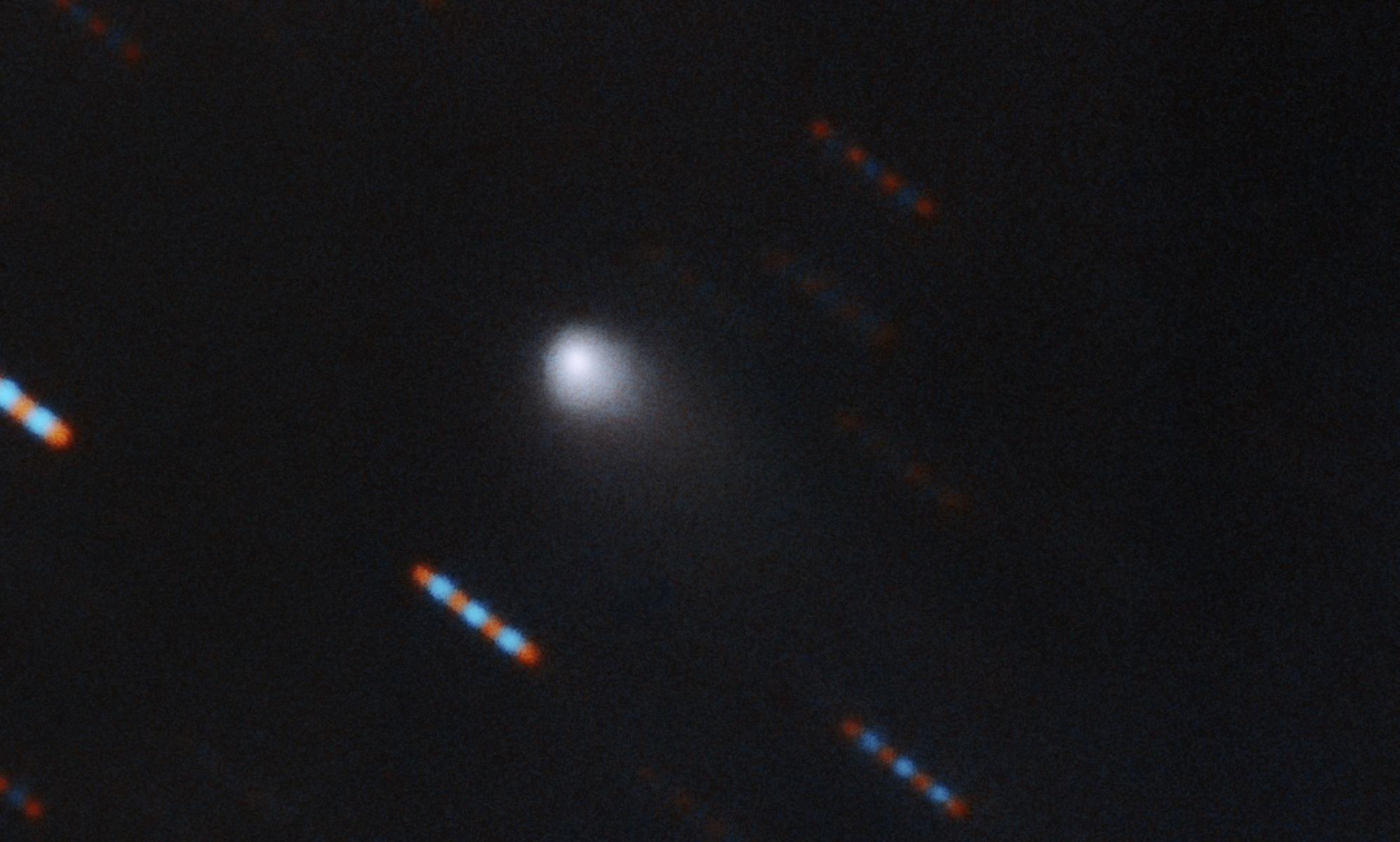
Color photograph of C/2019 Q4. Image Credit: Gemini Observatory/NSF/AURA
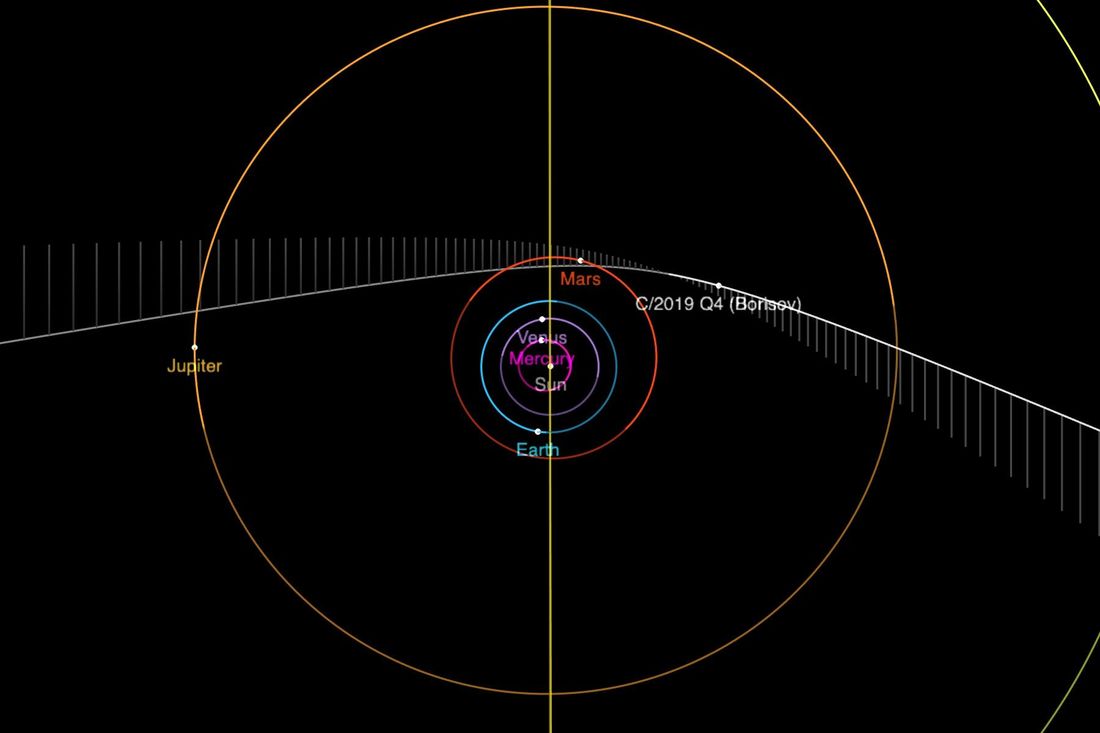
Orbit of C/2019 Q4 (Borisov). Credit: NASA/JPL-Caltech
Check out these links:
https://www.syfy.com/syfywire/wait-another-interstellar-object-is-passing-through-the-solar-system
09/16/2019 – Ephemeris Extra – I’ll be giving my presentation “Apollo and the Moon Race” tonight
I’ll be giving my illustrated talk Apollo and the Moon Race tonight at 7 p.m. at the Traverse Area District Library on Woodmere Avenue in Traverse City. The 1960s were a heady time with the space race between the US and the USSR in achieving space firsts. I will look at the competition, and the incremental steps that had to be made to finally send astronauts to the surface of the Moon on July 20th 1969.
If you miss this presentation, there will be another on Friday September 27, at 7 p.m. at the Betsie Valley District Library in Thompsonville.
Both events will have viewing of the skies with the Grand Traverse Astronomical Society including Jupiter and Saturn afterward if it’s clear.
09/16/2019 – Ephemeris – Astronomers view a supernova that completely destroyed its star
Ephemeris for Monday, September 16th. Today the Sun will be up for 12 hours and 29 minutes, setting at 7:51, and it will rise tomorrow at 7:23. The Moon, 2 days past full, will rise at 9:21 this evening.
When a star explodes in a supernova due to being very massive, it generally leaves a tiny compact remnant called a neutron star or a black hole within an expanding cloud of gas and dust. However in the early universe there was only hydrogen and helium. It turns out that stars could get much more massive, maybe several hundred times the mass of the Sun, rather than tens of times more massive that the Sun that exist now. Theoreticians suggest that when these stars explode, there was no core to collapse into a black hole or neutron star, but the whole star ignites in a thermonuclear reaction spewing its entire self, and newly created elements into the universe. Astronomers are studying a supernova suspect discovered in 2016: SN 2016iet.
The times given are for the Traverse City/Interlochen area of Michigan. They may be different for your location.
Addendum
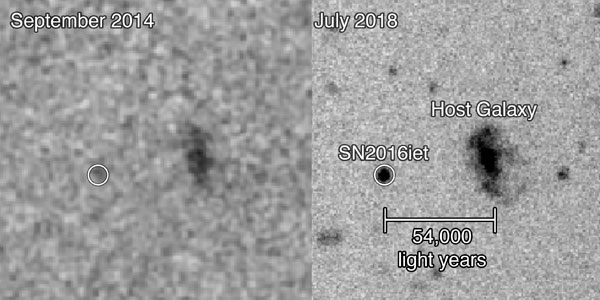
The discovery image (right) shows SN 2016iet and its most likely host galaxy. It was taken with the Low Dispersion Survey Spectrograph on the Magellan Clay 6.5-m telescope at Las Campanas Observatory on July 9, 2018. On the left is a pre-discovery image of the area wit a circle of where the supernova would appear.
The article I gleaned this information from: https://www.skyandtelescope.com/astronomy-news/supernova-that-destroyed-its-star/
It contains a link to the publication preprint.
09/13/2019 – Ephemeris – Harvest Moon tonight
Ephemeris for Friday, September 13th. Today the Sun will be up for 12 hours and 38 minutes, setting at 7:57, and it will rise tomorrow at 7:20. The Moon, 1 day before full, will rise tonight 8:12.
Tomorrow is the Harvest Moon. In fact the instant of full moon is 12:33 a.m. tonight, so one could consider the Harvest Moon tonight. Funny thing though, this morning the Moon will reach apogee from the Earth, of 252 thousand miles (406 thousand km), making it the opposite of a super moon, a mini moon. I bet you wouldn’t notice if I didn’t tell you. The Harvest Moon is the name given to the nearest full moon to the autumnal equinox. It is a special time of the lunar cycle when the Moon rises much less than the 50 minutes later average each night. This appeared to extend twilight allowing farmers before the advent of electric lights extra time to gather in their crops each day.
The times given are for the Traverse City/Interlochen area of Michigan. They may be different for your location.
Addendum
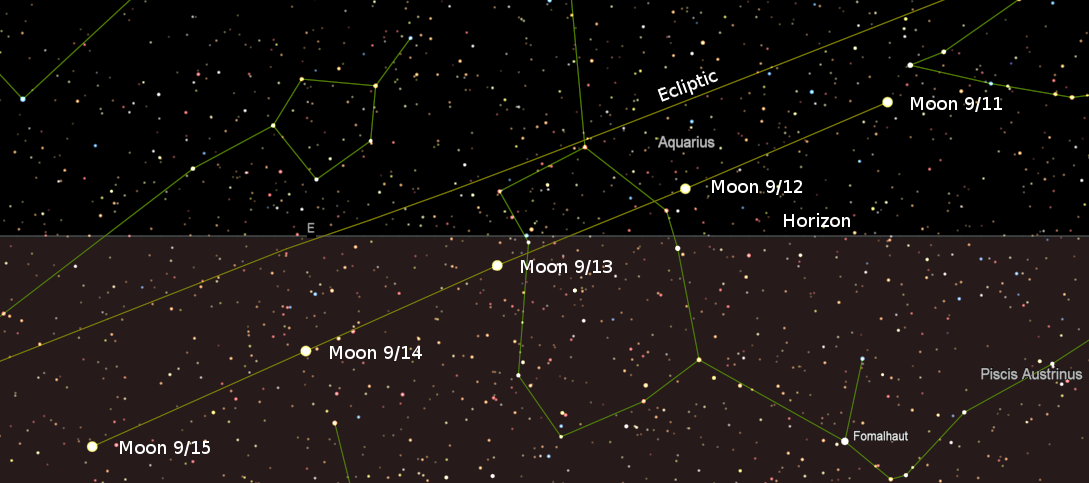
Harvest Moon effect from September 11 to the 15th, 2019. Note the shallowness of the ecliptic and Moon’s motion near sunset in this period. Click on the image to enlarge. Created using Cartes du Ciel (Sky Charts).
09/12/2019 – Ephemeris – NASA and the Europeans plan to deflect an asteroid
Ephemeris for Thursday, September 12th. Today the Sun will be up for 12 hours and 41 minutes, setting at 7:59, and it will rise tomorrow at 7:19. The Moon, 2 days before full, will set at 6:30 tomorrow morning.
Meeting now in Rome is the AIDA International Conference. It has nothing to do with the opera, but a tortured acronym for Asteroid Impact Deflection Assessment. NASA and the European Space Agency are going to target the satellite of a binary near Earth asteroid Didymos. NASA will supply DART, the impactor, The Italians, a cube sat to fly along and record the impact. Later the Europeans will launch a probe to assess the asteroid deflection. Didymos itself is a half mile in diameter (2560 ft, 780 m), its satellite, a bit more than 500 feet (525 ft, 160 m). The impact should make a marked change in the small body’s orbit of its parent. DART’s launch should come in the summer of 2021 with impact in 2022.
The times given are for the Traverse City/Interlochen area of Michigan. They may be different for your location.
Addendum
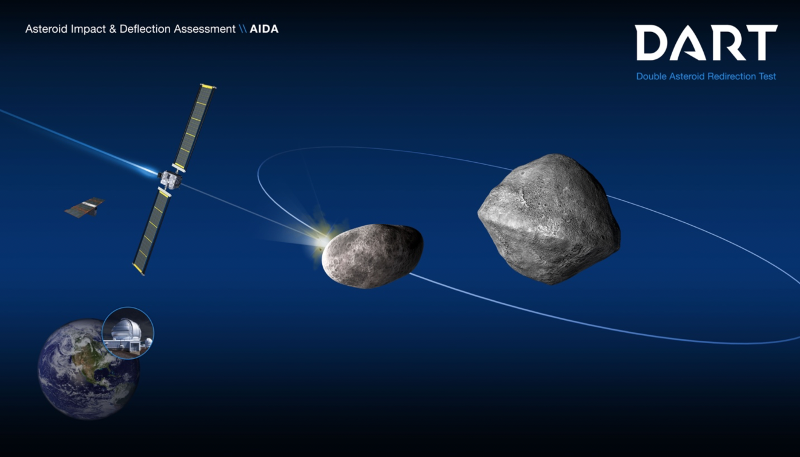
Schematic of the DART mission shows the impact on the moonlet of asteroid (65803) Didymos. Post-impact observations from Earth-based optical telescopes and planetary radar would, in turn, measure the change in the moonlet’s orbit about the parent body. Credits and caption: NASA/Johns Hopkins Applied Physics Lab.
More information: https://www.universetoday.com/143313/europe-and-us-are-going-to-try-and-deflect-an-asteroid/
09/11/2019 – Ephemeris – Let’s check out the bright planets or this week
Ephemeris for Wednesday, September 11th. Today the Sun will be up for 12 hours and 44 minutes, setting at 8:01, and it will rise tomorrow at 7:17. The Moon, 3 days before full, will set at 5:29 tomorrow morning.
Let’s look at the planets for this week. Mars, Venus and Mercury are too close to the Sun to be seen. Venus and Mercury are on the evening or east side of the Sun, Mars is on the west or morning side. Bright Jupiter will be in the south-southwestern sky as it gets dark. With steadily held binoculars a few of the 4 largest satellites of Jupiter can be seen. All four of Jupiter’s Galilean satellites can be spotted in telescopes before 10 this evening. The innermost moon Io will move in front of the planet until after midnight. Jupiter will set before then at 11:46 p.m. Saturn, the ringed planet, will be in the southern sky in the evening. It will pass the meridian, due south at 9:20 p.m. and will set at 1:46 a.m.
The times given are for the Traverse City/Interlochen area of Michigan. They may be different for your location.
Addendum
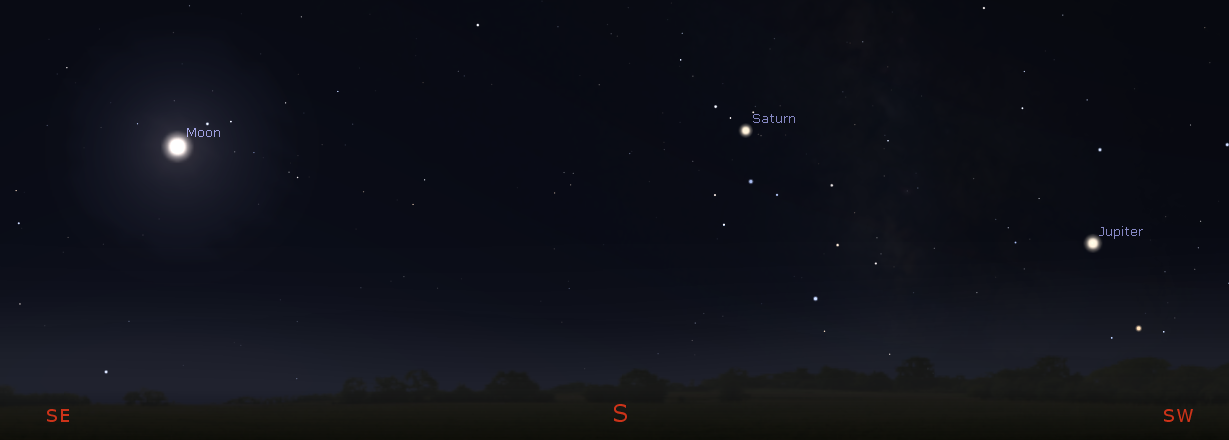
Jupiter, Saturn and the Moon with the bright stars of the southern summer sky at 10 p.m. September 11, 2019. Click on the image to enlarge. Created using Stellarium.
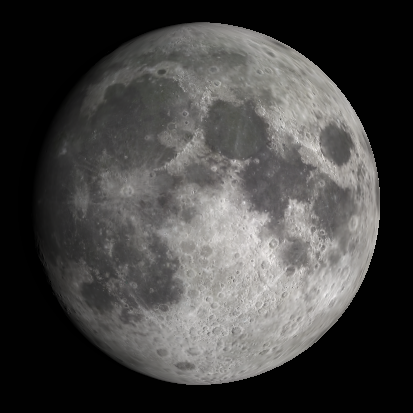
The gibbous Moon as it might appear in binoculars at 10 p.m. September 11, 2019. Created using Stellarium.,
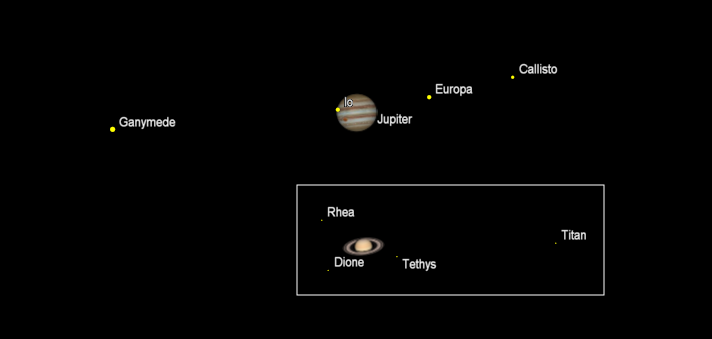
Telescopic views of Jupiter and Saturn with the same magnification at 10 p.m. September 11, 2019. Io starts a transit at 9:58 p.m. or 1:58 tomorrow UT. The shadow begins to cross at 11:15 p.m., 03:15 UT. The transit ends at 12:10 a.m., 4:10 UT, after Jupiter sets for observers in the listening area. The moons are much dimmer than what shows here so spotting the moon against the face of Jupiter is difficult. Created using Cartes du Ciel (Sky Charts).
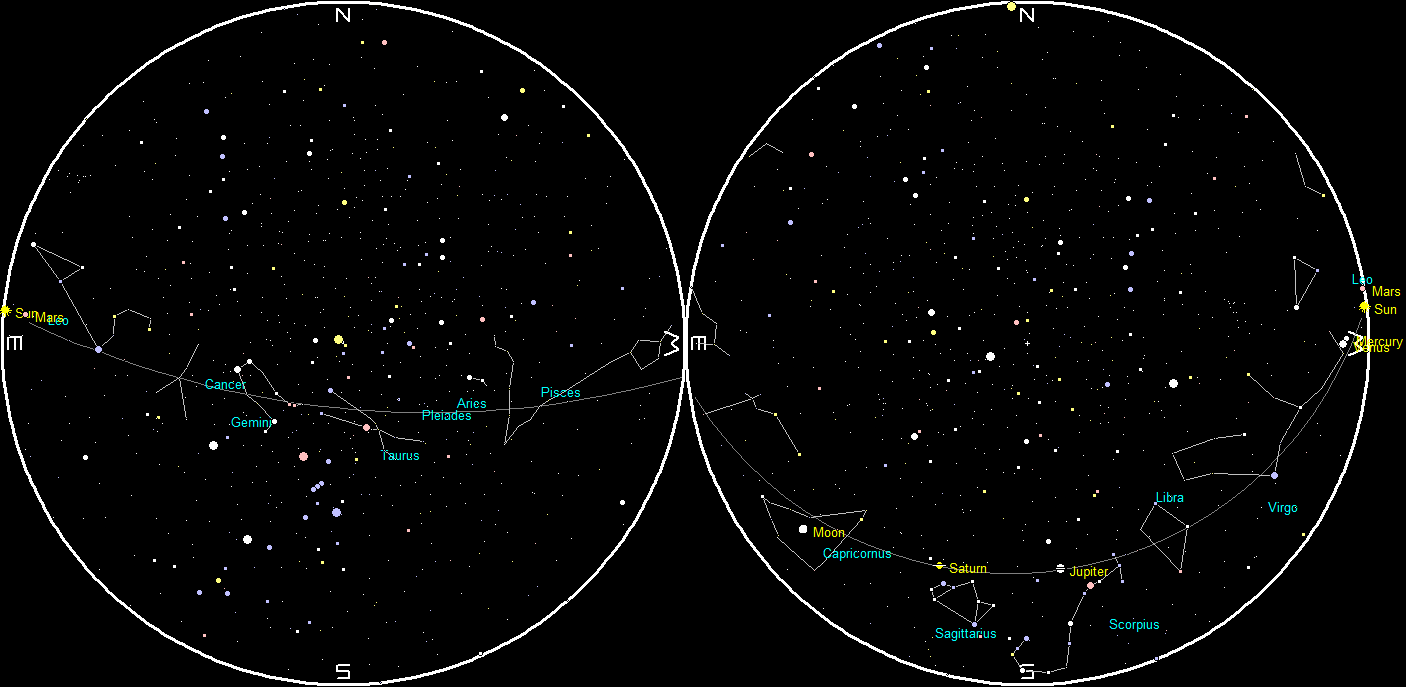
Planets and the Moon at sunset and sunrise of a single night starting with sunset on the right on September 11, 2019. The night ends on the left with sunrise on the 12th. Click on the image to enlarge. Created using my LookingUp program.
09/10/2019 – Ephemeris – India’s second lunar spacecraft
Ephemeris for Tuesday, September 10th. Today the Sun will be up for 12 hours and 47 minutes, setting at 8:03, and it will rise tomorrow at 7:16. The Moon, 4 days before full, will set at 4:29 tomorrow morning.
On July 22nd the Indian Space Research Organization ISRO launched Chandrayaan-2, their second mission to the Moon. India’s Chandrayaan-1 was a lunar orbiter launched 11 years ago. Chandrayaan-2 is much more ambitious spacecraft with an orbiter, a lander with a rover. Last Friday the lander attempted to land within 30 degrees of the Moon’s south pole. Unfortunately contact was lost when the lander was only 2.1 kilometers above the lunar surface. The last data received suggests that the lander’s vertical speed was excessive, and that it likely crashed on the lunar surface. This is the second failed lunar landing attempt this year after the Israeli Beresheet failure in April.
The times given are for the Traverse City/Interlochen area of Michigan. They may be different for your location.
Addendum
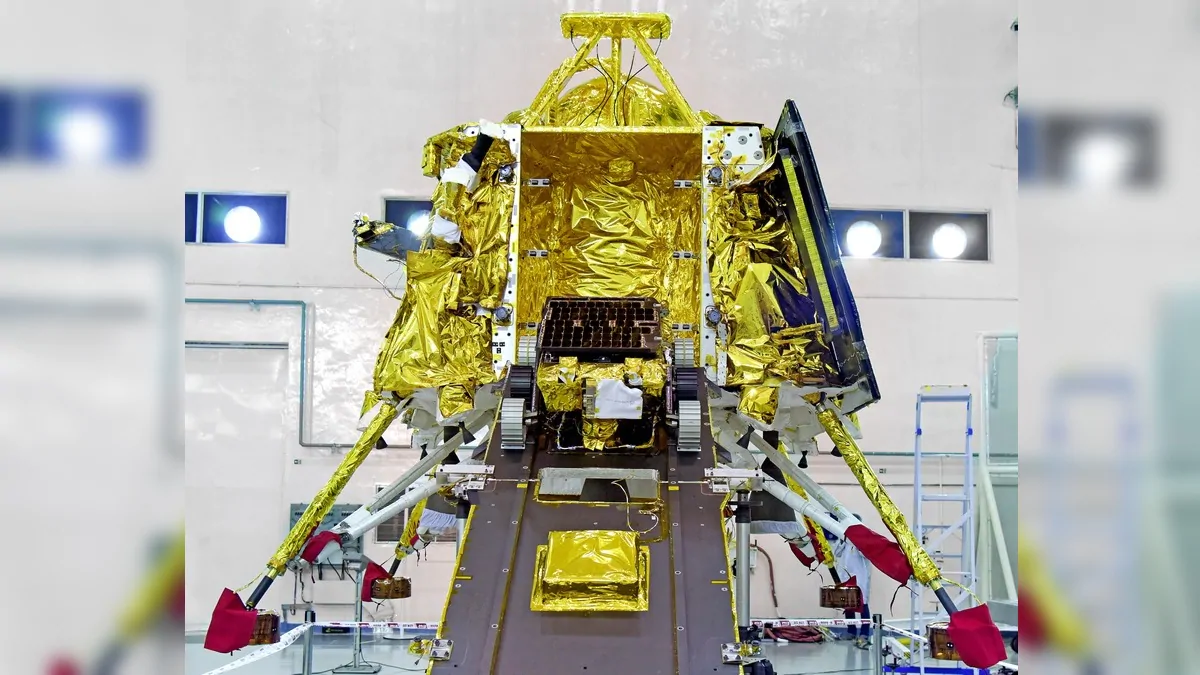
Chanrrayaan’s Vikram lander and Pragyan rover. before launch. The orbiter, not shown, is expected to have a 7 year life. The orbiter has viewed the landing site and has shown that the lander is in one piece. Credit ISRO.
09/09/2019 – Ephemeris – Looking for interstellar meteoroids hitting the Moon
Ephemeris for Monday, September 9th. Today the Sun will be up for 12 hours and 50 minutes, setting at 8:05, and it will rise tomorrow at 7:15. The Moon, 4 days past first quarter, will set at 3:29 tomorrow morning.
Two Harvard University astronomers who have studied the interstellar asteroid or comet that was discovered last year ‘Oumuamua are proposing to observe small interstellar meteoroids with a lunar orbiting satellite when they hit the Moon. A spectrum of the flash they make when they hit the Moon will allow the constituent elements and isotopes to be discovered. These values have been studied for a long time from meteorites in our solar system. So a body from another solar system born of material from a different supernova and hypernova than our solar system may show different isotope ratios of its elements. A hypernova is a newly discovered event, when two neutron stars collide, and are the main source of heavy elements like gold.
The times given are for the Traverse City/Interlochen area of Michigan. They may be different for your location.
Addendum
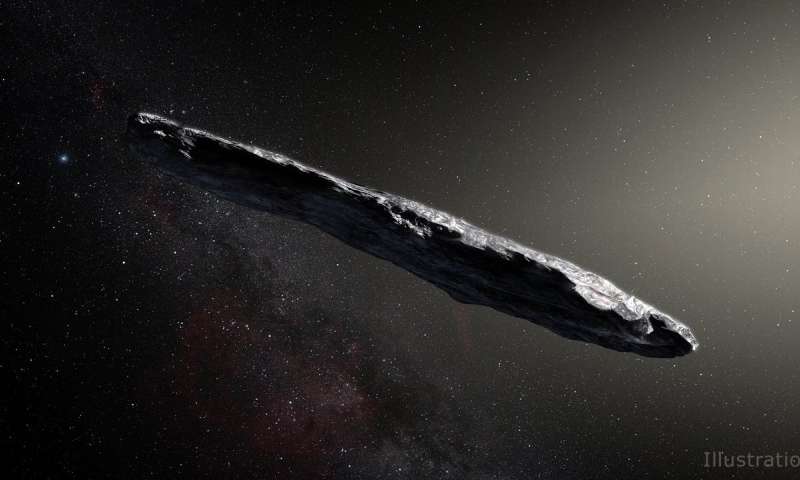
Artist visualization of ‘Oumuamua. Credit Credit: European Southern Observatory / M. Kornmesser.
There’s the article about it on Universe Today: https://www.universetoday.com/143234/by-continuously-watching-the-moon-we-could-detect-interstellar-meteorites/
09/06/2019 – Ephemeris – GTAS meeting looks at autumn skies
Ephemeris for Friday, September 6th. Today the Sun will be up for 12 hours and 59 minutes, setting at 8:10, and it will rise tomorrow at 7:11. The Moon, 1 day past first quarter, will set at 12:52 tomorrow morning.
I will be giving a presentation Autumn Stars, Galaxies Myths, and Stories tonight at this evening’s meeting of the Grand Traverse Astronomical Society at 8 p.m. at Northwestern Michigan College’s Rogers Observatory. In the autumn season we lose the southern part of the Milky Way in the southwest, but there are number of of constellations that tell a famous story, that’s even made it to the cinema twice in recent years. There’s a star that evilly winks at us, and a huge galaxy the is visible to the naked eye that will crash into our Milky Way galaxy in the far future. After the meeting there will be a star party starting at 9 p.m. featuring, if it’s clear the Moon, Jupiter, Saturn and that nearby galaxy.
The times given are for the Traverse City/Interlochen area of Michigan. They may be different for your location.
Addendum
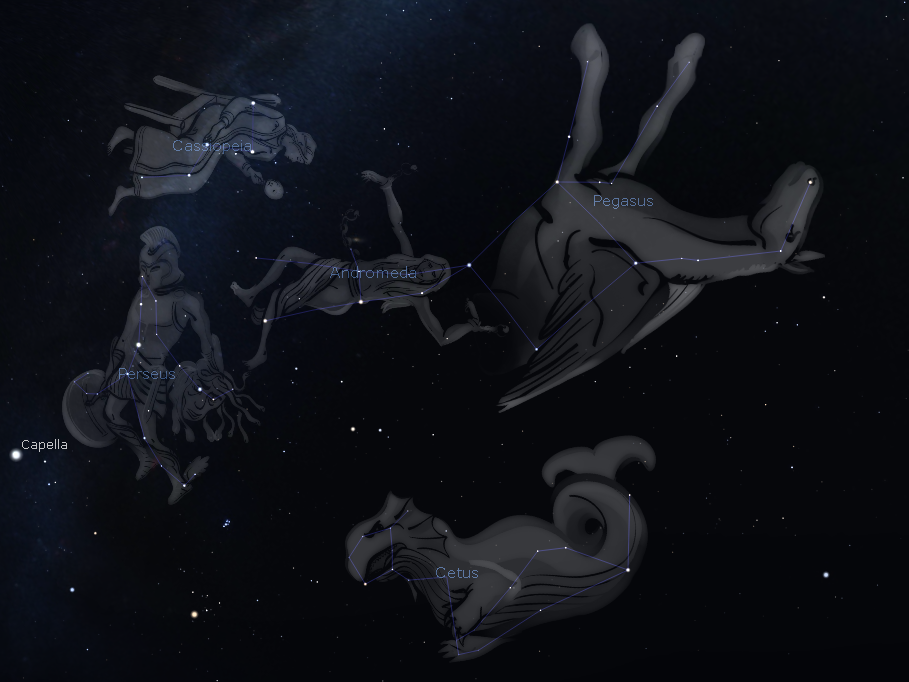
The constellations as characters in the great star story of Autumn. Click on image to enlarge. Created using Stellarium.
09/05/2019 – Ephemeris – A contest to name the Mars 2020 Rover
Ephemeris for Thursday, September 5th. Today the Sun will be up for 13 hours and 2 minutes, setting at 8:12, and it will rise tomorrow at 7:10. The Moon, at first quarter today, will set at 12:09 tomorrow morning.
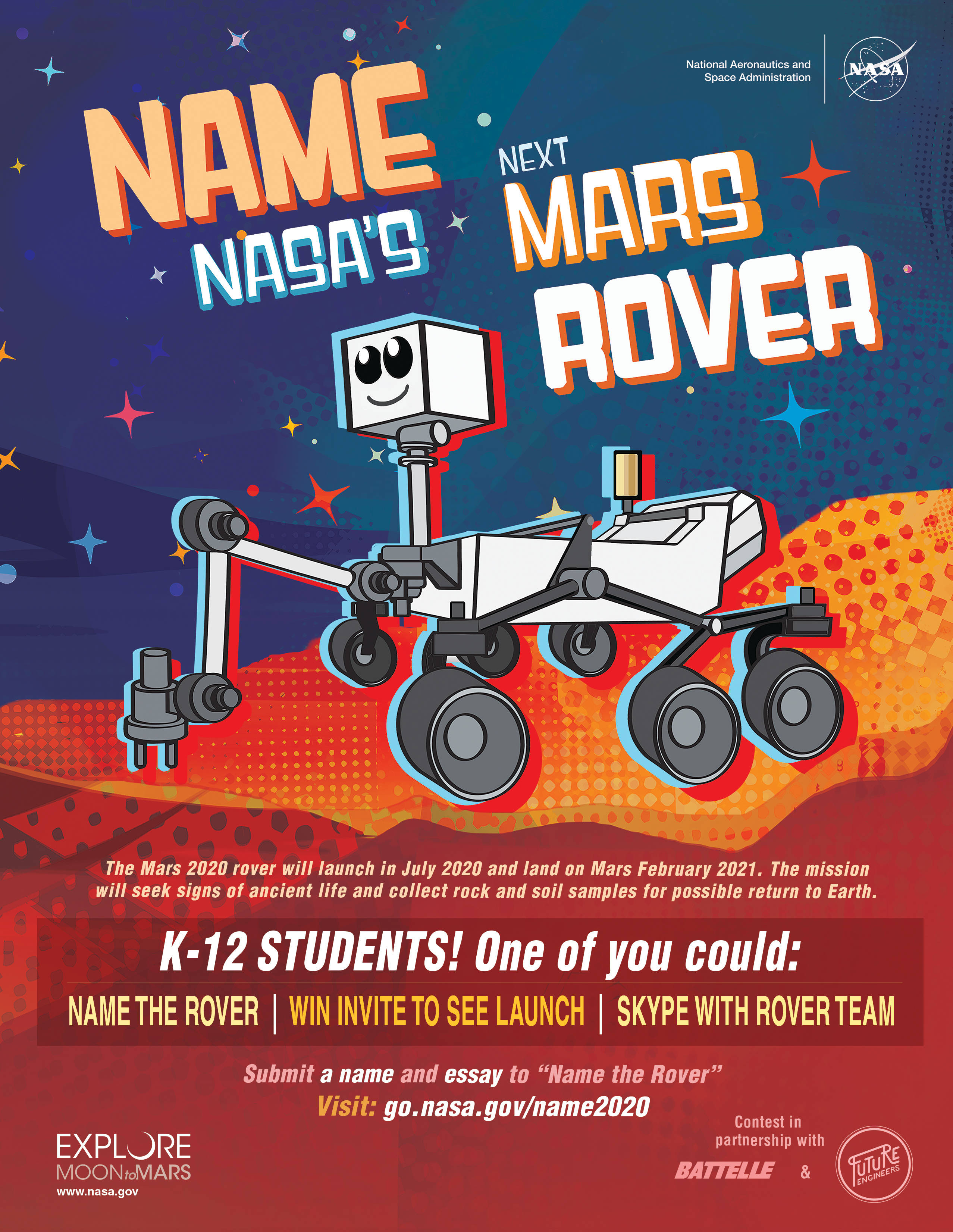
The Mars 2020 Rover is in final preparation to be launched late next year, and its time to give it a name. Prior rover names were Sojourner, Spirit, Opportunity and the currently operating Curiosity rover. NASA is holding a contest open to U.S. K through 12 students in public, Private and Home School, to submit a name with a short essay of up to 150 words why that name should be chosen. Deadline is November 1st. Nine names will be chosen and then the whole world will vote to pick the winner. For contest details use your favorite Internet browser and type in “go (dot) nasa (dot) gov forward slash name2020”. NASA also has a way to have your name sent to Mars with the Rover.
The times given are for the Traverse City/Interlochen area of Michigan. They may be different for your location.
Addendum
From Sarah Marcotte of the JPL Mars team. Please share this contest announcement with any interested K-12 student…
—————
Name NASA’s Next Mars Rover!
NASA’s Mars 2020 rover needs a name! Any K-12 student in U.S. public, private, and home schools has a chance to name the next Mars rover bound for the Red Planet in July 2020.
To enter the contest, students submit their rover name and a short essay (max 150 words) to explain the reasons why their chosen name is the best. The contest closes Nov. 1, 2019. For contest entry and details, visit the Name the Rover site. : https://www.futureengineers.org/nametherover
Interested adults, especially with STEM experience can sign up to be a judge on this page.
Not in the U.S.? In January 2020, people all over the world will have an opportunity to vote on the nine finalist names.
Help us spread the word by downloading and printing an eye-catching flyer for teachers or students!
Read more about the Mars 2020 mission.
visit: go.nasa.gov/name2020
 Bob Moler's Ephemeris Blog