Archive
02/28/2020 – Ephemeris – Previewing March Skies
Ephemeris for Friday, February 28th. Today the Sun will be up for 11 hours and 5 minutes, setting at 6:28, and it will rise tomorrow at 7:21. The Moon, 3 days before first quarter, will set at 11:30 this evening.
Let’s look at the skies for the month of March. The Sun will pass the celestial equator as the promising season of spring will begin. Daylight hours in the Interlochen/Traverse City area and will increase from 11 hours and 11 minutes Sunday to 12 hours 45 minutes on the 31st. The altitude, or angle, of the Sun above the southern horizon at local noon will be 38 degrees Sunday and will ascend to nearly 50 degrees on the 31st. Spring will start on the 19th at 11:50 p.m. Part of the fault for that early date is the switch to daylight saving time this early in the year a while back. The Gregorian calendar reform of 1582 will keep the vernal equinox from falling much further back. So spring will come a bit early this year, calendar-wise.
The times given are for the Traverse City/Interlochen area of Michigan. They may be different for your location.
Addendum
March Evening Star Chart
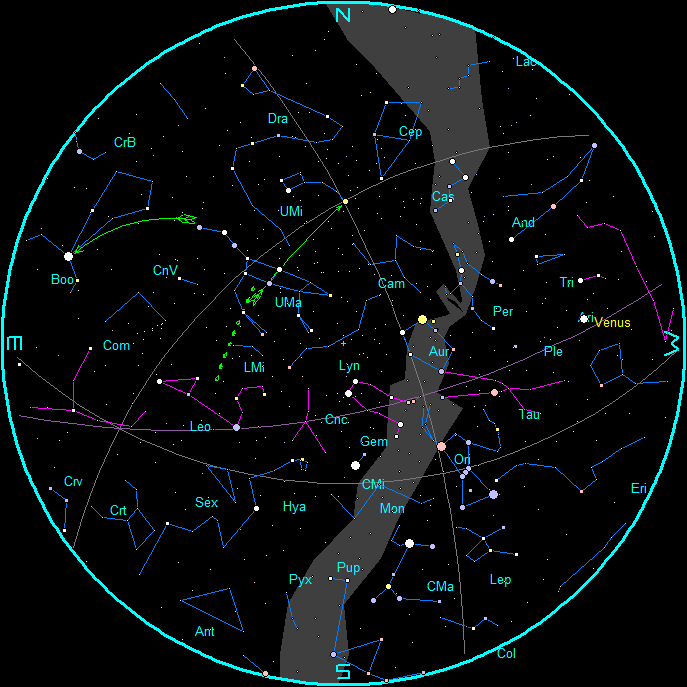
Star Chart for March 2020 (10 p.m. EDT March 15, 2020). Click on image to enlarge. Created using my LookingUp program. Click on image to enlarge. Created using my LookingUp program.
The planets and stars are plotted for the 15th at 10 p.m. EDT in the evening and 6 a.m. for the morning chart. These are the chart times. The brilliant planet Venus is our Evening Star in the West at chart time. Note that Traverse City is located approximately 45 minutes behind our time meridian, West 75° longitude. (An hour 45 minutes behind our daylight saving time meridian during EDT).
March Morning Star Chart
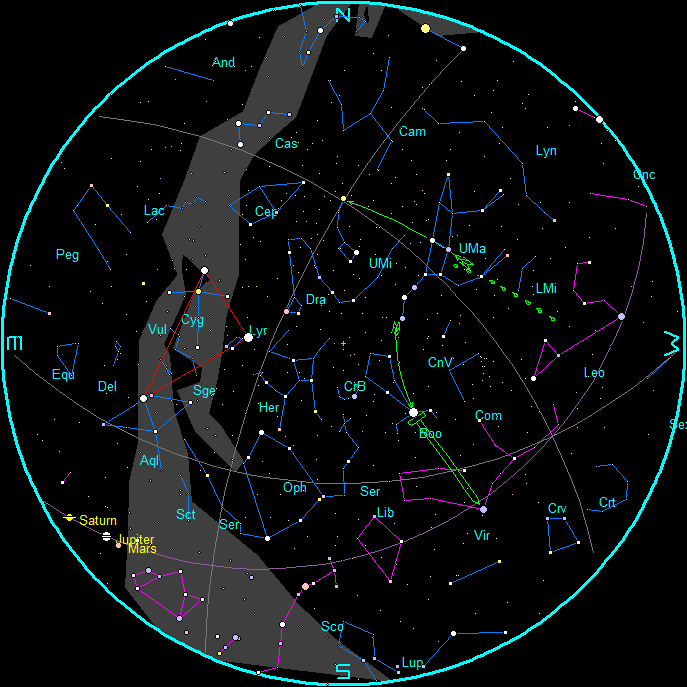
Star Chart for March mornings 2020 (6 a.m. EST March 15, 2020). Click on image to enlarge. Created using my LookingUp program.
For a list of constellation names to go with the abbreviations click here.
- Pointer stars at the front of the bowl of the Big Dipper point to Polaris the North Star.
- The leaky bowl of the Big Dipper drips on Leo.
- Follow the arc of the handle of the Big Dipper to the star Arcturus.
- The Summer Triangle appears in red.
Twilight Limits, Nautical and Astronomical
| EST/EDT | |||||||
| Morning twilight | Evening twilight | Dark night | Moon | ||||
| Date | Astro. | Nautical | Nautical | Astro. | Start | End | Illum. |
| 2020-03-01 | 5h43m | 6h17m | 19h33m | 20h06m | 0h33m | 5h43m | 0.41 |
| 2020-03-02 | 5h41m | 6h15m | 19h34m | 20h08m | 1h36m | 5h41m | 0.52 |
| 2020-03-03 | 5h39m | 6h13m | 19h35m | 20h09m | 2h40m | 5h39m | 0.62 |
| 2020-03-04 | 5h37m | 6h11m | 19h36m | 20h10m | 3h42m | 5h37m | 0.73 |
| 2020-03-05 | 5h36m | 6h10m | 19h38m | 20h12m | 4h40m | 5h36m | 0.82 |
| 2020-03-06 | 5h34m | 6h08m | 19h39m | 20h13m | 5h31m | 5h34m | 0.91 |
| 2020-03-07 | 5h32m | 6h06m | 19h40m | 20h14m | – | – | 0.97 |
| 2020-03-08 | 6h30m | 7h04m | 20h42m | 21h16m | – | – | 0.97 |
| 2020-03-09 | 6h28m | 7h02m | 20h43m | 21h17m | – | – | 1 |
| 2020-03-10 | 6h26m | 7h01m | 20h44m | 21h18m | – | – | 1 |
| 2020-03-11 | 6h25m | 6h59m | 20h46m | 21h20m | 21h20m | 22h26m | 0.96 |
| 2020-03-12 | 6h23m | 6h57m | 20h47m | 21h21m | 21h21m | 23h45m | 0.9 |
| 2020-03-13 | 6h21m | 6h55m | 20h48m | 21h23m | 21h23m | – | 0.81 |
| 2020-03-14 | 6h19m | 6h53m | 20h50m | 21h24m | 21h24m | 1h01m | 0.71 |
| 2020-03-15 | 6h17m | 6h51m | 20h51m | 21h25m | 21h25m | 2h14m | 0.6 |
| 2020-03-16 | 6h15m | 6h49m | 20h52m | 21h27m | 21h27m | 3h21m | 0.49 |
| 2020-03-17 | 6h13m | 6h48m | 20h53m | 21h28m | 21h28m | 4h21m | 0.38 |
| 2020-03-18 | 6h11m | 6h46m | 20h55m | 21h30m | 21h30m | 5h13m | 0.29 |
| 2020-03-19 | 6h09m | 6h44m | 20h56m | 21h31m | 21h31m | 5h55m | 0.2 |
| 2020-03-20 | 6h11m | 6h46m | 21h01m | 21h36m | 21h36m | 6h11m | 0.12 |
| 2020-03-21 | 6h09m | 6h44m | 21h03m | 21h38m | 21h38m | 6h09m | 0.07 |
| 2020-03-22 | 6h07m | 6h42m | 21h04m | 21h39m | 21h39m | 6h07m | 0.03 |
| 2020-03-23 | 6h04m | 6h40m | 21h05m | 21h41m | 21h41m | 6h04m | 0 |
| 2020-03-24 | 6h02m | 6h38m | 21h07m | 21h42m | 21h42m | 6h02m | 0 |
| 2020-03-25 | 6h00m | 6h36m | 21h08m | 21h44m | 21h44m | 6h00m | 0.02 |
| 2020-03-26 | 5h58m | 6h34m | 21h10m | 21h45m | 22h23m | 5h58m | 0.05 |
| 2020-03-27 | 5h56m | 6h32m | 21h11m | 21h47m | 23h25m | 5h56m | 0.1 |
| 2020-03-28 | 5h54m | 6h30m | 21h12m | 21h48m | – | 5h54m | 0.17 |
| 2020-03-29 | 5h52m | 6h28m | 21h14m | 21h50m | 0h28m | 5h52m | 0.25 |
| 2020-03-30 | 5h50m | 6h26m | 21h15m | 21h51m | 1h31m | 5h50m | 0.35 |
| 2020-03-31 | 5h48m | 6h24m | 21h16m | 21h53m | 2h33m | 5h48m | 0.45 |
Twilight calendar was generated using Cartes du Ciel (Sky Charts).
See my blog post: Twilight Zone for the definitions of the different periods of twilight here: https://bobmoler.wordpress.com/2018/09/27/.
NASA Calendar of Planetary Events
   Date      Time    Event
Mar 1  Su            Venus: 44.6° E
    2  Mo  02:57 pm  First Quarter
    4  We  09:58 am  Moon Ascending Node
    4  We  08:34 pm  Moon North Dec.: 23.4° N
    6  Fr  04:08 pm  Moon-Beehive: 1.1° S
    8  Su  08:09 am  Neptune Conjunction
    9  Mo  01:48 pm  Full Moon
   10  Tu  02:33 am  Moon Perigee: 357100 km
   16  Mo  05:34 am  Last Quarter
   16  Mo  09:00 pm  Moon Descending Node
   17  Tu  10:07 am  Moon South Dec.: 23.5° S
   18  We  04:19 am  Moon-Mars: 0.8° N
   18  We  06:18 am  Moon-Jupiter: 1.6° N
   18  We  08:04 pm  Moon-Saturn: 2.3° N
   19  Th  11:50 pm  Vernal Equinox
   20  Fr  06:24 am  Mars-Jupiter: 0.7° N
   21  Sa  01:48 pm  Moon-Mercury: 4° N
   23  Mo  09:59 pm  Mercury Greatest Elongation: 27.8° W
   24  Tu  05:28 am  New Moon
   24  Tu  11:23 am  Moon Apogee: 406700 km
   24  Tu  05:59 pm  Venus Greatest Elongation: 46.1° E
   31  Tu  12:51 pm  Moon Ascending Node
   31  Tu  04:00 pm  Mars-Saturn: 0.9° N
Apr 1  We            Venus: 45.9° E
All event times prior to 2 a.m. March 8 are given for UTC-5 Eastern Standard Time, after that time are given for UTC-4 Eastern Daylight Time
Sky Events Calendar by Fred Espenak and Sumit Dutta (NASA’s GSFC),
http://eclipse.gsfc.nasa.gov/SKYCAL/SKYCAL.html.
If you go to the above site you can print out a list like the above for the entire year or calendar pages for your time zone.
Sun and Moon Rising and Setting Events
LU                  Ephemeris of Sky Events for Interlochen/TC
March, 2020    Local time zone: EST
+-----------------------------------------------------------------------+
| DATE |  SUN     SUN  DAYLIGHT|   TWILIGHT*    |MOON  RISE OR    ILLUM |
|      |  RISE    SET    HOURS |  END    START  |PHASE SET** TIME FRACTN|
+=======================================================================+
|Sun  1| 07:19a  06:31p  11:11 | 07:34p  06:16a |      Set  01:36a   42%|
|Mon  2| 07:17a  06:32p  11:14 | 07:35p  06:14a |F Qtr Set  02:39a   52%|
|Tue  3| 07:15a  06:33p  11:18 | 07:37p  06:12a |      Set  03:41a   62%|
|Wed  4| 07:14a  06:35p  11:21 | 07:38p  06:11a |      Set  04:39a   72%|
|Thu  5| 07:12a  06:36p  11:24 | 07:39p  06:09a |      Set  05:31a   81%|
|Fri  6| 07:10a  06:37p  11:27 | 07:40p  06:07a |      Set  06:15a   89%|
|Sat  7| 07:08a  06:39p  11:30 | 07:42p  06:05a |      Set  06:54a   95%|
+------+-----------------------+----------------+-----------------------+
| EDT  |      Time Change      |                |                       |
|Sun  8| 08:07a  07:40p  11:33 | 08:43p  07:04a |      Set  08:27a   99%|
|Mon  9| 08:05a  07:41p  11:36 | 08:44p  07:02a |Full  Rise 07:46p  100%|
|Tue 10| 08:03a  07:43p  11:39 | 08:46p  07:00a |      Rise 09:07p   97%|
|Wed 11| 08:01a  07:44p  11:42 | 08:47p  06:58a |      Rise 10:26p   92%|
|Thu 12| 07:59a  07:45p  11:46 | 08:48p  06:56a |      Rise 11:45p   85%|
|Fri 13| 07:57a  07:47p  11:49 | 08:50p  06:54a |      Rise 01:01a   75%|
|Sat 14| 07:56a  07:48p  11:52 | 08:51p  06:53a |      Rise 02:14a   65%|
+------+-----------------------+----------------+-----------------------+
|Sun 15| 07:54a  07:49p  11:55 | 08:52p  06:51a |      Rise 03:21a   54%|
|Mon 16| 07:52a  07:50p  11:58 | 08:54p  06:49a |L Qtr Rise 04:21a   44%|
|Tue 17| 07:50a  07:52p  12:01 | 08:55p  06:47a |      Rise 05:12a   34%|
|Wed 18| 07:48a  07:53p  12:04 | 08:56p  06:45a |      Rise 05:55a   25%|
|Thu 19| 07:46a  07:54p  12:07 | 08:58p  06:43a |      Rise 06:31a   17%|
|Fri 20| 07:44a  07:55p  12:11 | 08:59p  06:41a |      Rise 07:00a   10%|
|Sat 21| 07:43a  07:57p  12:14 | 09:00p  06:39a |      Rise 07:26a    5%|
+------+-----------------------+----------------+-----------------------+
|Sun 22| 07:41a  07:58p  12:17 | 09:02p  06:37a |      Rise 07:49a    2%|
|Mon 23| 07:39a  07:59p  12:20 | 09:03p  06:35a |      Rise 08:11a    0%|
|Tue 24| 07:37a  08:01p  12:23 | 09:04p  06:33a |New   Set  08:21p    1%|
|Wed 25| 07:35a  08:02p  12:26 | 09:06p  06:31a |      Set  09:21p    2%|
|Thu 26| 07:33a  08:03p  12:29 | 09:07p  06:29a |      Set  10:22p    6%|
|Fri 27| 07:31a  08:04p  12:32 | 09:09p  06:27a |      Set  11:25p   11%|
|Sat 28| 07:30a  08:06p  12:36 | 09:10p  06:25a |      Set  12:28a   18%|
+------+-----------------------+----------------+-----------------------+
|Sun 29| 07:28a  08:07p  12:39 | 09:11p  06:23a |      Set  01:31a   26%|
|Mon 30| 07:26a  08:08p  12:42 | 09:13p  06:21a |      Set  02:32a   35%|
|Tue 31| 07:24a  08:09p  12:45 | 09:14p  06:20a |      Set  03:30a   45%|
+-----------------------------------------------------------------------+
* Nautical Twilight
** Moonrise or moonset, whichever occurs between sunrise and sunset
Generated using my LookingUp for DOS program.
02/27/2020 – Ephemeris – Saturday is the intercalary day
Ephemeris for Thursday, February 27th. Today the Sun will be up for 11 hours and 2 minutes, setting at 6:27, and it will rise tomorrow at 7:22. The Moon, half way from new to first quarter, will set at 10:28 this evening.
Saturday we’re going to have one of those special days that only occur once every 4 years making this a leap year. It’s the intercalary day that compensates for the fact that the earth takes 365 and nearly a quarter day to orbit the Sun. That orbit is a year, and those quarter days are accumulated and added as the last day of February on years divisible by 4. The Gregorian reform makes a slight adjustment on most century years, making century years not divisible by 400 ordinary years to keep the calendar in sync with the seasons. The Romans, from who we’ve gotten our calendar considered the month of February as unlucky, and so they shortened it. Enjoy your extra day on Saturday.
The times given are for the Traverse City/Interlochen area of Michigan. They may be different for your location.
02-26-2020 – Ephemeris – Let’s look at the naked-eye planets for this week
Ephemeris for Ash Wednesday, February 26th. Today the Sun will be up for 10 hours and 59 minutes, setting at 6:25, and it will rise tomorrow at 7:24. The Moon, 3 days past new, will set at 9:28 this evening.
Let’s look at the naked-eye planets for this week. Venus is our evening star shining brightly in the southwest in the early evening. It will set at 10:19 p.m. Mars is visible in the morning sky and will rise in the southeast at 4:27 a.m. It’s not very bright because it’s 161 million (260 million km) miles away, but it’s getting slowly closer to the Earth at the rate of about 6 million miles (9 million km) a week. However it’s brighter than Betelgeuse. Jupiter will rise at 5:06 a.m. Lastly, Saturn will rise at 5:39 tomorrow morning. Jupiter is currently about 9 degrees away from Saturn, a bit less than the width of your fist held at arms length. It will continue to approach Saturn until their paths cross on December 21st.
The times given are for the Traverse City/Interlochen area of Michigan. They may be different for your location.
Addendum
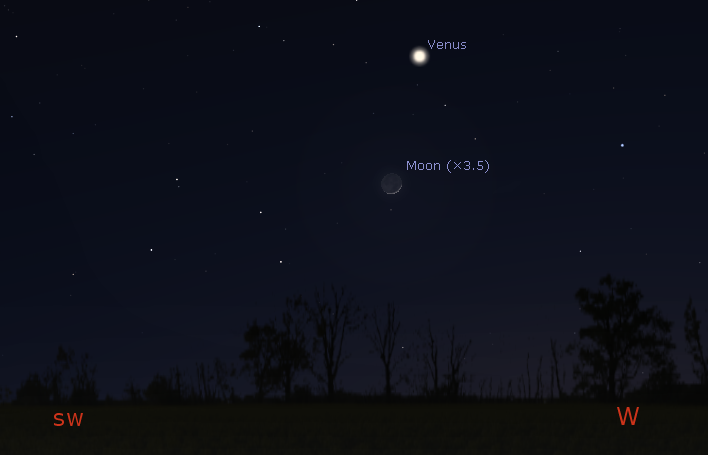
Venus and the Moon in the western sky at 7:30 p.m. or about an hour after sunset. February 26, 2020. Created using Stellarium.
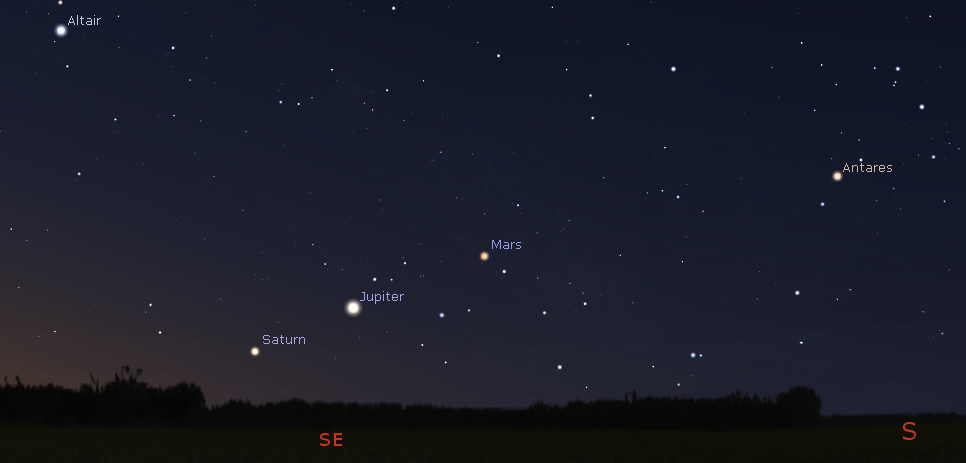
The morning planets and stars visible in the southern sky at 6:30 a.m. tomorrow morning February 37, 2020. The star Antares is in the constellation of Scorpius. Mars sits on top of the lid of the Teapot asterism of the constellation of Sagittarius the archer. Jupiter and Saturn are seen to the lower left. Click on the image to enlarge. Created using Stellarium.
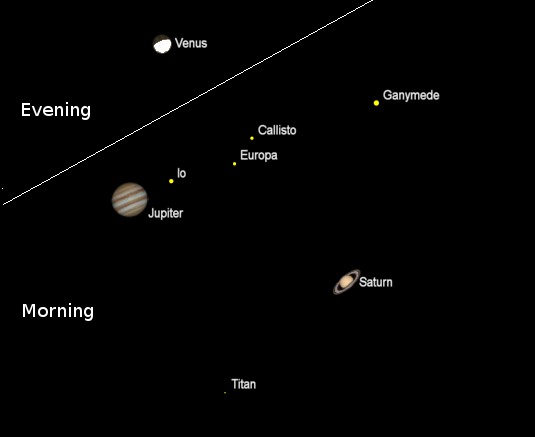
The planets as seen in a telescope with the same magnification. Venus in the evening and Jupiter and Saturn in the morning on the night of February 26/27, 2020. Apparent diameters: Venus, 18.3″; Jupiter, 34.0″; Saturn, 15.4″, rings, 36.0″. Mars at 5.4″ won’t be added until it reaches 10″. The ” symbol means seconds of arc (1/3600th of a degree.) Created using Cartes du Ciel (Sky Charts).
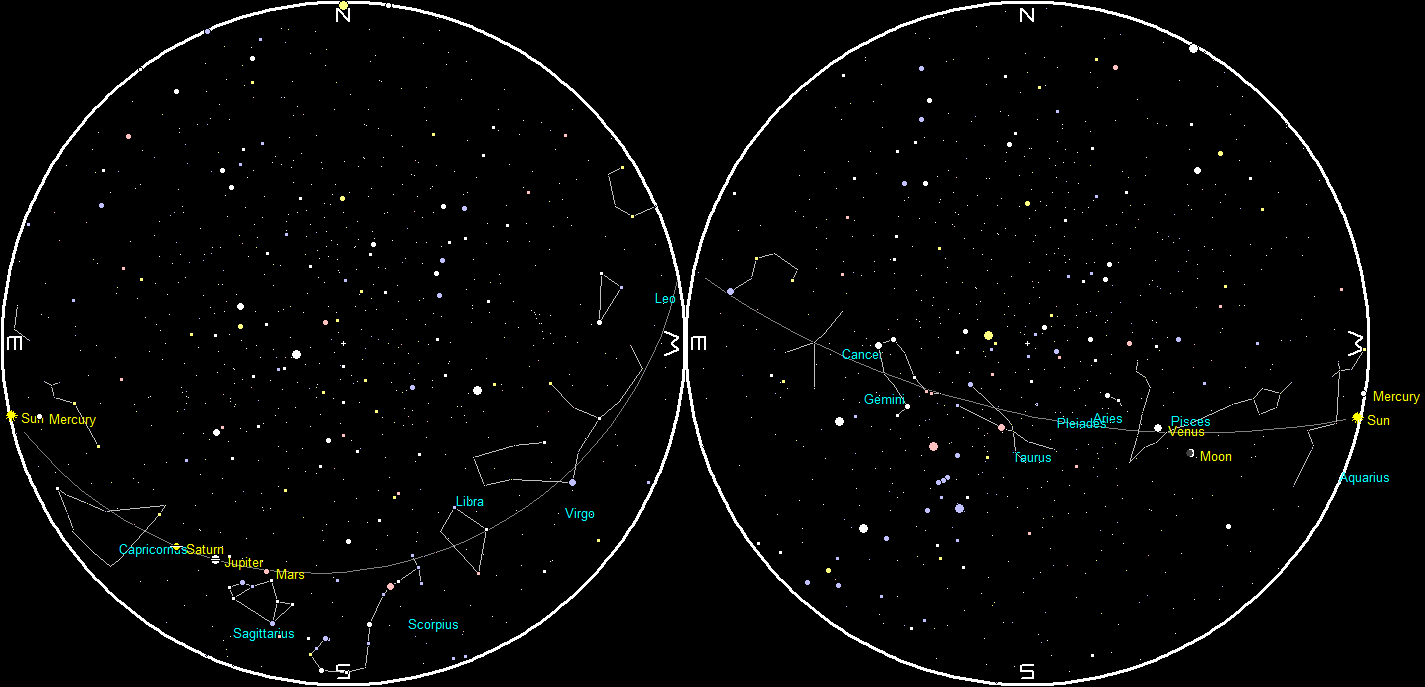
Planets and the Moon at sunset and sunrise of a single night starting with sunset on the right on February 26, 2020. The night ends on the left with sunrise on the 27th. Click on the image to enlarge. Created using my LookingUp program.
02/25/2020 – Ephemeris – Mercury at inferior conjunction with the Sun today
Ephemeris for Fat Tuesday, February 25th. Today the Sun will be up for 10 hours and 56 minutes, setting at 6:24, and it will rise tomorrow at 7:26. The Moon, 2 days past new, will set at 8:27 this evening.
A bit more than two weeks ago Mercury was visible in the evening twilight at its greatest elongation from the Sun, then at 8:37 this evening it will pass between the Earth and the Sun and enter the morning sky. The event is called an inferior conjunction. That’s not a dig on the quality of the event. Indeed an inferior conjunctions are more important and can produce a transit of the planet across the Sun. A rare and formerly important event when we were trying to determine the distance to the Sun. In astronomy an inferior planet is one that orbits the Sun inside the Earth’s orbit. A superior planet orbits the Sun farther than the Earth. It’s not a sign of quality. The best time to spot Mercury in the morning is in August to October, so we’ll miss Mercury this time.
The times given are for the Traverse City/Interlochen area of Michigan. They may be different for your location.
Addendum
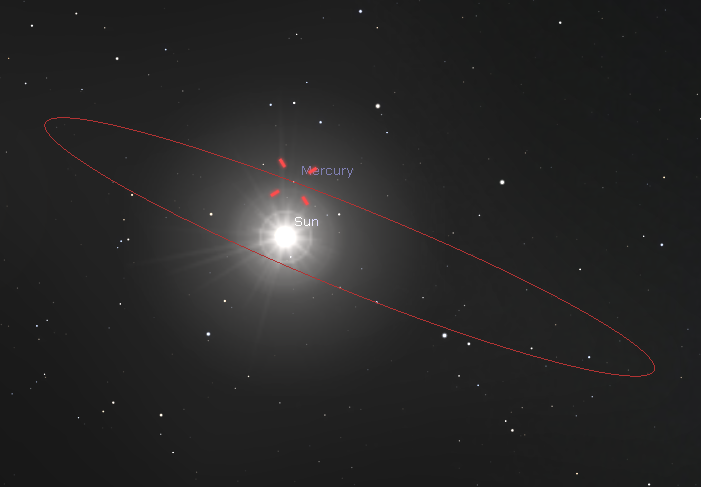
Mercury about 7 hours before inferior conjunction February 25, 2020 near local solar noon. The last inferior conjunction of Mercury on November 11, 2019 Mercury passed across the Sun’s disk in a transit. The red ellipse is Mercury’s orbit as seen From the Earth. It’s orbit is tilted about 7 degrees from the Earth’s orbit, so transits are fairly rare events. Created using Stellarium.
02/24/2020 – Ephemeris – Conflict in the skies: Orion vs. Taurus
Ephemeris for Monday, February 24th. Today the Sun will be up for 10 hours and 53 minutes, setting at 6:23, and it will rise tomorrow at 7:27. The Moon, 1 day past new, will set at 7:26 this evening.
The classical constellation figures of Orion the hunter and Taurus the bull appear to be interacting in the sky. Orion is in the south at 9 p.m. An angry Taurus, a bit above him in the southwest, appears to be charging at Orion who appears to be facing him with lion skin shield and an upraised club. Orion’s two hunting dogs, canes major and minor, appear to be unconcerned. The face of Taurus the bull is a letter V shape of faint stars with a bright reddish star at the upper left tip of the V called Aldebaran the bull’s angry bloodshot eye. There’s no mythological story that goes with this. Both Orion and Taurus have their own myths associated with them separate from their apparent clash in the heavens.
The times given are for the Traverse City/Interlochen area of Michigan. They may be different for your location.
Addendum
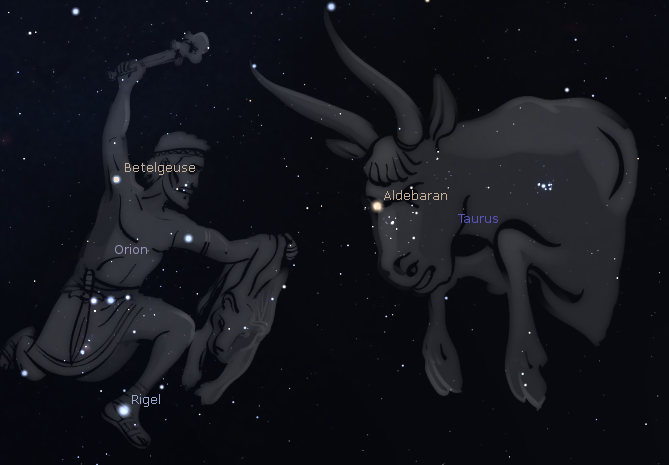
Conflict in the skis: Taurus is charging Orion. Seen at 9 p.m. in late February. Created using Stellarium and the dimming of Betelgeuse in GIMP.
022/21/2020 – Ephemeris – The almost invisible unicorn
Ephemeris for Friday, February 21st. Today the Sun will be up for 10 hours and 44 minutes, setting at 6:19, and it will rise tomorrow at 7:32. The Moon, 2 days before new, will rise at 7:27 tomorrow morning.
Among all the constellations in the sky of animals real and mythical, there is also a unicorn. It’s called Monoceros, and inhabits the southern sky at 9 p.m. bounded by Orion on the right, Canis Major, the great dog below and Canis Minor, the little dog to the left. Unfortunately for observers without optical aid Monoceros, though large, is devoid of any but the faintest stars. Maybe that’s why no one sees unicorns anymore. It has many faint stars because the Milky Way runs through it. To the telescope it is a feast of faint nebulae or clouds of gas and dust, the birth place of stars, including the red rose of the Rosette Nebula, and the strange and tiny Hubble’s Variable Nebula. It contains no bright stars, but a wealth of wonders below naked eye visibility.
The times given are for the Traverse City/Interlochen area of Michigan. They may be different for your location.
Addendum
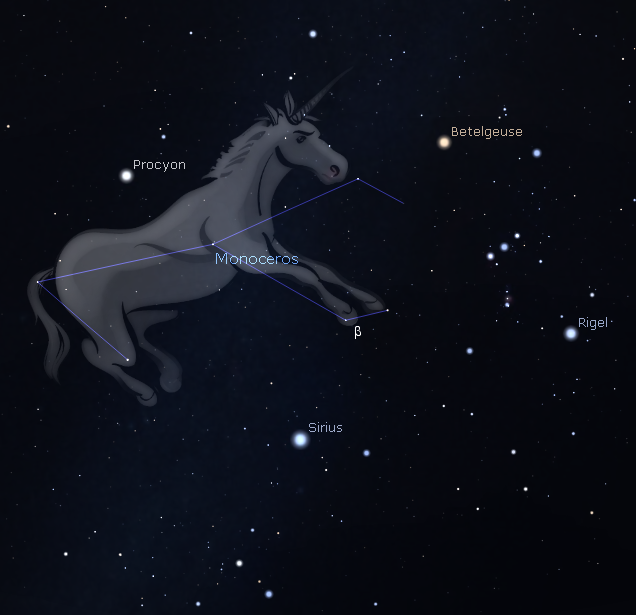
Monoceros the unicorn seen mostly inside the Winter Triangle of Betelgeuse, Sirius and Procyon. Note the star in the unicorn’s right hoof denoted with a funny B. That’s Beta Monocerotis,a triple star visible in small telescopes. Created using Stellarium with additions.
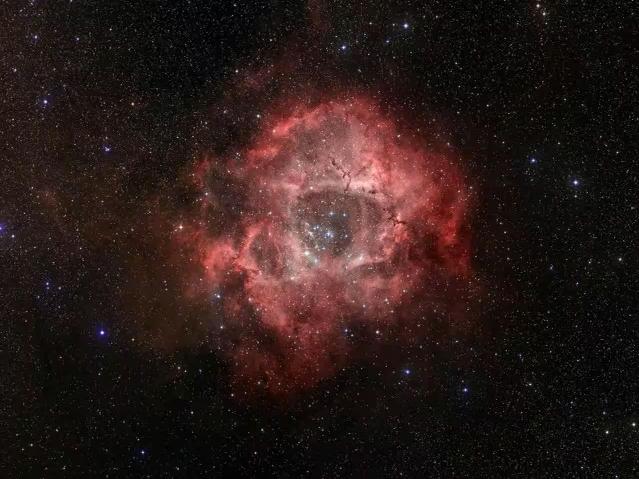
Rosette Nebula in the infrared from the Spitzer Space Telescope. Credit: NASA/JPL/Caltech
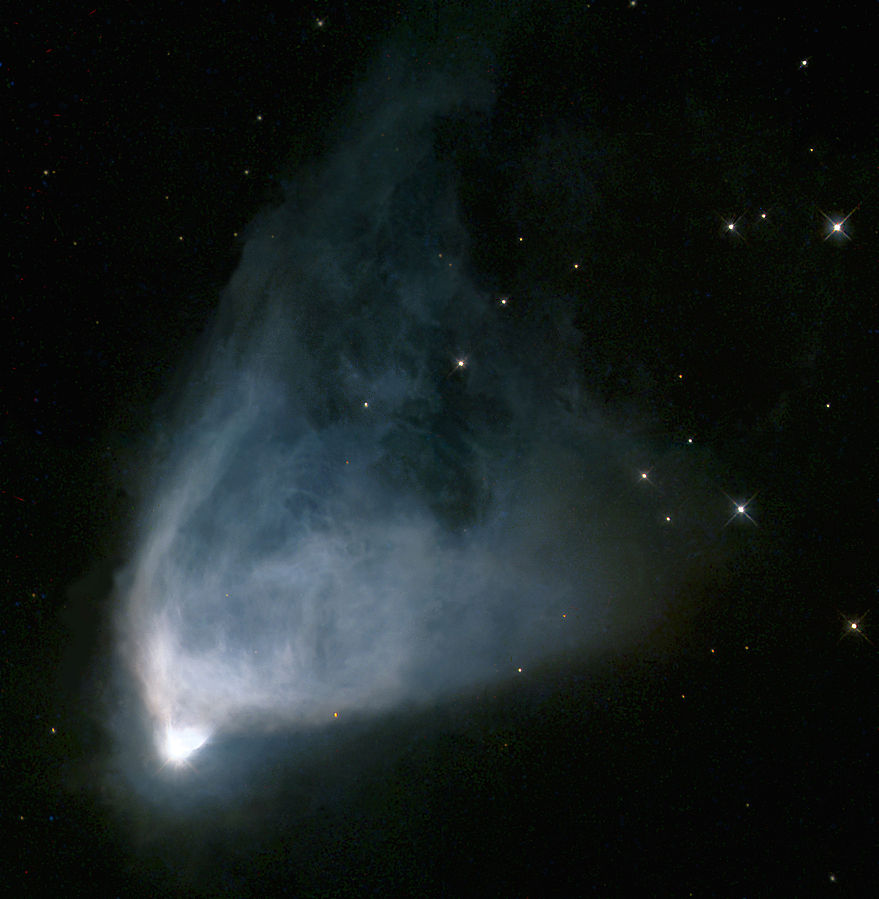
Hubble’s Variable Nebula photographed appropriately enough by the Hubble Space Telescope. Credit: NASA/ESA and The Hubble Heritage Team (AURA/STScI).
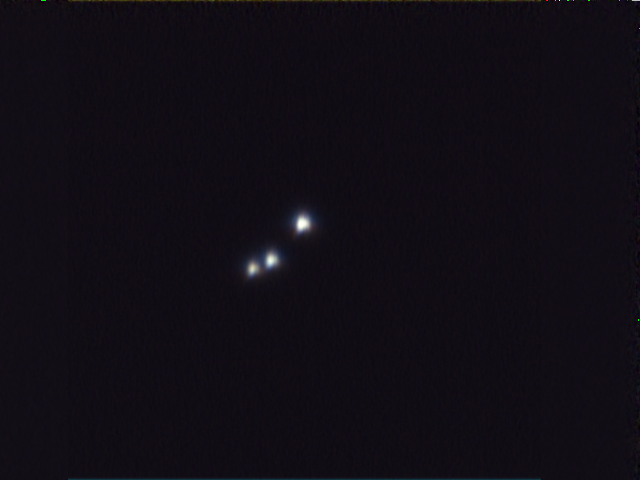
Telescopic Beta Monocerotis. William Hershel, discoverer of Uranus, said that it was “One of the most beautiful sights in the heavens.” Credit: F. Ringwald, Fresno State.
02/20/2020 – Ephemeris – The Winter Triangle
Ephemeris for Thursday, February 20th. Today the Sun will be up for 10 hours and 41 minutes, setting at 6:17, and it will rise tomorrow at 7:34. The Moon, 3 days before new, will rise at 6:53 tomorrow morning.
I usually talk about the Winter Circle of bright stars, but some other astronomers talk about the Winter Triangle. The stars involved are Betelgeuse in the hunter Orion, Sirius in Canis Major, Orion’s large hunting dog, and Procyon in Canis Minor, his other small hunting dog. These three stars enclose a rather blank piece of sky with the faint Milky Way running through it and the equally invisible constellation of Monoceros the unicorn. The Summer Triangle has three bright stars with no other close competition. The Winter Triangle has 4 other bright stars near it. Any three of these would make a nice triangle. One of these stars, Betelgeuse has been the news recently because it is dimming to an unprecedented degree.
The times given are for the Traverse City/Interlochen area of Michigan. They may be different for your location.
Addendum
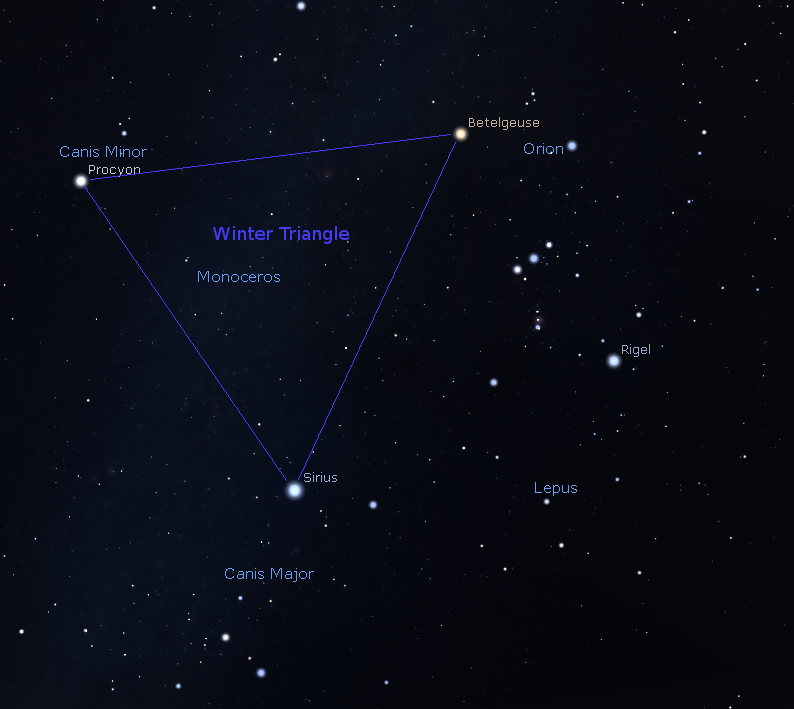
The Winter Triangle. It enclose a pretty blank space where Monoceros the unicorn lies. Created using Stellarium with my annotations for the Winter Triangle. By the way, Betelgeuse is currently only as bright as Bellatrix, the star next to the “n” in Orion.
02/19/2020 -Ephemeris – Let’s take a look at the bright planets
Ephemeris for Wednesday, February 19th. Today the Sun will be up for 10 hours and 38 minutes, setting at 6:16, and it will rise tomorrow at 7:36. The Moon, half way from last quarter to new, will rise at 6:12 tomorrow morning.
Let’s look at the naked-eye planets for this week. Venus is our evening star shining brightly in the southwest in the early evening. It will set at 10:03 p.m. Mercury is fading and will set only 58 minutes after the Sun. Mars is visible in the morning sky and will rise in the southeast at 4:34 a.m. It’s not very bright because it’s 167 million (268 million km) miles away, but it’s getting slowly closer to the Earth at the rate of about 4 million miles (6 million km) a week. Jupiter will rise at 5:32 a.m. Lastly, Saturn will rise at 6:04 tomorrow morning with the thin crescent Moon underneath it*. Jupiter will continue to approach Saturn throughout this year until their paths cross on December 21st.
The times given are for the Traverse City/Interlochen area of Michigan. They may be different for your location.
* Moon placement in this morning’s program was in error. The Moon is near Jupiter this morning, not tomorrow morning.
Addendum
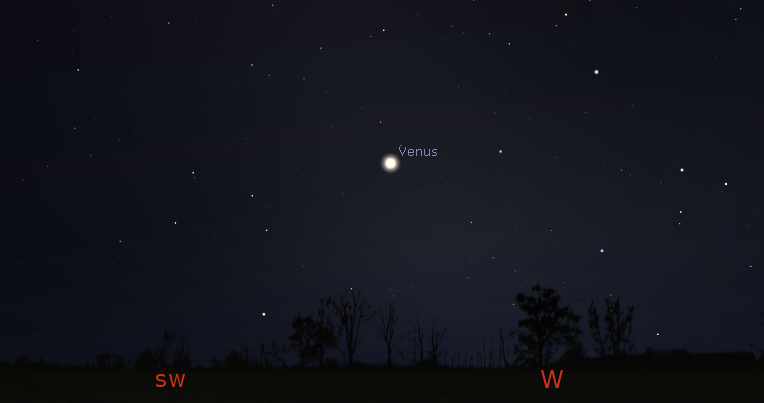
Venus and zodiacal light at 7:30 p.m. this evening February 19, 2020. The zodiacal light will appear more prominent in the next month or so. Here it’s mostly silhouetting the foreground trees. Check my prior posts for zodiacal light. I’ll cover it again in about a month. Created using Stellarium.
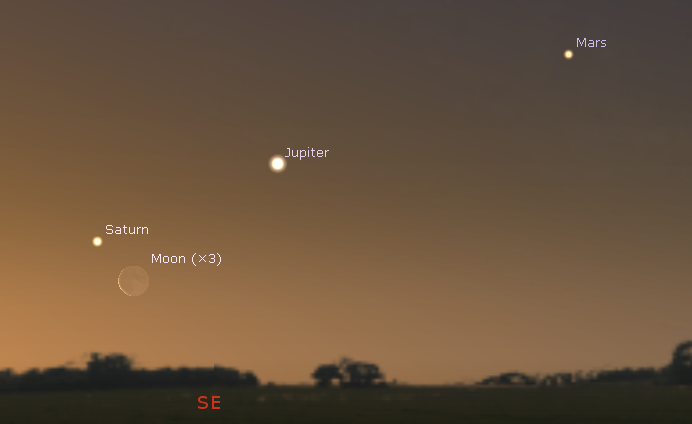
Morning planets and the Moon tomorrow morning at 7 a.m. February 20, 2020. Note that the Moon is 3 times its normal size. Created using Stellarium.
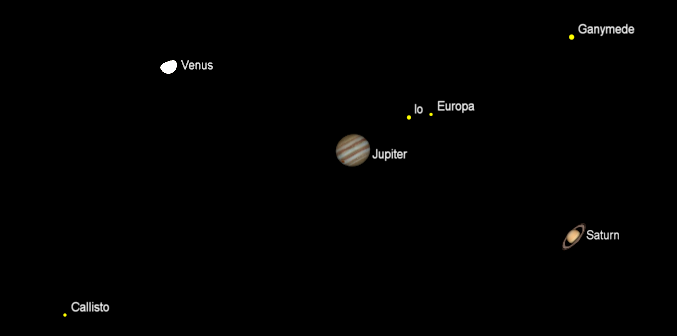
The planets as seen in a telescope with the same magnification. Venus in the evening and Jupiter and Saturn in the morning. Apparent diameters: Venus, 17.5″; Jupiter, 33.5″; Saturn, 15.4″, rings, 35.7″.
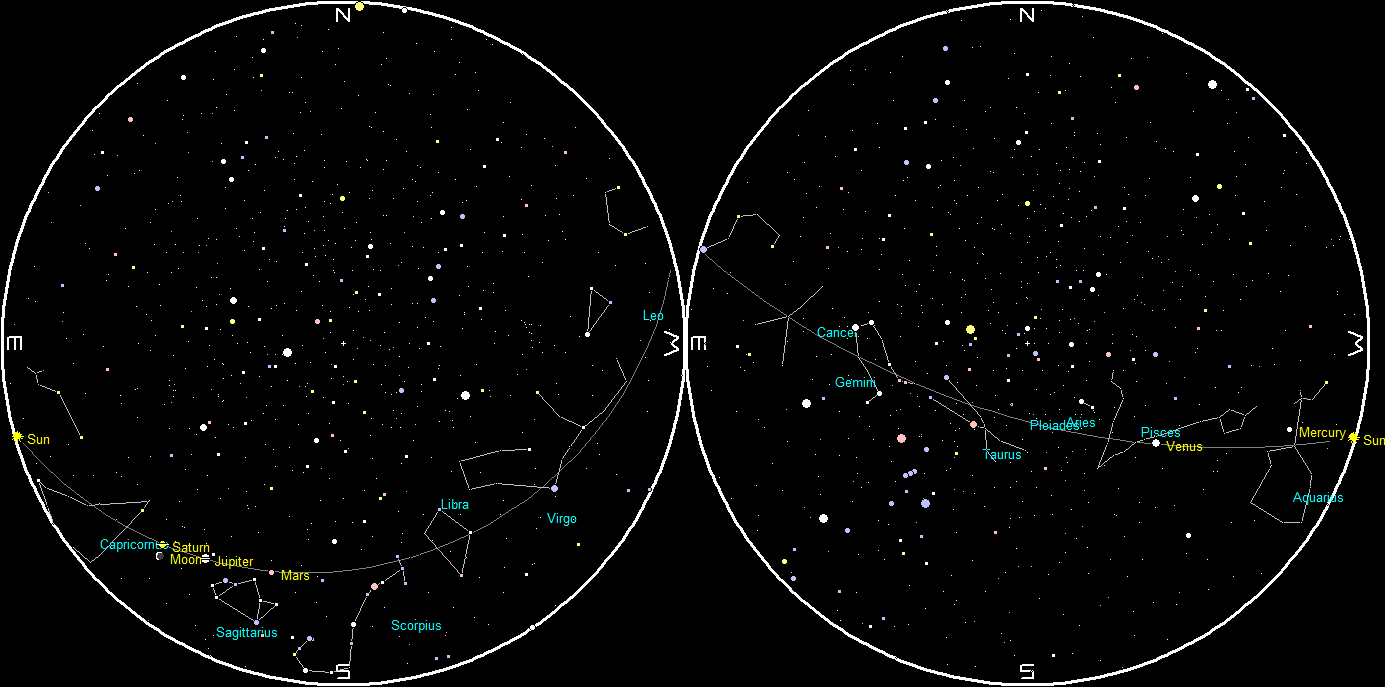
Planets and the Moon at sunset and sunrise of a single night starting with sunset on the right on February 19, 2020. The night ends on the left with sunrise on the 20th. Click on the image to enlarge. Created using my LookingUp program.
02/18/2020 – Ephemeris – Orion in three cultures
Feb 18. This is Bob Moler with Ephemeris for Tuesday, February 18th. Today the Sun will be up for 10 hours and 35 minutes, setting at 6:14, and it will rise tomorrow at 7:37. The Moon, 3 days past last quarter, will rise at 5:24 tomorrow morning.
We observe the constellation of Orion in the south at 9 p.m. and think of the hapless Greek hero. To the Hebrews it was Kesil, the fool who built the tower of Babel hoping to reach heaven. To the Anishinaabe native peoples of this place it is the Wintermaker whose rising in the evening announces the coming of winter. Where Orion’s arms carry a lion skin shield and a club, the Wintermaker’s arms are exaggerated and extend from Aldebaran in Taurus to Procyon in Canis Minor, embracing just about all of the winter sky. Two other Anishinaabe constellations are entering the skies at this time in the east and northeast, to announce the coming of spring. One the pleasures and the other the dangers.
The times given are for the Traverse City/Interlochen area of Michigan. They may be different for your location.
Addendum
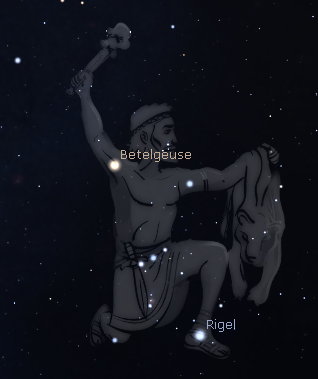
Orion as he is seen tonight at 9 p.m. Created using Stellarium.

The Wintermaker stretches his arms wide to embrace the winter stars. Created using Stellarium. Wintermaker figure from Ojibwe Sky Star Map by A. Lee, W. Wilson, C. Gawboy. Stellarium contains the constellation art from many cultures.
02/17/2020 – Ephemeris Extra – The Moon will cover the planet Mars in morning twilight tomorrow, Tuesday the 18th.
Sorry, I missed this until now. Tomorrow morning the 18th Mars will be occulted by the Moon. For Northern Lower Michigan Mars will disappear shortly after 7:10 a.m. The exact time depends on your location, so I can’t be more specific. At that time the Moon and Mars will be in the southeastern sky. Mars is now first magnitude, but will fare poorly in the morning twilight, so I’d suggest finding the Moon and Mars at least 15 minutes earlier with binoculars or telescope. Mars will reappear at the Moon’s unlit side around 8:37 a.m. This is after sunrise, so a telescope will be required to spot it. Hoping for clear skies, though the weather forecast isn’t promising.
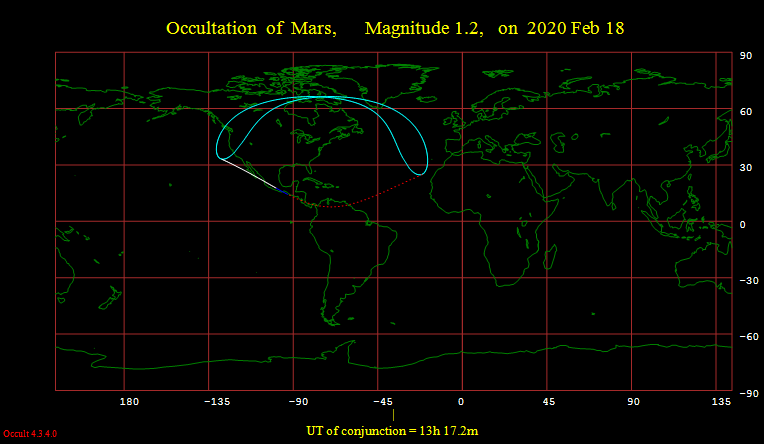
A map of where the occultation of Mars will be visible. Created using Occult4.
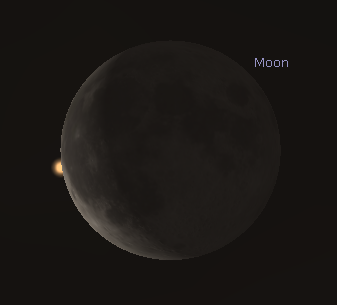
Where Mars will disappear at the Moon’s sunlit edge. Created using Stellarium.
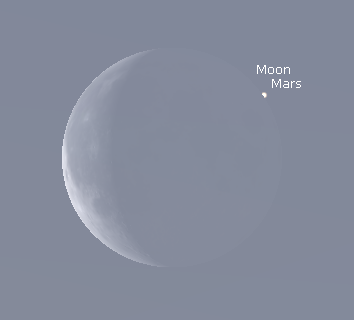
Mars will reappear at the Moon’s unlit edge around 8:36 a.m. give or take. Created using Stellarium.
 Bob Moler's Ephemeris Blog