Archive
Ephemeris Extra: 08/31/2023 – Comet C/2023 P1 (Nishimura) may be visible to the naked eye in September
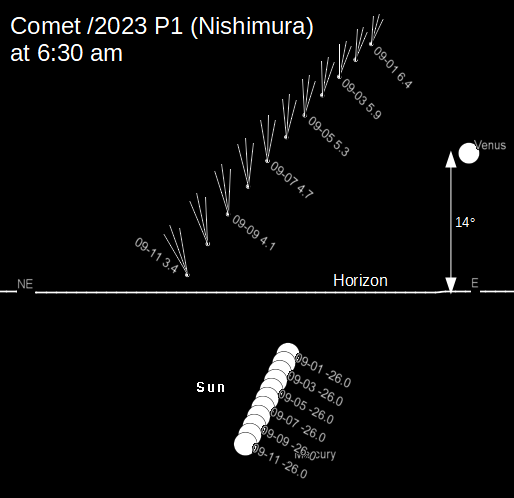
Comet Nishimura is shown at 6:30 AM in the east northeast for the mornings of September 1st through 11th. Venus stays pretty much at the same altitude of 14 degrees during this period. The Sun is shown here below the horizon. The comet and the Sun are labeled every other day with the month and day and estimated magnitude. Created using Cartes du Ciel (Sky Charts) by the author.
On August 12th this year Hideo Nishimura of Kakegawa, Japan discovered a comet that now bears his name. The comet has a chance of becoming a naked eye object this month, but for only a few days. It is a rapidly moving comet, and it is heading southward. We will only get a short period of time when it is possibly visible to the naked eye.
I’m sorry about all the weasel words about the brightness of the comet, but comets are notorious for being unpredictable with their brightness. They may brighten suddenly, they may dim suddenly, they may fall apart. We never know what happens to a comet until it happens.
Early brightness estimates were all over the place from 9th to 14th magnitude a range of 5 magnitudes or a brightness range of 100 from bright to dim. The comet was discovered only 12 days ago, as I write this, so there’s not very many brightness estimates to base future magnitudes on, even if the comet is well-behaved.
I’ve printed a chart, below, of the comet’s position in relation to the stars of Cancer and Leo for the period September 1 through 13th. The comet should be at least a binocular object during this period. I’ve also included a table of comet positions in altitude and azimuth for the start of astronomical and nautical twilight. The times of morning nautical twilight are listed on the Star Chart Page. Astronomical twilight starts about 36 minutes before nautical twilight this time of year.
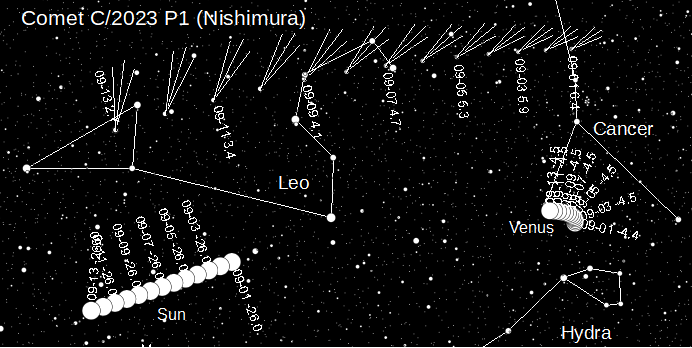
Comet Nishimura plotted against the stars of Cancer and Leo, along with the Sun and Venus. The comet, Venus and the Sun are labeled every other day with the month and day and estimated magnitude. Created using Cartes du Ciel (Sky Charts) by the author.
A pair of binoculars are the best way to view a comet that is just barely visible to the naked eye, or is competing with twilight. In both charts, the tail of the comet shows the direction that the tail would flow from and not its length.
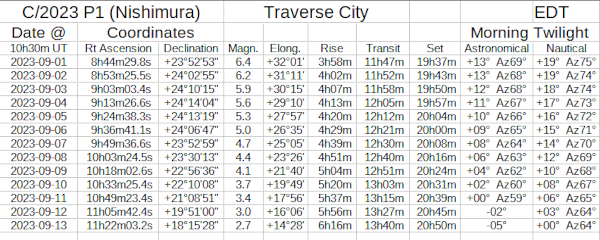
A table of positions of the comet at the beginning of astronomical and nautical twilight. Created using Cartes du Ciel.
At last report (August 26), it was half a magnitude dimmer than the predictions I have.
Ephemeris: 08/31/2023 – Looking ahead to September’s skies
This is Ephemeris for Thursday, August 31st. Today the Sun will be up for 13 hours and 17 minutes, setting at 8:21, and it will rise tomorrow at 7:04. The Moon, 1 day past full, will rise at 9:02 this evening.
Let’s look at the skies of September which starts tomorrow. The Sun will be moving at its greatest speed in its retreat to the south. Daylight hours in the Interlochen/Traverse City area will drop from 13 hours and 14 minutes tomorrow to 11 hours 46 minutes on the 30th. The altitude of the Sun above the southern horizon at local noon will be 53 degrees tomorrow, and will descend to 42 degrees on the 30th. The Straits* area will see the Sun a degree lower. The season of summer is getting short, so enjoy it while you can. Summer ends and fall begins at 12:50 a.m. on the 23rd, the autumnal equinox. Venus is our brilliant Morning Star now, And on the 29th we’ll have the Harvest Moon, the nearest full moon to the autumnal equinox. There is a comet approaching the Sun in the first half of September, It will be described in an Ephemeris Extra later today.
The astronomical event times given are for the Traverse City/Interlochen area of Michigan (EDT, UT –4 hours). They may be different for your location.
*For those not familiar with our area the Straits refer to the Straits of Mackinac (pronounced Mackinaw) that separate the Upper and Lower Peninsulas of Michigan.
Addendum
September Evening Star Chart
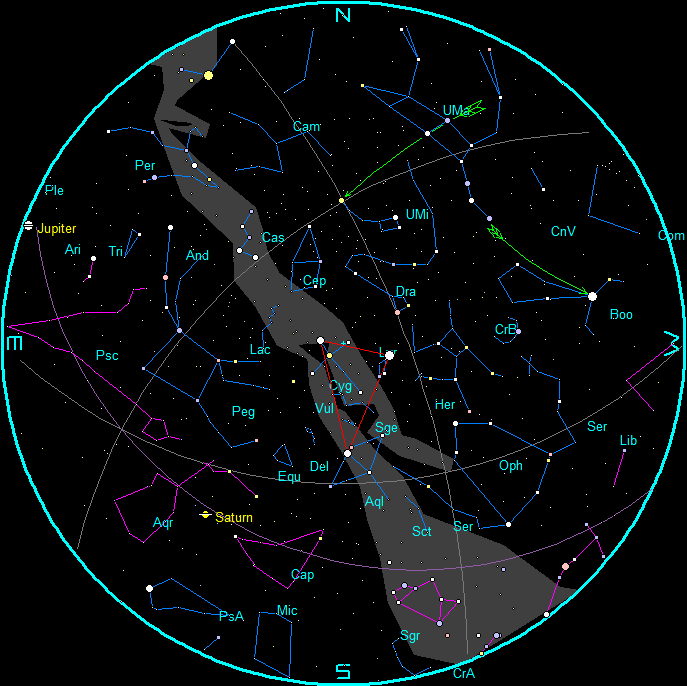
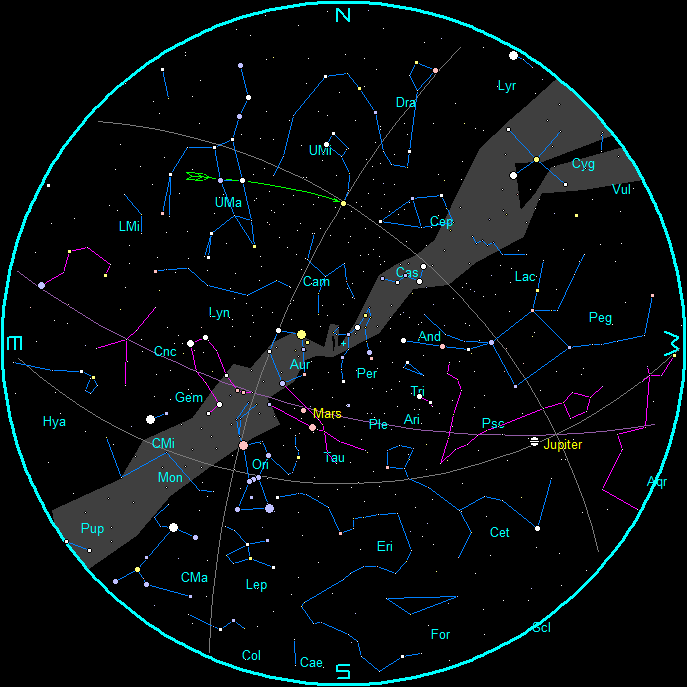
Star Chart for September 2023. Click or tap on the image to enlarge it. Created using my LookingUp program.
The planets and stars are plotted for the 15th at 10 p.m. EDT in the evening and 6 a.m. for the morning chart. These are the chart times. Note that Traverse City is located approximately 45 minutes behind our time meridian, West 75° longitude. (An hour 45 minutes behind our daylight saving time meridian during EDT). To duplicate the star positions on a planisphere you may have to set it to 1 hour 45 minutes earlier than the current time.
September Morning Star Chart
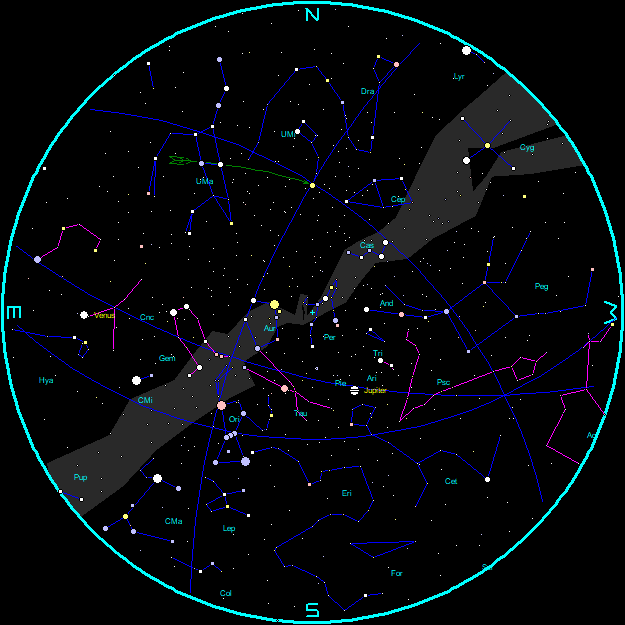
Star Chart for September 2023 (6 am EDT, September 15, 2022). Click on the image to enlarge it. Created using my LookingUp program.
For a list of constellation names to go with the abbreviations, click here.
- Pointer stars at the front of the bowl of the Big Dipper point to Polaris, the North Star.
- Leaky dipper drips on Leo.
- Follow the arc of the handle of the Big Dipper to the star Arcturus.
- The Summer Triangle is in red.
Twilight Limits, Nautical and Astronomical
| EDT | |||||||
| Morning | Twilight | Evening | Twilight | Dark | Night | Moon | |
| Date | Astro. | Nautical | Nautical | Astro. | Start | End | Illum. |
| 2023-09-01 | 5h26m | 6h04m | 21h29m | 22h08m | – | – | 0.93 |
| 2023-09-02 | 5h27m | 6h05m | 21h27m | 22h05m | – | – | 0.86 |
| 2023-09-03 | 5h29m | 6h07m | 21h25m | 22h03m | 22h03m | 22h07m | 0.78 |
| 2023-09-04 | 5h30m | 6h08m | 21h23m | 22h01m | 22h01m | 22h33m | 0.68 |
| 2023-09-05 | 5h32m | 6h09m | 21h21m | 21h59m | 21h59m | 23h03m | 0.57 |
| 2023-09-06 | 5h34m | 6h11m | 21h19m | 21h56m | 21h56m | 23h41m | 0.47 |
| 2023-09-07 | 5h35m | 6h12m | 21h17m | 21h54m | 21h54m | – | 0.37 |
| 2023-09-08 | 5h37m | 6h13m | 21h15m | 21h52m | 21h52m | 0h27m | 0.28 |
| 2023-09-09 | 5h38m | 6h15m | 21h13m | 21h50m | 21h50m | 1h21m | 0.20 |
| 2023-09-10 | 5h40m | 6h16m | 21h11m | 21h48m | 21h48m | 2h22m | 0.13 |
| 2023-09-11 | 5h41m | 6h17m | 21h09m | 21h46m | 21h46m | 3h27m | 0.07 |
| 2023-09-12 | 5h42m | 6h19m | 21h07m | 21h43m | 21h43m | 4h32m | 0.03 |
| 2023-09-13 | 5h44m | 6h20m | 21h05m | 21h41m | 21h41m | 5h38m | 0.01 |
| 2023-09-14 | 5h45m | 6h21m | 21h03m | 21h39m | 21h39m | 5h45m | 0.00 |
| 2023-09-15 | 5h47m | 6h23m | 21h01m | 21h37m | 21h37m | 5h47m | 0.01 |
| 2023-09-16 | 5h48m | 6h24m | 20h59m | 21h35m | 21h35m | 5h48m | 0.04 |
| 2023-09-17 | 5h50m | 6h25m | 20h57m | 21h33m | 21h33m | 5h50m | 0.09 |
| 2023-09-18 | 5h51m | 6h27m | 20h55m | 21h31m | 21h31m | 5h51m | 0.16 |
| 2023-09-19 | 5h52m | 6h28m | 20h53m | 21h28m | 21h39m | 5h52m | 0.24 |
| 2023-09-20 | 5h54m | 6h29m | 20h51m | 21h26m | 22h10m | 5h54m | 0.33 |
| 2023-09-21 | 5h55m | 6h30m | 20h49m | 21h24m | 22h52m | 5h55m | 0.44 |
| 2023-09-22 | 5h57m | 6h32m | 20h47m | 21h22m | 23h46m | 5h57m | 0.55 |
| 2023-09-23 | 5h58m | 6h33m | 20h45m | 21h20m | – | 5h58m | 0.66 |
| 2023-09-24 | 5h59m | 6h34m | 20h43m | 21h18m | 0h53m | 5h59m | 0.76 |
| 2023-09-25 | 6h01m | 6h35m | 20h41m | 21h16m | 2h11m | 6h01m | 0.85 |
| 2023-09-26 | 6h02m | 6h37m | 20h39m | 21h14m | 3h35m | 6h02m | 0.93 |
| 2023-09-27 | 6h03m | 6h38m | 20h37m | 21h12m | 4h59m | 6h03m | 0.98 |
| 2023-09-28 | 6h05m | 6h39m | 20h36m | 21h10m | – | – | 1.00 |
| 2023-09-29 | 6h06m | 6h40m | 20h34m | 21h08m | – | – | 0.99 |
| 2023-09-30 | 6h07m | 6h42m | 20h32m | 21h06m | – | – | 0.96 |
Twilight calendar was generated using Cartes du Ciel (Sky Charts).
See my blog post: Twilight Zone for the definitions of the different periods of twilight here: https://bobmoler.wordpress.com/2018/09/27/.
NASA Calendar of Planetary Events
Date         Time     Event
Sep  1  Fr            Venus: 27.4° W
     3  Su   3:44 am  Moon Ascending Node
     4  Mo   3:44 pm  Moon-Jupiter: 3.4° S
     5  Tu   3:25 pm  Moon-Pleiades: 1.3° N
     6  We   7:03 am  Mercury Inferior Conj.
     6  We   6:21 pm  Last Quarter
     8  Fr   9:18 am  Moon North Dec.: 28.2° N
     9  Sa  11:32 pm  Moon-Pollux: 1.7° N
    12  Tu  11:42 am  Moon Apogee: 406,300 km
    14  Th   9:40 pm  New Moon
    17  Su  11:12 am  Moon-Spica: 2.6° S
    17  Su   3:18 pm  Moon Descending Node
    19  Tu            Venus greatest brilliancy
    19  Tu   5:54 am  Neptune Opposition
    21  Th   3:50 am  Moon-Antares:  0.9° S
    22  Fr   8:59 am  Mercury Elongation: 17.9° W
                      Favorable greatest elongation for
                      the Northern Hemisphere.
    22  Fr   3:32 pm  First Quarter
    22  Fr  11:42 pm  Moon South Dec.: 28.3° S
    23  Sa   2:50 am  Autumnal Equinox
    26  Tu   9:25 pm  Moon-Saturn: 2.6° N
    27  We   9:05 pm  Moon Perigee: 359,900 km
    29  Fr   5:57 am  Full Harvest Moon
    30  Sa  12:49 pm  Moon Ascending Node
Oct  1  Su            Venus: 44.2° W
All event times are given for UTC-4 hr: Eastern Daylight Saving Time.
Sky Events Calendar by Fred Espenak and Sumit Dutta (NASA’s GSFC),
http://eclipse.gsfc.nasa.gov/SKYCAL/SKYCAL.html.
If you go to the above site, you can print out a list like the above for the entire year or calendar pages for your time zone.
Sun and Moon Rising and Setting Events
                Ephemeris of Sky Events for Interlochen/TC
September 2023    Local time zone: EDT
+-----------------------------------------------------------------------+
| DATE |  SUN     SUN  DAYLIGHT|   TWILIGHT*    |MOON  RISE OR    ILLUM |
|      |  RISE    SET    HOURS |  END    START  |PHASE SET** TIME FRACTN|
+=======================================================================+
|Fri  1| 07:04a  08:19p  13:14 | 09:26p  05:58a |      Rise 09:24p   94%|
|Sat  2| 07:06a  08:18p  13:11 | 09:24p  05:59a |      Rise 09:45p   88%|
+------+-----------------------+----------------+-----------------------+
|Sun  3| 07:07a  08:16p  13:08 | 09:21p  06:01a |      Rise 10:07p   79%|
|Mon  4| 07:08a  08:14p  13:05 | 09:19p  06:02a |      Rise 10:32p   70%|
|Tue  5| 07:09a  08:12p  13:02 | 09:17p  06:03a |      Rise 11:03p   60%|
|Wed  6| 07:10a  08:10p  12:59 | 09:15p  06:05a |L Qtr Rise 11:40p   49%|
|Thu  7| 07:12a  08:08p  12:56 | 09:13p  06:06a |      Rise 12:26a   39%|
|Fri  8| 07:13a  08:06p  12:53 | 09:11p  06:08a |      Rise 01:20a   30%|
|Sat  9| 07:14a  08:05p  12:50 | 09:09p  06:09a |      Rise 02:21a   22%|
+------+-----------------------+----------------+-----------------------+
|Sun 10| 07:15a  08:03p  12:47 | 09:07p  06:10a |      Rise 03:26a   14%|
|Mon 11| 07:16a  08:01p  12:44 | 09:05p  06:12a |      Rise 04:32a    8%|
|Tue 12| 07:17a  07:59p  12:41 | 09:03p  06:13a |      Rise 05:37a    4%|
|Wed 13| 07:19a  07:57p  12:38 | 09:01p  06:14a |      Rise 06:41a    1%|
|Thu 14| 07:20a  07:55p  12:35 | 08:59p  06:15a |New   Set  08:04p    0%|
|Fri 15| 07:21a  07:53p  12:32 | 08:57p  06:17a |      Set  08:20p    1%|
|Sat 16| 07:22a  07:51p  12:29 | 08:55p  06:18a |      Set  08:36p    3%|
+------+-----------------------+----------------+-----------------------+
|Sun 17| 07:23a  07:50p  12:26 | 08:53p  06:19a |      Set  08:54p    8%|
|Mon 18| 07:24a  07:48p  12:23 | 08:51p  06:21a |      Set  09:14p   14%|
|Tue 19| 07:26a  07:46p  12:20 | 08:49p  06:22a |      Set  09:39p   22%|
|Wed 20| 07:27a  07:44p  12:17 | 08:47p  06:23a |      Set  10:10p   31%|
|Thu 21| 07:28a  07:42p  12:13 | 08:45p  06:24a |      Set  10:51p   41%|
|Fri 22| 07:29a  07:40p  12:10 | 08:43p  06:26a |F Qtr Set  11:45p   52%|
|Sat 23| 07:30a  07:38p  12:07 | 08:41p  06:27a |      Set  12:52a   63%|
+------+-----------------------+----------------+-----------------------+
|Sun 24| 07:32a  07:36p  12:04 | 08:39p  06:28a |      Set  02:11a   74%|
|Mon 25| 07:33a  07:34p  12:01 | 08:38p  06:30a |      Set  03:34a   84%|
|Tue 26| 07:34a  07:33p  11:58 | 08:36p  06:31a |      Set  04:59a   91%|
|Wed 27| 07:35a  07:31p  11:55 | 08:34p  06:32a |      Set  06:22a   97%|
|Thu 28| 07:36a  07:29p  11:52 | 08:32p  06:33a |      Set  07:43a  100%|
|Fri 29| 07:38a  07:27p  11:49 | 08:30p  06:35a |Full  Rise 07:45p   99%|
|Sat 30| 07:39a  07:25p  11:46 | 08:28p  06:36a |      Rise 08:07p   96%|
+-----------------------------------------------------------------------+
* Nautical Twilight
** Moonrise or moonset, whichever occurs between sunrise and sunset
Generated using my LookingUp for DOS program.
Ephemeris: 08/30/2023 – Let’s find out where the naked-eye planets are
This is Ephemeris for Wednesday, August 30th. Today the Sun will be up for 13 hours and 20 minutes, setting at 8:23, and it will rise tomorrow at 7:03. The Moon, is the full Blue Moon today, and it will rise at 8:39 this evening. No, it’s not really blue in color. The Blue Moon is the second full moon in a particular month.
Let’s find out where the naked-eye planets are. Three of those five planets are now visible. Mars and Mercury are too close to the Sun to be seen. Saturn is the sole evening planet visible. Jupiter and Venus are officially the only visible morning planets. Saturn can be spotted in the southeast in the evening. And it will still be visible throughout the morning hours until just before sunrise. Tonight Saturn will appear above and right of the full moon, though it might be difficult to spot in the Moon’s glare. Saturn is in retrograde or westward motion now, against the stars of Aquarius. Jupiter will rise at 10:54pm. It is slowing its eastward motion and will become stationary on September 7th. Venus is making an appearance in the morning sky now as our brilliant morning star. It will rise at 5:13 tomorrow morning.
The astronomical event times given are for the Traverse City/Interlochen area of Michigan (EDT, UT –4 hours). They may be different for your location.
Addendum
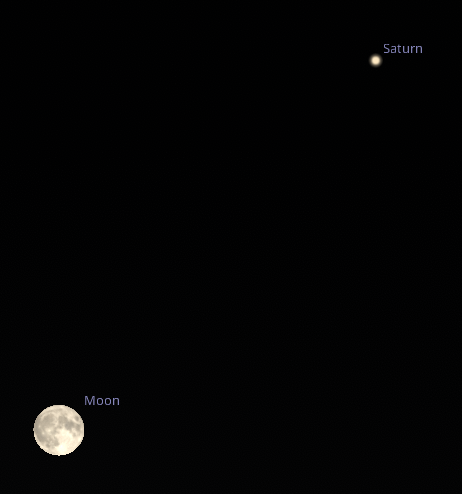
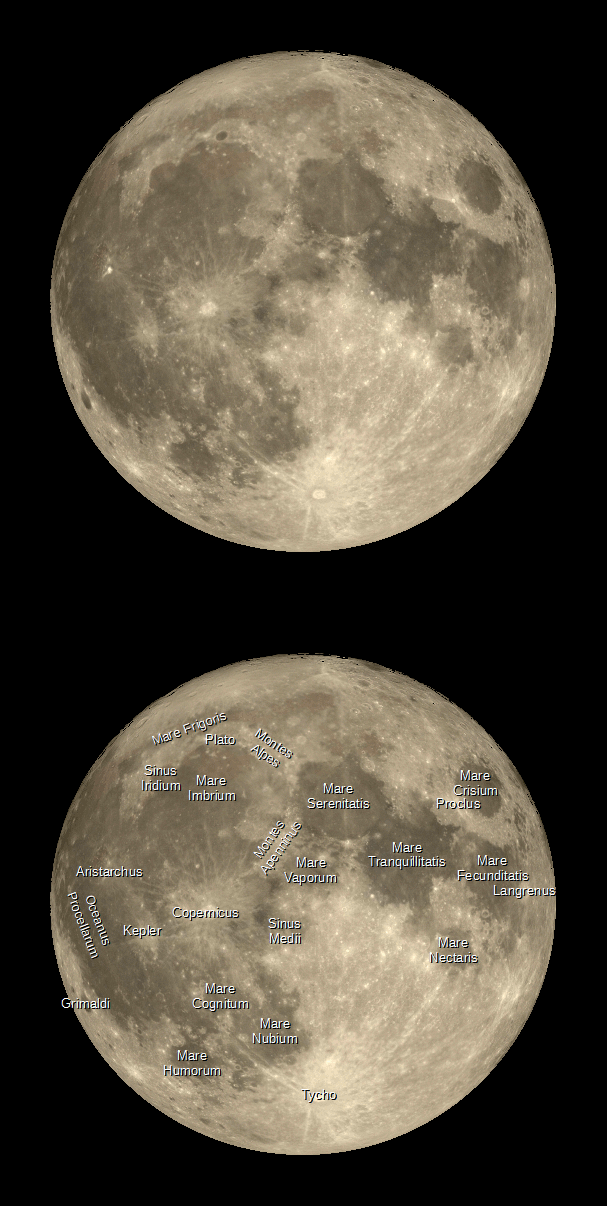
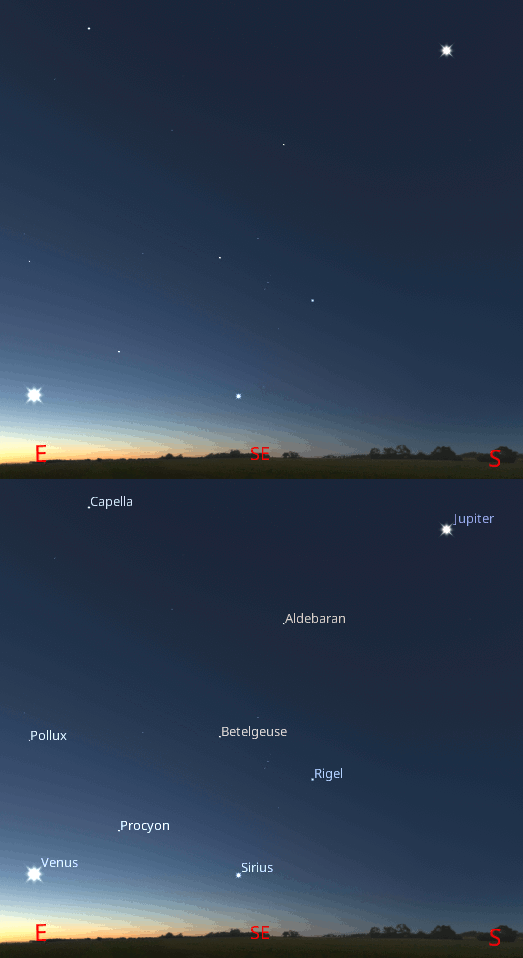
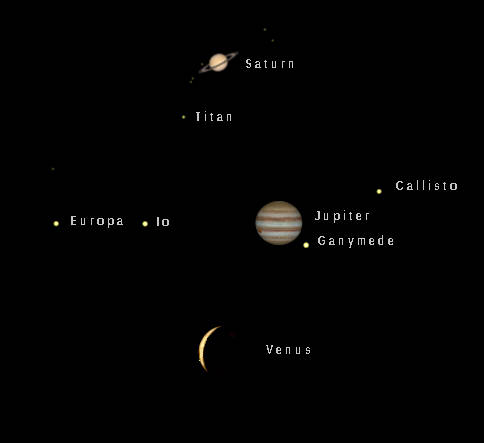
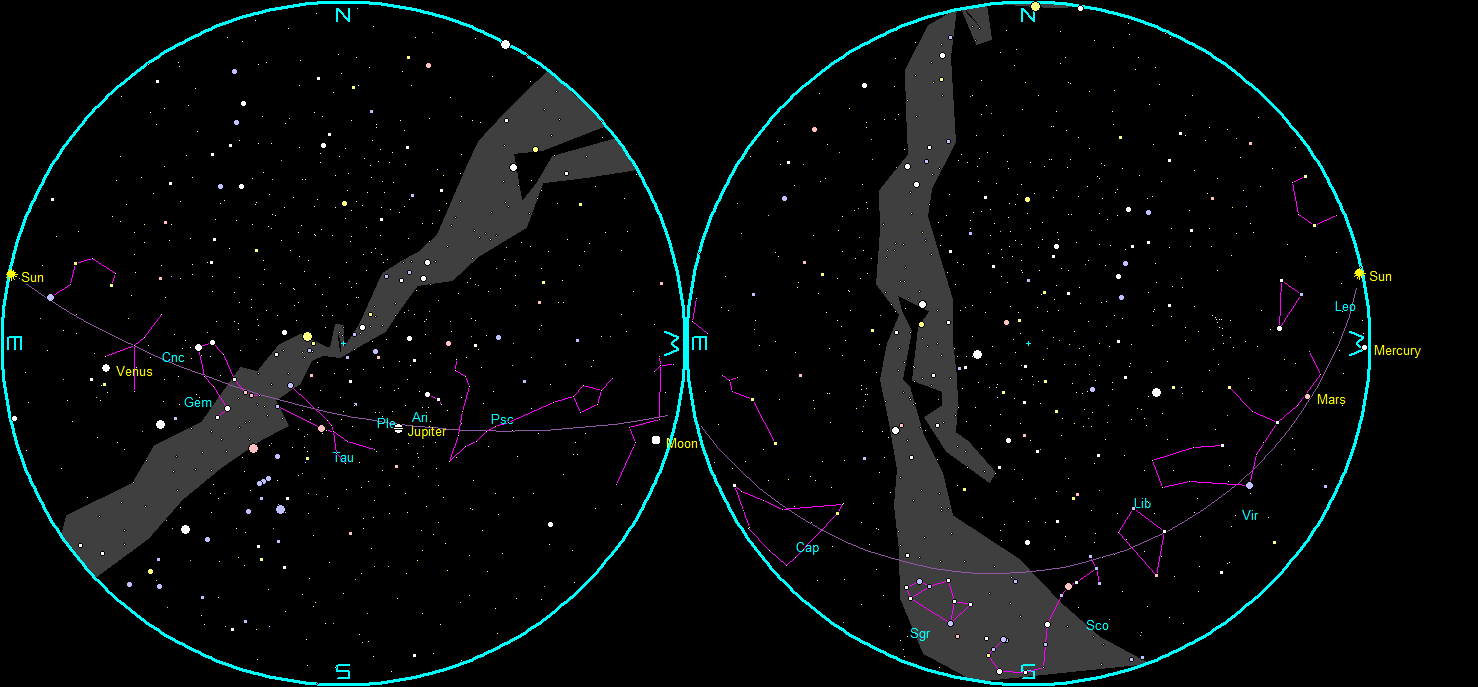
The naked-eye planets and the Moon at sunset and sunrise on a single night, starting with sunset on the right on August 30, 2023. The night ends on the left with sunrise on the 31st. Click or tap on the image to enlarge it. Created using my LookingUp app and GIMP.
Ephemeris: 08/29/2023 – Saturn’s rings disappear every 15 years
This is Ephemeris for Tuesday, August 29th. Today the Sun will be up for 13 hours and 23 minutes, setting at 8:25, and it will rise tomorrow at 7:02. The Moon, 1 day before full, will set at 6:05 tomorrow morning.
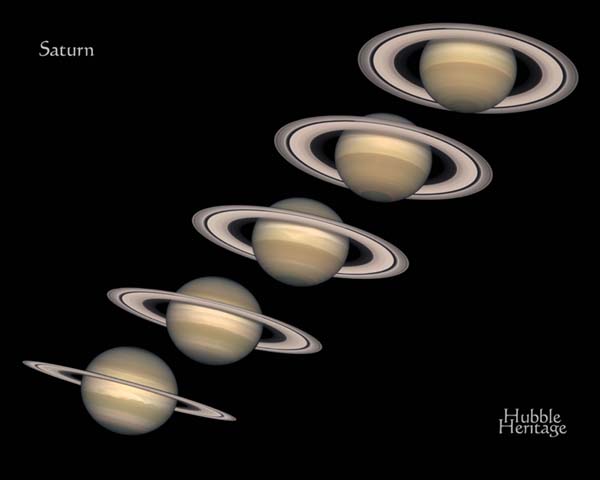
As seen in even low powered telescopes Saturn’s rings are visible. Currently, the rings are closing towards that edge on point which will they reach on March 23rd 2025 and then begin to open up again. The rings orbit Saturn’s equator, and Saturn has a nearly 27 degree inclination of its axis to its orbit, like the Earth’s 23 1/2 degrees and that means that near the equinoxes Saturn’s rings turn out to be nearly edge on to the Sun and the Earth, since we orbit much closer to the Sun than Saturn. Near the solstices on Saturn the rings are open to their widest extent. This occurs about 7 ½ years after the rings go edge on, and 7 ½ years before the next time. The next time the rings go edge on Saturn will be too close to the direction of the Sun to spot, but when they do go edge-on, they disappear. They are 150,000 miles in diameter and less than 70 feet thick.
The astronomical event times given are for the Traverse City/Interlochen area of Michigan (EDT, UT –4 hours). They may be different for your location.
Addendum
Ephemeris: 08/28/2023 – Observing Saturn’s rings
This is Ephemeris for Monday, August 28th. Today the Sun will be up for 13 hours and 26 minutes, setting at 8:26, and it will rise tomorrow at 7:01. The Moon, 2 days before full, will set at 4:38 tomorrow morning.
The most striking feature of the planet Saturn are its rings. It is not the only planet with rings. Jupiter Uranus and Neptune all have rings, plus some asteroids. And at least one Kuiper belt objects has rings, but Saturn has the grandest of all the ring systems. The broad rings are easily seen in small telescopes. They are labeled A, B and C, A being the outermost of the bright rings B is the center most and C is just barely seen inside the B ring. The diameter of these rings to the outside of the A ring is 150,000 miles, a bit more than the average distance from the Earth to our Moon, and a little less than 70 feet thick so when they go edge on to us as they do about every 15 or so years they completely disappear.
The astronomical event times given are for the Traverse City/Interlochen area of Michigan (EDT, UT –4 hours). They may be different for your location.
Addendum
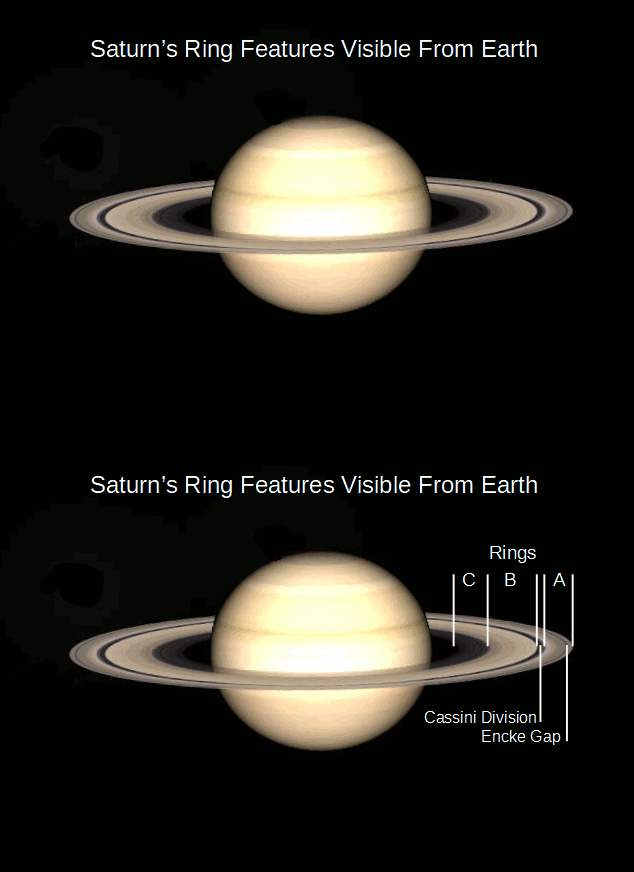
Saturn’s rings are much more complex than what can be seen in a small telescope. Observing Saturn through a small telescope, the A and B rings are evident, though the Cassini Division, of nearly 5,000 miles in width, may be elusive. The C, or Crêpe, ring is very hard to see, and is best seen as a dusky shadowlike feature against the planet. This image of Saturn was created by Stellarium, annotations were created in LibreOffice Draw, assembled and output using GIMP.
More on Saturn’s rings tomorrow.
Ephemeris: 08/25/2023 – Saturn will reach opposition on Sunday
This is Ephemeris for Friday, August 25th. Today the Sun will be up for 13 hours and 35 minutes, setting at 8:32, and it will rise tomorrow at 6:57. The Moon, 1 day past first quarter, will set at 12:57 tomorrow morning.
The planet Saturn will reach opposition on Sunday. That means it will be opposite the Sun in the sky. It will be rising as the sun sets, and it will then officially become an evening planet. Opposition is the time when Saturn is the closest it gets to the Earth, in this case it’s 816 million miles (1 billion 314 million kilometers). In telescopes, we’ll see very little in the way of shadows of the planet on the rings and the rings on the planet, because we are almost directly in line with the Sun and Saturn. We’re actually a little north of the line, so Saturn will exhibit very thin shadows, however a pretty big telescope will be needed to see them. This is the time when Saturn appears largest in telescopes, and the rings are the brightest.
The astronomical event times given are for the Traverse City/Interlochen area of Michigan (EDT, UT –4 hours). They may be different for your location.
Addendum
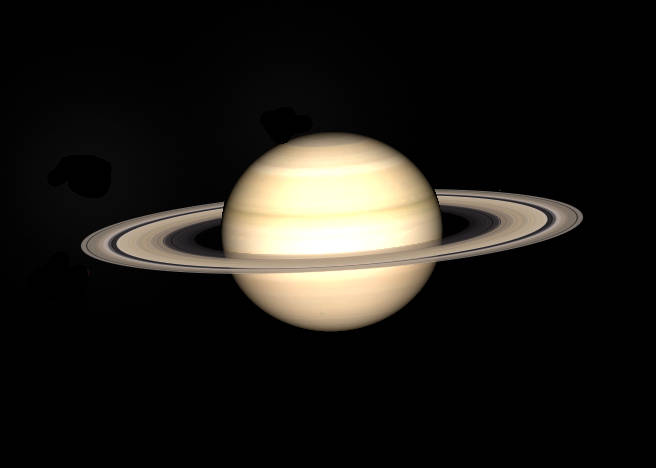
Saturn, as realized by the Stellarium planetarium app. It never appears this large in telescopes. The first time I saw Saturn in a telescope, and saw those rings, I was blown away. However, I was disappointed as to how small it was. Well, it is almost a billion miles (1.6 million kilometers) away, about twice as far as Jupiter. The extent of the rings are about as long as Jupiter’s apparent diameter, which averages about half of Saturn’s distance. Currently, the rings are getting more and more edge-on to us. The rings will be edge-on to us on March 23, 2025, nearly a year and a half from now, then begin to open up again. This is due to Saturn’s axial tilt of nearly 27 degrees, and the fact that the rings orbit the planet at its equator.
Ephemeris: 08/24/2023 – The Moon will pass in front of the star Antares tonight
This is Ephemeris for Thursday, August 24th. Today the Sun will be up for 13 hours and 38 minutes, setting at 8:33, and it will rise tomorrow at 6:56. The Moon, at first quarter today, will set at 12:11 tomorrow morning. | Tonight the Moon is going to pass in front of the bright reddish star in Antares in Scorpius scorpion. The event is called an occultation, and it is the only one of the monthly occultations which we’re going to be able to see in this series that began last month and will extend to August 2028. Antares will disappear at the lower left edge of the dark or night part of the Moon at approximately 10:28 pm* this evening, and it’ll stay hidden until 11:32 pm* when it will pop out on the lower right edge of the bright part of the Moon. Start looking for Antares early, probably with binoculars, because the Moon will be quite bright and might overpower Antares when viewed by the naked eye. Hoping for clear skies tonight.
*The astronomical event times given are for the Traverse City/Interlochen area of Michigan (EDT, UT –4 hours). They may be different for your location. For other locations a planetarium computer app like Stellarium can be used to graphically predict occultation timings within a few minutes. Check your planetarium app, and set it to use Topocentric coordinates. In Stellarium, the selection is in the Configuration window, Tools tab. Check everything under Topocentric coordinates. That way the position of the Moon in the sky will be based on the chosen location, rather than the center of the Earth.
Addendum
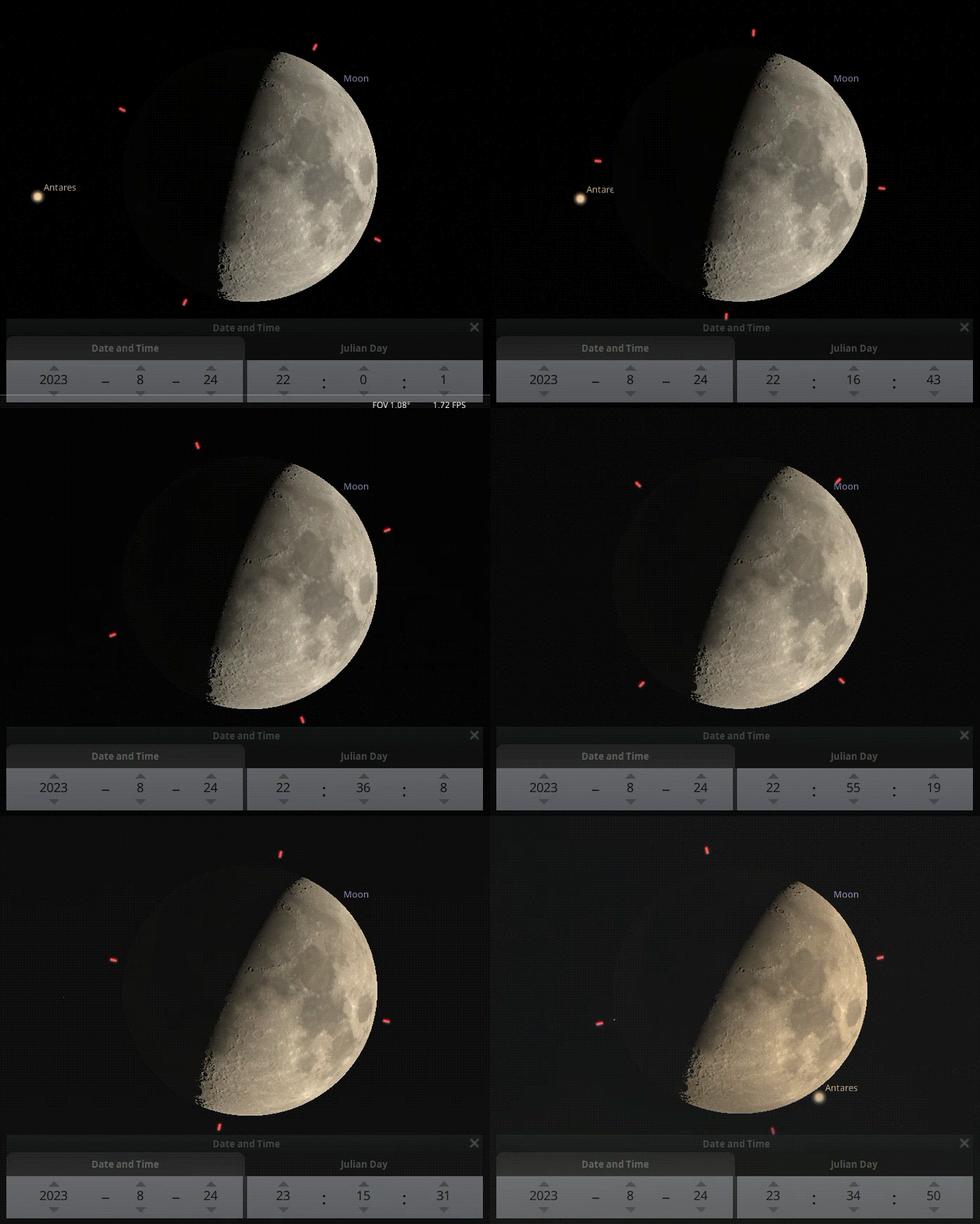
A time-lapse prediction of the occultation of Antares by the Moon based on Stellarium imagery. In the actual occultation Antares will wink out and on suddenly. Antares is a double star, with a 5th magnitude companion. It should wink out and in 9 seconds before the main first magnitude star.
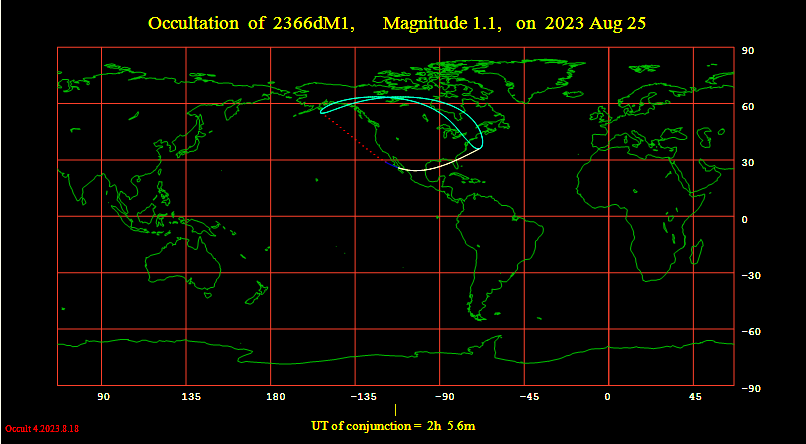
World map showing the area where the occultation of Antares can be visible. It is the area bounded by the white line, the red dotted line and the floppy figure 8 is the area where the occultation is visible. The red line shows that the area near that part of the line is where the occultation occurs during daylight the solid white line on the bottom encloses there is where the occultation will be seen at night. Michigan is close to that cyan line and so the occultation will occur near moonset. Credit: Occult 4 app.
Ephemeris: 08/23/2023 – Let’s find out where the naked-eye planets have wandered off to this week
This is Ephemeris for Wednesday, August 23rd. Today the Sun will be up for 13 hours and 41 minutes, setting at 8:35, and it will rise tomorrow at 6:55. The Moon, 1 day before first quarter, will set at 11:36 this evening.
Let’s find out where the naked-eye planets have wandered off to this week. Three of the five planets are now visible. Mars and Mercury are too close to the Sun to be seen. Jupiter, Saturn and Venus are all officially morning planets now, although Saturn does rise in the evening shortly after sunset. It will become an evening planet in four days, when it will rise at sunset. It can be spotted in the southeast in the evening. And it will still be visible throughout the morning hours. Saturn is in retrograde or westward motion now, against the stars of Aquarius. Jupiter will rise at 11:21pm. Venus is making an appearance in the morning sky now. It will rise at 5:53 tomorrow morning in the east.
The astronomical event times given are for the Traverse City/Interlochen area of Michigan (EDT, UT –4 hours). They may be different for your location.
Addendum
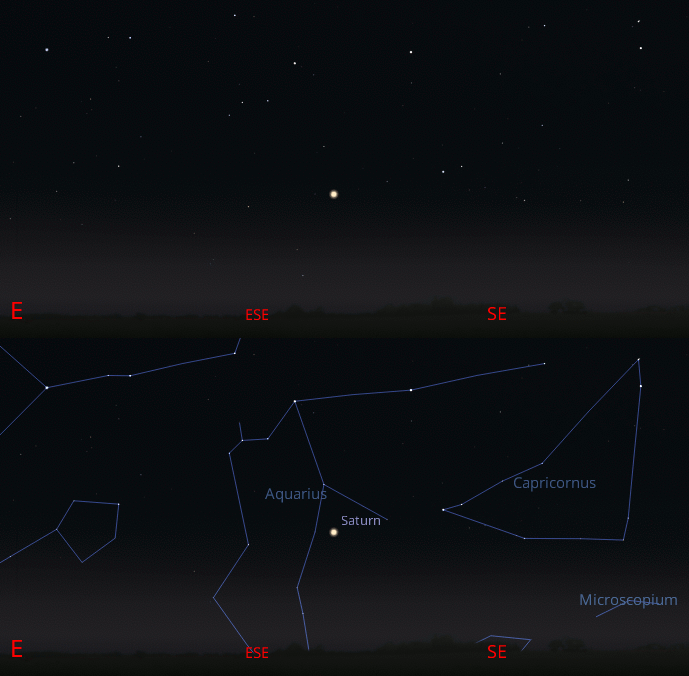
Finding Saturn in the evening for tonight at 10 pm, August 23, 2023. The unlabeled partial constellation on the left is part of Pisces, and the five stars in a circle is an asterism (informal constellation) called the Circlet. Another asterism is composed of the four stars in a small triangle with another in the center, above and a bit left of the Aquarius label is the Water Jar with water streaming from it to the right. Click or tap on the image to enlarge it. Created using Stellarium and GIMP.
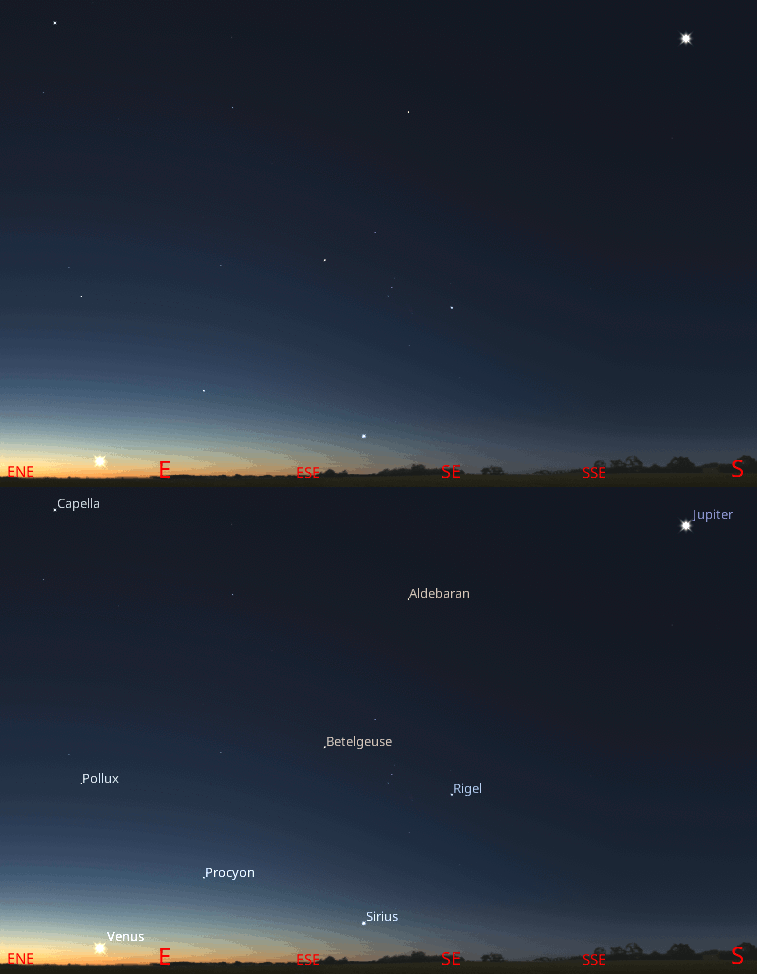
The morning planets at 6:10 am tomorrow morning, August 24, 3023, after Venus rises, with the bright stars of winter slowly disappearing in the advancing morning twilight. Click or tap on the image to enlarge it. Created using Stellarium and GIMP.
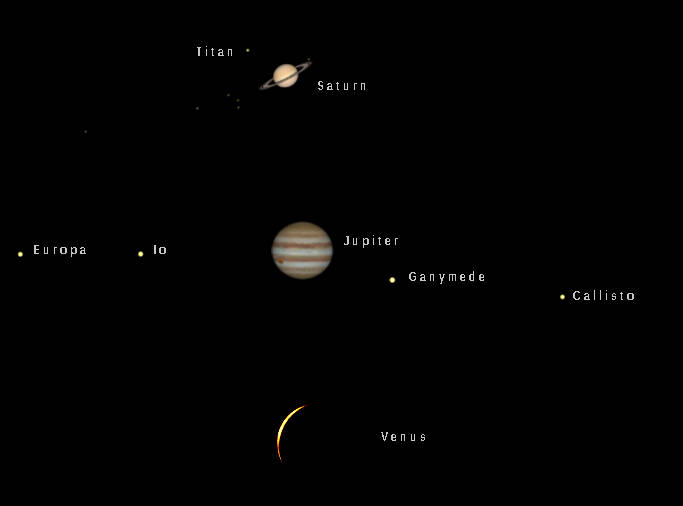
Telescopic Saturn, Jupiter and Venus (north up) as they would be seen in a small telescope, with the same magnification at 10 pm August 23, 2023, for Saturn and 6:10 am August 24, 2023, for Jupiter and Venus. Apparent diameters: Saturn 18.96″, its rings 44.17″; Jupiter 42.90″; and Venus 54.66″ and is 5.0% illuminated. The ” symbol means seconds of arc (1/3600th of a degree.) Click or tap on the image to enlarge it. Created using Cartes du Ciel (Sky Charts).
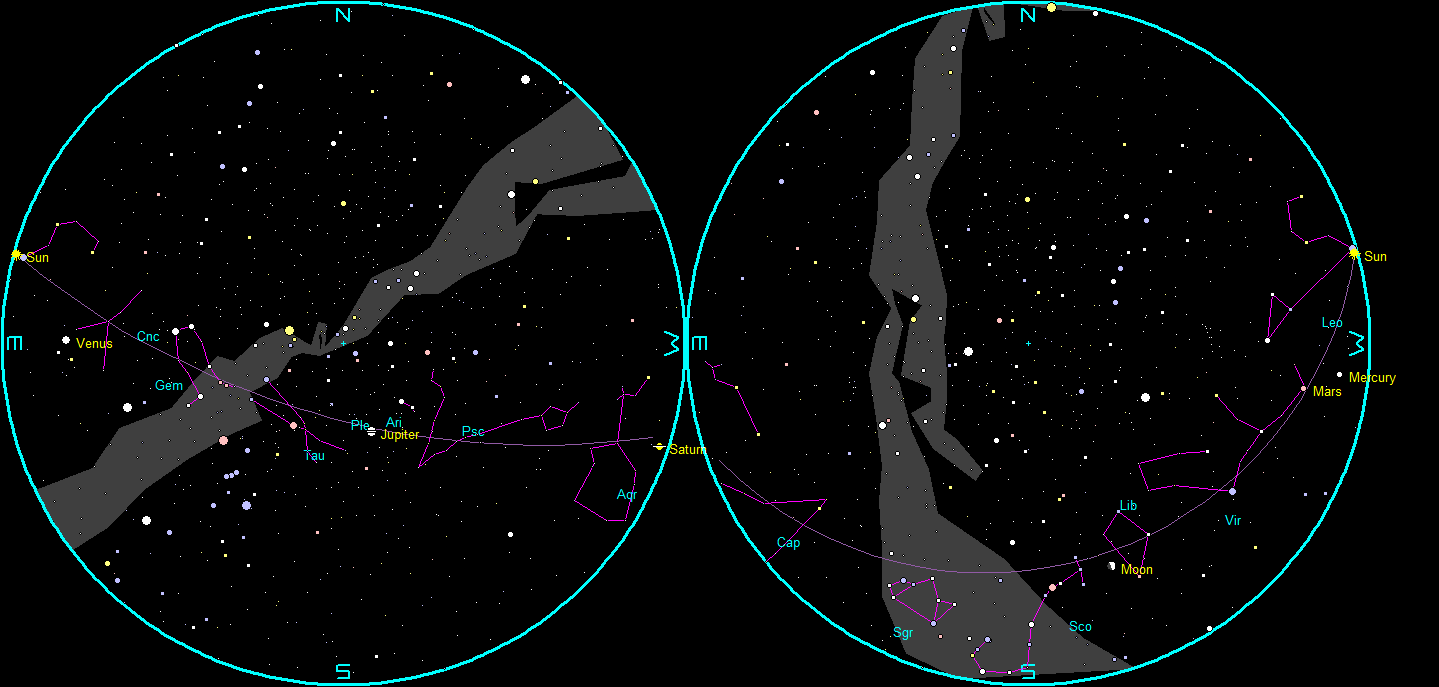
The naked-eye planets and the Moon at sunset and sunrise on a single night, starting with sunset on the right on August 23, 2023. The night ends on the left with sunrise on the 24th. Click or tap on the image to enlarge it. Created using my LookingUp app and GIMP.
Ephemeris: 08/22/2023 – We might see a naked eye comet next month
Aug 22. This is Ephemeris for Tuesday, August 22nd. The Sun will be up for 13 hours and 44 minutes today, setting at 8:37, and it will rise at 6:54 tomorrow. The Moon, 2 days before first quarter, will set at 11:09 this evening.
A new comet has been discovered that might be visible to the naked eye in early September. It was discovered 10 days ago by Hideo Nishimura of Kakegawa, Japan. Somehow he was able to scoop all the automated asteroid seeking discovery programs. The comet will be visible in the morning before sunrise in the northeastern sky. It will be probably be naked eye from the 7th to the 10th. That’s only about four days in September. At that point it may get up to about fourth magnitude which is not very bright, especially for a comet, it’s barely visible, since comets appear dimmer than their magnitude suggests. However, it will be far enough from the Sun at the beginning of the four-day period to be able to be viewed before astronomical twilight.
The astronomical event times given are for the Traverse City/Interlochen area of Michigan (EDT, UT –4 hours). They may be different for your location.
Addendum
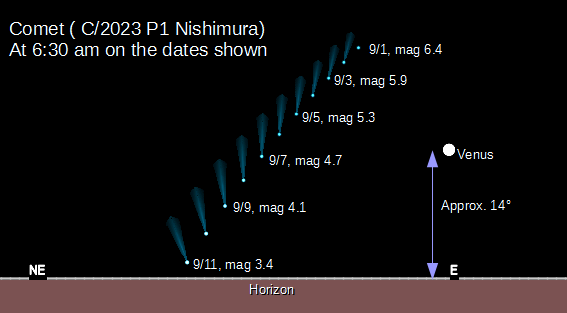
Most of the data for this posting comes from Seiichi Yoshida’s Weekly Information about Bright Comets webpage (www.aerith.net/comet/weekly/current.html).
Ephemeris: 08/21/2023 – Looking at a trio of lunar craters tonight
This is Ephemeris for Monday, August 21st. Today the Sun will be up for 13 hours and 47 minutes, setting at 8:39, and it will rise tomorrow at 6:53. The Moon, 3 days before first quarter, will set at 10:48 this evening.
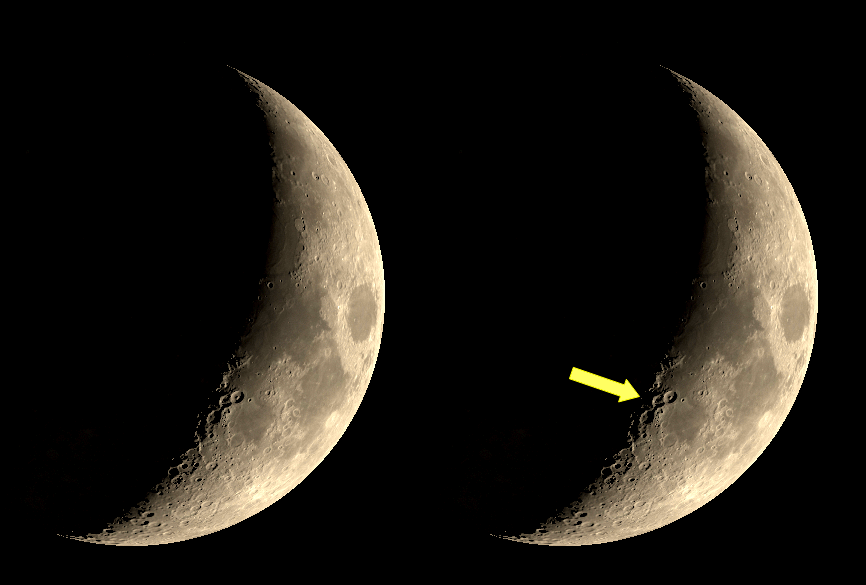
The crescent Moon tonight has what looks like a chain of three large craters near the terminator, visible in a low power telescope. The terminator is the line between day and night. Before the full moon, it’s the sunrise line. On closer inspection, these craters are of different ages. The north crater Theophilus, 63 miles in diameter and one of my favorite craters, looks relatively fresh. It’s not, it’s somewhat older than a billion years. The crater just south of it is Cyrillus, about the same size, which is almost 4 billion years old. Theophilus slightly overlaps Cyrillus. A bit farther south is Catharina, which again is about the same size and age range as Cyrillus, but seems more broken down than the other.
The astronomical event times given are for the Traverse City/Interlochen area of Michigan (EDT, UT –4 hours). They may be different for your location.
Addendum
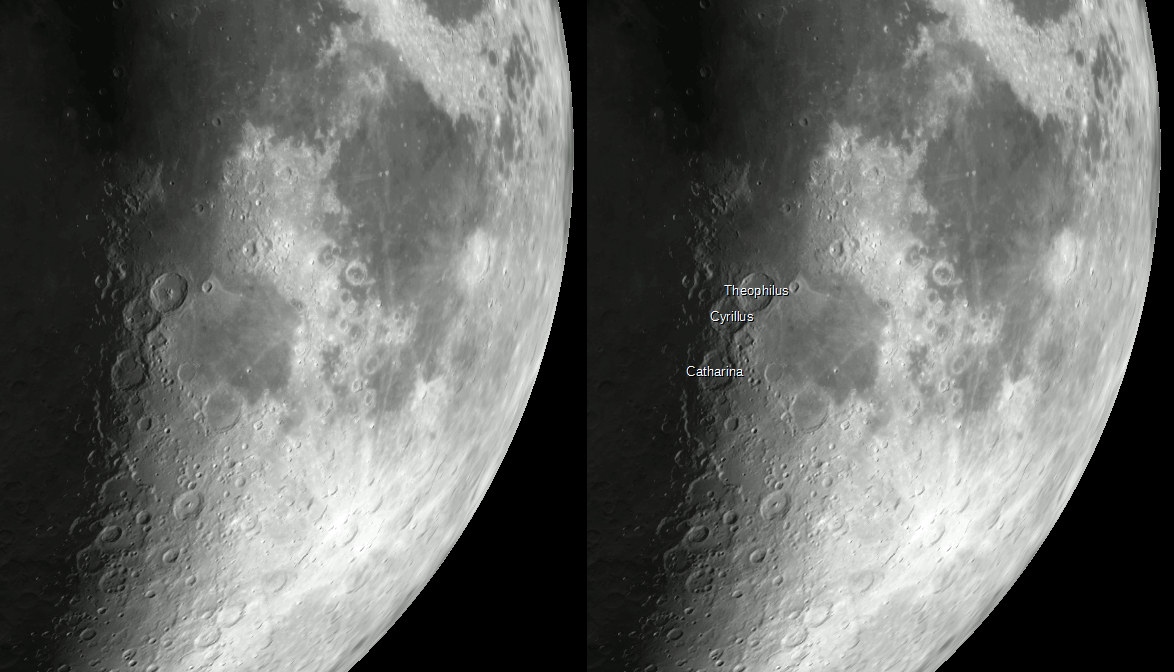
A closer look at these three craters for tonight at 10 pm. Created using Virtual Moon Atlas, LibreOffice Draw and GIMP.
 Bob Moler's Ephemeris Blog