Archive
Ephemeris: 03/04/2026 – Taking our weekly look at the whereabouts of the naked-eye planets
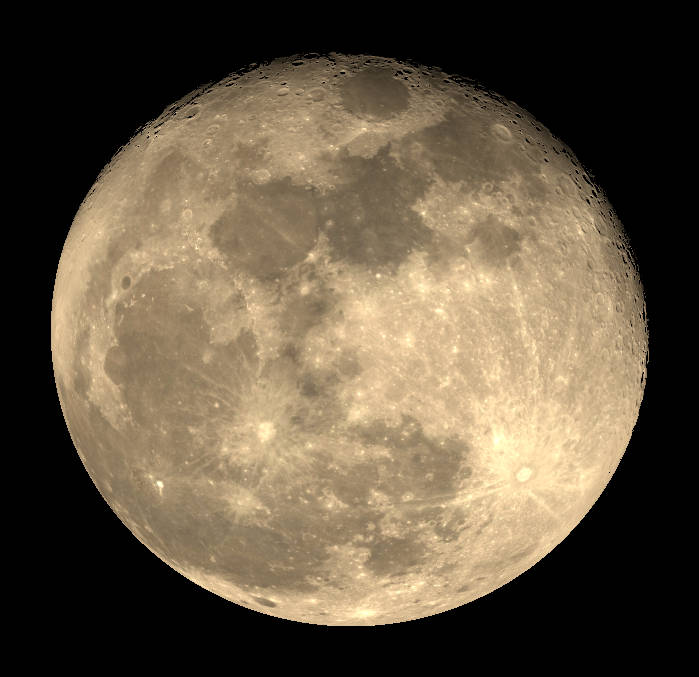
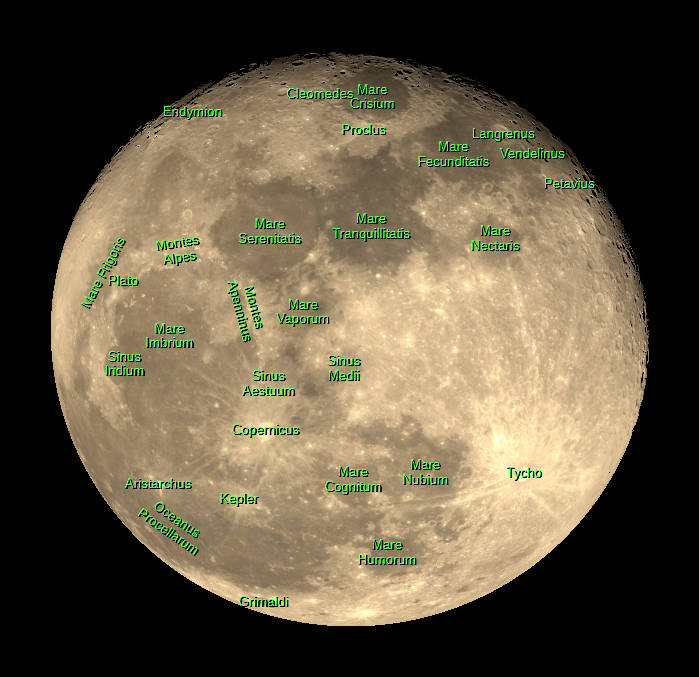
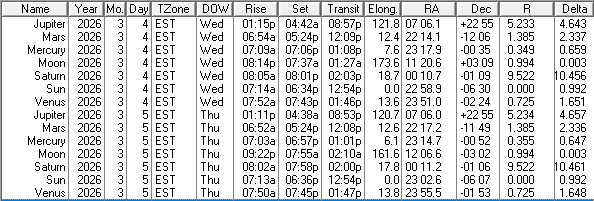
This is Ephemeris for Wednesday, March 4th. Today the Sun will be up for 11 hours and 19 minutes, setting at 6:34, and it will rise tomorrow at 7:13. The Moon, 1 day past full, will rise at 8:14 this evening.
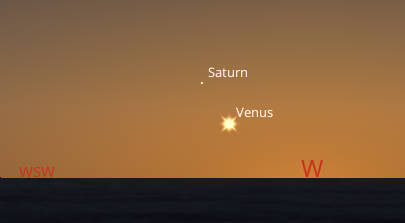
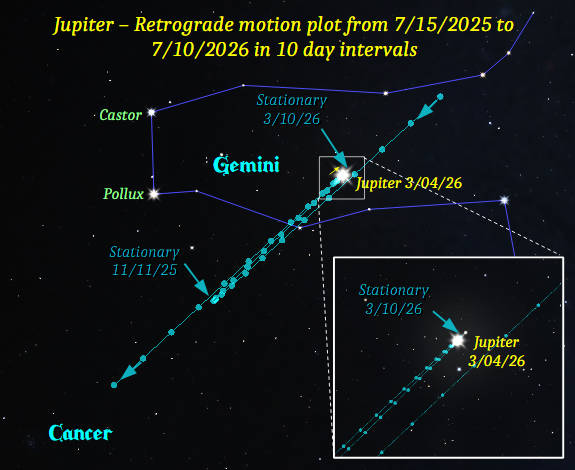
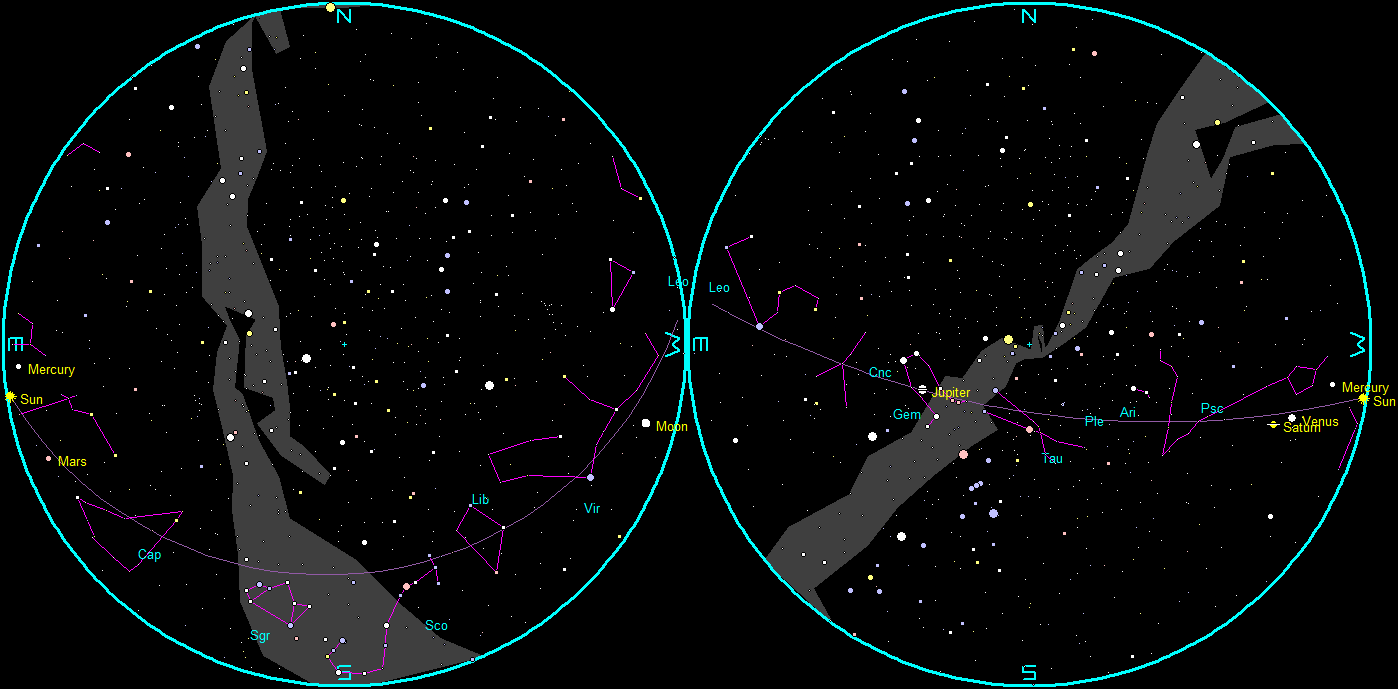
Let’s take our weekly look at the whereabouts of the naked-eye planets. At 7 PM or about a half hour after sunset, Venus may be seen very low in the West. Above it and a bit to the left might be Saturn which may not show up until a quarter of an hour later. We are in the last third of winter and the sunset times are increasing rapidly and taking with it Saturn. The evening sky will shift dramatically this Sunday when Daylight Saving Time returns, giving us darker mornings and brighter evenings. Jupiter is the brilliant star-like object more than halfway up in the southern sky. It’s the brightest star-like object in the sky. The planet and its moons are a treat for binoculars or a telescope.
The astronomical event times given in this blog are for the Traverse City/Interlochen area of Michigan (Lat 44.7° N, Long 85.7° W; EST, UT – 5 hours) unless stated otherwise. Times will be different for other locations.
Addendum

Ephemeris: 03/03/2026 – Eclipse prospects for the rest of the year
This is Ephemeris for Tuesday, March 3rd. Today the Sun will be up for 11 hours and 16 minutes, setting at 6:33, and it will rise tomorrow at 7:14. The Moon, at full today, will rise at 7:04 this evening.
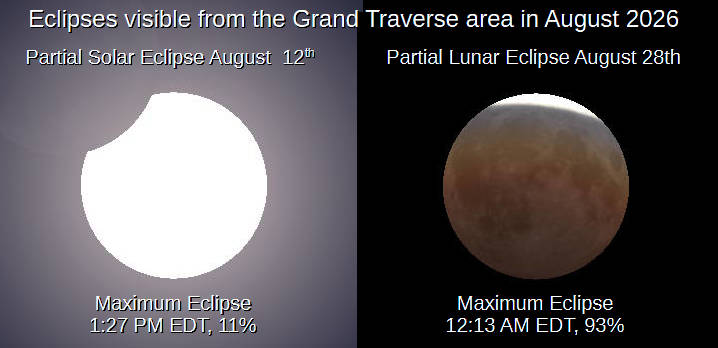
If you’re listening to me right now the total lunar eclipse this morning has ended or will shortly end. In any case it’s invisible because, even if it’s ongoing, twilight has wiped it out. Then there is the possibility of clouds, which I can’t predict from when I’m recording this Sunday night. We do have another chance to view a lunar eclipse, this year, on the night of August 27-28th. It’ll be a little bit earlier. It will start late in the evening and be almost total after midnight. There’s also going to be a solar eclipse on August 12th, but it will be just a little nibble of the moon on the sun for us. It’s going to be total for the east coast of Greenland, the northern Atlantic, and northern Spain, before ending at sunset in the Mediterranean Sea.
The astronomical event times given in this blog are for the Traverse City/Interlochen area of Michigan (Lat 44.7° N, Long 85.7° W; EST, UT – 5 hours) unless stated otherwise. Times will be different for other locations.
Addendum
Ephemeris: 03/02/2026 – There’s a total lunar eclipse tomorrow morning
This is Ephemeris for Monday, March 2nd. Today the Sun will be up for 11 hours and 13 minutes, setting at 6:32, and it will rise tomorrow at 7:16. The Moon, 1 day before full, will set at 7:19 tomorrow morning.
Early tomorrow morning* there will be total lunar eclipse. A lunar eclipse, also known as an eclipse of the Moon occurs when the full moon moves into the earth’s shadow cutting off most of its sunlight. A little sunlight does get in by being bent around the Earth by its atmosphere through all the sunrises and sunsets going on at that time. The moon’s color generally becomes dark red, this also depends on the Earth’s atmosphere and the amount of clouds, smoke and volcanic ash that are in it at the time. The partial phase will begin at 4:50 AM and will last until totality starts at 6:04 AM. Totality will last until 7:02 AM. The growing twilight may cause the totally eclipsed Moon to disappear before then.
The astronomical event times given in this blog are for the Traverse City/Interlochen area of Michigan (Lat 44.7° N, Long 85.7° W; EST, UT – 5 hours) unless stated otherwise. Times will be different for other locations.
* The Moon sets for us in Michigan before the end of the eclipse. Locations west of us in North America and the Pacific get to see the entire eclipse.
Addendum
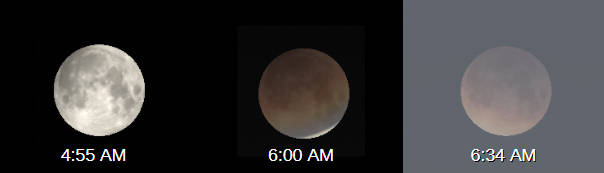
| Total Lunar Eclipse March 3, 2026 Events for the Grand Traverse area (Eastern Standard Time) |
|
| Time | Event |
| 03:44 AM | Begin Penumbral phase. This is the theoretical start of the eclipse. Nothing will appear to happen until about half an hour before the partial phase starts. Then the upper left part of the Moon will appear to darken. |
| 04:50 AM | Begin Partial phase. The umbra will encroach onto the Moon from upper left to lower right. The dull red of the umbral shadow may be discerned near the beginning of totality. |
| 05:40 AM | Astronomical Twilight begins. The Sun is 18° below the horizon. |
| 06:04 AM | Begin Totality. The expected dull red of the Moon will be brighter on the edge nearest the edge of the umbral shadow. How long will the totally eclipsed Moon be visible? |
| 06:14 AM | Nautical Twilight begins. The Sun is 12° below the horizon. |
| 06:34 AM | Mid-Eclipse |
| 07:03 AM | End Totality. Will a tiny slice of the Moon become visible in the brightening sky before it sets? |
| 07:18 AM | Sunrise |
| 07:19 AM | Moonset |
For more about lunar eclipses in general, see my post for last year’s lunar eclipse: Almost everything you wanted to know about lunar eclipses.
 Bob Moler's Ephemeris Blog