Archive
05/22/2017 – Ephemeris – Why does the Great Bear have a long tail?
Ephemeris for Monday, May 22nd. Today the Sun will be up for 15 hours and 4 minutes, setting at 9:11, and it will rise tomorrow at 6:06. The Moon, 3 days before new, will rise at 5:01 tomorrow morning.
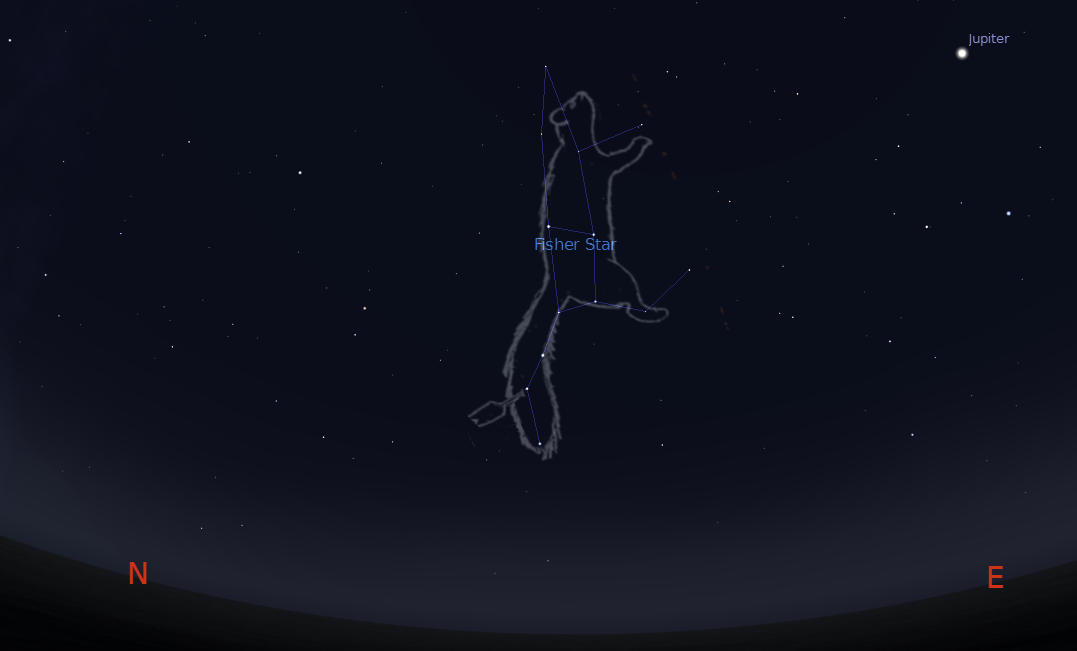
The Great Bear, or Ursa Major as the Greeks, Romans and others saw it, has been handed down to us to this day. We see the Great Bear as the Big Dipper overhead in the evening now, which is just his hind end, with a long very unbearlike tail. The ancient Greek story goes that a god, not wishing to grab the end with the teeth, grabbed instead her stubby tail and in hurling her into the sky, and stretched the tail. Native Americans who also saw a bear here, saw the three stars of the dipper handle as three hunters following the bear. The local Anishinaabek people saw here instead the Fisher, a magical weasel-like animal who had a long tail naturally. He brought summer to the Earth, and was killed for his efforts, but was placed in the sky to show us the seasons.
The times given are for the Traverse City/Interlochen area of Michigan. They may be different for your location.
Addendum

The Big Dipper/Great Bear/Fisher as seen by western and Anishinaabek people. Created using Stellarium and GIMP.
Western art is by Johan Meuris.
The source for the Ojibwe constellation art in Stellarium is from Ojibwe Sky Star Map Constellation Guide (An introduction to Ojibwe Star Knowledge) by Annette S. Lee, William Wilson, Jeffrey Tibbetts, and Carl Gawboy, ISBN 978-0-615-98678-4. The illustrations are by Annette S. Lee and William Wilson. There is also a poster sized star map available. It should be available in book stores locally, or on Amazon. I found my copy at Enerdyne in Suttons Bay.
My retelling of the Fisher or Fisher Star is here: https://bobmoler.wordpress.com/2012/10/11/the-story-of-the-fisher-star/
05/18/2017 – Ephemeris – Finding Corona Borealis, the Northern Crown
Ephemeris for Thursday, May 18th. Today the Sun will be up for 14 hours and 56 minutes, setting at 9:07, and it will rise tomorrow at 6:10. The Moon, at last quarter today, will rise at 2:54 tomorrow morning.
In the east at 11 this evening can be seen a small nearly circular constellation of Corona Borealis, the Northern Crown. It is just below Boötes, the kite shaped constellation off the handle of the Big Dipper. According to Greek myth the crown was given by the gods to the princess Ariadne, daughter of King Minos of Crete. The crown is more like a tiara with the bright star Alphecca at the front. To the Anishinaabek people, who are natives of our region it is the Sweat Lodge. Part of what we call Hercules next to it is the Exhausted Bather, who is lying on the ground after the ceremony. The seven stones that are heated for the Sweat Lodge are the Pleiades, now too close to the Sun to be seen.
The times given are for the Traverse City/Interlochen area of Michigan. They may be different for your location.
Addendum
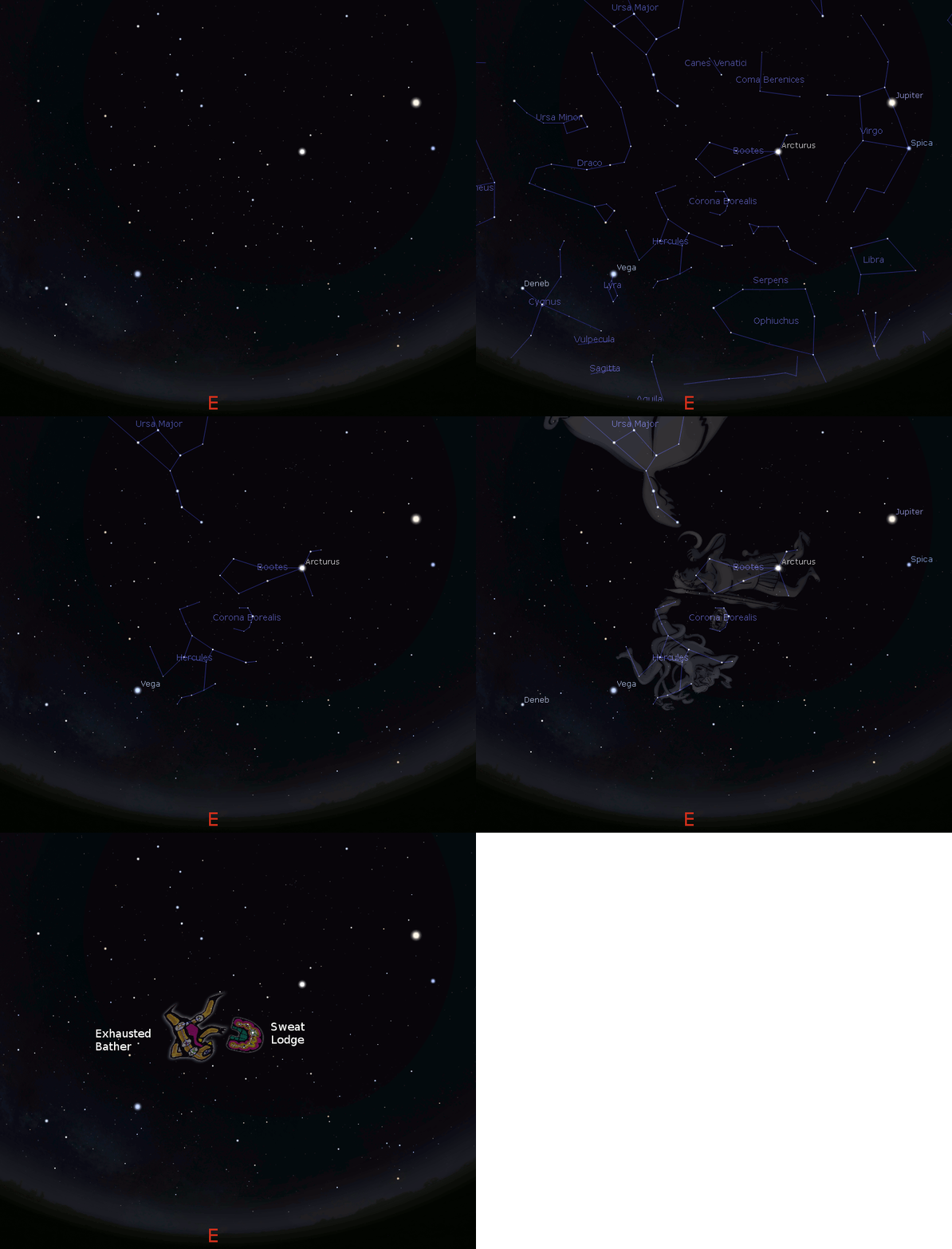
Animation for finding and showing Corona Borealis, the Sweat Lodge and nearby constellations. Created using Stellarium and GIMP. Click on the image to enlarge.
The source for the Ojibwe constellation art in Stellarium is from Ojibwe Sky Star Map Constellation Guide (An introduction to Ojibwe Star Knowledge) by Annette S. Lee, William Wilson, Jeffrey Tibbetts, and Carl Gawboy, ISBN 978-0-615-98678-4. The illustrations are by Annette S. Lee and William Wilson. There is also a poster sized star map available. It should be available in book stores locally, or at Amazon. I found my copy at Enerdyne in Suttons Bay.
03/16/2017 – Ephemeris – Curly Tail, The Great Underwater Panther
Ephemeris for Thursday, March 16th. The Sun will rise at 7:52. It’ll be up for 11 hours and 57 minutes, setting at 7:50. The Moon, half way from full to last quarter, will rise at 12:03 tomorrow morning.
The Anishinabek people of the Great Lakes Region, which includes the Ottawa, Chippewa and Ojibwe Indians have two constellations of winter that I know of. The first is The Winter Maker which uses many of Orion’s stars plus Procyon the Little Dog Star. It rises in the eastern skies in the evening as winter is beginning. The second is the Curly Tail, the Great Underwater Panther. Which uses the stars of Leo the lion’s backward question mark as its tail and the small knot of stars that are the head of Hydra the water snake below Cancer as its head. I imagine this constellation was a warning to youngsters to keep off the thinning ice of spring, lest they fall in and be snatched by the great underwater panther that lives beneath the ice.
Times are for the Traverse City/Interlochen area of Michigan. They may be different for your location.
Addendum
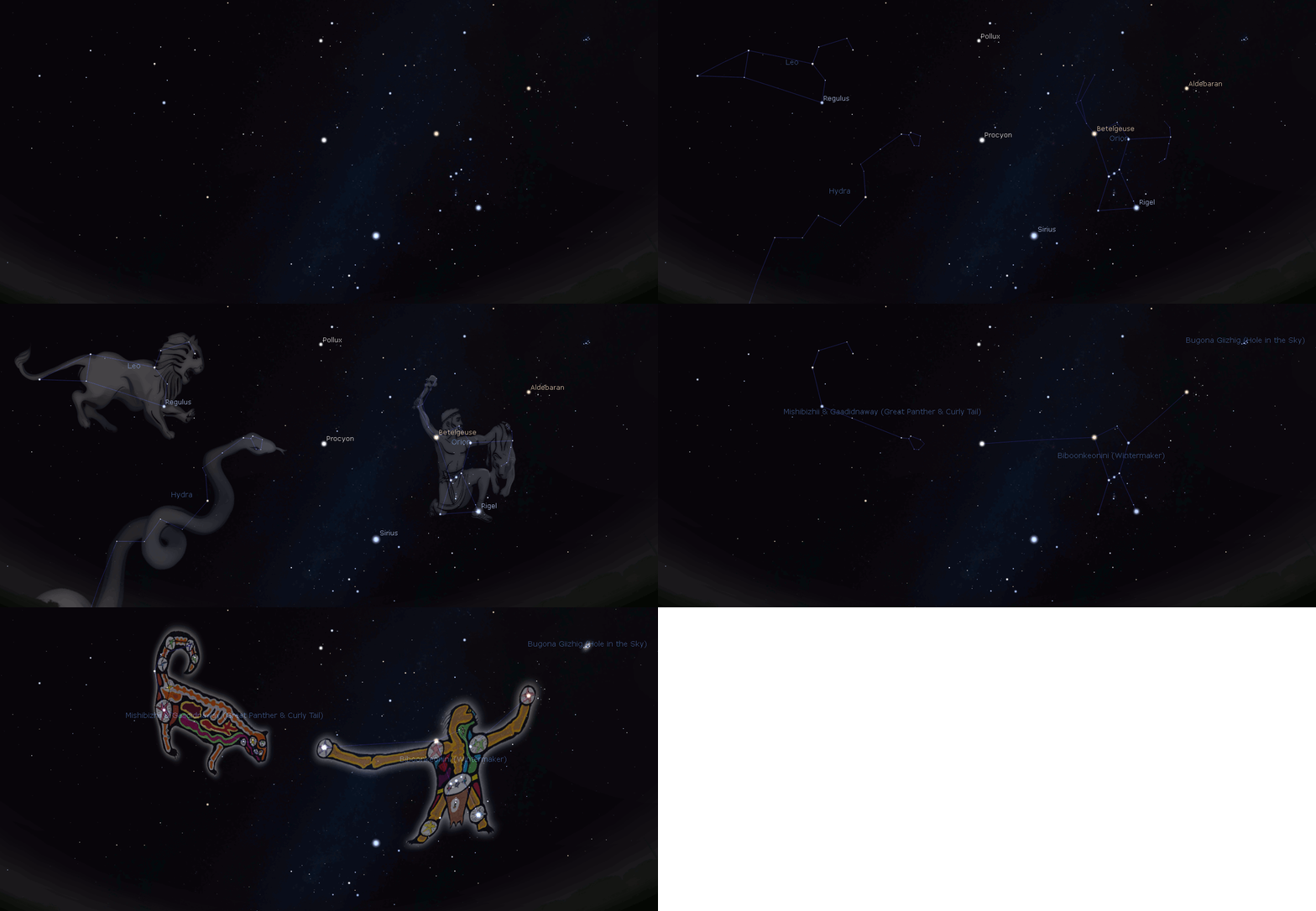
An animated GIF rotating between an unannotated star field facing south at 10 p.m. March 16th.; Western constellation names and lines for Orion, Hydra, and Leo; Western constellation art, Ojibwe constellation names and lines; and Ojibwe constellation art. Created using Stellarium. The Ojibwe constellation art is supplied as part of the latest version of Stellarium. Click on the image to enlarge.
The source for the Ojibwe constellation art is from Ojibwe Sky Star Map Constellation Guide (An introduction to Ojibwe Star Knowledge) by Annette S. Lee, William Wilson, Jeffrey Tibbetts, and Carl Gawboy, ISBN 978-0-615-98678-4. The illustrations are by Annette S. Lee and William Wilson. There is also a poster sized star map available. It should be available in book stores locally, or at Amazon. I found my copy at Enerdyne in Suttons Bay.
Also shown is the Pleiades, which to the Ojibwe is Hole in the Sky, which has to do with the Shaking Tent Ceremony. The Pleiades is also known as the Sweating Stones, the heated stones used in the Sweat Lodge Ceremony. In the later spring sky the Sweat Lodge itself is seen in the stars of the Western Corona Borealis.
Note: As far as tribe names go: Ottawa = Odawa, and Chippewa = Ojibwe.
02/15/2017 – Ephemeris – Your weekly look at the bright planets
Ephemeris for Wednesday, February 15th. The Sun will rise at 7:42. It’ll be up for 10 hours and 29 minutes, setting at 6:11. The Moon, 3 days before last quarter, will rise at 11:18 this evening.
Let’s check out the bright planets for this week. Saturn can be glimpsed this morning in the southeast at 7 a.m. It will rise tomorrow at 4:10 a.m. in the east-southeast. Jupiter can be seen in the south-southwest this morning above the star Spica in Virgo and below left of the Moon. Jupiter will rise tonight in the east at 10:47 p.m. Venus and Mars are in the evening sky. At 7 p.m. these planets will be seen in the west-southwestern sky. Venus is unmistakable as the brilliant evening star, Mars will be left and above it and much dimmer. Venus will set at 9:52 p.m. while Mars will set at 10:14. Venus exhibits a dazzling crescent in small telescopes now, but a month from now as it gets closer to Earth the thinning crescent will be big enough to be seen in binoculars.
Times are for the Traverse City/Interlochen area of Michigan. They may be different for your location.
Addendum
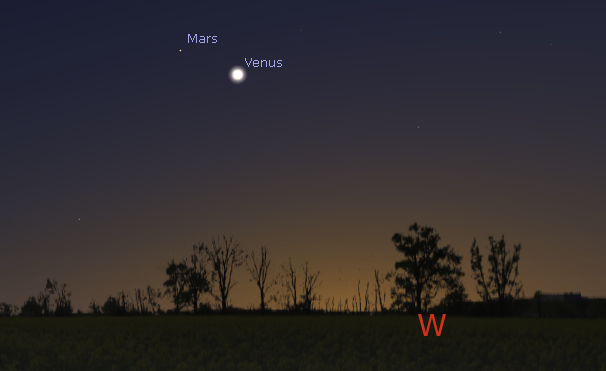
Venus and Mars in the evening twilight of about an hour after sunset. 7 p.m. February 15, 2017. Venus is now drawing away from Mars as it heads toward the Sun faster than Mars. Their apparent paths won’t cross again until October in the morning sky. Created using Stellarium.
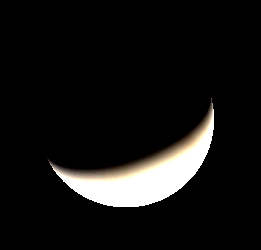
Venus as it might appear in a telescope tonight February 15, 2017. I processed the image to overexpose it as it would appear in a telescope. Venus is getting closer to the Earth at 40.5 million miles, 65.2 million km. It is 38.3″ (arc seconds) in diameter, slightly smaller that Jupiter’s apparent diameter. Created using Stellarium.
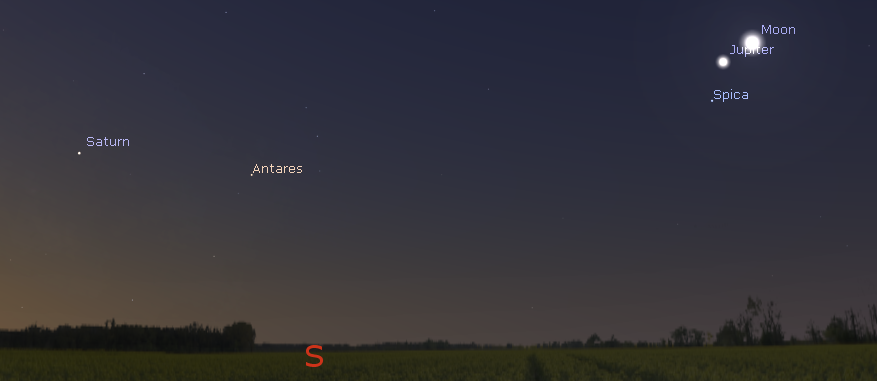
Jupiter in the south above the star Spica and the waning gibbous Moon to the right with Saturn in the southeast at 7 a.m. this morning, February 15, 2017. Created using Stellarium.
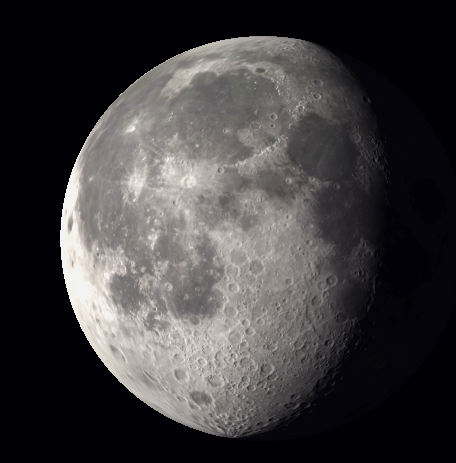
What the waning gibbous Moon might look like in binoculars this morning at 7 a.m. February 15, 2017. Created using Stellarium.
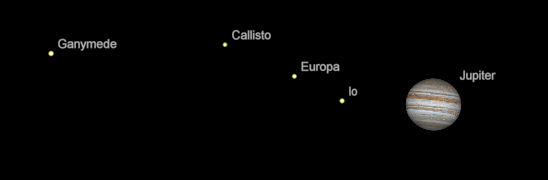
Jupiter and its moons hanging on the east side of the planet as they might appear in telescopes this morning at 7 a.m. February 15, 2017. Created using Cartes du Ciel (Sky Charts).
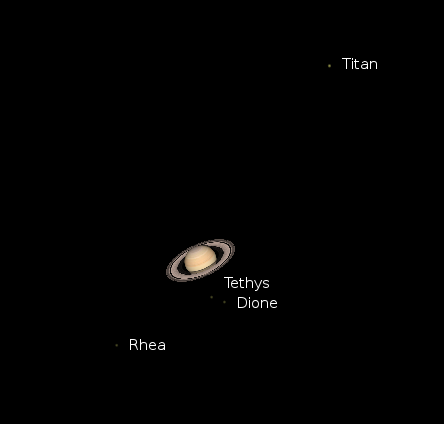
Saturn and its brightest moons as they might appear in telescopes this morning at 7 a.m. February 15, 2017. Created using Cartes du Ciel (Sky Charts).
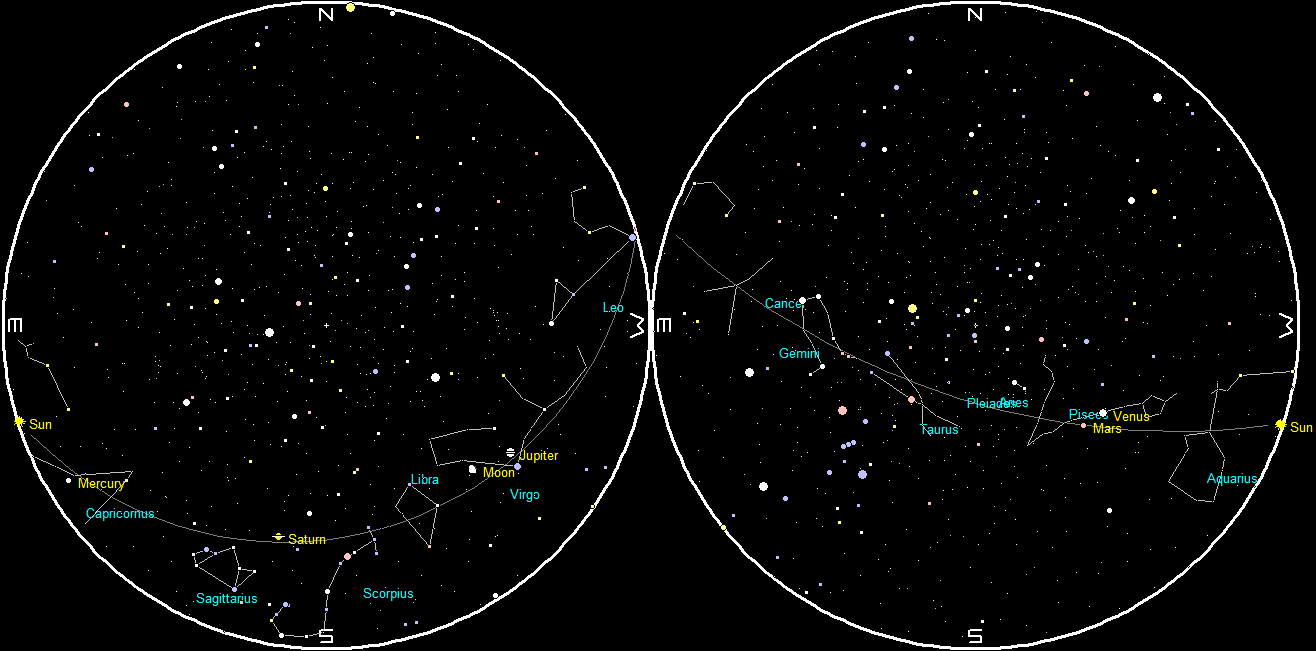
Planets and Moon at sunset and sunrise of a single night starting with sunset on the right on February 15, 2017. The night ends on the left with sunrise on February 16. Click on image to enlarge. Created using my LookingUp program.
07/28/2016 – Ephemeris – Two upcoming meteor showers plus an occultation tomorrow morning
Ephemeris for Thursday, July 28th. The Sun rises at 6:25. It’ll be up for 14 hours and 47 minutes, setting at 9:12. The Moon, 2 days past last quarter, will rise at 2:31 tomorrow morning.
We have a couple of meteor showers of note coming up. The first is the Southern Delta Aquariids which will peak on the 30th. The radiant point for these meteors will rise around midnight in the southeast. Their numbers and their brightness are not very great. The Perseid meteor shower peak will have interference from the waxing gibbous moon drowning out all but the brightest meteors on the evening of August 11 and morning of he 12th. However the Perseids have a long run up to their peak, so their numbers will grow after the moon sets. The Perseid radiant is circumpolar for Northern Michigan, meaning it never sets, so some Perseid meteors can always be seen at night. Their radiant will be low in the northeastern sky in the evening and much higher in the northeast just before dawn.
Times are for the Traverse City/Interlochen area of Michigan. They may be different for your location.
Addenda
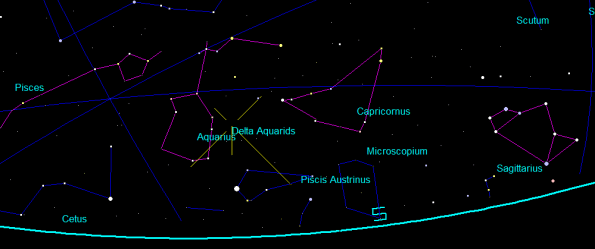
Approximate Radiant of the South Delta Aquariid meteor shower. The radiant does move over the several weeks of the shower to the east. Created using my LookingUp program.
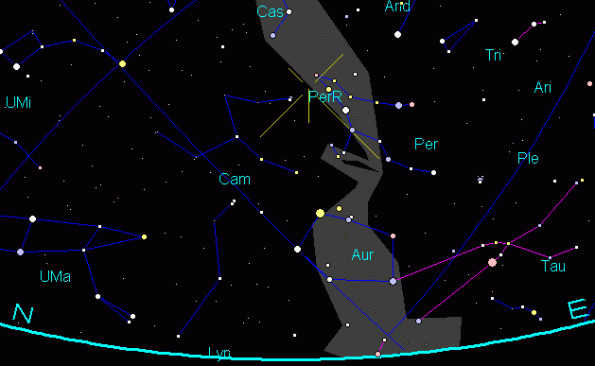
Perseid Meteor Shower radiant after midnight. Created using my LookingUp program.
Update: Occultation of Aldebaran tomorrow morning
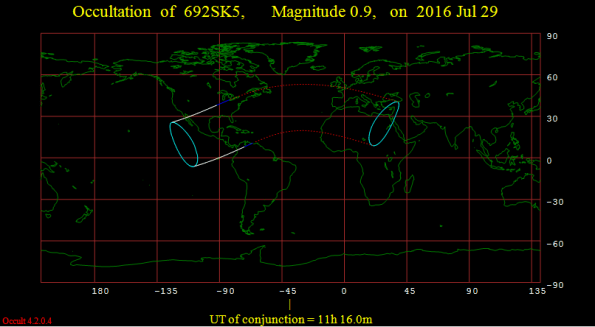
The area where the occultation of Aldebaran will be visible. The area bordered by the white lines is where the occultation will occur with the Sun below the horizon. Credit IOTA’s Occult 4 program.
There will be an occultation of Aldebaran by the Moon centered on 11:16 UT (7:16 a.m. EDT) July 29, 2016. Our area (Michigan) cannot see the event, being too far north. It will be visible south of a line containing the state of Maine down through Texas. Universe Today has information on grazing occultation possibilities: http://www.universetoday.com/129841/spectacular-aldebaran-graze-july-29/
02/04/2016 – Ephemeris – The Great Underwater Panther & Fun star contest tonight
Ephemeris for Friday, March 4th. The Sun will rise at 7:14. It’ll be up for 11 hours and 21 minutes, setting at 6:35. The Moon, 3 days past last quarter, will rise at 4:47 tomorrow morning.
The Anishnabek people of the Great Lakes Region, which includes the Odawa and Chippewa Indians have two constellations of winter that I know of. The first is The Winter Maker which uses many of Orion’s stars plus Procyon the Little Dog Star. It rises in the eastern skies in the evening as winter is beginning. The second is the Great Underwater Panther. Which uses the stars of Leo the lion’s backward question mark as its tail and the small knot of stars that are the head of hydra the water snake below Cancer as its head. I imagine this constellation was a warning to youngsters to keep off the thinning ice of spring, lest they fall in and be snatched by the great underwater panther that lives down there.
Times are for the Traverse City/Interlochen area of Michigan. They may be different for your location.
Addendum
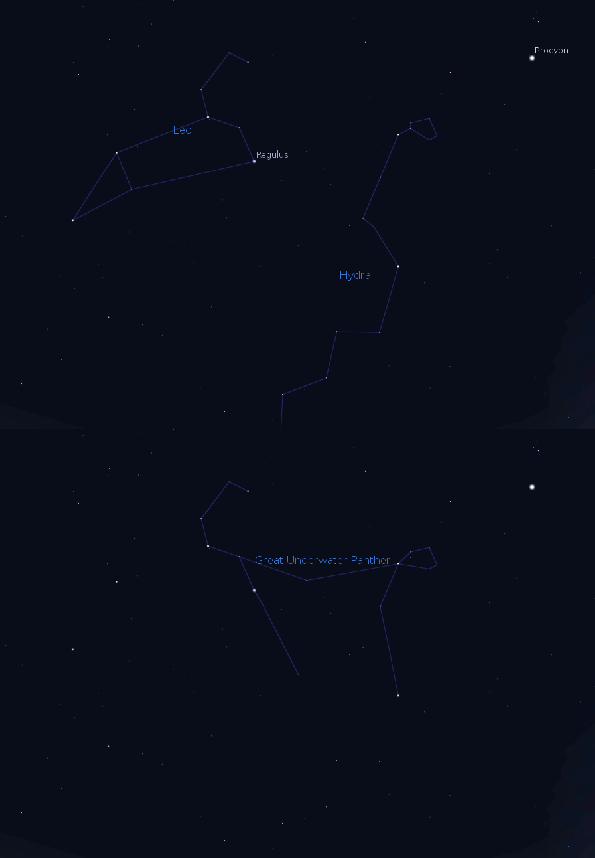
Alternately showing Leo and Hydra of our “Western” constellation and the Anishinabek constellation of the Great Underwater Panther. Created using Stellarium. The constellation drawing of the panther is mine after Michael Wassegijig Price.
Starpardy Tonight!
An astronomical quiz between the astronomy students and members of the Northwestern Michigan College Astronomy Club vs. the Grand Traverse Astronomical Society will be held tonight at 8 p.m. at the NMC Observatory. Folks attending can watch and learn or join one of the teams. The format is that of the popular Jeopardy show. These quizzes used to be called Star Bowls, after the old College Bowl TV shows. It’s been morphed into the Jeopardy format over the years, so this year I’m calling it Starpardy. And I can… I play Alex Trebek for this one, my second outing. Professor Jerry Dobek will be scorekeeper and arbiter of the Final Starpardy response, which will be open-ended this time. So come, enjoy the fun.
After the quiz there will be, weather permitting, a star party, and clear or not Becky Shaw will be by to continue her series on female astronomers of history and present day.
09/08/2015 – Ephemeris – Pegasus flies again
Ephemeris for Tuesday, September 8th. The Sun will rise at 7:13. It’ll be up for 12 hours and 53 minutes, setting at 8:07. The Moon, 3 days past last quarter, will rise at 3:44 tomorrow morning.
As summer wanes and the Sagittarius teapot tips its contents on the southwestern horizon the constellations of autumn rise in the east. I’ve already mentioned Cassiopeia, which is so far north it never really leaves us in northern Michigan. Pegasus the flying horse of Greek mythology is perhaps the most famous of the autumn constellations, and easiest to find. Its body, a large square of four stars, is in the east, standing on one corner. It is known as the Great Square of Pegasus. Only the front half of the horse is in the sky, and he’s flying upside down with his neck and head extending to the right from the rightmost star. His galloping front legs extend upward from the top star. Our Anishinaabek native peoples saw a moose here standing upright.
Times are for the Traverse City/Interlochen area of Michigan. They may be different for your location.
Addendum
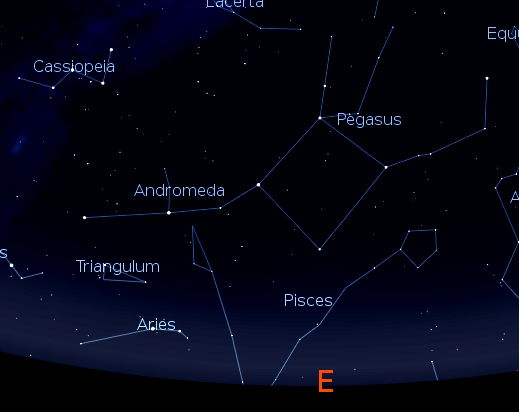
Pegasus at 10 p.m. Chart created using Stellarium.
04/09/2015 – Ephemeris – Two water creatures among the stars
Ephemeris for Thursday, April 9th. The Sun will rise at 7:09. It’ll be up for 13 hours and 10 minutes, setting at 8:20. The Moon, 2 days before last quarter, will rise at 1:30 tomorrow morning.
Hydra the water snake is the longest of the constellations. Its head is a group of five stars in a close group below a line between Leo the Lion and Gemini the twins in the southwest. This year it is below Jupiter. Its stars drop down and skirt the horizon underneath Corvus the crow, an interesting box-like constellation and Virgo and dip below the horizon in the southeast. It takes a low southern horizon to follow its body that far. It’s brightest star is Alphard. To the native peoples around here the sickle of Leo, the head of Hydra and stars down to Alphard made the Great Underwater Leopard, ready to snatch the foolish who ventured out on the thin ice and broke through this time of year.
Times are for the Traverse City/Interlochen area of Michigan. They may be different for your location.
Addendum
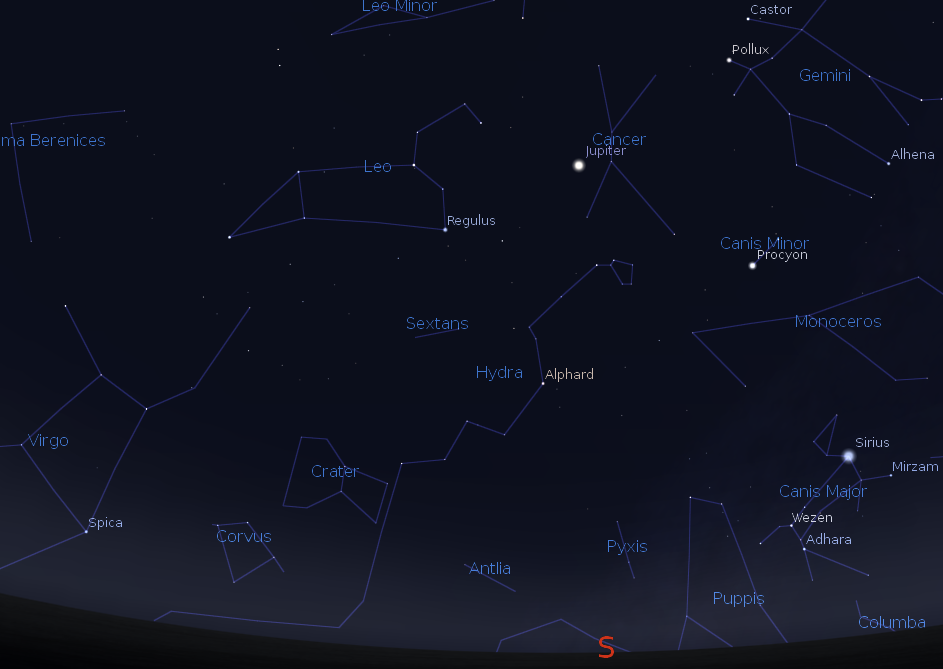
Hydra finder chart for 9:30 p.m. April 9, 2015. Created using Stellarium.
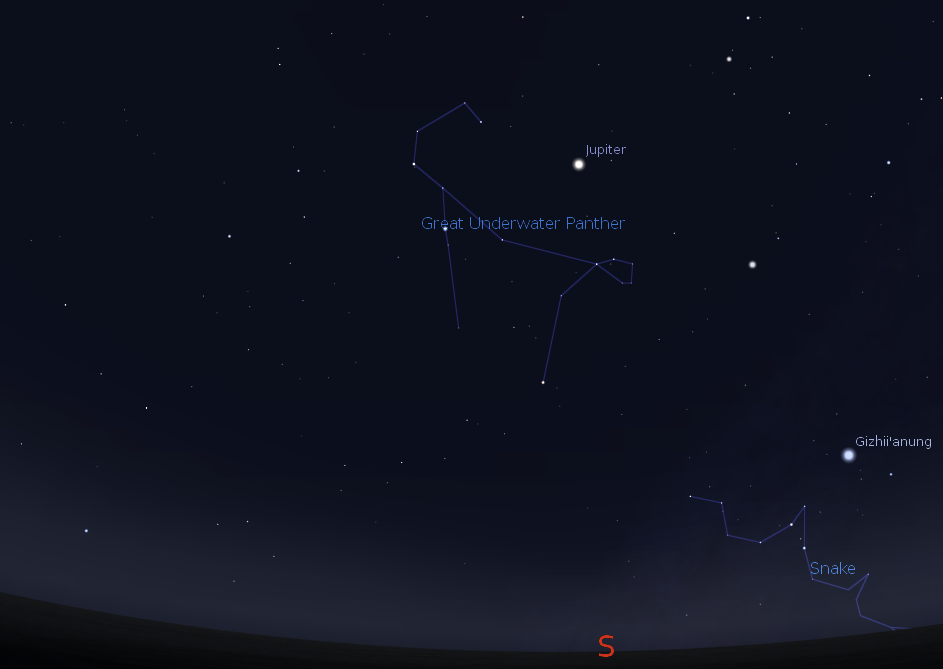
The Anishinaabek Great Underwater Panther. 9:30 p.m. April 9, 2015. Created using Stellarium. Constellation by Bob Moler, based on a video by Michael Wassegijig Price.
The video is here.
03/09/2015 – Ephemeris – The Big Dipper, a sign of spring
Ephemeris for Monday, March 9th. The Sun will rise at 8:06. It’ll be up for 11 hours and 34 minutes, setting at 7:40. The Moon, 4 days before last quarter, will rise at 11:43 this evening.
There’s a sign of spring appearing in the sky, rising high in the northeast. It’s the Big Dipper standing on its handle. In the native story of the Fisher Star, it’s the sign that it’s time for the maple sugar season. The Big Dipper is part of Ursa Major the great bear or a weasel-like creature called Fisher or Fisher Star. Draw a line through the bottom of the bowl of the dipper as if it leaks, and it will drip on the back of Leo the lion in the southeast. The handle of the Big Dipper will arc to Arcturus after 10 p.m. when that star rises. The most important guide that the Big Dipper provides is to point to Polaris, the north star. The two stars at the front of the bowl of the dipper point to Polaris, that alone of all the stars appears fixed in the north.
Times are for the Traverse City/Interlochen area of Michigan. They may be different for your location.
Addendum
The Big Dipper, part of Ursa Major and also part of Fisher Star in the northeastern sky at 9 p.m. March 9, 2015
For the story of Fisher Star follow this link.
06/19/2014 – Ephemeris – The constellation Hercules
Ephemeris for Thursday, June 19th. Today the sun will be up for 15 hours and 33 minutes, setting at 9:30. The moon, at last quarter today, will rise at 1:50 tomorrow morning. Tomorrow the sun will rise at 5:57.
Orion, the hard luck Greek hunter gets a splashy constellation in the winter sky, but the greatest hero of all, Hercules, gets a dim group of stars on the border between the spring and summer stars. At 11 p.m. Hercules is high in the southeast. It is located above and right of the bright star, Vega in the east. Hercules’ central feature is a keystone shaped box of stars, called the Keystone, which represents the old boy’s shorts. From each top corner extend lines of stars that are his legs, from the bottom stars, the rest of his torso and arms extend. So in one final indignity he’s upside down in our sky. Some see him crouched down, club upraised holding the Hydra about to throttle it. [For those with a telescope it contains the beautiful globular star cluster M13.]
Times are for the Traverse City/Interlochen area of Michigan. They may be different for your location.
Addendum
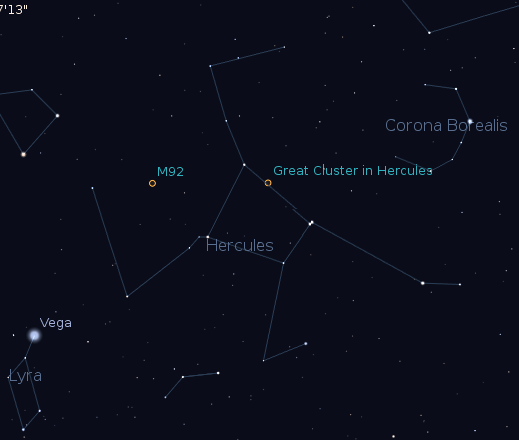
The constellation Hercules and his neighbors. Created with Stellarium.
On Tuesday I mentioned that for the Anishinabek people around the Great Lakes, Corona Borealis is a Sweat Lodge. Incidentally the Pleiades, only seen in the sky at the same time as Corona Borealis on autumn evenings on opposite ends of the sky, are the seven stones of the Sweat Lodge ceremony. The stars of Hercules represents one poor fellow, who couldn’t stand the heat of the sweat lodge and is splayed on the snow near by.
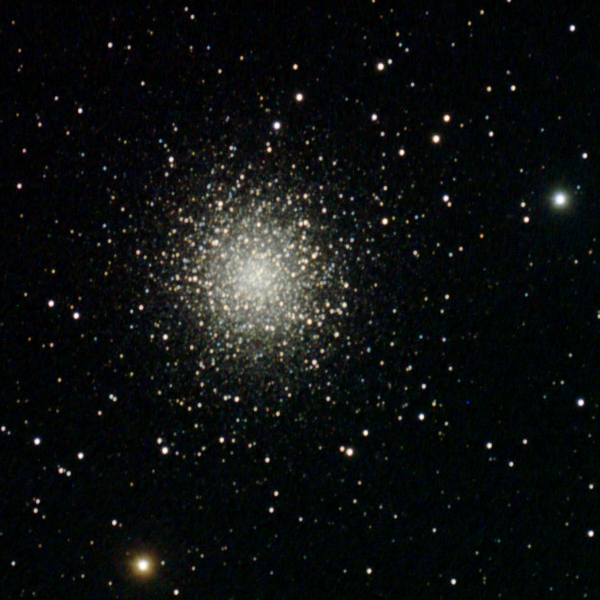
M13, the Great Globular Star Cluster in Hercules. Credit: Scott Anttila
 Bob Moler's Ephemeris Blog