Archive
10/24/2019 – Ephemeris – Let’s find Aquarius
Ephemeris for Thursday, October 24th. Today the Sun will be up for 10 hours and 33 minutes, setting at 6:43, and it will rise tomorrow at 8:11. The Moon, half way from last quarter to new, will rise at 4:41 tomorrow morning.
One of the constellations of the zodiac is in the southeastern sky at 8 in the evening. It’s the constellation of Aquarius the water bearer. The image that is supposed to be depicted in the stars is that of a fellow spilling a stone jar of water. Aquarius is fairly hard to spot because it is made of faint stars. One part of him, though, is easy to spot. That is the Water Jar, an asterism or informal constellation. It is a distinctive small nearly equilateral triangle of stars with another star in the center. Stars extending to the right from the water jar are the yoke he’s holding the water jar with. The Water jar is just below the top of the head of the upside down Pegasus the flying horse. The water is flowing down a vertical line of stars.
The times given are for the Traverse City/Interlochen area of Michigan. They may be different for your location.
Addendum
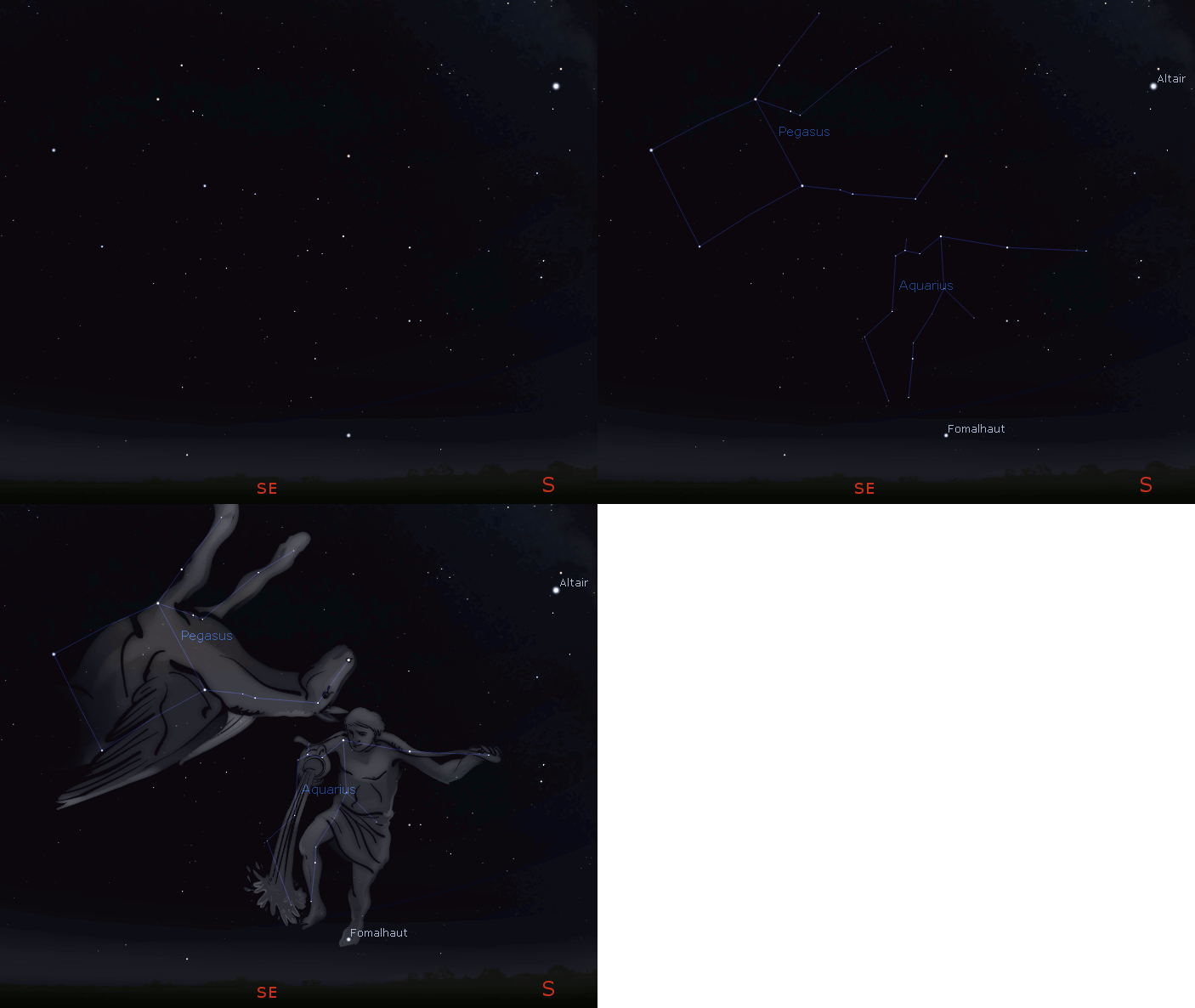
Aquarius finder animation for tonight at 8 p.m. October 24, 2019. Created using Stellarium and GIMP.
08/20/2019 – Ephemeris – To find Sagittarius, look for the Teapot
Ephemeris for Tuesday, August 20th. Today the Sun will be up for 13 hours and 49 minutes, setting at 8:40, and it will rise tomorrow at 6:51. The Moon, 3 days before last quarter, will rise at 11:16 this evening.
Due south and low in the sky at 10:30 p.m. now is one of my favorite asterisms the Teapot of the constellation Sagittarius. Sagittarius classically represents a centaur with a bow and arrow aimed at the heart of the constellation Scorpius to its west. I can find the bow and arrow here, but the half man half horse figure of the centaur eludes me. However the stout little teapot of the children’s song is quite obvious, with its base, lid on top, handle to the left and the spout to the right. To make things more realistic the bright Milky Way seems to rise like steam from its spout. As the night goes on the Teapot slides westward and appears to tilt, pouring its tea on the southwestern horizon. Saturn this year is above and left of it.
The times given are for the Traverse City/Interlochen area of Michigan. They may be different for your location.
Addendum
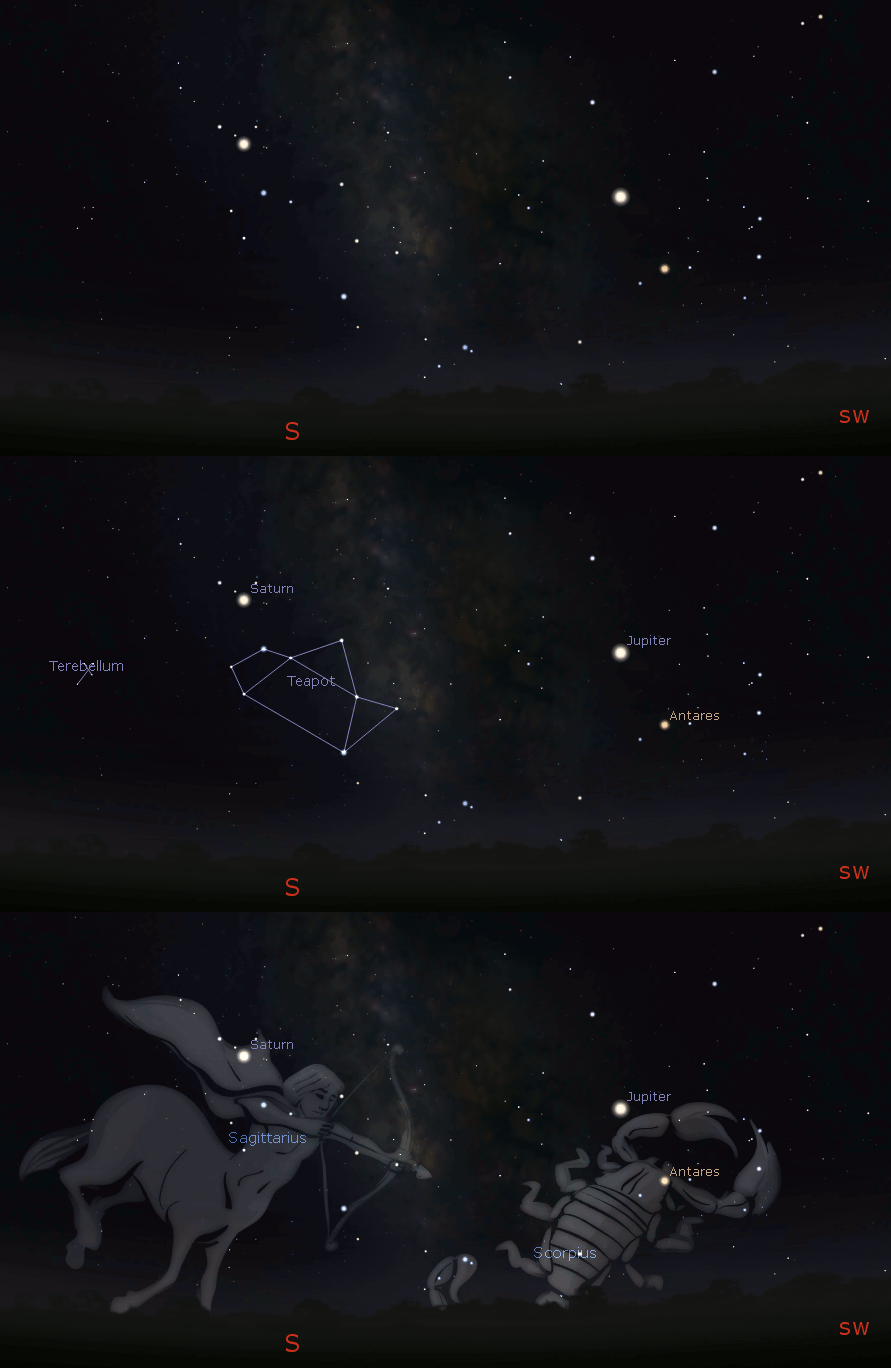
Sagittarius Teapot finder animation based of August 20, 2019 at 10:30 p.m. It includes the tiny asterism Terebellum, Latin for auger. It’s made to faint 4th and 5th magnitude stars. Created using Stellarium and GIMP.
07/26/2019 – Ephemeris – Scorpius the starry scorpion crawls over the southern horizon
Ephemeris for Friday, July 26th. Today the Sun will be up for 14 hours and 53 minutes, setting at 9:15, and it will rise tomorrow at 6:23. The Moon, 2 days past last quarter, will rise at 2:11 tomorrow morning.
There’s a large constellation located low in the south at about about 11 tonight. It’s Scorpius the scorpion. Its brightest star is Antares in its heart, a red giant star, that I get calls about from time to time as being a UFO. With bright Jupiter above and left of it, it won’t be as noticeable. From Antares to the right is a star then a vertical arc of three stars that is its head. The Scorpion’s tail is a line of stars running down to the left of Antares swooping to the horizon before coming back up and ending in a pair of stars that portray his poisonous stinger. There is a beautiful star cluster seen in binoculars at that first bend in the tail that is unfortunately too low to appreciate from this far north. I was very impressed with it when spotting it from the Florida Keys when I was down there in 1986 observing Halley’s Comet.
The times given are for the Traverse City/Interlochen area of Michigan. They may be different for your location.
Addendum
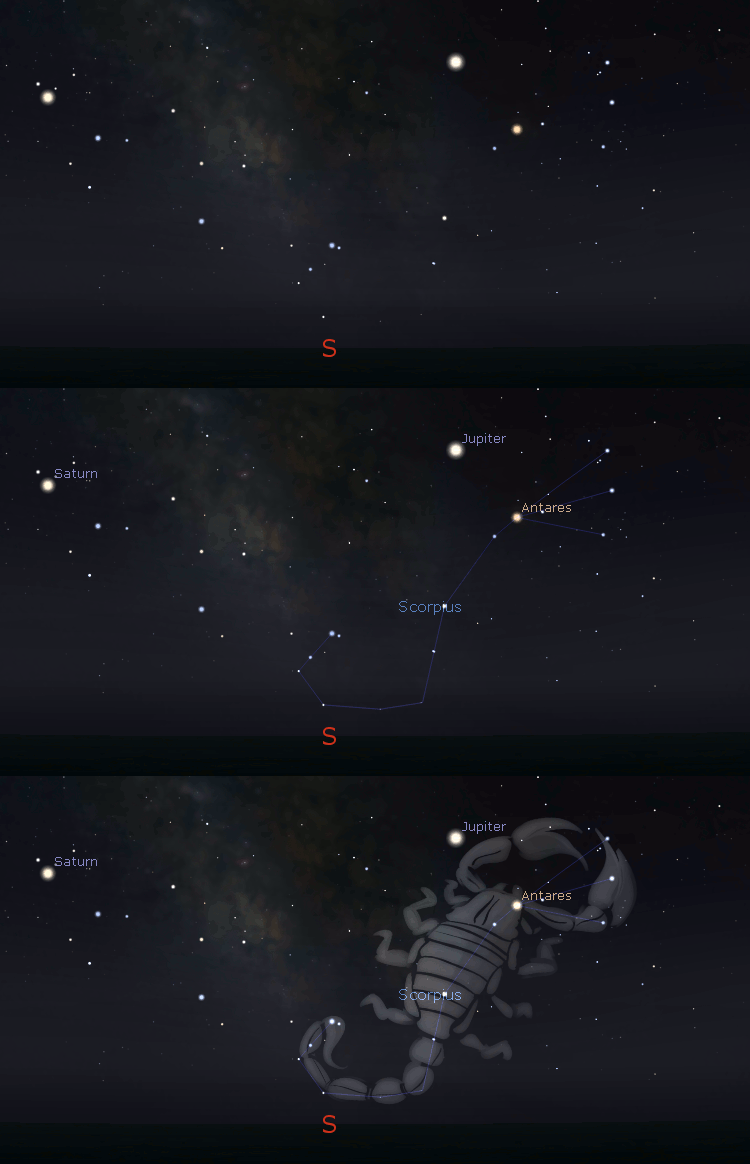
Animated finder chart for Scorpius the scorpion for 11 p.m. July 26, 2019. A year from now Jupiter will be just pass where Saturn is, and Saturn will be just off the frame of this image. Also note the “Teapot” asterism of Sagittarius just left of the scorpion with the Milky Way as steam rising from its spout.
03/28/2019 – Ephemeris – The Big Dipper as seen by some other countries
Ephemeris for Thursday, March 28th. Today the Sun will be up for 12 hours and 33 minutes, setting at 8:05, and it will rise tomorrow at 7:29. The Moon, at last quarter today, will rise at 4:21 tomorrow morning.
The Big Dipper is climbing up the northeastern sky at 9:30 in the evening, it’s seven stars shining brightly. The Big Dipper is not an actual constellation, recognized internationally. It’s part, the hind part, of Ursa Major, the great bear. The Big Dipper is an asterism or informal constellation. It is a distinctly North American constellation. For fugitive slaves, fleeing the southern states in the days before the Civil War, the Drinking Gourd, as they called it, showed the direction north to freedom. In England the dipper stars become the Plough, or Charles’ Wain (Charlemagne’s Wagon). In France, known for culinary delights it was the saucepan, or the cleaver. Many cultures saw what was familiar to them in these seven bright stars.
The times given are for the Traverse City/Interlochen area of Michigan. They may be different for your location.
Addendum
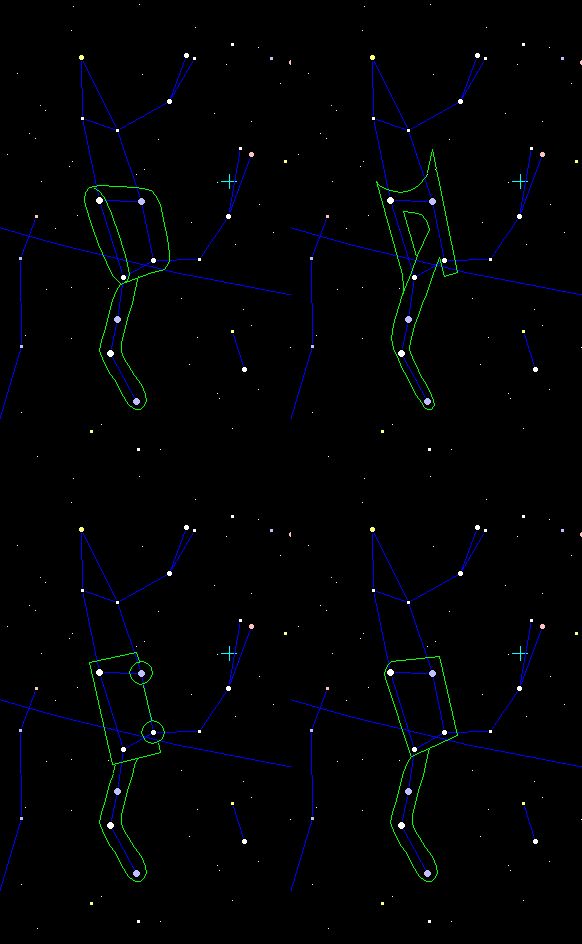
Cultural views of the Big Dipper as an Animation: Big Dipper/Sauce Pan, Plough (plow), Charle’s Wain (Charlemagne’s wagon), Cleaver.
12/04/2018 – Ephemeris – Auriga the Charioteer
Ephemeris for Tuesday, December 4th. The Sun will rise at 8:03. It’ll be up for 8 hours and 59 minutes, setting at 5:02. The Moon, 3 days before new, will rise at 6:03 tomorrow morning.
The constellation Auriga the charioteer is half way up the sky in the east northeast at 9 p.m. It is a pentagon of stars, with the brilliant star Capella at the upper left of its corners. Capella represents a mama goat he’s carrying. A narrow triangle of stars just right of Capella are her kids, that is her baby goats. The Kids is an informal constellation or asterism. The Milky Way runs through Auriga, but it’s not very bright here. We are looking away from the center of the Milky Way to the more sparse outer parts. Within and near that pentagon, one can sweep with binoculars and low power telescopes to find several star clusters, groups of hundreds of stars born in the clump we still see them in. These star clusters will appear as fuzzy spots in binoculars.
The times given are for the Traverse City/Interlochen area of Michigan. They may be different for your location.
Addendum

Auriga and neighboring constellations for 9 p.m. in early December. Created using Stellarium and GIMP.
11/13/2018 – Ephemeris – The Summer Triangle in autumn
Ephemeris for Tuesday, November 13th. The Sun will rise at 7:37. It’ll be up for 9 hours and 39 minutes, setting at 5:16. The Moon, 2 days before first quarter, will set at 10:20 this evening.
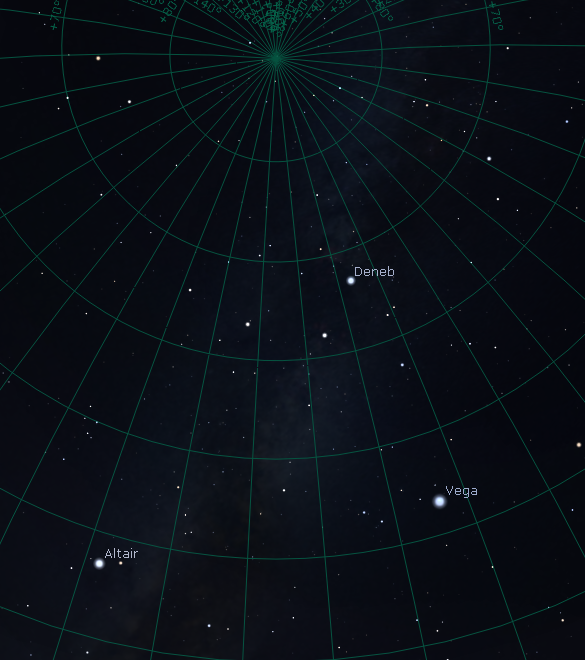
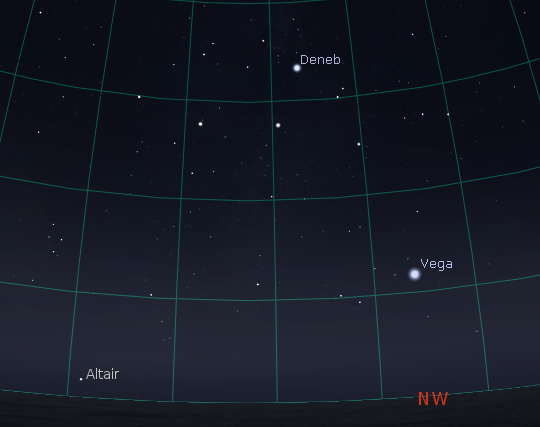
The Summer Triangle is still in the sky at 9 p.m., even though it’s November. These three bright stars that straddle the Milky Way are high in the east for most of the summer, move overhead and begin to slide to the west in autumn. We will lose Altair, the southernmost of the three stars at 9 p.m. on the winter solstice, December 21st. We’ll lose the brightest, Vega in January. For the northern half of the IPR listening area the northernmost of the triangle stars, Deneb won’t quite set below a north Lake Michigan horizon. Next spring we’ll be waiting and watching for these three stars to rise, reclaim the skies, and bring again the warm summer skies. The winter skies do however have more bright stars than the summer sky.
The times given are for the Traverse City/Interlochen area of Michigan. They may be different for your location.
Addendum
09/10/2018 -Ephemeris – The Coathanger in the sky
Ephemeris for Monday, September 10th. The Sun will rise at 7:15. It’ll be up for 12 hours and 47 minutes, setting at 8:02. The Moon, 1 day past new, will set at 8:57 this evening.
Just about every amateur astronomer knows a little asterism or informal constellation called the Coathanger. It’s stars are mostly below naked eye visibility, but it is a great sight in binoculars. It’s located along a line from Altair in Aquila the eagle to Vega in Lyra the harp. These are two star of the Summer Triangle. It is also just west of, or right of, the constellation Sagitta the arrow. It consists of six stars in just about a perfectly straight line with four stars in a tight group south of them making the hook. In telescope finders which invert the image the Coathanger appears right-side-up. Arab astronomer Al Sufi discovered it and described it in 964 AD. It has the catalog designation of Collinder 399. It is also known as Brocchi’s Cluster.
The times given are for the Traverse City/Interlochen area of Michigan. They may be different for your location.
Addendum
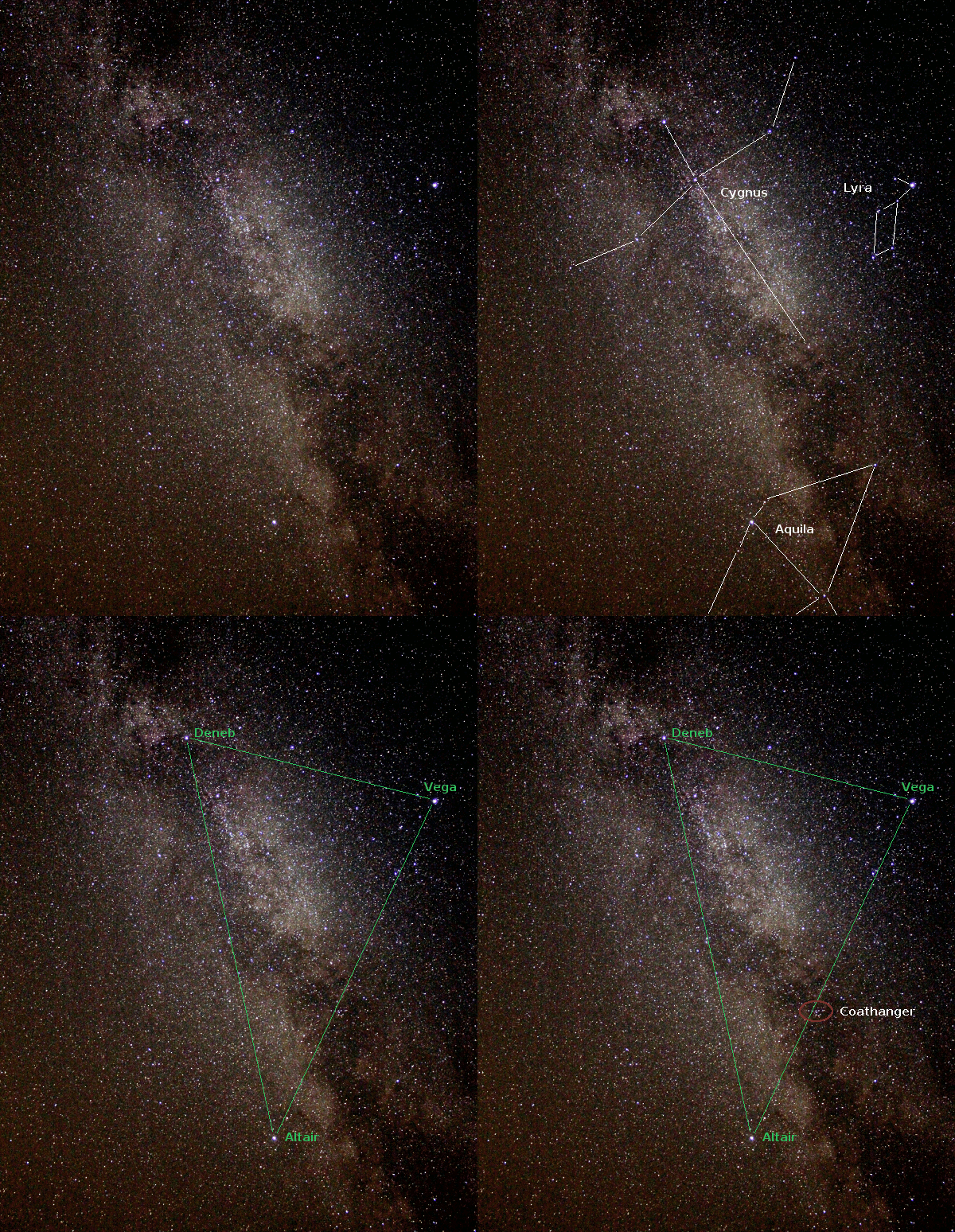
How to find the Coathanger. Look for the Summer Triangle. On the line from Altair to Vega the Coathanger can be found. Star imaged by Bob Moler.

Binocular view of the Coathanger. From the original resolution of the above photograph.

Telescope finder view of the Coathanger. Telescope finders usually invert the image, so it looks like a proper coat hanger.
07/02/2018 – Ephemeris – The starry triangle of summer
Ephemeris for Monday, July 2nd. Today the Sun will be up for 15 hours and 30 minutes, setting at 9:31, and it will rise tomorrow at 6:02. The Moon, half way from full to last quarter, will rise at 12:19 tomorrow morning.
Now that it’s summer it’s time to look for the Summer Triangle in the sky. It’s seen rising in the east as it gets dark. Highest of the three bright stars is Vega in the constellation Lyra the harp, whose body is seen in a narrow parallelogram nearby. The second star of the triangle is Deneb lower and left of Vega, It appears dimmer than Vega because it is by far the most distant of the three. The third star of the Summer Triangle is seen farther below and a right of Vega. It is Altair in Aquila the eagle, and the closest. Altair is 16.5 light years away, Vega is 27 light years while Deneb actually one of the brighter stars known, is 1500 or more light years away. It’s distance is not well known.
The times given are for the Traverse City/Interlochen area of Michigan. They may be different for your location.
Addendum
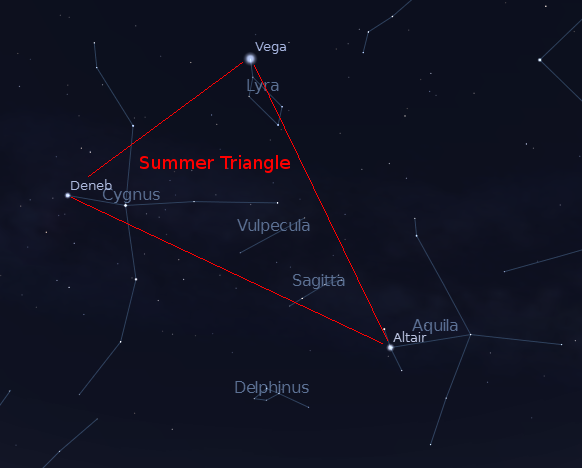
The Summer Triangle. Created using Stellarium.
04/23/2018 – Ephemeris – The Ursa Major Association
Ephemeris for Monday, April 23rd. The Sun rises at 6:45. It’ll be up for 13 hours and 52 minutes, setting at 8:37. The Moon, 1 day past first quarter, will set at 4:15 tomorrow morning.
The usual impression is to think that the stars of a constellation are actually located close together. This is usually not true. The stars of a constellation can be at vastly different distances. The Big Dipper is different. The five stars, excepting the two end stars of the dipper and 12 other dimmer stars in the general area are of similar distance and have the same motion through space. The group is called the Ursa Major Moving Cluster or Ursa Major Association, and is moving about 9 miles per second relative to the solar system to the east and south. An association is a rather loose, sparse star cluster. This association lies about 75 light years away. If it were five times farther away, it would be the same distance as the Pleiades.
The times given are for the Traverse City/Interlochen area of Michigan. They may be different for your location.
Addendum

Craig Brown’s drawing of where the stars of the Big Dipper are and are heading. Click on the image to go to Craig’s WordPress post.
04/19/2018 – Ephemeris – The Big Dipper’s stars Mizar and Alcor
Ephemeris for Thursday, April 19th. The Sun rises at 6:51. It’ll be up for 13 hours and 41 minutes, setting at 8:32. The Moon, 3 days before first quarter, will set at 12:47 tomorrow morning.
The most interesting star in the Big Dipper is Mizar and its dim companion Alcor. It is the second star from the end of the handle, where the bend in the handle takes place. Folks with good vision can see the dimmer star right next to Mizar. In ancient times it was used as an eye test for visual acuity for warriors as such it was known as the “Horse and the Rider”.
Mizar is second magnitude, in the second rank of star brightness invented by the Greek astronomer Hipparchus in the 2nd century BC. He ranked stars in 6 classes, from first magnitude for the brightest to 6th for the dimmest visible to the naked eye. Alcor comes in at 4th magnitude. It does suffer a bit by being close to Mizar which is 6 times brighter.
The times given are for the Traverse City/Interlochen area of Michigan. They may be different for your location.
Addendum
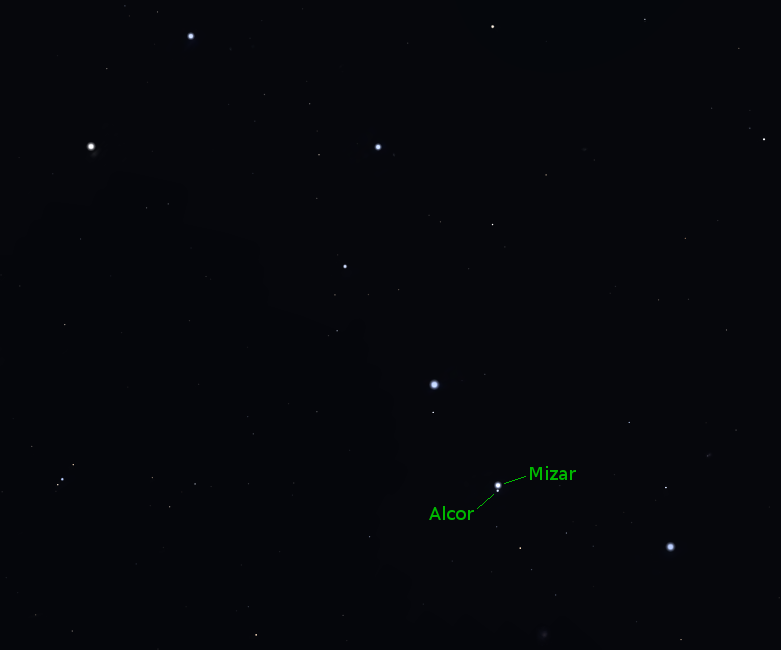
The Big Dipper, almost overhead at 10 p.m. April 19 with Mizar and Alcor pointed out. Created using Stellarium.
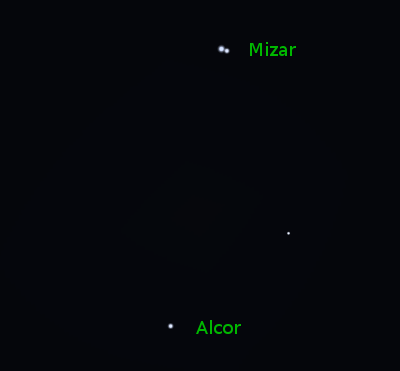
A view of Mizar and Alcor as seen in a telescope. Mizar is itself a binary star. In actuality both components of Mizar and Alcor are spectroscopic binaries, which are too close to split, but their presence is detected by their Doppler motions with spectrographs. Created using Stellarium.
 Bob Moler's Ephemeris Blog