Archive
04/23/2018 – Ephemeris – The Ursa Major Association
Ephemeris for Monday, April 23rd. The Sun rises at 6:45. It’ll be up for 13 hours and 52 minutes, setting at 8:37. The Moon, 1 day past first quarter, will set at 4:15 tomorrow morning.
The usual impression is to think that the stars of a constellation are actually located close together. This is usually not true. The stars of a constellation can be at vastly different distances. The Big Dipper is different. The five stars, excepting the two end stars of the dipper and 12 other dimmer stars in the general area are of similar distance and have the same motion through space. The group is called the Ursa Major Moving Cluster or Ursa Major Association, and is moving about 9 miles per second relative to the solar system to the east and south. An association is a rather loose, sparse star cluster. This association lies about 75 light years away. If it were five times farther away, it would be the same distance as the Pleiades.
The times given are for the Traverse City/Interlochen area of Michigan. They may be different for your location.
Addendum

Craig Brown’s drawing of where the stars of the Big Dipper are and are heading. Click on the image to go to Craig’s WordPress post.
04/19/2018 – Ephemeris – The Big Dipper’s stars Mizar and Alcor
Ephemeris for Thursday, April 19th. The Sun rises at 6:51. It’ll be up for 13 hours and 41 minutes, setting at 8:32. The Moon, 3 days before first quarter, will set at 12:47 tomorrow morning.
The most interesting star in the Big Dipper is Mizar and its dim companion Alcor. It is the second star from the end of the handle, where the bend in the handle takes place. Folks with good vision can see the dimmer star right next to Mizar. In ancient times it was used as an eye test for visual acuity for warriors as such it was known as the “Horse and the Rider”.
Mizar is second magnitude, in the second rank of star brightness invented by the Greek astronomer Hipparchus in the 2nd century BC. He ranked stars in 6 classes, from first magnitude for the brightest to 6th for the dimmest visible to the naked eye. Alcor comes in at 4th magnitude. It does suffer a bit by being close to Mizar which is 6 times brighter.
The times given are for the Traverse City/Interlochen area of Michigan. They may be different for your location.
Addendum
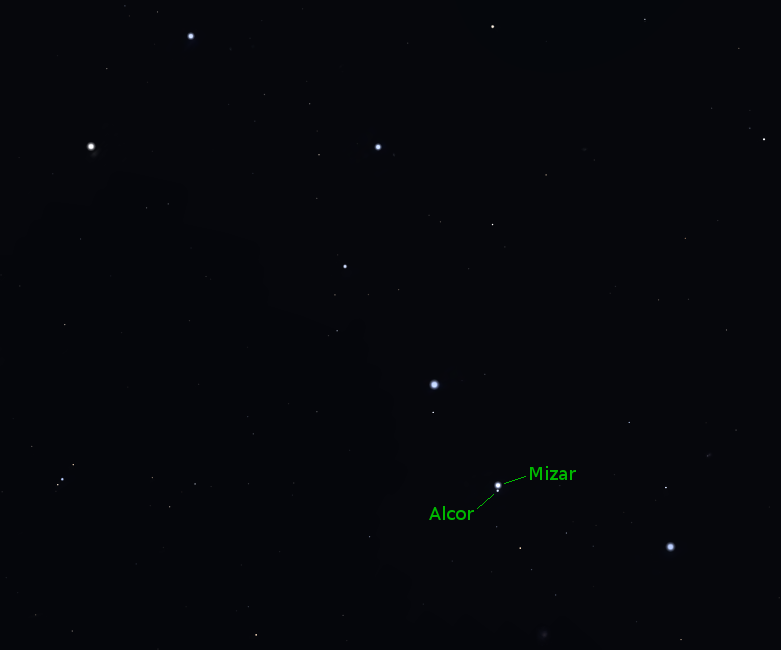
The Big Dipper, almost overhead at 10 p.m. April 19 with Mizar and Alcor pointed out. Created using Stellarium.
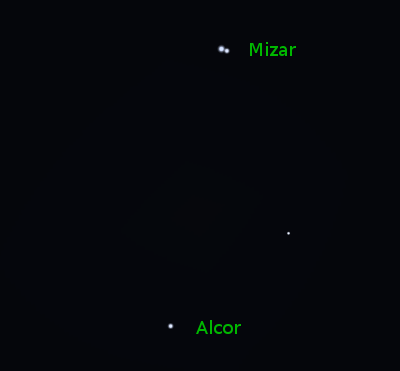
A view of Mizar and Alcor as seen in a telescope. Mizar is itself a binary star. In actuality both components of Mizar and Alcor are spectroscopic binaries, which are too close to split, but their presence is detected by their Doppler motions with spectrographs. Created using Stellarium.
06/22/2017 – Ephemeris – Now that it’s summer, lets check out the Summer Triangle
Ephemeris for Thursday, June 22nd. Today the Sun will be up for 15 hours and 33 minutes, setting at 9:31, and it will rise tomorrow at 5:57. The Moon, 1 day before new, will rise at 5:45 tomorrow morning.
We’re a day into summer, and the asterism or informal constellation called the Summer Triangle can be seen rising in the east as it gets dark. Highest of the three bright stars is Vega in the constellation Lyra the harp, whose body is seen in a narrow parallelogram nearby. The second star of the triangle is Deneb lower and left of Vega, It appears dimmer than Vega because it is by far the most distant of the three. The third star of the Summer Triangle is seen farther below and a right of Vega. It is Altair in Aquila the eagle, and the closest. Altair is 16.5 light years away, Vega is 27 light years while Deneb may be a whopping 2600 light years away. One light year is 6 trillion miles (9 trillion km).
The times given are for the Traverse City/Interlochen area of Michigan. They may be different for your location.
Addendum
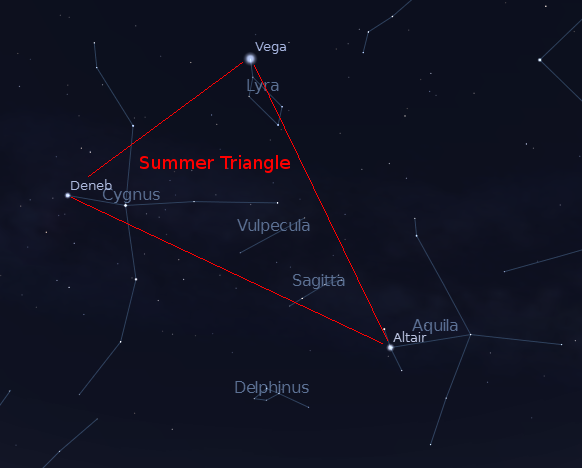
The Summer Triangle. Created using Stellarium and The Gimp.
05/23/2017 – Ephemeris – The Big Dipper as seen in many lands
Ephemeris for Tuesday, May 23rd. Today the Sun will be up for 15 hours and 6 minutes, setting at 9:12, and it will rise tomorrow at 6:05. The Moon, 2 days before new, will rise at 5:38 tomorrow morning.
The Big Dipper is overhead at 10 in the evening, it’s seven stars shining brightly. The Big Dipper is not an actual constellation, recognized internationally. It’s part, the hind part, of Ursa Major, the great bear. The Big Dipper is an asterism or informal constellation. It is a distinctly North American constellation. For fugitive slaves, fleeing the southern states in the days before the Civil War, the Drinking Gourd, as they called it, showed the direction north to freedom. In England the dipper stars become the Plough, or Charles’ Wain (Charlemagne’s Wagon), In France, known for culinary delights it was the saucepan, or the cleaver. So many cultures saw what was familiar to them in these seven bright stars.
The times given are for the Traverse City/Interlochen area of Michigan. They may be different for your location.
Addendum
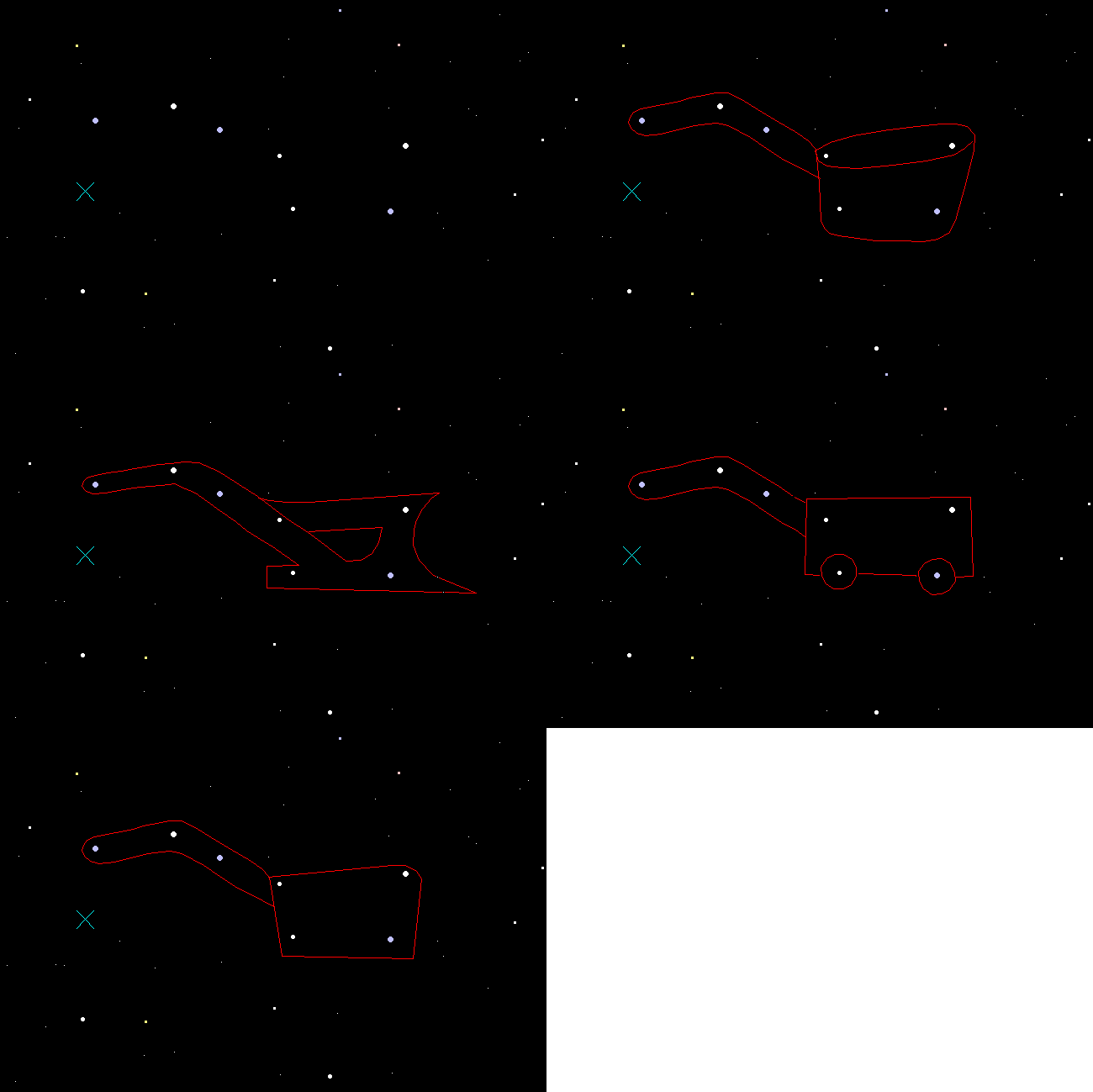
The Big Dipper as I imagine it from some lands facing southwest and looking straight up. The X in the picture is the zenith point. We cycle through the stars only, the Big Dipper or the Saucepan, The Plough (plow in the U.S.), Charles Wain, and finally the Cleaver. Created using my LookingUp program.
Do you know any other asterisms or informal constellations assigned to these stars, add a comment.
02/16/2017 – Ephemeris – The Winter Circle
Ephemeris for Thursday, February 16th. The Sun will rise at 7:40. It’ll be up for 10 hours and 32 minutes, setting at 6:12. The Moon, 2 days before last quarter, will rise at 12:17 tomorrow morning.
The winter skies are blessed with more first magnitude stars than any other season. These are the twenty-one brightest stars in the sky. Six of these stars lie in a large circle centered on the seventh. This circle is up all evening now that we are in the heart of winter. Starting high overhead is Capella in Auriga the charioteer. Moving clockwise, we come to Aldebaran in the face of Taurus the Bull. Then down to Orion’s knee we find Rigel. Down and left is the brightest star of all Sirius the Dog Star in Canis Major Orion’s large hunting dog, lowest of these stars in the south. Moving up and left there is Procyon in Canis Minor, Then above it is Pollux in Gemini the twins. All are centered on Betelgeuse in Orion.
Times are for the Traverse City/Interlochen area of Michigan. They may be different for your location.
Addendum
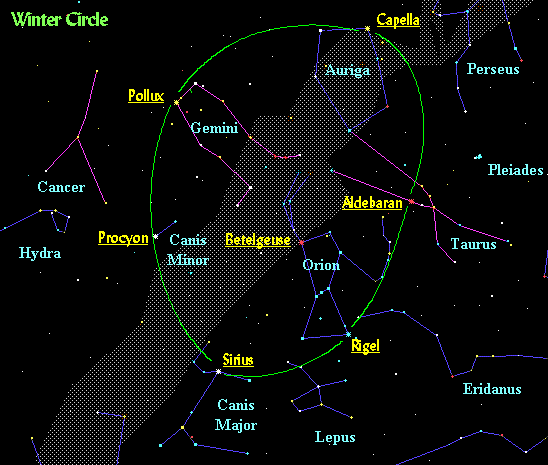
The Winter Circle of 1st magnitude stars. Created using my LookingUp program.
01/26/2017 – Ephemeris – Is it a dachshund or a hot dog?
Ephemeris for Thursday, January 26th. The Sun will rise at 8:07. It’ll be up for 9 hours and 36 minutes, setting at 5:43. The Moon, 1 day before new, will rise at 7:40 tomorrow morning.
The constellation Orion has two hunting dogs. We’ve seen Canis Major the greater dog at Orion’s feet with Sirius in its heart. The lesser dog, Canis Minor is level with Betelgeuse in Orion’s shoulder and off to the left. Just two stars mark it. Is it a dachshund or is it a hot dog? You decide. It’s brighter star’s name is Procyon which means “Before the dog”, an odd title. It means that though east of Sirius, it rises before Sirius, due to its more northerly position in the sky. In many ways Procyon is nearly a twin of Sirius. It shines with the same white color, although a bit cooler, and has a white dwarf companion like Sirius. It’s a bit farther away than Sirius’ 8 light years. Procyon is 11 and a half light years away. Procyon, Betelgeuse and Sirius make the winter triangle.
Times are for the Traverse City/Interlochen area of Michigan. They may be different for your location.
Addendum
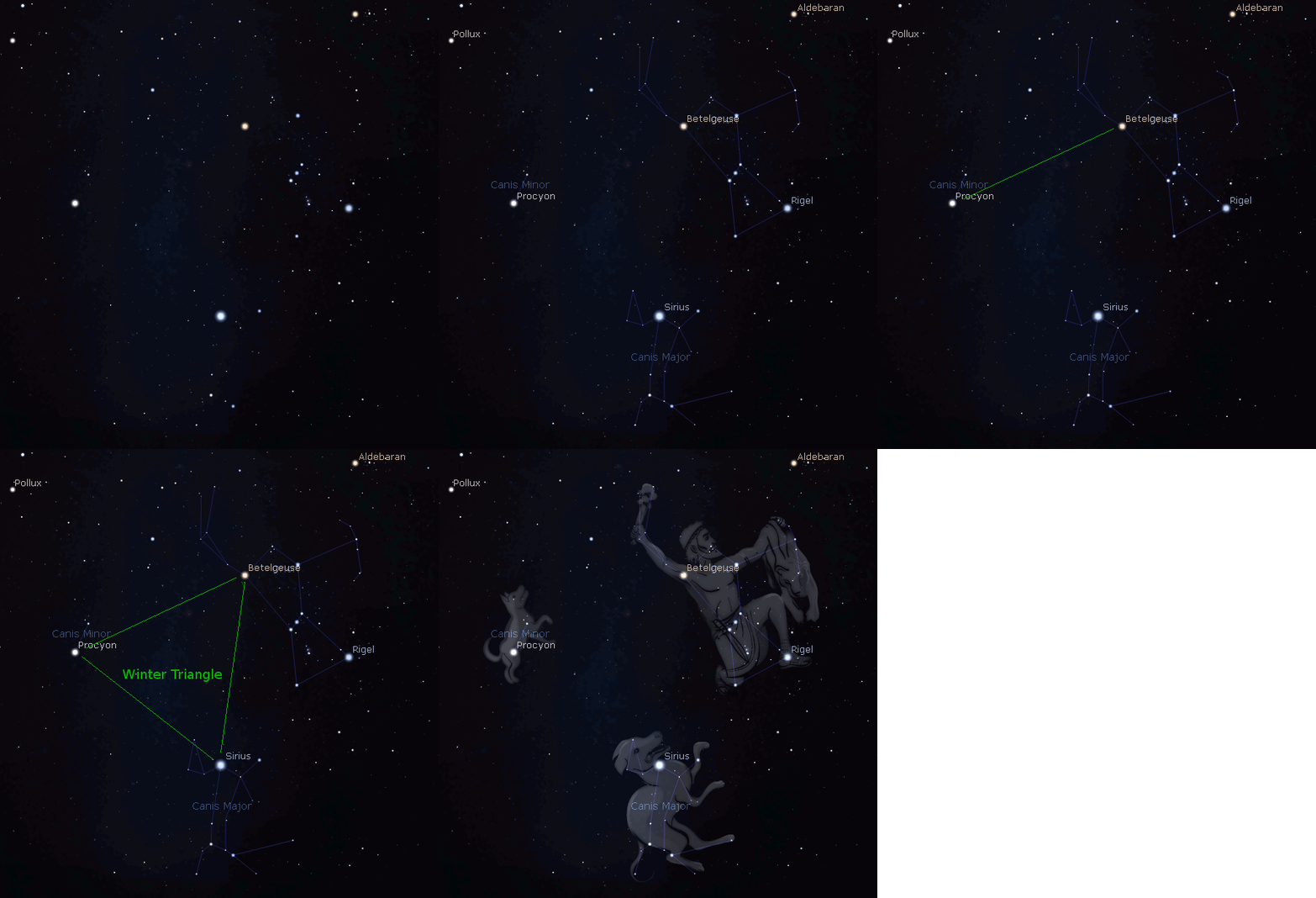
Procyon and Orion’s hunting dogs animation also showing the Winter Triangle asterism*. Created using Stellarium and GIMP.
* Asterism – an informal constellation like the Big Dipper, the Northern Cross, or the Summer Triangle. Not one of the 88 official constellations.
12/19/2016 – Ephemeris – OK kids, do I have to turn this chariot around
Ephemeris for Monday, December 19th. The Sun will rise at 8:16. It’ll be up for 8 hours and 48 minutes, setting at 5:04. The Moon, 1 day before last quarter, will rise at 11:44 this evening.
The constellation Auriga the charioteer is half way up the sky in the east at 8 p.m. It is a pentagon of stars, with the brilliant star Capella at one of its corners. Capella represents a she goat he’s carrying. A narrow triangle of stars nearby Capella are her kids, an informal constellation or asterism. Within and near that pentagon, binoculars and telescopes will find several star clusters, groups of hundreds of stars born in the clump we still see them in. These star clusters will appear as fuzzy spots in binoculars. One called M38 is near the center of the pentagon. Another, M36 is below it. Still another star cluster, M37, is farther below still. The M designations come from Charles Messier who two centuries ago ran into them while looking for comets.
Times are for the Traverse City/Interlochen area of Michigan. They may be different for your location.
Addendum
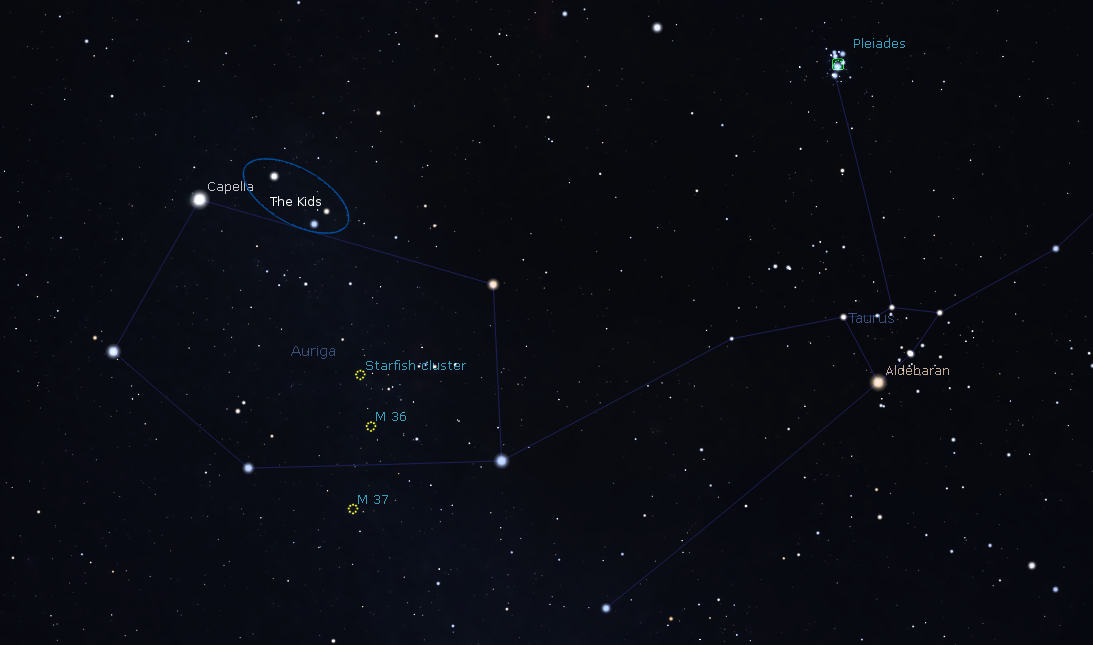
Auriga the charioteer with Capella and the Kids at 8 p.m. December 19, 2016. The object named the Starfish Cluster is M38. To the right is Taurus the bull with the Hyades, his face and above the Pleiades in his shoulder. Created using Stellarium and edited with GIMP. Click on the image to enlarge.
11/21/2016 – Ephemeris – The two fishies of Pisces
Ephemeris for Monday, November 21st. The Sun will rise at 7:48. It’ll be up for 9 hours and 20 minutes, setting at 5:08. The Moon, at last quarter today, will rise at 12:54 tomorrow morning.
High in the south-southeast at 9 p.m. are the four bright stars of the Great Square of Pegasus, the upside down flying horse. Lying along the left and bottom sides of the great square is the constellation of Pisces the fish, one of the 12 constellations of the Zodiac that lie along the path of the sun, moon and planets. Even though the constellation is called the fish, the fish themselves are not represented in the stars. What can be traced in the stars is the rope, that’s tied to their tails, anchored at the extreme southeastern part of the constellation that is seen in the stars. The right or western end of Pisces is the asterism, or informal constellation, of the Circlet. It’s the loop of 5 stars, the rope around the tail of one of the two fish.
Times are for the Traverse City/Interlochen area of Michigan. They may be different for your location.
Addendum
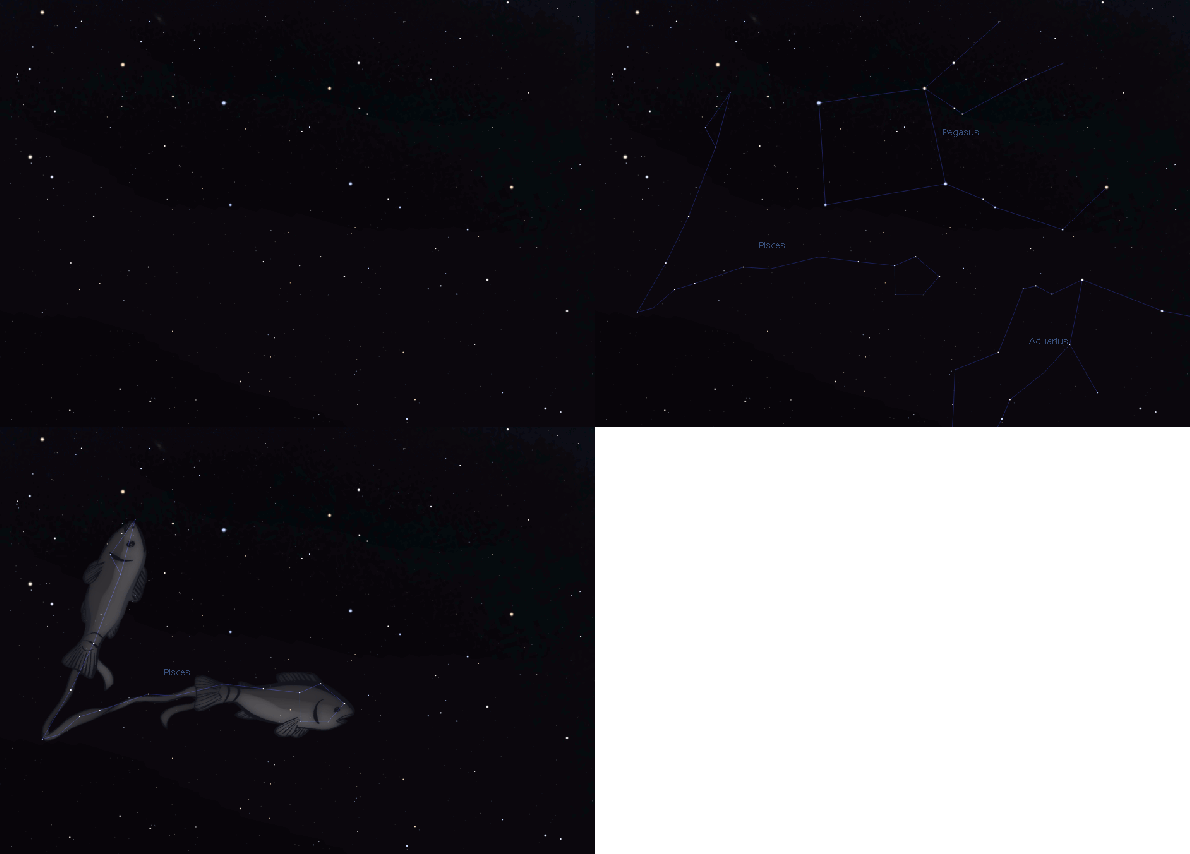
An animation of the constellation of Pisces the fish, showing first the stars, then the constellation outline including those of Pegasus, and Aquarius, then an artist rendering. Created using Stellarium and GIMP.
I don’t care what the artists think, I still think the circlet is a loop around the western fish’s tail.
08/29/2016 – Ephemeris – The celestial teapot
Ephemeris for Monday, August 29th. The Sun will rise at 7:02. It’ll be up for 13 hours and 21 minutes, setting at 8:23. The Moon, 3 days before new, will rise at 5:11 tomorrow morning.
If the ancient Greeks had teapots the constellation we call Sagittarius might have been Teapotius or something. It’s low in the south at 11 p.m. with the Milky Way rising like steam from its spout. Sagittarius is supposed to be a centaur with a bow and arrow. However to us the dearth of centaurs around outside of Harry Potter books, and there being lots of teapots around, and that great children’s song which perfectly describes the Sagittarius teapot. So the teapot is an asterism, like the Big Dipper, not one of the official constellations. A pair of binoculars is all you need to spot many fuzzy objects in and around Sagittarius. Pay special attention to that steam of the Milky way above the teapot’s spout for many fuzzy objects.
Times are for the Traverse City/Interlochen area of Michigan. They may be different for your location.
Addendum
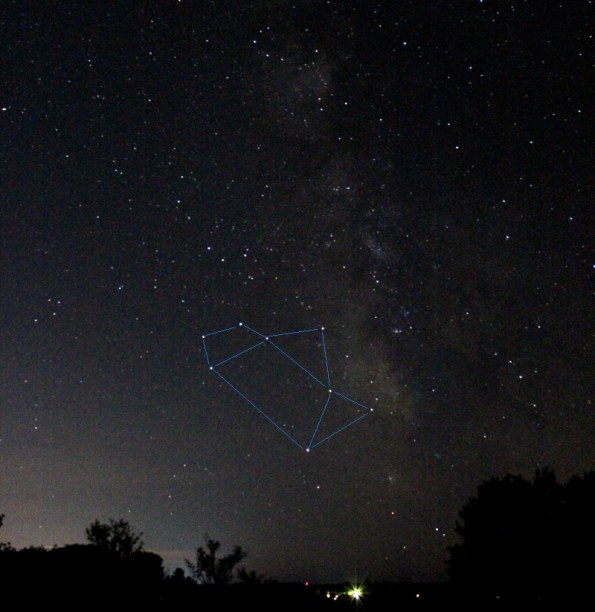
Sagittarius star field showing the Teapot. Credit Bob Moler.
06/23/2016 – Ephemeris – Tis the season to view the Summer Triangle
Ephemeris for Thursday, June 23rd. Today the Sun will be up for 15 hours and 34 minutes, setting at 9:32, and it will rise tomorrow at 5:58. The Moon, 3 days past full, will rise at 11:43 this evening.
Now that summer is here, the asterism or informal constellation called the Summer Triangle can be seen in the east as it gets dark. Highest of the three bright stars is Vega in the constellation Lyra the harp, whose body is seen in a narrow parallelogram nearby. The second star of the triangle is Deneb lower and left of Vega, It appears dimmer than Vega because its is by far the most distant of the three. The third star of the Summer Triangle is seen farther below and right of Vega. It is Altair in Aquila the eagle, and the closest. Altair is 16.7 light years away, Vega is 25 light years while Deneb may be a whopping 2600 light years away. With a light year at 6 trillion miles. That’s mind boggling to think in miles at least.
Times are for the Traverse City/Interlochen area of Michigan. They may be different for your location.
Addendum
The Summer Triangle. Created using Stellarium and The Gimp.

