Archive
Ephemeris: 11/13/2023 – Betelgeuse is acting weird again
This is Ephemeris for Monday, November 13th. Today the Sun will be up for 9 hours and 40 minutes, setting at 5:16, and it will rise tomorrow at 7:38. The Moon is new today, and won’t be visible.
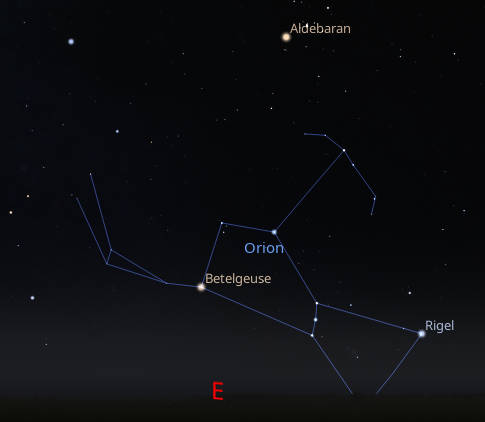
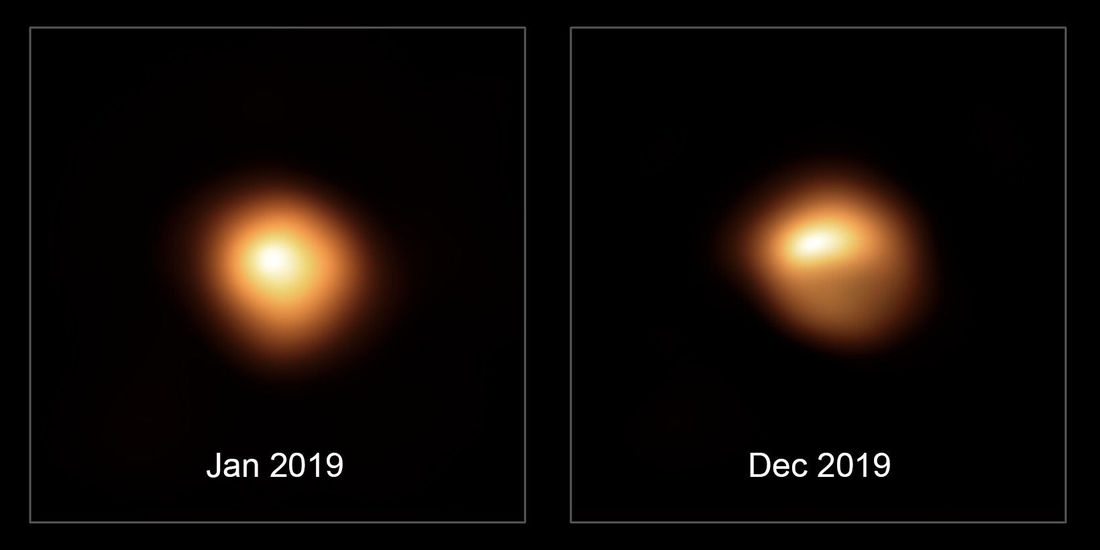
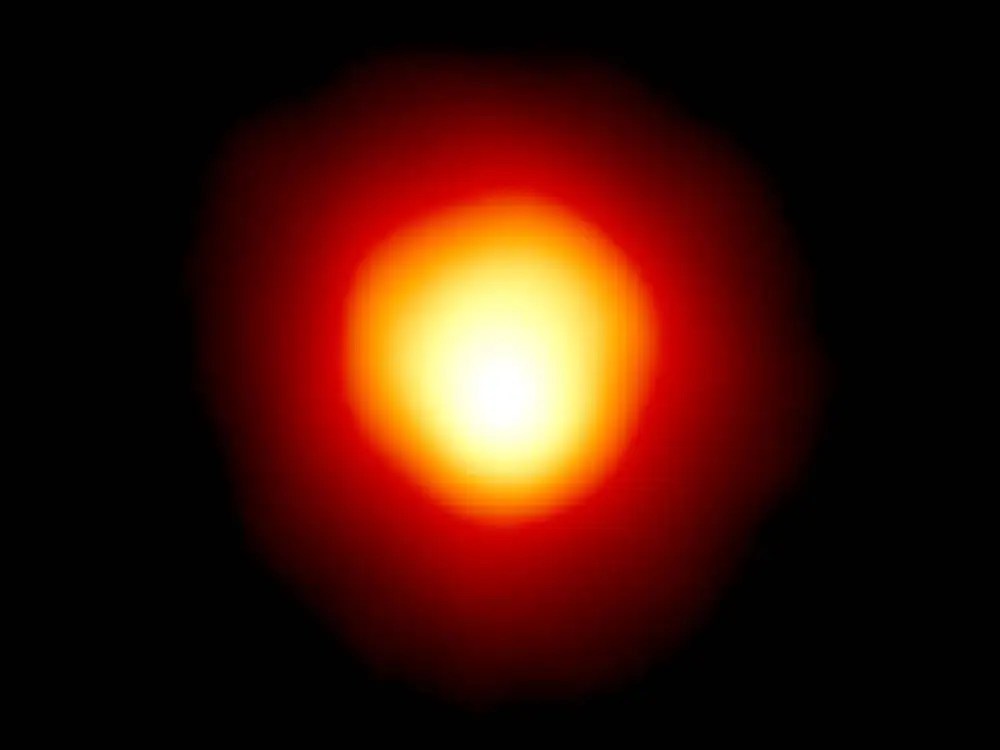
The constellation Orion is rising early in the evening now so what’s up with Betelgeuse. Betelgeuse is the bright reddish upper leftmost star of the torso of Orion the hunter, it’s in his shoulder. Betelgeuse has been acting up lately. In 2019 and 2020 Betelgeuse had dimmed significantly. Astronomers didn’t know why at the time, but found out later that it ejected a large cloud of gas and dust which blocked the light from the star. Now in the last year Betelgeuse has increased its brightness significantly, so it’s much brighter than normal. Again, we don’t exactly know why. Some have speculated that Betelgeuse is about ready to go supernova. We’ve known that for a while, but soon is measured within hundreds of thousands of years. So astronomers are keeping an eye on Betelgeuse to see what happens next.
The astronomical event times given are for the Traverse City/Interlochen area of Michigan (EST, UT –5 hours). They may be different for your location.
Addendum
Ephemeris: 10/27/2023 – Report on October 14th’s partial solar eclipse and looking forward
This is Ephemeris for Friday, October 27th. Today the Sun will be up for 10 hours and 25 minutes, setting at 6:38, and it will rise tomorrow at 8:15. The Moon, 1 day before full, will set at 7:55 tomorrow morning.
Two weeks ago tomorrow we had a partial eclipse of the Sun. Unfortunately around here it was pretty cloudy. I went to the Betsie Valley District Library knowing it was cloudy and brought a program to talk about mainly eclipses that I’ve seen and a preview of next April’s eclipse, which would be even better than the one we had two weeks ago. Towards the end of my talk I was looking out towards my audience and windows. I was the only one who could see out those windows, because I was facing that direction and I saw shadows. Sure enough the Sun came out, so we all piled out with our eclipse glasses and saw the maximum of the eclipse for maybe 15 minutes before it clouded up again. So the event was indeed a success.
The astronomical event times given are for the Traverse City/Interlochen area of Michigan (EDT, UT –4 hours). They may be different for your location.
Addendum
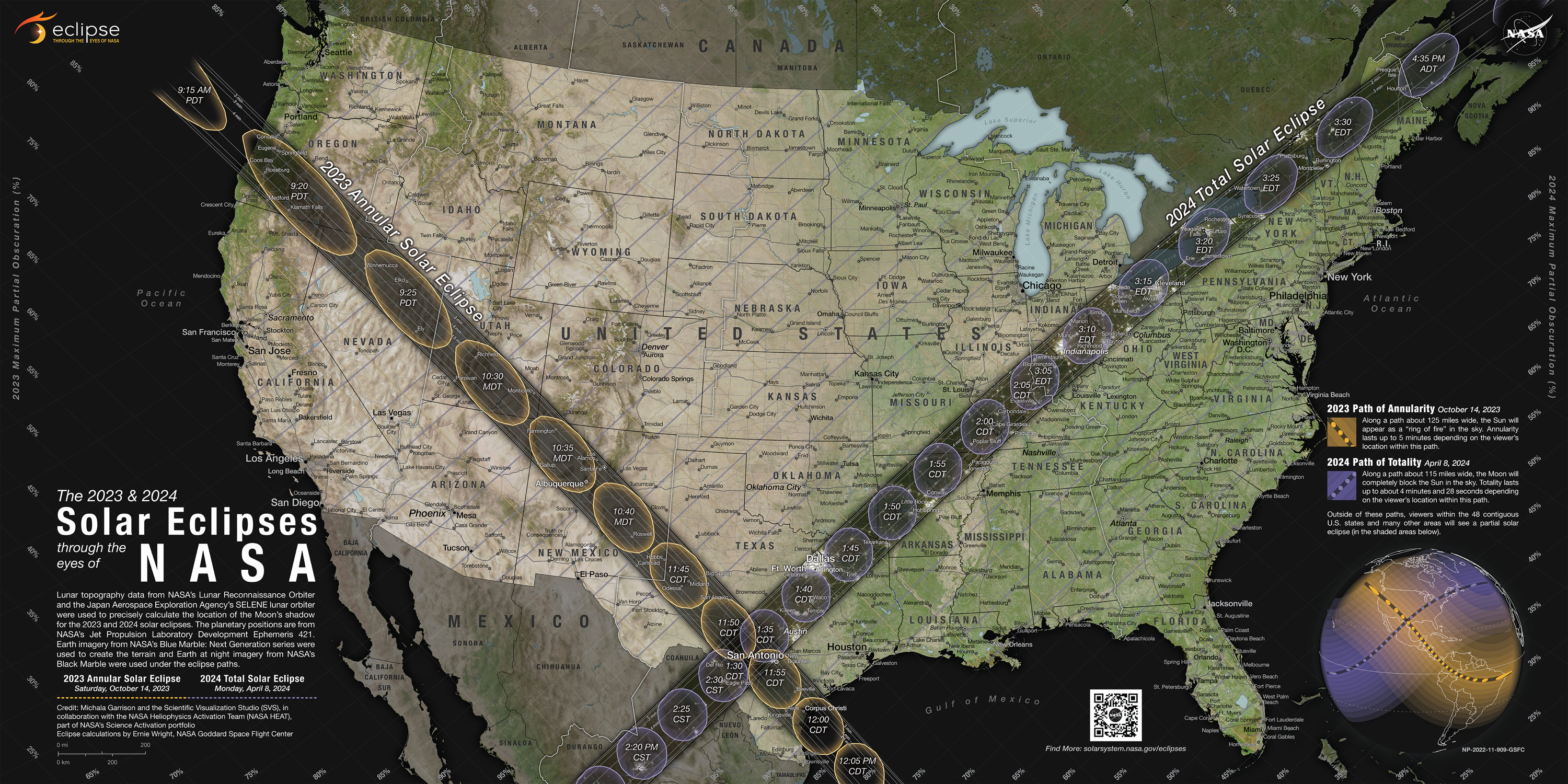
Below is a file to show April 8, 2024 eclipse path on Google Earth. It can be saved or used to bring up Google Earth. The file was created using Stellarium.
Ephemeris: 10/24/2023 – We might see a bright nova soon
This is Ephemeris for Tuesday, October 24th. Today the Sun will be up for 10 hours and 33 minutes, setting at 6:43, and it will rise tomorrow at 8:11. The Moon, 3 days past first quarter, will set at 3:57 tomorrow morning.
There is a star in the northern constellation of Corona Borealis the Northern Crown which we see normally on spring and summer evenings that is a recurring nova. A nova is a star that suddenly brightens from invisibility to visibility and soon fades. It is caused by a white dwarf orbiting with a larger, star siphoning off gases from the larger star until it builds up enough to create a thermonuclear explosion. This may not affect the star and may run through the process repeatedly. These are called reoccurring novae, and this one is designated T Coronae Borealis. It’s usually close to 11th magnitude which is hard to find even in binoculars to become one of the 50 brightest stars in the sky, as early as next year.
The astronomical event times given are for the Traverse City/Interlochen area of Michigan (EDT, UT –4 hours). They may be different for your location.
Addendum
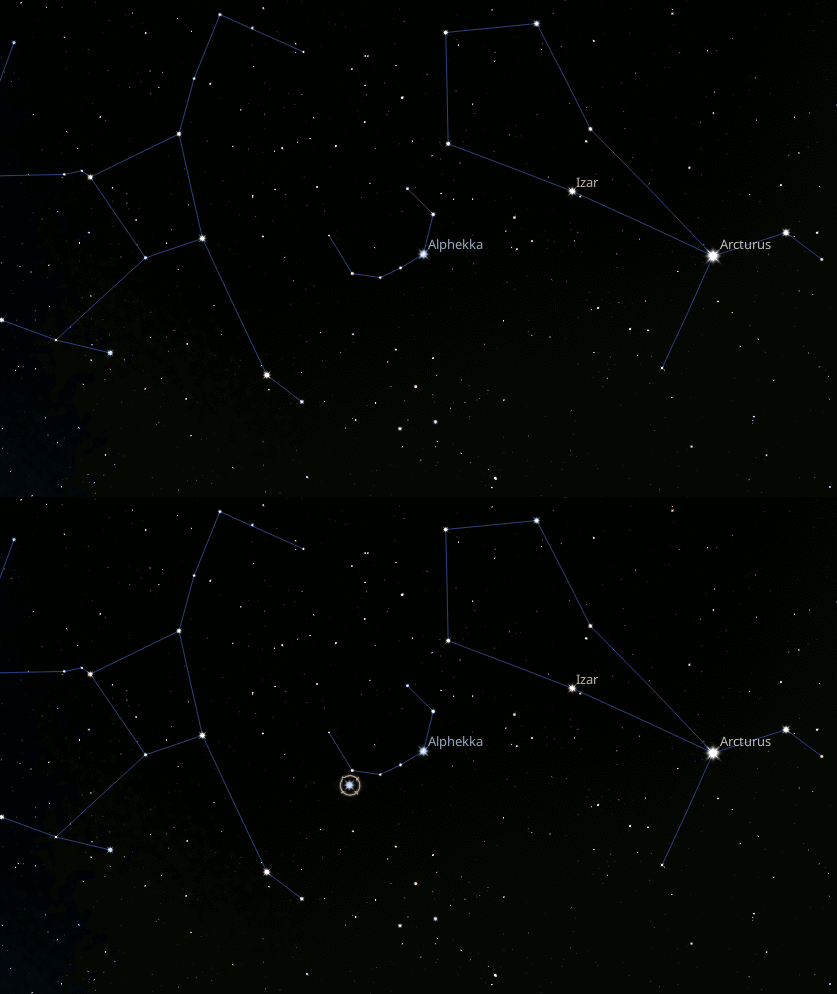
What got me onto this is an article from Universe Today for September 8th by Jon Voisey: A Medieval Manuscript Likely Hides a Record of an Impending Recurrent Nova. Another source for this Nova is to look up T CrB on Wikipedia. See below:
Ephemeris: 10/13/2023 – Tomorrow’s solar eclipse
This is Ephemeris for Friday, October 13th. Today the Sun will be up for 11 hours and 6 minutes, setting at 7:01, and it will rise tomorrow at 7:56. The Moon, 1 day before new, will rise at 7:45 tomorrow morning.
The safest way to view tomorrow’s solar eclipse is by projection, we call it pinhole projection, although the pinhole can be up to 1/4 inch in diameter and will cast a usable image of the Sun about 6 feet. My wife once used the mirror in her compact to reflect the Sun’s image onto the north side of a building across the street. It’s probably too late to buy them, but if you have any eclipse glasses leftover from the 2017 eclipse make sure they don’t have any pinholes in them. They can be used to view the eclipse. Make sure they are ISO approved. Still projection is your safest bet. For our area the eclipse will last from 11:42 am to 2:18 pm. I’ll be at the Betsie Valley District Library in Thompsonville for the eclipse. You’ll be in good shape for next April 8th total eclipse, whose path of totality will be much closer to us.
Jerry Dobek, Northwestern Michigan College instructor will be on campus with telescopes to view the eclipse on campus.
The astronomical event times given are for the Traverse City/Interlochen area of Michigan (EDT, UT –4 hours). They may be different for your location.
Addenda
In case of clouds, I will still be at the Betsie Valley District Library with an alternate program of my experience with five previous total solar eclipses, and a look at some future eclipses. Being a NASA Solar System Ambassador, I’ll have some NASA stickers and other things to hand out to the kids, big or small.
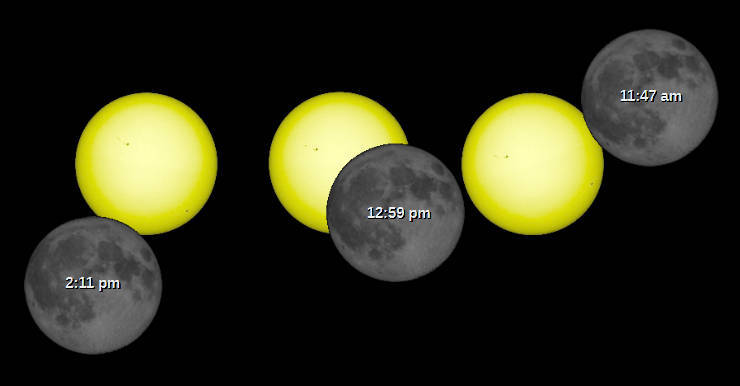
The next solar eclipse
The next eclipse visible from our area will occur on April 8, 2024, six months from now. It will be a total solar eclipse whose path of totality is within a day trip from our area, if it’s clear in Indiana or Ohio. I’ll have a lot more information as we approach April. On the Internet search for american eclipse 2024, or words to that effect. It’s always best to plan early.
Ephemeris: 08/24/2023 – The Moon will pass in front of the star Antares tonight
This is Ephemeris for Thursday, August 24th. Today the Sun will be up for 13 hours and 38 minutes, setting at 8:33, and it will rise tomorrow at 6:56. The Moon, at first quarter today, will set at 12:11 tomorrow morning. | Tonight the Moon is going to pass in front of the bright reddish star in Antares in Scorpius scorpion. The event is called an occultation, and it is the only one of the monthly occultations which we’re going to be able to see in this series that began last month and will extend to August 2028. Antares will disappear at the lower left edge of the dark or night part of the Moon at approximately 10:28 pm* this evening, and it’ll stay hidden until 11:32 pm* when it will pop out on the lower right edge of the bright part of the Moon. Start looking for Antares early, probably with binoculars, because the Moon will be quite bright and might overpower Antares when viewed by the naked eye. Hoping for clear skies tonight.
*The astronomical event times given are for the Traverse City/Interlochen area of Michigan (EDT, UT –4 hours). They may be different for your location. For other locations a planetarium computer app like Stellarium can be used to graphically predict occultation timings within a few minutes. Check your planetarium app, and set it to use Topocentric coordinates. In Stellarium, the selection is in the Configuration window, Tools tab. Check everything under Topocentric coordinates. That way the position of the Moon in the sky will be based on the chosen location, rather than the center of the Earth.
Addendum
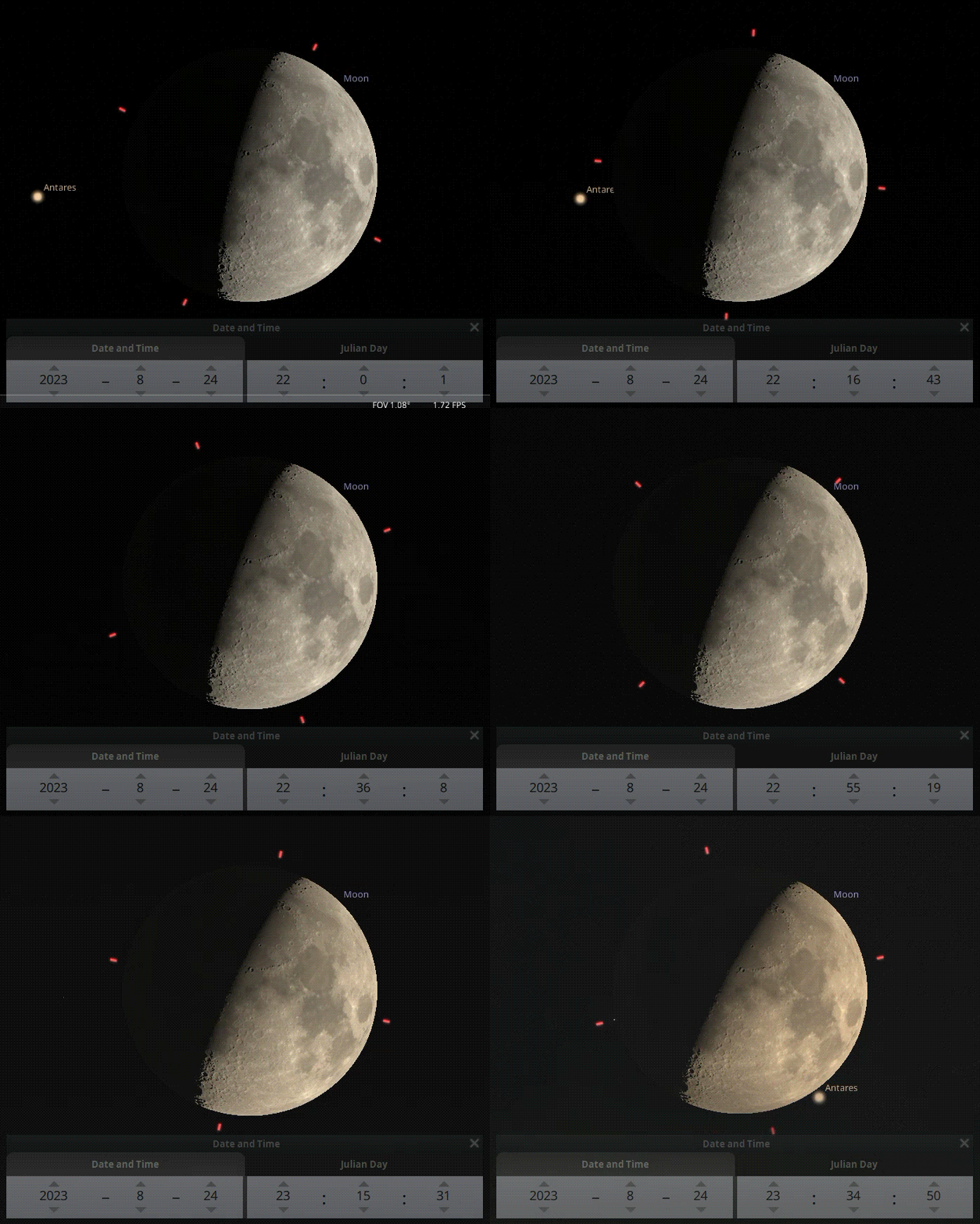
A time-lapse prediction of the occultation of Antares by the Moon based on Stellarium imagery. In the actual occultation Antares will wink out and on suddenly. Antares is a double star, with a 5th magnitude companion. It should wink out and in 9 seconds before the main first magnitude star.
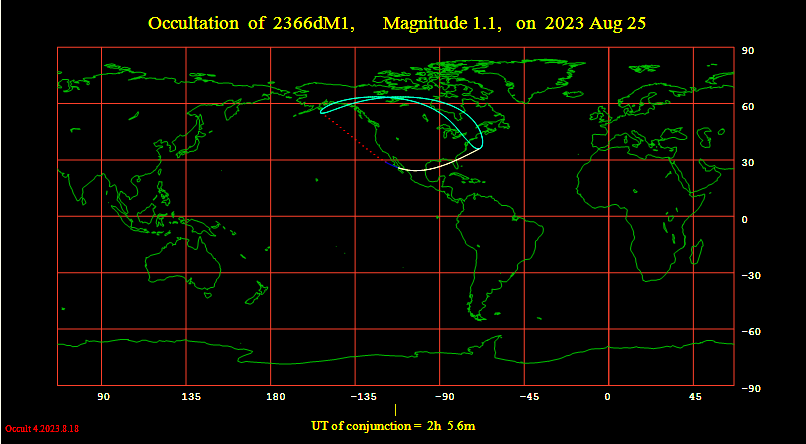
World map showing the area where the occultation of Antares can be visible. It is the area bounded by the white line, the red dotted line and the floppy figure 8 is the area where the occultation is visible. The red line shows that the area near that part of the line is where the occultation occurs during daylight the solid white line on the bottom encloses there is where the occultation will be seen at night. Michigan is close to that cyan line and so the occultation will occur near moonset. Credit: Occult 4 app.
04/20/2023 – Ephemeris – There’s a hybrid solar eclipse happening today*
This is Ephemeris for Thursday, April 20th. Today the Sun will be up for 13 hours and 43 minutes, setting at 8:33, and it will rise tomorrow at 6:48. The Moon is new today, and won’t be visible.
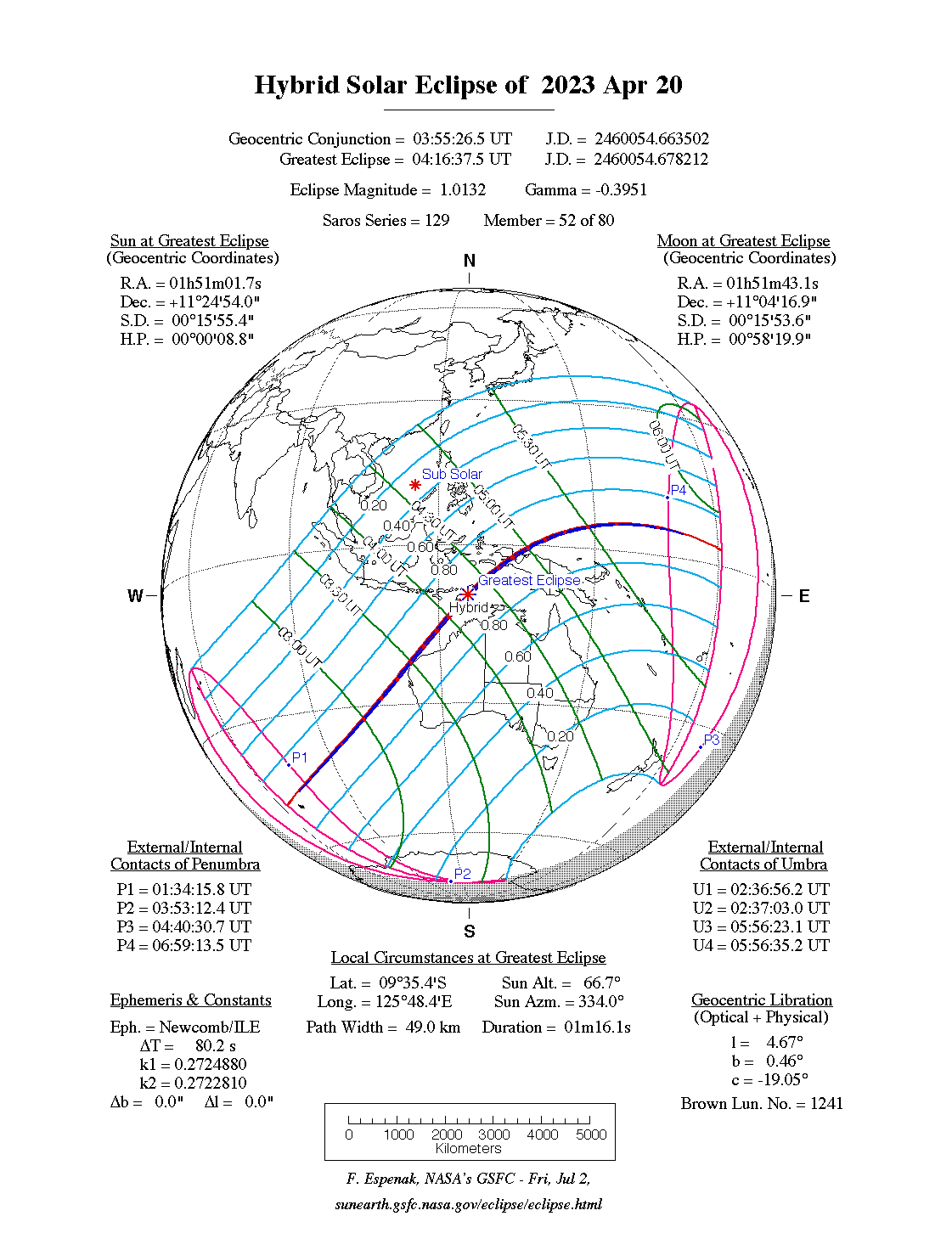
Last night and in the early morning hours this morning, for us, there was a solar eclipse visible from the Indian Ocean, through Indonesia and ending in the Pacific Ocean. This was a type of eclipse that I haven’t talked about before, a hybrid eclipse. It started at sunrise with the Moon too far away to completely cover the face of the Sun, as an annular eclipse. The central part of the eclipse path, due to the fact that the Earth is a sphere, was nearly four thousand miles closer to the Moon than at sunrise and sunset, evolves into a total eclipse. As the Moon’s shadow falls off toward the limb of the Earth, the increasing distance of the shadow to the Earth’s surface, causes the Moon to shrink enough to revert to an annular eclipse once again.
Next eclipse season, more specifically October 14th, there will be an annular eclipse, whose path crosses the US from the Oregon-California border to Texas. We will get a partial eclipse out of it. The big event will occur in the next eclipse season when a total solar eclipse will occur to cross the US from Texas to Maine on April 8, 2024. The path of totality will clip the southeast corner of Michigan.
The astronomical event times given are for the Traverse City/Interlochen area of Michigan (EST, UT –4 hours). They may be different for your location.
* By the time you read this, the eclipse is either happening right now, or it’s over.
Addendum
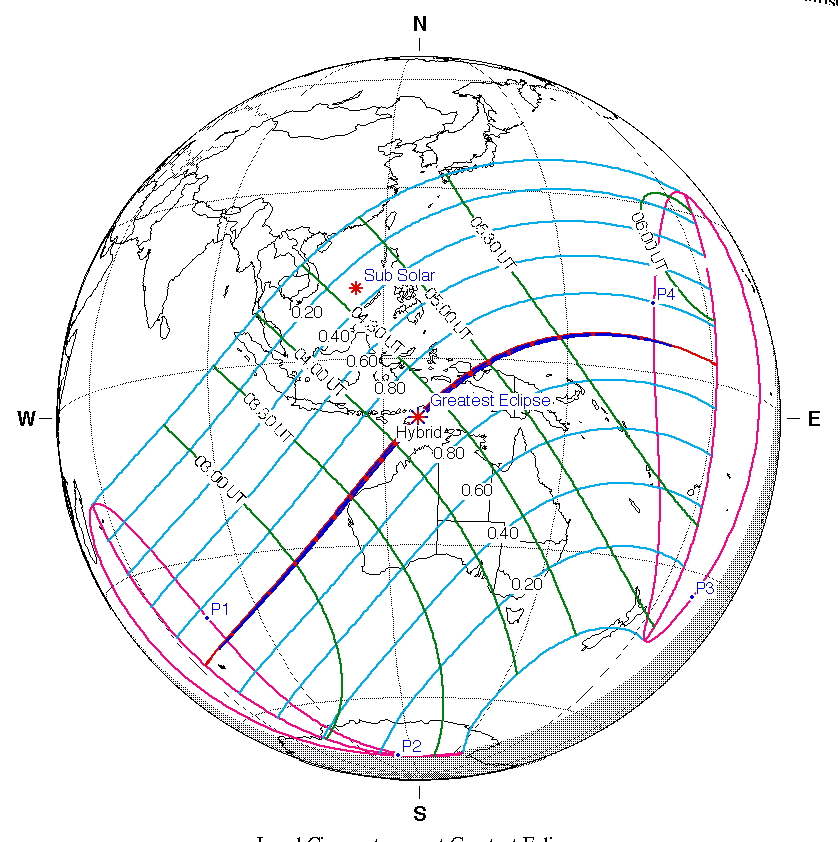
World solar eclipse map for the hybrid eclipse, April 20, 2023. The central path is in red, while the total eclipse part of the path is highlighted in blue. The image is of the world solar eclipse map for the hybrid eclipse, April 20, 2023. Taken from https://eclipse.gsfc.nasa.gov/SEplot/SEplot2001/SE2023Apr20H.GIF. Credit: NASA’s GSFC, Fred Espenak.
12/05/2022 – Ephemeris – Mars will hide behind the full Moon Wednesday night
This is Ephemeris for Monday, December 5th. Today the Sun will be up for 8 hours and 58 minutes, setting at 5:02, and it will rise tomorrow at 8:05. The Moon, 2 days before full, will set at 6:36 tomorrow morning.
Late Wednesday night we might get to view a really cool event when the full moon will cover or in astronomical lingo occult the planet Mars. In the Grand Traverse Region, this will occur for an hour between approximately 10:15 to 11:15 pm. The exact times depend on your location, and can vary by several minutes or more. Being a full moon, Mars might be difficult to spot. I’ll have more and hopefully more accurate information tomorrow. When astronomical objects line up like this, it’s called a syzygy. This time it’s a lineup of the Sun, Earth Moon and Mars in nearly a straight line, with both the Moon and Mars in opposition from the Sun on the same night. When the Moon is in opposition, we call it a full moon instead.
The astronomical event times given are for the Traverse City/Interlochen area of Michigan (EST, UT –5 hours). They may be different for your location.
Addendum
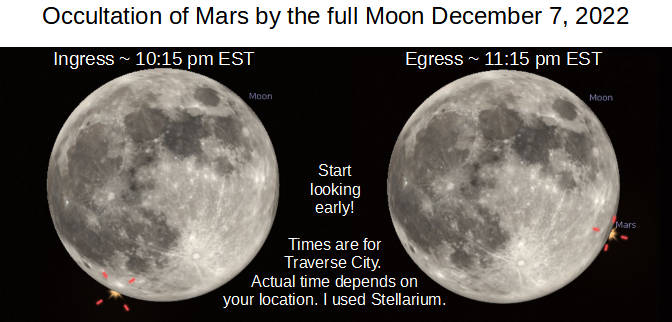
Mars ingress and egress chart and times for Traverse City, MI. The times will vary by a minute or two in the IPR listening area, ingress being earlier to the west and north and later east and south. Egress times will be earlier west and later east of Traverse City.
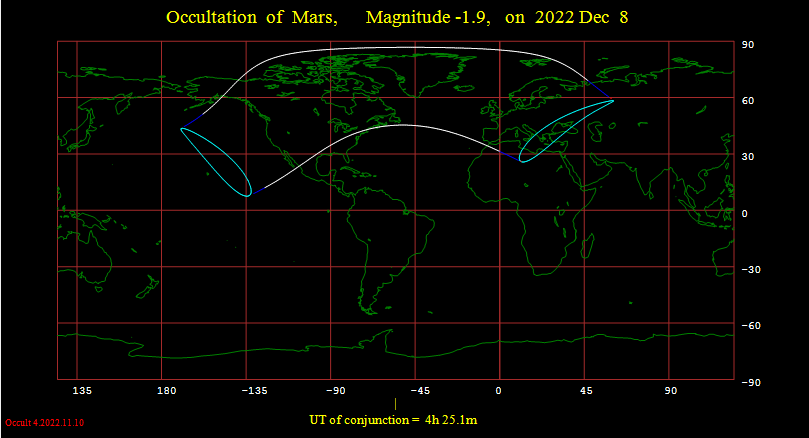
World map showing the area that the occultation of Mars will be visible. Occultation visibility will move from west to east. Credit: Occult version 4.
11/08/2022 – Ephemeris – Solar Eclipses in our future
This is Ephemeris for Election Day, Tuesday, November 8th. Today the Sun will be up for 9 hours and 51 minutes, setting at 5:22, and it will rise tomorrow at 7:31. The Moon, at full today, will rise at 5:28 this evening.
If you are listening to me early this morning, and it’s clear there is a lunar eclipse in progress. The eclipse will be total before 6:41 am, and partial until the Moon sets at 7:40 am. We will have to wait until March 2025 to see the next total lunar eclipse from our area.
However, we will be able to see two partial solar eclipses in the next year and a half. The first is October 14th, 2023. Nearly half of the Sun will be blocked by the Moon for us. The next one is the big one! April 8th, 2024 is a total eclipse less than a day’s drive away. The path of totality runs from Texas to Maine, just clipping the southeast corner of Michigan. Here in Northern Michigan, nearly 90% of the Sun will be covered by the Moon, so it will get noticeably dark at the peak of the eclipse.
The astronomical event times given are for the Traverse City/Interlochen area of Michigan (EDT, UT – 5 hours). They may be different for your location.
Addendum
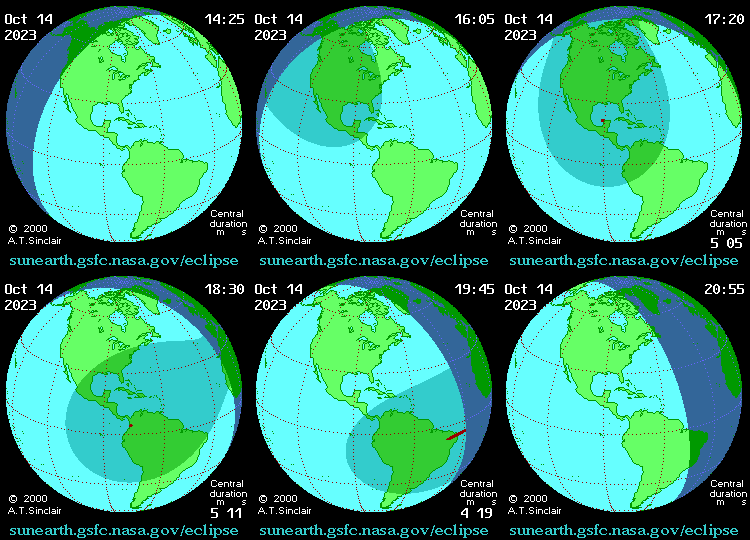
Areas on the Earth where the solar eclipse of October 14, 2023 can be seen via animation. The gray area is where the partial eclipse is visible. The dot is the place where the ring of the annular eclipse can be seen. Credit: NASA, A. T. Sinclair.
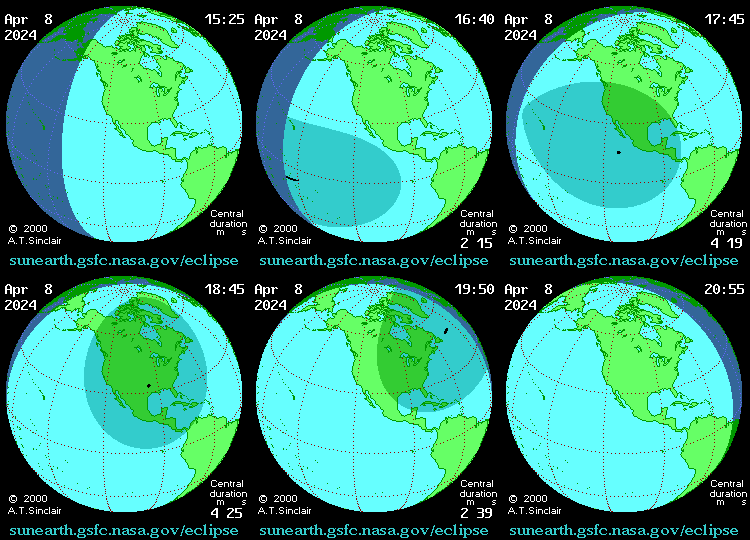
Areas on the Earth where the solar eclipse of April 8, 2024 can be seen via animation. The gray area is where the partial eclipse is visible. The dot is the place where the totally eclipsed Sun can be seen. Credit: NASA, A. T. Sinclair.
For more information on solar and lunar eclipses past and present, go here, NASA’s Eclipse Website.
10/25/2022 – Ephemeris – This eclipse season starts with a partial solar eclipse, but not for us
“But not for us” means not for Michigan in the United States. This is a script, as always, for a local radio program. Which also mentions the midterm election day, two weeks from now, which coincides with the total lunar eclipse that morning. I’ll have an Ephemeris Extra post before the lunar eclipse, which looks into the next few lunar and solar eclipses visible in Michigan and the United States.
This is Ephemeris for Tuesday, October 25th. Today the Sun will be up for 10 hours and 30 minutes, setting at 6:41, and it will rise tomorrow at 8:12. The Moon is new today, and won’t be visible.
The Moon will be visible in a negative way for some folks at this time. There is a partial solar eclipse in progress now for parts of Europe, Asia and Africa. So that thing blocking the northern part of the Sun for them will be the Moon. Being a partial eclipse means that an eclipse season has started, and we should have a lunar eclipse in about two weeks, when the Moon is full. There sure is, and it’s visible from here. In exactly two weeks, there will be. In the early morning hours of November 8th, Election Day, a total eclipse of the Moon. And if you’re standing outside the polling place waiting for the polls to open at 7 am, and it’s clear, and you have a view to the west, the partially eclipsed Moon will still be visible. That will be the ending partial phase of the eclipse.
The astronomical event times given are for the Traverse City/Interlochen area of Michigan (EDT, UT – 4 hours). They may be different for your location.
Addendum
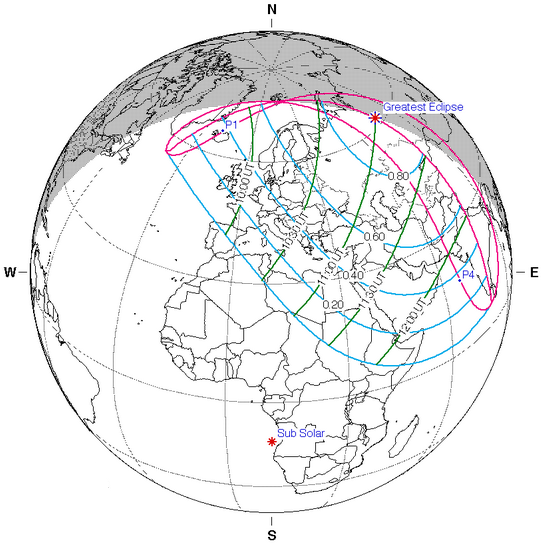
Map for the area on the Earth where the partial solar eclipse of October 25, 2022, will be visible. Credit: NASA/GSFC, Fred Espenak.
10/21/2022 – Ephemeris – Lots of transient astronomical activity this weekend
This is Bob Moler with Ephemeris for Friday, October 21st. Today the Sun will be up for 10 hours and 41 minutes, setting at 6:48, and it will rise tomorrow at 8:07. The Moon, halfway from last quarter to new, will rise at 4:44 tomorrow morning. | We have several astronomical events happening tonight and over the weekend. The Orionid meteor shower may still be at peak, appearing tonight between 11 pm and moonrise tomorrow morning. Up to 20, and maybe more, meteors per hour may be spotted just prior to moonrise. Tomorrow Venus will be in superior conjunction with the Sun, the passing behind, though not directly behind the Sun, and thus entering the evening sky. It will be a month or so for Venus to separate itself from the Sun’s glare to be spotted in the early evening. Finally, on Sunday Saturn will end its retrograde or westward movement against the stars of Capricornus and resume moving eastward, its normal motion around our sky.
The astronomical event times given are for the Traverse City/Interlochen area of Michigan (EDT, UT – 4 hours). They may be different for your location.
Addendum
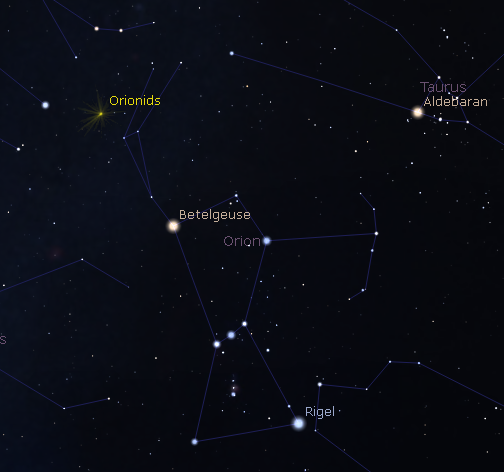
The Orionid meteor shower radiant. The radiant rises at 11 p.m., so the meteors will be visible from then into morning twilight. Despite the location of the radiant, the meteors will b e seen all over the sky. However, true Orionids can be traced back to the radiant point. This chart is from another year. This year, bright Mars would be at the top center of the image. Created using Stellarium.
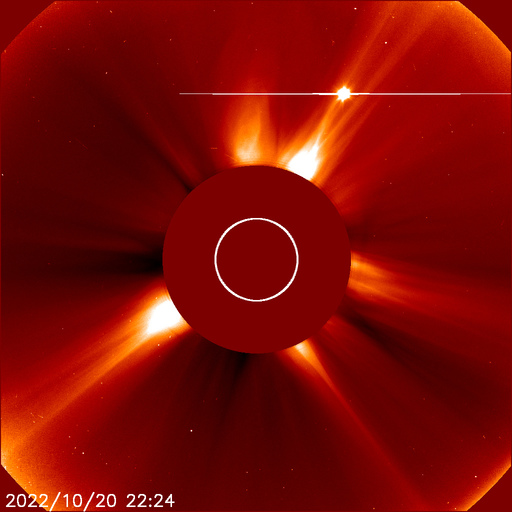
Venus near Superior conjunction through the Solar and Heliospheric Observatory (SOHO) LASCO C2 Coronagraph. The white circle inside the occulting disk is the diameter of the Sun’s photosphere, the disk we see of the Sun in white light. Launched in 1995, SOHO has been in halo orbit around the Sun-Earth L1 Lagrange point ever since.
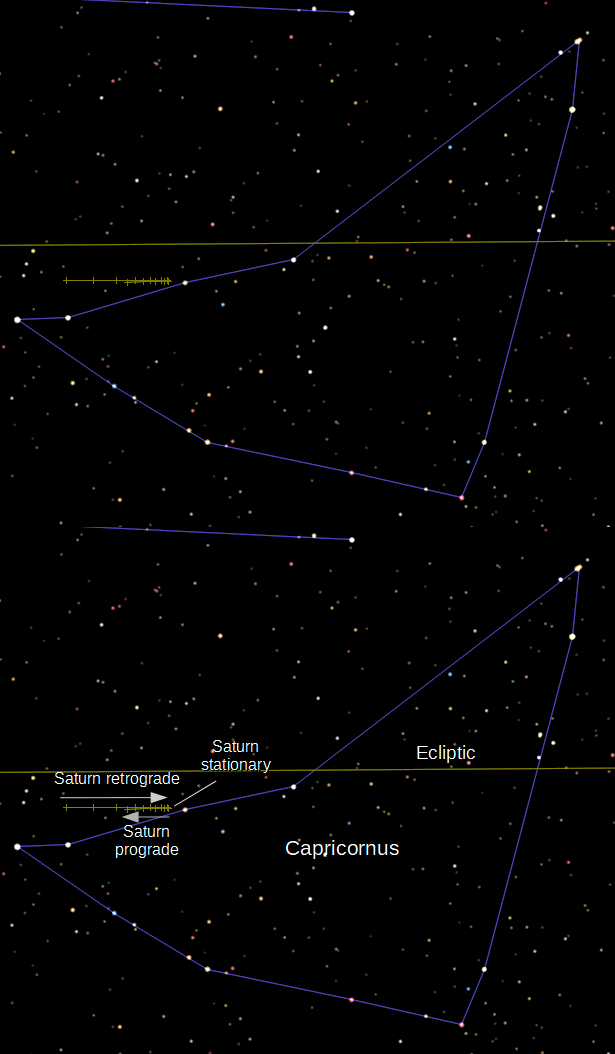
Saturn stationary animation showing it with and without annotations. The fine, folded line with tick marks is Saturn’s path. The tick marks are at 10-day intervals. Saturn starts out in retrograde motion, heading westward or to the right. On October 23rd, it slows and stops that motion. It begins to head back eastward in its normal prograde motion to the left. Outer planets like Saturn, Jupiter, Mars and the rest exhibit retrograde motion when the Earth in effect passes them on the same side of the Sun. Click on the image to enlarge it slightly. Created using Cartes du Ciel (Sky Charts), LibreOffice Draw, and GIMP.
 Bob Moler's Ephemeris Blog