Archive
12/31/2014 – Ephemeris – A New Year’s look at the bright planets and a comet
Ephemeris for New Years Eve, Wednesday, December 31st. The sun will rise at 8:19. It’ll be up for 8 hours and 52 minutes, setting at 5:11. The moon, 3 days past first quarter, will set at 4:42 tomorrow morning.
Lets take a last look at the bright planets for 2014. Mercury joins Venus low in the southwest. It will be below and right of Venus and will set at 6:07 p.m. Venus is low in the southwest shortly after sunset. It now sets at 6:26 p.m., an hour and 15 minutes after the sun. It will be seen low in the southwestern twilight by 5:55 p.m. Mars is low in the southwest at 7 p.m. and is in the constellation of Capricornus. The Red Planet will set tonight at 8:36 p.m. Jupiter will rise in the east at 8:33 p.m. It’s near the sickle-shaped head of Leo. Jupiter is now moving slowly westward. This is an effect that happens because the Earth is passing Jupiter, a motion shared by all the planets that baffled the ancients who thought the Earth to be motionless. Early risers will be able to spot Saturn which will rise in the east-southeast at 5:10 a.m.
Times are for the Traverse City/Interlochen area of Michigan. They may be different for your location.
Addendum
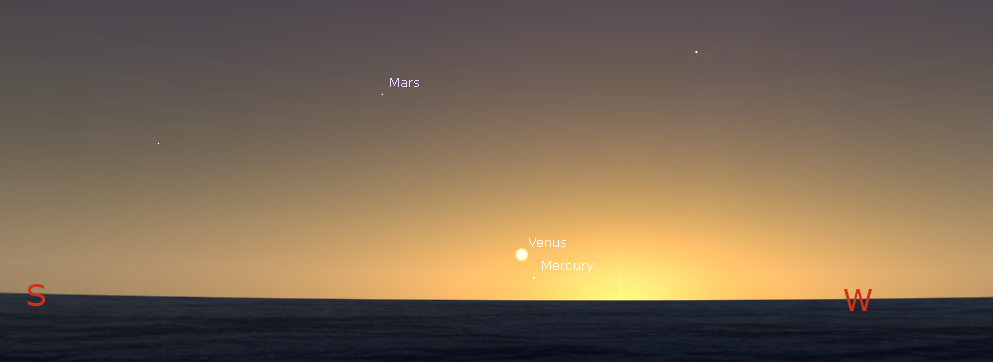
Mercury, Venus and Mars are seen in the southwestern sky shortly after sunset. In this case 5:45 p.m. December 31, 2014, only 34 minutes after sunset. Created using Stellarium.
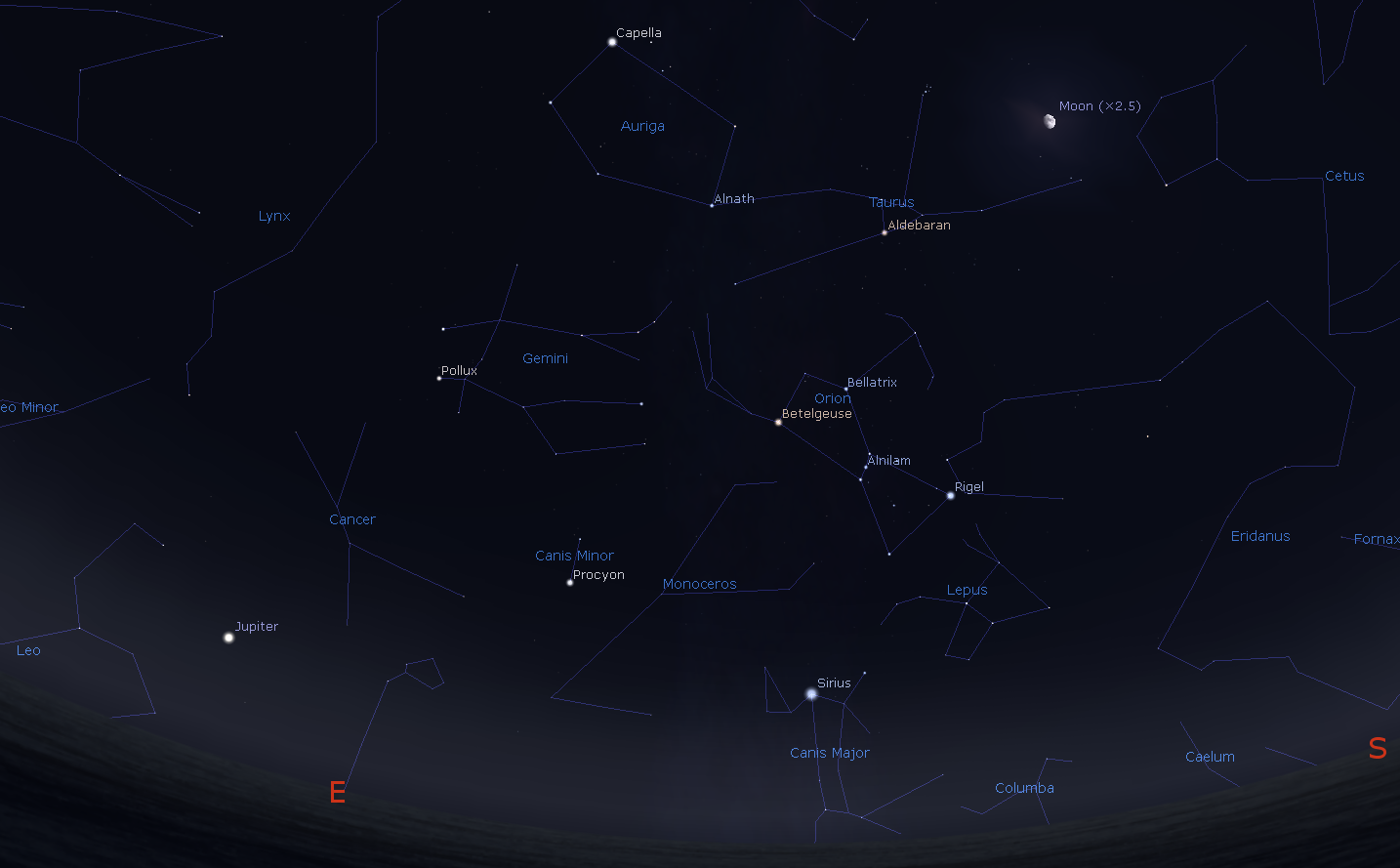
Jupiter, the Moon and the winter constellations at 9:30 p.m. December 31, 2014. Created using Stellarium.
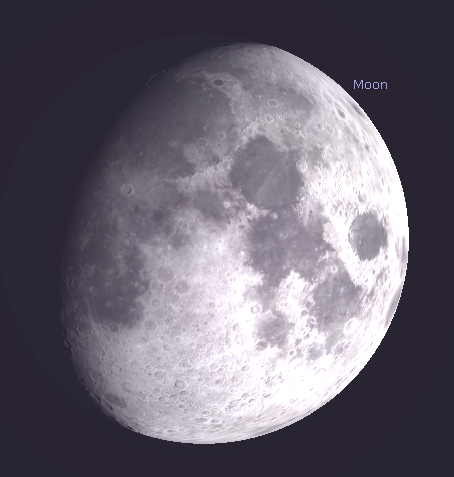
The Moon as it will appear in binoculars at 9:30 p.m. December 31, 2014. Created using Stellarium.
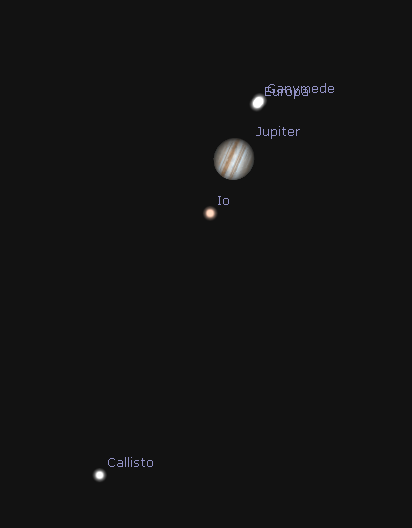
Jupiter seen through a telescope at 9:30 p.m. December 31, 2014. Note that Ganymede and Europa will appear very close to each other. Created using Stellarium.
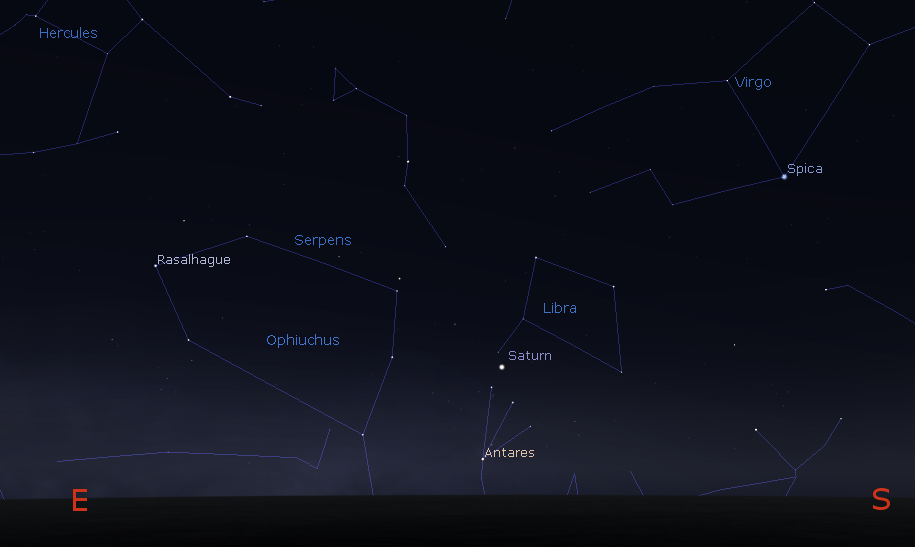
Saturn and the late spring and early summer constellations at 7 a.m. New Year’s Day 2015. Created using Stellarium.
Comet Lovejoy
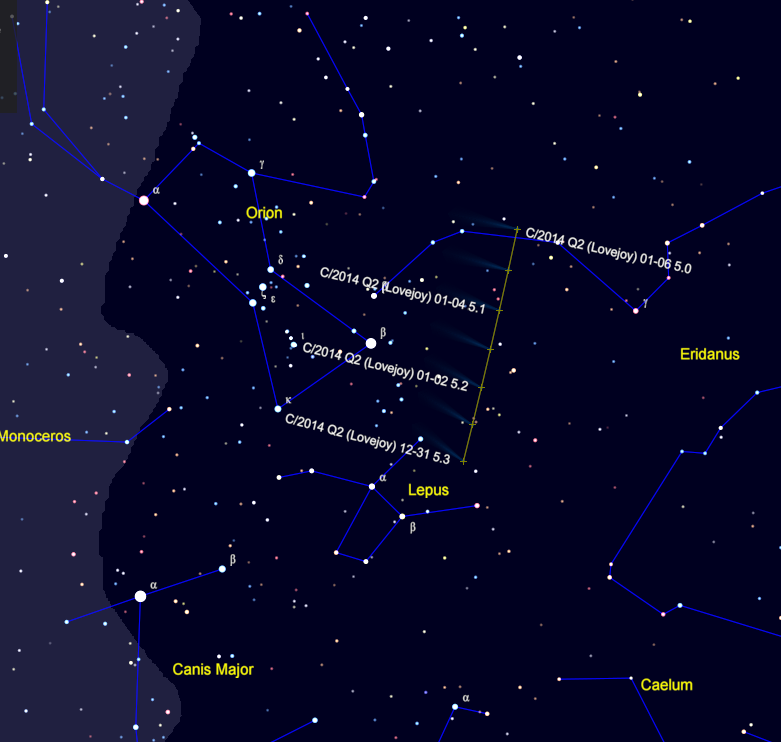
Comet Lovejoy (C/2014 Q2) plotted for 9 p.m. from 12/31/2014 to 1/06/2015. Created using Cartes du Ceil (Sky Charts).
12/24/2014 – Ephemeris – Twas the night before Christmas and only the planets and a comet were stirring
Ephemeris for Christmas Eve, Wednesday, December 24th. The sun will rise at 8:17. It’ll be up for 8 hours and 49 minutes, setting at 5:06. The moon, 3 days past new, will set at 8:37 this evening.
Twas the night before Christmas and only the planets were stirring. Venus is low in the southwest shortly after sunset. It now sets at 6:09 p.m., 63 minutes after the sun. It will be tough to spot at all. New Year’s Eve might be a good time to start to see it. Mars, low in the southwest at 7 p.m. has the Moon just to the right of it tonight. Mars will set tonight at 8:34 p.m. Jupiter, which will be our Christmas Star this year will rise in the east at 8:59 p.m. It’s near the sickle shaped head of Leo. Jupiter is now moving slowly westward. This is an effect that happens because the Earth is passing Jupiter, a motion shared by all the planets that baffled the ancients who thought the Earth to be motionless. Saturn will rise in the east-southeast at 5:34 a.m.
Times are for the Traverse City/Interlochen area of Michigan. They may be different for your location.
Addenda
The Planets tonight
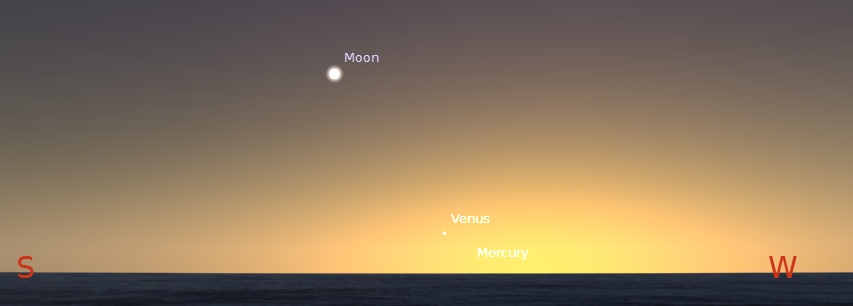
Venus low on the horizon, and the Moon, at 5 30 p.m. on December 24, 2014. Created using Stellarium.
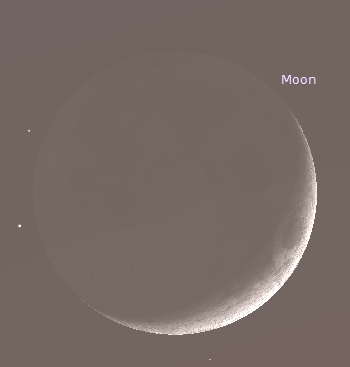
The crescent Moon through binoculars, at 5 30 p.m. on December 24, 2014. Created using Stellarium.
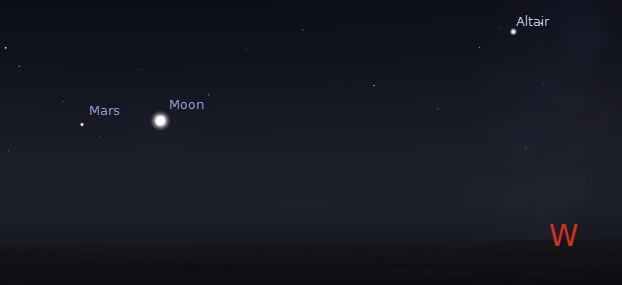
Mars and the Moon at 7:30 p.m. on December 24, 2014. Created using Stellarium.
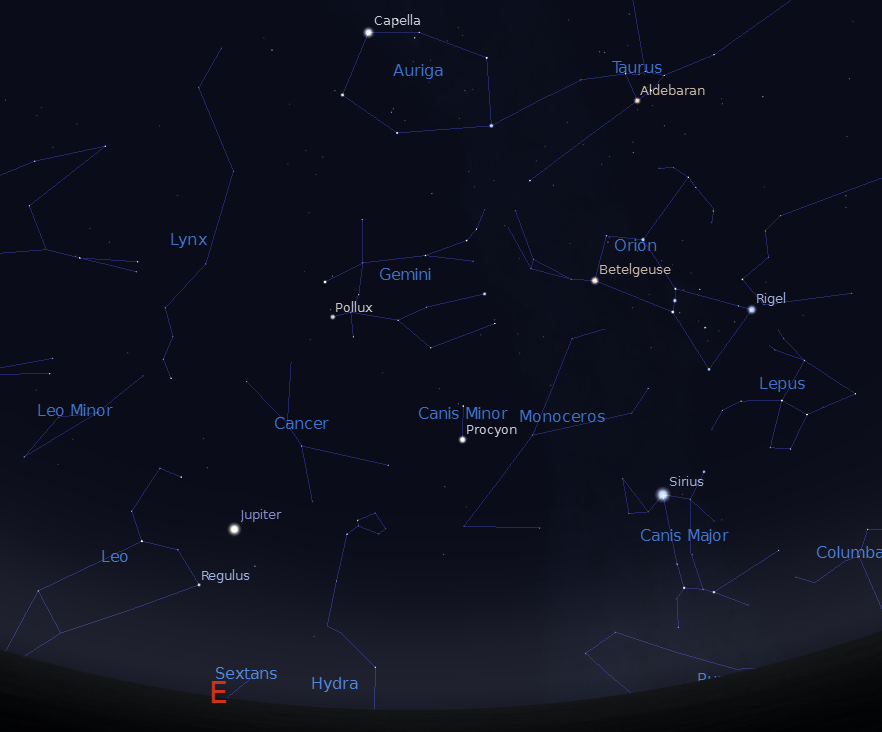
Jupiter and the winter constellations at 11 p.m. on December 24, 2014. Created using Stellarium.
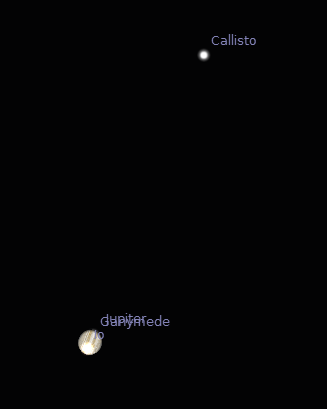
Jupiter with three hidden satellites, with only Callisto showing at 11 p.m. on December 24, 2014. See blow by blow of the satellite disappearances below. Created using Stellarium.
Jovian satellite events of the night of December 24-25, 2014
Ganymede starts eclipse (enters Jupiter’s shadow) 6:20 p.m.
Europa starts eclipse 8:27p.m.
Io’s shadow starts crossing Jupiter 9:32 p.m.
Ganymede leaves Jupiter’s shadow 10:00 p.m.
Ganymede starts being occulted by Jupiter 10:11 p.m.
Io’s transit across the face of Jupiter starts 10:29 p.m.
Io’s shadow leaves the face of Jupiter 11:50 p.m.
Io’s transit of Jupiter ends 12:46 a.m.
Europa’s occultation by Jupiter ends 1:10 a.m.
Ganymede’s occultation by Jupiter ends 1:50 a.m.
Note that Europa’s occultation by Jupiter starts before its eclipse ends, so unlike the more distant Ganymede there isn’t an interval of visibility between the two.
Jovian satellite event timings provided by Project Pluto www.projectpluto.com
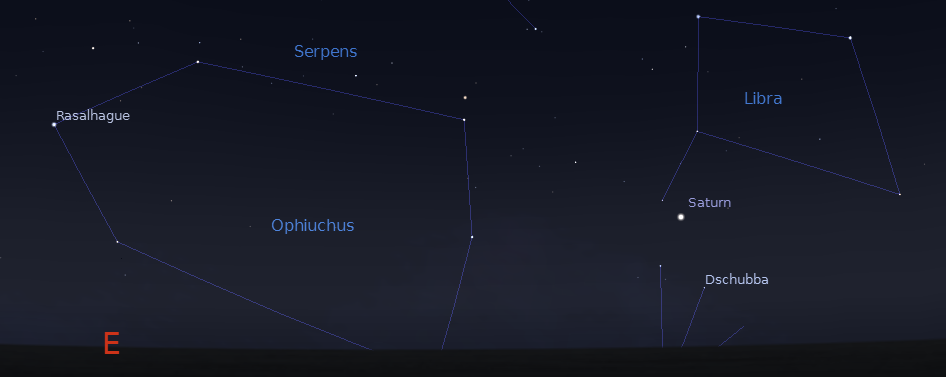
Saturn low in the east-southeast among the constellations of late spring and early summer at 6:30 a.m. on Christmas morning 2014 . Created using Stellarium.
Comet C/2014 Q2 (Lovejoy)
Normally my Ephemeris program deals with celestial objects that are visible to the naked eye. While Comet Lovejoy will, for a few weeks become brighter than 6th magnitude the normal limit for the unaided human eye, a comet is a diffuse object and always looks dimmer than a star of the same magnitude. This comet was discovered August 17, 2014 by Australian amateur astronomer Terry Lovejoy. He has discovered 5 comets. His most famous find was C/2011 W3 (Lovejoy) that buzzed the Sun and survived becoming a magnificent comet for southern hemisphere observers.
Recently Comet Lovejoy became brighter than expected. The data for the charts below are from Minor Planet Center and do not include new brightness estimates that include the outburst. They have the comet reaching magnitude 4.9. The aerith.net website gives the maximum brightness next month of 4. (Magnitudes are like golf scores the lower the magnitude the brighter the object). Each magnitude step is a brightness difference of about 2 and a half times. To check on the comet go to http://www.aerith.net/comet/weekly/current.html. Currently Comet Lovejoy is the brightest comet now visible and is the first comet on the list. Clicking on the comet ‘s name will give you the comet’s page. The last chart on the page is a chart tracking the comet’s brightness from reports vs. prediction. That chart predicts a magnitude of 4 just after the first of the year.
Photographs of the comet show a gaseous coma (head) and a very faint ion tail, which may not be visible visually in binoculars and telescopes. Right now the comet is highest around midnight.
The finder charts below designate the comet by month-day and the predicted magnitude
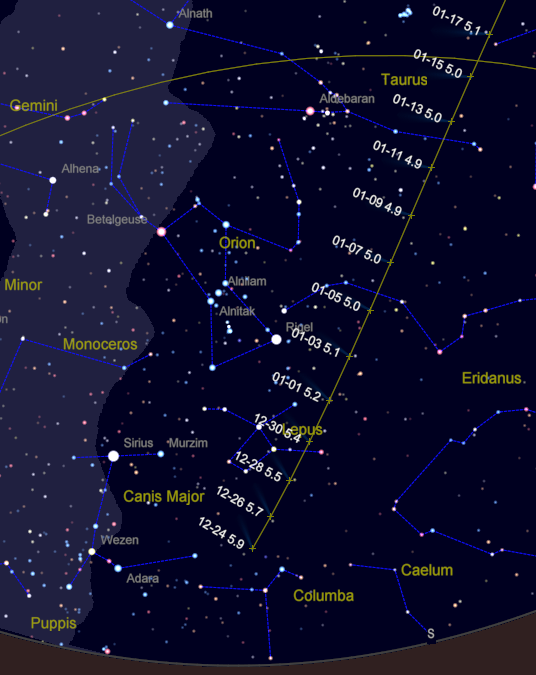
Comet C/2014 Q2 (Lovejoy) at 11 p.m. at 2 day intervals from tonight 12/24/2014 to 1/17/2015. Created using Cartes du Ceil (Sky Charts).
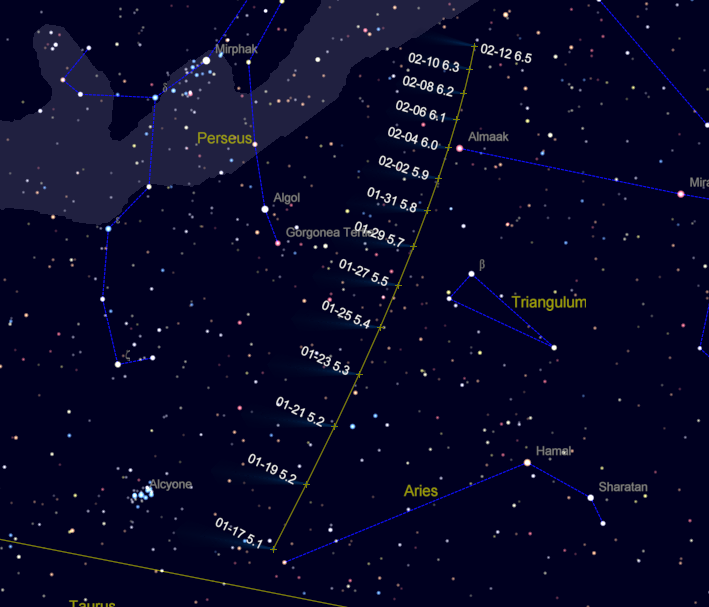
Comet C/2014 Q2 (Lovejoy) at 8 p.m. at 2 day intervals from tonight 1/17/2015 to 2/12/2015. Created using Cartes du Ceil (Sky Charts).
On December 28th Comet Lovejoy will appear to pass the globular cluster M79.
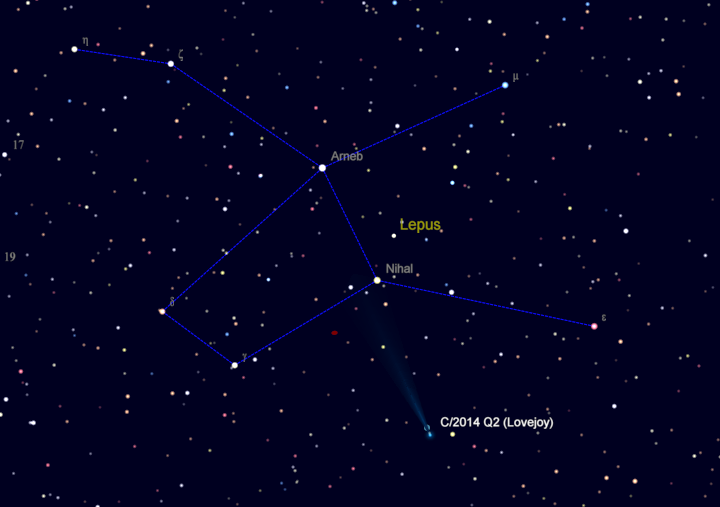
Comet Lovejoy and M79 a distant globular star cluster, in the constellation of Lepus the hare, will appear together at 11 p.m. December 28th, 2014. Note the that M79 is the unlabeled blue dot in the tail of the comet, next to the head. Created using Cartes du Ceil (Sky Charts).
11/18/2014 – Ephemeris – Rosetta, Philae with Comet 67P and Maven’s discovery of the effects of it’s comet encounter
Ephemeris for Tuesday, November 18th. The sun will rise at 7:43. It’ll be up for 9 hours and 28 minutes, setting at 5:11. The moon, half way from last quarter to new, will rise at 4:31 tomorrow morning.
Last week the Philae lander bounced down on Comet 67P/Churyumov-Gerasimenko, its harpoons not able to fire to hold the lander down. “Where is Captain Ahab when you need him?” I Twittered at the time. We were lucky it didn’t bounce off the comet entirely. It ended against a cliff and in a shadow, so it couldn’t recharge its batteries from sunlight. The ESA controllers had it perform all its possible experiments quickly before its batteries died. Philae was still an amazing success. News from last month’s encounter Mars encounter with Comet Siding Spring. The Maven satellite detected the aftermath of a great martian meteor shower when it peaked around the planet from where it was hiding.
Times are for the Traverse City/Interlochen area of Michigan. They may be different for your location.
Addendum
Philae
If I’m understanding the spacecraft controllers at the European Space Agency (ESA) correctly Philae was launched toward the comet with a velocity of something like .7 meters per second (m/s). It would have accelerated to 1 m/s by the time it hit the comet. So it was pushed into the comet at more than the comet’s escape velocity. One meter per second is only 2.2 miles per hour. So to bounce and not escape the comet either the lander, the surface of the comet or both would have to have a lot of give to it. On this comet one could jump faster than escape velocity and go floating off into space.
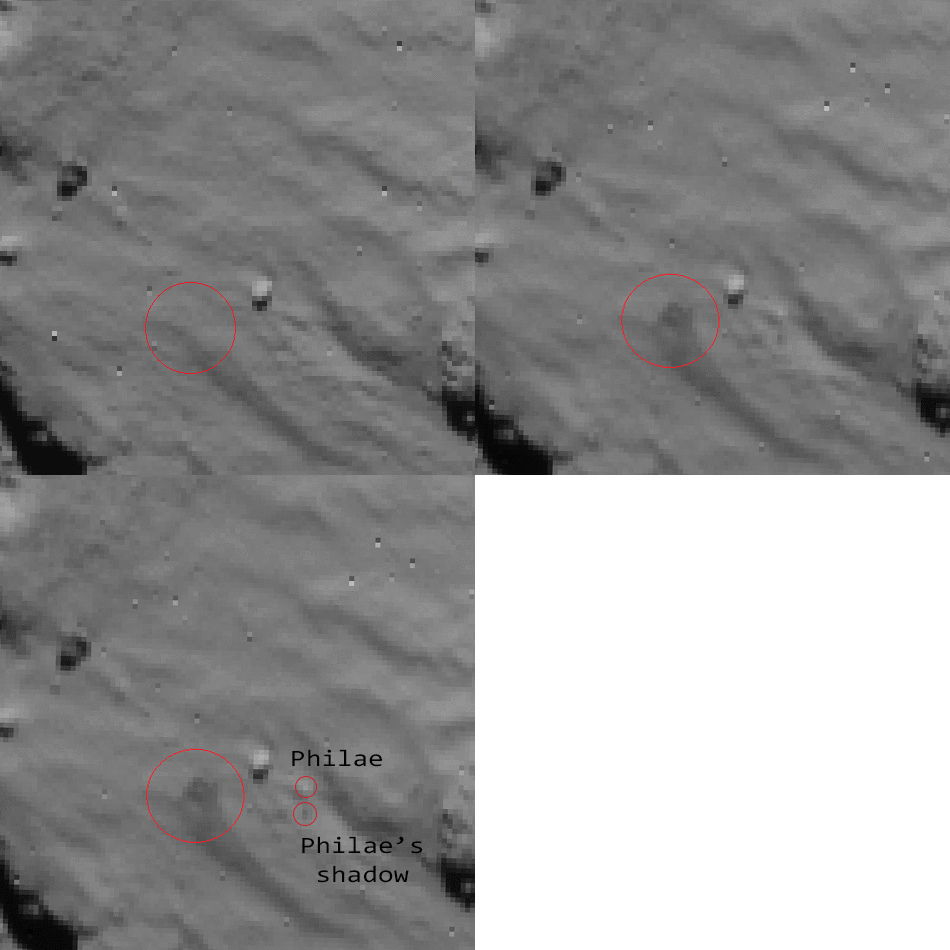
The Rosetta spacecraft spotted Philae and its shadow shortly after the lander touched down on Comet 67P/Churyumov–Gerasimenko and bounced up again. The first image is taken on Nov. 12, 2014 at 10:30 a.m. EDT (3:30 p.m. UTC) and the second five minutes later. Credit: ESA/Rosetta/NAVCAM; pre-processed by Mikel Catania. Hat tip to and credit for the caption to Universe Today.
Maven
Maven detected the aftermath of a meteor storm in the upper martian atmosphere with the signatures of eight metals. It looks like it was prudent to hide all the satellites when Mars came closest to the comet’s path. Here’s a link to Bob King’s post about it in Universe Today blog from 11 days ago.
10/16/2014 – Ephemeris – Comet Siding Spring will buzz Mars this Sunday
Ephemeris for Thursday, October 16th. The sun will rise at 7:59. It’ll be up for 10 hours and 57 minutes, setting at 6:56. The moon, 1 day past last quarter, will rise at 1:50 tomorrow morning.
Sunday afternoon our time the comet C/2013 A1 also known a Siding Spring will pass 86 thousand miles (140 thousand km) from Mars. The three NASA Mars satellites, Mars Odyssey, Mars Reconnaissance Orbiter and Maven plus the two rovers Opportunity and Curiosity; the European Mars Express and the latest to arrive, India’s Mars Orbital Mission or MOM will all be studying the comet. Protection of the satellites is key. The satellite’s orbits have all been phased so as to be behind the planet from the expected possible debris of the comet when Mars passes its closest to the comet’s orbit 101 minutes after the comet itself passes. Early next week we may have some spectacular photos of Comet Siding Spring.
Times are for the Traverse City/Interlochen area of Michigan. They may be different for your location.
Addendum
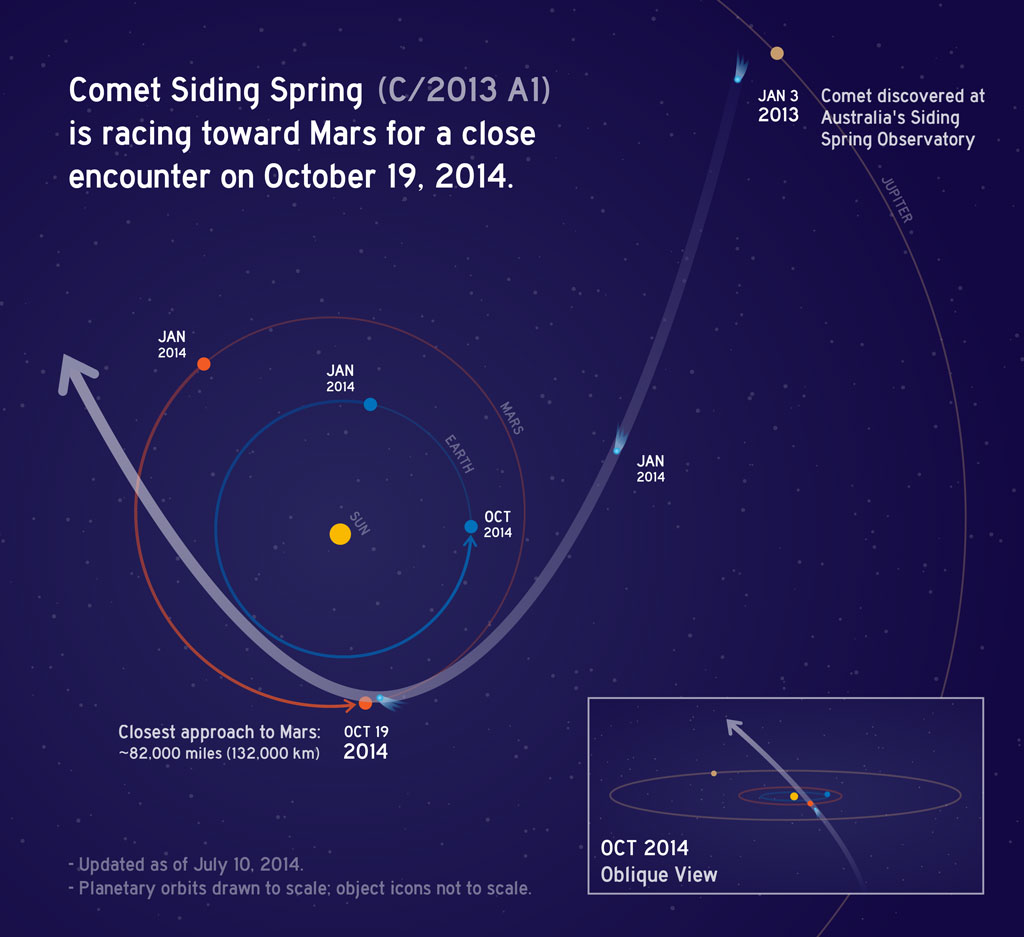
Two views of Comet Siding Springs orbit past Mars. Credit: NASA.
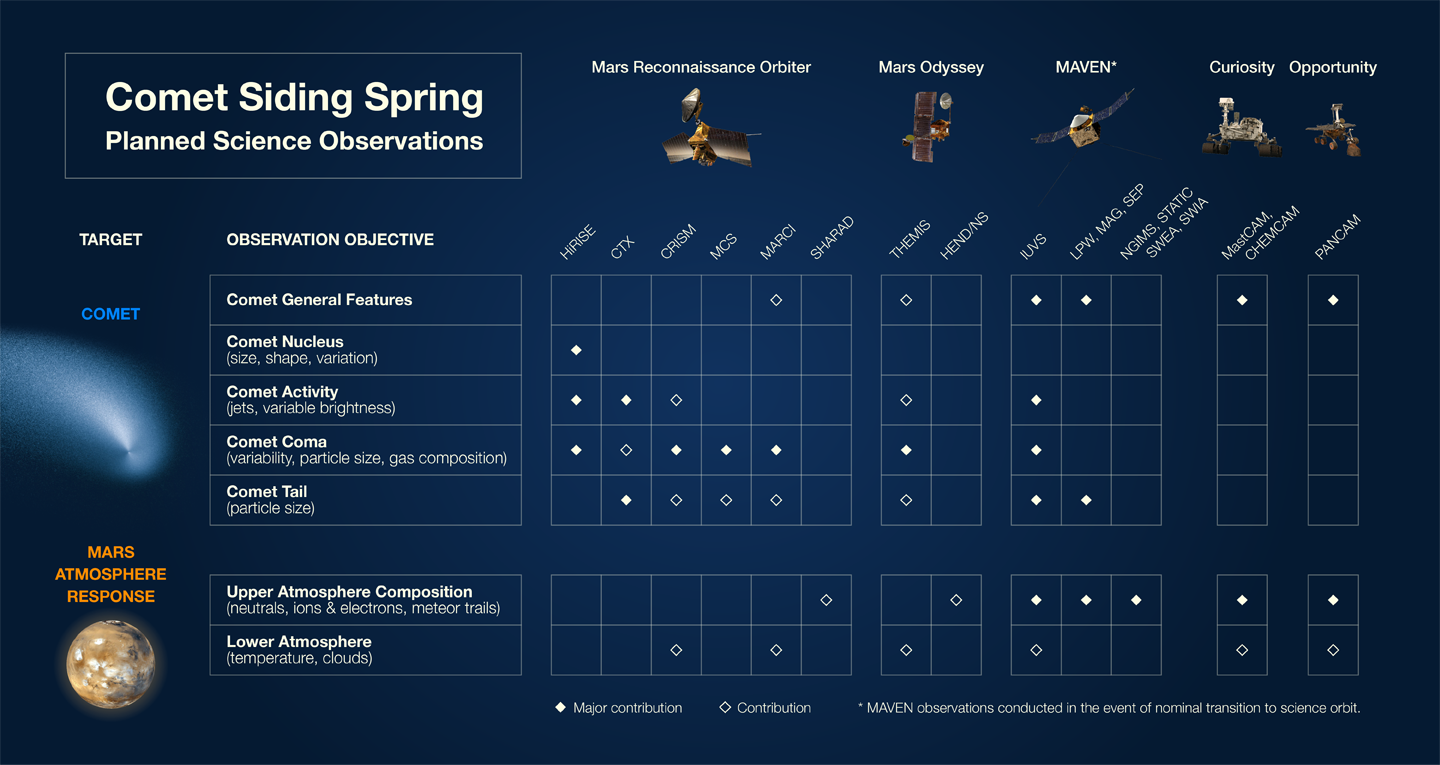
Planned science observations of Comet Siding Spring by NASA spacecraft and rovers at Mars. Credit: NASA.
Siding Spring Links:
08/12/2014 – Ephemeris – Comet Swift-Tuttle progenitor of the Perseid meteors
Ephemeris for Tuesday, August 12th. The sun rises at 6:41. It’ll be up for 14 hours and 11 minutes, setting at 8:52. The moon, 2 days past full, will rise at 9:50 this evening.
The Perseid meteor shower will reach its peak later this evening. The moon will still interfere with all but the brightest meteors. The meteors are caused by bits of sand grain to pea sized rubble given off by Comet Swift-Tuttle on past runs through the inner solar system. As comets go Comet Swift-Tuttle is large, with a nucleus of some 16 miles (26 km) in diameter. Comet Halley’s nucleus is half that and Churyumov–Gerasimenko’s nucleus that ESA’s Rosetta spacecraft is now orbiting is half Halley’s. Despite the wear and tear that a comet’s nucleus must endure when coming close to the Sun, the distribution of debris to give us a pretty even annual meteor shower means the comet has been near its present orbit for a very long time.
Times are for the Traverse City/Interlochen area of Michigan. They may be different for your location.
Addendum
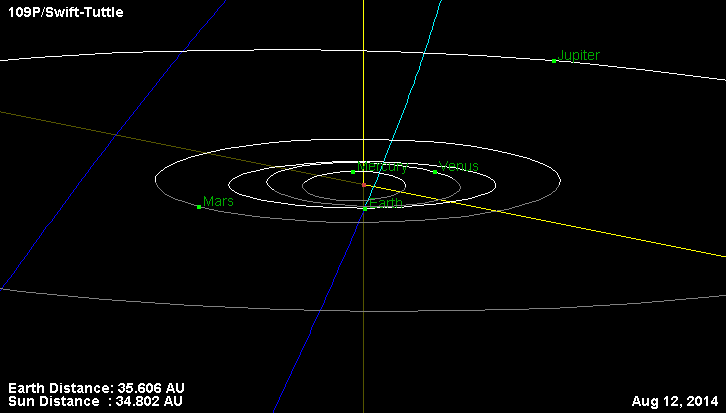
Orbit of Comet 109P/Swift-Tuttle. Blue line is the comet’s orbit, coming from above. Credit NASA / JPL / Applet by Osamu Ajiki (AstroArts), and further modified by Ron Baalke (JPL)
Link to the animation from which the above image was taken and other information on Comet Swift-Tuttle go to http://ssd.jpl.nasa.gov/sbdb.cgi?sstr=109P;cad=1
07/22/2014 – Ephemeris – Rosetta spies a cosmic rubber ducky
Ephemeris for Tuesday, July 22nd. Today the sun will be up for 15 hours even, setting at 9:18. The moon, half way from last quarter to new, will rise at 3:38 tomorrow morning. Tomorrow the sun will rise at 6:19.
The European Space Agency (ESA) Rosetta spacecraft is closing in on Comet 67P/Churyumov-Gerasimenko, also known as Comet Cherry-Gerry, or Comet C-G. After photos of the comet’s nucleus were published last week it has acquired a new nickname: Rubber Ducky. The nucleus may be a contact binary with two comet nuclei that stuck together after a slow speed collision. Further study may reveal the nature of the two pieces. Rosetta has more than a year to study the comet. It has a lander craft called Philae that can land on one of the pieces of the nucleus. No one expected the possibility of two possibly dissimilar comet nuclei to study. Rosetta will enter orbit of the comet August 6th.
Times are for the Traverse City/Interlochen area of Michigan. They may be different for your location.
Addendum
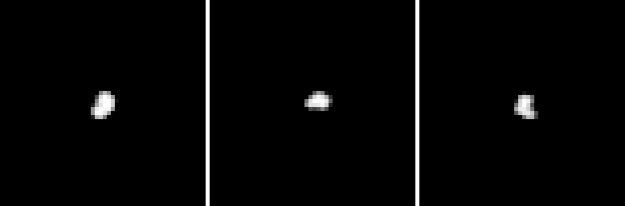
A hint of strangeness appears on July 4, 2014. What’s that lump on the side in that third image? Credits: ESA/Rosetta/MPS for OSIRIS Team MPS/UPD/LAM/IAA/SSO/INTA/UPM/DASP/IDA
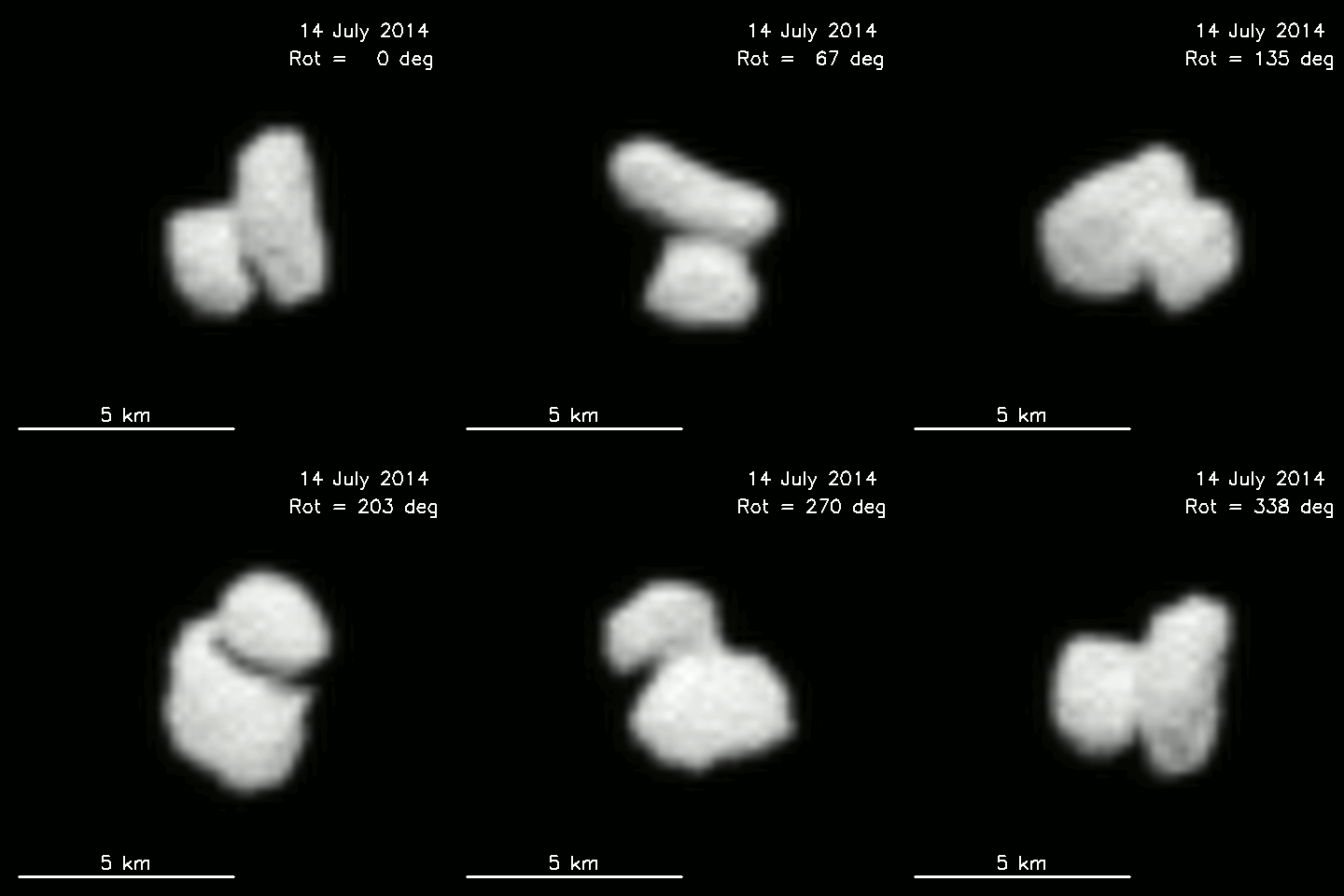
An animation of Comet C-G rotation on July 14, 2014. The 30 pixel wide image has been smoothed. The actual rotation rate is 1 rotation every 12.4 hours. Credits: ESA/Rosetta/MPS for OSIRIS Team MPS/UPD/LAM/IAA/SSO/INTA/UPM/DASP/IDA
For more information go to http://sci.esa.int/rosetta/, or search: esa rosetta.
The post that explains this image more fully is here.
ESA has a policy of weekly releases, so expect a new one this Wednesday, Thursday or Friday.
07/11/2014 – Ephemeris – Spot Mercury tomorrow and Learn about two comets tonight
Ephemeris for Friday, July 11th. Today the sun will be up for 15 hours and 19 minutes, setting at 9:27. The moon, 1 day before full, will set at 6:31 tomorrow morning. Tomorrow the sun will rise at 6:08.
Really diehard Mercury watchers just may catch a glimpse of this very elusive planet tomorrow morning after it rises at 4:47 a.m. It’s below and left of Venus at that time. But before then the Grand Traverse Astronomical Society will hold its monthly meeting tonight at Northwestern Michigan College’s Observatory on Birmley Road. Yours truly will be giving the talk starting at 8 p.m. about the two comets that will be in the news starting next month. The first will be orbited by the European Rosetta spacecraft which will send down a lander starting next month. The second will be a close approach of a comet to Mars, near enough to possibly menace our satellites orbiting Mars in October. There will be viewing afterwords.
Times are for the Traverse City/Interlochen area of Michigan. They may be different for your location.
More information on the talk is here.
Addendum
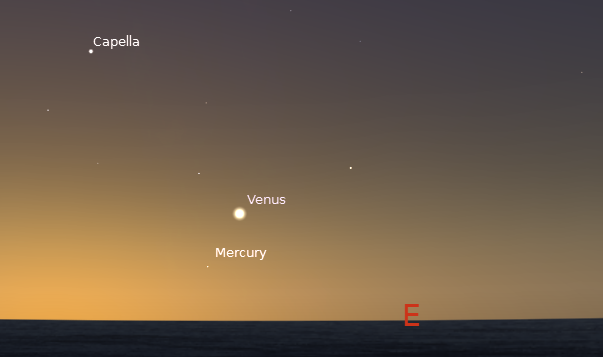
Mercury and Venus rising in twilight at 5:30 a.m. July 12, 2014. Created using Stellarium.
Title Slide for Tail of Two Comets
Tail of two comets
It should be tale, but with apologies to Mr. Dickens I couldn’t resist. The two comets in question are 67P/Churyumov-Gerasimenko and C/2013 A1 (Siding Spring). Neither of these comets will come close to the Earth or be easily visible in telescopes, but they will be in the news starting next month.
Comet 67P/Churyumov-Gerasimenko
Comet 67P/Churyumov-Gerasimenko or Comet CG for short is a member of the Jupiter family of comets, more than likely captured into their current orbits by the king of planets. It is the target of European Space Agency’s (ESA) Rosetta Mission to orbit the comet for 17 months and deposit the Philae lander on the surface of the nucleus.
Rosetta was launched on March 2, 2004 on a long and complicated trajectory utilizing four planetary encounters to boost its orbit so it could match the comet, whose aphelion is near Jupiter’s orbit. Rosetta passed the earth a year after launch, then Mars in 2007, Earth again later that year and finally Earth two years later in 2009. On the way it entered the asteroid belt twice and passed by two asteroids: 2767 Šteins, 5 km in diameter, in 2008 and 21 Lutetia, 121 km along its longest dimension, in 2010.
Rosetta is solar-powered with enormous solar panels, yet it could not maintain it normal operations load when farther than 4.5 Astronomical Units (AU) from the Sun so controllers put the spacecraft in hibernation in May of 2011 with instructions to wake up and phone home on January 20, 2014. The signal came about a half hour late, but Rosetta woke up after 31 months in hibernation.
Rosetta is as of this writing (late June 2014) matching orbits with the comet. It’s out in front of the comet, and after two long rocket burns is slowing itself with respect to the sun and approaching the comet from its sun-ward side. Mission planners hoped to reach the comet before it becomes active, but the comet has surprised everyone by becoming active early. However the activity has stopped, as of mid June.
After four short thruster burns in July the velocity with respect to the comet will be down to 7.9 meters/second or 26 feet/second. And 4126 kilometers or 2,563 miles to go. Orbiting a comet nucleus only 2 X 3 miles across will be hard. The spacecraft’s orbital velocity in relation to it will be centimeters or inches per second. That will happen in August. A landing site for the Philae lander will be found as Rosetta spirals even closer to the comet.
With a landing site chosen the Philae lander will settle down on the surface of the nucleus in November by firing harpoons into the comet when it touches down to anchor it. The Philae lander, weighing approximately 220 pounds on Earth contains 10 instruments weighing 46 pounds which include cameras, organic molecule detector, isotopic ratio detector, magnetometer and plasma monitor, subsurface drill, and more.
The Rosetta orbiter will stay with the comet through the comet’s perihelion in December 2015, just outside the Earth’s orbit at 1.2 AU.
C/2013 A1 (Siding Spring)
Siding Spring was the first comet discovered in 2013. It raised headlines then because it could possibly crash into Mars in October 2014. The orbit has been refined, so the comet will miss by 83,000 miles or 134,000 km. On October 19th. The nucleus of the comet is estimated at somewhat less than a half mile in diameter. The comet’s coma or head has been measured to be 12.000 miles or 19,300 km across, though it’s sure to increase as it approaches closer to the sun. Hydrogen gas from the comet’s head or coma will possibly affect Mars’ upper atmosphere for a short time, increasing atmospheric drag on the five satellites then to be in orbit of Mars: NASA’s Odyssey, Mars Reconnaissance Orbiter, and Maven; ESA’s Mars Express, and India’s Mars Orbiter Mission or MOM.
The amount and spread of meteoric dust that would affect the satellites is unknown. Being a very long period comet, and possibly a first time visitor to the inner solar system, it may have very little dust and debris to menace the orbital armada now circling Mars. I have seen what ESA scientists are planning for their Mars Express satellite. They will, or have been tweaking their satellite’s orbit to be behind the planet when the peak of the meteoric material is expected. And since you can’t hide behind the planet forever, have looked at the design of the spacecraft, and decided to face the incoming meteoric stream with their antenna first. NASA has similar plans to duck their orbital assets behind Mars.
How do you change an orbit to duck behind a planet at a specific time? It’s the same technique for two space craft to rendezvous. One doesn’t want to change altitude too much. So to speed up a bit, drop into a slightly closer orbit of the planet. You do this by slowing down. It’s not quite intuitive. And the opposite is true to slow down. When the desired distance along the orbit is achieved reverse the process to get back to your original orbital altitude.
The Mars rovers Opportunity and Curiosity will be protected by Mars’ atmosphere. But could see some nice meteors, meteor shower or meteor storm. Curiosity, being nuclear powered can operate at night. I’m not sure if Opportunity has the power reserve.
This was originally printed in the Stellar Sentinel the July 2014 newsletter of the Grand Traverse Astronomical Society.
Addendum
Links to my sources and more information:
Comet Siding Spring Wikipedia page
NASA’s Comet Siding Spring at Mars site
ESA’s Mars Express blog posts on Comet Siding Spring
05/19/2014 – Ephemeris – The meteor storm and an all night star party to view it
Ephemeris for Monday, May 19th. Today the sun will be up for 14 hours and 57 minutes, setting at 9:08. The moon, 2 days before last quarter, will rise at 1:33 tomorrow morning. Tomorrow the sun will rise at 6:09.
This will be a first for the Grand Traverse Astronomical Society, an all night star party this Friday night and Saturday morning. The reason is the predicted meteor storm Saturday morning from Comet 209P/LINEAR, discovered in 2004. Near a I can tell no one has seen a single meteor from this comet. However several astronomers who work on cometary debris have some confidence that debris from this comet which orbits the Sun every 5 years will cross the Earth orbit on the morning of May 24th around 3 a.m. give or take. The hardiest of the GTAS members will be at the Dune Climb of the Sleeping Bear Dunes National Lakeshore all night. Join us if you can.
Times are for the Traverse City/Interlochen area of Michigan. They may be different for your location.
Addendum
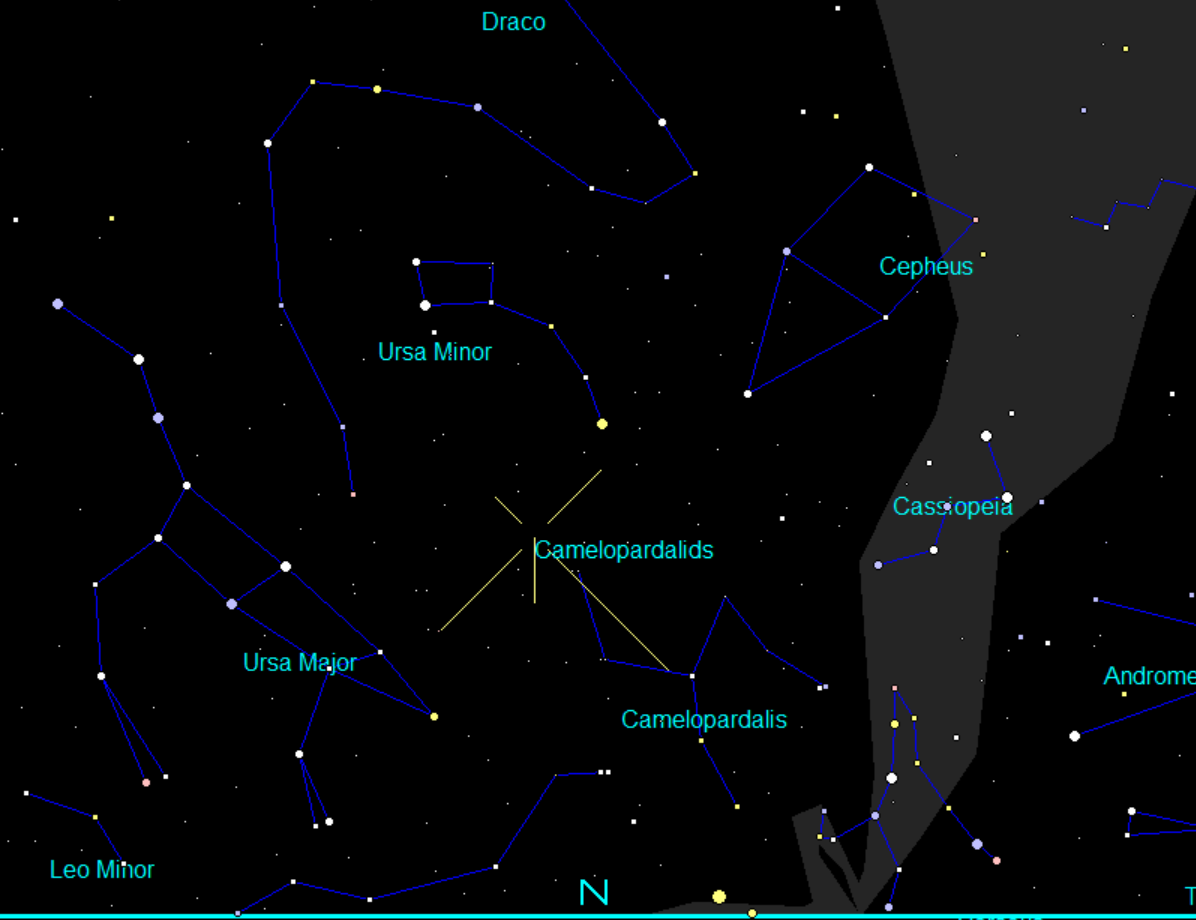
The expected radiant for the meteors of the May Camelopardids, the meteors from the comet 209P/LINEAR at 3 a.m. on May 24, 2014. Credit: My LookingUp program.
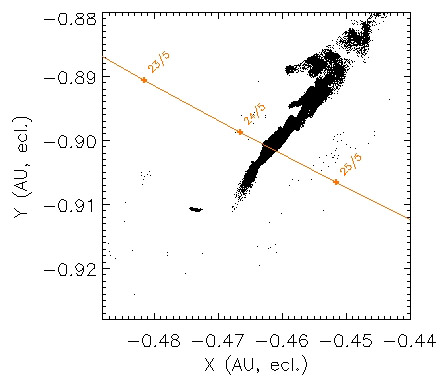
Earth’s motion in respect to the expected meteoroid stream from Comet 209P/LINEAR. Calculations by Jeremie Vaubaillon. From meteor.seti.org.
05/15/2014 – Ephemeris – Comet 209P/LINEAR and the meteor storm
Ephemeris for Thursday, May 15th. Today the sun will be up for 14 hours and 49 minutes, setting at 9:03. The moon, 1 day past full, will rise at 10:10 this evening. Tomorrow the sun will rise at 6:13. | A possible meteor storm is predicted for the morning of Saturday May 24th, between the hours of 3 and 4 a.m. with the first meteors showing up shortly after 1:30 a.m. and building after that. Meteor showers are produced by the debris of comets. The comet that will be responsible is 209P/LINEAR discovered in 2004 by Lincoln Near-Earth Asteroid Research, though the comet has been in and near its present orbit for centuries. The comet will pass closest to the Earth on May 28th, it will be very dim. The debris cloud will be ahead if it, crossing the earth’s orbit 4 days earlier. The Grand Traverse Astronomical Society is attempting to set up an all night star party/meteor watch. Stay tuned.
Times are for the Traverse City/Interlochen area of Michigan. They may be different for your location.
Addendum
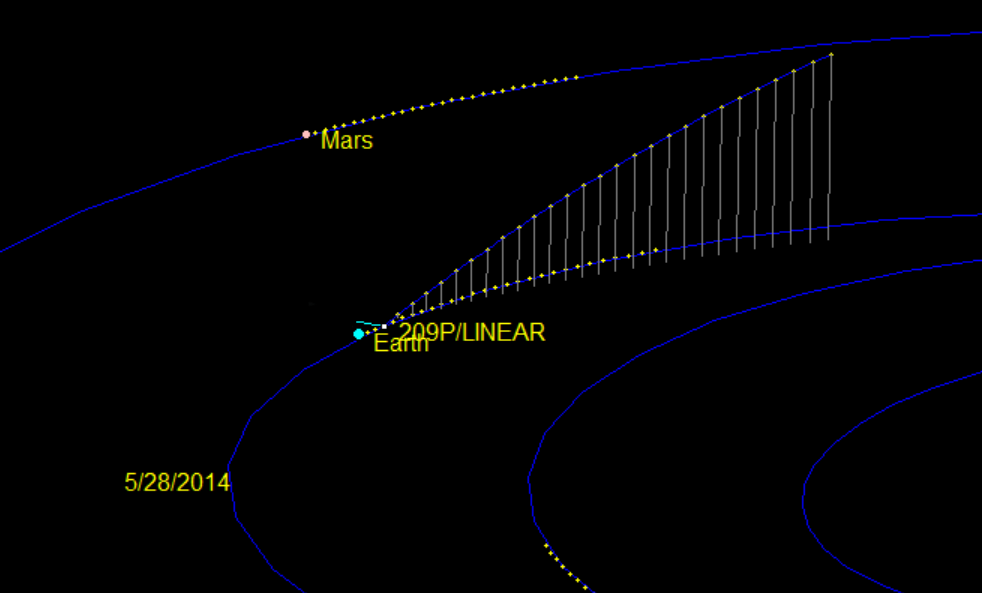
Comet 209P/LINEAR crosses the Earth’s orbit behind the Earth around May 28, 2014. The “stilts” on the comet’s orbit show that it is coming from north of the Earth’s orbital plane. Credit: Bob Moler’s LookingUp program.
The expected radiant for the meteors of the May Camelopardids, the meteors from the comet 209P/LINEAR at 3 a.m. on May 24, 2014. Credit: My LookingUp program.
 Bob Moler's Ephemeris Blog