Archive
Ephemeris: 10/18/2024 – Comet Tsuchinshan-ATLAS can barely compete with the bright Moon
This is Ephemeris for Friday, October 18th. Today the Sun will be up for 10 hours and 49 minutes, setting at 6:52, and it will rise tomorrow at 8:04. The Moon, 1 day past full, will rise at 7:21 this evening.
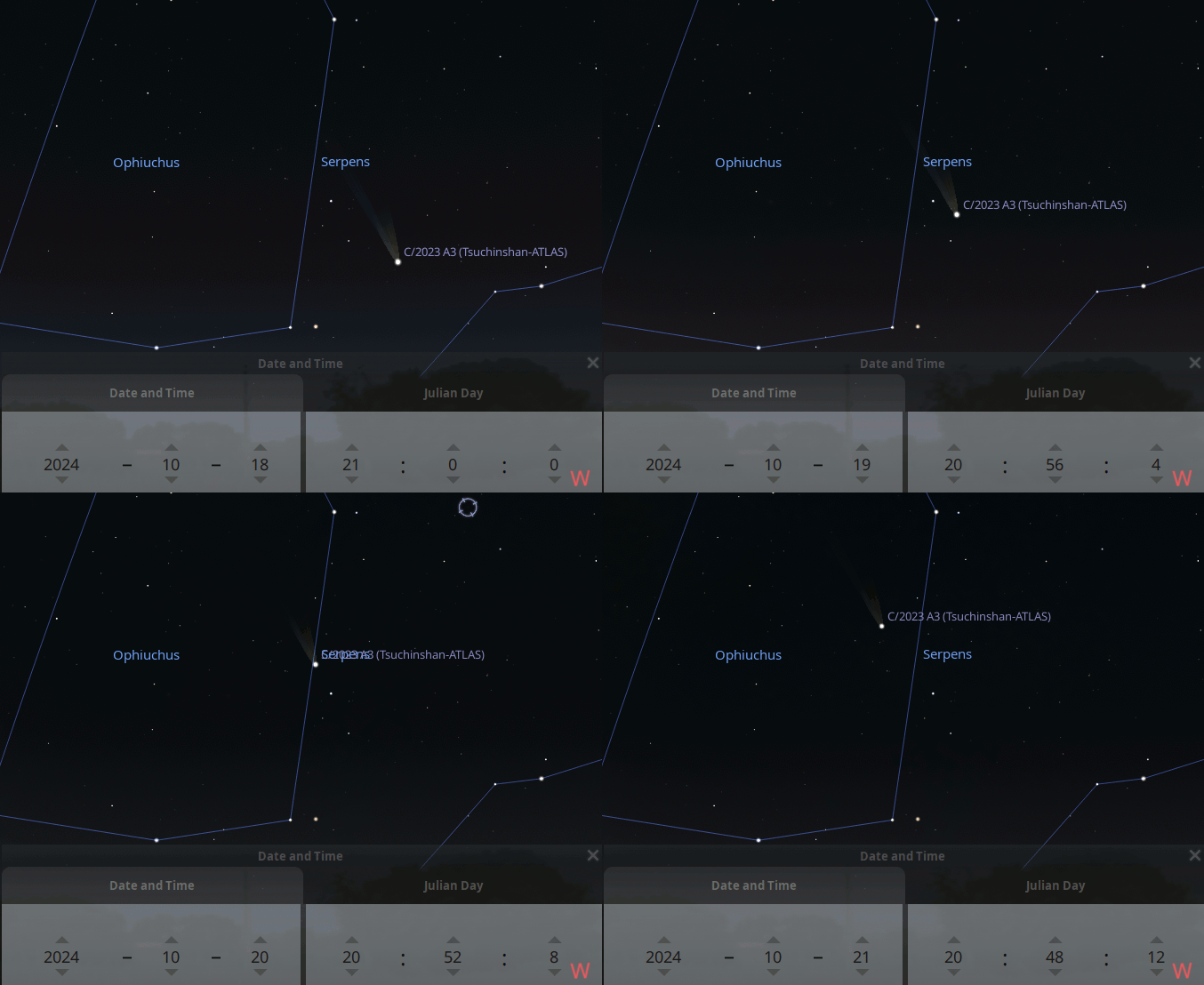
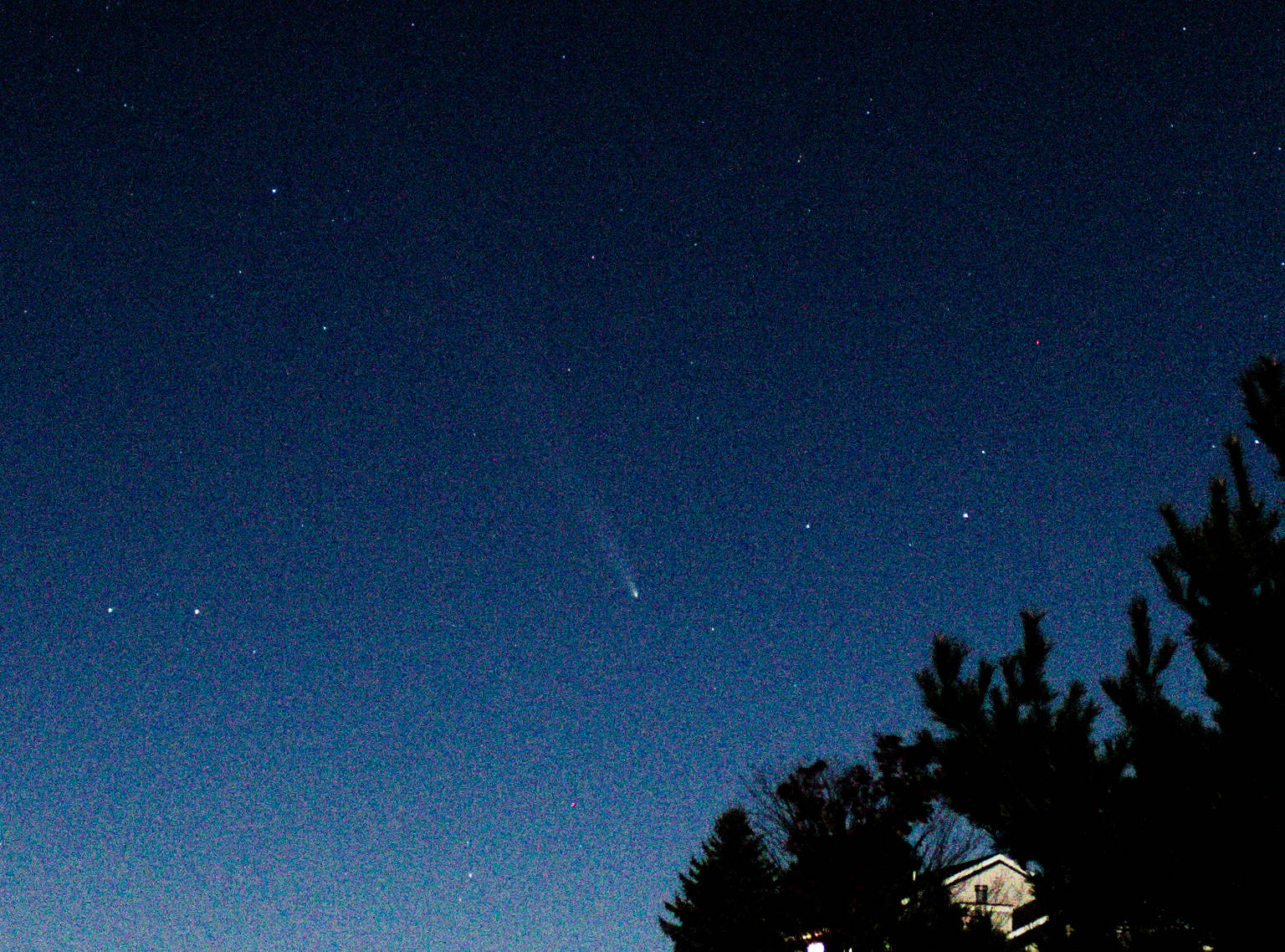
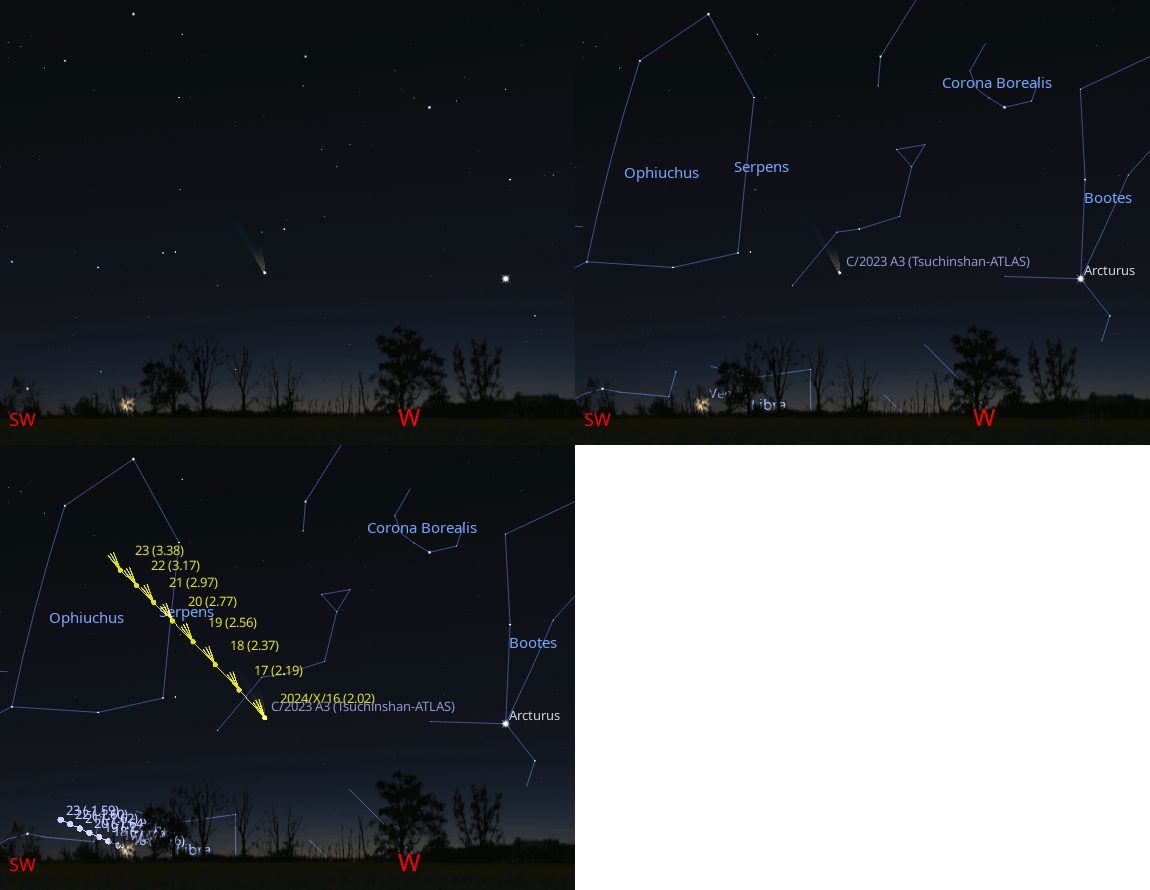
Comet Tsuchinshan-ATLAS will be visible by 8:00 PM in the west-southwest. It’s a bit higher than it was last night and tomorrow night it’ll be a bit higher still. It also is fading and must also compete with the bright moonlight. It is the brightest comet that we’ve seen around here this century. We’ve been looking forward to this comet for more than a year and a half, since it’s discovery in January of last year. Comets were not always objects to look forward to. In ancient times when they suddenly appeared, they struck fear. They were thought to portend disasters. In fact the word disaster means ill-starred. The word comet basically comes from the Latin meaning hairy star. The Chinese had a similar name for them, they called them broom stars.
The astronomical event times given are for the Traverse City/Interlochen area of Michigan (EDT, UT – 4 hours). Times will be different for other locations.
Addendum
Ephemeris: 10/17/2024 – Comets look a lot bigger than they actually are
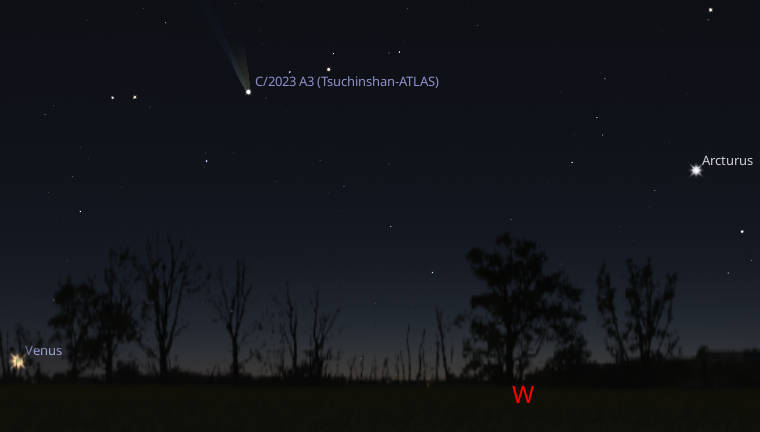
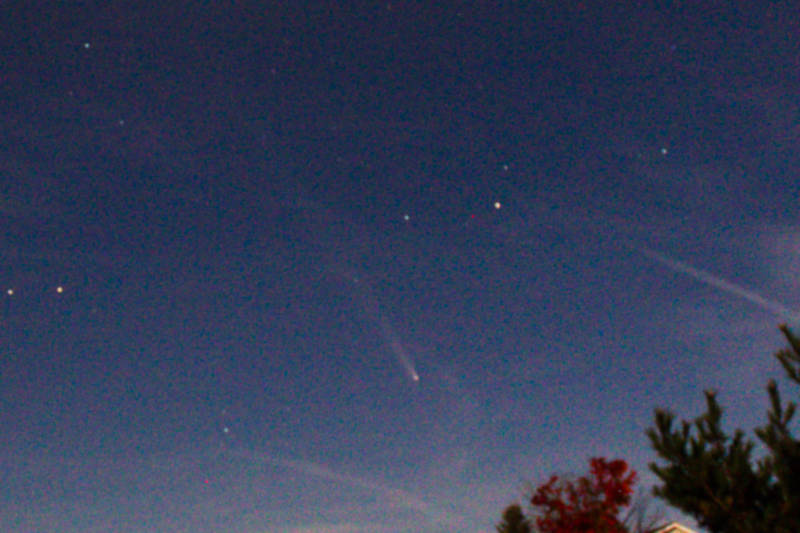
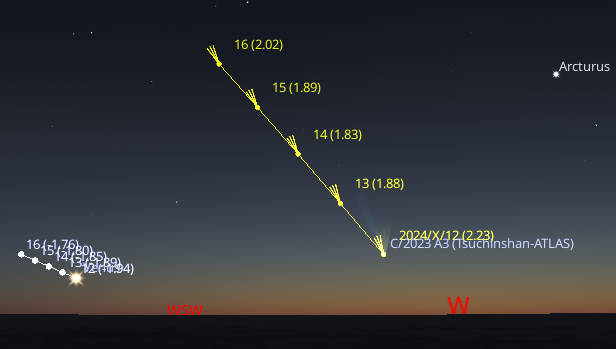
This is Bob Moler with Ephemeris for Thursday, October 17th. Today the Sun will be up for 10 hours and 52 minutes, setting at 6:53, and it will rise tomorrow at 8:02. The Moon, at full today, will rise at 6:53 this evening. | Comet Tsuchinshan-ATLAS will have its greatest competition with the Moon tonight since it’s full. However, in succeeding nights the Moon will get dimmer and also rise later. At 8 PM the comet will be nearly 18° above the west-southwestern horizon with its tail pointing to up into the bit to the left.* What makes comets spectacular is that they contain volatile materials, like frozen gases, water, and carbon compounds. The solid body of the comet, called the nucleus is quite small, from less than a mile to up to 25 miles in diameter, which on the solar system scale is tiny. They live quite happily in the outer solar system where it’s cold. When approaching the Sun the gases sublimate liberating the included dust, producing the tails the comets are famous for.
The astronomical event times given are for the Traverse City/Interlochen area of Michigan (EDT, UT – 4 hours). Times will be different for other locations.
* I was able to spot the comet last night at around 8:10 PM but only through binoculars. It was not visible to my unaided eye. However, it was visible in binoculars. It also photographed well with the image showing a lot more than what was visible even through binoculars and the amount of clouds that were actually in the sky. However, the clouds were light and generally did not hinder the comet too much. The photograph of the comet below has been processed to increase its brightness and contrast with the sky.
Addendum
Ephemeris: 10/16/2024 – Where are the naked-eye planets and the comet?
This is Bob Moler with Ephemeris for Wednesday, October 16th. Today the Sun will be up for 10 hours and 55 minutes, setting at 6:55, and it will rise tomorrow at 8:01. The Moon, 1 day before full, will set at 8:11 tomorrow morning.
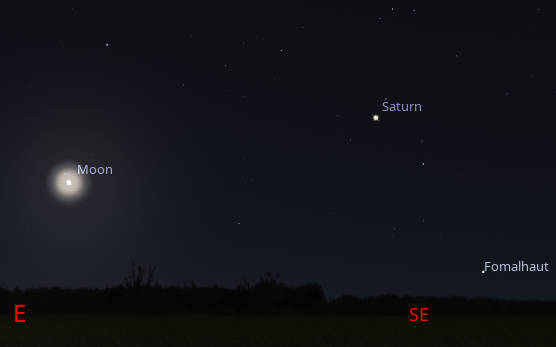
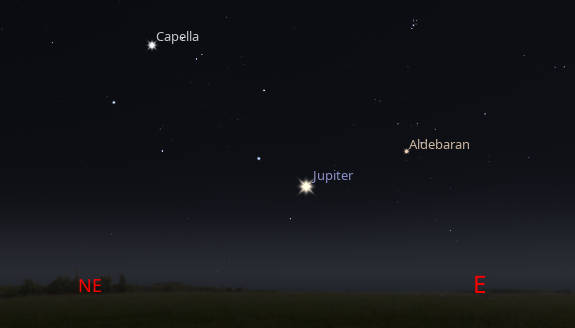
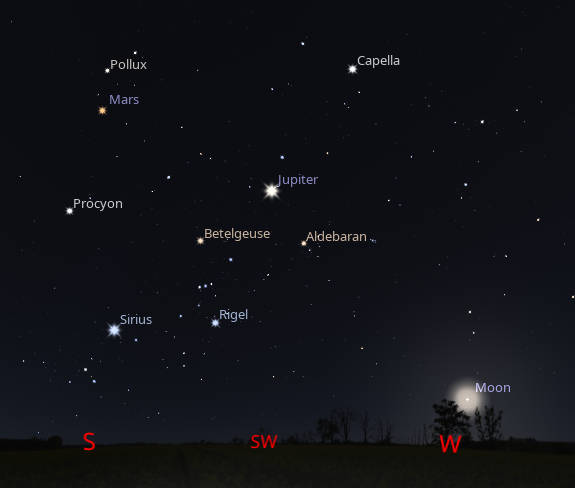
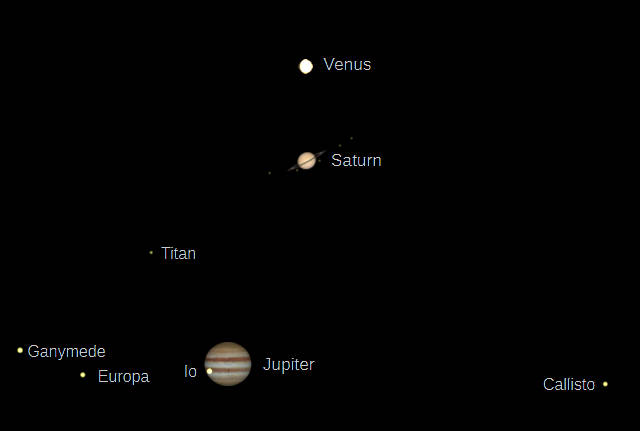
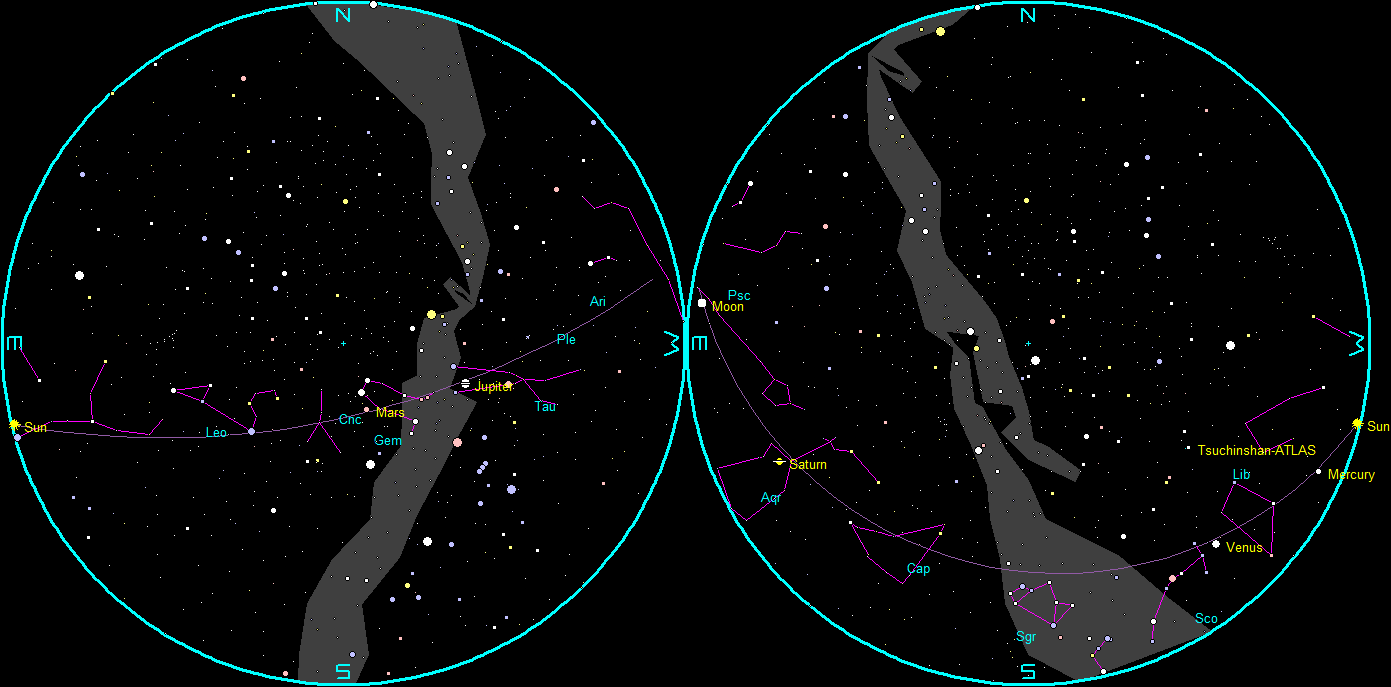
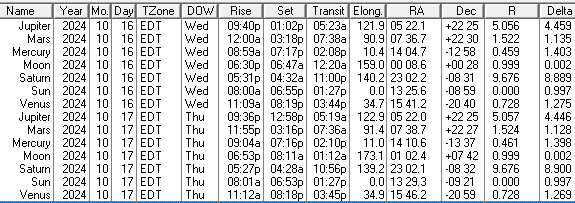
Let’s take our weekly look at the whereabouts of the naked-eye planets. Venus might be spotted in the West southwest low on the horizon at 7:30 PM, 35 minutes after sunset. It will set at 8:19. Comet Tsuchinshan-ATLAS will be west southwest way above and to the right of Venus. It will set at 9:46 PM. Saturn will be in the southeast at 8 PM. Jupiter will rise at 9:40 PM this evening and be a good object for the small telescope about an hour later. Jupiter and Mars are both mourning planets so they can be seen early in the morning before sunrise. By 7:00 AM tomorrow Jupiter will be high in the southwest while Mars will be high in the South.
The astronomical event times given are for the Traverse City/Interlochen area of Michigan (EDT, UT – 4 hours). Times will be different for other locations.
Addendum
Ephemeris: 10/15/2024 – Comet Tsuchinshan-ATLAS should be visible this week if clouds allow
This is Bob Moler with Ephemeris for Tuesday, October 15th. Today the Sun will be up for 10 hours and 58 minutes, setting at 6:57, and it will rise tomorrow at 8:00. The Moon, 2 days before full, will set at 6:47 tomorrow morning.
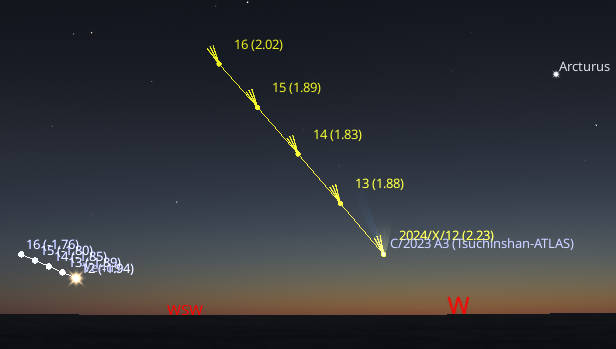
Comet Tsuchinshan-ATLAS has been visible in our evening skies for the last three nights and will be at least bright enough to be seen with the naked eye. And it should be so for most of the rest of the month. However, this week so far has been cloudy, and it will be cloudy until possibly Wednesday night however Thursday and Friday look like the best for viewing of the comet. Of course this is Michigan, so don’t hold me to it. The comet has been pretty much living up to expectations as far as its brightness and the length of its tail. The comet peak brightness which came early last week, when it could only be seen during the daytime, was as bright as the planet Venus. Now that it is headed away from the Sun and the Earth it will rapidly fade.
The astronomical event times given are for the Traverse City/Interlochen area of Michigan (EDT, UT – 4 hours). Times will be different for other locations.
Addendum
What we’ve missed
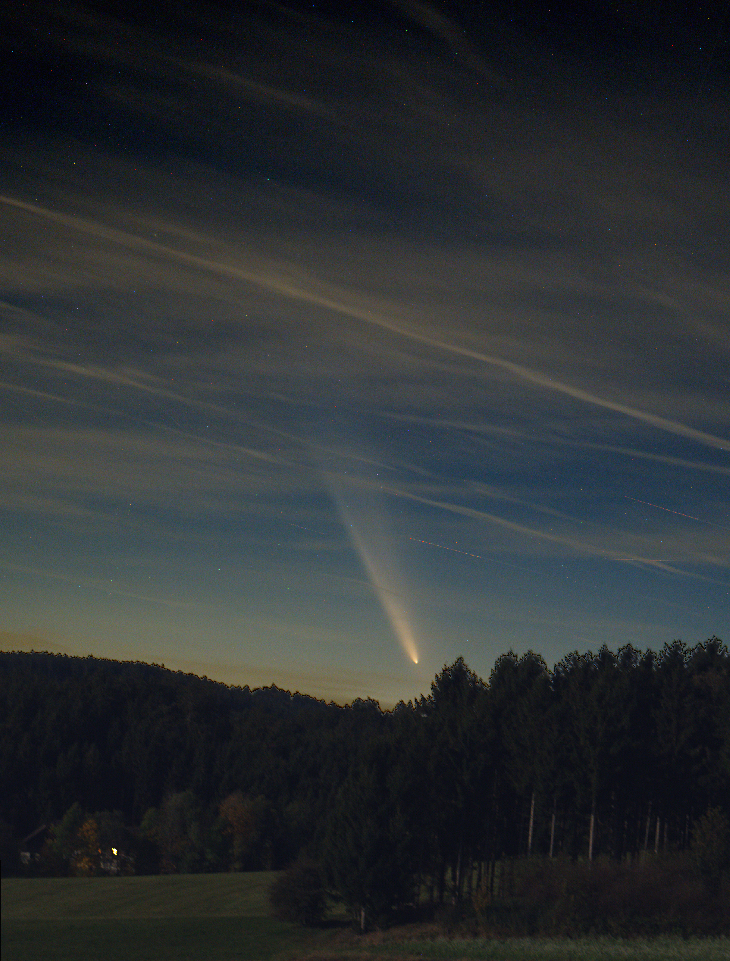
It was partly cloudy on the evening of 14th, last night. I went out a little after 8 PM to see if I could spot the comet. I could see Arcturus, however I could not spot the comet or the planet Venus. However, I believe someone in our area could have spotted the comet, if they were in the right location.
Ephemeris: 10/14/2024 – The One Who Came From a Shooting Star
This is Ephemeris for Indigenous Peoples Day, Monday, October 14th. Today the Sun will be up for 11 hours and 1 minute, setting at 6:58, and it will rise tomorrow at 7:58. The Moon, 3 days before full, will set at 5:24 tomorrow morning.
I’ll relate it to our comet. Comets are the cause of meteor showers. However, our current comet Tsuchinshan-ATLAS will never produce a meteor shower for us because its orbit doesn’t come close to the Earth’s. The closest it gets is half the distance to the Sun which it did five days ago.
The Anishinaabek have a story about how the Wolverine got its name, in their language, gwiingwa’aage, which means “The One Who Came From a Shooting Star”. An evil star spirit crashed to Earth and created a crater in what is now northern Quebec. Later it filled with water, and sometime later this ill-tempered creature crawled out of it. The University of Michigan’s teams are called the Wolverines, even though the wolverine is not native to Michigan.
The astronomical event times given are for the Traverse City/Interlochen area of Michigan (EDT, UT – 4 hours). Times will be different for other locations.
Addendum
Ephemeris: 10/11/2024 – Comet Tsuchinshan-ATLAS may be visible as early as tonight
This is Ephemeris for Friday, October 11th. Today the Sun will be up for 11 hours and 10 minutes, setting at 7:04, and it will rise tomorrow at 7:55. The Moon, 1 day past first quarter, will set at 1:22 tomorrow morning.
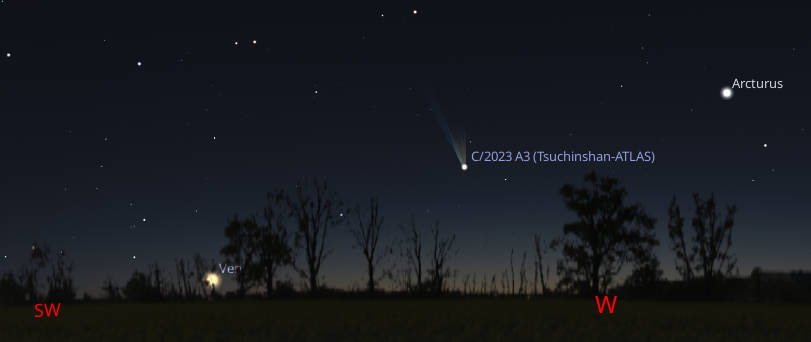
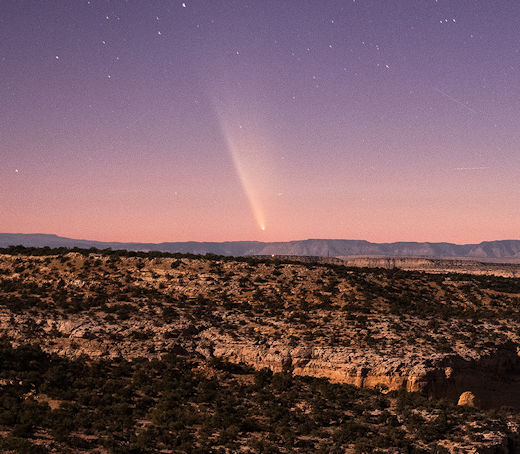
While I think the first time the spot Comet Tsuchinshan-ATLAS will be tomorrow night, sharp-eyed observers with binoculars might be able to find the comet tonight just about due west near the horizon after 7:30 PM it will be a difficult task being so close to the sun The comet will set at 8:09 PM, however if the tail is bright enough it may still be visible. The comet’s tail should be relatively short since it’s actually pointing back towards us. That may also make the tail somewhat brighter since we’re looking down through the thicker part of the tail rather than through its side. I’ve seen a lot of comets in my time, the first ones in 1957. There were two bright comets that year.
The astronomical event times given are for the Traverse City/Interlochen area of Michigan (EDT, UT – 4 hours). Times will be different for other locations.
Addendum
Ephemeris: 10/10/2024 – Where did Comet Tsuchinshan-ATLAS come from?
This is Ephemeris for Thursday, October 10th. Today the Sun will be up for 11 hours and 13 minutes, setting at 7:05, and it will rise tomorrow at 7:53. The Moon, at first quarter today, will set at 12:05 tomorrow morning.
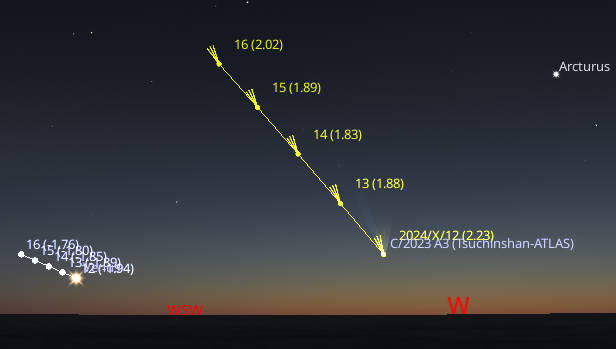
The comet Tsuchinshan-ATLAS will get far enough from the direction of the Sun so we can see it in the evening this weekend. It comes from the Oort Cloud of comets in the far reaches of the solar system probably extends maybe three quarters* of the way to the nearest other star to us Alpha Centauri. Somebody figured out that it has an orbital period of around 80,000 years. Every few million years or so a star comes close enough to the Sun to stir up the comets in the Oort Cloud, sending some of them out escaping the Sun and some sent in towards the inner solar system. This of course is one of the latter. No two comets are exactly alike so they’re quite unpredictable. Some have a lot of dust and some are mostly frozen gases.
The astronomical event times given are for the Traverse City/Interlochen area of Michigan (EDT, UT – 4 hours). Times will be different for other locations.
* On the radio program I stated a “quarter of the way”.
Addendum
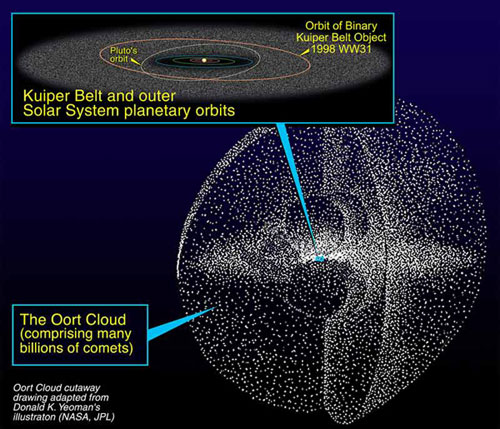
The Oort Cloud is named after Jan Oort, a Dutch astronomer, who proposed a cloud of comets in 1950 as the source of long period comets. The cloud would extend from 2,000 to 200,000 times Earth’s distance from the Sun. The shape of the cloud is roughly spherical. Comet encounters with Jupiter can cause them to become short period comets, or be ejected from the solar system.
Ephemeris: 10/07/2024 – Comet Tsuchinshan-ATLAS will be visible starting Saturday Night
This is Ephemeris for Monday, October 7th. Today the Sun will be up for 11 hours and 22 minutes, setting at 7:11, and it will rise tomorrow at 7:50. The Moon, 3 days before first quarter, will set at 9:15 this evening.
In January of last year a Chinese observatory discovered a comet which was subsequently lost. A month and a half later another observatory in South Africa rediscovered it. That’s why the comet is named, Tsuchinshan-ATLAS after the two observatories. It was soon learned that the comet had a chance of becoming visible to the unaided eye in late September and October 2024, this month. Despite having a dimming episode earlier this year the comet promises to be naked eye and possibly even spectacular. The comet is moving from the south to the north and in a direction counter to the orbiting planets around the Sun. We will begin to see it low in the West after sunset starting Saturday.
The astronomical event times given are for the Traverse City/Interlochen area of Michigan (EDT, UT – 4 hours). Times will be different for other locations.
Addendum
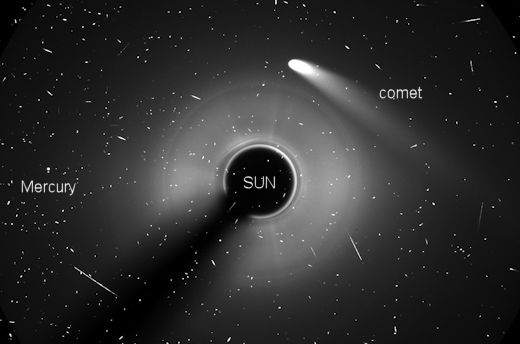
The comet will pass almost directly between the Earth and the Sun on the evening of the 9th. It’ll be about halfway between the Earth and the Sun at that point. It should be picked up by the Solar and Heliospheric Observatory satellite (SOHO) which is orbiting the Earth-Sun L1 Lagrange point a million miles sunward from the Earth with its C3 coronagraph*. Then the comet’s tail should be pointing almost directly at the Earth. As the comet swings out away from the Sun it will also be more rapidly moving away from Earth. This is because the comet has an orbit that is counter to that of the orbits of the Earth and the rest of the planets around the Sun and will rapidly fade as it increases its distance.
A note on the discovery designation: C/2023 A3 is C for comet; 2023, the year of discovery; A3, third object reportedly discovered in the first half of January.
The SOHO Real-time GIF Movies webpage is: https://soho.nascom.nasa.gov/data/realtime/gif/. Select LASCO/C3. It provides a time-lapse image of the Sun’s corona taken at hourly intervals for about the last 4 days.
Ephemeris: 10/01/2024 – Previewing the skies of October
This is Ephemeris for Tuesday, October 1st. Today the Sun will be up for 11 hours and 40 minutes, setting at 7:22, and it will rise tomorrow at 7:42. The Moon, 1 day before new, will rise at 7:30 tomorrow morning.
Let’s look at the skies for the month of October. The Sun will still be moving south rapidly. Daylight hours in the Interlochen/Traverse City area and will drop from 11 hours and 40 minutes today to 10 hours, 11 minutes at month’s end. The altitude of the Sun above the southern horizon at local noon will be 42 degrees today, and will descend to 31 degrees on Halloween, also in the Interlochen area. Sunrise times will increase from 7:41 today all the way to 8:20 a.m. in Interlochen and Traverse City on the 31st. Sunset times will decrease from 7:22 p.m. today to 6:32 on Halloween.
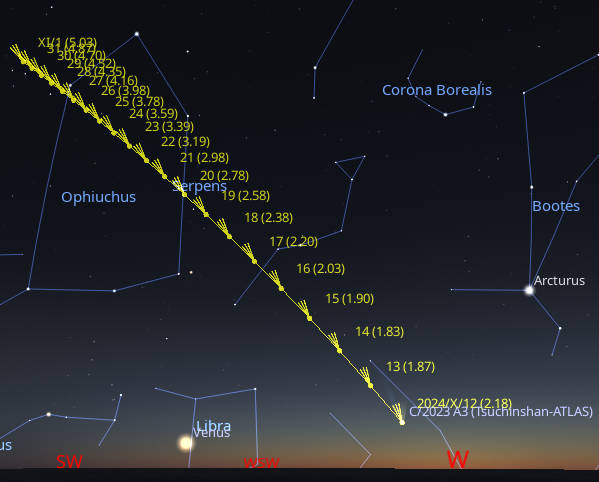
The big event of October will be the appearance of Comet Tsuchinshan-ATLAS in the evening sky which may become quite bright, but being a comet, all bets are off until you actually see it. It will become visible in the evening sky starting October 12th.
The astronomical event times given are for the Traverse City/Interlochen area of Michigan (EDT, UT – 4 hours). Times will be different for other locations.
Addendum
October path of Comet Tsuchinshan-ATLAS
October Evening Star Chart
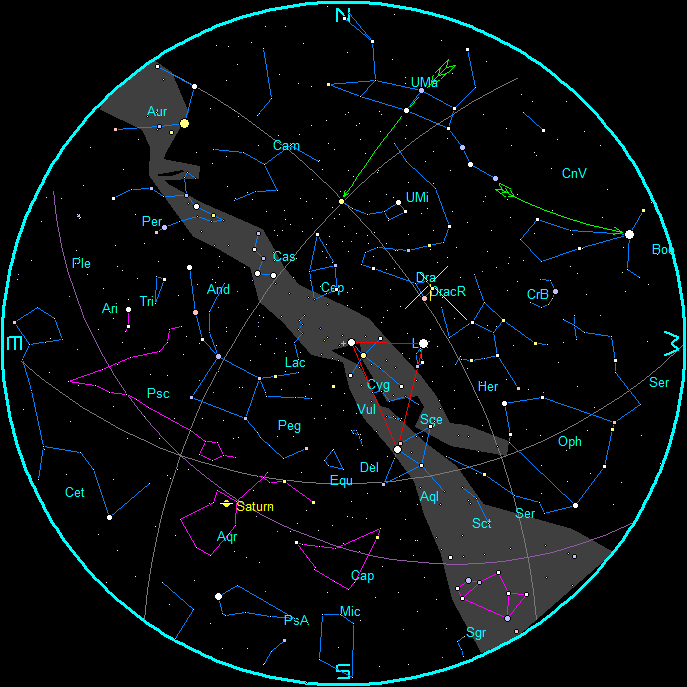
The planets and stars are plotted for the 15th at 9 p.m. EDT in the evening and 6 a.m. for the morning chart. These are the chart times. Note that Traverse City is located approximately 45 minutes behind our time meridian, West 75° longitude. (An hour 45 minutes behind our daylight saving time meridian during EDT). To duplicate the star positions on a planisphere you may have to set it to 1 hour 45 minutes earlier than the current time.
October Morning Star Chart
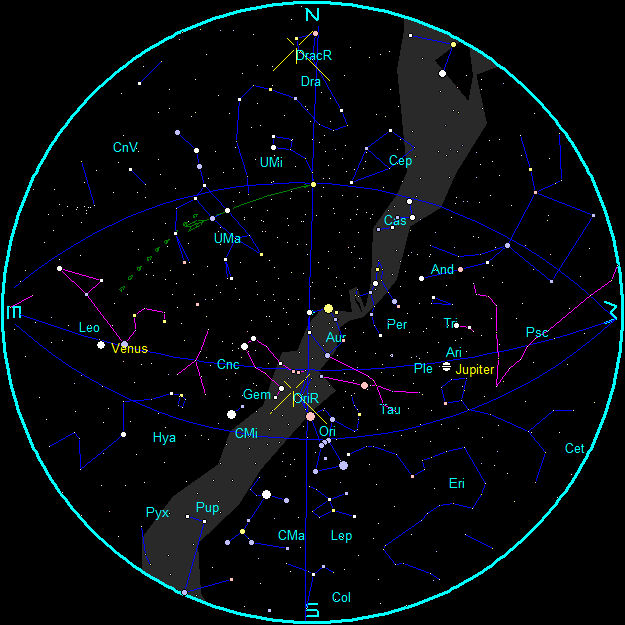
or a list of constellation names to go with the abbreviations, click here.
- Pointer stars at the front of the bowl of the Big Dipper point to Polaris, the North Star.
- Leaky dipper drips on Leo.
- Follow the arc of the handle of the Big Dipper to the star Arcturus.
- The Summer Triangle is in red.
- DracR – Draconid Radiant – Peaks the 8th – Zenithal Hourly Rate < 10 with rare outbursts of a thousand an hour. It’s hindered this year by the full moon.
- OriR – Orionid Radiant – Peak 21st – Zenithal Hourly Rate = 20
Twilight Limits, Nautical and Astronomical
| EDT | |||||||
| Morning | Twilight | Evening | Twilight | Dark | Night | Moon | |
| Date | Astro. | Nautical | Nautical | Astro. | Start | End | Illum. |
| 2024-10-01 | 6h06m | 6h40m | 20h28m | 21h03m | 21h03m | 6h06m | 0.00 |
| 2024-10-02 | 6h07m | 6h41m | 20h27m | 21h01m | 21h01m | 6h07m | 0.00 |
| 2024-10-03 | 6h08m | 6h42m | 20h25m | 20h59m | 20h59m | 6h08m | 0.02 |
| 2024-10-04 | 6h09m | 6h43m | 20h23m | 20h57m | 20h57m | 6h09m | 0.05 |
| 2024-10-05 | 6h11m | 6h45m | 20h21m | 20h55m | 20h55m | 6h11m | 0.10 |
| 2024-10-06 | 6h12m | 6h46m | 20h19m | 20h53m | 20h53m | 6h12m | 0.17 |
| 2024-10-07 | 6h13m | 6h47m | 20h17m | 20h51m | 21h15m | 6h13m | 0.25 |
| 2024-10-08 | 6h14m | 6h48m | 20h16m | 20h50m | 22h01m | 6h14m | 0.34 |
| 2024-10-09 | 6h16m | 6h50m | 20h14m | 20h48m | 22h58m | 6h16m | 0.44 |
| 2024-10-10 | 6h17m | 6h51m | 20h12m | 20h46m | – | 6h17m | 0.55 |
| 2024-10-11 | 6h18m | 6h52m | 20h10m | 20h44m | 0h06m | 6h18m | 0.65 |
| 2024-10-12 | 6h19m | 6h53m | 20h09m | 20h43m | 1h22m | 6h19m | 0.76 |
| 2024-10-13 | 6h21m | 6h54m | 20h07m | 20h41m | 2h42m | 6h21m | 0.85 |
| 2024-10-14 | 6h22m | 6h56m | 20h05m | 20h39m | 4h03m | 6h22m | 0.92 |
| 2024-10-15 | 6h23m | 6h57m | 20h04m | 20h37m | 5h25m | 6h23m | 0.98 |
| 2024-10-16 | 6h24m | 6h58m | 20h02m | 20h36m | – | – | 1.00 |
| 2024-10-17 | 6h26m | 6h59m | 20h00m | 20h34m | – | – | 0.99 |
| 2024-10-18 | 6h27m | 7h01m | 19h55m | 20h33m | – | – | 0.96 |
| 2024-10-19 | 6h28m | 7h02m | 19h53m | 20h31m | – | – | 0.89 |
| 2024-10-20 | 6h29m | 7h03m | 19h52m | 20h29m | 20h29m | 20h40m | 0.81 |
| 2024-10-21 | 6h31m | 7h04m | 19h50m | 20h28m | 20h28m | 21h36m | 0.72 |
| 2024-10-22 | 6h32m | 7h05m | 19h49m | 20h26m | 20h26m | 22h41m | 0.62 |
| 2024-10-23 | 6h33m | 7h07m | 19h47m | 20h25m | 20h25m | 23h51m | 0.51 |
| 2024-10-24 | 6h34m | 7h08m | 19h46m | 20h23m | 20h23m | – | 0.41 |
| 2024-10-25 | 6h35m | 7h09m | 19h44m | 20h22m | 20h22m | 1h01m | 0.32 |
| 2024-10-26 | 6h37m | 7h10m | 19h43m | 20h21m | 20h21m | 2h10m | 0.23 |
| 2024-10-27 | 6h38m | 7h12m | 19h42m | 20h19m | 20h19m | 3h16m | 0.16 |
| 2024-10-28 | 6h39m | 7h13m | 19h40m | 20h18m | 20h18m | 4h19m | 0.10 |
| 2024-10-29 | 6h40m | 7h14m | 19h39m | 20h17m | 20h17m | 5h22m | 0.05 |
| 2024-10-30 | 6h41m | 7h15m | 19h37m | 20h15m | 20h15m | 6h25m | 0.02 |
| 2024-10-31 | 6h43m | 7h16m | 19h36m | 20h14m | 20h14m | 6h43m | 0.00 |
Twilight calendar was generated using Cartes du Ciel (Sky Charts).
See my blog post: Twilight Zone for the definitions of the different periods of twilight here: https://bobmoler.wordpress.com/2018/09/27/.
NASA Calendar of Planetary Events
Date          Time    Event
Oct  1  Tu            Venus: 31.4° E
     2  We   7:52 am  Moon Descending Node
     2  We   2:46 pm  Annular Solar Eclipse
     2  We   2:49 pm  New Moon
     2  We   3:40 pm  Moon Apogee: 406500 km
     5  Sa   4:26 pm  Moon-Venus: 3.3° N
     7  Mo   2:48 pm  Moon-Antares:  .2° N
     9  We   7:53 am  Moon South Dec.: 28.7° S
    10  Th   2:55 pm  First Quarter
    14  Mo   2:05 pm  Moon-Saturn:  .1° S
    16  We   3:05 am  Moon Ascending Node
    16  We   8:46 pm  Moon Perigee: 357200 km
    17  Th   7:26 am  Full Moon
    18  Fr   7:50 pm  Mars-Pollux: 5.7° S
    19  Sa   3:59 pm  Moon-Pleiades:  .1° S
    21  Mo   1:58 am  Orionid Shower: ZHR = 20
    21  Mo   8:50 pm  Moon North Dec.: 28.7° N
    23  We   1:16 pm  Moon-Pollux: 1.8° N
    23  We   3:55 pm  Moon-Mars: 4.2° S
    24  Th   4:03 am  Last Quarter
    24  Th   1:35 pm  Moon-Beehive: 3.3° S
    25  Fr   7:43 pm  Venus-Antares: 3.1° N
    29  Tu  12:44 pm  Moon Descending Node
    29  Tu   5:50 pm  Moon Apogee: 406200 km
Nov  1  Fr            Venus: 38.2° E
All event times are given for UTC-4 hr: Eastern Daylight Saving Time.
Sky Events Calendar by Fred Espenak and Sumit Dutta (NASA’s GSFC),
http://eclipse.gsfc.nasa.gov/SKYCAL/SKYCAL.html.
If you go to the above site, you can print out a list like the above for the entire year or calendar pages for your time zone.
Sun and Moon Rising and Setting Times
     LU                  Ephemeris of Sky Events for Interlochen/TC
October, 2024    Local time zone: EDT
+-----------------------------------------------------------------------+
| DATE |  SUN     SUN  DAYLIGHT|   TWILIGHT*    |MOON  RISE OR    ILLUM |
|      |  RISE    SET    HOURS |  END    START  |PHASE SET** TIME FRACTN|
+=======================================================================+
|Tue  1| 07:41a  07:22p  11:40 | 08:25p  06:38a |      Rise 07:30a    1%|
|Wed  2| 07:42a  07:20p  11:37 | 08:23p  06:39a |New   Set  07:16p    0%|
|Thu  3| 07:43a  07:18p  11:34 | 08:21p  06:40a |      Set  07:33p    1%|
|Fri  4| 07:45a  07:16p  11:31 | 08:19p  06:42a |      Set  07:51p    4%|
|Sat  5| 07:46a  07:14p  11:28 | 08:17p  06:43a |      Set  08:13p    9%|
+------+-----------------------+----------------+-----------------------+
|Sun  6| 07:47a  07:13p  11:25 | 08:15p  06:44a |      Set  08:40p   15%|
|Mon  7| 07:48a  07:11p  11:22 | 08:14p  06:45a |      Set  09:15p   23%|
|Tue  8| 07:50a  07:09p  11:19 | 08:12p  06:47a |      Set  10:00p   32%|
|Wed  9| 07:51a  07:07p  11:16 | 08:10p  06:48a |      Set  10:57p   42%|
|Thu 10| 07:52a  07:05p  11:13 | 08:08p  06:49a |F Qtr Set  12:05a   52%|
|Fri 11| 07:53a  07:04p  11:10 | 08:07p  06:50a |      Set  01:22a   63%|
|Sat 12| 07:55a  07:02p  11:07 | 08:05p  06:51a |      Set  02:41a   73%|
+------+-----------------------+----------------+-----------------------+
|Sun 13| 07:56a  07:00p  11:04 | 08:03p  06:53a |      Set  04:03a   83%|
|Mon 14| 07:57a  06:58p  11:01 | 08:02p  06:54a |      Set  05:24a   91%|
|Tue 15| 07:58a  06:57p  10:58 | 08:00p  06:55a |      Set  06:47a   97%|
|Wed 16| 08:00a  06:55p  10:55 | 07:58p  06:56a |      Set  08:11a  100%|
|Thu 17| 08:01a  06:53p  10:52 | 07:57p  06:58a |Full  Rise 06:53p  100%|
|Fri 18| 08:02a  06:52p  10:49 | 07:55p  06:59a |      Rise 07:21p   96%|
|Sat 19| 08:04a  06:50p  10:46 | 07:54p  07:00a |      Rise 07:55p   91%|
+------+-----------------------+----------------+-----------------------+
|Sun 20| 08:05a  06:48p  10:43 | 07:52p  07:01a |      Rise 08:40p   83%|
|Mon 21| 08:06a  06:47p  10:40 | 07:50p  07:02a |      Rise 09:35p   74%|
|Tue 22| 08:08a  06:45p  10:37 | 07:49p  07:04a |      Rise 10:40p   64%|
|Wed 23| 08:09a  06:44p  10:34 | 07:47p  07:05a |      Rise 11:50p   53%|
|Thu 24| 08:10a  06:42p  10:31 | 07:46p  07:06a |L Qtr Rise 01:01a   43%|
|Fri 25| 08:12a  06:40p  10:28 | 07:45p  07:07a |      Rise 02:09a   34%|
|Sat 26| 08:13a  06:39p  10:25 | 07:43p  07:09a |      Rise 03:15a   25%|
+------+-----------------------+----------------+-----------------------+
|Sun 27| 08:14a  06:37p  10:23 | 07:42p  07:10a |      Rise 04:19a   17%|
|Mon 28| 08:16a  06:36p  10:20 | 07:40p  07:11a |      Rise 05:22a   11%|
|Tue 29| 08:17a  06:34p  10:17 | 07:39p  07:12a |      Rise 06:24a    6%|
|Wed 30| 08:18a  06:33p  10:14 | 07:38p  07:14a |      Rise 07:28a    2%|
|Thu 31| 08:20a  06:32p  10:11 | 07:36p  07:15a |      Rise 08:34a    0%|
+-----------------------------------------------------------------------+
* Nautical Twilight
** Moonrise or moonset, whichever occurs between sunset and sunrise
Generated using my LookingUp for DOS program.
Ephemeris: 08/08/2024 – The source of the Perseid Meteor Shower
This is Ephemeris for Thursday, August 8th. Today the Sun will be up for 14 hours and 20 minutes, setting at 8:58, and it will rise tomorrow at 6:38. The Moon, halfway from new to first quarter, will set at 10:47 this evening.
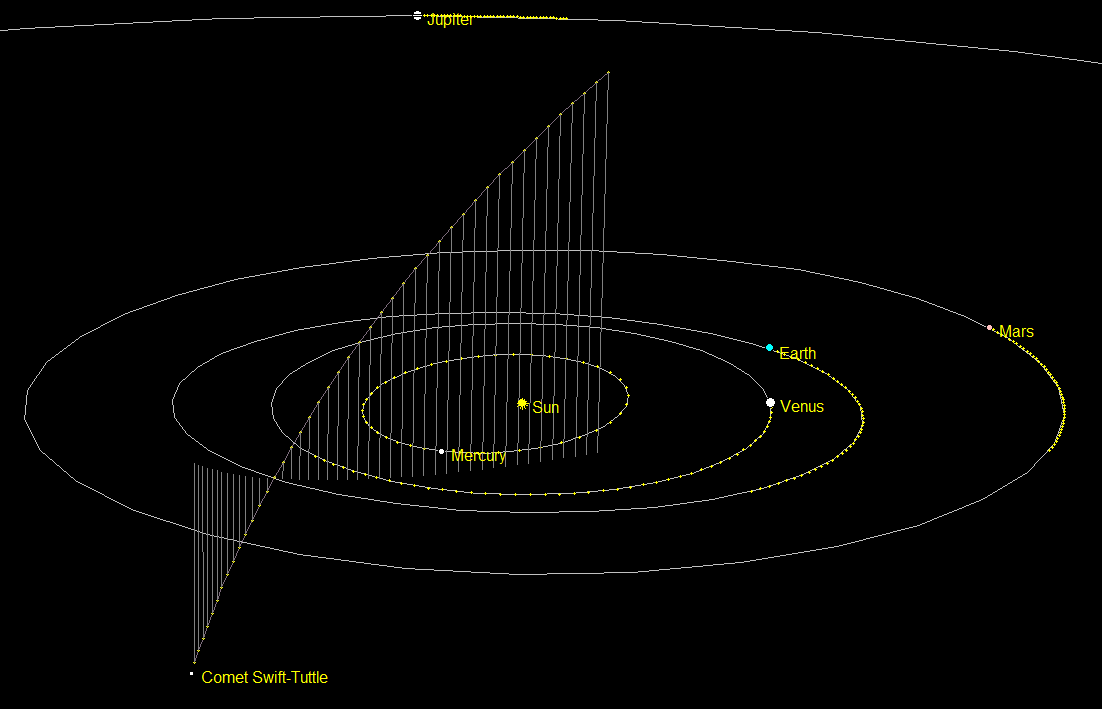
The source of the Perseid meteor shower is Comet Swift-Tuttle, first discovered in 1862 buy Lewis Swift and Horace Parnell Tuttle. The comet was expected back around 1982, but it didn’t show. Its orbit was recalculated and was expected around 1992, when it indeed showed up. The comet has a 130 or so year orbit of the Sun which does vary from appearance to appearance. The comet appears to be in resonance with Jupiter’s orbit of the Sun, going around once in the same time Jupiter goes around the Sun 11 times. Its next appearance in the inner solar system will be in the year 2126, when it is expected to be quite bright then, coming relatively close to the Earth.
The astronomical event times given are for the Traverse City/Interlochen area of Michigan (EDT, UT–4 hours). Times will be different for other locations.
Addendum
 Bob Moler's Ephemeris Blog