Archive
03/15/2021 – Ephemeris – Newly discovered comet may reach naked-eye brightness by December
This is Ephemeris for Ides of March, Monday, March 15th. Today the Sun will be up for 11 hours and 54 minutes, setting at 7:49, and it will rise tomorrow at 7:52. The Moon, 2 days past new, will set at 10:12 this evening.
Now that daylight saving time is here all the times I give for sunrises and sunsets bump up at least an hour along with anything else the rises or sets. It’s lighter out in the evening now. The end of nautical twilight, by which time it’s dark enough to see most of the stars and constellations ends around 8:21 tonight, but that will continue to advance toward 11 pm by July. On to possibly happier news, a comet was discovered, and is called Comet 2021 A1 (Leonard). It could reach naked eye visibility and be brightest in mid-December. I mean could. Comets are unpredictable, and so is our weather that time of year. I’ll have more on Comet Leonard, its antics and more about comets in general as it heads in from the outer solar system during this year.
The astronomical event times given are for the Traverse City/Interlochen area of Michigan. They may be different for your location.
Addendum
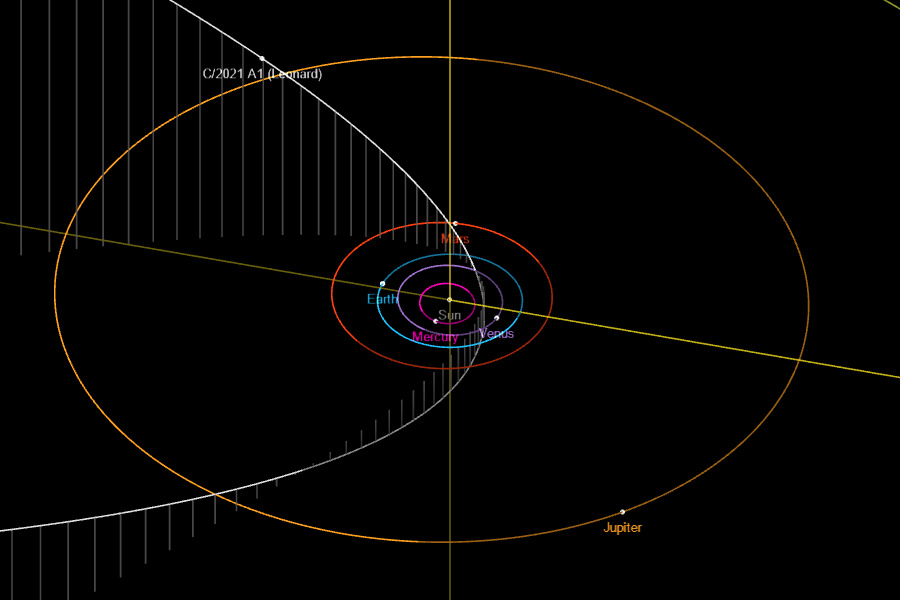
Comet C/2021 A1 (Leonard) orbit and position as of March 15, 2021. The vertical lines (I call them stilts) show the orbit’s position above or below the plane of the Earth’s orbit. It will reach its closest point to the Sun on January 3, 2022, just inside Venus’ orbit. Click on the image to enlarge. Credit NASA/JPL Small-Body Database Browser.
03/08/2021 – Ephemeris – 45 years ago today I saw and photographed Comet West!
This is Bob Moler with Ephemeris for International Women’s Day, Monday, March 8th. Today the Sun will be up for 11 hours and 32 minutes, setting at 6:40, and it will rise tomorrow at 7:05. The Moon, 3 days past last quarter, will rise at 5:34 tomorrow morning.
On this day 45 years ago, in 1976, during the first year of these Ephemeris programs I was able to report on, observe and photograph the brightest comet I had seen up till that time: Comet West. It was not supposed to be a bright comet, but as it rounded the Sun, it began to brighten spectacularly. Later I found out that it’s nucleus broke into several fragments, liberating a great quantity of gas and dust. It turned out to be a very dusty comet which ended up in a broad and bright tail. It was going to be visible before sunrise, and this was the first morning in a while it was clear. Even before the head of the comet rose, the tail could be seen rising in the east. I was able to get several photographs of this wonderful comet!
The astronomical event times given are for the Traverse City/Interlochen area of Michigan. They may be different for your location.
Addendum
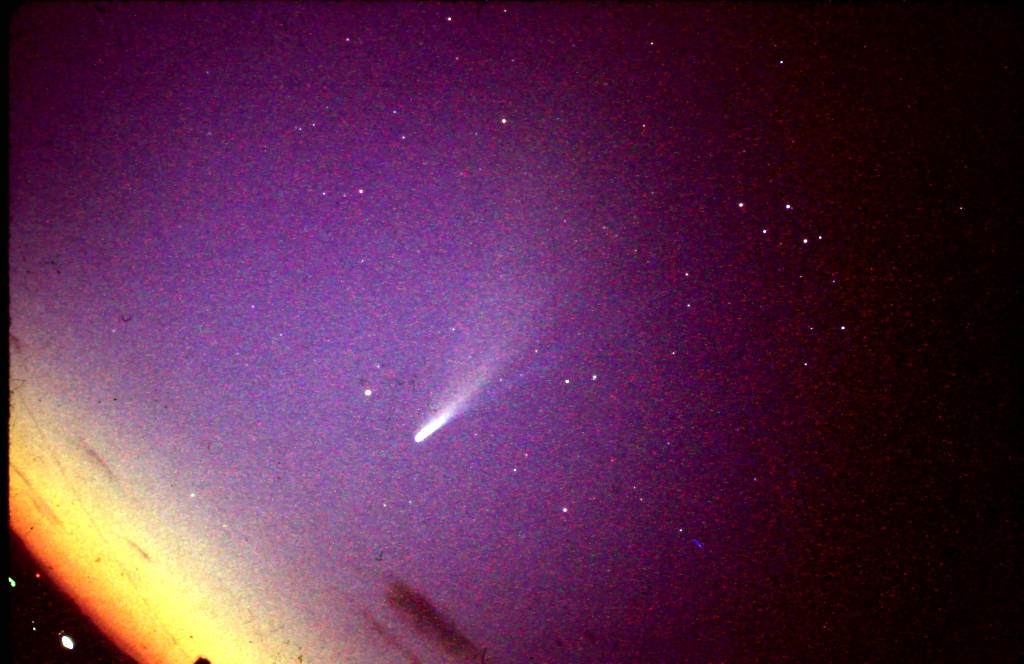
Comet West, C/1975 V1, as photographed by me at about 6 am, March 8, 1976. The wide, curved dust tail is most prominent with the narrow blue ion tail pointed more directly at the rising Sun. The small summer constellation of Delphinus the dolphin is to the upper right. The diamond shape of stars at the front of the dolphin’s body is an asterism called Job’s Coffin.
In the image above is tilted about 45 degrees to the horizon in the lower left due to the fact that it was on an equatorial mount, where up and down is north and south in the sky, horizontally is east and west. It’s cocked 45 degrees to the horizon because we are at 45 degrees latitude. Actually the angle is 90 – your latitude which around here is 90 – 45 = 45.
I got up early in the morning of March 8th 1976. I had my telescope mount outside because it takes awhile to set it up to true north and everything. The telescope and camera that mounts on it were taken inside. I just left it there covered with a tarp and wasn’t observing too much that winter. When I got up in wee hours of the morning of the eighth I found out that my telescope mount was buried in the middle of a snowdrift, so I had to dig it out. As I was digging it out I looked to the east and saw the tail of the comet rising before the head did. I then redoubled my efforts and got everything set up so I could take photographs of the comet.
I had built a small telescope a few years before for a solar eclipse as a kind of contingency camera in case my automatic cameras I had built didn’t work. It was a 108 mm f/6 reflecting telescope that I attached a camera back to and took some minute or two long exposures that way. I then realized that the sky was getting brighter, so I quickly switched, and took a couple of wide angle pictures with the 50 mm lens with tracking. That’s one of them above that shows the lovely comet with the long tail.
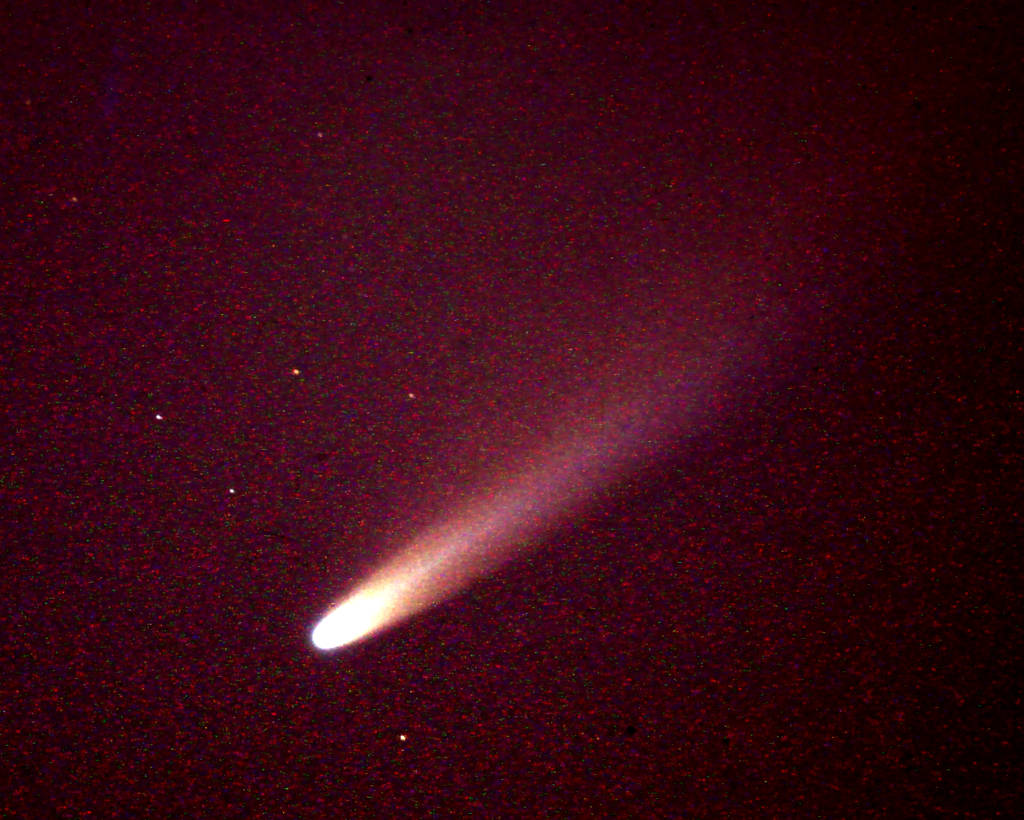
Comet West taken through the 108 mm f/6 telescope around 5:30 am, March 8, 1976 by a much younger me.
12/29/2020 – Ephemeris – 2020 the bad and the good in astronomy
This is Ephemeris for Tuesday, December 29th. Today the Sun will be up for 8 hours and 50 minutes, setting at 5:10, and it will rise tomorrow at 8:19. The Moon, at full today, will rise at 4:45 this evening.
2020 has been a terrible year due mostly to the COVID-19 pandemic that cost over 300 thousand American lives. It also saw the end of the 1,000 foot (305 meter) radio telescope dish set into a natural bowl near the north shore of Puerto Rico, 8.5 miles south of the city of Arecibo. The Arecibo Radio Telescope was until earlier this year the world’s largest single telescope. It also possessed a powerful radar transmitter allowing radar imaging of planets, moons and asteroids. It started to collapse several months ago and finally gave way December 1st.
On a positive note we were graced by the bright Comet NEOWISE visible first in the morning, then in the evening last July. It was the brightest comet in the northern skies since Comet Hale-Bopp appeared in 1997.
The event times given are for the Traverse City/Interlochen area of Michigan. They may be different for your location.
Addendum
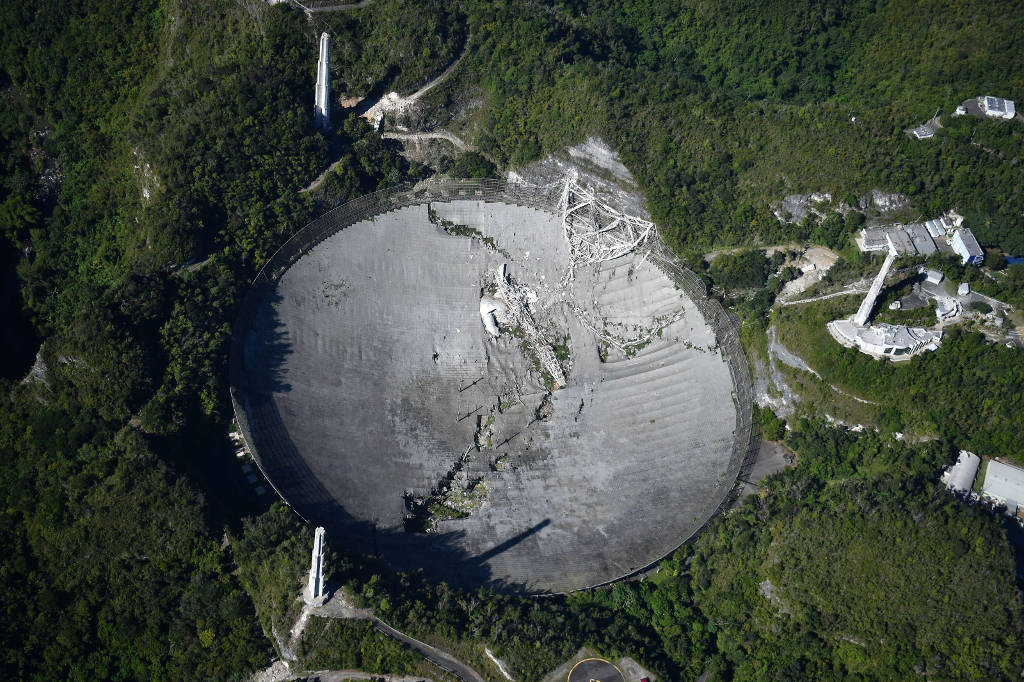
Aerial view of the Arecibo telescope after the collapse of the 900 ton feed platform suspended above the dish on December 1, 2020. Credit: Ricardo Arduengo/AFP via Getty Images

My photograph of Comet NEOWISE at 4:40 am over the west arm of Grand Traverse Bay south of the Discovery Pier off M22. (For non-Michigander astronomers M22 is not the globular star cluster in Sagittarius, but a very scenic Michigan state road.) Click on the image to enlarge.
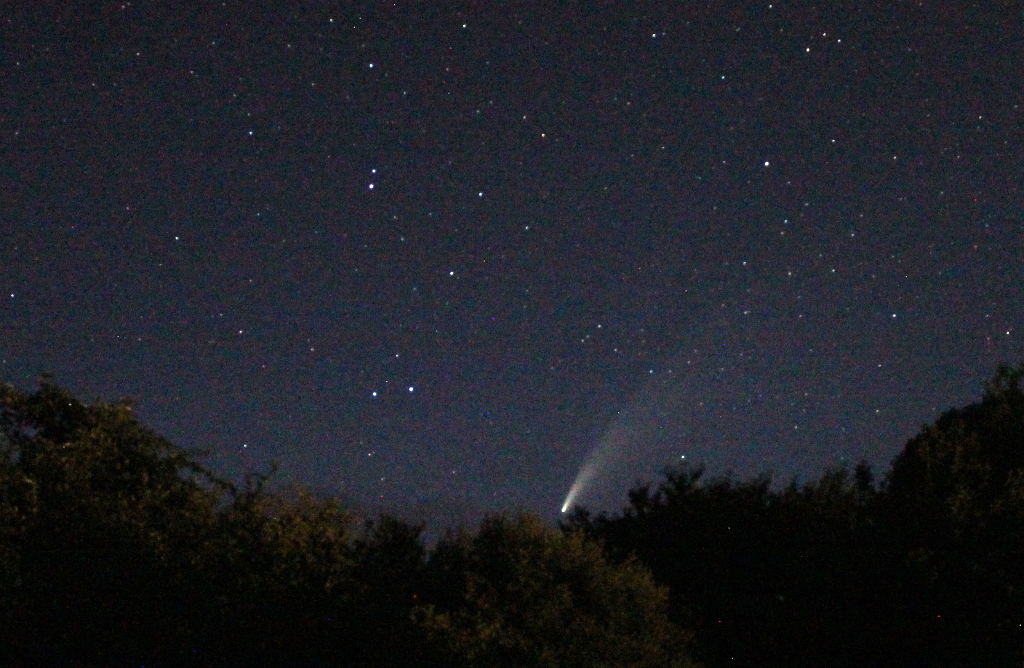
Comet NEOWISE from backyard over tall shrubbery 11:18 pm July 16, 2020. I didn’t have time to focus properly which actually accentuates the stars.
07/29/2020 – Ephemeris – Let’s look at a the naked-eye planets and not so naked-eye comets for this week
This is Bob Moler with Ephemeris for Wednesday, July 29th. Today the Sun will be up for 14 hours and 45 minutes, setting at 9:11, and it will rise tomorrow at 6:27. The Moon, 2 days past first quarter, will set at 2:27 tomorrow morning.
Let’s look at a the naked-eye planets for this week. Jupiter and Saturn are both low in the southeastern sky in the evening. Jupiter is the very bright one. To the left of it will be Saturn. Both planets will be up most of the night with Jupiter setting first at 5:05 am tomorrow morning and Saturn following at 5:44 am. Comet NEOWISE is in the evening sky fading to below naked-eye visibility and also it is hampered by the bright moon. It was a great sight in this bleak year of 2020. The next planet visible will be Mars which will rise at 12:03 am. Its now down to 60.6 million miles (97.5 million km) away, as the Earth slowly overtakes it at the rate of about 3.6 million miles (5.7 million km) a week. Venus will rise at 3:14 am in the east-northeast as our Morning Star. Finally Mercury will rise at 4:59 am.
The event times given are for the Traverse City/Interlochen area of Michigan. They may be different for your location.
Addendum
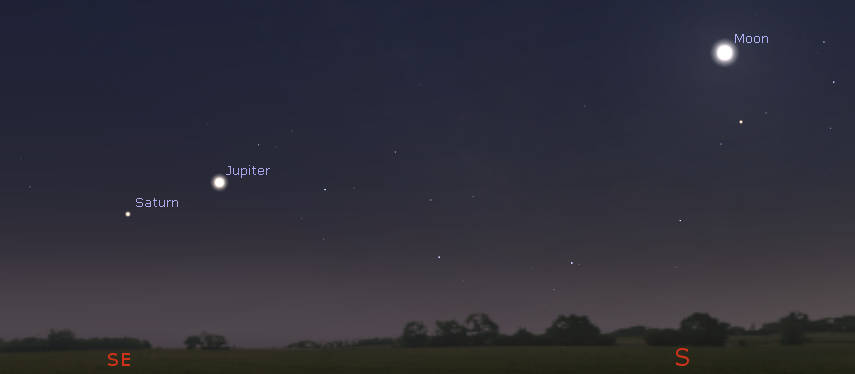
Evening planets Jupiter and Saturn seen in the southeast at 10 pm, about 45 minutes after sunset July 29, 2020. Click on the image to enlarge. Created using Stellarium.
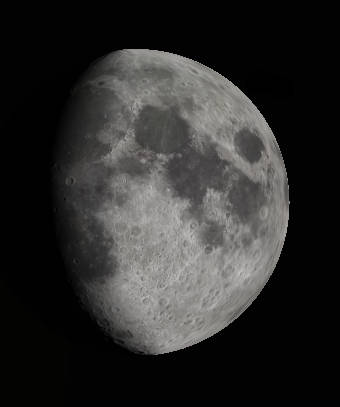
The gibbous Moon as it might be seen tonight at 10 pm July 29, 2020. Created using Stellarium.
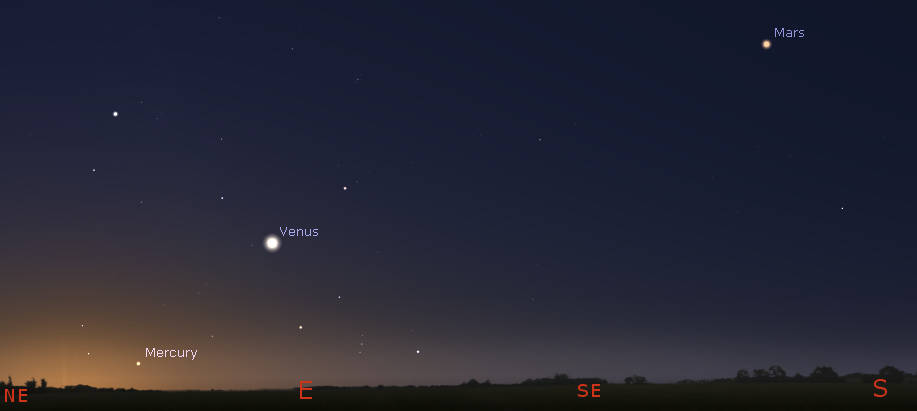
The morning planets as seen at 5:30 am or about an hour before sunrise July 30,2020. Mercury is showing up, rising at 4:56 amClick on the image to enlarge. Created using Stellarium.
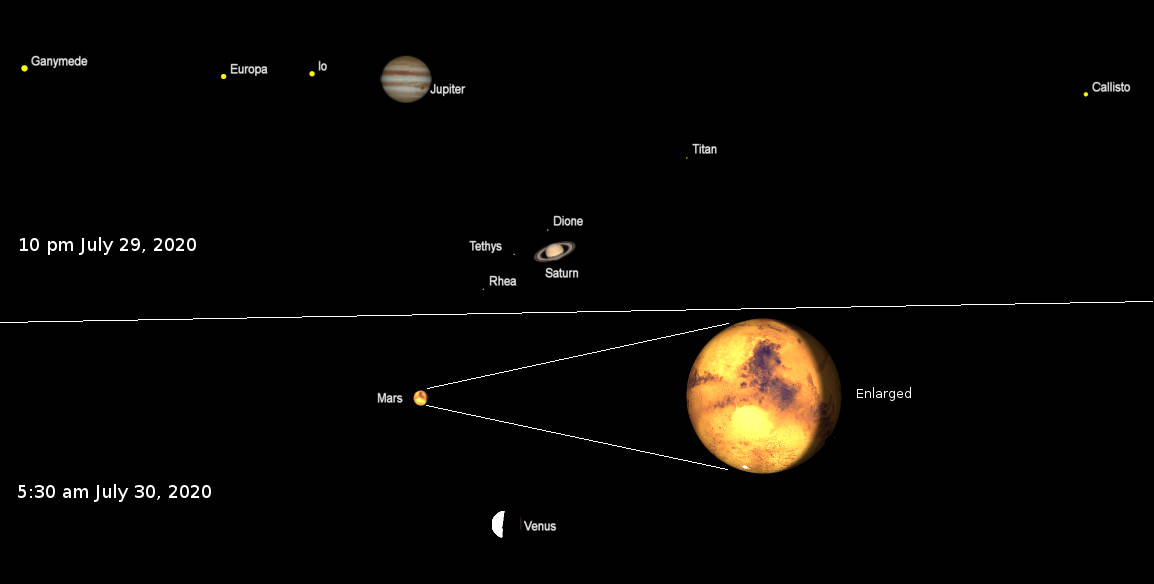
The planets as seen in a telescope (north up) with the same magnification tonight and tomorrow July 29/30, 2020. Apparent diameters: Jupiter, 47.26″; Saturn, 18.45″, rings, 42.98″ at 10 pm. Mars, 14.40″, and Venus 27.78″ at 5:30 am. Mars also displays an enlargement showing surface detail. The ” symbol means seconds of arc (1/3600th of a degree.) Click on the image to enlarge. Created using Cartes du Ciel (Sky Charts).
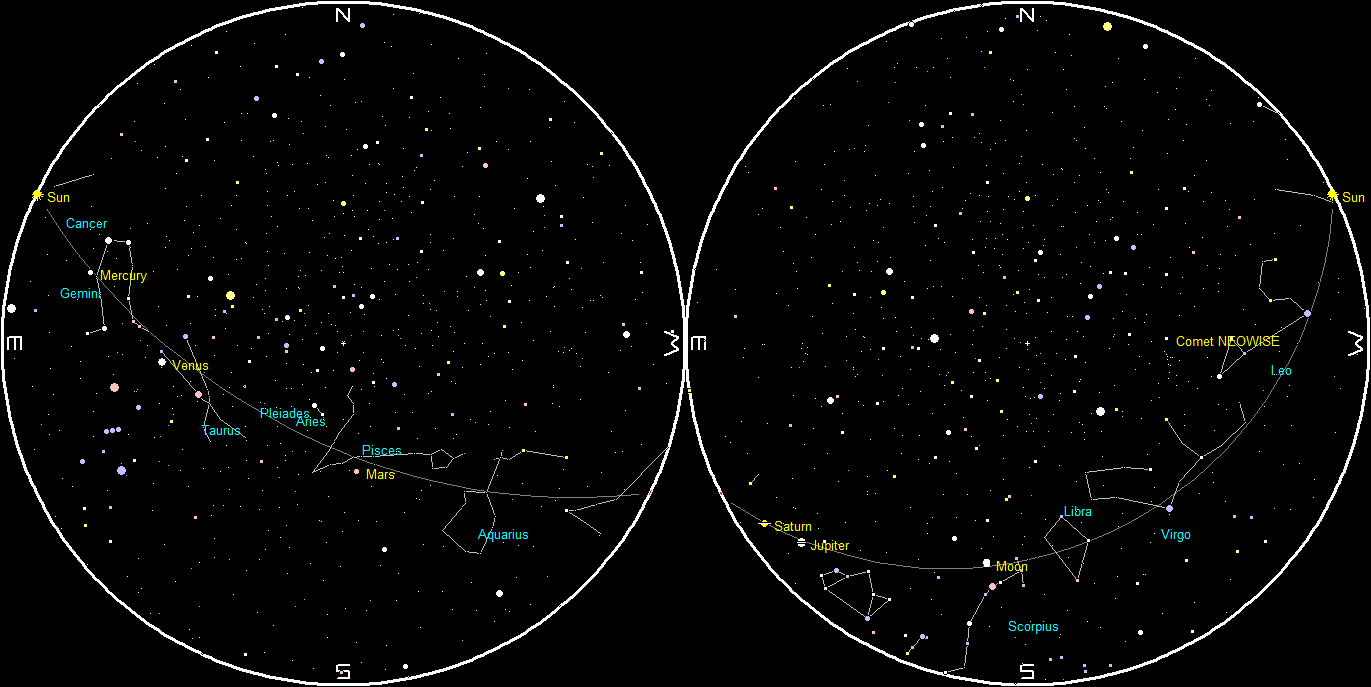
Planets and the Moon at sunset and sunrise of a single night starting with sunset on the right on July 29, 2020. The night ends on the left with sunrise on the 30th. Click on the image to enlarge. Created using my LookingUp program.
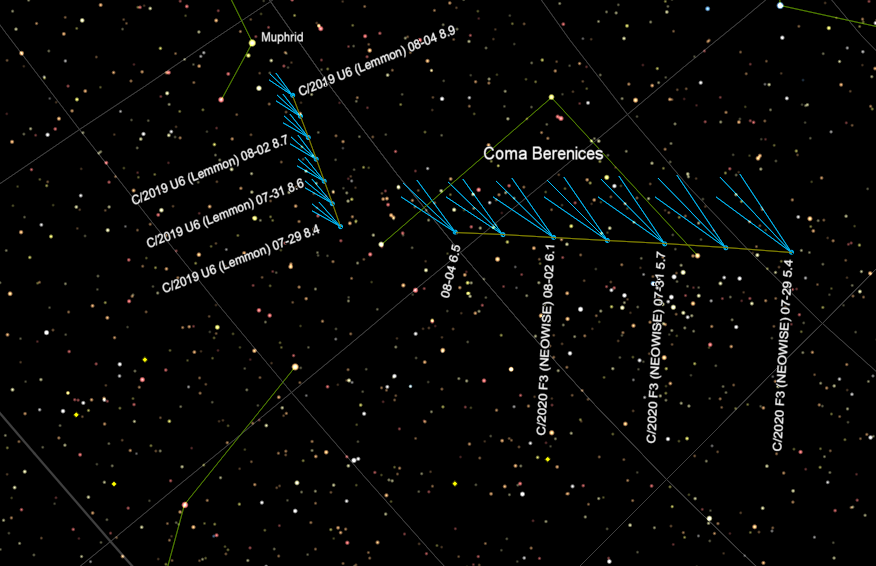
Finder chart for Comets NEOWISE and Lemmon at 11 pm for the week of 07/29/20 to 08/04/20. NEOWISE will be a visible in binoculars. Lemmon will require a telescope. Labels give name, month/day and predicted magnitude. Click on the chart to enlarge. Created using Cartes du Ciel (Sky Charts).
07/24/2020 – Ephemeris – Where did Comet NEOWISE come from?
This is Ephemeris for Friday, July 24th. Today the Sun will be up for 14 hours and 56 minutes, setting at 9:17, and it will rise tomorrow at 6:21. The Moon, 3 days before first quarter, will set at 11:58 this evening.
Ephemeris – Over the weekend Comet C/2020 F3 (NEOWISE) will be moving toward the west in the sky as it continues dimming as the Moon gets brighter. This make for a real challenge to spot. So where do comets hang out when they’re not buzzing the Sun? NEOWISE came in from 709 times the Earth’s distance from the Sun. That’s 66 billion miles (106 billion km), and a round trip that takes 6,800 years to complete. That aphelion point is between where the Kuiper belt of dwarf planets like Pluto and Eris hang out and the more distant Oort Cloud of pristine comets. Comets are leftovers from the formation of the solar system, four and a half billion years ago. The cold that far out preserves the volatile ices until a passing star sends them inward.
The event times given are for the Traverse City/Interlochen area of Michigan. They may be different for your location.
Addendum
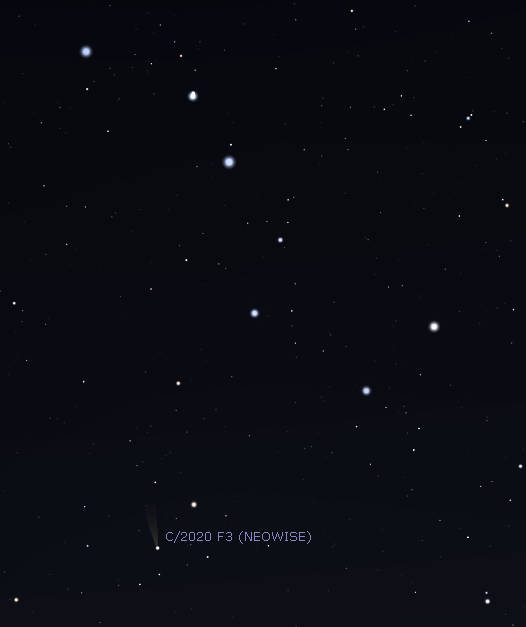
Comet NEOWISE finder chart for tonight July 24, 2020 at 11 pm or about an hour and a half after sunset looking northwest under the Big Dipper. The Moon is brightening up the sky and the comet is getting dimmer. Stellarium shows the comet at around 4th magnitude. I admit I fudged the formula in the app for the comet brightness, using the values from Seiichi Yoshida’s website entry for C/2020 F3 (NEOWISE). Created using Stellarium.
Seiichi Yoshida’s Weekly Information about Bright Comets: http://www.aerith.net/comet/weekly/current.html.
07/23/2020 – Ephemeris – The two tails of Comet NEOWISE
This is Bob Moler with Ephemeris for Thursday, July 23rd. Today the Sun will be up for 14 hours and 58 minutes, setting at 9:18, and it will rise tomorrow at 6:20. The Moon, 3 days past new, will set at 11:31 this evening.
Tonight Comet C/2020 F3 (NEOWISE) has moved so it is not below the bowl of the Big Dipper but more below the handle. It is dimming, so it is best found with optical aid like a pair of binoculars. Many pictures of it can be found now on the Internet and in print. Many photos show that the comet has two distinct tails. A broad whitish tail that we can see visually and a thin blue one separated by a slight angle. To the eye we see the broad tail which is made of dust. The particles are pushed away from the Sun by the force of sunlight itself. The blue tail is made of ionized gasses and pushed back by the solar wind. This tail leaves the comet’s head faster than the dust so the comet’s sideways motion to the Sun causes the tails to separate. The tail on the chart below closely matches the direction of the ion tail. The brighter dust tail is canted to the right.
The event times given are for the Traverse City/Interlochen area of Michigan. They may be different for your location.
Addendum
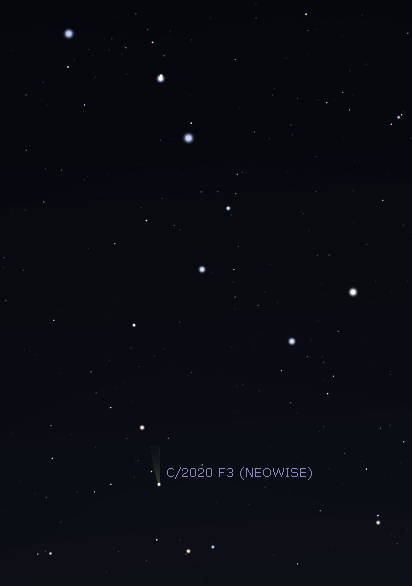
Comet NEOWISE finder chart for tonight July 23, 2020 at 11 pm or about an hour and a half after sunset looking northwest under the Big Dipper. Created using Stellarium.
07/22/2020 – Ephemeris – Let’s look at a comet and the naked-eye planets for this week
This is Bob Moler with Ephemeris for Wednesday, July 22nd. Today the Sun will be up for 15 hours even, setting at 9:19, and it will rise tomorrow at 6:19. The Moon, 2 days past new, will set at 11:01 this evening.
Let’s look at a comet and the naked-eye planets for this week. Jupiter now rises at before sunset, so does Saturn. Both are now official evening planets. They are both low in the southeast in the evening. Jupiter is the very bright one. To the left of it will be Saturn. Comet C/2020 F3 (NEOWISE) is visible in the evening sky. A good time to start looking would be about 11 pm toward the northwest. The comet be beneath the bowl of the Big Dipper. The comet is fading as it recedes from the Sun. After tonight the waxing Moon will light up the sky and make the comet harder to spot. The next planet up will be Mars which will rise at 12:41 am. Its now down to 64.2 million miles (103.2 million km) away, as the Earth slowly overtakes it at the rate of about 3.7 million miles (6 million km) a week. Venus will rise at 3:22 am in the east-northeast as our Morning Star.
The event times given are for the Traverse City/Interlochen area of Michigan. They may be different for your location.
Addendum
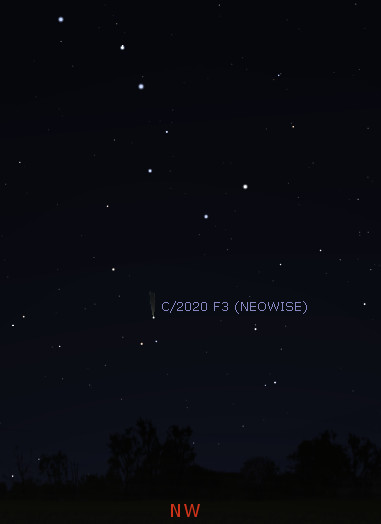
Comet NEOWISE finder chart for tonight July 22, 2020 at 11 pm or about an hour and a half after sunset. Created using Stellarium.
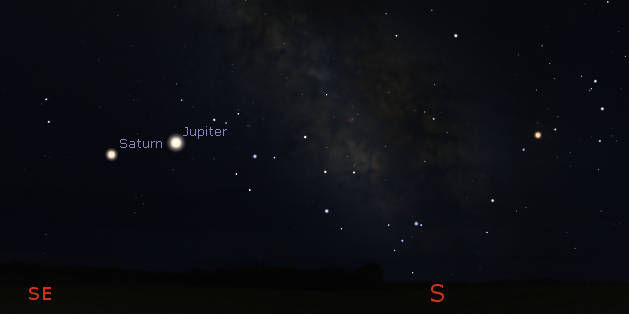
Saturn and Jupiter planets plus two southern constellations to the right of them at 11 pm tonight July 22, 2020. Just right of Jupiter is Sagittarius that looks more like a teapot than a centaur with a bow and arrow. Further right is Scorpius the scorpion. Click on the image to enlarge. Created using Stellarium.
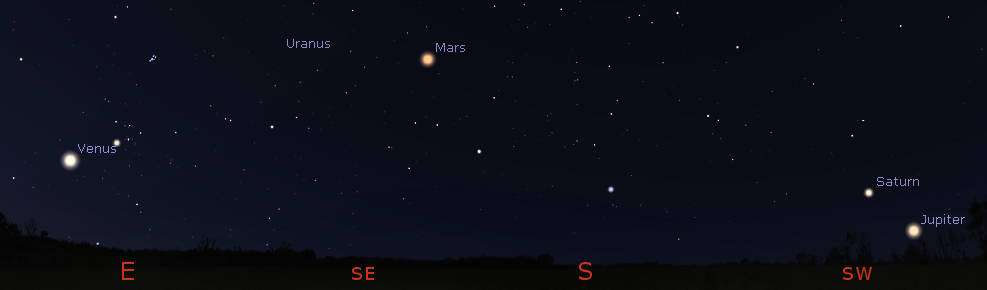
Planets visible at 5 am tomorrow morning July 23, 2020. Click on the image to enlarge. Created using Stellarium.
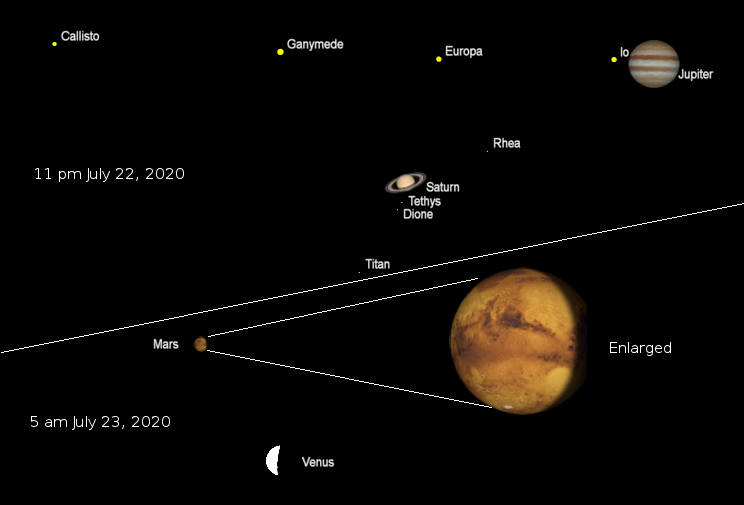
The planets as seen in a telescope (north up) with the same magnification tonight and tomorrow July 22/23, 2020. Apparent diameters: Jupiter, 47.52″; Saturn, 18.48″, rings, 43.04″, Mars, 13.60″, and Venus 33.53″. At 11 pm. Mars also displays an enlargement showing surface detail. The ” symbol means seconds of arc (1/3600th of a degree.) Created using Cartes du Ciel (Sky Charts).
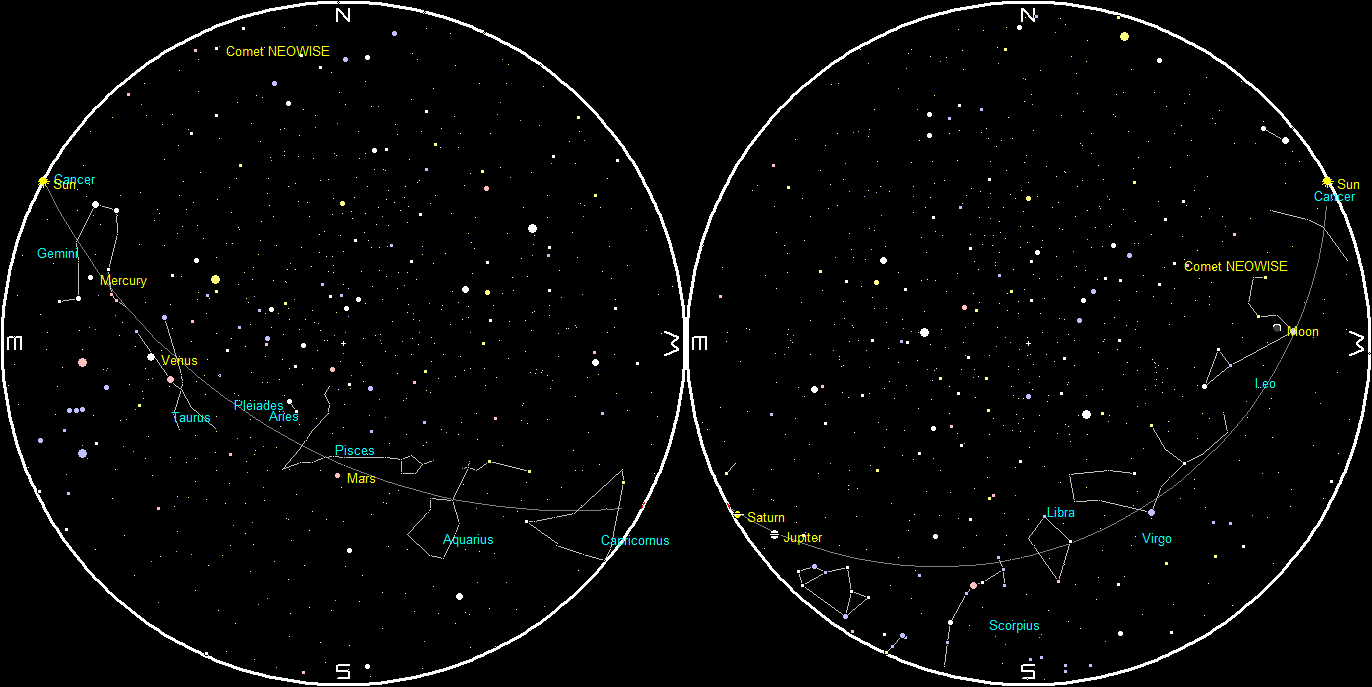
Planets and the Moon at sunset and sunrise of a single night starting with sunset on the right on July 22, 2020. The night ends on the left with sunrise on the 23rd. Click on the image to enlarge. Created using my LookingUp program.
07/21/2020 – Ephemeris – Saturn’s opposition yesterday and Comet NEOWISE update
This is Ephemeris for Tuesday, July 21st. Today the Sun will be up for 15 hours and 2 minutes, setting at 9:20, and it will rise tomorrow at 6:18. The Moon, 1 day past new, will set at 10:26 this evening.
The planet Saturn passed opposition from the Sun yesterday and is its closest to the Earth at 837 million miles (1,348 km). Saturn’s apparent size doesn’t change much in telescopes over the year because its distance only changes plus or minus 10% over the year and week and a half or so of its synodic period, the period between successive oppositions. Closer to the Sun Comet NEOWISE is approaching and is about to pass above the rear paw of the Great Bear Ursa Major below the bowl of the Big Dipper which marks the bear’s hind end. The comet is higher in the sky than it was last week, but it is fading. Moonlight will begin to affect the comet later this week, so binoculars will definitely help in spotting it.
The event times given are for the Traverse City/Interlochen area of Michigan. They may be different for your location.
Addendum
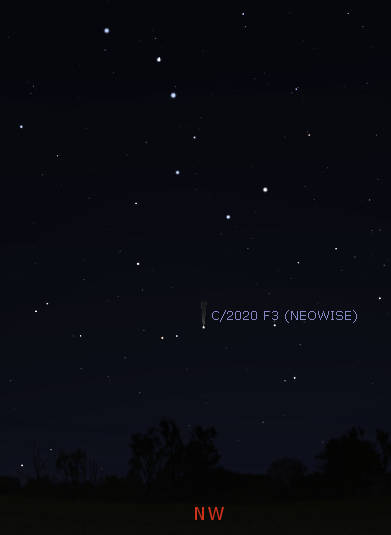
Comet NEOWISE finder chart for tonight July 21, 2020 at 11 pm or about an hour and a half after sunset. Created using Stellarium.
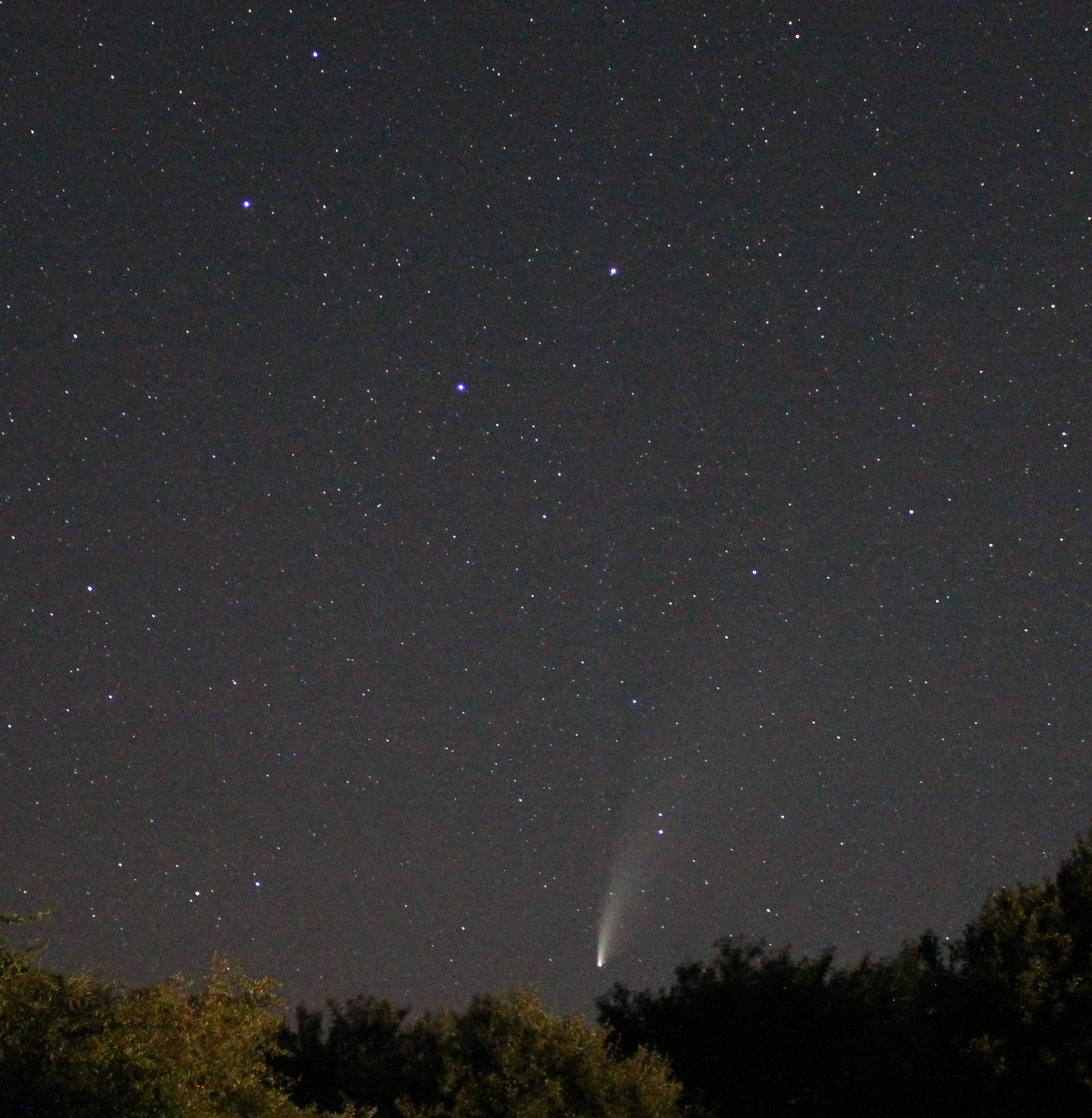
Photograph of Comet NEOWISE taken Sunday night at midnight July 20, 2020 EDT. The direction of the bright dust tail of the comet leans a bit to the right. The barely visible thin blue ion tail is pointed more directly away from the Sun. The slower escaping dust tail shows the sideways component of the comet’s motion relative to the Sun. Credit Bob Moler. Camera: Canon EOS REBEL T5, f/3.5, 15 seconds, fixed camera (not tracking), ISO 6400, Focal Length 18mm.
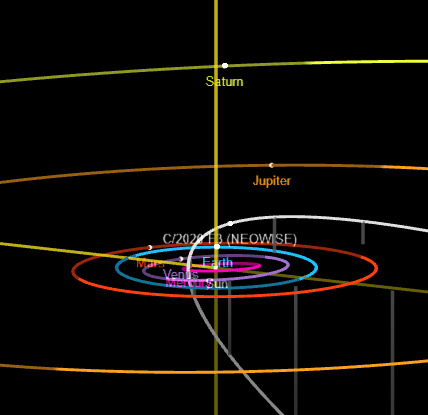
Saturn opposition diagram using the JPL Small-Body Database Browser. I tried to align the Z-axis (vertical) with the Earth on the blue orbit and Saturn on the yellow orbit so the Earth is directly between the Sun and Saturn.
07/20/2020 – Ephemeris – Comet NEOWISE tonight and the spacecraft that discovered it
This is Ephemeris for Monday, July 20th. Today the Sun will be up for 15 hours and 4 minutes, setting at 9:21, and it will rise tomorrow at 6:17. The Moon is new today, and won’t be visible.
With the Moon being new today, that means that by the end of the week it will interfere some with spotting Comet NEOWISE. Tonight the comet will be below the lowest star in the bowl of the Big Dipper. Its head should be as bright as the dimmest star of that dipper (the one that joins the handle to the bowl). Where did the comet’s name come from? Back in 2009 NASA launched the Wide-field Infrared Survey Explorer (WISE) spacecraft to survey the infrared sky. It was a telescope built inside a cylinder of solid hydrogen to keep it near absolute zero. In 10 months the hydrogen sublimated away and the project ended. They found that even a warmed up WISE could still find asteroids, so began the Near Earth Object or NEOWISE program.
The event times given are for the Traverse City/Interlochen area of Michigan. They may be different for your location.
Addendum
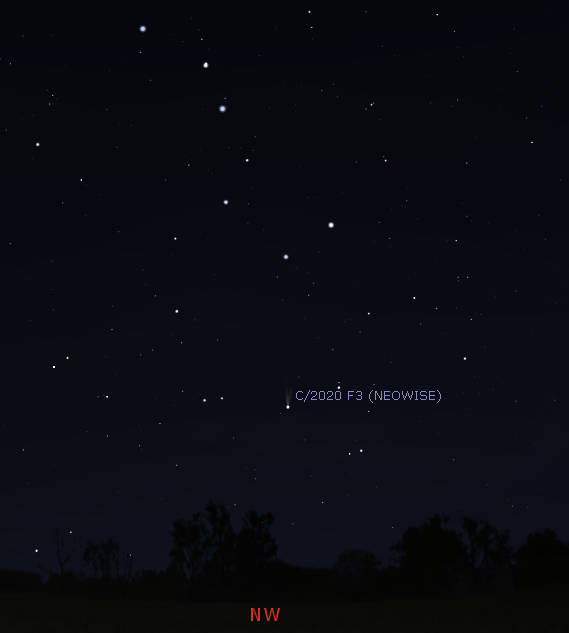
Comet NEOWISE Finder for 11 pm tonight July 20, 2020. Created using Stellarium.
07/17/2020 – Ephemeris – Viewing Comet C/2020 F3 (NEOWISE) this weekend
This is Ephemeris for Friday, July 17th. Today the Sun will be up for 15 hours and 9 minutes, setting at 9:23, and it will rise tomorrow at 6:14. The Moon, 3 days before new, will rise at 4:01 tomorrow morning.
With Comet NEOWISE visible low in the northwest around 11 pm, one might wonder just what a comet is. Comets in general scared the crap out of the peoples of Eurasia. Comets gate crashed the perfect order of the cosmos they had thought up and supposedly caused all sorts of mayhem. As far as I’m concerned this comet is the one bright spot so far this year. A comet is mostly nothing. NEOWISE has a solid nucleus which is perhaps 3 miles (5 km) in diameter and a tail of many million of miles (km) long. If that nucleus was rock instead of frozen gasses, water and pebbles one would need a good sized telescope to spot it. Instead the gasses evaporate creating a giant head that rivals Jupiter in size and a tail all considered pretty good vacuum by earthly standards.
The event times given are for the Traverse City/Interlochen area of Michigan. They may be different for your location.
Addendum
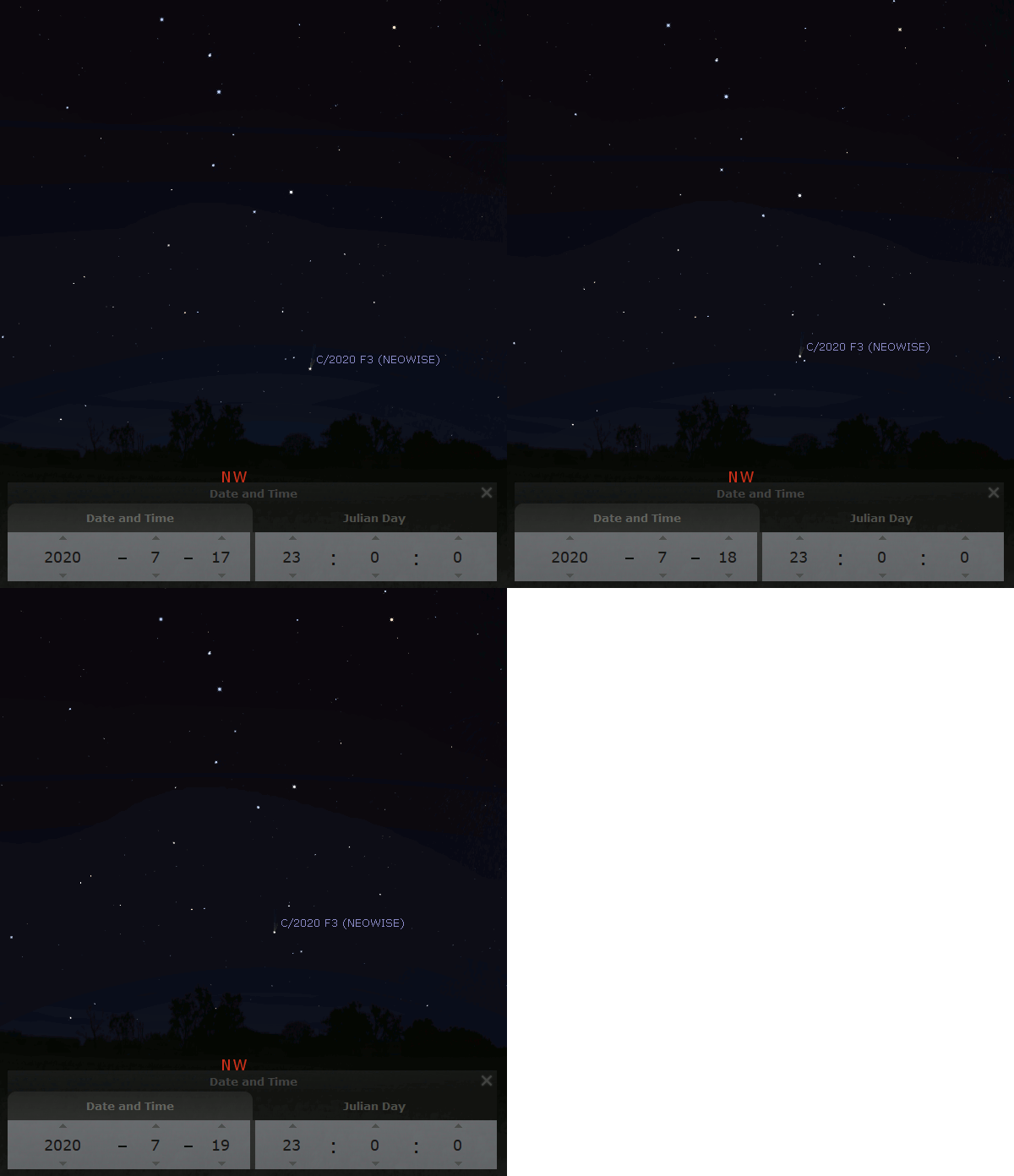
An animation showing the position of Comet NEOWISE at 11 pm (or approximately an hour and a half after sunset if you’re not from Northern Michigan) for Friday, Saturday and Sunday evenings July 17-19, 2020. Created using Stellarium.
Update
Comet NEOWISE from backyard over tall shrubbery 11:18 pm July 16, 2020. I didn’t have time to focus properly which actually accentuates the stars.
 Bob Moler's Ephemeris Blog