Archive
01/15/2019 – Ephemeris – Welcome 8:19 a.m. listeners
Ephemeris for Tuesday, January 15th. Today the Sun will be up for 9 hours and 11 minutes, setting at 5:28, and it will rise tomorrow at 8:16. The Moon, 1 day past first quarter, will set at 3:11 tomorrow morning.
Welcome to the 8:19 a.m. listeners to this program. Due to the two-hour span from the 6:19 and 8:19 airings it was thought to always give you event times in advance, which is why I’m giving tomorrow’s sunrise times. Don’t worry tomorrow’s sunrise time will never be more than 2 minutes before or after today’s. Right now, sunrise times are retreating by a half-minute a day. It’s faster in spring and fall. For more information see my blog: bobmoler.wordpress.com. Transcripts of the program are there with illustrations and additional information. And today a way to create your own sunrise and sunset calendar.
The times given are for the Traverse City/Interlochen area of Michigan. They may be different for your location.
Addendum
The times of rising and setting of celestial objects is accurate for only one spot on the Earth. In the case of the times I give, it’s for my house. There’s a good reason for it. I live approximately half way between Interlochen and Traverse City. In the early days I interpolated from astronomical tables in the Royal Astronomical Society of Canada’s Observers Handbook. I preferred it to the Naval Observatory’s Astronomical Almanac, which was more expensive. Anyway I had a relatively flat horizon everywhere but north, so if I climbed on the roof I could check out and verify the rising and setting times. Note that the times assume a flat sea horizon.
About accurate times: At my latitude celestial objects rise and set one minute later for each 12 1/3 miles (19.85 km) you are west of me, or a good landmark would be Traverse City West Senior High School. For every 12 1/3 miles east of there rising and setting events would be earlier by a minute. The correction for latitude or north and south isn’t that simple. See the illustration below:
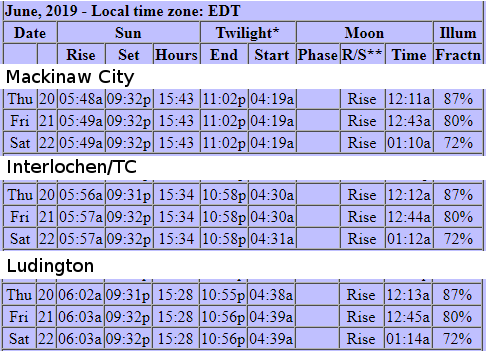
These are snippets of calendars for three locations that are in a straight line from south-southwest to north-northeast in the IPR listening area. A line drawn perpendicular to it to the west-northwest is to the Sun’s setting point. Thus the setting times for all three locations are the same. However their rising times are the most divergent, as are the daylight hours.
On my Ephemeris website, not to be confused with the blog that you are now reading, I have rise and set calendars for: Cadillac, Interlochen/Traverse City (Source for times on the Ephemeris program), Ludington, Mackinaw City, Petoskey, Eagle Harbor – Keweenaw Peninsula, Houghton Lake, and Earth’s Equator at the Prime Meridian. Go Here: http://ephemeris.bjmoler.org/calendar.htm.
If you’d like these times for a different location go to the Complete Sun and Moon Data for One Day, or Sun or Moon Rise/Set Table for One Year from the United States Naval Observatory (USNO). It calculates sunrise, sunset, moonrise, moonset, and twilight for locations in the US and other locations world-wide. Note that these do not follow the changes to and from Daylight Saving Time.
12/17/2017 – Ephemeris – What is a Lagrange Point?
Ephemeris for Monday, December 17th. The Sun will rise at 8:14. It’ll be up for 8 hours and 48 minutes, setting at 5:03. The Moon, 2 days past first quarter, will set at 3:15 tomorrow morning. |
Newton’s law of gravitation allows for some gravitational equilibrium points around two bodies that orbit each other. Discovered in th 18th century by Leonhard Euler and Joseph-Louis Lagrange these are known as Lagrange or L points. There are five. L1 is between the two bodies. The L1 point between the Earth and Sun is a million miles sun-ward of the Earth, where we station solar observation satellites. L2 is a million miles in the other direction, where there are astronomy satellites looking anywhere but the Sun. The James Webb telescope will join them there. L3 is point on the other side of the Sun, for which no use has yet been found. L4 and L5 are 60 degrees ahead of and behind the Earth’s position in its orbit. These are quite stable. Jupiter has thousands of asteroids in its L4 and L5 locations called Trojan asteroids.
The times given are for the Traverse City/Interlochen area of Michigan. They may be different for your location.
Addendum
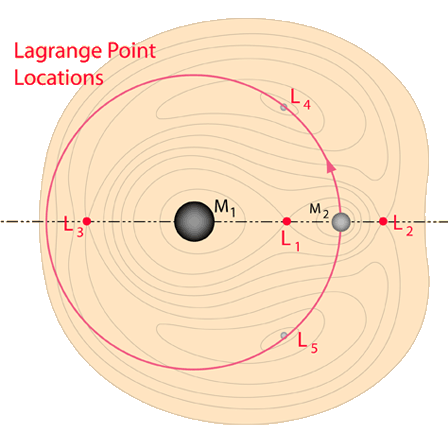
The 5 Lagrange points about two bodies M1 and M2 orbiting each other. Credit Georgia State University.
10/12/2018 – Ephemeris – The Moon’s phases
Ephemeris for Friday, October 12th. The Sun will rise at 7:54. It’ll be up for 11 hours and 8 minutes, setting at 7:03. The Moon, halfway from new to first quarter, will set at 9:31 this evening.
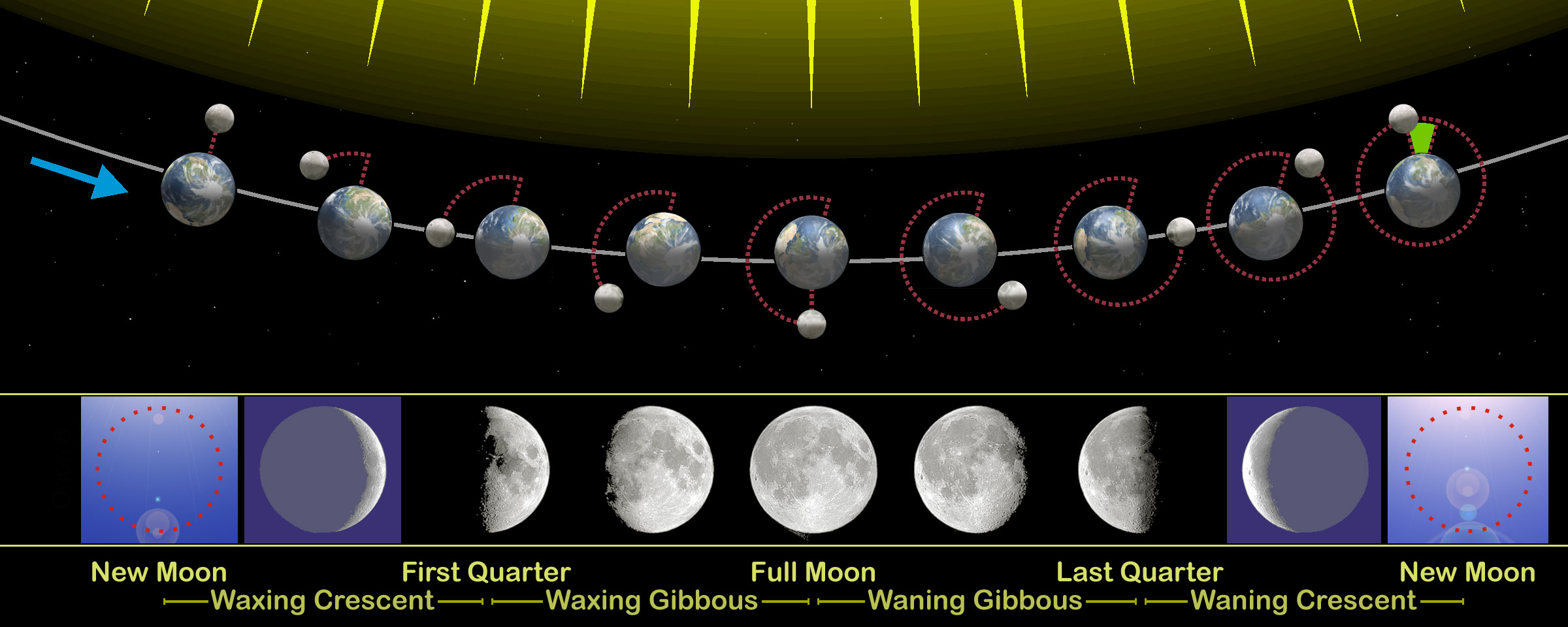
The Moon’s changing appearance over the month may seem to be mysterious at first glance. Maybe because one may think that the objects in the sky are somehow different from the familiar objects we see around us on the Earth. In ancient times, especially the Greeks thought that everything in the heavens halfway perfect and spotless. They explained the definite markings we see as the man-in-the-moon as a reflection of the Earth by a spotless Moon. The Moon’s phases are simply light and shadow on a ball in the sunlight. Sometimes, when the Moon appears in the daytime, take a small ball, like a golf ball and hold it up to the Moon, while the ball is also in sunlight, and the small ball will exhibit the same phase as the Moon.
The times given are for the Traverse City/Interlochen area of Michigan. They may be different for your location.
Addendum


09/27/2018 – Ephemeris – Twilight zone
Ephemeris for Thursday, September 27th. The Sun will rise at 7:35. It’ll be up for 11 hours and 54 minutes, setting at 7:30. The Moon, 3 days past full, will rise at 9:12 this evening.
It will get dark tonight with the end of astronomical twilight at 9:11 p.m., and a minute later the bright Moon will rise spoiling the dark sky. Speaking of astronomical twilight there are three twilight periods: Civil, Nautical and Astronomical. In the evening civil twilight lasts from sunset to when the Sun drops to 6 degrees below the horizon. The scene around is still quite bright, but car headlights still need to be on. Nautical twilight lasts until the Sun is 12 degrees below the horizon. Bright stars and the horizon are visible for sextant use. After that is astronomical twilight until the Sun is 18 degrees below the horizon, when the stars become more and more numerous. After that it’s officially dark, Moon willing.
The times given are for the Traverse City/Interlochen area of Michigan. They may be different for your location.
Addendum
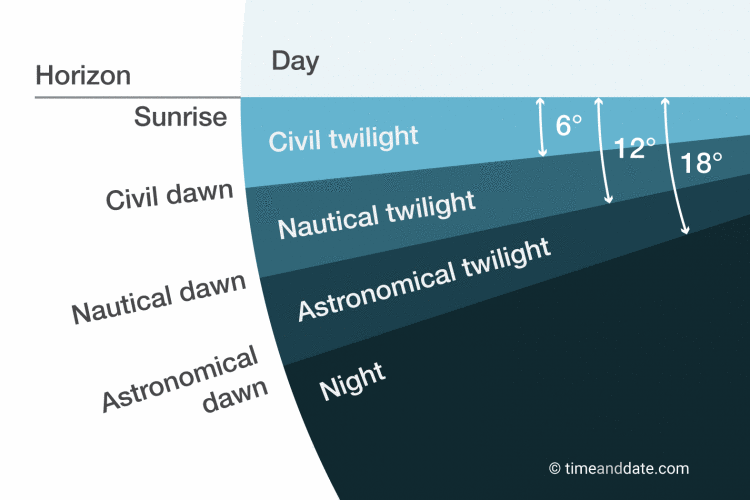
More information about twilight, dusk and dawn can be found here: https://www.timeanddate.com/astronomy/different-types-twilight.html.
08/16/2018 -Ephemeris – The Moon’s phase, a closer look
Ephemeris for Thursday, August 16th. The Sun rises at 6:46. It’ll be up for 14 hours exactly, setting at 8:46. The Moon, 2 days before first quarter, will set at 11:59 this evening.
With the Moon at a fat crescent tonight, it’s a good time to turn binoculars or a small telescope toward it. The demarcation between the bright part and the dark part is called the terminator. In the case before full moon, it is the sunrise line. After that the sunset line. The Moon’s entire day lasts about 29 ½ earthly days. I am sometimes asked “What’s blocking the light from the unlit side of the Moon?” It’s the Moon itself. It’s the night side of the Moon, just as when we are in night. The Earth itself is blocking the Sun’s light from us. The Moon, like the Earth and all the other planets are spheres lit on one side by the Sun. It’s near the terminator of the Moon where the most detail is revealed by the long shadows cast by the Moon’s features.
The times given are for the Traverse City/Interlochen area of Michigan. They may be different for your location.
Addendum
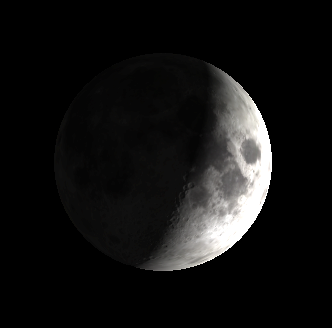
The crescent moon as it should appear tonight. Created using Stellarium. Stellarium always shows details on the night side of the Moon. The crescent phase of the Moon is now too fat to really see earthshine on it’s night side.
Demonstration of the Moon’s crescent phase with the Styrofoam moon ball we use for Project Astro held up to a light off frame to the right. The night side of the ball is illuminated a bit by the translucency of the ball, and the reflection off my hand. Note the roughness of the ball is visible only at the terminator.
07/30/2018 – Ephemeris – Early tomorrow morning Mars will be the closest to is in 15 years
Ephemeris for Monday, July 30th. The Sun rises at 6:26. It’ll be up for 14 hours and 44 minutes, setting at 9:10. The Moon, 3 days past full, will rise at 10:51 this evening.
Mars’ closest approach to the Earth since August 27, 2003 is tomorrow at about 3:51 a.m. at a distance of 35.8 million miles (57.6 million km). The last really close approach of Mars was on August 27, 2003 when it was about 600 thousand miles (a million km) closer. That close approach was probably the closest in 50 thousand years. Mars and the Earth get close in their orbits about every 26 months. But because Mars has a much more elliptical orbit than the Earth, the very best close encounters occur every 15 or 17 years. Despite the fact that we have satellites that orbit Mars and two rovers operating on its surface, amateur astronomers still challenge themselves to observe and photograph Mars at its very closest.
The times given are for the Traverse City/Interlochen area of Michigan. They may be different for your location.
Addendum
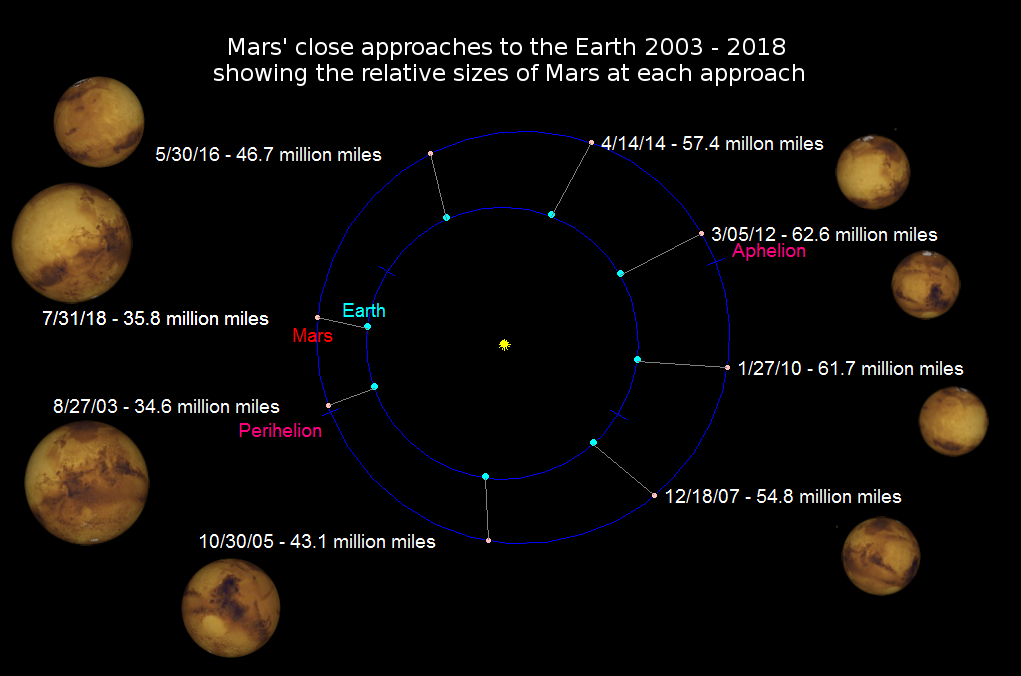
Mars’ closest approaches to the Earth in the period 2003 to 2018 also showing the apparent sizes of the planet at each approach. Click on image to enlarge. Created using my LookingUp program and Cartes du Ciel (Sky Charts).
07/26/2018 – Ephemeris – How can you get to Mars – the Hohmann transfer orbit
Ephemeris for Thursday, July 26th. The Sun rises at 6:22. It’ll be up for 14 hours and 53 minutes, setting at 9:15. The Moon, 1 day before full, will set at 6:06 tomorrow morning.
How does one get a spacecraft to another planet, like Mars? One might think to wait until the two planets are closest and zip across. That would take more energy than we are capable of. We cab barely escape the Earth and get a spacecraft into solar orbit. Also one needs energy to slow down to be captured by the planet if one wants to orbit it. The most economical way was devised way before the space age by Walter Hohmann, a German scientist in 1925. The idea is to launch a spacecraft with enough velocity to reach the other planet half way around the Sun, so the transfer orbit is tangent to both the Earth’s and the planet’s orbit. Transit times to Mars would be in the range of 7 months. The InSight lander is currently on such a trajectory.
The times given are for the Traverse City/Interlochen area of Michigan. They may be different for your location.
Addendum
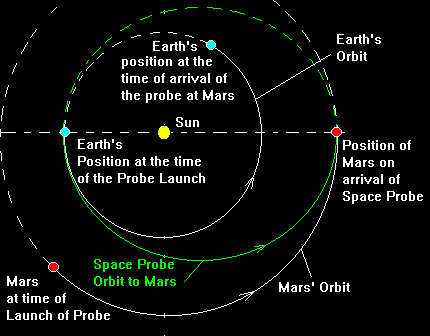
Hohmann transfer orbit. Credit Planetary Society-Myron Kayton
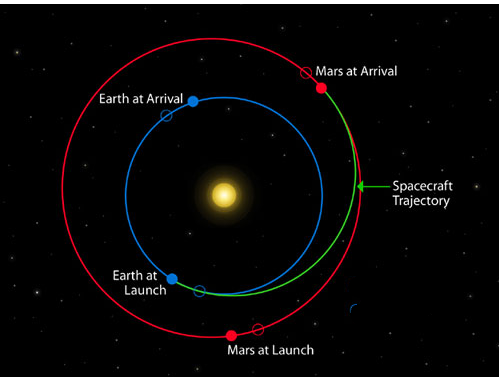
A Hohmann lowest energy transfer orbit to Mars. This diagram is for the Mars Exploration Rovers Spirit and Opportunity orbits, launched in 2003, arrived in 2004. Solid planets, Spirit launch and arrival. Ghost planets, Opportunity launch and arrival. Credit NASA/JPL.
07/23/2018 – Ephemeris – The importance of Mars in determining the nature of the solar system
Monday, July 23rd. The Sun rises at 6:19. It’ll be up for 14 hours and 59 minutes, setting at 9:18. The Moon, half way from first quarter to full, will set at 3:41 tomorrow morning.
The accurate observational positions of Mars by Tycho Brahe allowed Johannes Kepler in the early 17th century to discover his three laws of planetary motion. Tycho was the last and greatest of the naked eye astronomers. Kepler befriended Tycho who jealously guarded his observations. It was only after his death in 1601 that Kepler took possession of Tycho’s data. Until then it was believed that planets moved with uniform circular motion, even though they didn’t look like it. Astronomers added circle after circle, called epicycles, to attempt to make their system work. Mars was the worst case. Kepler finally determined that Mars, and indeed all the planets, orbited the Sun in elliptical orbits. That was his first law of planetary motion.
The times given are for the Traverse City/Interlochen area of Michigan. They may be different for your location.
Addendum
The source if the images below is the talk “Mars 2018” I gave at the Betsie Valley District Library, July, 20, 2018.
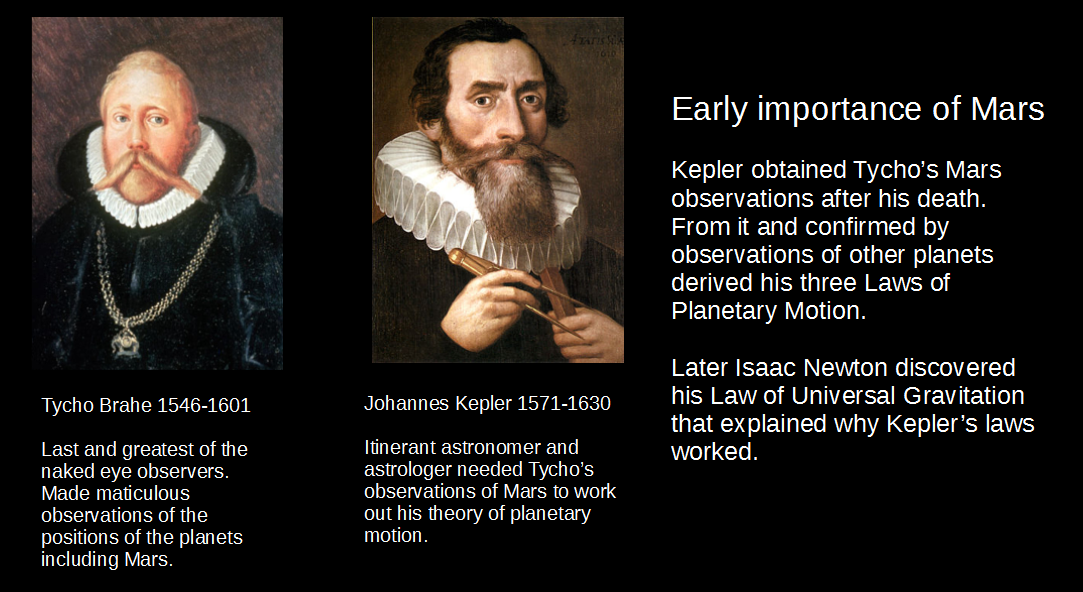
Tycho and Kepler. Artist for Tycho: Eduard Ender (1822-1883). Artist for Kepler, unknown. Source: Wikipedia.
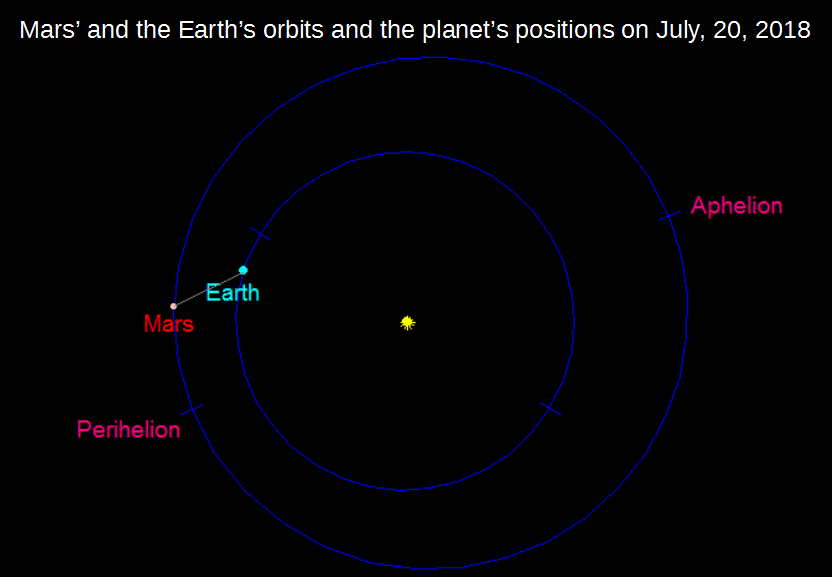
Mars’ and Earth’s orbits to scale and positions of the Earth and Mars July 20, 2018, one week before opposition. Note that Mars’ orbit is decidedly not circular. Credit my LookingUp program.
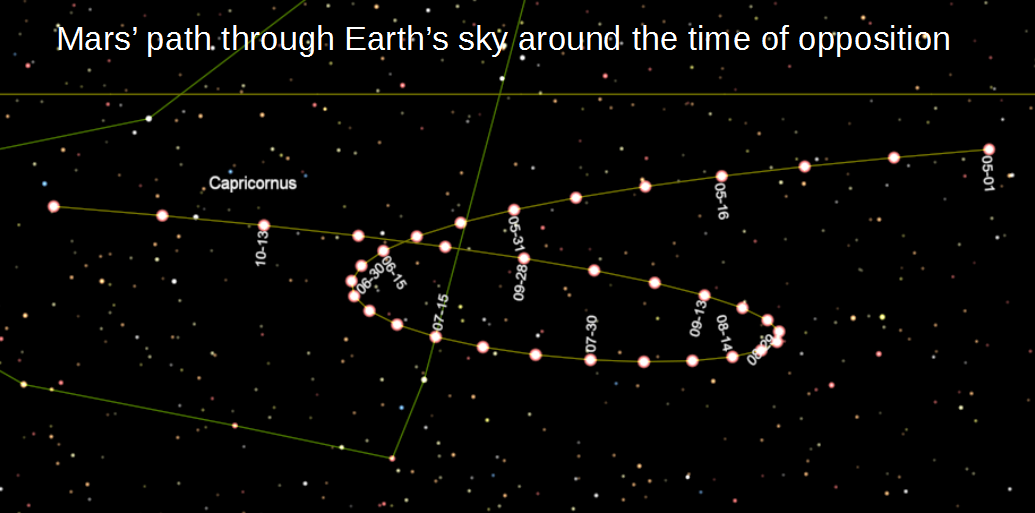
Created using Cartes du Ciel (Sky Charts).
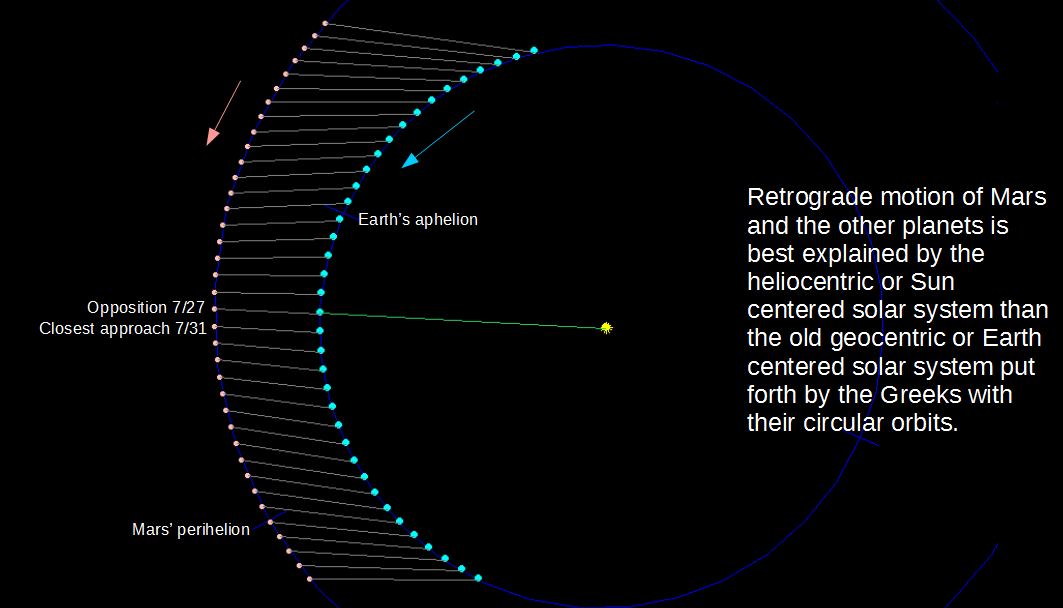
Created using Cartes du Ciel (Sky Charts).
05/24/2018 – Ephemeris – Jupiter is really BIG
Ephemeris for Thursday, May 24th. Today the Sun will be up for 15 hours and 8 minutes, setting at 9:14, and it will rise tomorrow at 6:05. The Moon, 3 days past first quarter, will set at 4:24 tomorrow morning.
Jupiter is a big planet. How big is it? One could fit thirteen hundred Earths inside it. Even so Jupiter has the mass of only 318 Earths, so Jupiter is made of lighter stuff than the Earth, including a lot of hydrogen and helium. NASA’s Juno spacecraft is currently orbiting Jupiter, working that out. Still, Jupiter is massive. The late science and science fiction writer Isaac Asimov wrote that the solar system consists of the Sun, Jupiter and debris. Jupiter contains more than twice the mass of all the other planets and asteroids combined. Jupiter is also surrounded by a huge set of radiation belts, lethal to all but the most radiation hardened spacecraft. And that goes for would be astronauts too.
The times given are for the Traverse City/Interlochen area of Michigan. They may be different for your location.
Addendum
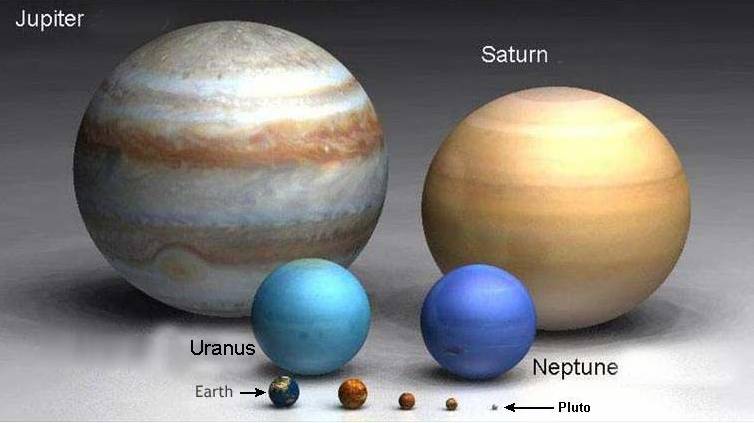
Planet size comparison. Note that even though Saturn looks almost as large as Jupiter it is less than 30% of Jupiter’s mass. From connormorency.wordpress.com
05/08/2018 – Ephemeris – Jupiter at opposition
Ephemeris for Tuesday, May 8th. The Sun rises at 6:23. It’ll be up for 14 hours and 33 minutes, setting at 8:56. The Moon, 1 day past last quarter, will rise at 3:45 tomorrow morning.
At 8:10 p.m. Jupiter will be in opposition, that is opposite the Sun in the sky. Thursday at 8 a.m. it will be its closest to the Earth at 408.9 million miles away, and its biggest in telescopes at 44.8 arc seconds. The Moon averages about 1,800 arc seconds in diameter. So the Moon appears 40 times larger in diameter, meaning you could put 40 Jupiters across the diameter of the moon. Jupiter’s disk is visible in binoculars, along with several of its moons. The moons change position from night to night. Most computer planetarium programs will show the moons for any time past and future. Telescopes will reveal that Jupiter’s face is crossed by bands of contrasting colors of clouds, and the famous Great Red Spot.
The times given are for the Traverse City/Interlochen area of Michigan. They may be different for your location.
Addendum
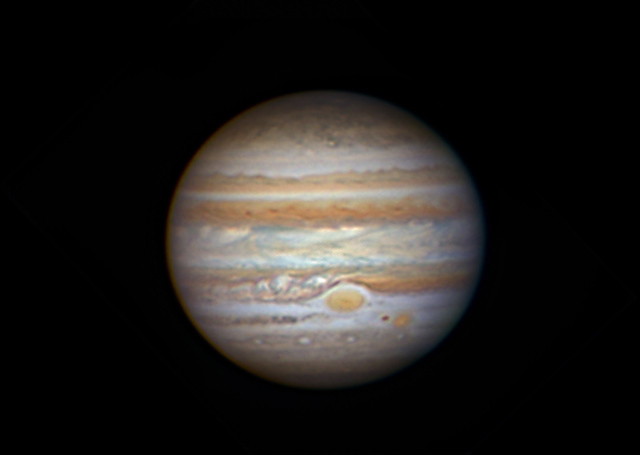
Jupiter with its Great Red Spot November 18, 2012 by Scott Anttila.
 Bob Moler's Ephemeris Blog