Archive
07/26/2018 – Ephemeris – How can you get to Mars – the Hohmann transfer orbit
Ephemeris for Thursday, July 26th. The Sun rises at 6:22. It’ll be up for 14 hours and 53 minutes, setting at 9:15. The Moon, 1 day before full, will set at 6:06 tomorrow morning.
How does one get a spacecraft to another planet, like Mars? One might think to wait until the two planets are closest and zip across. That would take more energy than we are capable of. We cab barely escape the Earth and get a spacecraft into solar orbit. Also one needs energy to slow down to be captured by the planet if one wants to orbit it. The most economical way was devised way before the space age by Walter Hohmann, a German scientist in 1925. The idea is to launch a spacecraft with enough velocity to reach the other planet half way around the Sun, so the transfer orbit is tangent to both the Earth’s and the planet’s orbit. Transit times to Mars would be in the range of 7 months. The InSight lander is currently on such a trajectory.
The times given are for the Traverse City/Interlochen area of Michigan. They may be different for your location.
Addendum
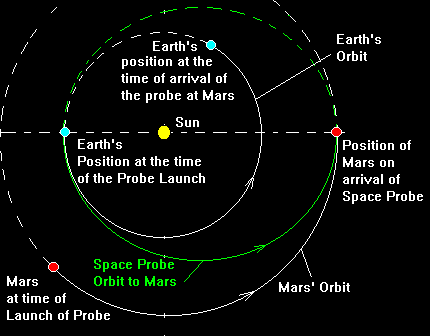
Hohmann transfer orbit. Credit Planetary Society-Myron Kayton
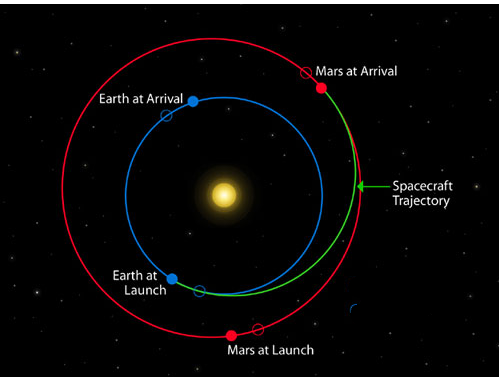
A Hohmann lowest energy transfer orbit to Mars. This diagram is for the Mars Exploration Rovers Spirit and Opportunity orbits, launched in 2003, arrived in 2004. Solid planets, Spirit launch and arrival. Ghost planets, Opportunity launch and arrival. Credit NASA/JPL.
07/23/2018 – Ephemeris – The importance of Mars in determining the nature of the solar system
Monday, July 23rd. The Sun rises at 6:19. It’ll be up for 14 hours and 59 minutes, setting at 9:18. The Moon, half way from first quarter to full, will set at 3:41 tomorrow morning.
The accurate observational positions of Mars by Tycho Brahe allowed Johannes Kepler in the early 17th century to discover his three laws of planetary motion. Tycho was the last and greatest of the naked eye astronomers. Kepler befriended Tycho who jealously guarded his observations. It was only after his death in 1601 that Kepler took possession of Tycho’s data. Until then it was believed that planets moved with uniform circular motion, even though they didn’t look like it. Astronomers added circle after circle, called epicycles, to attempt to make their system work. Mars was the worst case. Kepler finally determined that Mars, and indeed all the planets, orbited the Sun in elliptical orbits. That was his first law of planetary motion.
The times given are for the Traverse City/Interlochen area of Michigan. They may be different for your location.
Addendum
The source if the images below is the talk “Mars 2018” I gave at the Betsie Valley District Library, July, 20, 2018.
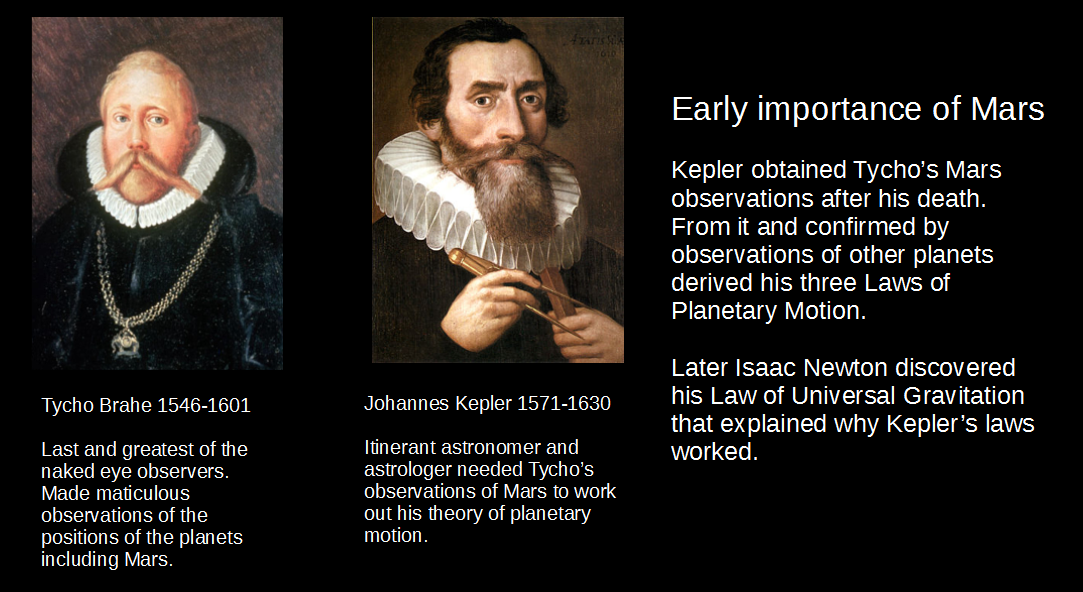
Tycho and Kepler. Artist for Tycho: Eduard Ender (1822-1883). Artist for Kepler, unknown. Source: Wikipedia.
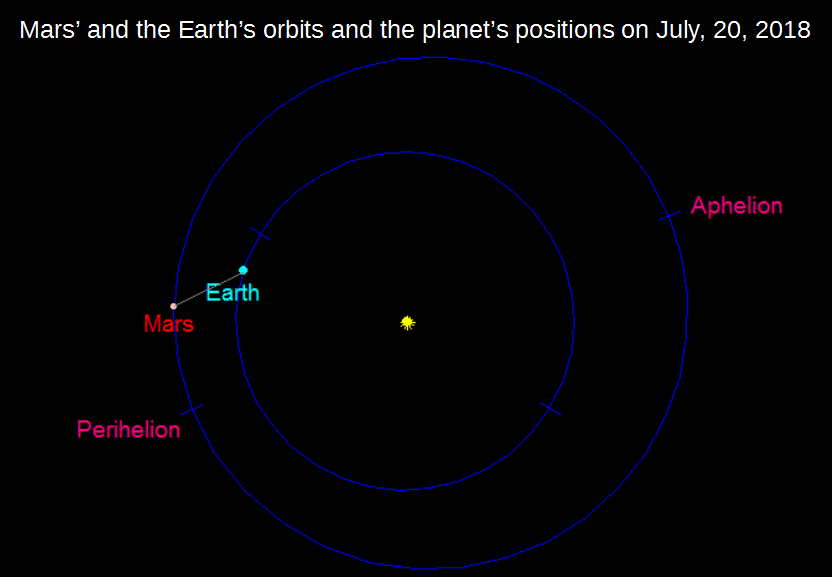
Mars’ and Earth’s orbits to scale and positions of the Earth and Mars July 20, 2018, one week before opposition. Note that Mars’ orbit is decidedly not circular. Credit my LookingUp program.
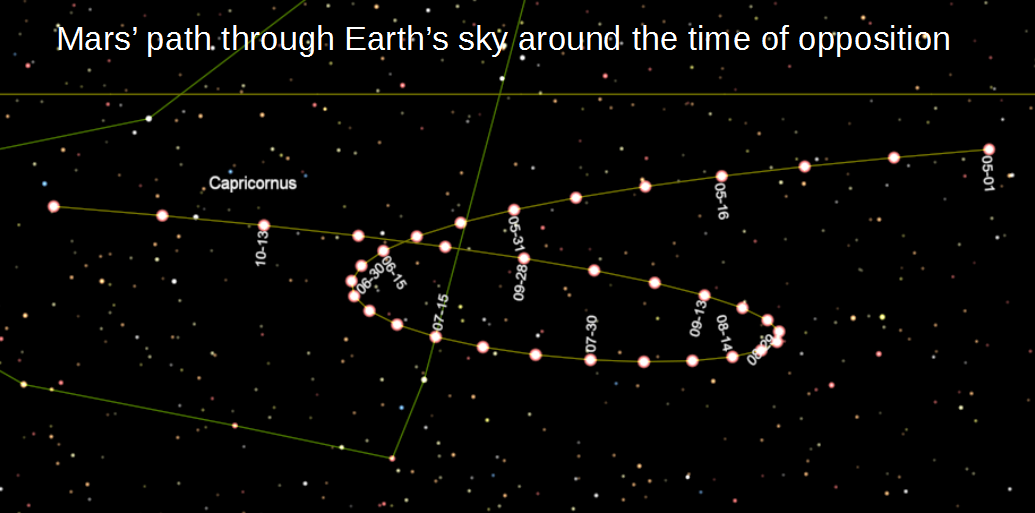
Created using Cartes du Ciel (Sky Charts).
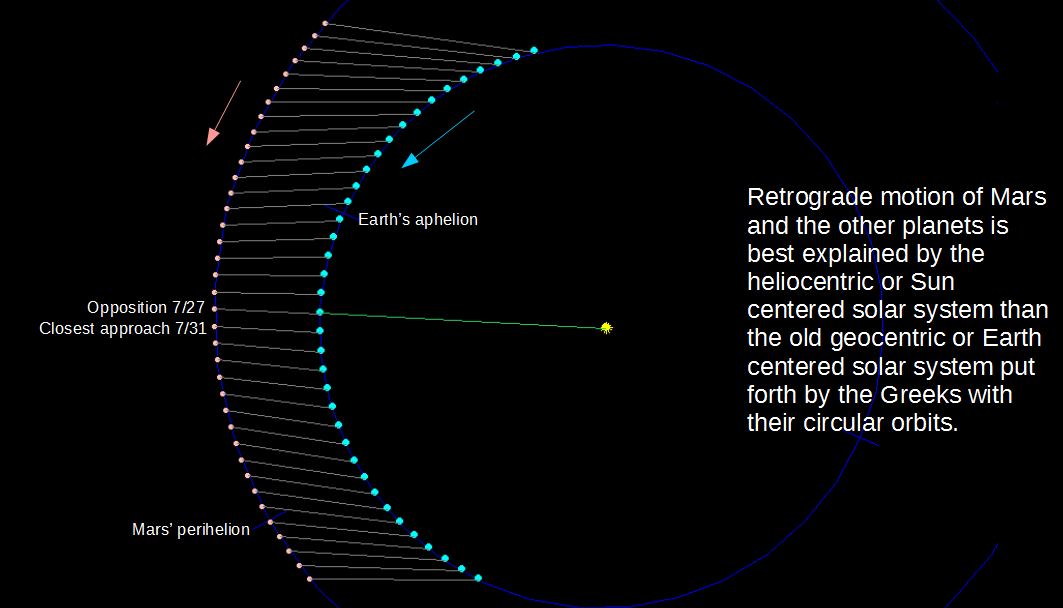
Created using Cartes du Ciel (Sky Charts).
05/24/2018 – Ephemeris – Jupiter is really BIG
Ephemeris for Thursday, May 24th. Today the Sun will be up for 15 hours and 8 minutes, setting at 9:14, and it will rise tomorrow at 6:05. The Moon, 3 days past first quarter, will set at 4:24 tomorrow morning.
Jupiter is a big planet. How big is it? One could fit thirteen hundred Earths inside it. Even so Jupiter has the mass of only 318 Earths, so Jupiter is made of lighter stuff than the Earth, including a lot of hydrogen and helium. NASA’s Juno spacecraft is currently orbiting Jupiter, working that out. Still, Jupiter is massive. The late science and science fiction writer Isaac Asimov wrote that the solar system consists of the Sun, Jupiter and debris. Jupiter contains more than twice the mass of all the other planets and asteroids combined. Jupiter is also surrounded by a huge set of radiation belts, lethal to all but the most radiation hardened spacecraft. And that goes for would be astronauts too.
The times given are for the Traverse City/Interlochen area of Michigan. They may be different for your location.
Addendum
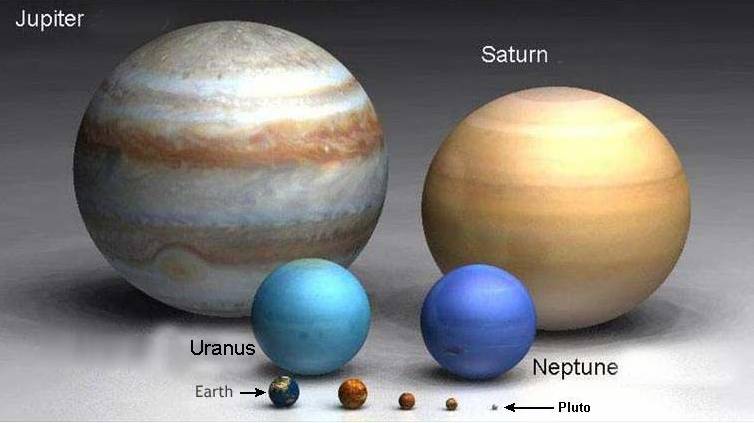
Planet size comparison. Note that even though Saturn looks almost as large as Jupiter it is less than 30% of Jupiter’s mass. From connormorency.wordpress.com
05/08/2018 – Ephemeris – Jupiter at opposition
Ephemeris for Tuesday, May 8th. The Sun rises at 6:23. It’ll be up for 14 hours and 33 minutes, setting at 8:56. The Moon, 1 day past last quarter, will rise at 3:45 tomorrow morning.
At 8:10 p.m. Jupiter will be in opposition, that is opposite the Sun in the sky. Thursday at 8 a.m. it will be its closest to the Earth at 408.9 million miles away, and its biggest in telescopes at 44.8 arc seconds. The Moon averages about 1,800 arc seconds in diameter. So the Moon appears 40 times larger in diameter, meaning you could put 40 Jupiters across the diameter of the moon. Jupiter’s disk is visible in binoculars, along with several of its moons. The moons change position from night to night. Most computer planetarium programs will show the moons for any time past and future. Telescopes will reveal that Jupiter’s face is crossed by bands of contrasting colors of clouds, and the famous Great Red Spot.
The times given are for the Traverse City/Interlochen area of Michigan. They may be different for your location.
Addendum
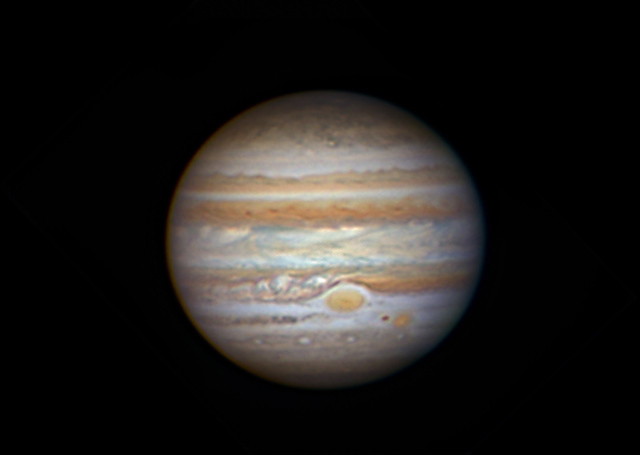
Jupiter with its Great Red Spot November 18, 2012 by Scott Anttila.
05/07/2018 – Ephemeris – Twilight
Note: Sorry for the delay. I was hit with a fast developing cold Sunday. So I was unable to post this at my normal time, and was unable to record my next Tuesday through Monday programs.
Ephemeris for Monday, May 7th. The Sun rises at 6:24. It’ll be up for 14 hours and 30 minutes, setting at 8:55. The Moon, at last quarter today, will rise at 3:14 tomorrow morning.
We are in the time of year when it appears that twilight doesn’t seem to end. There are three definitions of twilight, Civil, Nautical and Astronomical. Each ends in the evening when the Sun is 6, 12, and 18 degrees below the horizon respectively. Astronomers don’t really care about civil twilight, the sky is too bright. Sailors using a sextant for star positions can usually see the horizon for star sighting up to the end of nautical twilight. Astronomers consider the skies dark at the end of astronomical twilight, barring he Moon being up. The brightest stars and planets become visible a half hour after sunset. We begin to pick out constellations at the end of nautical twilight. For instance, for tonight, nautical twilight ends at 10:10 p.m., while astronomical twilight ends at 10:57.
The times given are for the Traverse City/Interlochen area of Michigan. They may be different for your location.
04/30/2018 – Ephemeris – Venus-Earth resonances, and Jupiter & the Moon tonight
Ephemeris for Monday, April 30th. The Sun rises at 6:34. It’ll be up for 14 hours and 12 minutes, setting at 8:46. The Moon, 1 day past full, will rise at 9:30 this evening.
Jupiter will be near the moon tonight. The gravitational force between the planets produces some interesting resonances in their orbital periods. Venus has three different kinds with the Earth. First, Venus orbits the Sun 13 times in the same time it takes the Earth to orbit the Sun 8 times. This is a 13 to 8 resonance. This sets up the 5 Venus Cycles equaling 8 years resonance the Mayan’s discovered. A Venus cycle of 584 days takes Venus to go from Morning Star to Evening Star and back again. The next one wasn’t discovered until we started to bounce radar signals off Venus. We found it rotates backwards, and very slowly at that. Its rotation with respect to the stars is longer than its year. And it so happens that every passage near the Earth the same side of Venus is facing us.
The times given are for the Traverse City/Interlochen area of Michigan. They may be different for your location.
Addendum
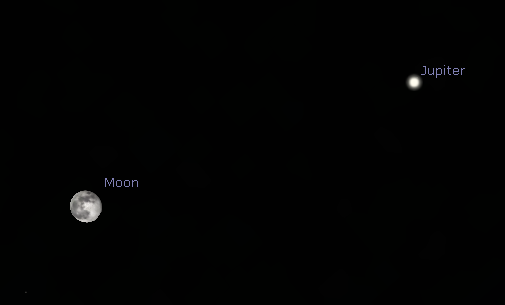
The Moon and Jupiter at 10 p.m. tonight, April 30, 2018. Created using Stellarium.
04/26/2018 – Ephemeris – When the Greeks thought Venus was two separate planets
Ephemeris for Thursday, April 26th. The Sun rises at 6:40. It’ll be up for 14 hours and 1 minute, setting at 8:41. The Moon, 3 days before full, will set at 5:52 tomorrow morning.
For the next three programs I’m going to take a look at Venus through the eyes of the ancient, or pre-telescopic cultures. It’s a teaser for the program I’m presenting at the NMC Observatory May 4th. Venus from the mists of time to today. We call Venus’ appearance in the morning the Morning Star and its evening appearance, the Evening Star. The very ancient Greeks thought they were two separate planets. The morning planet was Phosphorus, and the evening planet was Hesperus. Somewhere around the 4th or 3rd century BC someone figured the when Hesperus was out in the evening Phosphorus was not out the next morning, and vice versa. The then single planet was named Aphrodite, by whose Roman name, Venus, we still call it by today.
The times given are for the Traverse City/Interlochen area of Michigan. They may be different for your location.
Addendum
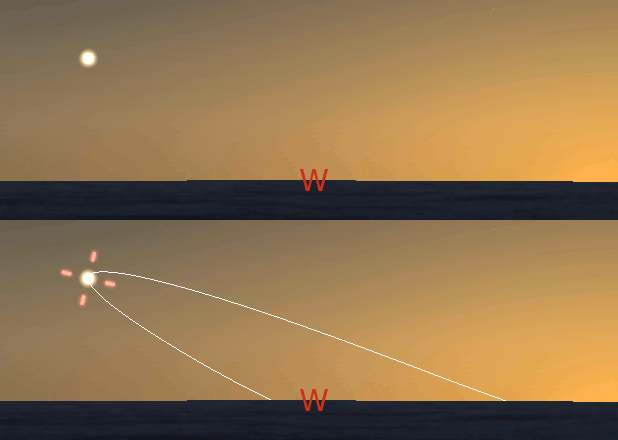
Venus (Hesperus) at its evening eastern greatest elongation on August 18, 2018 showing the part of its orbit that’s above the horizon. Created using Stellarium and GIMP.
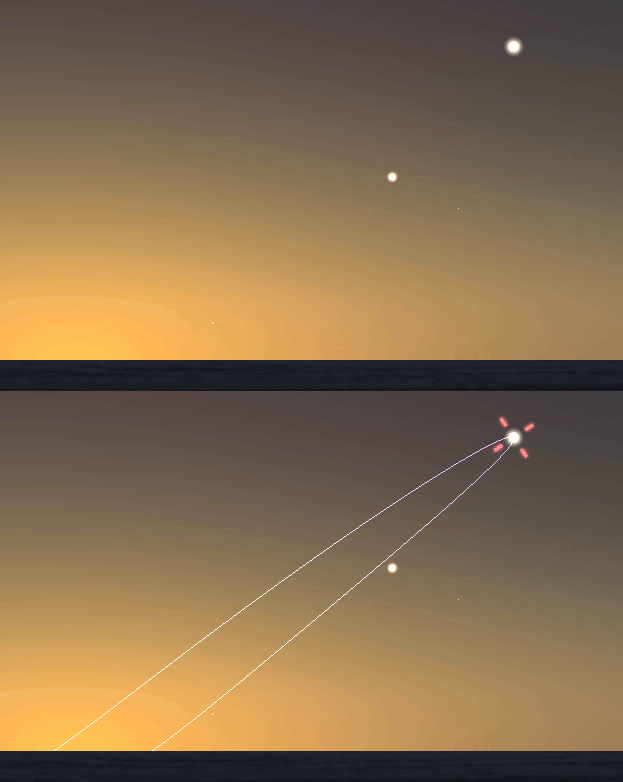
Venus (Phosphorus) at its morning western greatest elongation on January 6, 2019 showing the part of its orbit that’s above the horizon. Jupiter is the other planet visible. Created using Stellarium and GIMP.
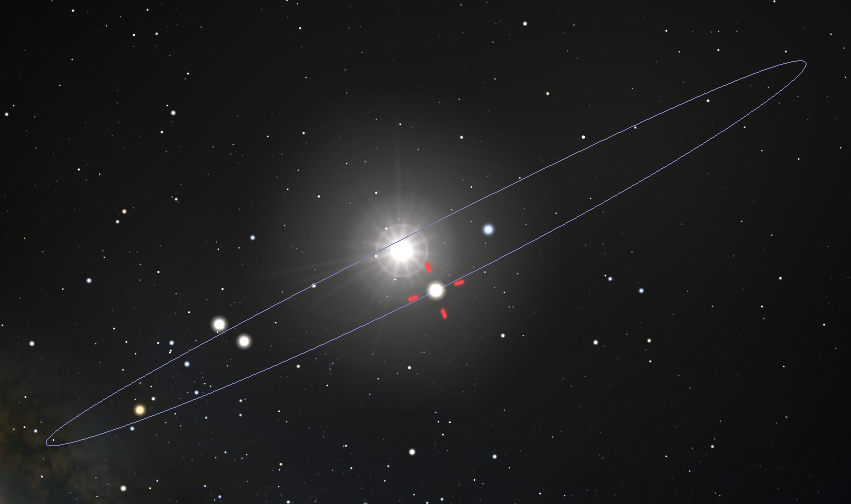
Venus at inferior conjunction on October 27, 2018 showing its entire orbit on a smaller scale than the images above from the Earth’s perspective. The far part of the orbit goes behind the Sun. The planets Mercury and Jupiter are seen left of the Sun. Created using Stellarium.
04/06/2018 – Ephemeris – Marking the passage of 13 hours of daylight
Ephemeris for Friday, April 6th. The Sun will rise at 7:14. It’ll be up for 13 hours and 2 minutes, setting at 8:16. The Moon, 2 days before last quarter, will rise at 2:33 tomorrow morning.
Tomorrow morning early, the crescent Moon will pass Saturn and Mars. These planets will be below the Moon in the dark early morning hours. The dark night hours will be increasingly more inaccessible as summer approaches. Today we’ve broached 13 hours of daylight. By the summer solstice on June 21st the Sun will be out just a bit over 15 and a half hours. Meaning that the Sun will be down for only eight and a half hours, with only three and a half hours of really dark sky, Moon permitting, between the end of evening astronomical twilight and the beginning of morning astronomical twilight. Twilight is really long around the summer solstice because the Sun sets at a shallow angle.
The times given are for the Traverse City/Interlochen area of Michigan. They may be different for your location.
Addendum
Definitions
End or start of Civil Twilight: Sun is 6° below the horizon
Brighter planets become visible
End or start of Nautical Twilight: Sun is 12° below the horizon
Brighter deep sky objects can be found for public star parties
End or start of astronomical twilight: Sun is 18° below the horizon
On moonless nights, the twilight glow is gone and the sky is dark
03/15/2018 – Ephemeris – Mercury at greatest separation (elongation) from the Sun today
Ephemeris for the Ides of March, Thursday, March 15th. The Sun will rise at 7:55. It’ll be up for 11 hours and 53 minutes, setting at 7:48. The Moon, 2 days before new, will rise at 7:45 tomorrow morning.
Today the planet Mercury will be at its greatest separation east from the Sun. It is called its greatest eastern elongation from the Sun. It is at an angle of 18.4 degrees from the Sun. It will be seen in the west about 8:15 for about an hour before it sets. It will be above right of the much brighter Venus. Mercury is probably at its best place to be observed than any time this year, with eastern elongation happening near the vernal equinox and is placed at a high angle above the Sun. The best morning appearance of Mercury will be its greatest western elongation on August 26th, almost a month short of the autumnal equinox, where it won’t be placed at as great an angle above the rising Sun.
The times given are for the Traverse City/Interlochen area of Michigan. They may be different for your location.
Addendum
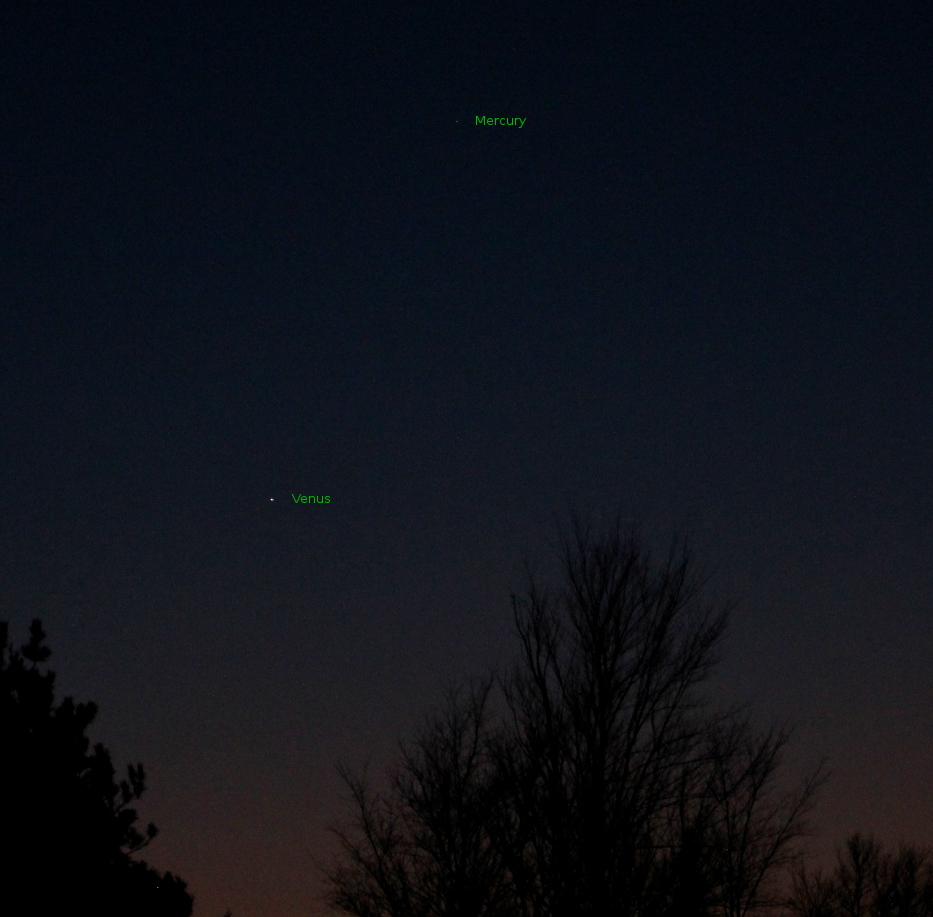
Venus and Mercury photographed last night at 8:20 EDT March 14, 2018. Did some tweaks to bring out Mercury in GIMP. Canon EOS Rebel T5, 75 mm, though reduced by 67%; f/4, 1/400 sec., ISO 1600. Click on image to enlarge. Click on image to enlarge. Credit Bob Moler.
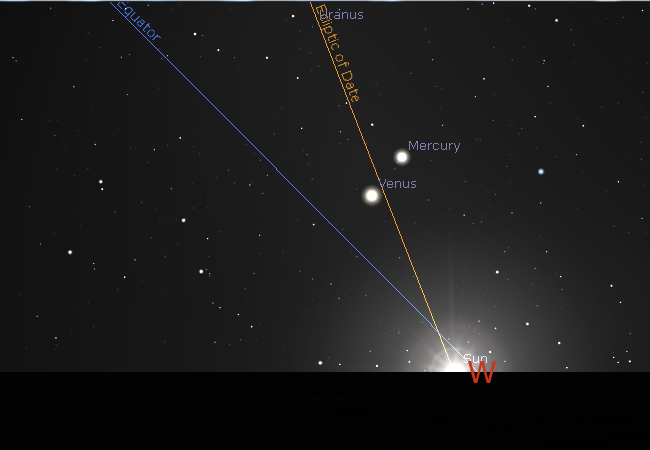
Stellarium’s showing of Venus and Mercury at 8:15 p.m. March 15. 2018.
Note in the above image, the steepness of the ecliptic (plane of the Earth’s orbit) is to the horizon in the spring. Its angle to the celestial equator is 23.5°. The angle the celestial equator makes with the horizon is your co-latitude (90° – your latitude). At my location my latitude is 44.7°, so the celestial equator meets the horizon at 45.3°. On the March equinox the ecliptic, near where the planets hang out, reaches its most vertical at nearly 70°. This makes planets, including Mercury appear higher in the sky near sunset, and as they set, moving parallel to the equator, will stay up their longest.
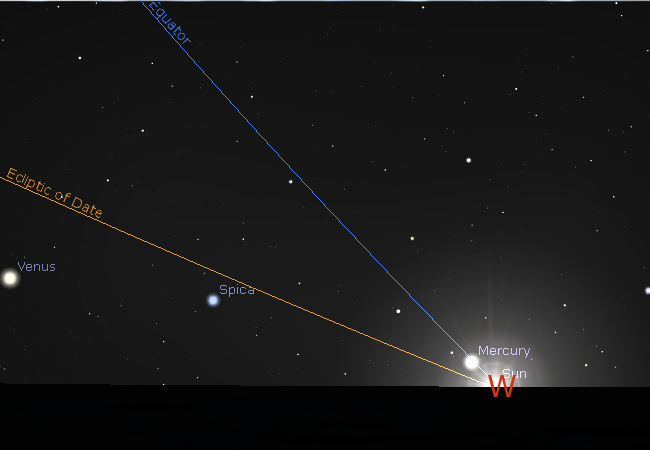
Celestial equator and ecliptic at the September equinox showing how low it appears. Created using Stellarium.
On the September equinox the ecliptic, near where the planets hang out, reaches its most horizontal at near 22°. This makes planets, including Mercury appear lower in the sky near sunset, and as they set, moving parallel to the equator, will set shortly after the Sun. This September Venus happens to be approaching its inferior conjunction and is very close to the Earth. This exaggerates its orbital inclination. in this case shows the planet a good deal south of the ecliptic.
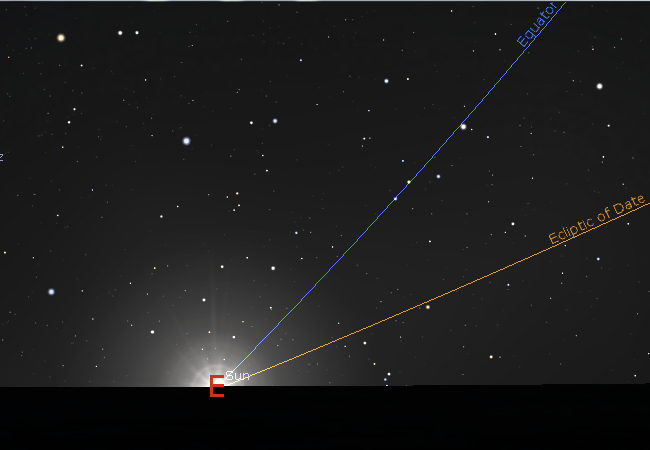
At the spring equinox close morning planets to the Sun will be hard to spot, being low to the horizon.
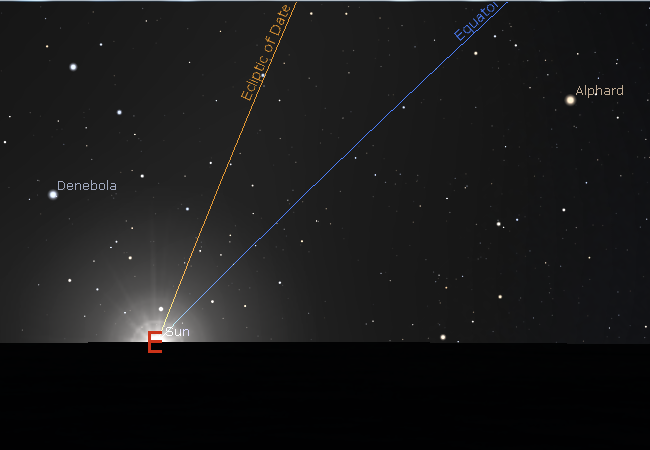
Celestial equator and ecliptic at the September equinox mornings showing how high it appears. Created using Stellarium.
Update
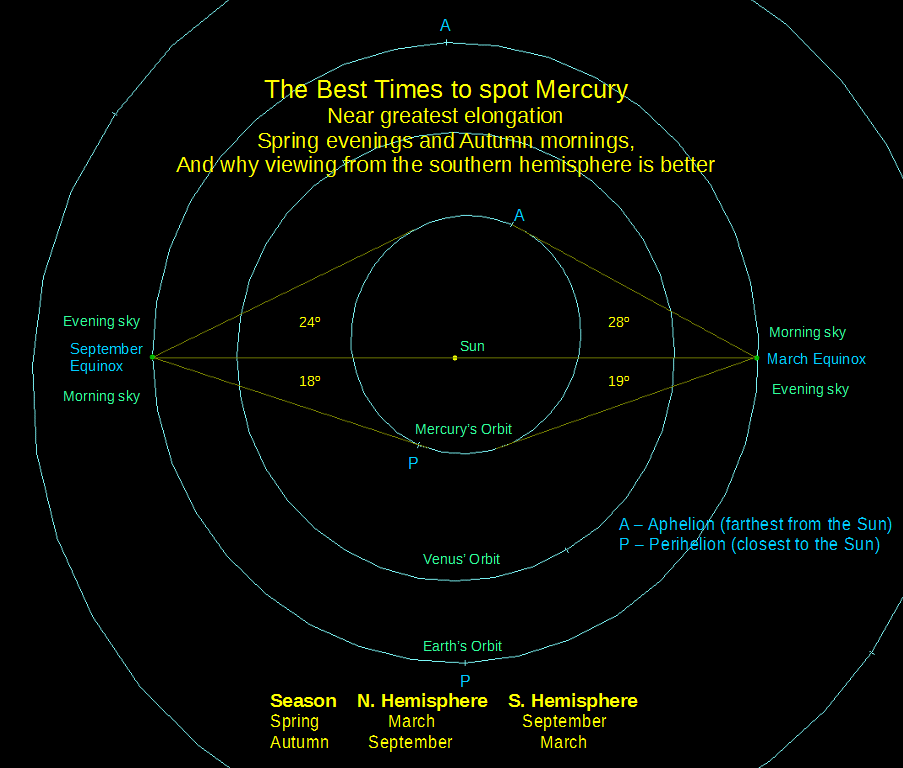
The angles of the elongation of Mercury at the equinoxes. Click on image to enlarge. Created using my LookingUp program.
Due to the eccentricity of Mercury’s orbit and its orientation with respect to the Earth’s positions at the equinoxes, observers on the southern hemisphere of the Earth get a better view of Mercury than us northerners.
(I created a similar diagram for posting yesterday, but found right before the scheduled posting time that it was incorrect in its orientation, so I redid it this morning.)
01/05/2018 – Ephemeris – Telescope Clinic tonight (Has been canceled due to weather)
Ephemeris for Friday, January 5th. The Sun will rise at 8:19. It’ll be up for 8 hours and 56 minutes, setting at 5:16. The Moon, 3 days before last quarter, will rise at 9:56 this evening.
If you’ve received a telescope for Christmas and are having trouble setting it up, or have an unused one in a closet, basement or attic, bring them to Northwestern Michigan College’s Rogers Observatory tonight at 8 p.m. The Grand Traverse Astronomical Society will be holding their annual telescope clinic to help you understand and use your telescope. The clinic will extend through the period that will be set aside for a star party if it’s clear, to test the telescopes and show the owners how to use them. Like anything telescopes take some time to learn how to use them and find celestial objects. It took me 15 minutes to find Saturn with a telescope the first time I tried, and I knew where it was in the sky. The observatory is south of Traverse City on Birmley Road.
The times given are for the Traverse City/Interlochen area of Michigan. They may be different for your location.
Addendum
Link to my December 26 post on telescope basics to start you off: https://bobmoler.wordpress.com/2017/12/26/
Can’t make it tonight? Members are generally available at star parties at the observatory when time permits to help folks who bring their telescopes out. See http://www.gtastro.org for our current schedule of events for 2018.
Updated 7:02 p.m.
 Bob Moler's Ephemeris Blog