Archive
10/07/2019 – Ephemeris – Tides on and by the Moon
Ephemeris for Monday, October 7th. Today the Sun will be up for 11 hours and 24 minutes, setting at 7:12, and it will rise tomorrow at 7:49. The Moon, 2 days past first quarter, will set at 2:21 tomorrow morning.
We always see the same face of the Moon turned toward the Earth. This does not mean that the Moon doesn’t rotate. It means that the Moon rotates on its axis in exactly the same time it takes to orbit the Earth. That is no coincidence. The effect of the Earth gravitation across the diameter of the Moon have essentially locked the Moon’s rotation to its revolution period. The crust of the far side of the Moon is thicker than the Earth facing side. The Moon is trying to do the same thing to the Earth. Its pull on the side of the Earth facing it is greater than the pull on the Earth’s opposite side. This stresses the Earth and raises tides in the ocean which actually slow the Earth’s rotation a tiny bit. As a consequence it pushes the Moon away by about 3.8 centimeters a year.
The times given are for the Traverse City/Interlochen area of Michigan. They may be different for your location.
Addendum
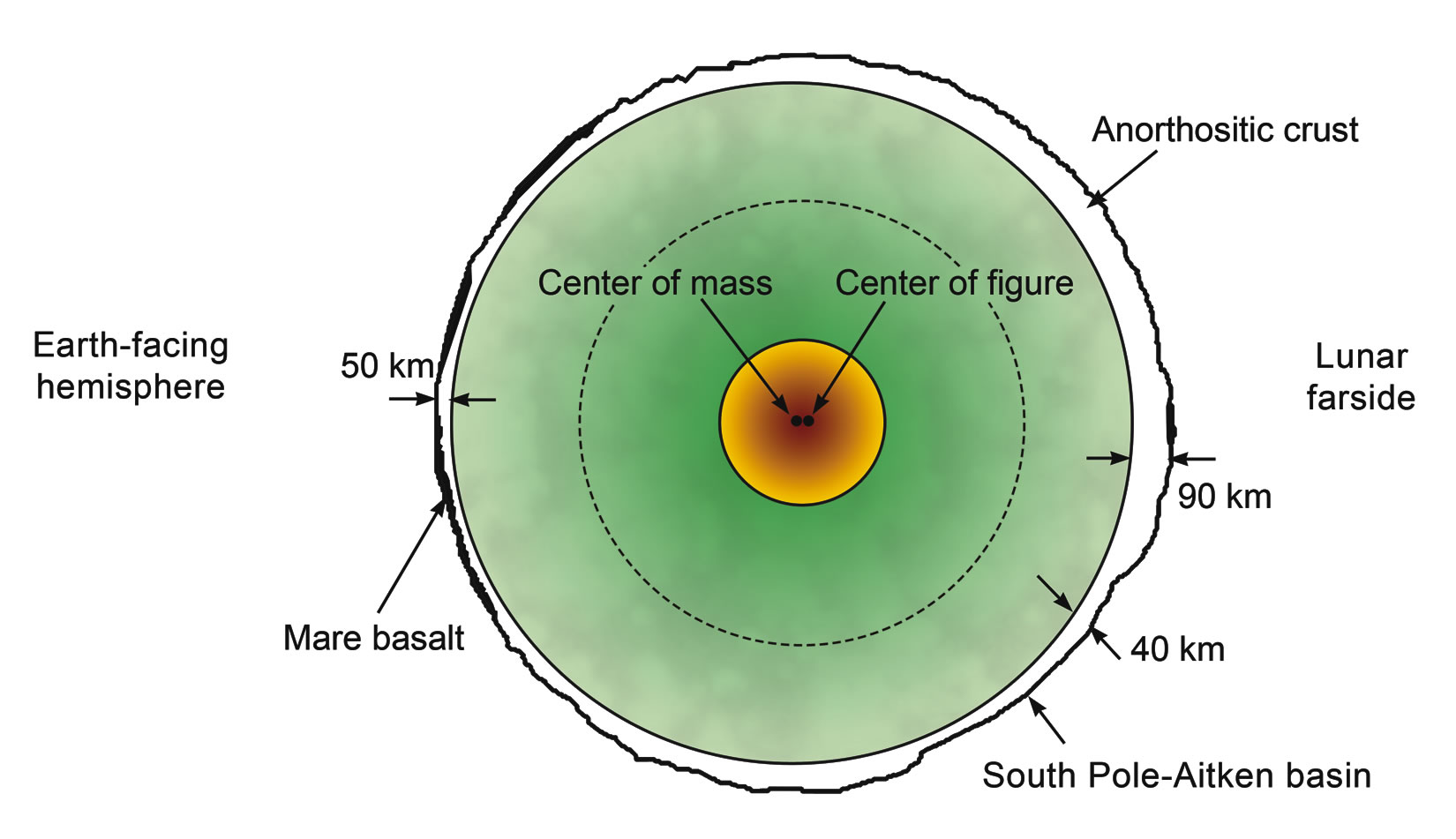
Asymmetry of the crust of the Moon. Credit Lunar and Planetary Institute and Center for Lunar Science and Exploration.
For more information on this illustration: https://www.lpi.usra.edu/exploration/training/illustrations/planetaryInteriors/ 4th illustration.
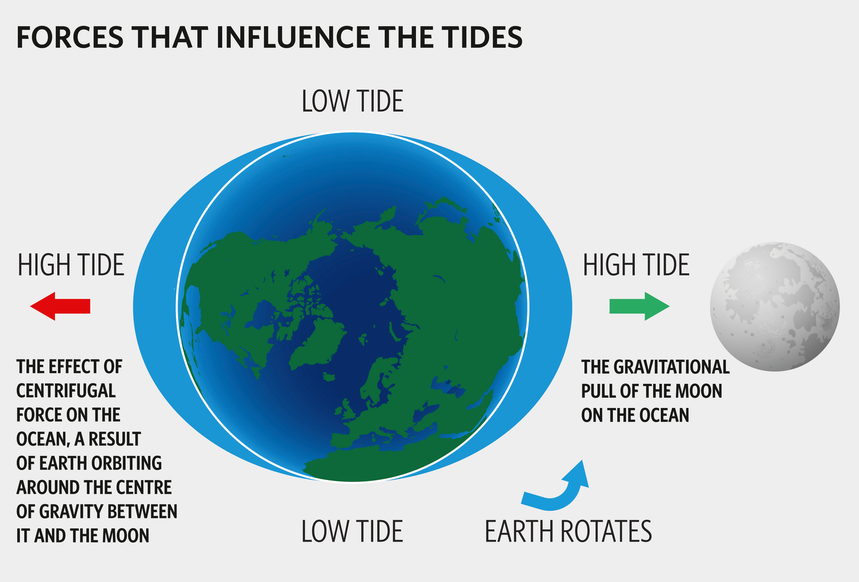
Credit: Cosmosmagazine.com
09/13/2019 – Ephemeris – Harvest Moon tonight
Ephemeris for Friday, September 13th. Today the Sun will be up for 12 hours and 38 minutes, setting at 7:57, and it will rise tomorrow at 7:20. The Moon, 1 day before full, will rise tonight 8:12.
Tomorrow is the Harvest Moon. In fact the instant of full moon is 12:33 a.m. tonight, so one could consider the Harvest Moon tonight. Funny thing though, this morning the Moon will reach apogee from the Earth, of 252 thousand miles (406 thousand km), making it the opposite of a super moon, a mini moon. I bet you wouldn’t notice if I didn’t tell you. The Harvest Moon is the name given to the nearest full moon to the autumnal equinox. It is a special time of the lunar cycle when the Moon rises much less than the 50 minutes later average each night. This appeared to extend twilight allowing farmers before the advent of electric lights extra time to gather in their crops each day.
The times given are for the Traverse City/Interlochen area of Michigan. They may be different for your location.
Addendum
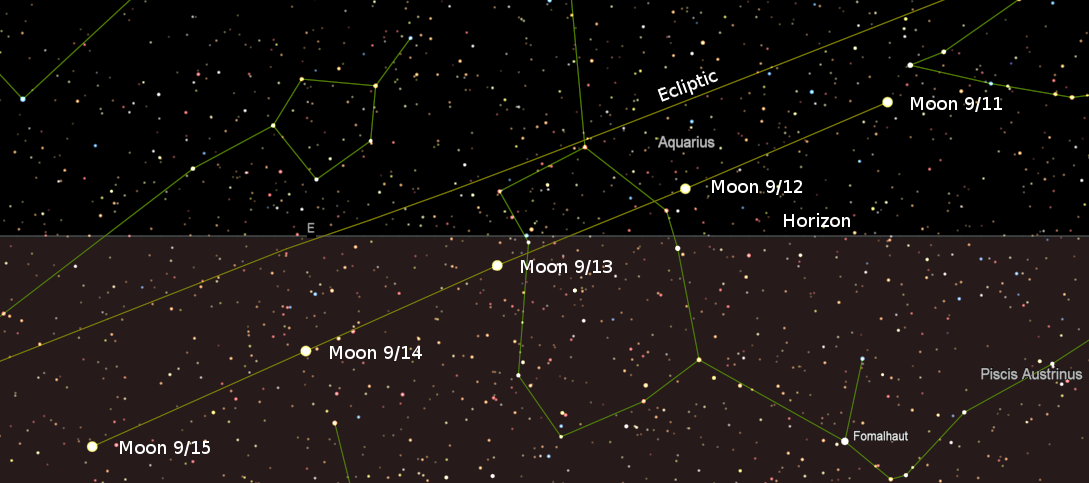
Harvest Moon effect from September 11 to the 15th, 2019. Note the shallowness of the ecliptic and Moon’s motion near sunset in this period. Click on the image to enlarge. Created using Cartes du Ciel (Sky Charts).
09/09/2019 – Ephemeris – Looking for interstellar meteoroids hitting the Moon
Ephemeris for Monday, September 9th. Today the Sun will be up for 12 hours and 50 minutes, setting at 8:05, and it will rise tomorrow at 7:15. The Moon, 4 days past first quarter, will set at 3:29 tomorrow morning.
Two Harvard University astronomers who have studied the interstellar asteroid or comet that was discovered last year ‘Oumuamua are proposing to observe small interstellar meteoroids with a lunar orbiting satellite when they hit the Moon. A spectrum of the flash they make when they hit the Moon will allow the constituent elements and isotopes to be discovered. These values have been studied for a long time from meteorites in our solar system. So a body from another solar system born of material from a different supernova and hypernova than our solar system may show different isotope ratios of its elements. A hypernova is a newly discovered event, when two neutron stars collide, and are the main source of heavy elements like gold.
The times given are for the Traverse City/Interlochen area of Michigan. They may be different for your location.
Addendum
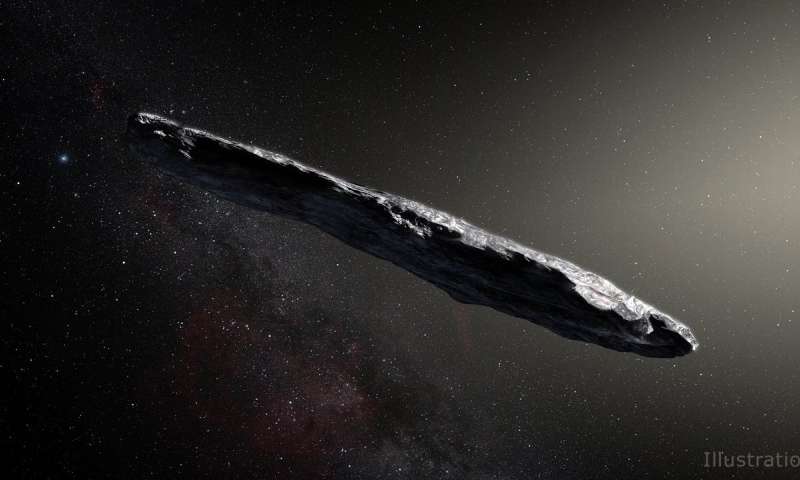
Artist visualization of ‘Oumuamua. Credit Credit: European Southern Observatory / M. Kornmesser.
There’s the article about it on Universe Today: https://www.universetoday.com/143234/by-continuously-watching-the-moon-we-could-detect-interstellar-meteorites/
04/18/2019 – Ephemeris – Tides
Ephemeris for Thursday, April 18th. Today the Sun will be up for 13 hours and 37 minutes, setting at 8:31, and it will rise tomorrow at 6:52. The Moon, 1 day before full, will set at 7:22 tomorrow morning.
The Moon and the Earth gravitationally attract each other. And the Moon raises tides in the Earth itself and its oceans. The Earth’s tides on the mass of the Moon has slowed its rotation so it continually shows the Earth the same face. The Moon, only one 81st the mass of the Earth hasn’t been as successful at greatly slowing the Earth’s rotation. It does cause the world’s timekeepers to add one second occasionally to the time stream to offset our atomic clocks to the Earth’s rotation. The most noticeable effects of the Moon’s tidal force is the tides in the Earth’s oceans. The highest tides are when the Sun and Moon are in line with the Earth at new and full moon. Small bodies of water like the Great Lakes don’t have luni-solar tides greater than 2 inches (5 cm). The Great Lakes do have tide like effects called seiches, like water sloshing in a bath tub, caused by wind or barometric pressure, and can be several feet high.
The times given are for the Traverse City/Interlochen area of Michigan. They may be different for your location.
Addendum
This link from NOAA explains tides better than I can: https://scijinks.gov/tides/.
This link is the explanation of seiches: https://oceanservice.noaa.gov/facts/gltides.html.
04/11/2019 – Ephemeris – How far away is the Moon?
Ephemeris for Thursday, April 11th. Today the Sun will be up for 13 hours and 16 minutes, setting at 8:22, and it will rise tomorrow at 7:04. The Moon, 1 day before first quarter, will set at 3:02 tomorrow morning.
This year, the 50th anniversary of the Apollo 11 first human landing on the Moon, I’ll be talking about some basic facts about the Moon, the Apollo program. The first thing is to realize just how far the Moon is from the Earth. Most diagrams of the Earth and Moon cheat and make them closer than they are. The Greek astronomer Hipparchus in the second century BC got pretty close. The Moon is about 30 times the Earth’s diameter away. If the Earth were represented by a basketball and the Moon by a tennis ball to get their proportional distance correct they would have to be 23 and a half feet (7.16 meters) away from each other, give or take. On average 238,000 miles (383,000 km). It took the Apollo astronauts 3 days cover that distance to get to the Moon.
The times given are for the Traverse City/Interlochen area of Michigan. They may be different for your location.
Addendum

The Earth and Moon to scale. Click on the image to enlarge. Source Wikipedia.
04/08/2019 – Ephemeris – How to find Polaris, the North Star
Ephemeris for Monday, April 8th. Today the Sun will be up for 13 hours and 7 minutes, setting at 8:18, and it will rise tomorrow at 7:09. The Moon, 3 days past new, will set at 11:54 this evening.
The most useful of the navigation stars for the average person is Polaris, the North Star or Pole Star. It is very close to the point in the sky that the Earth’s axis points to in the north. Currently it is about three-quarters of a degree from the pole, about one and a half moon diameters. In 2110 or thereabouts it will approach to slightly less than a moon diameter from the pole before slowly heading away. Polaris is always closer to true north than a magnetic compass in Michigan. To find it use the two stars in front of the Big Dipper’s bowl to point to it. This time of year the Big Dipper is above Polaris, so the pointer stars, that’s what they are called, point down to it. Polaris is at the end of the handle of the faint Little Dipper. The reason for Polaris’ motion is the slow 26,000 year wobbling of the Earth’s axis, called precession.
The times given are for the Traverse City/Interlochen area of Michigan. They may be different for your location.
Addendum
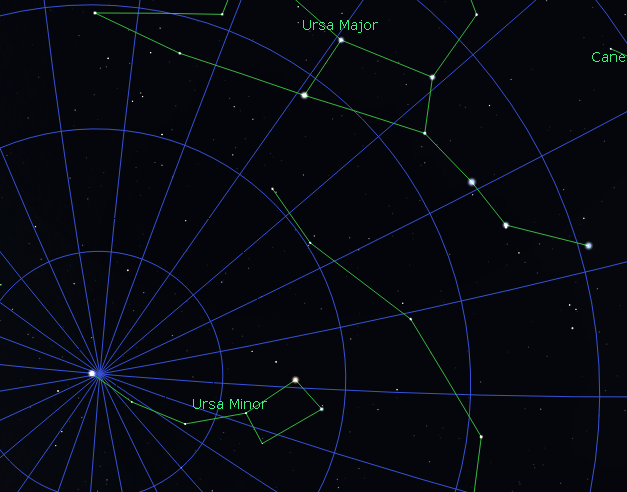
Ursa Major and Minor, the Big and Little Dippers. See how the two stars at the front of the bowl point to Polaris. It happens that the pointer stars are close to the 11th hour of right ascension (longitude in the sky). The right ascension lines converge at the north celestial pole, just as the longitude lines converge at the Earth’s north pole. Created using Stellarium.
The year I was born, 1941, Polaris was a whole degree from the celestial north pole.
If you’ve ever wondered why right ascension is in hours instead of degrees it’s because the Earth rotates within the celestial sphere, so it’s easier to keep track of the east-west position in the sky by using a clock that set to gain 3 minutes and 56 seconds a day. Such a clock keeps sidereal (star) time rather than solar (sun) time. One hour equals 15 angular degrees or 4 minutes a degree.
03/21/2019 – Ephemeris – Are day and night really equal at the equinoxes?
Ephemeris for Thursday, March 21st. Today the Sun will be up for 12 hours and 11 minutes, setting at 7:56, and it will rise tomorrow at 7:42. The Moon, 1 day past full, will rise at 8:52 this evening.
What we had yesterday was the vernal equinox, the start of spring. The word equinox means “equal night”. Yesterday’s daylight hours were 12 hours and 8 minutes. What’s with the 8 minutes? The rising or setting Sun is a mirage. The Earth’s atmosphere acts like a lens and makes the Sun appear higher in the sky than when it is when near the horizon. When the bottom edge of the Sun touches the horizon the Sun is actually still completely below the horizon geometrically. If the Earth had no atmosphere sunrises would occur 4 minutes later, and sunsets would occur 4 minutes earlier around here. That would completely correct the 12 hour 8 minutes daylight time of yesterday to 12 hours even.
The times given are for the Traverse City/Interlochen area of Michigan. They may be different for your location.
Addendum
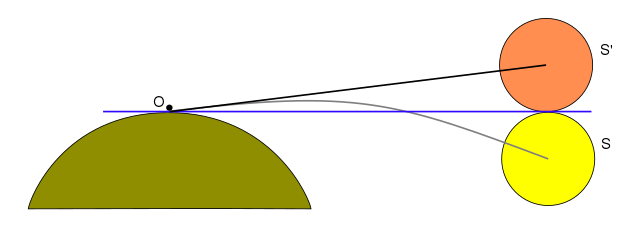
How the atmosphere bends the light of the Sun or Moon rising or setting to appear higher than it actually is. Credit Francisco Javier Blanco González, 2017.
I took a look at the related atmospheric refraction effect last month: https://bobmoler.wordpress.com/2019/02/19/02-19-2019-ephemeris-the-moon-aint-just-super-near-the-horizon/.
03/18/2019 – Ephemeris – Spring, the full moon and Easter
Ephemeris for Monday, March 18th. Today the Sun will be up for 12 hours and 2 minutes, setting at 7:52, and it will rise tomorrow at 7:48. The Moon, 2 days before full, will set at 7:21 tomorrow morning.
Spring is two days away. In checking my astronomical calendars I noticed an odd thing related to the date of Easter for western churches. If I said that the date of Easter was the first Sunday after the first full Moon after the vernal equinox. I’d be wrong. Even if I replaced vernal equinox with first day of spring, I would still be wrong by ecclesiastical standards. The ecclesiastical vernal equinox is March 21st, no matter what. Plus the full moon date is a tabulated value and not necessarily the astronomical full moon date. This year the astronomical first full moon of spring falls less than 4 hours after the astronomical vernal equinox on March 20th. Therefore Easter will be late this year on April 21st, 4 days earlier than its latest possible date.
The times given are for the Traverse City/Interlochen area of Michigan. They may be different for your location.
03/14/2019 – Ephemeris – Happy Pi Day
Ephemeris for Pi Day, Thursday, March 14th. Today the Sun will be up for 11 hours and 49 minutes, setting at 7:47, and it will rise tomorrow at 7:55. The Moon, at first quarter today, will set at 4:09 tomorrow morning.
Pi day: the first three digits of the mathematical constant π is 3.14 the ratio of a circle’s circumference to its diameter, so March 14th is Pi day. Why do we use the Greek letter pi? Pi is the first letter of the Greek word perimetros which means circumference. The first Pi Day was celebrated in 1988, organized by Larry Shaw at San Francisco’s Exploratorium. There are other lass known pi related days on the calendar. The fraction used in pi approximations is 22/7ths. So July 22nd is Pi Approximation Day. In many formulae π is multiplied by two, or 2π. 2π to two decimal places is 6.28, so it’s Two Pi Day or Tau (τ) Day, June 28th. So whether you like apple, cherry, or pumpkin, have a happy Pi day. https://www.piday.org/pi-facts/
The times given are for the Traverse City/Interlochen area of Michigan. They may be different for your location.
Addendum

Credit http://www.piday.org.
Check out https://www.piday.org/pi-facts/ for more information on pi.
03/12/2019 – Ephemeris – Does the Moon rotate?
Ephemeris for Tuesday, March 12th. Today the Sun will be up for 11 hours and 43 minutes, setting at 7:44, and it will rise tomorrow at 7:59. The Moon, 2 days before first quarter, will set at 2:00 tomorrow morning.
Since we see only one face of the Moon throughout the month does that mean that the Moon doesn’t rotate? It doesn’t appear to rotate with respect to the Earth, but the Moon rotates through all the stars and constellations of the zodiac in a 27.32 days. That’s called a sidereal month. The lunar month we’re more familiar with is the synodic month, or lunation, that lasts 29.53 days which is the interval between new moons. It is the basis of the Jewish and Islamic calendars. The reason for the locking of the Moon’s rotation and revolution of the Earth, also called synchronous rotation, is the tidal pull of each on the other. The Earth has managed to slow the Moon’s rotation to match its revolution. The Moon is trying to do the same to the Earth with much less success, though every year or two a second is added to the time stream, UTC1 or Greenwich Mean Time, due to the slowing of the Earth’s rotation.
The times given are for the Traverse City/Interlochen area of Michigan. They may be different for your location.
Addendum
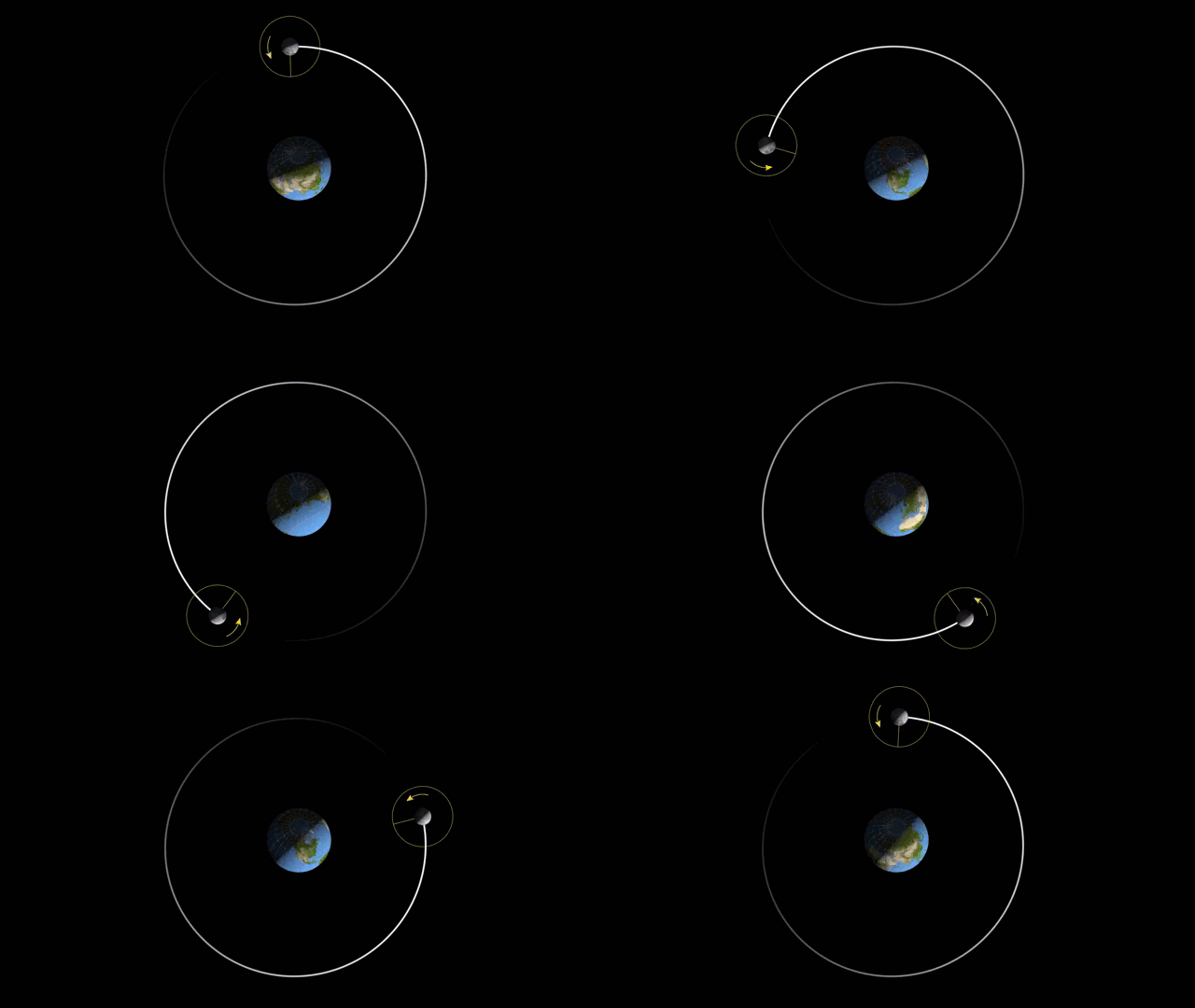
Animation of the Moon orbiting the Earth showing the Moon’s rotation. Credit: NASA’s Scientific Visualization Studio/Ernie Wright, modified and converted to GIF by Bob Moler.
NASA’s Scientific Visualization Studio web page where I got the original for the above video.
 Bob Moler's Ephemeris Blog